
COSORI TurboBlaze vs Dual Blaze: Which Should You Buy?
Most air fryer comparisons are written for purchase day. This one is written for month twelve.
That is when the app notifications you were excited about have become background noise. It is also when the limits you skimmed past — a temperature ceiling, a 60-minute timer, a basket that needs flipping — have quietly shaped every meal the machine has made.
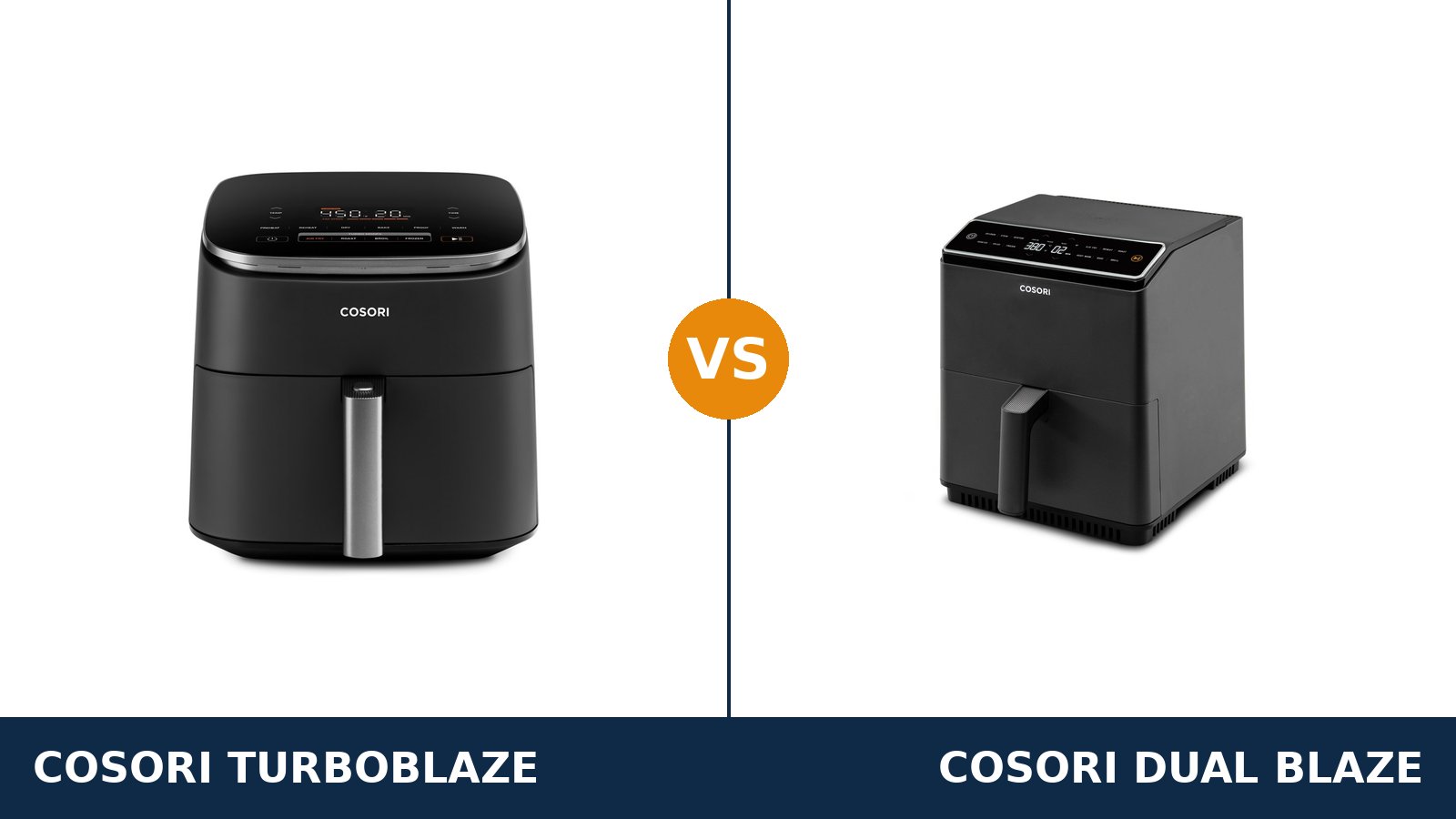
The COSORI TurboBlaze (CAF-DC601-KUS) and the COSORI Dual Blaze (CAF-P583S-KUS) are the two flagship basket fryers in the same range, and they spend their money on opposite things. One buys range and airflow control. The other buys a second heating element and a phone app.
Both look like sensible upgrades on day one. They age very differently. Every figure below comes from COSORI's own product pages and user manuals, and the verdict is the one we would give a friend choosing between them for the next five years, not the next five weeks.
Key Takeaways
- The TurboBlaze's advantages are load-bearing. The 90–450°F range, 24-hour timer and five fan speeds get used on ordinary Tuesdays, not just special occasions.
- The Dual Blaze's best feature is also structural. A heating element under the basket ends the flip-the-food routine for family-sized loads, permanently.
- Its smartest features are the perishable ones. App control is genuinely handy, but it depends on software in a way a heating element never will.
- The baskets are the same width. The Dual Blaze's extra 0.8 quarts live in its depth: 4.8 inches against 3.48 inches of usable depth.
- Read the Dual Blaze listing carefully before ordering. A newer listing under the same model number describes a different basket coating than the manual specifies.
Quick Verdict
Buy the COSORI TurboBlaze if you want the fryer with the longest useful life. Its range does jobs the Dual Blaze cannot attempt at any setting.
It proofs dough at 90°F and broils at a true 450°F. It dehydrates over a 24-hour timer. Its ceramic-coated basket wipes clean, and its body stands nearly two inches shorter, so it fits the counters the Dual Blaze cannot.
Buy the COSORI Dual Blaze for family-sized cooking you never have to babysit. The 6.8-quart basket is deeper, the lower element browns food from beneath, and the VeSync app watches dinner while you are in another room.
If flipping food mid-cook is the habit you most want to retire, this is the machine that retires it.
The Scorecard
Scores below are derived directly from the manufacturer specifications compared in this guide — capacities, temperature ranges, basket dimensions and feature lists. They are a reading aid, not benchmark results.
| Category | TurboBlaze | Dual Blaze | ||
|---|---|---|---|---|
| Capacity | 7 / 10 | 9 / 10 | ||
| Cooking system | 8 / 10 | 9 / 10 | ||
| Temperature & timer range | 10 / 10 | 6 / 10 | ||
| Ease of use | 8 / 10 | 9 / 10 | ||
| Cleaning & coating | 9 / 10 | 8 / 10 | ||
| Footprint | 9 / 10 | 7 / 10 | ||
| Value | 9 / 10 | 8 / 10 | ||
| Overall | 8.6 / 10 | 8.0 / 10 | ||
Read the table as two philosophies. The Dual Blaze collects the volume and convenience rows. The TurboBlaze takes range, surface and space — the three things no accessory, update or workaround can add to a fryer later.
At a Glance: Who Each Fryer Fits
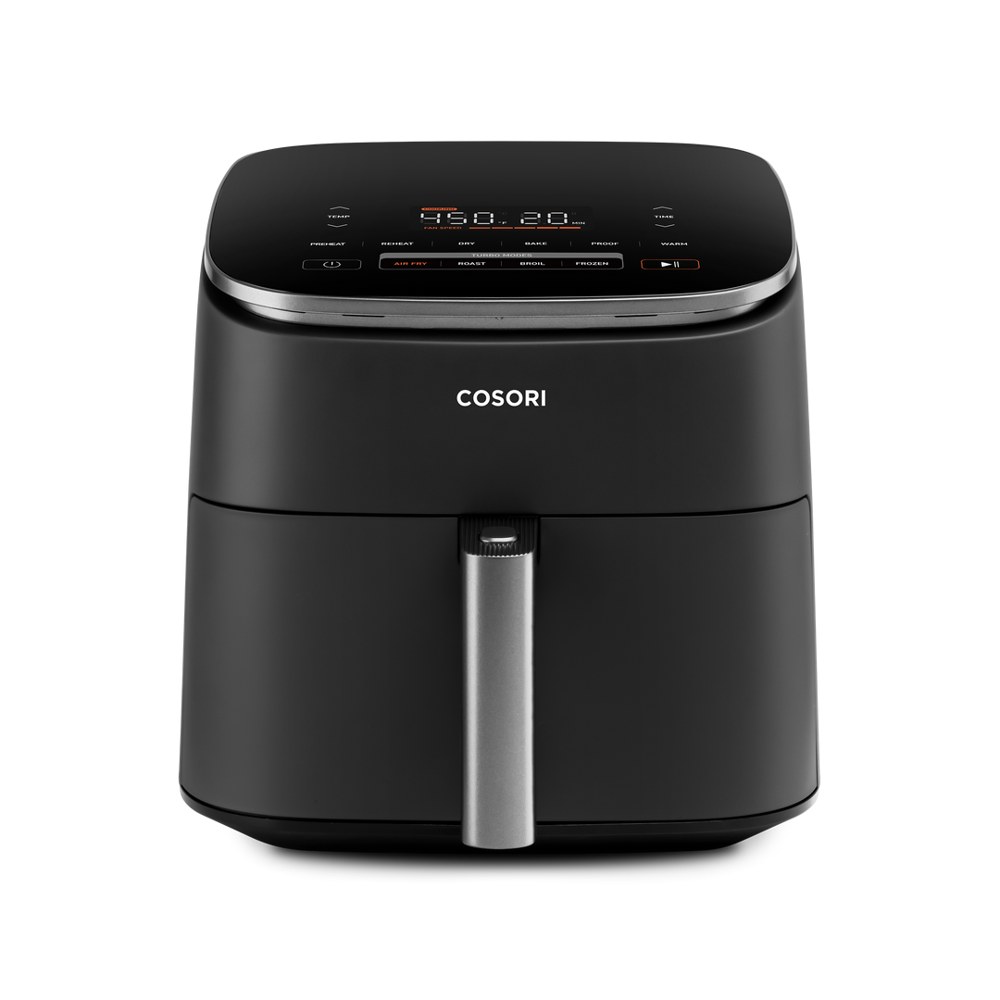
COSORI TurboBlaze 6.0-Quart
- DC motor fan with 5 speeds, up to 3,600 rpm
- 90°F–450°F range; timer runs to 24 hours
- 9 functions, including Proof and Dehydrate
- PFAS-free ceramic-coated basket and crisper plate
- Stands 11.9 in tall; panel controls, no app
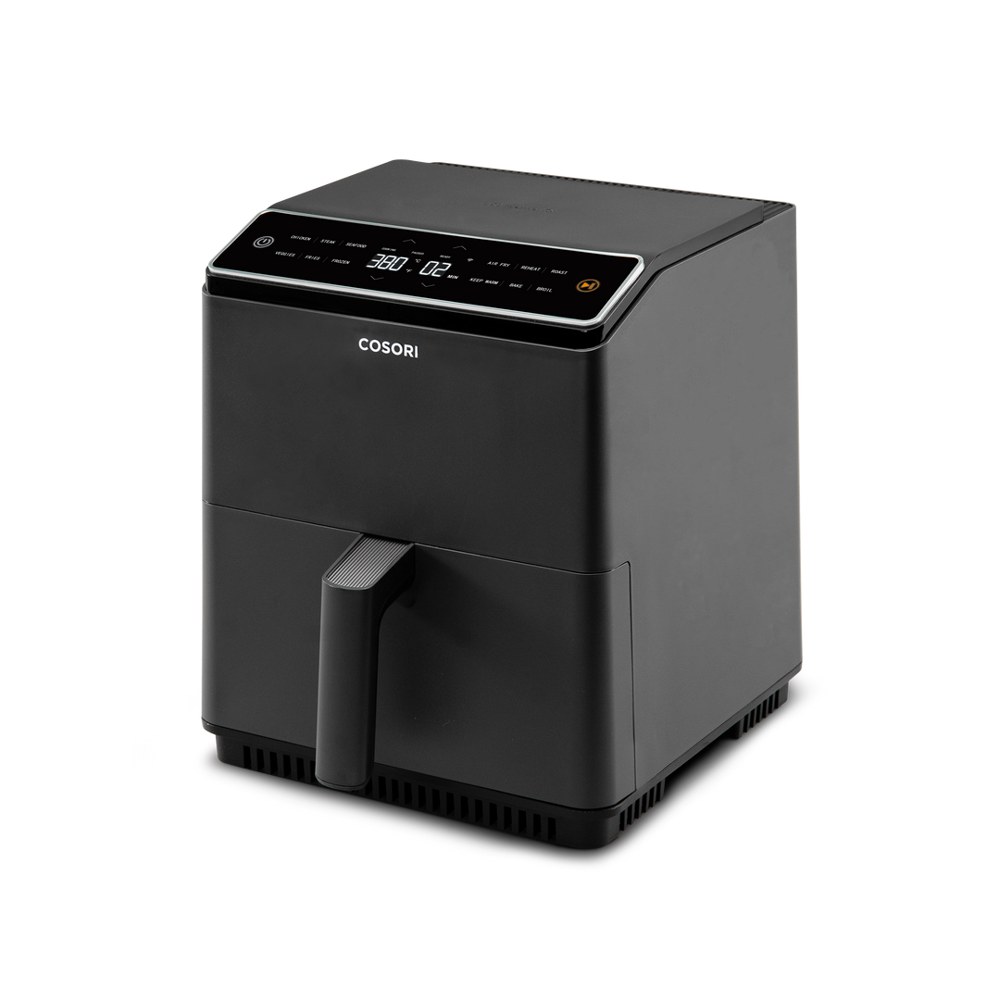
COSORI Dual Blaze 6.8-Quart
- Heating elements above and below the basket
- 6.8 qt basket, 9.4 × 9.4 in floor, 4.8 in deep
- 12 functions, including six one-touch food presets
- VeSync app, Alexa and Google Assistant control
- No preheating step for most cooking
Choose the TurboBlaze if…
You cook for one to five people and your menu wanders: fries on Monday, a proofed dough on Saturday, jerky drying overnight.
You adjust as you cook. Five fan speeds let you soften the blast for delicate food or pin it at maximum for hard browning.
Your wall cabinets hang low. At 11.9 inches, this fryer slides into kitchens that cannot house its rival.
Choose the Dual Blaze if…
You feed four to six people most nights and batch size is your recurring bottleneck.
You are done opening the basket halfway through to turn everything over. Heat from below ends that chore.
You like supervising dinner from the sofa, with a notification when it finishes and a voice command when your hands are covered in flour.
As an Amazon Associate I earn from qualifying purchases at no extra cost to you.
Specifications: The Specs That Actually Matter
Every figure below is taken from COSORI's published specifications and the official user manuals for these two US models, cross-checked against the manufacturer's product data.
Regional variants carry different model suffixes and different electrical ratings. This table covers the North American 120V versions most readers will buy.
| Specification | COSORI TurboBlaze | COSORI Dual Blaze |
|---|---|---|
| Model number | CAF-DC601-KUS | CAF-P583S-KUS |
| Capacity | 6.0 qt / 5.7 L (serves 3–5) | 6.8 qt / 6.4 L (serves 4–6) |
| Rated power | 1,725 W | 1,750 W |
| Temperature range | 90°–450°F / 30°–230°C | 175°–400°F / 80°–205°C |
| Time range | 1 min – 24 hr | 1–60 min |
| Heating elements | One (top) | Two (top and bottom) |
| Fan / airflow | DC motor, 5 fan speeds, up to 3,600 rpm | 360 ThermoIQ® technology, fixed airflow programme |
| Cooking functions | 9: Air Fry, Roast, Bake, Broil, Dehydrate, Frozen, Proof, Reheat, Keep Warm, plus Preheat | 12: Air Fry, Bake, Broil, Roast, Keep Warm, Reheat, Chicken, Steak, Seafood, Veggies, Fries, Frozen |
| Basket type | Square pull-out basket with crisper plate | Square pull-out basket with crisper plate |
| Basket coating | PFAS-free ceramic nonstick (basket and crisper plate) | Nonstick-coated aluminium (basket and crisper plate) |
| Basket cooking space | 9.31 × 9.31 in floor; 3.48 in deep with crisper plate | 9.4 × 9.4 in floor; 4.8 in deep |
| Dishwasher-safe parts | Basket and crisper plate | Basket and crisper plate |
| Controls | Angled touch panel on the unit | Touch panel plus VeSync app, Amazon Alexa and Google Assistant |
| Dimensions (with handle) | 11.8 × 14.4 × 11.9 in (W × D × H) | 11.7 × 15.4 × 13.8 in (W × D × H) |
| Weight | 13.2 lb / 6 kg | 13.7 lb / 6.22 kg |
| Warranty | 2-year limited | 2-year limited |
Naming note: the Dual Blaze also answers to “COSORI Pro III.” Same model number, same machine, different badge on the box.
The TurboBlaze has a naming trap of its own. A separate TurboBlaze Smart edition adds app control; the fryer compared here is the original panel-only CAF-DC601-KUS.
One further caution belongs in this table's shadow. A newer Amazon listing under the Dual Blaze's model number describes a ceramic-coated basket, while the CAF-P583S-KUS manual specifies nonstick-coated aluminium. The buying guide below explains how to tell which surface a given listing is actually selling.
The Differences That Actually Matter
1. Temperature and timer range — the gap that never closes
Start with the only numbers in this comparison that cannot soften with time. The TurboBlaze's dial sweeps from 90°F all the way to 450°F. Its rival is confined to the band between 175°F and 400°F.
The top of the range is about finishing. At 450°F the TurboBlaze's Broil function delivers the aggressive surface heat that blisters cheese, chars pepper skins and puts a real crust on a steak. At 400°F the Dual Blaze gets close — and close is all it ever gets.
The bottom of the range is about whole categories of cooking. Proofing dough needs the 90°F the TurboBlaze offers as a preset function. Dehydrating needs low heat held for hours, and its default starts at 135°F.
The timer enforces the same divide. Twenty-four hours on the TurboBlaze against a 60-minute ceiling on the Dual Blaze means long, slow jobs exist on one machine and are arithmetically impossible on the other.
Nobody's cooking range expands to fill a narrower fryer over the years. This is the section that decides the comparison, and it is not close in either direction of the dial.
2. Heating design — a second element against a smarter fan
The Dual Blaze's answer to uneven cooking is hardware: an element below the basket as well as above it. The underside of the food gets direct heat instead of leftovers conducted through a crisper plate.
COSORI pairs that with its 360 ThermoIQ programme and a clear promise: no preheating, and little or no shaking or flipping. The reasoning is sound. The pale, soft underside is the classic basket-fryer failure, and this design attacks it at the source.
The TurboBlaze's counterattack is moving air. Its DC motor reaches 3,600 rpm and, more usefully, can be throttled across five speeds.
Fan speed turns out to be a cooking variable, not a spec-sheet ornament. Maximum airflow for wings that need drying and crisping. A gentle setting for proofing dough, drying herbs or baking something that a fixed full-speed fan would desiccate.
After a year, which matters more? If your loads are large and your habit is load-and-leave, the second element wins its argument nightly. If you cook varied food in moderate loads, the fan's flexibility shows up in more different meals.
3. Capacity — same footprint on the plate, different depth in the basket
The quart figures — 6.8 against 6.0 — overstate the difference in one direction and understate it in another.
Overstate, because the two basket floors are effectively the same size: 9.4 × 9.4 inches against 9.31 × 9.31 inches of usable floor. A single layer of fries, wings or chops covers the same area in both machines, and single layers are how air fryers cook best.
Understate, because depth is where family cooking actually happens. The Dual Blaze gives you 4.8 inches of basket depth; the TurboBlaze gives you 3.48 inches of usable depth above its crisper plate.
That extra inch and a third is a whole chicken sitting comfortably. It is a taller roast. It is a second partial layer that does not suffocate the first.
COSORI's own serving guidance lands where the geometry does: three to five people for the TurboBlaze, four to six for the Dual Blaze. Households at the top of that range will feel the gap weekly. Households at the bottom may never feel it at all.
4. Controls and the app — the feature with a shelf life
The Dual Blaze is a connected appliance. The TurboBlaze, in this version, has no radio in it at all.
Through the VeSync app you can watch a cook's progress from another room, get pinged when it ends, pull up chef-developed recipes that load their own settings, and scan packaged food for its programme. Alexa and Google Assistant take voice commands.
One boundary is worth knowing before it surprises you: the manual is explicit that the app cannot start a cook remotely. Safety rules reserve starting for the panel. The app supervises; it does not initiate.
The TurboBlaze's entire interface is its angled touch panel, a Preheat button and the fan-speed control. Nothing to pair, nothing to update, nothing to log into.
Here is the second-year question. App ecosystems change: accounts, updates, phone replacements, the occasional feature that quietly retires. The Dual Blaze fries perfectly well from its panel if any of that happens — but its headline convenience is software, and software is the only part of either machine with an expiry date.
5. Coating and cleaning — a tie in the sink, a difference on the surface
On the mechanics of cleanup, score this section even. Both baskets and both crisper plates are dishwasher-safe, per their manuals.
The surfaces you are cleaning are not the same. The TurboBlaze coats its basket and crisper plate in a PFAS-free ceramic nonstick — the current-generation answer for anyone deliberately retiring conventional nonstick from their kitchen.
The Dual Blaze uses the proven older formula: aluminium under a conventional nonstick coating. It releases food well and asks for standard care in return — soft sponges, no scouring pads, no abrasive cleaners.
Day to day, ceramic tends to wipe down with less persuasion between dishwasher runs. Over years, both surfaces reward the same discipline: keep metal utensils away from them.
The Dual Blaze carries one housekeeping duty the other machine does not. Fat from rich food collects beneath its crisper plate, directly above a working heating element, and COSORI instructs owners to discard that fat after fatty cooks so it cannot burn and smoke. The TurboBlaze's underside is inert. An extra thirty seconds of cleanup is a small price — but it is a price charged after every batch of wings.
6. Size on the counter — decided by your cabinets, not your counter
Countertop depth rarely kills an air fryer purchase. Cabinet height does, and here the two machines differ by enough to matter.
The TurboBlaze stands 11.9 inches tall and runs 14.4 inches deep including its handle. Opposite it, the Dual Blaze needs 13.8 inches of height and 15.4 inches of depth.
Measure the gap between your counter and your wall cabinets. If it is under fourteen inches, this section is the whole review: the Dual Blaze does not fit your kitchen and the TurboBlaze does.
Both machines demand the same breathing room — COSORI specifies five inches clear behind and above the unit, plus space in front to slide the basket toward you.
Weight settles nothing. Half a pound separates them, 13.2 against 13.7, and either one moves easily if it has to live in a cupboard between uses.
7. Functions and presets — twelve labels, two philosophies
Count the buttons and the Dual Blaze wins, twelve functions to nine. Read the lists and the story inverts.
Six of the Dual Blaze's twelve are food presets: Chicken, Steak, Seafood, Veggies, Fries and Frozen, sitting alongside Air Fry, Bake, Broil, Roast, Keep Warm and Reheat. They are convenience shortcuts to settings you could dial in yourself — genuinely useful on a tired weeknight, and the reason its panel feels so approachable.
The TurboBlaze's nine are process functions: Air Fry, Roast, Bake, Broil, Dehydrate, Frozen, Proof, Reheat and Keep Warm, plus a dedicated Preheat button. No food wears its name on the panel.
What the shorter list contains is range in disguise. Proof and Dehydrate exist because the temperature floor allows them. Preheat is separated because the fan makes it fast and worth doing properly.
Presets save seconds. Functions open categories. After the first month, most owners have their two or three settings memorised either way — which leaves the categories as the lasting difference.
Which Fryer Fits Your Household?
Start from who is eating and how the cooking actually happens in your house. This table compresses the whole comparison into one view.
| Your household / cooking style | TurboBlaze | Dual Blaze | Our call |
|---|---|---|---|
| Couples and small households (1–3 people) | Excellent — sized right, heats fast | Good — capacity you will rarely use | TurboBlaze |
| Families of 3–5, weeknight dinners | Excellent | Excellent | TurboBlaze on range; Dual Blaze on batch size |
| Families of 4–6, batch cooking | Workable — expect two rounds | Excellent — the deeper basket earns it | Dual Blaze |
| “I always forget to flip the food” | Fair — bigger loads still want a shake | Excellent — heat arrives from below too | Dual Blaze |
| Home bakers: proofing, dehydrating, jerky | Excellent — 90°F floor, 24-hour timer | Not suited — 175°F floor, 60-minute timer | TurboBlaze, outright |
| Smart-home cooks who want app control | Not available on this model | Excellent — VeSync, Alexa, Google Assistant | Dual Blaze, outright |
| Small kitchens, low wall cabinets | Excellent — 11.9 in tall | Tight — 13.8 in tall, deeper with handle | TurboBlaze |
The two rows marked “outright” are the honest core of this comparison. Slow, low-temperature cooking and connected control are not dial settings one machine does better — each fryer simply has one of them, and cannot have the other.
Ready to check today’s price?
Both fryers sell through Amazon. Prices move, so check the live figure on the one that fits your kitchen.
View on Amazon — TurboBlazeView on Amazon — Dual BlazeThe 30-Second Decision
| If this sounds like you… | Buy this |
|---|---|
| “One fryer for frying, broiling, baking, drying and proofing.” | TurboBlaze |
| “Family batches, and I refuse to flip food halfway.” | Dual Blaze |
| “I want my phone to tell me when dinner is done.” | Dual Blaze |
| “Conventional nonstick is leaving my kitchen for good.” | TurboBlaze (ceramic, PFAS-free) |
| “My cabinets hang low and my counter is shallow.” | TurboBlaze |
| “Whole chickens and big weekend batches are the plan.” | Dual Blaze |
What You Gain. What You Give Up.
COSORI TurboBlaze
You gain: the broadest working envelope COSORI fits to a basket fryer — proofing warmth at one end, true broiling heat at the other, a timer that runs a full day, and five fan speeds that behave like a real cooking control. Add the ceramic basket and the shorter body.
You give up: the under-basket element, so larger loads still reward a shake or a flip. Roughly a quart of capacity and the basket depth that comes with it. And the entire connected layer — no app, no alerts, no voice commands.
COSORI Dual Blaze
You gain: family-scale volume in a deeper basket. Heat delivered from beneath the food, and no preheating ritual before it. Six food presets that make weeknights thoughtless, and an app that monitors, notifies and takes voice orders.
You give up: both ends of the temperature dial — nothing below 175°F, nothing above 400°F, nothing longer than an hour on the timer. The ceramic surface. And about two inches of clearance under your cabinets.
Pros and Cons
TurboBlaze — Pros
- 90–450°F range backed by a 24-hour timer
- Five fan speeds from a DC motor spinning to 3,600 rpm
- Proof and Dehydrate functions most rivals omit
- PFAS-free ceramic coating on basket and crisper plate
- The shorter body: 11.9 in under the cabinets
Cons
- One heating element — flipping still improves big loads
- Shallower basket: 6.0 qt, 3.48 in of usable depth
- No Wi-Fi, app or voice control on this model
- No named food presets for one-touch cooking
Dual Blaze — Pros
- Elements top and bottom — even results, minimal flipping
- Deeper 6.8 qt basket built for family batches
- 12 functions with six tuned food presets
- VeSync app, finish notifications, Alexa and Google Assistant
- Most cooking needs no preheating step
Cons
- 175–400°F range with a 60-minute timer ceiling
- No proof or dehydrate capability
- Conventional nonstick coating rather than ceramic
- Tallest and deepest of the pair: 13.8 in, 15.4 in with handle
Check the Model Number, Not Just the Name
Anchor on the model number. This comparison is CAF-DC601-KUS against CAF-P583S-KUS. If a listing cannot show you one of those two strings, it is not selling the fryer you just read about.
COSORI's badges overlap on purpose. The Dual Blaze is also boxed as the “Pro III.” A TurboBlaze Smart edition exists next to the panel-controlled TurboBlaze reviewed here, and it is the Smart edition — not this one — that carries the app.
Decide which side of that line you want before ordering. A buyer who wanted app control and receives the manual TurboBlaze has bought the wrong flagship, and the names alone will not warn them.
Interrogate the Dual Blaze's coating claim. The manual for CAF-P583S-KUS specifies a nonstick-coated aluminium basket. A second, newer Amazon listing under the same model number advertises a ceramic-coated basket instead.
Two different cooking surfaces are circulating under one model number. Open the listing's specification block, find the coating line, and order the surface you actually intend to own.
Mind the suffix. The -KUS ending identifies the 120V North American build compared here. Units ending -KUK and -KEU are made for 220–240V supplies and carry slightly different ratings.
A cheap grey import with the wrong suffix buys you an incompatible plug and a warranty argument. It is not a saving.
On the 2023 recall: the recall that made headlines that year reached only COSORI's older CP- and CS-series machines. Neither the TurboBlaze (CAF-DC601) nor the Dual Blaze (CAF-P583S) appears on that model list.
If you are buying any COSORI used, spend two minutes matching the rating label's model number against the official CPSC recall list before money changes hands.
Accessories, Parts and the Long View
An air fryer's working life is set by two things: how its coating ages, and whether replacement parts still exist when it does. Both of these machines start from a strong position.
COSORI stocks spare baskets and crisper plates for each model, plus the standard run of liners and racks. Order by model number — despite the family resemblance, a TurboBlaze basket does not fit a Dual Blaze body.
Coating discipline is the owner's half of the bargain. Both manuals give the same counsel: non-abrasive sponges, no metal scouring pads, and the understanding that the dishwasher is permitted while hand-washing is gentler across hundreds of cycles.
Beyond parts, the two machines carry different kinds of ageing risk. The Dual Blaze's connected features ride on the VeSync app and a 2.4 GHz Wi-Fi link. Panel cooking survives any software sunset untouched; notifications and synced recipes are the exposed layer.
The TurboBlaze has no software layer to expose. Its long-term unknowns are a fan, an element and a coating — the same short list every good dumb appliance has. For anyone planning a decade of service, that simplicity is a feature with a real cash value.
When to Skip Both
Plenty of kitchens are honest reasons to walk past this entire pairing.
Skip both if two foods at two temperatures, finishing together, is your normal dinner. That is dual-basket territory, and no single basket — however it heats — can be in two thermal places at once.
Skip both if even 11.9 inches of height will not fit your space. Low-profile and oven-door formats are built for precisely that problem.
Skip both if watching the food matters to you. COSORI's own Clear Blaze line and several competitors build a window into the door; neither of these machines lets you see in without opening up and dumping the heat.
And skip both if dinner at your house means small portions for one or two people. A 4-quart fryer heats quicker, washes easier and occupies less of your kitchen than either of these family-format baskets.
Everyone else — households of three to six choosing one serious basket fryer — is choosing between these two. The rest of this page exists to make that choice the right one.
Warranty and Support
File this section under genuine tie.
Both fryers carry COSORI's 2-year limited warranty, administered by Arovast Corporation, with US-based support reachable by email and phone during weekday hours.
The manuals give matching advice: register the product after purchase, keep the invoice and order ID, and talk to support before giving up on a faulty unit. Cover applies to purchases from authorised sellers — one more reason the seller's name on a listing deserves the same scrutiny as its specification block.
Recipe and guidance support reaches both owners through the VeSync ecosystem: the full app for the Dual Blaze, COSORI's recipe library for the TurboBlaze. Neither buyer is left to improvise alone.
Final Verdict
The COSORI TurboBlaze is the fryer we would put in most kitchens.
It wins on the quality that outlasts every other: range. A fryer that works from 90°F to 450°F, holds a timer for a full day and meters its own airflow at five speeds can cook categories of food that a 400°F, 60-minute machine cannot attempt on its best day.
The ceramic basket and the shorter body are supporting arguments. The range is the verdict.
Buy the TurboBlaze for households of one to five, for bakers and dehydrators, for low cabinets, and for cooks who would rather hold the controls than hand them over.
Buy the Dual Blaze if dinner at your house is family-sized and interruption-free by design. The deeper basket, the element underneath it and the app watching from your pocket make it the stronger batch-cooking appliance.
Its compromises live at the extremes of the dial. If your cooking never travels there, you will never once feel them.
Frequently Asked Questions
What actually separates the TurboBlaze from the Dual Blaze?
Where each one spends its engineering. The TurboBlaze invests in airflow and range: one top element, a DC-motor fan with five speeds, and a 90–450°F span with a 24-hour timer. The Dual Blaze invests in heat placement and convenience: elements above and below a larger 6.8-quart basket, food presets, and full app control across a 175–400°F span.
Which one holds more food in practice?
The Dual Blaze, with an asterisk. Its 6.8 quarts beat 6.0, but the baskets' floor areas are nearly identical, so a single layer of wings or fries comes out the same size in both. The Dual Blaze's advantage is its 4.8-inch depth against 3.48 inches of usable depth — it shows in whole chickens, tall roasts and stacked batches.
Can the Dual Blaze really cook without flipping?
For most foods, yes, per COSORI: the lower element cooks the underside directly, removing the main reason to shake or turn. A very tightly packed basket still benefits from one shake. TurboBlaze owners get no such exemption: COSORI's guidance there is to turn or shake anything from 1.5 lb upward at the halfway mark.
Why do some Dual Blaze listings mention a ceramic basket?
Because two listings exist under the same model number. The long-standing listing matches the CAF-P583S-KUS manual, which specifies a nonstick-coated aluminium basket. A newer listing describes a ceramic-coated basket instead. Check the coating stated in the listing's own specification block before you order, so the surface you receive is the one you chose.
Which fryer reaches higher and lower temperatures?
The TurboBlaze at both ends: 450°F at the top for genuine broiling, 90°F at the bottom for proofing dough. The Dual Blaze's span stops at 175°F at the bottom and 400°F at the top. The low end is also why only the TurboBlaze can dehydrate properly — that job additionally needs its 24-hour timer, against the Dual Blaze's 60-minute limit.
Does the TurboBlaze connect to an app or voice assistant?
No. The CAF-DC601-KUS TurboBlaze is operated entirely from its touch panel. COSORI sells a separate TurboBlaze Smart edition with VeSync app control under its own listing. The Dual Blaze is connected out of the box — VeSync app, cooking notifications, Alexa and Google Assistant — though the app cannot start a cook remotely, for safety compliance.
Are the baskets and crisper plates dishwasher-safe on both?
Yes, on both machines, according to their user manuals. The coatings underneath that convenience differ: PFAS-free ceramic nonstick on the TurboBlaze, conventional nonstick over aluminium on the Dual Blaze. Both manuals advise non-abrasive cleaning tools to protect the surface.
Was either model caught up in the 2023 COSORI recall?
No. The 2023 recall covered COSORI's older CP- and CS-series models; the TurboBlaze (CAF-DC601) and Dual Blaze (CAF-P583S) are not on the list. Whatever model you buy — particularly second-hand — checking the rating label's model number against the official CPSC list remains a two-minute habit worth having.
Sources & Verification
COSORI TurboBlaze™ 6.0-Quart Air Fryer official product page, cosori.com • COSORI TurboBlaze user manual, model CAF-DC601-KUS (specifications, cooking chart, care & maintenance, warranty) • COSORI Dual Blaze® 6.8-Quart Smart Air Fryer official product page, cosori.com • COSORI Dual Blaze user manual, model CAF-P583S-KUS (specifications, VeSync features, care & maintenance, warranty) • Manufacturer product data supplied with retail listings for basket usable dimensions. Specifications verified November 2026.

James Wilson
James has spent more than a decade testing and comparing home appliances, and writes Honestly Compared's kitchen and home guides. His rule for every comparison: the verdict has to survive the spec sheet, not the marketing page.