
COSORI Dual Blaze vs Ninja Foodi DZ401: Which Should You Buy?
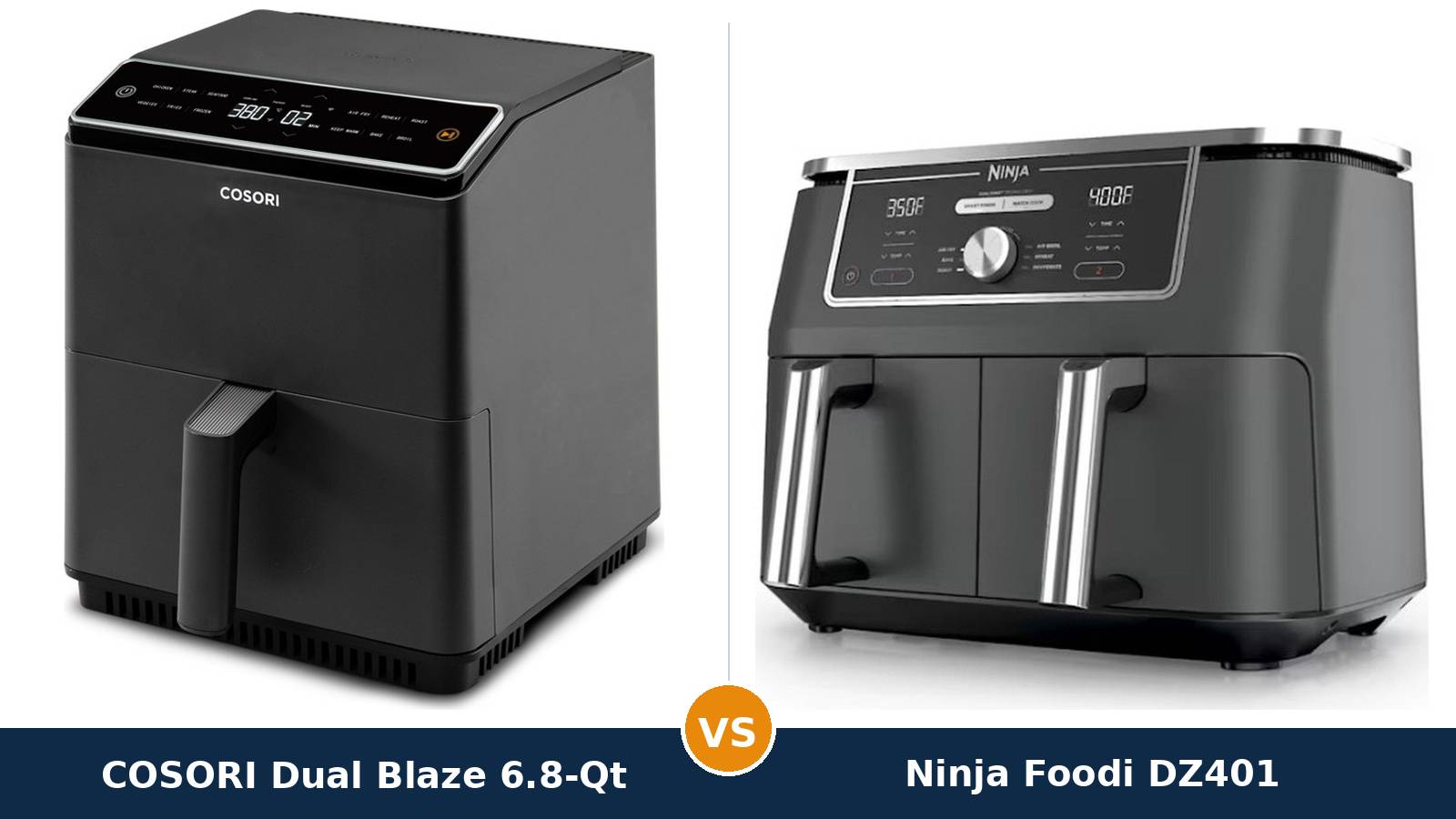
Every air fryer has the same awkward moment halfway through cooking. The top of the food is crisping. The underside is not. Something has to be flipped, shaken or swapped around — or the meal has to wait its turn.
These two machines are the two rival answers to that moment, and they could hardly be more different. The COSORI Dual Blaze puts a second heating element underneath the basket, so the underside cooks without you touching anything. The Ninja Foodi DZ401 splits the machine in half instead: two independent baskets, two heaters, two dinners at once.
One naming job before anything else. “Ninja Dual Zone” is not a model name — DualZone is the name of Ninja’s two-basket technology, and it covers a whole family of machines. The model that phrase points to, and the one compared here, is the Foodi DZ401: the 10-quart flagship of the DualZone line, with two 5-quart baskets. Its smaller 8-quart sibling, the DZ201, is a different machine and gets its own note below.
So the real question in this comparison is not which fryer is better in the abstract. It is which shape of dinner you cook. One big dish, cooked hands-off? Or two different dishes, landing on the table at the same time?
Every specification below comes from COSORI’s and SharkNinja’s own published data and manuals. The verdict at the end is the same one we would give a friend choosing between them.
Key Takeaways
- It finishes level on points — 8.0 apiece. The scorecard cannot separate them; the shape of your dinners has to.
- The Dual Blaze is the no-flip machine. Heating elements above and below the basket cook both faces of the food in one uninterrupted 6.8-quart space.
- The DZ401 is the two-dinners machine. Two independent 5-quart zones run different temperatures and finish together with Smart Finish.
- Ninja reaches further on temperature. 105–450°F in each zone, against the Dual Blaze’s 175–400°F single range.
- COSORI wins the ownership rows. Half the washing-up parts, 6 pounds lighter, a 2-year warranty against Ninja’s 1 year — and app control the DZ401 does not offer.
Quick Verdict
Buy the COSORI Dual Blaze if your dinners are one dish at a time. A family tray of wings. A big batch of fries. A single roast.
Its one wide basket cooks from above and below at once, so food browns on both faces without a mid-cook flip. You get 6.8 quarts in a single layer, an app that runs the machine from the sofa, and the longer warranty.
Buy the Ninja Foodi DZ401 if your dinners are two dishes at once. Salmon in one basket, asparagus in the other. Wings at 400°F, fries at 390°F, both ready together.
No single basket — at any size — can do that. The DZ401’s two zones are not a bigger version of the COSORI’s trick. They are a different capability entirely, and for main-plus-side households it settles the argument on its own.
The Scorecard
Scores below are derived directly from the manufacturer specifications compared in this guide — capacities, temperature ranges, basket dimensions and feature lists. They are a reading aid, not benchmark results.
| Category | COSORI Dual Blaze | Ninja Foodi DZ401 | ||
|---|---|---|---|---|
| Capacity | 9 / 10 | 10 / 10 | ||
| Cooking design | 9 / 10 | 9 / 10 | ||
| Temperature range | 6 / 10 | 9 / 10 | ||
| Ease of use | 9 / 10 | 8 / 10 | ||
| Cleaning | 8 / 10 | 7 / 10 | ||
| Footprint | 7 / 10 | 3 / 10 | ||
| Value | 8 / 10 | 8 / 10 | ||
| Overall | 8.0 / 10 | 8.0 / 10 | ||
A dead heat, and an honest one. Read the rows as two different shopping lists: the Dual Blaze wins the ownership rows — ease, cleaning, footprint — while the DZ401 wins capacity and temperature reach, and cooking design ties.
One thing no row above can score: simultaneity. Cooking two different foods at two different temperatures at the same time is a capability, not a specification, and it is the DZ401’s alone. If that is your dinner, the tie is broken before it starts.
At a Glance: Who Each Fryer Fits
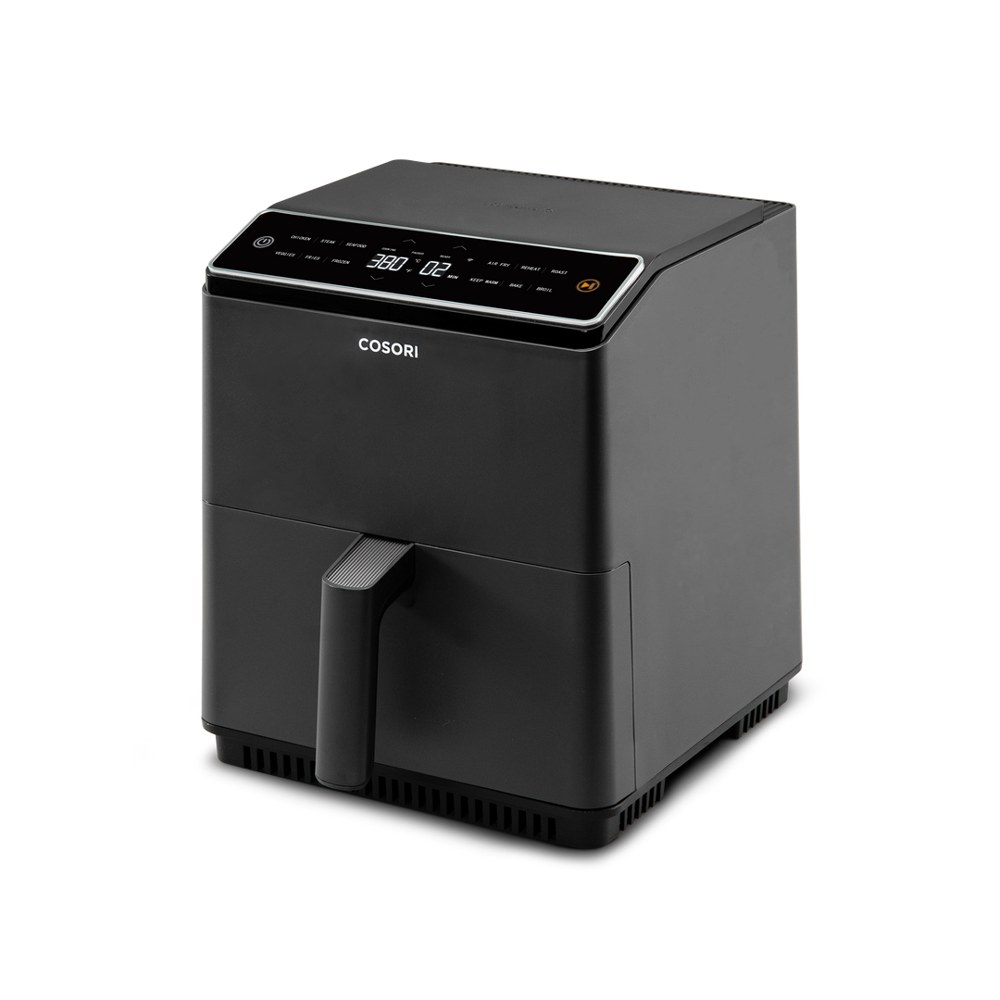
COSORI Dual Blaze 6.8-Quart
- Heating elements above and below the basket — no flipping
- 6.8 qt in one uninterrupted basket, 4.8 in deep
- 12 functions, six of them tuned food presets
- VeSync app control with Alexa and Google Assistant
- 2-year limited warranty
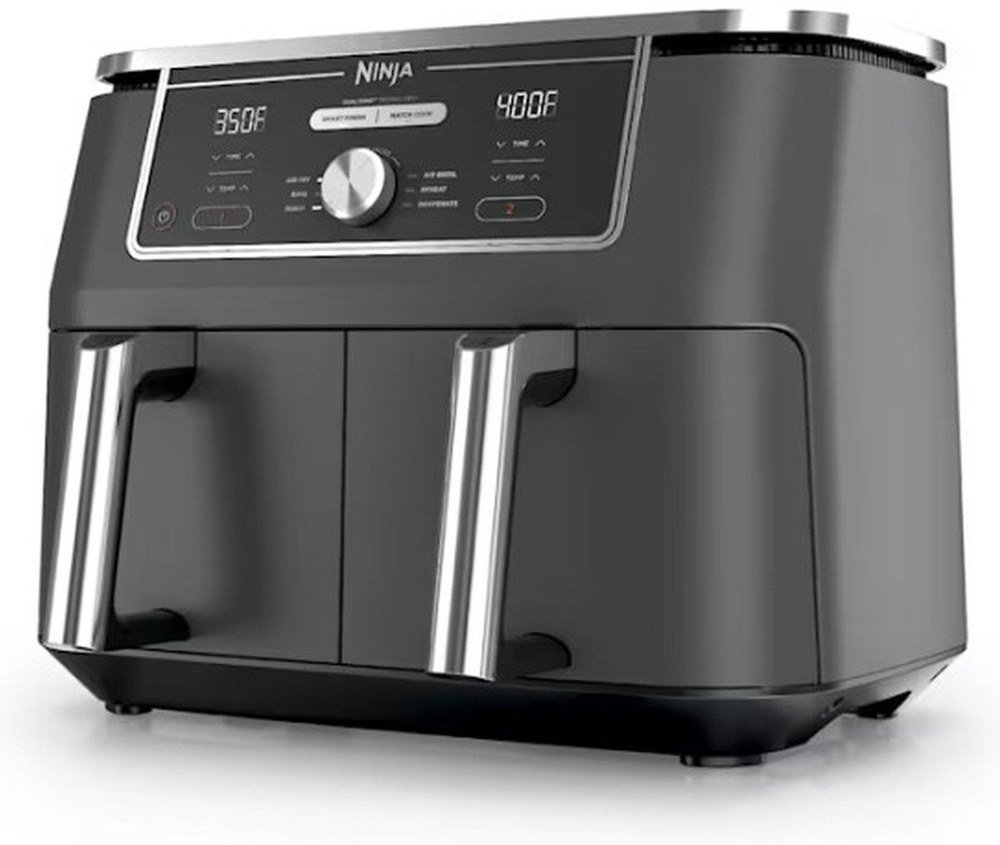
Ninja Foodi DZ401 (DualZone)
- Two independent 5-qt baskets, 10 qt total
- Smart Finish syncs two different cooks to end together
- 105–450°F in each zone, set independently
- Rated for up to 8 lbs of wings across both baskets
- IQ Boost shares power between zones when both run
Choose the COSORI Dual Blaze if…
You cook one dish at a time, in family-size batches. One layer, one temperature, everyone fed.
You hate the mid-cook interruption. The shake reminder, the tongs, the heat escaping while you flip.
You want the machine on your phone — started from the sofa, checked from the garden, bossed around by voice.
Or your counter is narrow. The Dual Blaze is nearly 5.5 inches slimmer across the front than the Ninja.
Choose the Ninja Foodi DZ401 if…
Your standard dinner is a main and a side. Protein in one basket, vegetables in the other, ready at the same moment.
Your household eats different things at different temperatures — and nobody wants to eat in shifts.
You dehydrate, or cook low and slow. A 105°F floor opens jobs the COSORI’s 175°F floor cannot start.
Or you simply need the most total capacity: 10 quarts against 6.8.
As an Amazon Associate I earn from qualifying purchases at no extra cost to you.
Specifications: The Specs That Actually Matter
Every figure below is taken from COSORI’s and SharkNinja’s published specifications and official manuals for these US models, cross-checked against the manufacturer’s product data.
Both machines compared here are the North American 120V versions. Regional variants of each carry different suffixes and different electrical ratings.
| Specification | COSORI Dual Blaze | Ninja Foodi DZ401 |
|---|---|---|
| Model number | CAF-P583S-KUS | DZ401 |
| Capacity | 6.8 qt / 6.4 L in one basket (serves 4–6) | 10 qt total — two 5-qt baskets |
| Single-batch space | 6.8 qt in one uninterrupted layer | 5 qt per basket — batches split across two zones |
| Cooking zones | 1 zone | 2 independent zones, each with its own heater and fan |
| Rated power | 1,750 W | 1,690 W |
| Temperature range | 175–400°F | 105–450°F, set independently per zone |
| Time range | 1–60 min | Set independently per zone; limits vary by function |
| Heating elements | Two — above and below the basket (360 ThermoIQ) | One per zone — two in total, each serving its own basket |
| Cooking functions | 12: Air Fry, Bake, Broil, Roast, Keep Warm, Reheat, Chicken, Steak, Seafood, Veggies, Fries, Frozen | 6: Air Fry, Air Broil, Roast, Bake, Reheat, Dehydrate |
| Multi-zone modes | Not applicable — single zone | Smart Finish, Match Cook, IQ Boost power distribution |
| Basket type | Square pull-out basket with crisper plate | Two pull-out baskets, each with its own crisper plate |
| Basket material & coating | Nonstick-coated aluminium basket and crisper plate | Nonstick-coated metal baskets and crisper plates |
| Basket cooking space | 9.4 × 9.4 in floor; 4.8 in deep with crisper plate | Two 5-qt baskets; rated for up to 8 lbs of wings across both |
| Controls & connectivity | Touch panel plus VeSync app, Amazon Alexa and Google Assistant | Touch panel and central dial — no app control |
| Dishwasher-safe parts | Basket and crisper plate | Baskets and crisper plates only |
| Dimensions (W × D × H) | 11.7 × 15.4 × 13.8 in — the narrower footprint | 17.1 × 13.9 × 12.8 in — wider, but an inch shorter |
| Weight | 13.7 lb | 19.8 lb |
| Warranty | 2-year limited | 1-year limited |
Name note: “DualZone” is Ninja’s technology name for the whole two-basket family — the DZ201, DZ401, DZ550 and others all wear it. This comparison uses the DZ401, the 10-quart model the bare phrase “Ninja Dual Zone” refers to in the US market. If a listing just says “DualZone,” check the model number before assuming it is this machine.
Coating note: the Dual Blaze’s manual specifies a nonstick-coated aluminium basket. A newer Amazon listing under the same Dual Blaze model number describes a ceramic-coated basket instead. Those are not the same claim — check the coating named on the listing before you order. More in the buying guide below.
Also-sold-as note: the Dual Blaze is also sold as the “COSORI Pro III” air fryer. Same model number, same machine, different range name on the box.
The Differences That Actually Matter
1. One basket or two — the decision everything else hangs on
Strip away the branding and these are two different kitchen tools that happen to share a category name.
The Dual Blaze is one cooking space: 6.8 quarts, undivided. Everything you cook shares one temperature, one timer, one airflow. The whole design effort went into making that single space cook better.
The DZ401 is two cooking spaces sharing a housing. Each 5-quart zone has its own heater, its own fan and its own controls. The design effort went into making the pair cooperate.
Neither approach is a compromise version of the other. A divided meal is a problem the COSORI cannot solve at any price. A single oversized item is a problem the Ninja’s partition cannot solve at all.
Decide which problem is yours. The rest of this guide is detail.
2. Heat from below, or a second heater entirely
The Dual Blaze’s signature is its lower element. Conventional air fryers heat from above only, which is why the underside of a chicken thigh lags behind the top — and why every recipe tells you to flip halfway.
COSORI heats from both ends of the basket and calls the system 360 ThermoIQ. The practical promise: food browns on both faces in one run, with no mid-cook intervention from you. For flat, single-layer foods — wings, cutlets, fries, frozen snacks — that removes the one chore air frying usually demands.
The DZ401’s answer is different in kind. It also has two heating elements — but each one serves its own basket. They never cooperate on the same piece of food.
So the honest summary is this: the COSORI spends its second element on the food’s underside. The Ninja spends its second element on a second dish. Both are legitimate. They are not interchangeable.
3. Temperature reach — Ninja, and it is not close
The DZ401 runs 105–450°F. In each zone. Set independently. That is a wider span at both ends than the Dual Blaze offers anywhere.
The Dual Blaze’s entire working span sits between 175°F and 400°F. For the great majority of air frying — which lives between 350°F and 400°F — that range is entirely sufficient, and we will not pretend otherwise.
Where it bites is at the edges. Dehydrating wants genuinely low temperatures; the DZ401’s 105°F floor starts jobs the COSORI’s 175°F floor cannot. At the top end, the Ninja’s 450°F ceiling — including its Air Broil function — sears harder than 400°F does.
And because the Ninja’s range exists twice, it can run a 450°F broil in one zone and a 300°F bake in the other, simultaneously. Temperature is the DZ401’s clearest specification win.
4. What actually fits — one wide floor against two deep baskets
Total capacity favours the Ninja: 10 quarts against 6.8. But capacity you cannot use in one layer is worth less than the number suggests.
The Dual Blaze’s basket floor measures 9.4 × 9.4 inches, 4.8 inches deep over the crisper plate. That is one wide, genuinely usable single layer — the layout batch cooking actually wants. A family load of fries or wings spreads out, crisps evenly, and the bottom element means the layer underneath is not steaming in the dark.
The DZ401 answers with volume and rating: SharkNinja rates the pair for up to 8 lbs of chicken wings in a single run, and a whole chicken fits in one 5-quart zone with room for air to move. Two zones also means a big cook and a small cook never have to share — or wait.
The failure modes are mirror images. One oversized item that cannot be split defeats the Ninja’s partition. Two dishes that need different treatment defeat the COSORI’s single space. Know which failure would annoy you more.
5. Controls — an app and twelve presets against a dial and three tricks
The Dual Blaze is the connected machine. Twelve functions: six cooking modes plus six tuned food presets — Chicken, Steak, Seafood, Veggies, Fries, Frozen.
Behind the panel sits the VeSync app, with Amazon Alexa and Google Assistant on top. Start dinner from the sofa. Get the notification on your phone. That is a real, daily convenience, not a spec-sheet ornament.
The DZ401 has no app at all. What it has instead are three modes that exist only because it has two zones — and they are genuinely clever.
Smart Finish staggers two different cooks — different temperatures, different times — so both end at the same moment. Match Cook copies one zone’s settings to the other for a double batch. IQ Boost distributes power between the zones when both are running hard.
Call it fairly: COSORI wins automation and convenience. Ninja wins coordination. The dial-and-panel Ninja is also the simpler machine to lend to a teenager or a grandparent — there is less to go wrong, and nothing to pair.
6. Footprint — width against height, and six pounds
Measure your counter before you fall for either machine. They fail different tape measures.
The DZ401 is 17.1 inches wide — a serious slab of counter — but only 12.8 inches tall. The Dual Blaze is just 11.7 inches wide, then rises to 13.8 inches tall.
So the Ninja is the one that will not fit a narrow counter run, and the COSORI is the one to measure against low wall cabinets. Either could be the one that does not fit your kitchen; they are opposite problems.
Weight follows the same pattern. At 13.7 lb the Dual Blaze is easy to slide out from under a cabinet or carry to a sink. At 19.8 lb the DZ401 is a machine that finds its spot and stays there.
Neither is small. The Dual Blaze is simply the only one of the two that behaves like a movable appliance.
7. Cleaning — same rule, half the parts
Both manufacturers clear exactly the same kinds of parts for the dishwasher: the baskets and the crisper plates. Everything else is a wipe-down. On paper, a tie.
In the sink, it is not. The DZ401 produces two baskets and two crisper plates after every two-zone meal — four nonstick parts to wash, dry and store. The Dual Blaze produces one basket and one plate.
Both use nonstick coatings rather than ceramic on the models compared here, so the care rules match: no abrasives, no metal scourers, and the dishwasher clearance both manuals give you.
Add the warranty to the ownership ledger while we are here. COSORI covers the Dual Blaze for two years. SharkNinja covers the DZ401 for one. Small print, real difference.
Which Fryer Fits Your Household?
Start from how dinner actually works in your house. This table is the whole comparison in one view.
| Your household / pattern | COSORI Dual Blaze | Ninja Foodi DZ401 | Our call |
|---|---|---|---|
| Solo or couple, one dish at a time | Excellent — right-sized, no flipping | More machine than the job needs | Dual Blaze |
| Family of 4–6, one big batch (wings, fries, nuggets) | Excellent — one wide single layer | Very good — the same load split across two zones | Dual Blaze |
| Main + side dinners, ready together | Cooks the two dishes in sequence | Excellent — Smart Finish lands both at once | DZ401 |
| Two eaters, two temperatures, one mealtime | Not possible in a single basket | Excellent — zones are fully independent | DZ401 |
| Meal prep — two proteins, two settings | One batch at a time | Excellent — both proteins in one run | DZ401 |
| Narrow counter, standard cabinets | Good — 11.7 in wide; check the 13.8 in height | Needs 17.1 in of width; shorter at 12.8 in | Dual Blaze, after a height check |
| App or voice control wanted | Excellent — VeSync, Alexa, Google Assistant | Panel and dial only | Dual Blaze |
| Dehydrating and low-temperature cooking | Limited — 175°F floor | Excellent — 105°F floor in each zone | DZ401 |
Notice the pattern in the table. The Dual Blaze’s wins are about one dish done well. Every DZ401 win is the same win restated: two things at once.
Ready to check today’s price?
Both fryers sell through Amazon. Prices move, so check the live figure on the machine that fits your dinners.
View on Amazon — COSORI Dual BlazeView on Amazon — Ninja Foodi DZ401The 30-Second Decision
| If this sounds like you… | Buy this |
|---|---|
| “Dinner is one dish, in family volume.” | COSORI Dual Blaze |
| “Dinner is a main and a side, ready at the same time.” | Ninja Foodi DZ401 |
| “I never want to flip or shake food halfway again.” | COSORI Dual Blaze |
| “Two of us eat different things at different temperatures.” | Ninja Foodi DZ401 |
| “I want to run the fryer from my phone.” | COSORI Dual Blaze |
| “I dehydrate, and I need genuinely low temperatures.” | Ninja Foodi DZ401 |
What You Gain. What You Give Up.
COSORI Dual Blaze
You gain: one uninterrupted 6.8-quart cooking space with heat from above and below. No flipping, no shaking, no second batch waiting. App and voice control, twelve functions, a 2-year warranty, and a machine light and narrow enough to move.
You give up: simultaneity — one temperature, one timer, one dish at a time. Temperature reach at both ends: no dehydrating lows, no 450°F sear. And total capacity: 6.8 quarts is where it stops.
Ninja Foodi DZ401
You gain: two independent zones that cook different foods at different temperatures and finish together. Ten quarts of total capacity, an 8-lb wing rating, a 105–450°F range in each zone, and a Dehydrate function the COSORI lacks.
You give up: the undivided basket — nothing wider than one 5-quart zone ever fits. App control of any kind. Counter width, nearly 6 lb of extra weight, double the washing-up parts, and a year of warranty coverage.
Pros and Cons
Dual Blaze — Pros
- Dual heating elements — no mid-cook flipping
- One wide 9.4 × 9.4 in single-layer basket floor
- VeSync app plus Alexa and Google Assistant
- 12 functions with six tuned food presets
- 2-year warranty; lighter and narrower body
Cons
- One zone — one temperature, one dish at a time
- 175–400°F range is the narrowest here
- No Dehydrate function
- Taller than the Ninja — check cabinet clearance
- Two Amazon listings disagree on the basket coating
DZ401 — Pros
- Two fully independent 5-qt zones, 10 qt total
- Smart Finish syncs different cooks to end together
- 105–450°F range in each zone
- Rated for up to 8 lbs of wings per run
- Shorter body fits under more cabinets
Cons
- 17.1 in wide and 19.8 lb — it stays where it lands
- Nothing wider than a 5-qt zone ever fits
- No app or voice control
- Four parts to wash after a two-zone meal
- 1-year warranty only
Check the Listing, Not Just the Fryer
Check the Dual Blaze coating. This is the one genuine trap in this comparison. COSORI’s manual for the CAF-P583S-KUS specifies a nonstick-coated aluminium basket.
A newer Amazon listing under the same Dual Blaze model number describes a ceramic-coated basket. Both listings cannot be describing the same basket.
Our links point to the long-standing listing that matches the manual. Whichever listing you buy from, read the coating line on the page and make sure it is the basket you actually want.
Check the DualZone model number. “DualZone” is a family name, not a model. The DZ201 is the 8-quart sibling — same idea, 4-quart baskets. The DZ550 adds a Smart Thermometer probe to this same 10-quart platform.
The DZ401 compared here is the 10-quart, 6-in-1 model. If a listing’s capacity says 8 quarts, it is not this machine, whatever the headline calls it.
Mind the regional names. Ninja sells a similar two-basket machine in the UK as the AF400UK “Foodi MAX Dual Zone.” It is a 220–240V appliance for a different market — not a US DZ401 under another badge.
Check the box. The DZ401 ships with the main unit, two baskets, two crisper plates and a recipe guide. The Dual Blaze ships with its basket, crisper plate and documentation, and COSORI sells the VeSync app as part of the package — it costs nothing, but the fryer’s smart features do nothing until it is installed and paired.
The Second-Year Test
Judge these two by the dinners you will be cooking in year two, not the novelty of week one.
The Dual Blaze’s second year is calm. The no-flip habit becomes invisible — you simply stop thinking about the halfway shake. The app routines settle in. The one question that can grow is the single zone: households that start cooking for more people, or more tastes, feel the one-temperature limit more each year.
The DZ401’s second year usually goes the other way. Households grow into the second zone — a side dish here, a picky eater’s separate portion there — and Smart Finish becomes the default way dinner gets made. The costs stay constant instead: the counter width, the four-part wash-up.
Neither machine has an upgrade path within itself. You cannot add a zone to the COSORI or an app to the Ninja. Buy the capability, not the hope of one.
When to Skip Both
Honesty cuts both ways. Some kitchens are served by neither design.
Skip both if your signature dish is one oversized item — a large whole bird or a full sheet-pan-style load. An oven-style air fryer with a wide single cavity takes what both of these must refuse or split.
Skip both if you need more than 10 quarts regularly. At that point you are feeding a crowd, and two appliances or an oven will serve you better than any countertop fryer.
Skip both if connected features are a hard requirement and you need two zones. That combination is not what either of these machines is — the smart one has one zone, the two-zone one is not smart.
And skip both if your counter genuinely cannot spare the space. Both are full-size appliances with real footprints; a compact 4-quart class machine exists for a reason.
Warranty and Long-Term Support
The warranty gap is on the spec sheet, not in the fine print: two years of limited cover from COSORI against one year from SharkNinja.
COSORI’s support runs through the VeSync app as well as the usual channels, and the app is also where the Dual Blaze’s recipes and firmware-side features live. The machine still cooks fully from its own panel if you never install it.
SharkNinja’s DualZone platform is one of the most widely sold air fryer lines in the US, which shows up in the practical places: replacement baskets and crisper plates are standard catalogue parts, and the recipe ecosystem around the platform is large.
For both machines, the wear items are the same — the nonstick baskets and plates. Treat them gently, use the dishwasher clearance both manuals actually give you, and they are the parts most likely to decide how long either fryer stays in service.
Final Verdict
On points, this is a genuine tie — 8.0 against 8.0 — and the tie itself is the finding.
These machines do not do the same job at different quality levels. They do different jobs. The scorecard rows each one wins barely overlap, because the products barely overlap.
Buy the COSORI Dual Blaze if your cooking is one dish at a time and you want it cooked without supervision: heat from both sides, a wide single layer, an app in your pocket, half the washing-up and twice the warranty.
View on Amazon — COSORI Dual Blaze
Buy the Ninja Foodi DZ401 if dinner at your house is two things at once. Two zones, two temperatures, one finish time is a capability no single basket can imitate — and if that is your weeknight, it outweighs every row the COSORI wins.
Decide by the shape of your meals, not by the spec sheet. One dish, done effortlessly: COSORI. Two dishes, done simultaneously: Ninja.
View on Amazon — Ninja Foodi DZ401
Watch Out: Similar Names, Different Fryers
Air fryer names are a trap for the hurried buyer. Four warnings belong in this guide.
First: the Dual Blaze is also sold as the “COSORI Pro III.” Same model number — CAF-P583S-KUS — same machine. Do not pay a premium for the range name, and do not buy both thinking they differ.
Second: “DualZone” covers a family. The DZ201 is 8 quarts, the DZ401 in this comparison is 10, and the DZ550 adds a thermometer probe. Match the model number, not the family name.
Third: COSORI’s own range invites confusion. The TurboBlaze is a different, single-element 6.0-quart machine with the wider temperature range — a fine fryer, but not the dual-element model compared here.
Fourth: two Amazon listings currently sell a “Dual Blaze” with different basket coatings described. The manual’s specification — nonstick-coated aluminium — is the reference point. Verify the listing, as the buying guide explains.
Frequently Asked Questions
Which Ninja model is “the Dual Zone” in this comparison?
The Ninja Foodi DZ401. DualZone is the name of Ninja’s two-basket technology, shared by a family of models; the DZ401 is the 10-quart flagship — two 5-quart baskets — that the bare phrase refers to in the US market. The smaller DZ201 (8 quarts) is its sibling, not the same machine.
Can the DZ401 cook two different foods at the same time?
Yes — that is its defining capability. Each zone has its own heater, fan, temperature and timer. Smart Finish staggers the two cooks so a longer item and a shorter item finish at the same moment, and IQ Boost distributes power between the zones while both run.
Do you really not have to flip food in the Dual Blaze?
That is what the second heating element is for. With elements above and below the basket, both faces of single-layer food cook in one run, and COSORI’s design removes the flipping and shaking step for the foods the machine is built around. Very thick or stacked items can still benefit from a turn — physics has not been repealed — but the routine mid-cook flip is designed out.
Which is better for a big batch of fries or wings?
It depends how you want to cook them. The Dual Blaze fits the batch in one wide 9.4 × 9.4 in layer and cooks it from both sides at once. The DZ401 holds more in total — SharkNinja rates it for up to 8 lbs of wings — but the load is split across two baskets. One layer, one dish: COSORI. Maximum total volume: Ninja.
Which takes up more counter space?
The DZ401, by width: 17.1 in across against the Dual Blaze’s 11.7 in. But the Dual Blaze is the taller machine — 13.8 in against 12.8 in — so it is the one to check against low wall cabinets. The Ninja is also about 6 lb heavier, at 19.8 lb against 13.7 lb.
Are the baskets and plates dishwasher safe on both?
Yes, within the same limits. Both manufacturers clear the baskets and crisper plates for the dishwasher, and only those parts. The practical difference is quantity: the Dual Blaze produces two parts to wash, the DZ401 produces four after a two-zone meal.
Which is better for dehydrating?
The DZ401, clearly. It has a dedicated Dehydrate function and a 105°F floor in each zone. The Dual Blaze has no Dehydrate function and its range starts at 175°F — too warm for proper dehydrating work.
Is the COSORI Pro III the same as the Dual Blaze?
Yes. The Pro III is the same CAF-P583S-KUS machine under a range name. One caution applies to the Dual Blaze name itself: a newer Amazon listing under the same model number describes a ceramic-coated basket, while the manual specifies nonstick-coated aluminium — check the coating on the listing before you buy.
Sources & Verification
COSORI Dual Blaze product page, cosori.com • COSORI Dual Blaze 6.8-Quart Smart Air Fryer user manual, model CAF-P583S-KUS (specifications, care, warranty) • Ninja Foodi DZ401 instruction manual and SharkNinja product data (10 qt, 1,690 W, 105–450°F, dimensions, warranty), via SharkNinja and manufacturer product data supplied to retailers • Model determination for “Ninja Dual Zone” = DZ401 follows US market usage of the DualZone line. Specifications verified November 2026.

James Wilson
James has been testing and comparing kitchen appliances for over a decade and writes Honestly Compared’s kitchen and home guides. His rule for every comparison: the verdict has to survive the spec sheet, not the marketing page.