
COSORI Dual Blaze vs COSORI TurboBlaze: Which Should You Buy?
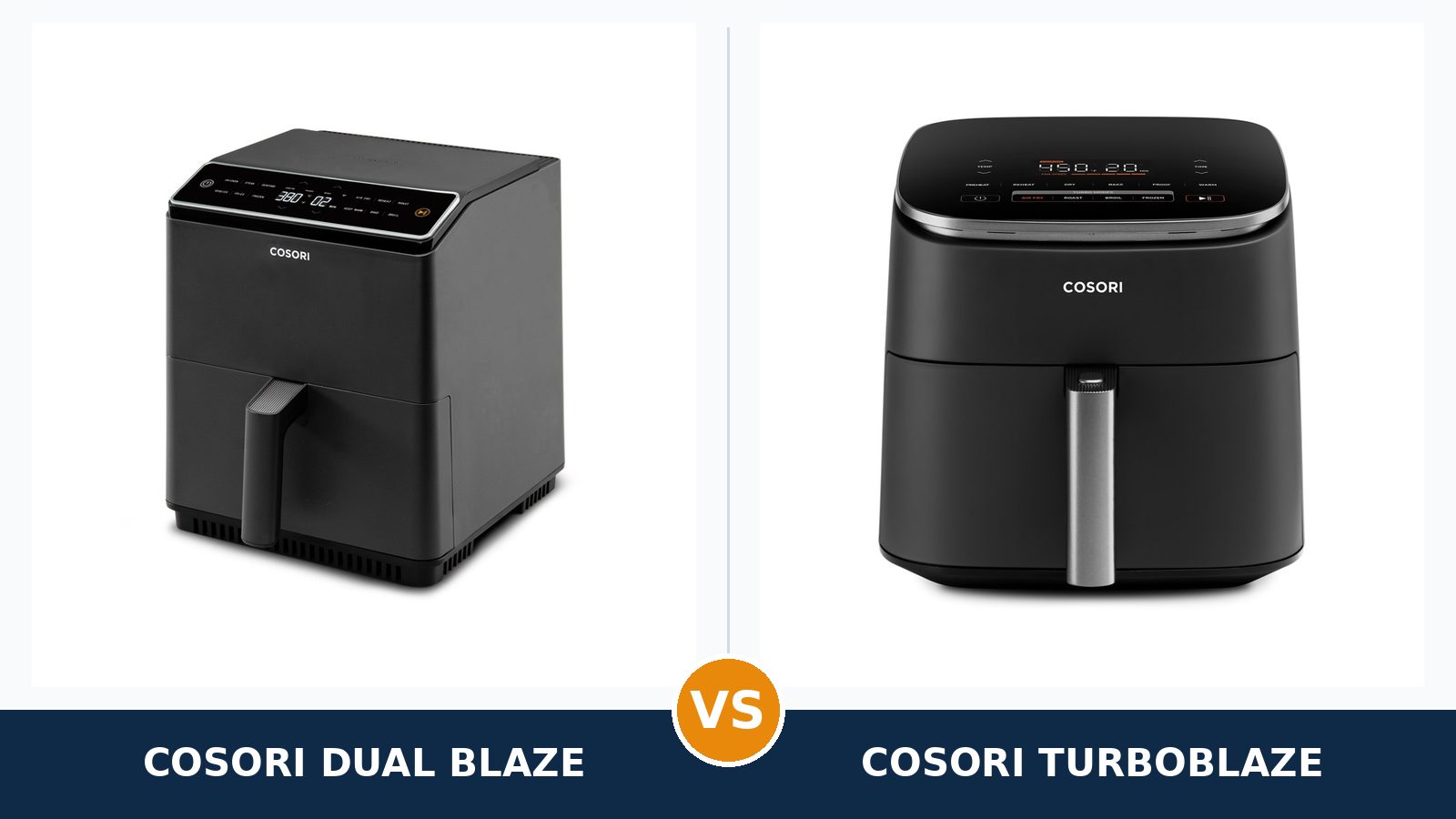
Most air fryer comparisons pit one brand against another. This one is harder, because both machines come from the same brand, wear the same dark gray finish, and sit at the top of the same range.
The COSORI Dual Blaze (model CAF-P583S-KUS) is the elder flagship: a 6.8-quart smart fryer with a heating element above the basket and another one below it.
The COSORI TurboBlaze (model CAF-DC601-KUS) is the newer challenger: a 6.0-quart fryer built around a fast DC-motor fan, a much wider temperature range, and a ceramic-coated basket.
Neither name explains any of that. Shoppers are left comparing two black boxes and a pair of slogans, when the real choice is between two different cooking philosophies.
So here is the honest version. Every figure below is taken from COSORI's own product pages and user manuals for these two US models, and the verdict follows the spec sheets, not the marketing.
Key Takeaways
- The TurboBlaze wins for most kitchens. It works from 90°F to 450°F, times cooks up to 24 hours, and offers five fan speeds in a shorter body.
- The Dual Blaze is the family batch machine. A deeper 6.8-quart basket, heat from both ends, and cooking you rarely need to interrupt.
- Connectivity is one-way traffic. The Dual Blaze runs on the VeSync app with voice assistants. The TurboBlaze in this comparison has no app at all.
- The baskets clean up equally well. Both go in the dishwasher; the TurboBlaze's PFAS-free ceramic surface is the more modern material.
- Model numbers matter more than names here. The Dual Blaze also answers to “Pro III,” and a Dual Blaze listing with a ceramic basket claim needs a second look.
Quick Verdict
Buy the COSORI TurboBlaze if you want the broader, more flexible cooker. That is most households, most of the time.
It proof dough at 90°F, dehydrates for hours against a 24-hour timer, and still reaches a genuine 450°F broil at the top end. Five fan speeds turn airflow into a real cooking control.
It also stands nearly two inches shorter than its rival, which decides where it can live in a lot of kitchens.
Buy the COSORI Dual Blaze if your cooking is bigger and more hands-off. Its basket is deeper as well as larger, the second element browns food from underneath, and the app keeps watch from the next room.
For a household of four to six that loads a fryer, picks a preset and walks away, that combination beats raw range.
The Scorecard
Scores below are derived directly from the manufacturer specifications compared in this guide — capacities, temperature ranges, basket dimensions and feature lists. They are a reading aid, not benchmark results.
| Category | Dual Blaze | TurboBlaze | ||
|---|---|---|---|---|
| Capacity | 9 / 10 | 7 / 10 | ||
| Cooking system | 9 / 10 | 8 / 10 | ||
| Temperature & timer range | 6 / 10 | 10 / 10 | ||
| Ease of use | 9 / 10 | 8 / 10 | ||
| Cleaning & coating | 8 / 10 | 9 / 10 | ||
| Footprint | 7 / 10 | 9 / 10 | ||
| Value | 8 / 10 | 9 / 10 | ||
| Overall | 8.0 / 10 | 8.6 / 10 | ||
Read the table column by column and a shape emerges. The Dual Blaze takes the rows about volume and convenience. The TurboBlaze takes every row about reach — hotter, colder, longer, smaller — and reach is harder to retrofit than convenience.
At a Glance: Who Each Fryer Fits
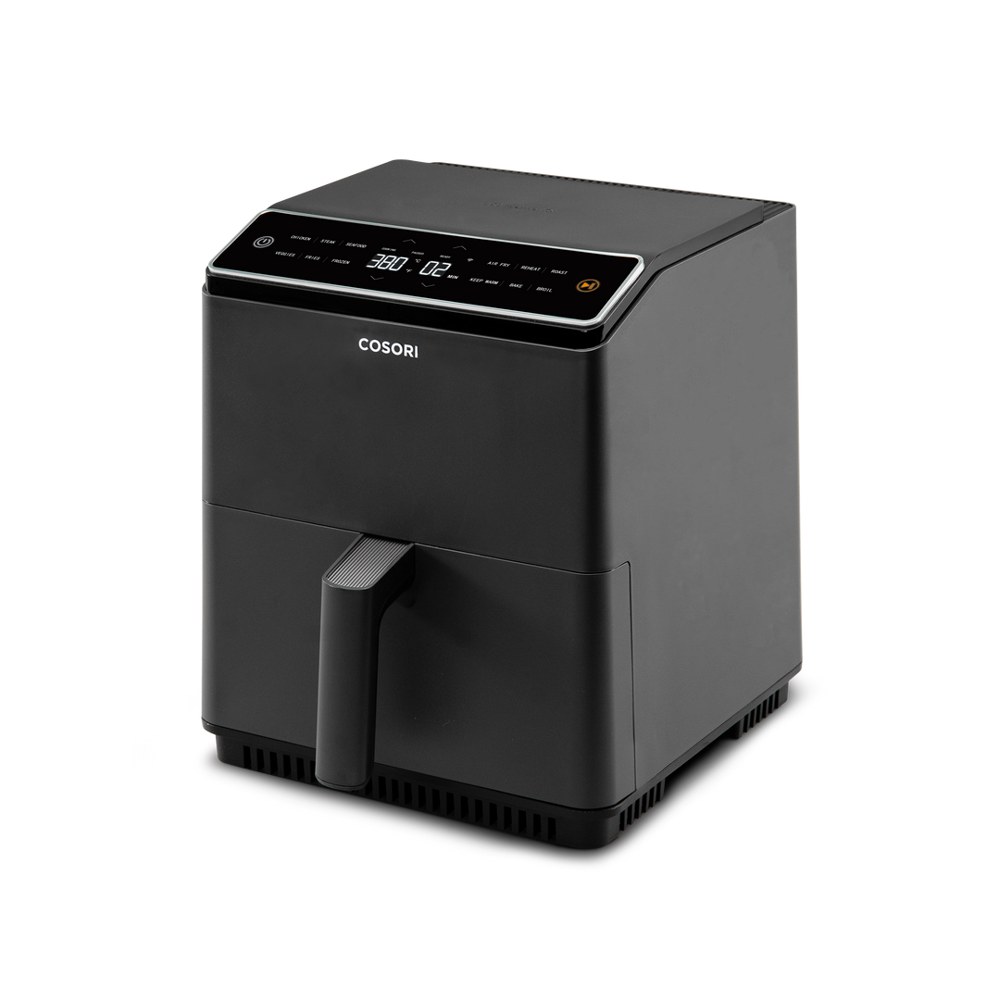
COSORI Dual Blaze 6.8-Quart
- Heating elements above and below the basket
- 6.8 qt basket, 4.8 in deep over the crisper plate
- 12 functions, six of them tuned food presets
- VeSync app control with Alexa and Google Assistant
- COSORI rates it for households of four to six
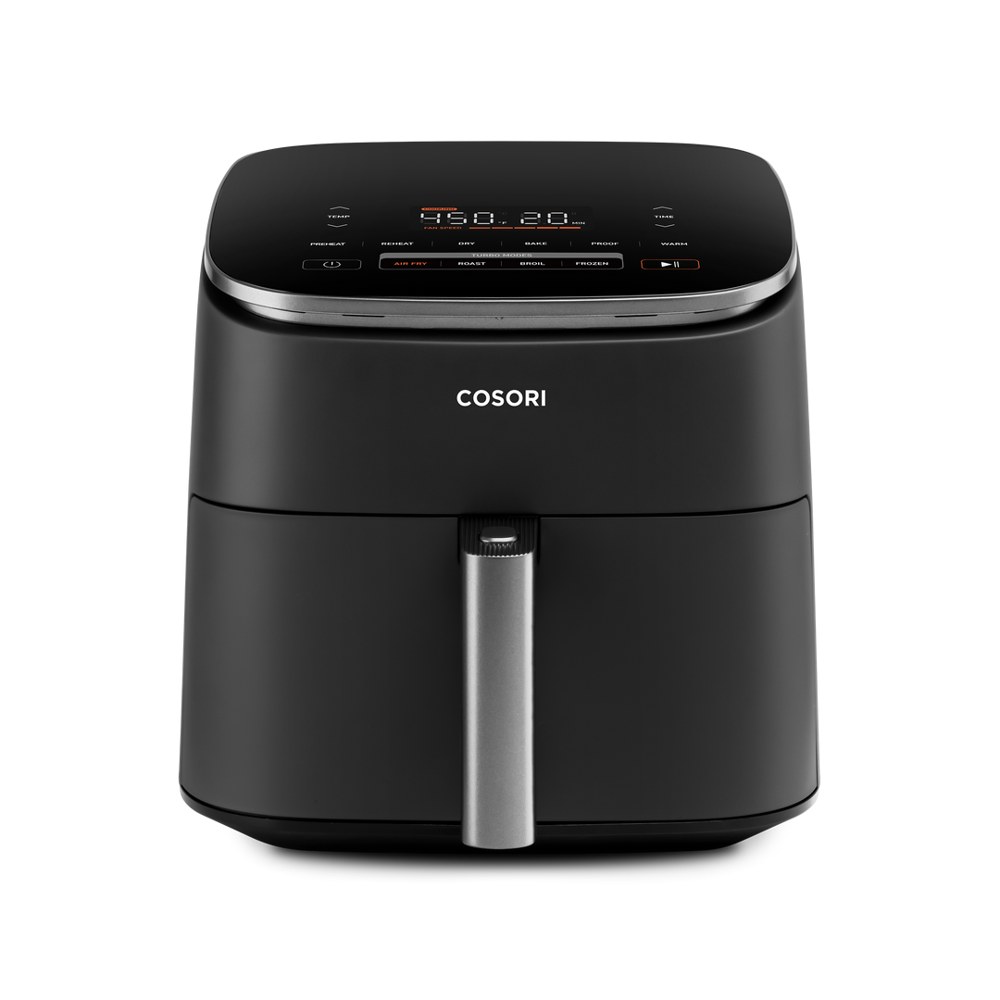
COSORI TurboBlaze 6.0-Quart
- DC motor fan with five speeds, up to 3,600 rpm
- 90°F–450°F working range; timer to 24 hours
- Dehydrate and Proof functions on the panel
- Ceramic-coated, PFAS-free basket and crisper plate
- Stands 11.9 in tall — the easier fit under cabinets
Choose the Dual Blaze if…
Your regular load is a family's worth of food: a whole chicken, a deep tray of wings, fries for five.
You dislike mid-cook chores. Heat arriving from below means most food finishes without a shake or a flip.
You want the fryer to report back. Notifications, recipe settings and voice control are part of how you already run your kitchen.
Choose the TurboBlaze if…
You cook for one to five people and your menu wanders: weeknight fries, weekend bread dough, a tray of dried apple slices.
You are phasing out conventional nonstick. The ceramic basket is the deciding feature, and it is a legitimate one.
Your wall cabinets sit low. At 11.9 inches tall, this machine clears spaces its rival cannot.
As an Amazon Associate I earn from qualifying purchases at no extra cost to you.
Specifications: The Specs That Actually Matter
Every figure below comes from COSORI's published specifications and the official user manuals for these two US models, cross-checked against the manufacturer's product data.
Sister models sold abroad carry different suffixes and electrical ratings. This table is about the North American 120V machines most readers will actually buy.
| Specification | COSORI Dual Blaze | COSORI TurboBlaze |
|---|---|---|
| Model number | CAF-P583S-KUS | CAF-DC601-KUS |
| Capacity | 6.8 qt / 6.4 L (serves 4–6) | 6.0 qt / 5.7 L (serves 3–5) |
| Rated power | 1,750 W | 1,725 W |
| Temperature range | 175°–400°F / 80°–205°C | 90°–450°F / 30°–230°C |
| Time range | 1–60 min | 1 min – 24 hr |
| Heating elements | Two (top and bottom) | One (top) |
| Fan / airflow | 360 ThermoIQ® technology, fixed airflow programme | DC motor, 5 fan speeds, up to 3,600 rpm |
| Cooking functions | 12: Air Fry, Bake, Broil, Roast, Keep Warm, Reheat, Chicken, Steak, Seafood, Veggies, Fries, Frozen | 9: Air Fry, Roast, Bake, Broil, Dehydrate, Frozen, Proof, Reheat, Keep Warm, plus Preheat |
| Basket type | Square pull-out basket with crisper plate | Square pull-out basket with crisper plate |
| Basket coating | Nonstick-coated aluminium (basket and crisper plate) | PFAS-free ceramic nonstick (basket and crisper plate) |
| Basket cooking space | 9.4 × 9.4 in floor; 4.8 in deep | 9.31 × 9.31 in floor; 3.48 in deep with crisper plate |
| Dishwasher-safe parts | Basket and crisper plate | Basket and crisper plate |
| Controls | Touch panel plus VeSync app, Amazon Alexa and Google Assistant | Angled touch panel on the unit |
| Dimensions (with handle) | 11.7 × 15.4 × 13.8 in (W × D × H) | 11.8 × 14.4 × 11.9 in (W × D × H) |
| Weight | 13.7 lb / 6.22 kg | 13.2 lb / 6 kg |
| Warranty | 2-year limited | 2-year limited |
Name note: the Dual Blaze also appears in shops as the “COSORI Pro III.” Underneath the badge it is the identical CAF-P583S machine, not a separate, better model.
The TurboBlaze name hides a split too. COSORI sells a TurboBlaze Smart edition with app control alongside the manual model; the one on this page is the original panel-controlled CAF-DC601-KUS.
And one caution that belongs in the open: a newer Amazon listing carries this same Dual Blaze model number while describing a ceramic-coated basket. The CAF-P583S manual specifies nonstick-coated aluminium, so the coating printed on the listing is worth confirming before money changes hands. The buying guide returns to this.
The Differences That Actually Matter
1. Where the heat comes from — an element below versus a fan above
Everything else in this comparison orbits one engineering decision: how energy reaches the underside of your food.
The Dual Blaze puts hardware there. Alongside the usual top element, a second element sits under the basket, so the face of the food resting on the crisper plate gets cooked directly instead of waiting for heat to work its way around.
That is why COSORI can credibly say this machine needs no preheating and little turning. The dead zone that plagues ordinary basket fryers — pale, soft undersides — is largely engineered away.
The TurboBlaze attacks the same problem with moving air. A DC motor rated to 3,600 rpm drives the fan, and crucially it does so at five selectable speeds rather than one fixed blast.
Speed control changes what the machine is for. Driven hard, it strips moisture and crisps. Turned down, it moves warm air gently enough to proof dough or dry herbs without scattering them.
Our verdict on this round: the Dual Blaze's layout is the better answer for the food most people air fry most often. The TurboBlaze's fan is the better answer for everything around that core job.
2. Capacity — width is a tie, depth is not
Quart figures flatter the gap between these two. Six point eight against six sounds like a rout. The baskets themselves tell a narrower story.
Lay them side by side and the floors are effectively the same: 9.4 inches square in the Dual Blaze, 9.31 inches square of usable floor in the TurboBlaze once its crisper plate is in. A single layer of chicken thighs or fries covers the same ground in either.
Where the Dual Blaze genuinely pulls away is vertical room — 4.8 inches of basket depth against 3.48 inches above the TurboBlaze's plate. Depth is what swallows a whole bird, a thick roast, or a second layer that does not sit directly on the first.
COSORI's own serving guidance matches that reading: three to five people for the TurboBlaze, four to six for the Dual Blaze.
So judge by the shape of your cooking, not the quart badge. Flat, single-layer food is a wash. Tall food and stacked batches belong to the Dual Blaze.
3. Temperature and time — the widest gap on the page
If one section settles this comparison for most readers, it is this one.
The TurboBlaze works between 90°F and 450°F. The Dual Blaze works between 175°F and 400°F. Every boundary in that sentence has a consequence.
Start at the ceiling. Four hundred and fifty degrees is broiling heat: cheese bubbles and browns, steak surfaces crust, gratins finish with conviction. At 400°F the Dual Blaze gets close, but close is the operative word.
Drop to the floor. Ninety degrees is warm enough to coax yeast dough upward and gentle enough for proper dehydrating, which the TurboBlaze supports with a dedicated function starting at 135°F. A 175°F minimum simply cannot do either job.
Time widens the split further. The TurboBlaze's timer runs a full day, so an eight-hour batch of jerky is a single programme. The Dual Blaze stops the clock at sixty minutes, which makes long, slow work a series of restarts.
Credit where due: within its narrower band, the Dual Blaze is well tuned, and its six food presets live comfortably inside it. But a contest about range has only one winner, and it is not close.
4. Controls and connectivity — supervised cooking versus standing there
The Dual Blaze is the connected appliance in this pairing, and the connection is more than a novelty.
Through the VeSync app you can follow a cook from another room, get a notification when it ends, pull up chef-built recipes whose settings transfer to the machine, and scan packaged food for a suggested programme. Alexa and Google Assistant take voice commands on top.
One limit from the manual deserves plain sight: the app is not allowed to start the fryer remotely. Safety rules require a person at the panel to begin cooking; the software supervises after that.
The TurboBlaze offers no app, no Wi-Fi and no voice control. Its interface is an angled touch panel, a preheat button and the fan-speed selector — full control, provided you are standing in front of it.
Think about your own evenings. Air frying is mostly short cooks measured in minutes, where supervision-by-phone saves nothing. For longer roasts in a busy house, the notifications genuinely earn their place.
5. Basket surfaces and the washing-up — honours even, materials not
On the chore itself, neither machine wins. Both baskets and both crisper plates are rated dishwasher-safe by their manuals, and both deserve the same gentle treatment if you want the coatings to outlast the warranty.
The materials underneath the chore do differ. The TurboBlaze's basket and plate wear a ceramic nonstick with no PFAS — the coating chemistry most buyers are now deliberately shopping for.
The Dual Blaze uses the older recipe: aluminium parts with a conventional nonstick coating. It releases food well and has a long track record, but its manual's care rules are the familiar ones — keep abrasive pads and scouring chemicals away.
Ceramic surfaces also tend to shrug off a quick hand-wash between dishwasher cycles, which suits a machine you use daily.
One Dual Blaze maintenance habit is worth adopting from day one. Dripped fat collects beneath its crisper plate close to that lower element, and COSORI advises tipping it away after fatty cooks so it cannot smoke next time. The TurboBlaze, with a passive underside, asks for no such routine.
6. Living with the size — height is the argument
Air fryers earn permanent counter space or they get exiled to a cupboard. Between these two, the tape measure casts the deciding vote more often than any cooking feature.
The TurboBlaze stands 11.9 inches tall and reaches 14.4 inches deep including its handle. The Dual Blaze stands 13.8 inches and stretches 15.4 inches deep on the same basis.
Call it two inches up and one inch back. In a kitchen with standard cabinet clearance, that difference decides whether the fryer slides under the cupboards at all, and how much counter it shadows when it cannot.
Both manuals demand the same breathing room regardless: five inches clear behind and above the unit, plus space in front to draw the basket toward you.
Weight, at least, argues nothing. Half a pound separates them — 13.2 lb against 13.7 lb — so either is easy to shift for cleaning or store away if counter space is at a premium.
Which Fryer Fits Your Household?
Start from who is eating and how the cooking actually happens, and the choice usually makes itself. This table compresses the whole comparison into that view.
| Your household / cooking style | Dual Blaze | TurboBlaze | Our call |
|---|---|---|---|
| Couples and small households (1–3 people) | Good — more basket than the job needs | Excellent — right-sized and quick | TurboBlaze |
| Families of 3–5, weeknight dinners | Excellent | Excellent | Either — decide on batches versus range |
| Families of 4–6, batch cooking | Excellent — the deeper basket pays off | Workable — expect two rounds | Dual Blaze |
| “I never remember to flip the food” | Excellent — heat arrives from below as well | Fair — bigger loads still want turning | Dual Blaze |
| Home bakers: proofing, dehydrating, jerky | Not suited — 175°F floor, 60-minute timer | Excellent — 90°F floor, 24-hour timer | TurboBlaze, outright |
| Smart-home cooks who want app control | Excellent — VeSync, Alexa, Google Assistant | Not available on this model | Dual Blaze, outright |
| Small kitchens, low wall cabinets | Tight — 13.8 in tall, deeper with handle | Excellent — 11.9 in tall | TurboBlaze |
Notice the two rows marked “outright.” Proofing and dehydrating on one side, app control on the other, are not strengths one machine has more of — the rival simply cannot do them at all. If either row describes you, your decision is already made.
The 30-Second Decision
| If this sounds like you… | Buy this |
|---|---|
| “Family batches are the whole point, and I hate flipping food.” | Dual Blaze |
| “I want one machine that fries, broils, bakes, proofs and dehydrates.” | TurboBlaze |
| “Dinner should ping my phone when it is ready.” | Dual Blaze |
| “I am moving away from conventional nonstick coatings.” | TurboBlaze (ceramic, PFAS-free) |
| “A whole chicken on Sunday is non-negotiable.” | Dual Blaze |
| “My counter is shallow and my cabinets hang low.” | TurboBlaze |
Ready to check today’s price?
Both fryers sell through Amazon. Prices move, so check the live figure on the model that fits your kitchen.
View on Amazon — Dual BlazeView on Amazon — TurboBlazeWhat You Gain. What You Give Up.
COSORI Dual Blaze
You gain: the largest, deepest basket in this pairing, with a heating element underneath it — food finishes evenly with no preheating and rarely a flip. Six ready-tuned food presets. An app that monitors the cook, sends the notifications and loads recipe settings for you.
You give up: the temperature extremes — nothing under 175°F, nothing over 400°F, and no cook longer than an hour without restarting the timer. The ceramic coating. And roughly two inches of clearance under your cabinets.
COSORI TurboBlaze
You gain: the broadest working range COSORI fits to a basket fryer — proofing at 90°F, broiling at 450°F, and a timer that runs a full day. Five fan speeds that behave like a texture control. A PFAS-free ceramic basket inside the shorter, tidier body.
You give up: the under-basket element, so heavier loads still benefit from a mid-cook shake. About a quart of capacity and a meaningful slice of basket depth. And the entire smart layer — no app, no notifications, no voice commands.
Pros and Cons
Dual Blaze — Pros
- Elements at both ends of the basket — even results, minimal flipping
- Roomiest basket here: 6.8 qt and 4.8 in deep
- Twelve functions, six of them food presets
- Full VeSync app control with notifications and voice assistants
- Most cooking needs no preheat step
Cons
- Range stops at 175–400°F with a 60-minute timer
- No way to dehydrate or proof dough
- Conventional nonstick rather than ceramic
- The taller, deeper body: 13.8 in high, 15.4 in with handle
TurboBlaze — Pros
- 90–450°F span backed by a 24-hour timer
- Five fan speeds from a DC motor running to 3,600 rpm
- Dedicated Dehydrate and Proof functions
- Ceramic-coated basket and plate, free of PFAS
- Compact height of 11.9 in suits low cabinets
Cons
- One heating element — fuller loads still want a shake
- Less room: 6.0 qt, 3.48 in of depth over the plate
- No connectivity of any kind on this model
- No one-touch food presets for chicken, steak or fries
Buy the Model Number, Not the Name
Anchor on the model number. The Dual Blaze on this page is CAF-P583S-KUS. The TurboBlaze is CAF-DC601-KUS. Those strings settle every ambiguity the marketing names create.
Know the aliases. COSORI also badges the Dual Blaze as the Pro III, which sounds like an upgrade and is not one — it is the same fryer in a different box.
The TurboBlaze hides the opposite trap. A TurboBlaze Smart edition adds VeSync app control to a similar machine. If connectivity is why you are choosing the TurboBlaze line, the listing has to say Smart; the standard model reviewed here never gains an app later.
Interrogate the Dual Blaze coating claim. COSORI's manual for CAF-P583S-KUS describes a nonstick-coated aluminium basket. A newer Amazon listing under this very model number describes a ceramic-coated basket instead.
One of those descriptions belongs to the listing, the other to the manual, and they cannot both describe the same basket. Read the listing's specification block carefully and be sure which surface you are paying for before ordering.
Check the suffix for region. -KUS marks the 120V North American version compared here. Units suffixed -KUK or -KEU are built for 220–240V supplies and slightly different ratings.
An imported unit at a tempting price brings the wrong plug and a warranty that may not travel. The saving is rarely worth either.
A word on the 2023 recall. COSORI's much-reported recall that year concerned older CP- and CS-series machines. Neither model in this comparison — CAF-DC601 nor CAF-P583S — appears on that list.
Still, anyone buying a COSORI second-hand should match the rating-label model number against the official CPSC recall list. It costs two minutes and settles the question permanently.
Parts, Accessories and the Long View
Ask what an air fryer looks like in year three, and the answer is mostly its basket. Both of these machines are backed by a proper spares shelf.
COSORI lists replacement baskets and crisper plates for the two models, alongside the standard liners and racks. Shop by model number when ordering: the baskets look alike in photographs, but the 6.0-quart TurboBlaze basket does not fit the Dual Blaze body.
How long the coating lasts is largely your decision. The manuals agree on the regime: sponges that do not scratch, no metal scouring pads, the dishwasher permitted but a hand-wash gentler across hundreds of cycles.
The Dual Blaze carries one dependency the TurboBlaze never will. Its headline conveniences live in software — the VeSync app, a 2.4 GHz Wi-Fi link, voice-assistant integrations. Strip those away and the fryer still cooks perfectly well from its own panel, but everything you paid extra for has quietly retired.
The TurboBlaze's ageing curve is purely physical: a coating that wears and a fan that spins. For an appliance you might keep a decade, there is real comfort in having so little that can be switched off.
When to Skip Both
Neither machine is the answer to every kitchen. A few honest cases point elsewhere.
Skip both when dinner regularly means two foods at two settings at the same time. That is dual-basket territory, and a single basket — however well heated — cannot split itself in two.
Skip both when even the TurboBlaze's 11.9 inches will not slide under your cabinets. Oven-door and low-profile designs exist for exactly that constraint.
Skip both when watching food cook matters to you. COSORI's own Clear Blaze line and several rivals build a window into the door; both of these fryers ask you to open the basket and look.
Skip both when you cook small amounts for one or two. A quality 4-quart machine heats sooner, washes faster and occupies far less of a small counter than either of these family-sized baskets.
Everyone outside those cases — roughly, households of three to six wanting one serious basket fryer — is choosing between these two, and the only real question is which strength matches your cooking.
Warranty and Support
Support is the one section of this comparison with nothing to argue about.
Each fryer carries COSORI's 2-year limited warranty, run by Arovast Corporation, with US customer support reachable by email and phone during weekday hours.
The manuals give matching instructions: register the product after purchase, keep the invoice and order ID somewhere findable, and talk to support before throwing a faulty unit away. Cover is tied to authorised sellers, which is one more reason the seller's name on a listing deserves as much attention as its price.
Recipe support is plentiful on both sides of the pairing. The Dual Blaze draws it from inside the VeSync app; the TurboBlaze from COSORI's published recipe library. Neither owner will run out of things to cook.
Final Verdict
The COSORI TurboBlaze is the fryer we would put on most counters.
It takes this comparison on scope. An appliance that can proof dough in the morning, dehydrate through the afternoon on a 24-hour timer and broil at 450°F in the evening is doing the work of several machines, and doing it in the shorter body with the better basket coating.
The Dual Blaze's advantages are real, but they are narrower: a bigger basket and a smarter interface around the same core temperatures every fryer already covers.
Buy the TurboBlaze if your household is one to five people, your cooking roams beyond fries and wings, your cabinets sit low, or you simply prefer a machine whose features cannot be deprecated by an app update.
Buy the Dual Blaze if feeding four to six people hands-off is the actual job description. The deeper basket, the heat from beneath and the app supervision add up to the calmer family fryer, and for that household it is worth more than temperature range it would never use.
Just go in clear-eyed about what the convenience costs: the cold end, the hot end and every cook past the hour mark.
Frequently Asked Questions
What actually separates the Dual Blaze from the TurboBlaze?
Philosophy. The Dual Blaze cooks with two heating elements — one over the basket, one under it — inside a 6.8-quart smart fryer with app control. The TurboBlaze cooks with one element and a five-speed DC fan, across a far wider 90–450°F range with a timer that runs to 24 hours.
Which of the two COSORI fryers holds more?
The Dual Blaze, at 6.8 quarts to 6.0. The honest detail is where the extra lives: the basket floors are nearly the same size, so the advantage is depth — 4.8 inches against 3.48 inches over the TurboBlaze's crisper plate. Tall food and stacked batches feel it most.
Does food really not need flipping in the Dual Blaze?
For most foods, that is COSORI's position and the design supports it: the lower element cooks the underside directly, so the shake-and-flip routine becomes optional. A very crowded basket still benefits from one shake. In the TurboBlaze, COSORI recommends flipping or shaking loads of 1.5 lb or more partway through.
Which fryer reaches the higher temperature?
The TurboBlaze, comfortably — 450°F against a 400°F ceiling, which is the difference between warming-through and genuine broiling. The gap at the cold end is wider still: 90°F for proofing, where the Dual Blaze cannot go below 175°F.
Can the TurboBlaze be controlled from a phone?
Not the model compared here. The CAF-DC601-KUS TurboBlaze works only from its touch panel. COSORI sells a separate TurboBlaze Smart variant with VeSync app control under a different listing. The Dual Blaze is connected out of the box — app monitoring, notifications, Alexa and Google Assistant — although the app cannot start a cook remotely, for safety.
Are the baskets on both machines dishwasher-safe?
Yes — basket and crisper plate on each model, per the user manuals. What differs is the surface being washed: a PFAS-free ceramic nonstick on the TurboBlaze, a conventional nonstick coating over aluminium on the Dual Blaze.
Which one should I pick for dehydrating or proofing?
The TurboBlaze, without a contest. It has dedicated Dehydrate and Proof functions, reaches down to 90°F and can time a cook for up to 24 hours. The Dual Blaze's 175°F floor and one-hour timer ceiling rule both jobs out completely.
Is the Dual Blaze the same product as the COSORI Pro III?
Yes. Pro III is a range name applied to the same CAF-P583S machine. If a Pro III listing and a Dual Blaze listing show the same model number on the rating label, you are looking at one fryer wearing two badges — buy whichever listing is clearer about what is in the box.
Sources & Verification
COSORI Dual Blaze® 6.8-Quart Smart Air Fryer official product page, cosori.com • COSORI Dual Blaze user manual, model CAF-P583S-KUS (specifications, VeSync features, care & maintenance, warranty) • COSORI TurboBlaze™ 6.0-Quart Air Fryer official product page, cosori.com • COSORI TurboBlaze user manual, model CAF-DC601-KUS (specifications, cooking chart, care & maintenance, warranty) • Manufacturer product data supplied with retail listings for basket usable dimensions. Specifications verified November 2026.

James Wilson
James has been testing and comparing home appliances for over a decade and writes Honestly Compared's kitchen and home guides. His rule for every comparison: the verdict has to survive the spec sheet, not the marketing page.