
COSORI Turbo Tower vs Ninja DoubleStack XL: Which Should You Buy?
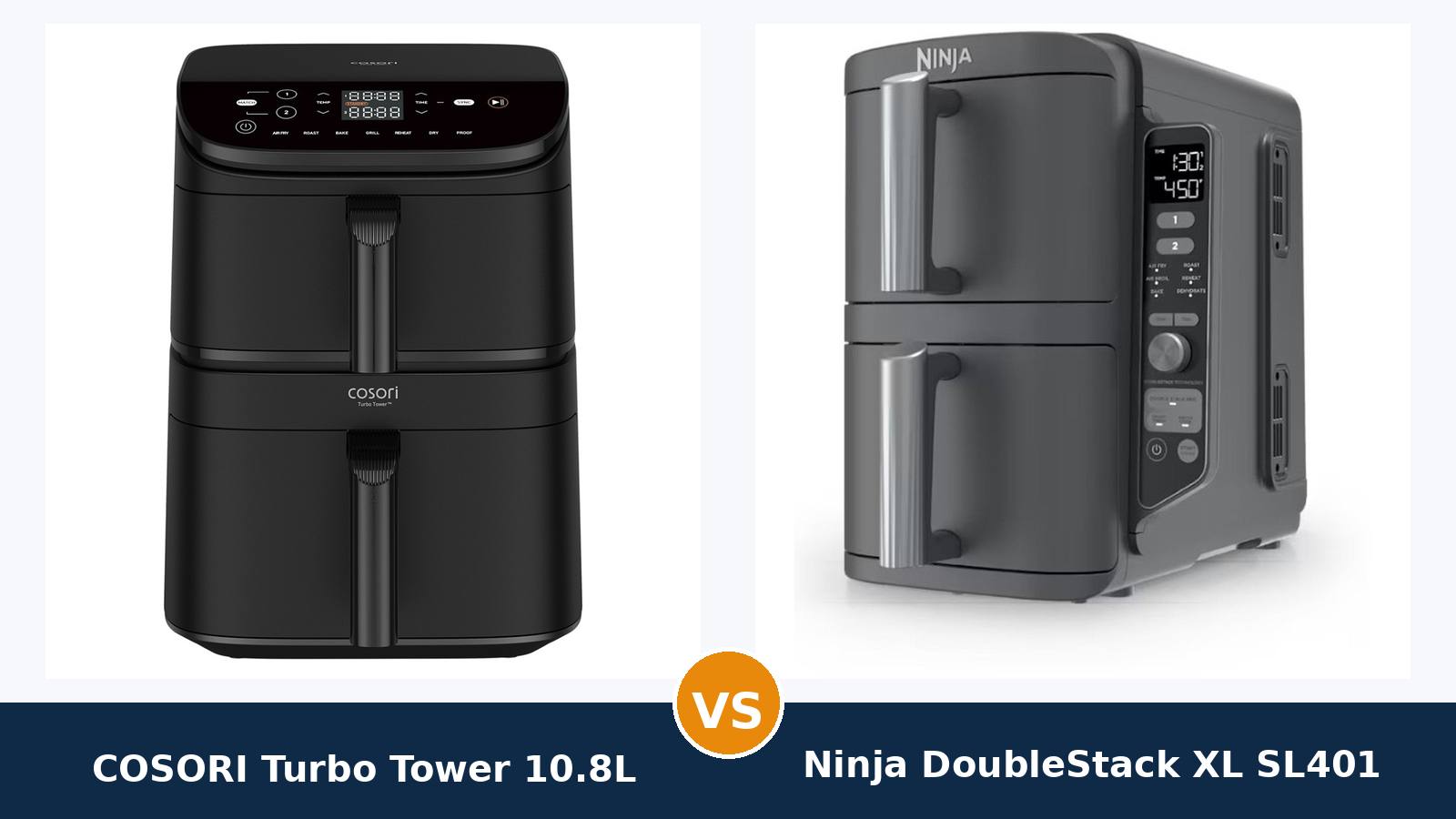
Two towers. Two stacked baskets each. The same promise: family-size capacity without the wide footprint of a side-by-side dual basket fryer.
The COSORI Turbo Tower and the Ninja DoubleStack XL look like the same idea executed twice. On paper they are close — within a litre of each other, with matching sync tricks and stacked layouts.
Then the details split them. COSORI splits its capacity unevenly, heats with two DC motors and reaches lower temperatures. Ninja splits its baskets evenly, racks both for four layers, and broils at a fixed 450°F.
And one difference towers over the rest, so we will state it now rather than bury it: the Turbo Tower is a UK/European model. It runs on 220–240V, and COSORI does not sell a US version. The DoubleStack XL is a US model, built for 120V. Which of those sentences matters to you decides most of this comparison before the cooking starts.
Two name checks, up front. “Turbo Tower” means the base Turbo Tower 10.8-Litre (model CAF-DC121), not the Pro step-ups. “Ninja Double Stack” means the DoubleStack XL, model SL401 — the 10-quart tower the comparison market pairs against it, not the 8-quart SL201 or thermometer-equipped SL451.
Key Takeaways
- On hardware, the Turbo Tower is the stronger tower. More capacity (10.8 L vs 10 qt), a wider temperature range (90–450°F), easier cleaning, a smaller footprint and a two-year warranty.
- For US readers, the DoubleStack XL wins by default — and on merit. It is the only one of the two sold in the US, it runs on US power, and its four-layer racking is a genuine cooking advantage.
- The capacity split is the real cooking difference. COSORI: one 4.3 L basket over one 6.5 L basket. Ninja: two equal 5-qt baskets. Big single dishes favour COSORI; matched pairs favour Ninja.
- Layer count: Ninja 4, COSORI 3. Both Ninja baskets take a stacked rack. COSORI's roasting rack fits only its deeper bottom basket.
- Wattage does not compare across these two. 2,630W at 230V and 1,690W at 120V each mean “as much as the local circuit allows.” Neither number makes one tower faster.
Quick Verdict
Buy the Ninja DoubleStack XL (SL401) if you are in the US — which is most readers of this page. It is sold there, supported there, and plugs into a US outlet.
It is also a genuinely good tower: two equal 5-qt baskets, racks in both for four layers, a dedicated Air Broil mode, and dishwasher-safe baskets and plates.
Buy the COSORI Turbo Tower if you are in the UK or Europe. Judged purely as an appliance, it is the better tower.
It holds more, its 6.5 L bottom basket swallows dishes the Ninja's 5-qt baskets cannot, it proofs dough at 90°F, it weighs less, it takes up less counter, and its warranty runs twice as long. If COSORI sold a 120V version in the US, this verdict would be a much harder call.
The Scorecard
Scores below are derived directly from the manufacturer specifications compared in this guide — capacities, function lists, temperature ranges, dishwasher rulings and warranty terms. They are a reading aid, not benchmark results. One row is scored for this site's US readers and labelled as such; the text under the table shows the hardware-only picture.
| Category | COSORI Turbo Tower | Ninja DoubleStack XL | ||
|---|---|---|---|---|
| Capacity | 9 / 10 | 8 / 10 | ||
| Cooking design & layers | 8 / 10 | 9 / 10 | ||
| Temperature & function control | 9 / 10 | 8 / 10 | ||
| Ease of use | 8 / 10 | 8 / 10 | ||
| Cleaning | 8 / 10 | 7 / 10 | ||
| Footprint & counter fit | 8 / 10 | 7 / 10 | ||
| Value for a US buyer | 3 / 10 | 9 / 10 | ||
| Overall | 7.6 / 10 | 8.0 / 10 | ||
Read the table honestly and it tells two stories. On the six hardware rows, the Turbo Tower averages the higher score — it wins capacity, temperature control, cleaning and footprint, and loses only the layering row. The seventh row is not hardware. It is geography.
For a UK or European reader, swap that last row around and the Turbo Tower takes this comparison. For a US reader, a 220–240V appliance with no US model or warranty route is no value pick at any specification. The DoubleStack XL wins this page's verdict on that basis — the better racking system is a genuine cooking bonus on top.
At a Glance: Who Each Tower Fits
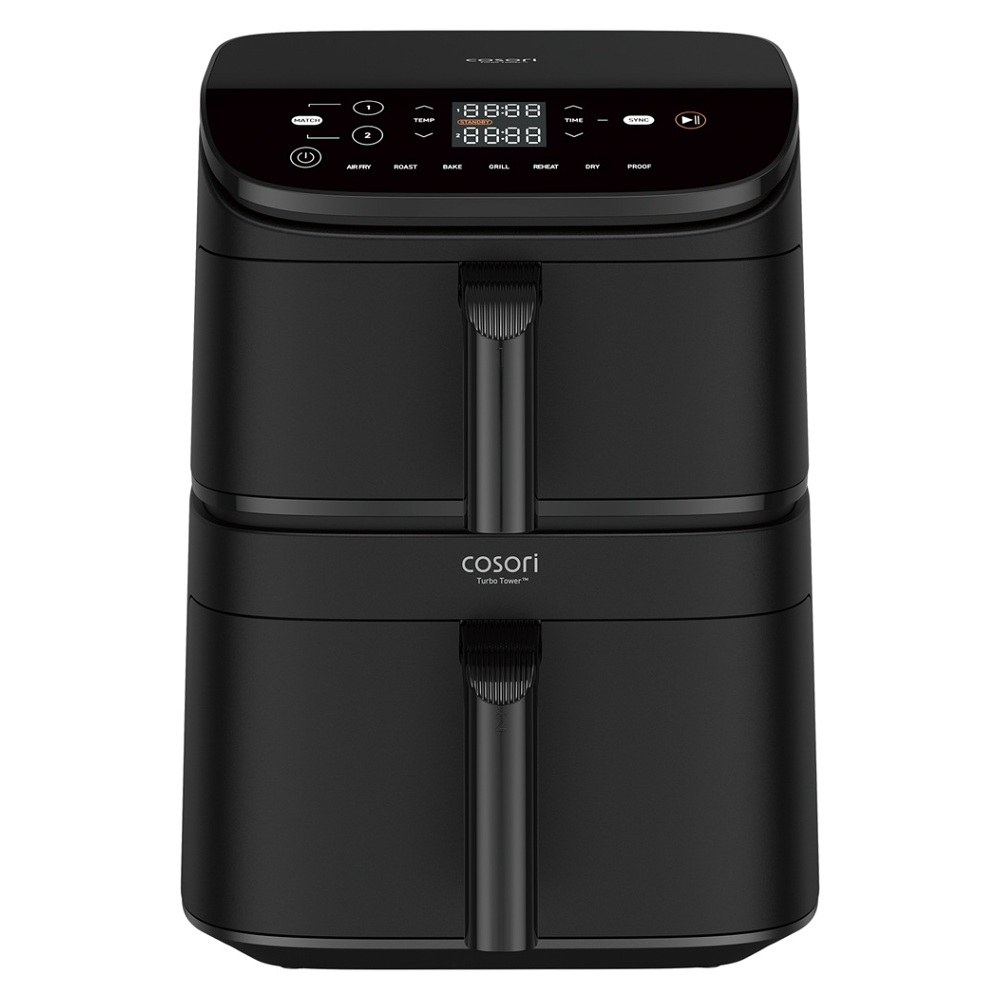
COSORI Turbo Tower 10.8L
- 10.8 L total: 4.3 L top basket + 6.5 L bottom basket
- Seven functions, including Grill and dough Proof at 90°F
- Dual DC motors with four fan speeds
- Baskets, crisper plates and rack all dishwasher-safe
- Two-year warranty — but UK/EU model, 220–240V only
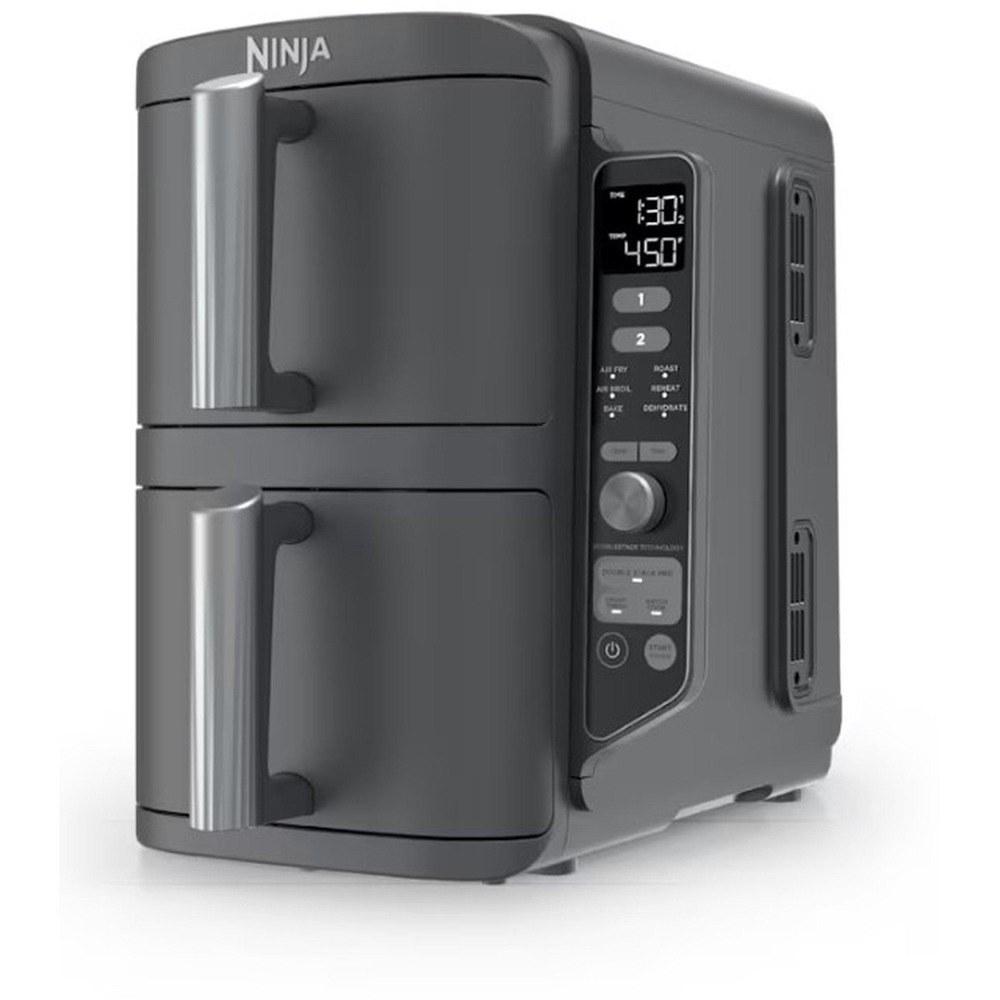
Ninja DoubleStack XL (SL401)
- 10 qt total: two equal 5-qt stacked baskets
- Six functions, including a dedicated Air Broil at 450°F
- Stacked racks in both baskets — up to four cooking layers
- Baskets and crisper plates dishwasher-safe
- US model: 120V, one-year warranty, sold and supported in the US
Choose the COSORI Turbo Tower if…
You live in the UK or Europe, on 220–240V power. That condition comes first, and there is no way around it.
You cook one big dish plus a side, more often than two matched dishes. A whole chicken, a tray of vegetables, a family batch of fries — the 6.5 L bottom basket is built for exactly that.
You proof dough, dry fruit, or work at low temperatures. The Turbo Tower starts at 90°F and holds it precisely; the Ninja starts at 105°F and reserves its long, low runs for Dehydrate.
Choose the Ninja DoubleStack XL if…
You are buying in the United States. This is, full stop, the tower of the two that exists in your market.
You cook in layers, and you broil. Wings over fries, salmon over asparagus, four levels at once — racks in both baskets is the DoubleStack's signature trick, the Turbo Tower cannot match it, and Air Broil is a dedicated fixed 450°F mode with no equivalent on the other panel.
As an Amazon Associate I earn from qualifying purchases at no extra cost to you.
Specifications: The Specs That Actually Matter
Every figure below is taken from the manufacturers' published specifications and owner's guides: COSORI's Turbo Tower user manual (model CAF-DC121) and SharkNinja's DoubleStack XL owner's guide and product data. Read the power row carefully — these two appliances were built for different electrical systems, and several other rows only make sense once that is understood.
| Specification | COSORI Turbo Tower | Ninja DoubleStack XL (SL401) |
|---|---|---|
| Model | CAF-DC121 (UK/EU) | SL401 (US) |
| Total capacity | 10.8 L (about 11.4 qt) | 10 qt (about 9.5 L) |
| Basket split | 4.3 L top + 6.5 L bottom — one small, one large | 5 qt + 5 qt — two equal baskets |
| Power supply | 220–240V, 50Hz — no US version | 120V, 60Hz — standard US outlet |
| Rated power | 2,630W (at 230V) | 1,690W (at 120V) |
| Temperature range | 90–450°F (30–230°C) | 105–450°F, varies by function |
| Time range | 1 minute – 12 hours | Function-dependent; Dehydrate up to 12 hours |
| Cooking functions | 7: Air Fry, Roast, Grill, Bake, Reheat, Dry, Proof | 6: Air Fry, Air Broil, Bake, Roast, Reheat, Dehydrate |
| Two-zone sync | Sync (finish together) + Match (mirror settings) | Smart Finish + Match Cook |
| Cooking layers | 3 — roasting rack in the bottom basket only | 4 — stacked racks in both baskets |
| Heating & airflow | Dual DC motors, 4 fan speeds, an element over each basket, perforated baskets | Rear-mounted fans, two-position crisper plates |
| Baskets & coating | Aluminium baskets, non-stick coating | Non-stick baskets, ceramic-coated crisper plates |
| Dishwasher-safe parts | Baskets, crisper plates and roasting rack | Baskets and crisper plates (racks hand-wash) |
| Dimensions | 16.3 × 11.8 × 15.9 in (D × W × H, incl. handle) | 19.2 × 11.3 × 15.1 in (manufacturer data) |
| Weight | 20.5 lb (9.3 kg) | About 24.3 lb |
| In the box | 2 crisper plates, 1 roasting rack, quick start guide | 2 crisper plates, 2 stacked meal racks, recipe guide |
| Warranty | 2 years limited | 1 year limited |
Variant note: “Turbo Tower” is a family, not a single model. Alongside the base tower (CAF-DC121) sit a smaller Compact (8.6 L), a Pro with Dual Blaze bottom heating and ceramic baskets, and a Pro Smart adding Wi-Fi. None is sold in the US.
Variant note: the DoubleStack family is just as layered. The SL451 is this same tower plus an integrated Smart Cook thermometer. The SL201 is the smaller, original 8-qt DoubleStack. International XL models are 9.5 L, run on 2,470W at 220–240V, and swap Air Broil for Max Crisp — do not cross-shop their listings with the US SL401.
Power note: wattage cannot be compared across these two rows. A UK circuit delivers roughly twice the voltage of a US one, so 2,630W there and 1,690W here each mean “near the practical ceiling of a household outlet.” Judge cooking design on heating layout and airflow, not the wattage figure.
The Differences That Actually Matter
1. The market difference — one of these towers is not sold in the US
Start here, because for most readers it ends the comparison. The Turbo Tower is built for 220–240V power and sold in the UK and Europe. COSORI's US range does not include it, in any variant.
That is not a paperwork detail. A 230V appliance cannot run on a 120V US outlet — not slowly, not badly, not at all, short of a heavy-duty transformer no kitchen should host. There is no US listing, warranty or support line behind it either.
The DoubleStack XL is the opposite case: a US model, on US power, with US support behind it.
So this section scores the comparison before any food is cooked. US readers: the Ninja is your tower, and the rest of this article explains what you are getting. UK and European readers: read on — on hardware alone, the COSORI is the machine to beat.
2. The capacity split — one big basket, or two equal ones
The totals are close: 10.8 litres against 10 quarts, roughly 11.4 qt against 10 qt. The split is where they diverge, and it changes what dinner looks like.
COSORI divides unevenly: a 4.3 L top basket over a 6.5 L bottom basket — the biggest single basket on either tower. A whole chicken, a large tray of vegetables, a family batch of potatoes: the jobs that make dual-basket owners reach for the oven fit downstairs.
The top basket is then honestly a side-dish basket: fries, wings, reheats, a portion of vegetables. COSORI's own manual aims it at “smaller portions, starches, and proteins that benefit from extra crisping.”
Ninja divides evenly: 5 qt over 5 qt. Neither basket is big. Both baskets are useful.
For a household cooking a main and a side of similar size — chicken thighs and potatoes, salmon and asparagus — the even split is the better tool. For one large item plus something small, the COSORI split wins. Neither is wrong; they answer different kitchens.
3. Layers — four cooking levels against three
This is the DoubleStack's signature, and it is a real win. Both Ninja baskets accept a stacked rack, and the crisper plates sit in two positions: up to four separate cooking layers in a tower the width of a single basket.
Four layers changes the meal maths. Protein on two levels, vegetables on two more, all in one run, all finishing together under Smart Finish.
COSORI counters with three layers: its roasting rack stands in the deeper bottom basket only. The manual is explicit that the rack does not fit the shallow top basket, and does not pretend otherwise.
Three layers is still a full meal in one run — protein on the rack, vegetables below, a side up top. But it is one layer fewer, and the top basket is the shallowest space on either machine.
If layered, multi-component cooking is why you are buying a tower at all, this is the Ninja's strongest argument — for US readers, stronger than it needs to be; for UK readers, the one place the Turbo Tower genuinely trails.
4. Heat and airflow — DC motors and fan speeds against rear fans
Both towers attack the same problem — stacked baskets cook unevenly if the air gives up halfway down — with different hardware.
COSORI fits two DC motors, one per zone, four adjustable fan speeds, an element over each basket, and baskets perforated to pass air through the food layer, not just over it. Fan speed is a real tool: drop it for baking, raise it for crisping.
Ninja mounts its fans at the rear of each basket and blows forward through the chamber. Its two-position crisper plates raise food into the airstream for crisping or lower it for gentler cooking — a mechanical answer to the question COSORI answers with fan speeds.
What about wattage? Ignore the headline gap: 2,630W at 230V and 1,690W at 120V are both near the ceiling of their local outlets. Neither tower is “more powerful” in any way a cook can taste; the honest contest is airflow design, and there both machines are credible, differently.
One COSORI feature is absent here by design: Dual Blaze bottom heating belongs to the Pro models, not this base tower. On the CAF-DC121, both baskets heat from above, like the Ninja.
5. Temperature and functions — the low end against the hot end
Both towers top out at 450°F. They part company at the bottom of the dial and in two signature functions.
The Turbo Tower runs from 90°F to 450°F, and its Proof function is the reason why. Dough rising, yoghurt culturing, gentle drying — the COSORI treats low-temperature work as a first-class job, with a 12-hour timer to match. Its Dry function covers dehydrating; Grill covers the searing work.
The DoubleStack XL runs 105–450°F, function by function. Its signature sits at the other end: Air Broil, a fixed 450°F blast that behaves more like a grill element than an air fry mode. Its Dehydrate handles long, low work up to 12 hours — but it will not proof dough at 90°F, because it does not go there.
The lists otherwise mirror each other: both air fry, roast, bake, reheat and dehydrate, and both sync zones to finish together or mirror settings across both. Call the sync systems a tie, and the lists a trade: Proof and a true 90°F floor against a proper broil mode. Bakers lean COSORI; browners lean Ninja.
6. Cleaning — everything in the dishwasher, or almost everything
COSORI's manual clears the baskets and crisper plates for the dishwasher, and its setup instructions wash the roasting rack the same way. Every part that touches food can go in the machine. That is the cleanest possible answer, and the Turbo Tower gives it.
SharkNinja clears the DoubleStack's baskets and crisper plates for the dishwasher — and stops there. The owner's guide names those as the only dishwasher-safe parts, which puts both stacked meal racks in the sink, by hand, after every layered cook.
Coatings differ slightly too: aluminium non-stick baskets on the COSORI; non-stick baskets with ceramic-coated crisper plates on the Ninja. Both interiors wipe clean rather than wash.
7. Size, weight and counter fit — smaller footprint, taller tower
Both machines are towers, so both trade counter area for height. The exchange rates differ.
The Turbo Tower's footprint — 16.3 × 11.8 inches, roughly 192 square inches — undercuts the DoubleStack XL's roughly 216 (19.2 × 11.3 in per manufacturer data). The COSORI takes about a tenth less counter, mostly by being shallower front-to-back.
It pays for that in height: 15.9 inches against the Ninja's 15.1. Both fit under standard wall cabinets, and both manuals demand clearance behind for the exhaust — 5 inches in COSORI's book.
Weight separates them more clearly. At 20.5 lb the Turbo Tower is a liftable appliance; at roughly 24.3 lb the DoubleStack XL is a park-it-and-leave-it one. If your tower lives in a cupboard between uses, that four-pound gap argues for the COSORI every day.
Household & Use-Case Fit Guide
Start from your kitchen and your cooking, not the spec sheets. This table is the comparison in one view.
| Your household / use case | COSORI Turbo Tower | Ninja DoubleStack XL | Our call |
|---|---|---|---|
| US household, standard 120V outlets | Not sold in the US; cannot run on US power | Excellent — built for exactly this | Ninja DoubleStack XL |
| UK / European household | Excellent — sold and supported locally | Only via the separate 9.5 L international models | COSORI Turbo Tower |
| Family of 3–4, main + side weeknights | Excellent — big bottom basket, small top | Excellent — two equal baskets | Either; pick by basket split |
| Whole chicken + trimmings in one run | Excellent — 6.5 L bottom basket | Tight — split across two 5-qt baskets | COSORI Turbo Tower |
| Layer cookers — 3–4 dishes at once | Good — 3 layers, rack downstairs only | Excellent — 4 layers, racks in both baskets | Ninja DoubleStack XL |
| Bread bakers & dough proofers | Excellent — Proof function, 90°F floor | Poor — 105°F minimum, no Proof | COSORI Turbo Tower |
| Jerky, dried fruit & long slow runs | Excellent — Dry, 12-hour timer | Excellent — Dehydrate, up to 12 hours | Tie |
| Small counter, high cabinets | Excellent — smaller footprint, taller body | Good — larger footprint, slightly shorter | COSORI Turbo Tower |
Ready to check today’s price?
Check the live figure on the tower that fits your kitchen — and your continent.
View on Amazon — COSORI Turbo TowerView on Amazon — Ninja DoubleStack XLThe 30-Second Decision
| If this sounds like you… | Buy this |
|---|---|
| “I am buying in the United States.” | Ninja DoubleStack XL — it is the only one sold there |
| “I am buying in the UK or Europe.” | COSORI Turbo Tower — the stronger tower, locally sold |
| “One big dish plus a side is my typical cook.” | COSORI Turbo Tower (6.5 L bottom basket) |
| “I cook in layers — four dishes at once.” | Ninja DoubleStack XL (racks in both baskets) |
| “I proof dough and dry food at low temperatures.” | COSORI Turbo Tower (Proof, 90°F floor) |
| “Everything I use must go in the dishwasher.” | COSORI Turbo Tower (rack included) |
| “I want a thermometer-guided tower.” | Neither base model — see the SL451 in the buying guide |
What You Gain. What You Give Up.
COSORI Turbo Tower
You gain: the bigger tower — 10.8 L with a genuinely large 6.5 L bottom basket. A 90–450°F range with Proof and four fan speeds. Every food-contact part in the dishwasher, rack included. The smaller footprint, the lighter body, a two-year warranty.
You give up: the entire US market — no 120V version, no US listing, no US support route. Plus the fourth cooking layer, the even basket split, and a dedicated broil mode.
Ninja DoubleStack XL (SL401)
You gain: a tower you can actually buy in the US, on US power, with US support. Four cooking layers from racks in both baskets. Two equal baskets for matched main-and-side cooking. A fixed 450°F Air Broil, and the wider US parts ecosystem.
You give up: about a litre of capacity and any basket over 5 qt. The low end of the dial — no Proof, nothing below 105°F. Dishwasher clearance for the racks. A year of warranty, and roughly 24 square inches of counter.
Pros and Cons
Turbo Tower — Pros
- Largest capacity: 10.8 L, with a 6.5 L main basket
- 90–450°F range; Proof and Dry functions
- Dual DC motors, four fan speeds
- All removable parts dishwasher-safe
- Smallest footprint; lightest tower here
- Two-year warranty
Cons
- UK/EU only — 220–240V, no US model or listing
- Three cooking layers, not four
- Uneven basket split limits matched pairs
- No dedicated broil mode
- Tallest tower here at 15.9 in
DoubleStack XL — Pros
- Sold and supported in the US; standard 120V
- Four cooking layers — racks in both baskets
- Two equal 5-qt baskets
- Dedicated Air Broil at 450°F
- Smart Finish / Match Cook zone sync
- Baskets and crisper plates dishwasher-safe
Cons
- No basket larger than 5 qt
- No Proof; 105°F temperature floor
- Stacked racks are hand-wash only
- One-year warranty
- Heavier, and the larger footprint
Check the Variant and the Voltage, Not Just the Tower
Check the voltage first. This comparison crosses an electrical border, and it is the one check that cannot be undone after checkout. The Turbo Tower is a 220–240V appliance: on North American 120V power it is not a risky purchase or an import adventure — it is simply not an option, and no adapter plug changes that.
Check which Turbo Tower. Four models share the name. The base tower here (CAF-DC121) has seven functions, top heating in both baskets, and no app. The Pro adds Dual Blaze — a second element under the lower basket — and ceramic baskets. The Pro Smart adds Wi-Fi and app control. The Compact is a smaller machine: 8.6 L, two equal baskets. A listing without a suffix is the base model.
Check which DoubleStack. The SL401 here is the plain DoubleStack XL: six functions, no thermometer. The SL451 is the same chassis plus the Smart Cook System — a leave-in thermometer that cooks to a target internal temperature, bottom basket only. Cook thick proteins often and it is the version to price; cook by time and temperature and the SL401 is the identical tower for less. The SL201 is a smaller 8-qt machine; do not let a listing blur them.
Check the box contents. The Ninja's four-layer claim depends on two stacked racks being in the box — they are, on the US SL401. The COSORI's three-layer claim depends on its single roasting rack, also included. On either tower, a missing rack quietly deletes a headline feature.
The Upgrade Path Test
Both towers sit inside families, and the families point in different directions.
Stay with COSORI and the path runs upward in features: the Pro adds bottom heating and ceramic baskets, the Pro Smart adds the app — all inside a deep European accessory range of replacement baskets, plates and racks.
Stay with Ninja and the path runs upward in guidance: the SL451 adds thermometer cooking to this exact tower, and SharkNinja's US parts store keeps DoubleStack baskets, plates and racks on the shelf. In the US that matters in year three, when a worn non-stick basket should be a reorder, not a replacement appliance.
Neither tower strands you. But COSORI's upgrade path is closed to US readers entirely, while Ninja's is open on day one — longevity arguments only count in a market where the parts ship.
When to Skip Both
Towers solve one problem — counter width — and create another: height, and small basket openings. Some kitchens should solve a different problem instead.
Skip both if your cooking is wide rather than tall. Flatbreads, a spatchcocked chicken laid flat, sheet-pan-style food: a side-by-side dual basket or an oven-style fryer fits that food; a tower's narrow baskets fight it.
Skip both if you cook for one or two. A 5–6 qt single-basket fryer heats faster, cleans easier and costs less than either tower, and you will never use the second basket you paid for.
Skip both if your cabinets are low. Both machines stand over 15 inches and vent upward and backward; a kitchen that cannot give them air should not give them counter space.
And skip the Turbo Tower, whatever your kitchen, if you are in North America. Search results will happily sell you the idea — there is no US version, and importing the 240V model is no workaround.
Warranty and Long-Term Support
The warranty terms differ by a factor of two: COSORI backs the Turbo Tower for two years in its markets; SharkNinja backs the DoubleStack XL for one.
Support differs by market more than by brand. Turbo Tower baskets and plates are standard catalogue items in the UK and EU. SharkNinja's US bench is deeper on home turf: US parts sales, a large installed base, and retail availability that makes a warranty swap straightforward.
The honest summary: in Europe, the COSORI is the better-supported, longer-warranted machine. In the US, only one of these companies can support its tower at all — and it is not the one with the two-year warranty.
Final Verdict
For US readers, the Ninja DoubleStack XL (SL401) is the tower to buy — and it earns the win, not just inherits it.
Yes, availability decides the headline: the Turbo Tower is not sold in the US and cannot run on US power. But strip that away and the SL401 still holds real cards — four cooking layers, two equal baskets, a proper broil mode, and a parts ecosystem that keeps it alive for years.
Buy the DoubleStack XL if you are in the US, cook in layers, or cook matched main-and-side pairs.
View on Amazon — Ninja DoubleStack XL
Buy the COSORI Turbo Tower if you are in the UK or Europe. There, the verdict flips on the hardware: more capacity in a more useful split, the wider temperature range, the easier cleaning, the smaller footprint and the longer warranty.
It is the better-designed tower of the two — designed, simply, for a different continent's kitchens. The honest verdict has to say both halves of that sentence.
View on Amazon — COSORI Turbo Tower
Watch Out: Similar Names, Different Towers
Stacked air fryers have the most confusing naming in the category right now. Four warnings belong in every version of this guide.
First: Turbo Tower, Turbo Tower Pro, Turbo Tower Pro Smart and Turbo Tower Compact are four different models. Pro means bottom heating and ceramic baskets; Pro Smart adds Wi-Fi; Compact is a smaller 8.6 L machine with equal baskets.
Second: the Ninja DoubleStack (SL201, 8 qt) and DoubleStack XL (SL401/SL451, 10 qt) are different sizes of tower, and reviews and listings use “DoubleStack” for both. The model number is the only reliable identity.
Third: the SL451 is not a bigger SL401 — it is the same tower plus a thermometer. A listing that prices it as a capacity upgrade is selling you a probe, not a quart.
Fourth: international DoubleStack XL models (9.5 L, 2,470W) wear the US model's name with different specifications, including Max Crisp in place of Air Broil. A cheap “DoubleStack XL” import is a different appliance from the one compared here.
Frequently Asked Questions
Can I buy the COSORI Turbo Tower in the United States?
No. The line is sold in the UK and Europe and runs on 220–240V. COSORI offers no US version in any variant — base, Pro, Pro Smart or Compact — and a 240V model cannot run on a US 120V outlet. US readers should buy the DoubleStack XL or choose from COSORI's separate US range.
Is the COSORI Turbo Tower better than the Ninja DoubleStack XL?
On specifications, mostly yes: more capacity, lower temperatures, every removable part dishwasher-safe, less counter, and a two-year warranty against one. The Ninja counters with four layers against three and a broil mode. Outside the UK/EU it is academic — the COSORI is not sold in the US.
Which tower cooks more food at once?
It depends on the food. The Turbo Tower holds more in total, and its 6.5 L bottom basket takes the largest single dish. The DoubleStack XL spreads 10 qt across four racked layers, suiting lots of smaller items — wings, tenders, vegetables. Big single dish: COSORI. Many layered items: Ninja.
What is the difference between the DoubleStack XL SL401 and SL451?
One feature: the SL451 adds the Smart Cook System, a leave-in thermometer that ends the cook at a target internal temperature (bottom basket only). Capacity, functions, baskets and racks are otherwise the same tower. Buy the SL451 for thick proteins, the SL401 for time-and-temperature cooking.
Does the Turbo Tower have an app?
Not in base or Pro form — those are panel-controlled only. App control via VeSync Wi-Fi arrives with the Turbo Tower Pro Smart, which also adds Dual Blaze bottom heating. Neither DoubleStack XL model has an app.
Which tower is easier to clean?
The COSORI. Its baskets, crisper plates and roasting rack are all dishwasher-safe per its manual. The DoubleStack XL clears its baskets and crisper plates, but SharkNinja's guide makes the two stacked meal racks hand-wash only — and they are the parts layered cooking uses most.
Will either tower fit under my kitchen cabinets?
Both stand over 15 inches: about 15.9 in for the Turbo Tower, 15.1 in for the DoubleStack XL. Standard counter-to-cabinet clearance is around 18 inches, so both fit — but both need clear space behind for hot exhaust (COSORI specifies 5 inches). Measure with that clearance included, not the machine alone.
Sources & Verification
COSORI Turbo Tower 10.8-Litre user manual, model CAF-DC121-AEUR (official manual: specifications, functions, care, two-year warranty) • COSORI UK retail product data for the Turbo Tower (aluminium baskets, dimensions, four fan speeds) • Ninja DoubleStack XL SL401 US Owner's Guide and Quick Start Guide via SharkNinja (functions, Smart Finish / Match Cook, dishwasher ruling, one-year warranty) • SharkNinja official SL451 product page • Amazon.com manufacturer product data for SL401 (ASIN B0CZS6SS3Y, UPC 622356631211). Turbo Tower US availability checked against COSORI's US range and the model's UK/EU-only distribution. Specifications verified November 2026.

James Wilson
James has been testing and writing about kitchen appliances and PC hardware for over a decade and writes Honestly Compared's small-appliance guides. His rule for every comparison: the verdict has to survive the spec sheet, not the marketing page.