
COSORI TurboBlaze vs Ninja Air Fryer Pro XL (AF181): Which Should You Buy?
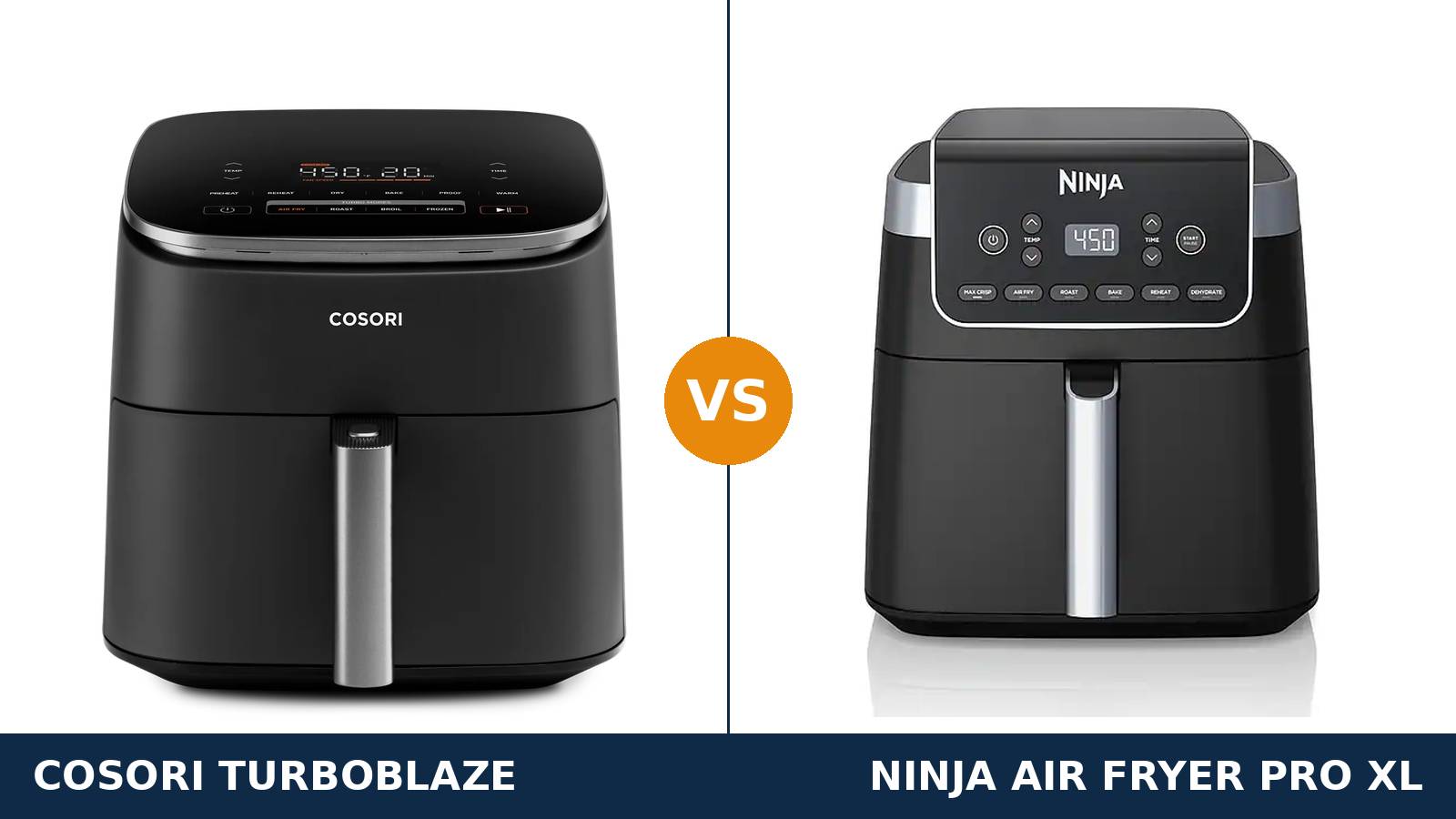
Two flagship single-basket fryers. Both promise 450°F heat. Both land within half a quart of each other. On a listing page, they look interchangeable.
They are not. The COSORI TurboBlaze (model CAF-DC601-KUS) is a control freak’s fryer: a DC-motor fan with five speeds, a 90°F–450°F working range on every function, and a timer that runs for a full day.
The Ninja entry needs one clarification before anything else. “Ninja Pro XL” is the Ninja Air Fryer Pro XL, model AF181 — SharkNinja’s current 6.5-quart, 6-in-1 US model in grey. It is not the older AF161 Max XL, and it is not the 6.2-litre AF180 Max Pro sold overseas. The AF181 is the machine compared here, and every Ninja figure below comes from its official owner’s guide and manufacturer product data.
The Ninja’s pitch is simpler than the COSORI’s: a bigger basket, a dedicated Max Crisp mode for frozen food, and six buttons with nothing to configure. This guide settles which pitch survives the spec sheet.
Key Takeaways
- The TurboBlaze is the more versatile fryer. A 90–450°F range on every function, five fan speeds, nine functions plus Preheat, and a 24-hour timer.
- The Ninja Pro XL is the bigger, simpler fryer. 6.5 quarts against 6.0, a Max Crisp mode built for frozen food, and a two-position crisper plate.
- Read the Ninja’s 450°F claim carefully. Per Ninja’s own owner’s guide, 450°F exists only in Max Crisp. Every other function caps at 400°F.
- Cleaning is close. Both baskets and crisper plates are dishwasher-safe. The TurboBlaze’s PFAS-free ceramic coating is the more modern surface.
- Warranty is not close. COSORI covers the TurboBlaze for two years. Ninja covers the AF181 for one.
Quick Verdict
Buy the COSORI TurboBlaze for most kitchens. It is the more capable machine.
Its full temperature range is available on every function — broil at a genuine 450°F, proof dough at 90°F, dehydrate for up to 24 hours. Five fan speeds turn airflow into a texture control most fryers do not offer.
It does all of that in a shorter, shallower body with a ceramic-coated basket and a two-year warranty behind it.
Buy the Ninja Air Fryer Pro XL (AF181) if your cooking is family-sized and mostly frozen. The 6.5-quart basket swallows up to 9 lb of wings by Ninja’s rating, Max Crisp is a one-button answer to frozen fries and nuggets, and the panel could not be simpler.
It is also the lighter machine by nearly two pounds, and its crisper plate sits in two positions — a small, genuinely useful design touch the COSORI does not match.
The Scorecard
Scores below are derived directly from the manufacturer specifications compared in this guide — capacities, temperature ranges, function lists and feature sets. They are a reading aid, not benchmark results.
| Category | TurboBlaze | Ninja Pro XL | ||
|---|---|---|---|---|
| Capacity | 7 / 10 | 8 / 10 | ||
| Cooking design | 8 / 10 | 7 / 10 | ||
| Temperature & timer range | 10 / 10 | 7 / 10 | ||
| Ease of use | 8 / 10 | 8 / 10 | ||
| Cleaning & coating | 9 / 10 | 8 / 10 | ||
| Footprint | 9 / 10 | 8 / 10 | ||
| Value | 9 / 10 | 8 / 10 | ||
| Overall | 8.6 / 10 | 7.7 / 10 | ||
The pattern is consistent. The Ninja wins the size row and ties on ease of use. The TurboBlaze wins everything about range, control and long-term backing — and range is the thing you cannot add later.
At a Glance: Who Each Fryer Fits
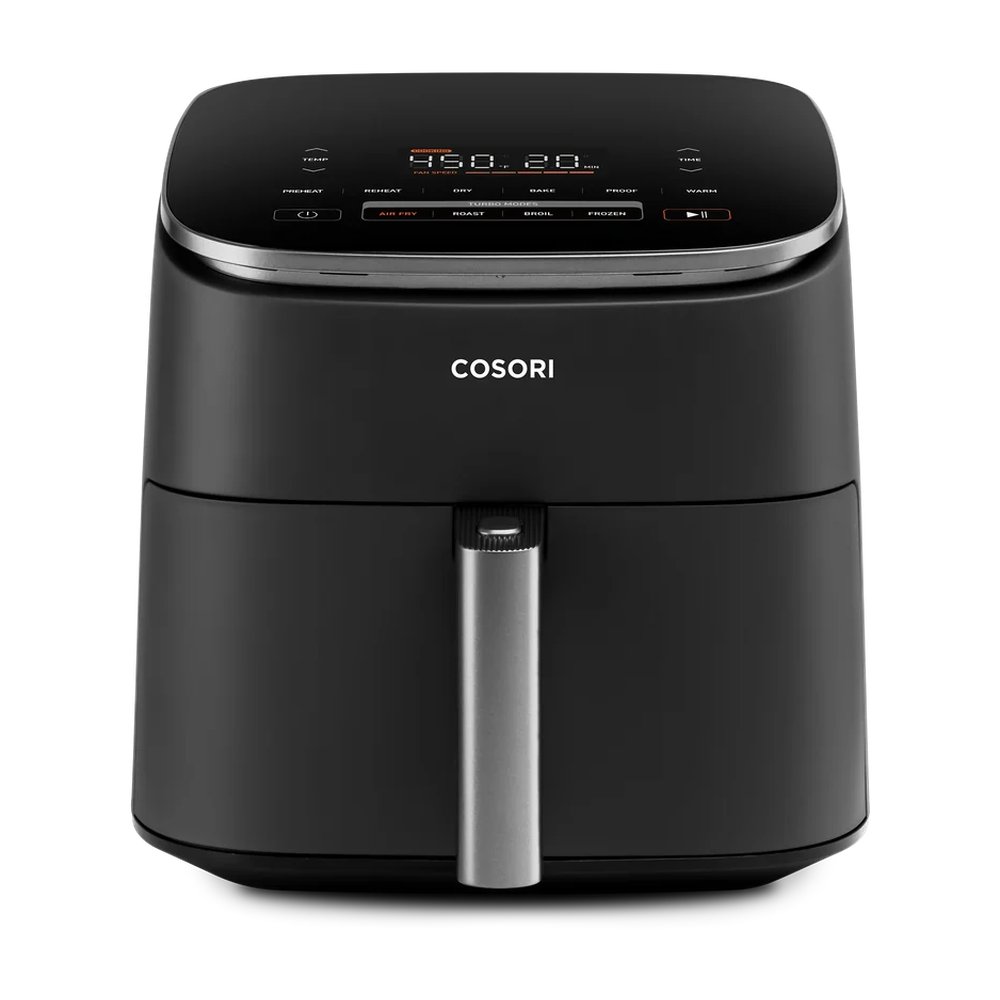
COSORI TurboBlaze 6.0-Quart
- DC motor fan, 5 speeds, up to 3,600 rpm
- 90°F–450°F on every function; 24-hour timer
- 9 functions plus Preheat, including Proof and Broil
- PFAS-free ceramic-coated basket and crisper plate
- Compact body: 11.9 in tall, 2-year warranty
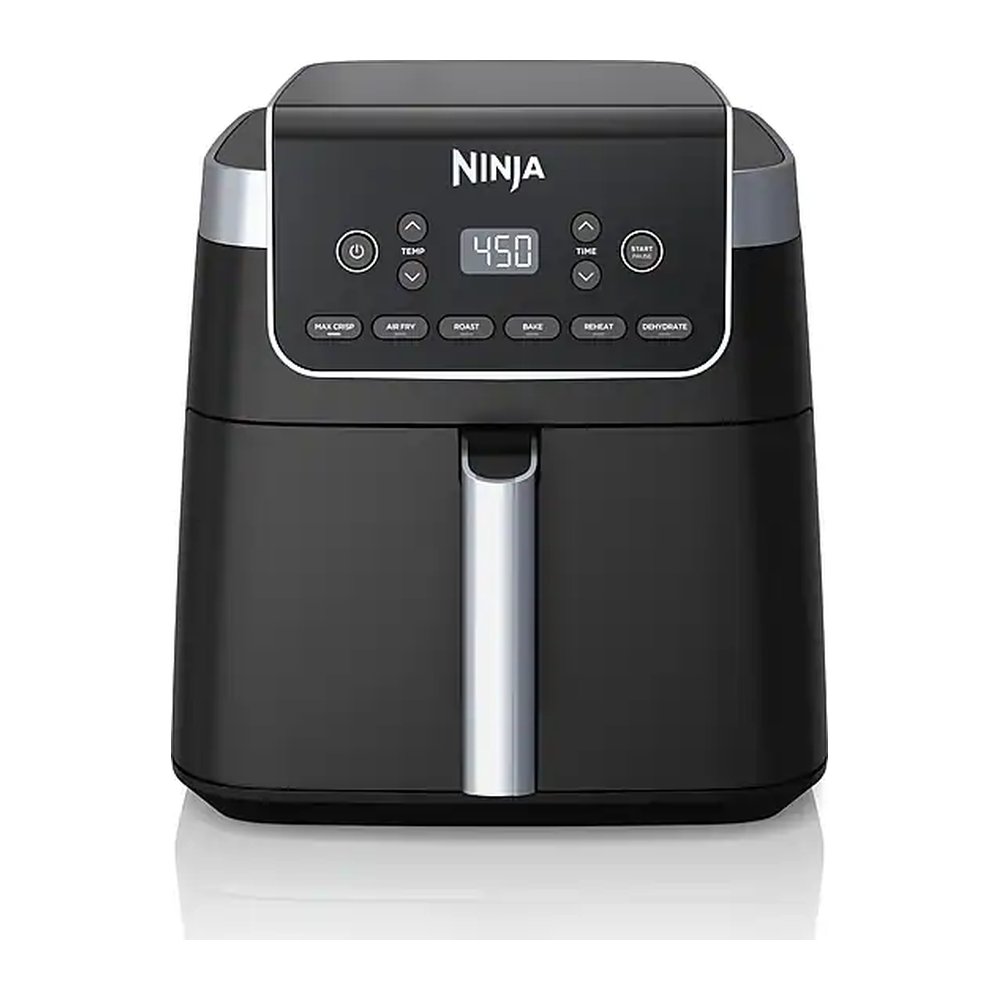
Ninja Air Fryer Pro XL 6.5-Quart
- 6.5 qt basket: fits 5 lb of fries or 9 lb of wings
- Max Crisp mode: fixed 450°F for frozen food
- 6 functions: Max Crisp, Air Fry, Roast, Bake, Reheat, Dehydrate
- Two-position crisper plate, upper and lower
- Lightweight at 11.4 lb; 20-recipe cookbook included
Choose the TurboBlaze if…
You cook varied food and adjust as you go. Fan speed, temperature and time are all yours to command, across the full range, on every function.
You proof dough, dehydrate snacks or broil with real heat. The Ninja cannot proof at all, and its broil-equivalent heat lives in one fixed mode.
Your cabinets sit low or your counter is shallow. The TurboBlaze is the shorter, less deep machine of the two.
Choose the Ninja Pro XL if…
You feed four or more people regularly. The extra half-quart and the deeper load rating are sized for family batches.
Most of your air frying starts from the freezer. Max Crisp is one button, at full 450°F, with nothing to set.
You want the lightest machine on the counter and the simplest panel in the class. Six functions, two arrow pairs, done.
As an Amazon Associate I earn from qualifying purchases at no extra cost to you.
Specifications: The Specs That Actually Matter
Every figure below is taken from the manufacturers’ published specifications and official manuals for these two US models: COSORI’s CAF-DC601-KUS data and SharkNinja’s AF181 owner’s guide and product data.
Regional variants carry different model numbers and electrical ratings. This table covers the North American 120V versions most readers will buy.
| Specification | COSORI TurboBlaze | Ninja Pro XL |
|---|---|---|
| Model number | CAF-DC601-KUS | AF181 |
| Capacity | 6.0 qt / 5.7 L (serves 3–5) | 6.5 qt / 6.2 L (fits 5 lb fries or 9 lb wings) |
| Rated power | 1,725 W | 1,750 W |
| Temperature range | 90–450°F / 30–230°C, on every function | 105–450°F; 450°F in Max Crisp only, 400°F cap on other functions |
| Time range | 1 min – 24 hr | Function-dependent; Dehydrate runs multi-hour cycles (charts to 10 hr) |
| Heating / airflow | DC motor fan, 5 speeds, up to 3,600 rpm; single top element | MaxCrisp Technology; single top element, fixed fan programme |
| Cooking functions | 9 + Preheat: Air Fry, Roast, Bake, Broil, Dehydrate, Frozen, Proof, Reheat, Keep Warm | 6: Max Crisp, Air Fry, Roast, Bake, Reheat, Dehydrate |
| Basket type | Square pull-out basket with crisper plate | Square pull-out basket with two-position crisper plate |
| Basket coating | PFAS-free ceramic nonstick (basket and crisper plate) | Nonstick-coated (basket and crisper plate) |
| Basket cooking space | 9.31 × 9.31 in floor; 3.48 in deep with crisper plate | Not published as floor dimensions |
| Dishwasher-safe parts | Basket and crisper plate | Basket and crisper plate |
| Controls | Angled touch panel on the unit; no app | Front touch panel with function buttons; no app |
| Dimensions (W × D × H) | 11.8 × 14.4 × 11.9 in | 11.3 × 14.9 × 12.0 in |
| Weight | 13.2 lb / 6 kg | 11.4 lb |
| Warranty | 2-year limited | 1-year limited |
Model note: “Pro XL” is a range name Ninja has used loosely. The current US machine is the AF181 listed here. The AF161 Max XL is an older, smaller 5.5-quart 7-in-1; the AF180 Max Pro is a 6.2-litre 220–240V model for other regions; the AF181C is the Canadian version of this same fryer.
There is also a separate Amazon Renewed listing for the AF181. It is a refurbished unit under a different listing — the buttons on this page point to the new AF181. Check which one a listing describes before ordering.
On the COSORI side, a separate TurboBlaze Smart version with app control exists. The TurboBlaze compared here is the original panel-controlled model, CAF-DC601-KUS.
The Differences That Actually Matter
1. Temperature range — the 450°F asterisk
Both boxes advertise 450°F. Only one of these fryers actually gives it to you across the board.
The TurboBlaze runs 90–450°F on every function. Set Broil and you get the full 450°F. Set Air Fry and 450°F is there if a recipe wants it. The range is a property of the machine, not of one mode.
The Ninja reserves its top heat for a single job. SharkNinja’s own owner’s guide states it plainly in the troubleshooting section: the maximum temperature is 450°F for Max Crisp, and 400°F for all other functions. Max Crisp’s temperature cannot be adjusted at all.
So on the Ninja, everyday Air Fry, Roast and Bake all live under a 400°F ceiling — the same ceiling as an ordinary mid-range fryer. The headline number belongs to frozen food only.
The bottom of the range tells the same story in reverse. The TurboBlaze reaches down to 90°F, which is what makes its Proof function possible. The Ninja’s floor is 105°F, and it offers no proofing mode in any case.
Our call: if you cook beyond the frozen aisle, this is the most important section in the comparison, and it is not close.
2. Capacity — the Ninja’s honest win
Give the Ninja its due. At 6.5 quarts against 6.0, it is the bigger basket, and Ninja rates it for up to 5 lb of French fries or 9 lb of chicken wings in one load.
For a family of four to six doing wings, nuggets or a big tray of fries, that extra half-quart is real. Fewer second batches, fewer rounds of reheating the first round.
The TurboBlaze narrows the gap with shape. COSORI publishes the usable basket floor: 9.31 × 9.31 inches with the crisper plate fitted. That is a wide, square single layer for a 6-quart machine, and single-layer cooking is where air fryers do their best work.
Ninja does not publish an equivalent floor figure for the AF181, so the honest comparison is the headline one: the Ninja holds more, the COSORI spreads a modest load unusually well. COSORI rates its machine for three to five people.
If your typical load is a family batch, buy the Ninja’s capacity. If it is a weeknight dinner for two to four, the gap will rarely show.
3. Airflow — five fan speeds against a fixed programme
Both machines heat from a single top element. What each does with the air is where they part company.
The TurboBlaze’s DC motor offers five fan speeds, up to 3,600 rpm. Fan speed is a texture dial: full speed for fries and wings that need hard, dry heat; low speed for dehydrating, proofing and gentle baking that a fixed blast would dry out or blow around.
The Ninja’s answer is MaxCrisp Technology — superheated air up to 450°F, run as a fixed programme. There is no fan control to adjust. The machine decides, and its decision is aimed squarely at frozen food.
For frozen fries and nuggets, the Ninja’s approach is hard to fault: one button, maximum heat, no settings to get wrong. For everything else, the TurboBlaze’s control is the more flexible tool.
Neither approach is a gimmick. They are, again, answers to different questions — but only one of them lets you change the answer.
4. Functions — nine plus Preheat against six
Count the panels. The TurboBlaze offers nine functions — Air Fry, Roast, Bake, Broil, Dehydrate, Frozen, Proof, Reheat and Keep Warm — plus a dedicated Preheat button. The Ninja offers six: Max Crisp, Air Fry, Roast, Bake, Reheat and Dehydrate.
Some of the COSORI’s extras are conveniences. Keep Warm and a proper Preheat button are small things you will use weekly. Frozen is a preset where the Ninja’s Max Crisp does the same job under a different name.
Two of the extras are capabilities, not conveniences. Broil, at a true and adjustable 450°F, has no equivalent on the Ninja outside the fixed Max Crisp mode. Proof exists because the heating range reaches 90°F; the Ninja cannot offer it at any setting.
On connectivity, this section is an honest tie: neither machine has an app, Wi-Fi or voice control. Both are operated entirely at the panel. If you want app control from COSORI, that is the separate TurboBlaze Smart model, not this one.
The timer belongs in this section too. The TurboBlaze counts up to 24 hours, which is what makes long dehydrating and slow proofing practical. The Ninja’s Dehydrate runs multi-hour cycles — its own charts run to ten hours for bananas — but its standard functions are minute-class cooking, and there is no 24-hour timer.
5. Coating and cleaning — the quiet TurboBlaze win
On cleanup mechanics, this is a tie. Both baskets and both crisper plates are dishwasher-safe, per each manufacturer’s manual.
The surfaces differ. The TurboBlaze’s basket and crisper plate carry a PFAS-free ceramic nonstick coating — the newer coating technology, and the one to choose if you are deliberately moving away from conventional nonstick.
The Ninja uses the established formula: a nonstick-coated basket and crisper plate. It works and releases food well. Note one line from SharkNinja’s cleaning table, though: the basket is dishwasher-safe, but Ninja recommends hand-washing it to extend its life.
One design point goes the other way. The Ninja’s crisper plate installs in two positions — upper, with the cut-outs front and back, or lower, with them at the sides. Raising food closer to the element for a harder finish, or dropping it for taller items, is a real bit of cooking design the COSORI’s fixed plate does not offer.
Net: the TurboBlaze takes the coating argument, the Ninja takes a small design point, and both will come out of the dishwasher equally clean.
6. Size, weight and where each one lives
These are both countertop residents, but they ask for slightly different counters.
The TurboBlaze measures 11.8 inches wide, 14.4 deep and 11.9 tall. The Ninja measures 11.3 wide, 14.9 deep and 12.0 tall, per the manufacturer product data supplied with its listing.
Read that as a trade. The COSORI is the shorter and shallower machine — the easier fit under low wall cabinets and on shallow counters. The Ninja is half an inch narrower but needs more depth front to back.
Weight flips the result. At 11.4 lb, the Ninja is nearly two pounds lighter than the 13.2 lb TurboBlaze. If the fryer lives in a cupboard and comes out for weekends, the Ninja is the easier lift, every time.
Both need the same clearance discipline: space behind and above for the air outlet, and room to pull the basket toward you. Measure for the depth first — on both machines, the handle is part of the working footprint.
7. Controls — two philosophies, both honest
The TurboBlaze puts an angled touch panel on top of the unit, read from above as you stand at the counter. Everything is there: functions, fan speed, temperature, time, Preheat.
The Ninja puts its panel on the front face: six function buttons in a row, TEMP and TIME arrow pairs, a large readout. It is the simpler interface, and for a household that rotates through frozen food and reheats, simpler is a feature.
Preheating shows the difference in miniature. The TurboBlaze has a Preheat button. The Ninja’s guide recommends a three-minute preheat run you set up manually with the timer.
Neither panel will confuse anyone for long. The question is whether you want the extra controls the COSORI offers — because on the Ninja, they simply are not there to want.
Which Fryer Fits Your Household?
The fastest way to choose between these two is to start from who is eating and how you cook. This table is the whole comparison in one view.
| Your household / cooking style | TurboBlaze | Ninja Pro XL | Our call |
|---|---|---|---|
| Couples and small households (1–3 people) | Excellent — right-sized, most versatile | Good — more basket than you need | TurboBlaze |
| Families of 4–6, batch cooking | Workable — cook in two rounds | Excellent — 6.5 qt, 9 lb wing rating | Ninja Pro XL |
| Frozen food most nights (fries, nuggets, wings) | Excellent — Frozen mode, full range | Excellent — Max Crisp at fixed 450°F | Ninja Pro XL, by a nose |
| Home bakers: proofing, dehydrating, jerky | Excellent — 90°F floor, Proof mode, 24-hour timer | Fair — dehydrates, but no Proof and a 105°F floor | TurboBlaze, outright |
| “I am avoiding conventional nonstick coatings” | Excellent — PFAS-free ceramic | Conventional nonstick coating | TurboBlaze |
| Small kitchens, low wall cabinets | Excellent — 11.9 in tall, 14.4 in deep | Tight — 12.0 in tall, 14.9 in deep | TurboBlaze |
| Stored in a cupboard between uses | Fair — 13.2 lb to lift | Excellent — 11.4 lb | Ninja Pro XL |
Read the proofing row carefully. It is not a matter of degree: the Ninja’s temperature floor and function list rule the job out, where the TurboBlaze was built with it in mind.
The 30-Second Decision
| If this sounds like you… | Buy this |
|---|---|
| “I want one fryer that fries, broils, bakes, dehydrates and proofs.” | TurboBlaze |
| “Frozen fries and wings are the main event in my house.” | Ninja Pro XL |
| “I cook for five or six people at once.” | Ninja Pro XL |
| “I want to control fan speed and temperature, not just pick a mode.” | TurboBlaze |
| “My cabinets are low and my counter is shallow.” | TurboBlaze |
| “I want the lightest fryer and the simplest panel.” | Ninja Pro XL |
Ready to check today’s price?
Both fryers sell through Amazon. Prices move, so check the live figure on the one that fits your kitchen.
View on Amazon — TurboBlazeView on Amazon — Ninja Pro XLWhat You Gain. What You Give Up.
COSORI TurboBlaze
You gain: the widest usable range in this pairing — 90°F proofing to a genuine, adjustable 450°F broil, with a 24-hour timer behind it. Five fan speeds that genuinely change texture. Proof, Broil and Keep Warm functions. A PFAS-free ceramic basket. And a two-year warranty.
You give up: the extra half-quart and the Ninja’s 9 lb wing rating. The one-button Max Crisp shortcut for frozen food. The two-position crisper plate. And nearly two pounds of lightness — this is the heavier machine to move.
Ninja Air Fryer Pro XL
You gain: the bigger basket for family cooking, rated for 5 lb of fries or 9 lb of wings. Max Crisp: frozen food at a fixed 450°F with nothing to set. A two-position crisper plate, a 20-recipe cookbook in the box, and the lightest body of the two.
You give up: real range. Outside Max Crisp, every function stops at 400°F; there is no Proof, no Broil, no Keep Warm and no fan control. The ceramic coating. And a year of warranty cover — one year against COSORI’s two.
Pros and Cons
TurboBlaze — Pros
- 90–450°F range on every function, 24-hour timer
- Five fan speeds from a DC motor, up to 3,600 rpm
- Proof and Broil functions the Ninja lacks entirely
- PFAS-free ceramic-coated basket and crisper plate
- Shorter and shallower body; 2-year warranty
Cons
- Smaller basket (6.0 qt) for family batches
- Heavier at 13.2 lb
- No app, Wi-Fi or voice control on this model
- No dedicated frozen-food shortcut mode at fixed heat
Ninja Pro XL — Pros
- Bigger 6.5 qt basket; fits 5 lb fries or 9 lb wings
- Max Crisp: one-button 450°F for frozen food
- Two-position crisper plate (upper and lower)
- Lightest of the two at 11.4 lb; simplest panel
- 20-recipe cookbook and cooking charts included
Cons
- 450°F only in Max Crisp; 400°F cap elsewhere
- No Proof, Broil or Keep Warm functions
- Conventional nonstick coating, not ceramic
- 1-year warranty; deeper body at 14.9 in
Check the Model Number, Not Just the Name
On the Ninja side, the name is the trap. “Pro XL” has been applied loosely, and three different machines can show up under similar wording.
The fryer in this comparison is the AF181: 6.5 quarts, six functions, grey, UPC 622356635660. Its owner’s guide is the AF181 series guide on SharkNinja’s support library.
The AF161 Max XL is a different, older machine — 5.5 quarts and seven functions, despite the similar name. The AF180 Max Pro is a 6.2-litre model built for 220–240V markets; a grey import is a warranty problem with the wrong plug.
Watch the condition, too. Amazon also carries a Renewed (refurbished) AF181 under its own separate listing. The buttons on this page lead to the new unit. If a price looks unusually keen, check whether the listing says Renewed before you celebrate.
On the COSORI side, match CAF-DC601-KUS. A separate TurboBlaze Smart version adds VeSync app control; it is a different listing, and it is not the fryer reviewed here.
Check the suffix before ordering either brand. -KUS and the plain US model numbers are the 120V North American versions in this comparison. UK and EU suffixes denote 220–240V machines.
On the 2023 COSORI recall: the widely reported recall covered older COSORI CP- and CS-series models. The TurboBlaze (CAF-DC601) is not on that model list.
Buying any COSORI second-hand, check the model number on the rating label against the official CPSC recall list anyway. It takes two minutes.
Accessories, Parts and the Long View
An air fryer’s second year is decided by its basket coating and its spare parts shelf. Both brands back their machines properly here.
SharkNinja sells replacement baskets, crisper plates and racks for the AF181 through its accessories store, and COSORI sells replacement baskets and crisper plates for the TurboBlaze. Match parts by model number — a 6.0-quart COSORI basket does not fit the Ninja, despite the similar silhouettes.
Coating care decides longevity. Both manuals steer you the same way: non-abrasive sponges, no metal scouring pads, and dishwasher use permitted — with Ninja adding that hand-washing its basket will extend its life.
The Ninja’s optional mid-level dehydrating rack is worth knowing about if you dehydrate often; it layers a second level of food over the crisper plate. The TurboBlaze counters with a timer and temperature floor built for the same job without accessories.
Neither machine depends on an app or a cloud account to cook. For a ten-year appliance, that shared simplicity is worth something: there is no software here to be discontinued out from under either fryer.
When to Skip Both
Honesty cuts both ways. Some kitchens are served better by a different shape of machine.
Skip both if you routinely cook two different foods at two temperatures at once. That is a dual-basket fryer’s job, and no single basket — however clever its fan or its crisp mode — can do it.
Skip both if you want app control and cooking notifications. Neither of these models is connected; look at COSORI’s TurboBlaze Smart or Dual Blaze, or a smart rival, instead.
Skip both if you want to watch food cook without opening anything. Oven-door and window designs exist for that; neither of these has one.
And skip both if you cook for one or two people in small portions. A good 4-quart fryer heats faster, cleans easier and takes less counter than either of these family-sized baskets.
For everyone else — households of three to six who want one serious basket fryer — one of these two is the right answer. The only question is whether you will use the Ninja’s extra space or the COSORI’s extra range more.
Warranty and Support
This section is not a tie, and it matters more with every year you keep the machine.
The TurboBlaze is covered by COSORI’s 2-year limited warranty, administered by Arovast Corporation, with US-based customer support by email and phone on weekday hours.
The AF181 is covered by SharkNinja’s One (1) Year Limited Warranty, on purchases from authorised retailers, for the original owner. SharkNinja’s support runs through its website and a US customer service line, and the guide asks you to register the product and keep your receipt.
Both manuals give the same practical advice: register the product, keep your invoice or order ID, and contact support before disposing of a faulty unit. Warranty cover on both sides applies to products bought from authorised sellers — one more reason to check the seller on the listing, not just the price.
Final Verdict
The COSORI TurboBlaze is the fryer we would buy for most kitchens.
It wins this comparison on range, and range is destiny in an air fryer. A machine that works from 90°F to 450°F on every function, with five fan speeds and a 24-hour timer, simply cooks more kinds of food than one whose top heat is locked inside a single frozen-food mode.
Add the ceramic-coated basket, the shorter and shallower body, and a warranty twice as long, and the TurboBlaze is the more complete appliance — despite being the smaller of the two.
Buy the TurboBlaze for households of one to five, for bakers, proofers and dehydrators, for low cabinets, and for anyone who would rather control the cook than delegate it.
Buy the Ninja Air Fryer Pro XL if your cooking is family-sized and freezer-led. The 6.5-quart basket, the one-button Max Crisp mode and the lightest body in this pairing make it the better batch machine.
Just buy it knowing what the 450°F on the box actually means: full heat for frozen food, and a 400°F ceiling for everything else.
Frequently Asked Questions
What is the main difference between the TurboBlaze and the Ninja Pro XL?
Control versus capacity. The TurboBlaze offers a 90–450°F range on every function, five fan speeds, nine functions and a 24-hour timer in a 6.0-quart body. The Ninja Pro XL (AF181) offers a bigger 6.5-quart basket and a fixed 450°F Max Crisp mode, with six functions and a 400°F cap outside that mode.
Which air fryer is bigger, the TurboBlaze or the Ninja Pro XL?
The Ninja. It holds 6.5 quarts against the TurboBlaze’s 6.0, and Ninja rates it for up to 5 lb of French fries or 9 lb of chicken wings. The TurboBlaze counters with a wide square basket floor — 9.31 × 9.31 inches of usable space, per COSORI — so modest single-layer loads spread out well in both.
Does the Ninja Pro XL really cook at 450°F?
Yes, but only in one mode. SharkNinja’s owner’s guide states that the maximum temperature is 450°F for Max Crisp, and 400°F for all other functions; Max Crisp’s temperature cannot be adjusted. The TurboBlaze offers up to 450°F on every function, including Broil and Air Fry.
Which model is the “Ninja Pro XL”?
The Ninja Air Fryer Pro XL, model AF181 — SharkNinja’s current US 6.5-quart, 6-in-1 version in grey. It is not the older AF161 Max XL (5.5 qt, 7-in-1), nor the AF180 Max Pro, which is a 6.2-litre model for 220–240V regions. The AF181C is the Canadian version of the same AF181 fryer.
Which is better for frozen food?
The Ninja, by design. Max Crisp runs at a fixed 450°F specifically for prepackaged frozen food such as fries and nuggets, with nothing to set. The TurboBlaze has a Frozen function and full manual control up to the same 450°F, so it is hardly weak here — the Ninja is simply more single-minded about it.
Which is better for dehydrating or proofing dough?
The TurboBlaze, and it is not close. It has dedicated Dehydrate and Proof functions, a 90°F minimum temperature and a timer that runs to 24 hours. The Ninja dehydrates well — its charts run to ten hours — but its 105°F floor comes with no Proof function at all.
Are both baskets dishwasher-safe?
Yes. On both machines the basket and crisper plate are dishwasher-safe, per their manuals. The coatings differ: the TurboBlaze’s is a PFAS-free ceramic nonstick, while the Ninja uses a conventional nonstick coating — and Ninja recommends hand-washing its basket to extend its life.
Which fryer has the better warranty?
The TurboBlaze. COSORI covers it with a 2-year limited warranty. SharkNinja covers the AF181 with a one (1) year limited warranty for the original owner on purchases from authorised retailers. Both brands offer US-based support and sell replacement baskets and crisper plates.
Sources & Verification
COSORI TurboBlaze™ 6.0-Quart Air Fryer official product page, cosori.com • COSORI TurboBlaze user manual, model CAF-DC601-KUS (specifications, cooking chart, care & maintenance, warranty) • Ninja® Air Fryer Pro XL Owner’s Guide, AF181 series, ninjakitchen.com (technical specifications, cooking functions, cleaning table, troubleshooting, One (1) Year Limited Warranty) • SharkNinja manufacturer product data supplied with the AF181 retail listing (model number, UPC 622356635660, dimensions, weight) • Manufacturer product data supplied with retail listings for basket usable dimensions. Specifications verified November 2026.

James Wilson
James has been testing and comparing home appliances for over a decade and writes Honestly Compared's kitchen and home guides. His rule for every comparison: the verdict has to survive the spec sheet, not the marketing page.