
Ninja Crispi vs Ninja Crispi Pro: Which Should You Buy?
The “reddit” at the end of this search tells its own story. Nobody types that word looking for a brochure.
You are looking for the argument — and this pairing produces a good one, because the Crispi (FN101) and the Crispi Pro (AS101) split owners into two camps. One calls the Pro the real appliance and the original a clever gadget. The other says the original is the whole point of the Crispi idea, and the Pro is that idea with its best trick removed.
Both camps are half right. The debate is not good versus bad — it is two answers to one question: how much air fryer do your household and your kitchen genuinely need?
So this guide is organised the way the threads are — around the questions people actually keep asking. Is the Pro an upgrade or just a bigger Crispi? Do the containers swap? What does owning each one feel like after the first month? Every answer is checked against SharkNinja’s own product pages, comparison data and owner’s guides. No posts are quoted and nobody is paraphrased; where forum instinct and the manual disagree, the manual wins.
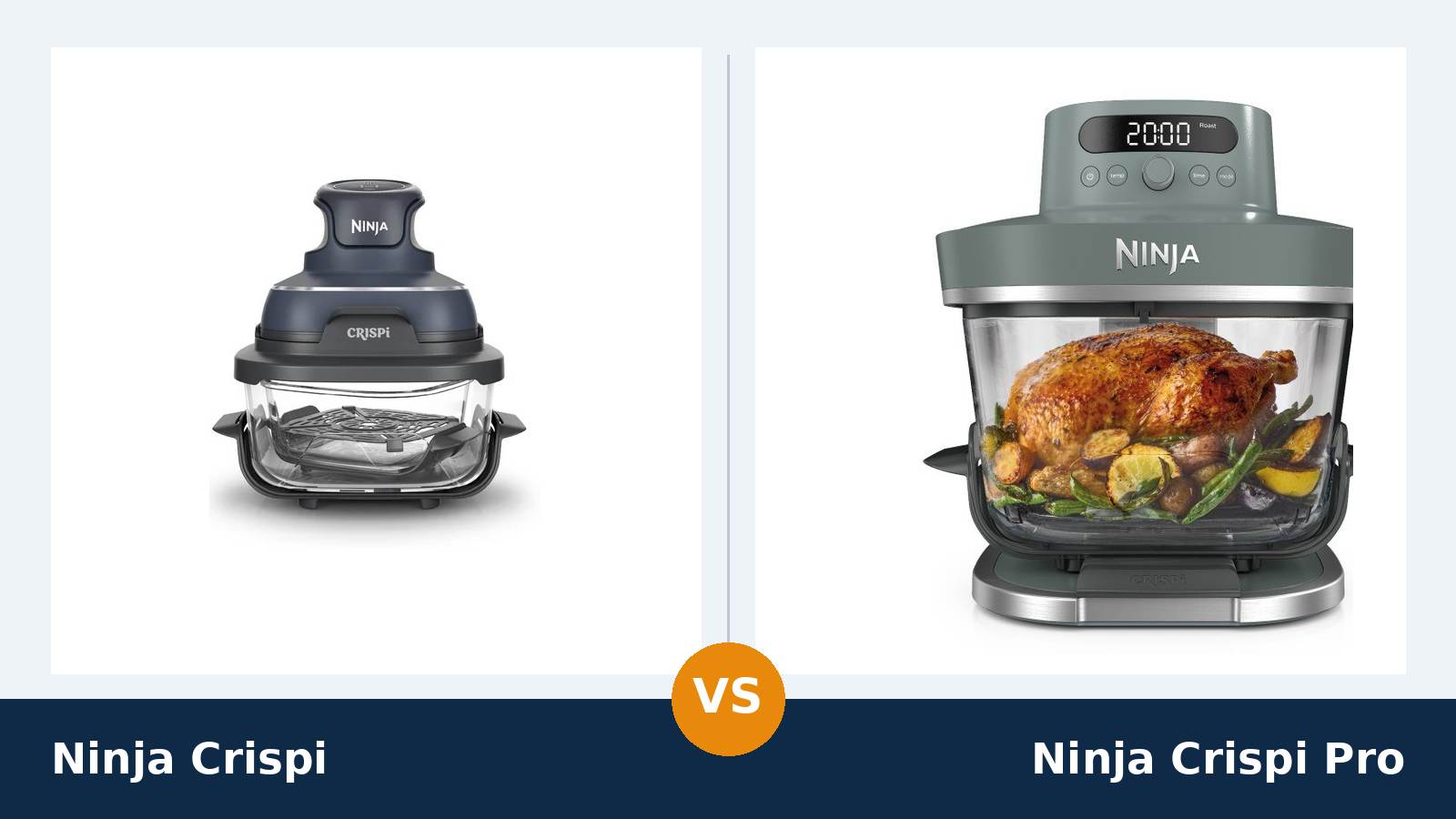
The one-sentence version: the original Crispi is a heating pod that cooks on glass dishes and then vanishes into a cupboard. The Crispi Pro keeps the glass, gives up the vanishing, and spends the savings on capacity and control.
Key Takeaways
- The Pro is not a bigger Crispi — it is a different format. A detachable pod over glass dishes versus a fixed countertop appliance using the same glassware.
- The single biggest functional gap is temperature. The original runs four preset bands and cannot be set to a number; the Pro adjusts inside every function, 105–450°F.
- Your glassware mostly survives an upgrade. The 2.5-qt and 4-qt containers fit both families; the 6-cup is pod-only and the 6-qt is Pro-only.
- Headcount settles most of this. The original tops out at a 4-qt batch built around four servings; the Pro’s 6-qt is rated for a 7.5-lb chicken and up to ten servings.
- Neither machine has Keep Warm. If that function is on your list, you are looking at the third sibling, the 5-in-1 — not at either Crispi here.
Quick Verdict
Buy the Ninja Crispi Pro if this will be the air fryer your household leans on daily. It holds more, heats harder at 1,800 watts, roasts and dehydrates, and lets you set the temperature the recipe actually asks for.
As a family’s main machine, it is the finished version of the glass concept.
Buy the original Ninja Crispi if you cook small and your kitchen is short on permanent counter. Dinner cooks in a glass dish, gets served from it, gets lidded and stored in it — and the fryer itself goes back in the cupboard. You trade batch size and temperature control for a machine that fits around your life instead of rearranging it.
The Scorecard
These scores are read directly off the manufacturer specifications — container sizes, wattages, function lists, temperature ranges and included parts. They map the spec sheet; they are not test-bench results.
One piece of context before the numbers cause an argument: the Pro’s 8.3 is the same score it earns in every comparison we publish. The original’s 7.8 is a touch kinder than its results against ordinary basket fryers, because this scorecard counts portability and storage as headline categories — the ground the FN101 was engineered to win. Where it loses, it loses on the categories that decide what you can cook.
| Category | Ninja Crispi | Ninja Crispi Pro | ||
|---|---|---|---|---|
| Capacity | 6 / 10 | 9 / 10 | ||
| Temperature & function control | 5 / 10 | 9 / 10 | ||
| Cooking design & portability | 10 / 10 | 5 / 10 | ||
| Ease of use | 8 / 10 | 8 / 10 | ||
| Cleaning | 9 / 10 | 8 / 10 | ||
| Storage | 10 / 10 | 7 / 10 | ||
| Value | 9 / 10 | 7 / 10 | ||
| Overall | 7.8 / 10 | 8.3 / 10 | ||
Split the table down the middle and the debate is visible: everything about cooking belongs to the Pro, everything about living with the machine afterwards belongs to the original.
At a Glance: Who Each Crispi Fits
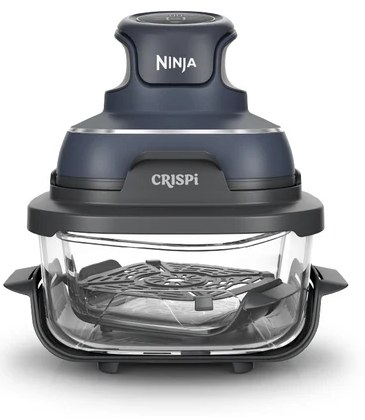
Ninja Crispi (FN101)
- 4-in-1: Max Crisp, Air Fry, Bake, Recrisp at preset temperatures
- 1,500W PowerPod lifts off; dishes nest away for storage
- 6-cup and 4-qt glass containers with lids included
- 4-qt handles a 4-lb chicken with vegetables; up to 4 servings
- One dish cooks, serves, stores and reheats the meal
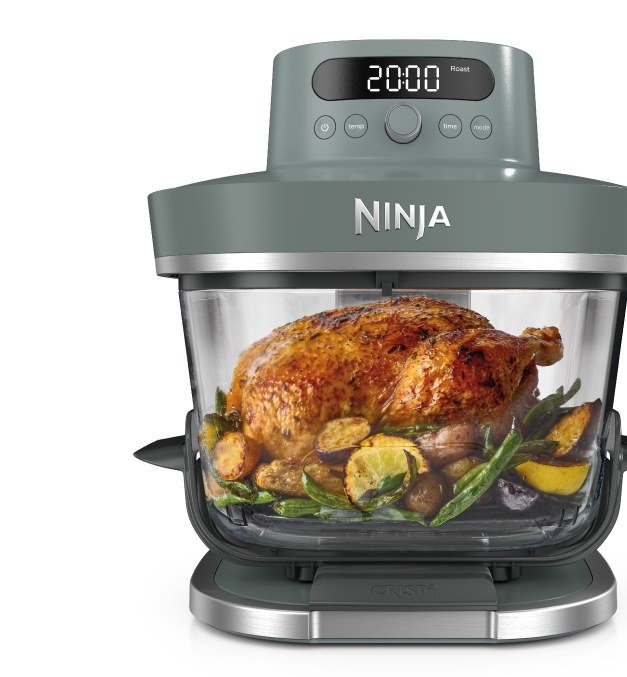
Ninja Crispi Pro (AS101)
- 6-in-1: Max Crisp, Air Fry, Bake/Proof, Roast, Recrisp, Dehydrate
- Temperature adjusts within every function, 105–450°F
- 6-qt and 2.5-qt CleanCrisp glassware; rated up to 10 servings
- 1,800W fixed countertop unit on a modular base
- Base also accepts the 4-qt container, sold separately
Choose the Ninja Crispi if…
Most of your cooking is for one or two people, and a 4-qt batch is dinner rather than round one.
Your counter has no permanent vacancy. The pod and dishes go into a cabinet and the worktop goes back to being a worktop.
You reheat and meal-prep constantly. A lidded dish that handles the cooking, the serving, the fridge and the reheating deletes a pile of washing-up from your week.
Choose the Ninja Crispi Pro if…
Three to ten people eat from this machine, and cooking in two rounds is the chore you are trying to retire.
Your recipes give temperatures, not vibes — and you want dehydrating and dough-proofing in the same appliance.
You can hand over a fixed patch of counter, roughly a foot square, and leave it handed over.
As an Amazon Associate I earn from qualifying purchases at no extra cost to you.
Specifications: The Specs That Actually Matter
Every figure here comes from SharkNinja’s published specifications, product pages and owner’s guides for the US models. Nothing is estimated and nothing is lifted from a review.
Naming note: plain “Ninja Crispi” is the original portable system, model FN101, sold as the 4-in-1 Portable Glass Air Fryer Cooking System. “Crispi Pro” is the countertop model AS101. A third product, the 5-in-1 FN103, sits between them in the catalogue and is untangled in the buying guide below.
| Specification | Ninja Crispi (FN101) | Ninja Crispi Pro (AS101) |
|---|---|---|
| Format | Detachable PowerPod over removable glass containers | Fixed countertop appliance with modular base |
| Capacity | 6-cup + 4-qt containers; biggest batch 4 qt | 2.5-qt + 6-qt containers; biggest batch 6 qt |
| Power | 1,500W, 120V | 1,800W, 120V |
| Functions | 4-in-1: Max Crisp, Air Fry, Bake, Recrisp | 6-in-1: Max Crisp, Air Fry, Bake/Proof, Roast, Recrisp, Dehydrate |
| Temperature control | Fixed preset band per function, spanning 380–450°F; no adjustment | Adjustable inside each function; 105–450°F across the range |
| Container type & material | Borosilicate glass, PFAS- and PTFE-free; aluminium nano-ceramic crisper plates | Borosilicate CleanCrisp glass, PFAS- and PTFE-free; aluminium nano-ceramic crisper plates |
| Biggest single cook | 4-qt dish — a 4-lb chicken with vegetables | 6-qt dish — a 7.5-lb chicken; up to 10 servings |
| Footprint | 11.5″ × 9.76″ × 11.81″ in the 4-qt setup; varies by container | 11.8″ D × 12.2″ W × 11″ H, fixed |
| Weight | 14.55 lbs for the whole system (pod + both containers) | 11.4 lbs for the countertop unit |
| Dishwasher-safe parts | Glass containers, crisper plates and storage lids; the PowerPod, never | Glass containers, crisper plates and storage lids; base and head, never |
| Storage | Pod and containers nest; the fryer lives in a cabinet | Sits out permanently, like any full-size appliance |
| Cord | 36 in, published | Countertop cord; length not published by SharkNinja |
| Warranty | 1-year limited | 1-year limited |
The weight figures do not measure the same thing. The original’s 14.55 lbs is everything you own — pod plus both dishes. The Pro’s 11.4 lbs is the appliance alone. Side by side, they compare a packed suitcase with an empty one.
Variant warning: these are the standard US models. SharkNinja itself flags that retailer editions wander — some US versions of the original run 3-in-1 with no Max Crisp, and the Pro’s function count shifts between four and six depending on the retailer. Overseas versions wander further: a 1,700W UK original, international Pros up to 2,050W.
The Differences That Actually Matter
1. “Is the Pro just the Crispi with a bigger bowl?”
No — and getting this wrong is how buyers end up surprised. The two machines share a cooking vessel concept and very little else about how they occupy a kitchen.
The original is a PowerPod: a heating unit that locks onto glass containers, cooks, then comes away again so the dishes can be stored or served from and the pod can nest into a cupboard. The fryer is, in effect, a lid with ambitions.
The Pro is a countertop appliance in the conventional sense. A fixed base and head, a control panel, a footprint it keeps around the clock. The modular base reshapes itself to the container size, but the machine itself goes nowhere.
Everything else flows from that fork. If your mental picture of the Pro is “the portable, scaled up,” reset it: it is the glass idea rebuilt as furniture.
2. “I already own the Crispi. What would upgrading actually buy me?”
The honest answer is narrower than the marketing suggests: three things, and only three.
First, a temperature control. SharkNinja’s own Crispi-versus-Pro guidance names adjustable temperature as the feature the Pro has and the original lacks. On the FN101 each function arrives with its band fixed — Max Crisp 425–450°F, Air Fry 400–425°F, Bake 375–400°F, Recrisp 380–400°F — and time is the only variable you own. On the Pro you set the number inside every band, and two extra bands open up below: Roast at 350–400°F and Dehydrate at 105–195°F.
Second, the functions those bands belong to. Roast turns a crisping tool into one that cooks a chicken dinner gently and properly. Dehydrate is effectively a second hobby — jerky, fruit, herbs — at temperatures the pod cannot reach. Proof rides along inside Bake.
Third, batch size, covered in the next section. That is the complete upgrade — same glass, same plates, same warranty. If none of those three gaps has ever bitten you at dinner, the upgrade buys a new appliance, not a better dinner.
3. “Will my containers fit the Pro?” — the compatibility question
Mostly, yes — which makes the upgrade path unusually painless. SharkNinja’s compatibility guidance crosses the two families: the 2.5-qt and 4-qt containers work on both the portable FN100-series pods and the Pro’s AS100-series base.
The exceptions sit at the extremes: the little 6-cup belongs to the portable series alone, and the Pro’s headline 6-qt belongs to the Pro alone — the pod was never built to drive it.
One wrinkle deserves bold mental type: the Pro ships with the 6-qt and the 2.5-qt, and the 4-qt — the size most households would use daily — is an extra purchase, despite the base being designed around it. An FN101 owner stepping up already owns that missing dish; a first-time Pro buyer has to budget for it.
4. “Does the 6-quart actually feed a family in one pass?”
The sceptical version of this question is healthy — quarts describe volume, and crisping rewards a shallow layer. Ignore the badge; use SharkNinja’s anchors.
The 6-qt container is rated around a 7.5-lb chicken and up to ten servings. The original’s 4-qt is built around a 4-lb chicken with vegetables and up to four servings. Nearly double the bird is not a rounding trick — it is one run instead of two.
Where the sceptics score their point: the extra room is mostly height, not width, so deep loads still need shaking and turning on both machines.
Settled answer: the Pro genuinely retires the second batch for households of four to ten. It does not repeal the single-layer rule, and no specification says it does.
5. “Which one is less hassle to live with, day to day?”
Split the question in two, because each machine wins a half.
Washing up: on both, everything that meets food — glass containers, crisper plates, lids — is dishwasher-safe, a real advantage over scrubbing a coated basket. On both, the heating hardware stays out of the water entirely: the PowerPod must never be immersed, and the Pro’s head and base are wipe-down only. The original takes the half on points — its dishes are smaller and lighter, while the Pro’s 6-qt vessel is the single biggest wash-up item in the range.
Putting away: no contest. The original’s containers take lids and double as storage, so leftovers move from counter to fridge inside the dish they cooked in, and the pod nests into a cabinet. The Pro’s glassware stores food perfectly well, but the appliance is a permanent tenant, and a 6-qt dish occupies fridge space like it means it.
6. “Is the glass a gimmick — and will it survive my kitchen?”
The glass is the product, on both machines. Each cooks in borosilicate that SharkNinja markets as PFAS- and PTFE-free — the entire reason the line exists for buyers leaving coated baskets behind. It also cooks visibly: browning happens in front of you, with no basket to yank open and heat to dump.
Two honest footnotes, both correctly spotted in the forums. The food rests on a crisper plate, and that plate is aluminium carrying a nano-ceramic coating — on the original and the Pro alike. The vessel is bare glass; the plate is not bare metal. Buyers avoiding every coating should weigh that line carefully.
And glass has rules metal does not: cool before washing, no cold water on a hot dish, respect thermal shock. Follow them and a damaged dish is a replaceable spare part, not a dead appliance. Treat it like a steel basket and borosilicate will eventually object.
7. The ties nobody wants to award
Several rows here are genuinely level, and calling them is part of the answer.
Same glassware material and plate construction. Same 1-year limited warranty. Same dishwasher rule for food-contact parts, same hands-off rule for the heater, same mid-cook shake.
And one shared absence: neither offers Keep Warm. That function lives on the 5-in-1 FN103, and owners who hold food hot while dinner catches up should shop there instead.
Strip the ties away and the decision gets simple. The Pro is the stronger cooker. The original is the stronger house-mate. Pick the argument that matches your kitchen.
Who Each Crispi Suits: Household and Use-Case Fit
Run your household down this table before you run the spec sheet again — for most readers it ends the debate.
| Your situation | Ninja Crispi | Ninja Crispi Pro | Our call |
|---|---|---|---|
| Cooking for 1–2, most nights | Excellent — the 4-qt is dinner-sized | Good — the 2.5-qt covers small meals | Ninja Crispi |
| Family of 4–10 at one table | Stretched — plan on two rounds | Excellent — one 6-qt run | Ninja Crispi Pro |
| Sunday whole chicken | Capable — 4-lb fit, crisp functions only | Excellent — 7.5-lb fit and a Roast mode | Ninja Crispi Pro |
| Meal prep and leftovers in the fridge | Excellent — cook, lid, store, reheat | Good — dishes store food, bulkier | Ninja Crispi |
| Dorm, RV, studio or shared house | Excellent — packs away, moves with you | Poor — demands its own counter | Ninja Crispi |
| Jerky, dried fruit, dough proofing | Not available at any setting | Excellent — Dehydrate from 105°F, Bake/Proof | Ninja Crispi Pro |
| Recipes written with exact temperatures | Frustrating — presets approximate them | Excellent — set the stated number | Ninja Crispi Pro |
| Counter space going spare | Good — portability you may never use | Excellent — nothing wasted | Ninja Crispi Pro |
The 30-Second Decision
| If this sounds like you… | Buy this |
|---|---|
| “It has to go back in the cupboard when I’m done.” | Ninja Crispi |
| “One appliance, whole family, no second batches.” | Ninja Crispi Pro |
| “I already own the Crispi and my containers are the 4-qt size.” | Ninja Crispi Pro — your dish fits it |
| “I reheat more than I cook, and leftovers live in their dish.” | Ninja Crispi |
| “I want to dehydrate, proof dough and follow recipes exactly.” | Ninja Crispi Pro |
| “My kitchen is a dorm, a van or a very negotiated space.” | Ninja Crispi |
Ready to check today’s price?
Both models sell through Amazon, and prices move around. Check the live figure on the one that fits your household.
View on Amazon — Ninja CrispiView on Amazon — Crispi ProWhat You Gain. What You Give Up.
Ninja Crispi (FN101)
You gain: a fryer that stores itself, travels between kitchens, and turns its cooking dishes into serving and storage dishes. Controls could not be simpler — function plus time — and it is the cheapest seat in the glass-air-frying house.
You give up: any say over temperature, plus Roast, Dehydrate and Proof. And 4 quarts is your ceiling forever; a growing household outgrows it rather than growing with it.
Ninja Crispi Pro (AS101)
You gain: the glass concept at full scale — a 6-qt container, 1,800 watts, six functions, and a temperature dial that starts at dehydrating lows and tops out at 450°F.
You give up: the disappearing act. It is a permanent countertop commitment with a bulky flagship dish to wash, and the everyday 4-qt container is an extra line on the receipt.
Pros and Cons
Ninja Crispi — Pros
- Pod detaches and the whole system nests into a cabinet
- Cook, serve, store and reheat in one lidded dish
- 6-cup container is perfectly sized for solo meals
- Nothing to mis-set — function plus time is the whole interface
- Lowest-cost entry into glass air frying
Cons
- Temperatures are presets; nothing can be dialled in
- No Roast, Dehydrate or Proof
- 4-qt ceiling splits family dinners into rounds
- Retailer variants quietly alter the function list
- The PowerPod can never be immersed or dishwashed
Ninja Crispi Pro — Pros
- Adjustable temperature across 105–450°F
- 6-qt capacity rated for up to 10 servings
- Roast, Dehydrate and Proof beyond the shared four
- 1,800W — the strongest heater in the Crispi family
- Same coating-free glass vessel as the portable
Cons
- Fixed appliance; permanently occupies counter space
- 6-qt glass dish is heavy work in the sink and fridge
- Mid-size 4-qt container costs extra
- No Keep Warm function
- The most expensive way to buy into the Crispi line
Buying Guide: Land the Exact Model You Intended
Shop by model number, never by nickname. Three products answer to “Crispi” at checkout. The FN101 is the original portable 4-in-1. The FN103 is the 5-in-1 — same pod idea, an added Keep Warm and a third container at 2.5 qt. The AS101 is the Crispi Pro, a countertop appliance. A title that blends one model’s name with another’s function count is a listing to back out of.
Count functions on the packaging, not the headline. SharkNinja says plainly that counts vary by retailer on both lines. Certain US retailer editions of the original run 3-in-1 without Max Crisp; certain Pro listings show four functions instead of six. The standard US configurations here are the 4-in-1 FN101 and the 6-in-1 AS101. If the box in front of you disagrees, it is a different build wearing the same name.
Keep the region straight. Everything compared here is US specification: 120V, a 1,500W portable and a 1,800W Pro. The UK original runs 1,700W with a reshuffled function list; overseas Pros climb to 2,050W with, in the UK, a 7-in-1 badge. An import is not a bargain version of either machine — it is a different machine.
TempWare and CleanCrisp are one glassware family. Older FN101-era material brands the containers TempWare; current SharkNinja copy calls the line CleanCrisp. Same borosilicate, new name.
Colour is a listing, not a specification. Crispi finishes — Cyber Space, Stone and the rest — share one spec sheet and carry separate listings, as do the Pro’s. Pick the colour, then re-check the model number and function list on that listing before paying.
Price the Pro’s missing dish into the Pro. If your everyday cooking is mid-size, the 4-qt container is not an accessory; it is the main event. Add it to the Pro’s cost up front and compare honestly — unless you are upgrading from the FN101, in which case you may already own it.
The Upgrade Path Test
Because these are stablemates, the second-year question is unusually concrete: start with the pod, step up later, and what follows you?
More than the format change implies. The 2.5-qt and 4-qt containers are cross-compatible, so an FN101 owner’s most-used dish goes straight onto the Pro’s base — and the skills transfer completely: same glass behaviour, same shaking discipline, same dishwasher rules.
What does not transfer is the 6-cup container, which stays with the portable series, and nothing narrows the built-in gaps: temperature adjustment, Roast and Dehydrate are hardware, not accessories.
Buy for the kitchen you have this year; the glassware overlap means a later change of mind is cheaper than most appliance regrets. And on both systems, spare glassware is sold separately — the fragile-seeming part of the concept is also the replaceable part, which is the right way round.
When to Skip Both
The glass idea is genuinely good. It is not the right idea for every kitchen, and pretending otherwise helps no one.
Skip both if dinner regularly means two different foods finishing at the same moment — that is a dual-basket machine’s party trick, and no Crispi attempts it. Skip both if your cooking is sheet-pan shaped; an oven-format fryer swallows flat food better than any deep round dish. Skip both if the glass rules will irritate you daily — cooling before washing, no cold shocks, a little care in the sink. A household that resents that routine should buy a metal basket and enjoy it.
Skip both if six quarts still is not enough, or if the budget is the entire decision — a competent coated-basket fryer crisps fries for less. The honest premium here buys glass, visibility and coating-free cooking, not extra crispness.
Warranty, Support and the “ADD POT” Message
Both models carry SharkNinja’s 1-year limited warranty in the US, backed by the same parts network and the same replaceable-glassware programme.
One behaviour fills a steady trickle of confused threads, so here is the plain answer: when a Crispi Pro pauses or displays ADD POT, it has not found a container seated on its base. SharkNinja documents the pause as intended behaviour — the unit waits for its glassware. Seat the dish squarely and cooking can start; the message is the safety system introducing itself, not a defect report.
Two habits from the guides protect whichever machine you buy. Give the pod its clearance — the FN101’s guide specifies 6 inches of vent space around it while it runs. And treat hot glass as borosilicate asks: cool before washing, nothing cold against it while hot, nothing hot parked on a cold wet surface. Do those things and the wear item in either system is a dish you can replace — the appliance behind it has no scheduled way to wear out.
Final Verdict
The Ninja Crispi Pro is the stronger air fryer, and for most households it is the one to buy.
It wins where cooking is decided: half again the batch, the hotter heater, the two functions with real jobs to do, and the temperature control SharkNinja deliberately reserved for it. As the primary fryer for three or more people, the original cannot match it.
Buy the Crispi Pro for family batches, whole chickens, exact-temperature recipes, dehydrating and proofing — in any kitchen that can give it a permanent home.
Buy the original Ninja Crispi if you cook for one or two, if the counter is contested ground, or if the fryer needs to pack away, travel, and let dinner live in the dish it cooked in.
The forum argument resolves into a question about your life rather than the machines: the Pro is the better appliance, the original the better fit for a smaller, more mobile household — and not the consolation prize it is sometimes painted as.
Watch Out: Similar Names, Different Machines
The Crispi shelf is a minefield of near-identical badges. Four traps account for most of the wrong boxes.
First: the number is the model. 4-in-1 means the FN101. 5-in-1 means the FN103, which adds Keep Warm and the 2.5-qt dish. 6-in-1 means the Pro. A listing that pairs a count with the wrong function list is mislabelled, full stop.
Second: listings for an older FN100 refuse to die. It is a 3-in-1 built around a 5-cup container, Bake never made its function list, and it undercuts the FN101 because it is less machine.
Third: “Ninja Air Fryer Pro” is not this product at all. That name belongs to a conventional coated-basket fryer in the AF141 family. In Ninja’s catalogue, “Pro” is a suffix looking for work; the glass is what makes a Crispi Pro.
Fourth: regional Crispis share names across different wattages and function lists, and some third-party listings borrow the branding over specifications SharkNinja never published. If the seller cannot show a model number that exists on SharkNinja’s own site, what is in the box is not what this guide compared.
Slow down at the product page. Model number first, function list second, colour third, price last. Checking in that order is the whole defence.
Frequently Asked Questions
Should I upgrade from the Crispi to the Crispi Pro?
Only if the three real gaps have started to bite: no temperature you can set, no Roast or Dehydrate, and family dinners splitting into two batches. That is the complete upgrade — same glass, same plates, same warranty. Your 2.5-qt and 4-qt containers carry over to the Pro’s base; the 6-cup stays behind. If none of the gaps has ever cost you a dinner, keep the pod.
Can the original Crispi be set to an exact temperature?
No. The FN101 sets time only, and each function runs the preset band printed in its owner’s guide: Max Crisp 425–450°F, Air Fry 400–425°F, Bake 375–400°F, Recrisp 380–400°F. Setting a specific number is precisely the ability SharkNinja reserves for the Pro, which adjusts inside every function from 105°F on Dehydrate up to 450°F.
Do Crispi containers work in the Crispi Pro?
The middle sizes do. SharkNinja’s own compatibility chart crosses the ranges: the 2.5-qt and 4-qt dishes are listed for the portable FN100 series and the Pro’s AS100 series alike. The 6-cup is portable-only, and the Pro’s 6-qt fits the Pro alone. Note that the Pro’s box leaves the 4-qt out — a separate purchase for new buyers, or a carry-over for upgraders.
Which Crispi feeds a family of five without cooking twice?
The Pro. Its 6-qt container is rated for a 7.5-lb chicken and up to ten servings, against a 4-lb chicken and up to four servings for the original’s 4-qt. Keep the honest caveat in view: the extra room is mostly depth, so big loads still want a shake and a turn halfway, on either machine.
Is the original Crispi portable enough for a dorm or an RV?
It is the only one of the two that travels at all — the pod detaches and the containers nest. But portable means packable, not featherweight: the full system is 14.55 lbs, it needs a mains outlet, and its guide asks for 6 inches of vent clearance while it cooks. For a dorm or RV with the cupboard to suit, yes; as a grab-and-go gadget, no.
Why does my Crispi Pro keep saying ADD POT?
Because it cannot detect a container seated on its base. SharkNinja describes the pause as designed behaviour — the unit waits for the glassware to be properly in place before it will run. Lift the dish, seat it squarely on the modular base, and the cycle can start. Treat the message as a prompt, not a fault code, unless it persists with the container correctly seated.
Does either Crispi have a Keep Warm function?
Neither. Keep Warm belongs to the middle sibling, the 5-in-1 FN103, which otherwise follows the original’s portable pod format. If holding food warm matters more to you than the Pro’s temperature control and capacity, the 5-in-1 — not either machine in this comparison — is your model.
What can go in the dishwasher, and what must never go near water?
The glass containers, crisper plates and storage lids are dishwasher-safe on both. The heating hardware is strictly hands-off: the PowerPod must never be immersed, and the Pro’s head and base are wiped clean only. Let hot glass cool before any wash — sudden cold on hot borosilicate is how dishes crack.
Sources & Verification
SharkNinja US Ninja Crispi FN101 product page — sold as the “4-in-1 Portable Glass Air Fryer Cooking System” (1,500W, container set, dimensions, system weight, 36 in cord, servings) • Ninja FN101 owner’s guide (preset temperature bands per function, dishwasher rules, glass care, 6-inch clearance) • SharkNinja US Ninja Crispi Pro AS101 product page and official comparison data (1,800W, six functions, adjustable temperature, container compatibility, serves up to 10) • AS101 instruction manual data (per-function temperature ranges, 11.8 × 12.2 × 11 in, 11.4 lbs, dishwasher-safe parts) • SharkNinja Crispi vs Crispi Pro FAQ (adjustable temperature as a Pro feature, container cross-compatibility, ADD POT detection behaviour, retailer function variants). Specifications verified November 2026.

James Wilson
James has been testing and comparing home and kitchen appliances for over a decade and writes Honestly Compared’s small-appliance guides. His rule for every comparison: the verdict has to survive the spec sheet, not the marketing page.