
Cuisinart ClearView AFC-4 vs Ninja Crispi FN101: Which Should You Buy?
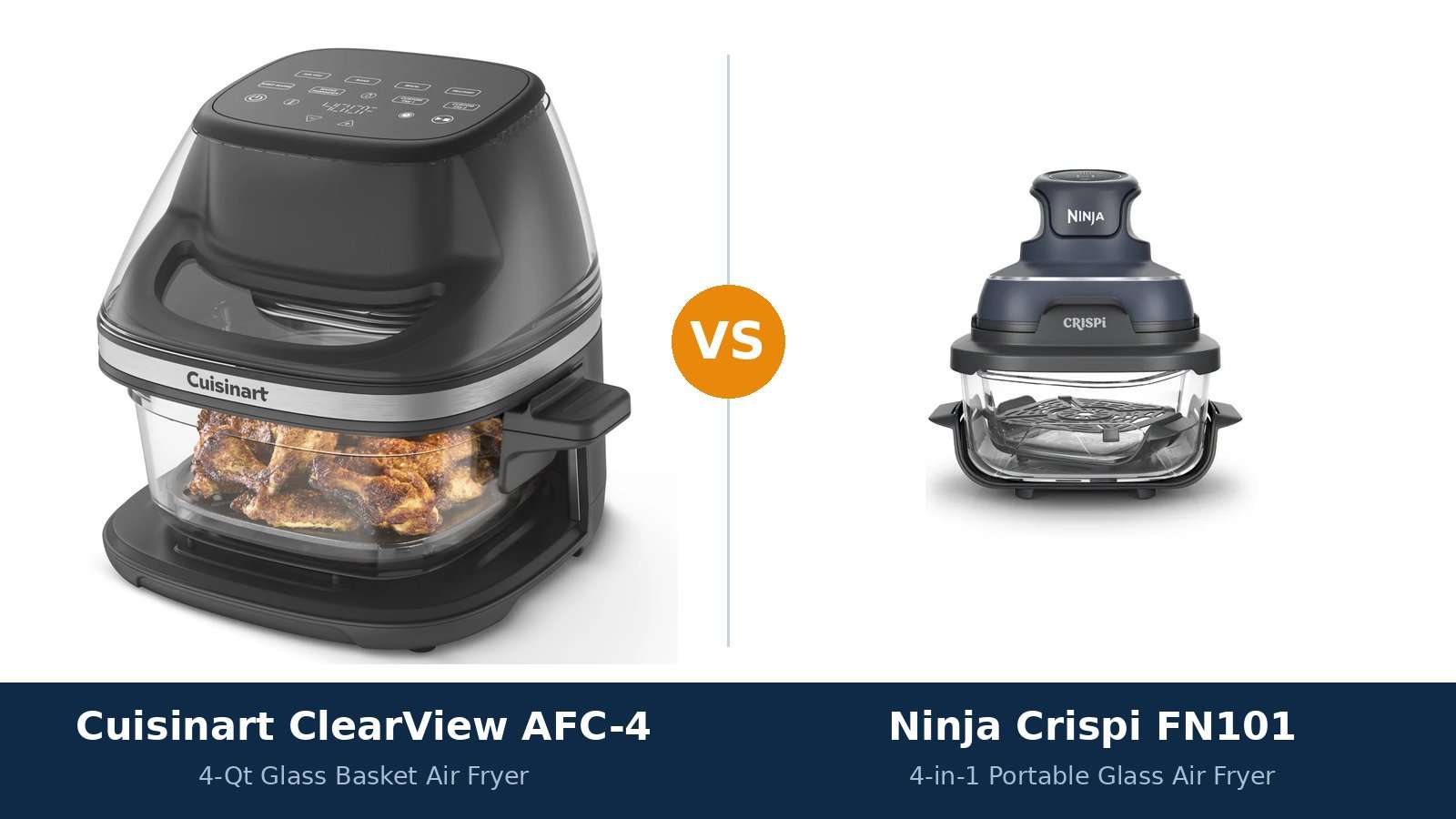
Two air fryers. Both cook in glass. Almost nothing else about them is the same.
One quick note on names before we start. “Cuisinart glass air fryer” means the Cuisinart ClearView 4-Qt Glass Basket Air Fryer, model AFC-4 — Cuisinart’s glass-basket machine, sold under exactly that description.
The Crispi side needs no translation. It is the Ninja Crispi 4-in-1 Portable Glass Air Fryer Cooking System, model FN101: a PowerPod that clamps onto borosilicate glass containers.
Same material, opposite philosophies. The Cuisinart is a conventional countertop air fryer that swapped its coated drawer for glass. The Ninja is not really an appliance at all — it is a heating pod that borrows whatever glass container it sits on.
Every specification below comes from Cuisinart’s and SharkNinja’s own published data and manuals. The verdict at the end is the one we would give a friend spending their own money.
Key Takeaways
- Temperature control is the biggest gap. The AFC-4 adjusts in 5°F steps on every function. The Crispi’s temperatures are fixed presets — SharkNinja reserves adjustable control for the Crispi Pro.
- The Cuisinart is the fuller appliance. Five functions plus two custom presets, a Broil mode the Crispi lacks, 1,600 watts, and an automatic Keep Warm.
- The Crispi is the flexible system. Two glass containers (4-qt and 6-cup) instead of one basket, and the whole kit nests away instead of living on your counter.
- Cleaning is a genuine tie. Both cook on PFAS-free glass, and every food-contact part on both machines is dishwasher safe.
- Warranty is not close. Cuisinart covers the AFC-4 for three years. Ninja covers the Crispi for one.
Quick Verdict
Buy the Cuisinart ClearView AFC-4 if you want a glass air fryer that behaves like a real air fryer. It is the more complete cooking appliance.
You set the temperature yourself, in 5°F steps. You get Broil and Keep Warm alongside Air Fry, Bake and Recrisp. A top window and interior light let you watch food brown without opening anything.
And it is backed for three years, not one. For a fryer that will live on the counter and cook dinner most nights, this is the safer buy.
Buy the Ninja Crispi FN101 if your kitchen, your household, or your habits are small. Its 6-cup container is the best single-serving air fryer setup here.
The two-container system preps, cooks, serves and stores in the same glass. Then it all stacks away — no permanent counter footprint at all.
The Scorecard
Scores below are derived directly from the manufacturer specifications compared in this guide — function counts, temperature control, container systems, dishwasher scope and warranty terms. They are a reading aid, not benchmark results.
| Category | Cuisinart AFC-4 | Ninja Crispi FN101 | ||
|---|---|---|---|---|
| Capacity & flexibility | 7 / 10 | 8 / 10 | ||
| Temperature control | 9 / 10 | 5 / 10 | ||
| Functions & power | 8 / 10 | 7 / 10 | ||
| Ease of use | 8 / 10 | 8 / 10 | ||
| Cleaning | 8 / 10 | 8 / 10 | ||
| Footprint & storage | 6 / 10 | 9 / 10 | ||
| Warranty & support | 9 / 10 | 6 / 10 | ||
| Overall | 8.0 / 10 | 7.6 / 10 | ||
The pattern is clean. The Cuisinart wins everything about cooking control and long-term cover. The Crispi wins everything about space and portion flexibility. Which list matters more is the whole decision.
At a Glance: Who Each Fryer Fits
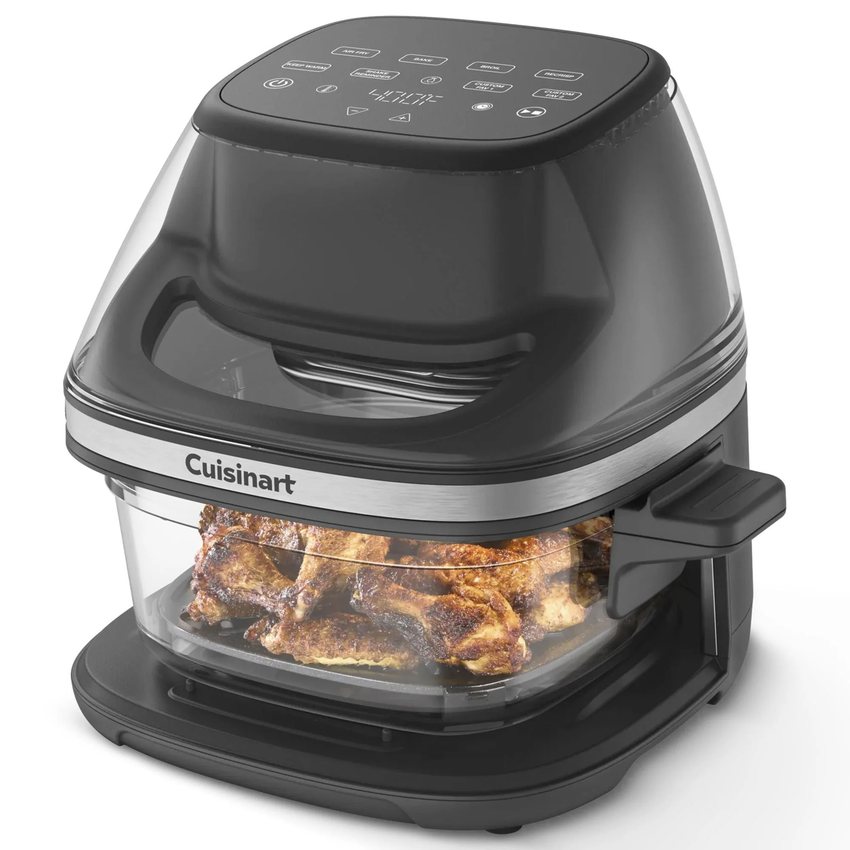
Cuisinart ClearView AFC-4
- 4-qt borosilicate glass basket, 7.75 × 7.75 in cooking surface
- Adjustable temperature to 450°F, in 5°F steps
- 5 functions + 2 custom presets; Broil and Keep Warm included
- Top viewing window with interior light
- 3-year limited warranty
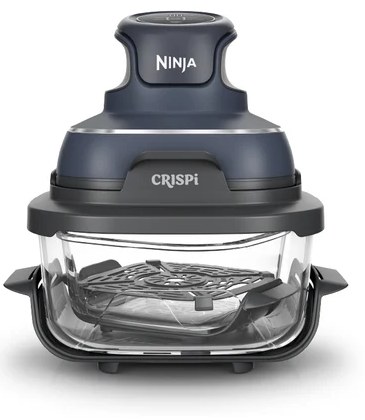
Ninja Crispi FN101
- PowerPod plus two glass containers: 4-qt and 6-cup
- 4 functions: Max Crisp, Air Fry, Bake, Recrisp
- Temperatures preset by function; 450°F on Max Crisp
- Containers double as serving and storage dishes, lids included
- Nests away — no permanent counter footprint
Choose the Cuisinart AFC-4 if…
You actually cook. Recipes with real temperatures, proteins that need a specific heat, bakes that cannot guess.
You want one appliance that stays on the counter and handles dinner end-to-end — including keeping it warm for up to an hour when timing slips.
You broil. Cheese finishes, salmon tops, reheated anything that wants direct heat from above. The Crispi has no answer to that mode.
Choose the Ninja Crispi FN101 if…
You cook for one or two, and half your meals are small. The 6-cup container exists precisely for that, and the Cuisinart has nothing like it.
Your counter space is genuinely scarce. The Crispi’s parts stack into a cabinet; the Cuisinart is furniture.
You meal-prep. Two containers with lids means one batch can be eaten while the next is already portioned in the fridge.
As an Amazon Associate I earn from qualifying purchases at no extra cost to you.
Specifications: The Specs That Actually Matter
Every figure below is taken from Cuisinart’s product page and instruction booklet for the AFC-4, and from SharkNinja’s published data and owner’s guide for the FN101.
Where the two brands publish different kinds of figures — and they do — the table says so rather than smoothing it over.
| Specification | Cuisinart ClearView AFC-4 | Ninja Crispi FN101 |
|---|---|---|
| Capacity | 4-qt glass basket (single vessel) | 4-qt + 6-cup glass containers (two vessels) |
| Cooking surface | 7.75 × 7.75 in basket floor | Container-dependent; 4-qt for batches, 6-cup for singles |
| Wattage | 1,600 W | 1,500 W |
| Temperature range | Adjustable up to 450°F, in 5°F steps, on every function | Preset by function; up to 450°F on Max Crisp only |
| Cooking functions | Air Fry, Bake, Broil, Recrisp, Keep Warm + 2 custom presets | Max Crisp, Air Fry, Bake, Recrisp |
| Basket / container type | Borosilicate glass drawer basket, fixed side handles, storage lid | Borosilicate glass containers (CleanCrisp), snap-on storage lids |
| Crisper plate | PFAS-free ceramic nonstick plate, silicone feet | Crisper plates sized per container |
| Visibility | Glass basket + top viewing window + interior light | Glass containers; no window or interior light |
| Dimensions / footprint | Fixed countertop body; 12.75 lb | 11.5 × 9.76 × 11.81 in on the 4-qt container; parts nest for storage |
| Dishwasher-safe parts | Glass basket, crisper plate, storage lid | Glass containers, crisper plates, storage lids |
| Extras in the box | Storage lid for the basket | Second (6-cup) container + 2 storage lids |
| Warranty | 3-year limited | 1-year limited |
Temperature note: the Crispi’s four functions each carry their own preset heat. SharkNinja’s own comparison FAQ is explicit that adjustable temperature control is a Crispi Pro feature, not a base Crispi one. The 450°F figure on the FN101 belongs to Max Crisp.
Size note: Cuisinart’s published materials for the AFC-4 lead with the basket — its 7.75 × 7.75 in cooking surface and the unit’s 12.75 lb weight — rather than an exterior dimension block, so that is what the table uses. SharkNinja publishes full assembled dimensions for the Crispi system.
Variant note: the Crispi’s function set varies by retailer and region. Some US retailer versions are 3-in-1 without Max Crisp, and the UK FN101 is a different specification again (1,700 W, different functions). The table reflects the standard US FN101. Check the exact listing before buying — the buying guide below explains what to look for.
The Differences That Actually Matter
1. Temperature control — the difference that decides cooking, not convenience
The AFC-4 is a fully adjustable air fryer. Pick a function, then set the temperature yourself, in precise 5°F steps, up to 450°F.
The FN101 is not. Each of its four functions runs at temperatures Ninja chose for you. SharkNinja says so itself: adjustable temperature control belongs to the Crispi Pro, one model up.
Does that matter in practice? For fries, nuggets and reheats, honestly, no. The presets are sensible and the food does not care.
For anything with a real temperature in the recipe — salmon at a gentle heat, a bake that specifies 325°F, leftovers you want warm but not re-cooked — it matters completely. One machine follows your recipe. The other follows its own.
This is the single largest functional gap in the comparison, and it is why the Cuisinart wins the scorecard’s control row by four points.
2. Format — a countertop appliance against a pod and two pots
The Cuisinart is built like every basket air fryer you have ever used. A body lives on the counter. A drawer slides out. You cook, you serve, you wash the drawer.
The difference is the drawer is glass. You season in it, cook in it, carry it to the table, and — with the included lid — put leftovers straight in the fridge in the same vessel.
The Crispi inverts the idea. The appliance is just the PowerPod: a compact heating head. It clamps onto a glass container, cooks, and comes off again.
That inversion buys real things. No bulky body to store. A system you can take to an office, a dorm or an RV. Containers that are ordinary glassware the rest of the day.
It also costs real things. Alignment and setup every cook. More separate pieces to wash and keep track of. A cooking setup that feels like a kit, because it is one.
Neither format is wrong. They are answers to different questions: “what should my air fryer be?” against “why does an air fryer need to be a box at all?”
3. Capacity — one wide basket against two right-sized containers
Headline capacity is a tie: 4 quarts each. Usable capacity is not.
The Cuisinart’s single basket has a 7.75 × 7.75 in floor. That wide, square surface is what air frying actually uses — food in one layer, air on every side.
Cuisinart’s own cooking chart runs a whole chicken of up to 4 lb in that basket, baked directly in it. For a household of two or three eating one dish, this is the simpler, roomier tool.
The Crispi splits its capacity across two containers. The 4-qt matches the Cuisinart for batches — Ninja rates it for a 4-lb chicken with vegetables.
The 6-cup container is the Crispi’s quiet superpower. A single portion cooked in a small vessel heats faster, crisps better and washes in seconds. Solo cooks feel this difference every single day.
Call it this way: the Cuisinart has the better one big basket. The Crispi has the better answer to “it’s just me tonight.”
4. Visibility — glass everywhere, but only one machine lights it up
Both fryers cook in transparent glass. On visibility alone, you might expect a draw. It is not quite a draw.
The Cuisinart stacks three viewing aids. The glass basket itself. A large window in the top of the unit, looking straight down at the food. And an interior light you tap on for 45 seconds at a time.
That top view is the one that matters. Browning happens on top first, and the AFC-4 lets you watch it happen without breaking the cook.
The Crispi’s containers are clear from every side, and for a small pod system that is genuinely good. But there is no light and no window — in a dim kitchen you are reading your food through glass in ambient light.
Both machines end the open-the-drawer-to-check habit. The Cuisinart just ends it more completely.
5. Functions and power — five modes and presets against four honest ones
The AFC-4 runs five functions: Air Fry, Bake, Broil, Recrisp and Keep Warm. Two of them deserve emphasis.
Broil is a real mode here — direct heat from the top coil, with automatic preheat, for finishing and browning. The Crispi has no broil equivalent at all.
Keep Warm is equally practical. It holds food for up to an hour after cooking, automatically, when the main cook finishes. Households that eat in shifts will use this weekly.
Add two saveable custom presets and a shake reminder, plus automatic preheat on Bake and Broil, and the Cuisinart’s control panel is simply doing more.
The Crispi’s four functions — Max Crisp, Air Fry, Bake, Recrisp — cover the core jobs without decoration. Max Crisp is its party trick: the 450°F blast for frozen food straight from the freezer.
Power is close: 1,600 watts for the Cuisinart against 1,500 for the Ninja. On paper the Cuisinart edges it; in a kitchen, treat the wattage gap as minor next to the function gap.
6. Cleaning and materials — the honest tie
This is the section both brands want to win, and on the manufacturers’ own data, neither does.
Both cook food on borosilicate glass with no nonstick coating on the vessel itself. Both put every food-contact part in the dishwasher: basket, plate and lid on the Cuisinart; containers, plates and lids on the Crispi.
The care notes differ in flavour, not in burden. Cuisinart’s crisper plate wears a PFAS-free ceramic nonstick coating — kind to food, but it asks for non-metal utensils and a soak rather than a scour for baked-on residue.
Ninja’s glass care rule is thermal: let the containers cool before washing, as with any glass that has just held 450°F air. The Crispi also simply has more pieces to rinse.
If avoiding coated cooking surfaces brought you to these two machines, both honour that brief. Score this one even and move on.
7. Warranty and what it signals
Cuisinart warrants the AFC-4 for three years. Ninja warrants the FN101 for one. In a category where one year is the norm, three is a statement.
It matters more here than usual because both machines ask glass to do a hot, heavy, everyday job. Glass is durable — borosilicate handles thermal shock well — but it is also the part most likely to meet a hard floor.
Neither warranty covers dropping your basket, and we will not pretend otherwise. What the longer term does cover is the machine around the glass: heaters, fans, electronics, controls.
On a pod system, that risk concentrates in one small replaceable-feeling part. On a full appliance, it is the whole purchase. The Cuisinart’s three-year cover fits its format; the Crispi’s one year is its weakest line on the spec sheet.
Household Fit Guide
The fastest way to choose between these two is to start from who is eating and where the machine will live. This table is the whole comparison in one view.
| Your household / use case | Cuisinart AFC-4 | Ninja Crispi FN101 | Our call |
|---|---|---|---|
| Solo cook, single portions | Workable — big basket for small loads | Excellent — 6-cup container is built for this | Ninja Crispi |
| Couple, weeknight dinners | Excellent — wide basket, full controls | Good — 4-qt container handles it | Cuisinart AFC-4 |
| Small family (3–4) | Good — one dish at a time, whole small chicken | Good — batches across two containers | Cuisinart, unless you batch-cook |
| Meal prep and leftovers | Good — basket + lid stores one batch | Excellent — two lidded containers, Recrisp built in | Ninja Crispi |
| Precise recipes and baking | Excellent — adjustable heat in 5°F steps, preheat on Bake | Limited — preset temperatures only | Cuisinart AFC-4 |
| Tiny kitchen, dorm, RV, office | Poor — a fixed countertop appliance | Excellent — nests away, travels | Ninja Crispi |
| Broiling and finishing | Excellent — dedicated Broil with preheat | Not available | Cuisinart AFC-4 |
Read the first and last rows together. They describe two different buyers so completely that most readers can stop there.
Ready to check today’s price?
Both fryers sell through Amazon. Prices move, so check the live figure on the machine that fits your kitchen.
View on Amazon — Cuisinart AFC-4View on Amazon — Ninja Crispi FN101The 30-Second Decision
| If this sounds like you… | Buy this |
|---|---|
| “I want a glass air fryer that works like a normal air fryer, only better.” | Cuisinart AFC-4 |
| “I follow recipes with exact temperatures.” | Cuisinart AFC-4 (adjustable in 5°F steps) |
| “I mostly cook for myself.” | Ninja Crispi FN101 (6-cup container) |
| “I have nowhere to keep a countertop appliance.” | Ninja Crispi FN101 (nests in a cabinet) |
| “Broiling and keeping dinner warm actually matter to me.” | Cuisinart AFC-4 |
| “I meal-prep and live out of storage containers.” | Ninja Crispi FN101 |
What You Gain. What You Give Up.
Cuisinart ClearView AFC-4
You gain: real temperature control in 5°F steps. Five functions including Broil and an automatic Keep Warm. A lit top window for watching food brown. A wide single basket that preps, cooks, serves and stores. And a three-year warranty.
You give up: the second, smaller container — small portions cook in a big basket. Portability and storage flexibility: this is a fixed 12.75 lb countertop appliance, and it stays one.
Ninja Crispi FN101
You gain: two glass containers sized for real life — 4-qt for batches, 6-cup for one person. A system that stores in a cabinet and travels. Prep-to-fridge storage in the cooking vessel itself, with lids included.
You give up: temperature control — presets only, with adjustable heat reserved for the Crispi Pro. Broil and Keep Warm modes. Two years of warranty cover against the Cuisinart’s three.
Pros and Cons
Cuisinart AFC-4 — Pros
- Adjustable temperature in 5°F steps, to 450°F
- Five functions + two custom presets; Broil included
- Glass basket, top window and interior light
- Automatic Keep Warm for up to 60 minutes
- 3-year limited warranty
- Shake reminder and auto-pause when the basket is removed
Cons
- One basket only — no small-portion vessel
- Fixed countertop footprint; 12.75 lb
- Ceramic crisper plate needs non-metal utensils
- Glass basket is heavy when loaded; two hands
Ninja Crispi FN101 — Pros
- Two containers: 4-qt and 6-cup, lids included
- Nests away — the smallest storage footprint here
- Portable: dorms, offices, RVs, small kitchens
- Max Crisp 450°F mode for frozen food
- All food-contact parts dishwasher safe
Cons
- No adjustable temperature control — presets only
- No Broil or Keep Warm function
- 1-year warranty
- More pieces to wash, store and keep together
- Function set varies by retailer — check the listing
Check the Name, the Variant and the Bundle
Check what “Cuisinart glass air fryer” refers to. It is the ClearView line, and this comparison covers the 4-qt AFC-4 — the model Cuisinart sells under the glass basket name.
Cuisinart also sells a larger 9-qt ClearView sibling, the AFC-9. It shares the glass-basket idea at family size. If the AFC-4’s capacity is your only objection, that is the machine to look at — not a different brand.
Do not confuse either with Cuisinart’s windowed metal-basket fryers, like the AIR-200 line. A viewing window in a coated basket is a different product from a glass basket, and the spec sheets are not interchangeable.
Check the Crispi variant. “FN101” covers several listings. US Crispi sets are sold per colour, and each colour carries its own listing — the functions are the same, but confirm you are looking at the 4-in-1 with Max Crisp.
Some retailer versions of the Crispi are 3-in-1 and drop Max Crisp entirely, per SharkNinja’s own notes. And the Crispi sold in the UK is a different specification (1,700 W, different functions and container sizes) — a US buyer importing one gets the wrong machine on the wrong voltage.
Check the upgrade you might actually want. If the Crispi’s format appeals but its preset temperatures do not, the Crispi Pro exists precisely for you — it adds the adjustable temperature control this FN101 lacks. Price that before deciding the base model’s compromise is acceptable.
Check the bundle. The AFC-4’s box centres on the basket and its storage lid. The FN101’s value sits in the full system: PowerPod, both containers, both crisper plates, both lids. A Crispi listing missing the 6-cup container is not the same product at a better price — it is a smaller kit.
The Longevity Test
Judge these two by their second year, not their first week.
Year one, both delight. Glass cooks cleanly, food is visible, and neither machine asks you to trust a coated basket. The honeymoon is real on both sides.
Year two is where the formats diverge. The Cuisinart’s ownership story is stability: one appliance, one basket, controls that still do everything your recipes ask, and a warranty still running.
The Crispi’s story is accumulation. Extra containers are cheap to add. The pod keeps working across all of them. If your household’s shape changes, the system reshapes with it.
The risks age differently too. The Cuisinart’s glass basket is a proprietary part on a warrantied appliance. The Crispi’s containers are closer to consumable glassware — replaceable without replacing the machine.
Neither path is wrong. Buy the one whose year two sounds like your kitchen.
When to Skip Both
Honesty cuts both ways. Some buyers should walk past this entire comparison.
Skip both if you regularly cook for five or more. Two 4-qt-class machines will batch-cook your evenings away; look at the 9-qt ClearView or a dual-basket fryer instead.
Skip both if breakability worries you more than coatings do. Glass is honest and durable, but a metal basket survives drops that glass will not, and no warranty covers gravity.
Skip the Crispi — specifically — if you already know you want temperature control, and skip the Cuisinart if you already know the fryer will live in a cupboard. Each of those answers ends this comparison early, and that is fine.
For everyone else — small households who want to see their food cook, in glass — one of these two is the right answer.
Warranty and Support
The warranty gap is the widest on the spec sheet: three years from Cuisinart for the AFC-4, one year from SharkNinja for the FN101.
Both are limited warranties covering defects in materials and workmanship under normal home use. Neither covers accidental damage, misuse, or a basket meeting a tile floor.
Practically, the longer Cuisinart term protects the parts you cannot replace yourself — the heater, fan and touchscreen electronics of a full appliance.
On the Crispi, the equivalent risk sits in the PowerPod alone; the glassware it drives is separately replaceable, which softens the shorter term somewhat. Softens — it does not erase it.
Register whichever you buy, keep the receipt, and note the model suffix on the box. With per-colour Crispi listings and a growing ClearView family, the exact model name is what any support claim will turn on.
Final Verdict
The Cuisinart ClearView AFC-4 is the glass air fryer we would buy for a kitchen counter.
It wins this comparison on the things that decide whether an air fryer gets used daily or tolerated: control over temperature, a function set with no meaningful holes, and visibility that includes a light.
Adjustable heat in 5°F steps is the headline. Broil, automatic Keep Warm, custom presets and a shake reminder are the supporting cast. The three-year warranty is the safety net under all of it.
Buy the AFC-4 for couples and small families, for recipe-driven cooking, and for any kitchen where the fryer earns a permanent spot.
View on Amazon — Cuisinart AFC-4
Buy the Ninja Crispi FN101 if your cooking is smaller and your space is tighter. For one person, its 6-cup container is not a compromise — it is the better tool.
It is also the pick for meal preppers, dorms, offices and RVs, and for anyone who would rather store a fryer in a cabinet than look at one on the counter. Just buy it knowing its temperatures are Ninja’s choices, not yours.
View on Amazon — Ninja Crispi FN101
Frequently Asked Questions
Which Cuisinart model is “the Cuisinart glass air fryer”?
The ClearView 4-Qt Glass Basket Air Fryer, model AFC-4. It is the Cuisinart machine built around a borosilicate glass basket, with a top viewing window and interior light. Cuisinart also sells a larger 9-qt ClearView (AFC-9); its windowed metal-basket models, such as the AIR-200 line, are different products.
Can you adjust the temperature on the Ninja Crispi FN101?
No. The FN101’s temperatures are preset within each of its four functions, and its 450°F maximum applies to Max Crisp. SharkNinja’s own comparison information states that adjustable temperature control is a feature of the Crispi Pro, not the base Crispi. The Cuisinart AFC-4 adjusts in 5°F steps on every function.
Is the Cuisinart AFC-4’s basket really glass all the way through?
Yes. The basket is transparent borosilicate glass with fixed side handles and a 7.75 × 7.75 in cooking surface. The crisper plate that sits inside it is metal with a PFAS-free ceramic nonstick coating. The basket is freezer safe and dishwasher safe, and it ships with a storage lid.
Which one is better for cooking for one person?
The Ninja Crispi. Its 6-cup container cooks a single portion in a small vessel, which heats quickly and washes in seconds, and its storage lid turns the same container into the fridge box. The Cuisinart cooks a solo portion perfectly well, but in a 4-qt basket sized for more.
Are both machines dishwasher safe?
Every food-contact part on both is. On the Cuisinart: the glass basket, crisper plate and storage lid. On the Crispi: the glass containers, crisper plates and lids. Both manufacturers still recommend hand-washing for baked-on residue, and Ninja advises letting its glass cool before washing.
Can either fryer cook a whole chicken?
Both manufacturers rate their 4-qt vessels for a chicken of up to about 4 lb. Cuisinart’s own cooking chart bakes a whole chicken up to 4 lb directly in the glass basket at 350°F. Ninja rates the Crispi’s 4-qt container for a 4-lb chicken with vegetables. Expect a small bird, cooked in one go — not a family roast.
How long are the warranties?
Three years for the Cuisinart AFC-4, one year for the Ninja Crispi FN101. Both are limited warranties covering defects in materials and workmanship in normal home use; neither covers accidental breakage of the glass.
What is the difference between the Crispi and the Crispi Pro?
The headline difference is control: the Crispi Pro adds adjustable temperature control, which SharkNinja explicitly does not offer on the base FN101 in this comparison. If the Crispi’s pod-and-container format appeals but preset temperatures do not, the Pro is the version aimed at you.
Sources & Verification
Cuisinart ClearView 4-Qt Glass Basket Air Fryer (AFC-4) official product page, cuisinart.com • Cuisinart AFC-4 instruction booklet (IB-19398; Canadian edition AFC-4C) — functions, cleaning, warranty • SharkNinja Ninja Crispi FN101 official product page and owner’s guide via manuals.plus — containers, dimensions, dishwasher scope, warranty • SharkNinja Crispi vs Crispi Pro FAQ — temperature-control distinction. Specifications verified November 2026.

James Wilson
James has been testing and writing about kitchen appliances and PC hardware for over a decade and writes Honestly Compared’s buying guides. His rule for every comparison: the verdict has to survive the spec sheet, not the marketing page.