
Ninja 4-Qt Air Fryer AF100 vs AF101: Which Should You Buy?
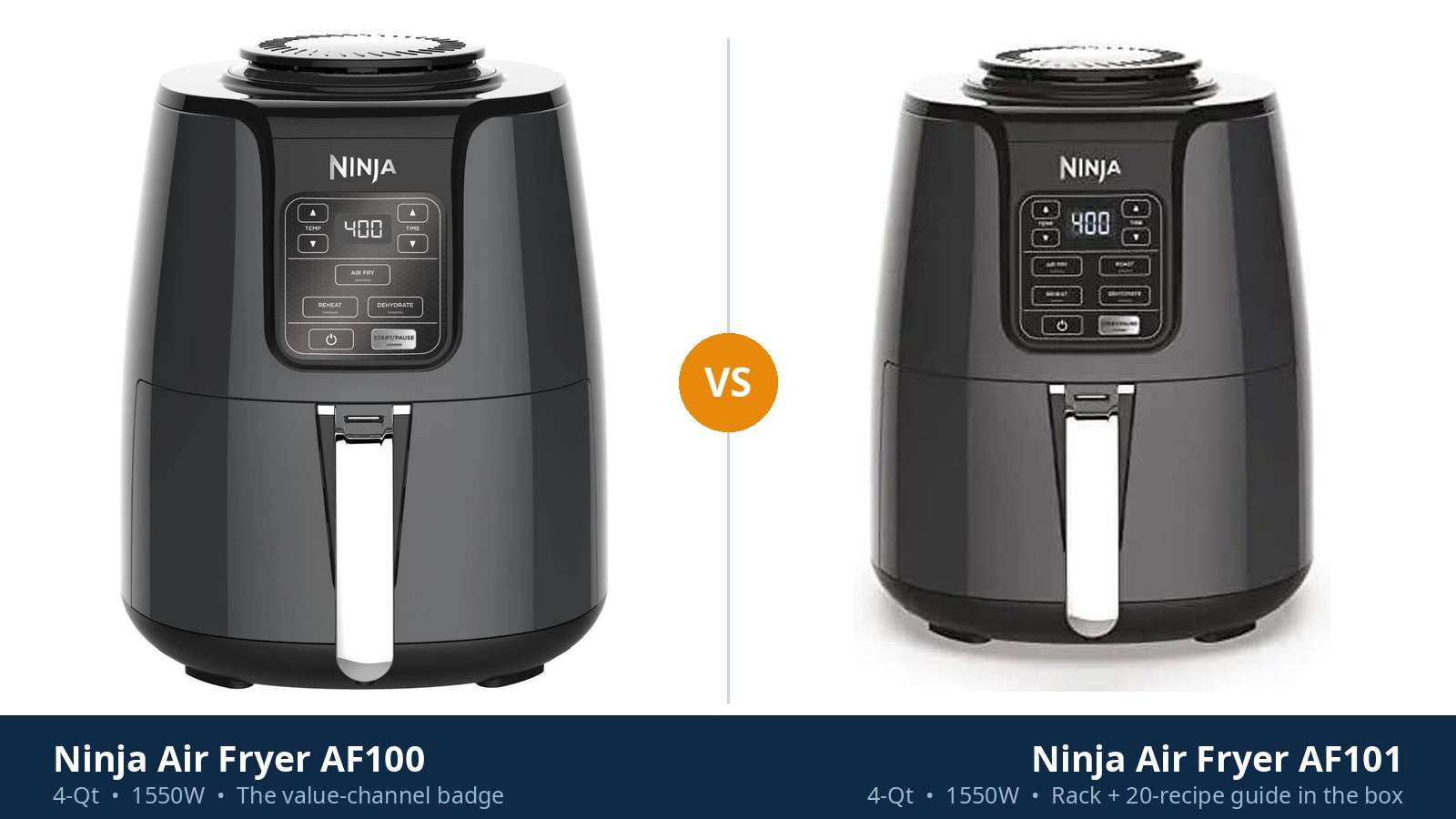
Most people land on this comparison holding a shopping list, not a spec sheet. They want a 4-quart Ninja. Two listings show up wearing that description, at two different prices, and the model numbers differ by a single digit.
Here is the spoiler, confirmed by the manufacturer itself: underneath the badges sits one and the same air fryer. Same heater, same basket, same control logic. Nothing you cook in the AF100 will cook any differently in the AF101.
So this guide does something more useful than a fake performance contest. It cooks a week of real dinners in the shared basket — fries night, roast night, a jerky weekend, leftover pizza — and marks the exact meals where the badge on the front starts to matter. There are two: one involves a button that quietly vanishes on the cheapest version, the other involves what is packed inside the carton.
Every figure below traces to SharkNinja’s own owner’s guides and manufacturer product data. Where the AF100 name stretches across several retail variants, each one is named before it can catch you out.
Key Takeaways
- One machine, two badges. SharkNinja’s support team states outright that the AF100 and AF101 are the same unit — 1550W, 4-quart ceramic basket, 105°F–400°F, 1-year warranty.
- The AF101 carton is the complete one. A stainless multi-layer rack and a 20-recipe guide ride along. The AF100 carton carries a 10-recipe guide and leaves the rack out.
- One AF100 variant loses a whole function. Walmart’s AF100WM panel stops at three buttons — Air Fry, Reheat, Dehydrate. Roast never made it onto that machine.
- Dinner cannot tell them apart. Fries, wings, reheats and roasts emerge identically, because the hardware producing them never changed.
- The AF100’s current Amazon listing needs a careful eye. It is a seller-relisted unit whose brand field reads “Generic” even though its model field says AF100. Judge it by the model field and the seller, not the brand line.
Quick Verdict
Buy the Ninja AF101 if you want the purchase finished in one click. The badge promises a single, complete specification: the four-function panel, the rack in the carton, the fatter recipe guide.
There is no AF101 lottery. Every unit rolling off that listing carries the full kit, and for dehydrating households the included rack is worth real money on its own.
Buy the Ninja AF100 when the discount is genuine and the panel photo checks out. A four-function AF100 is this identical fryer at a value-channel price, and the rack can join it later from Ninja’s accessories store.
Respect the two traps on that badge: the three-function Walmart panel, and a relisted Amazon page with a scrambled brand field. Clear both, and the cheaper badge is the smarter buy.
The Scorecard
Scores below are derived directly from the manufacturer specifications compared in this guide — capacity, function sets, included accessories and published dimensions. They are a reading aid, not benchmark results. One scoring note matters: the AF100’s functions score reflects the AF100WM, the version US shoppers will actually find on shelves. Fit an AF100 with all four functions and its row matches the AF101’s exactly.
| Category | Ninja AF100 | Ninja AF101 | ||
|---|---|---|---|---|
| Capacity & layered cooking | 8 / 10 | 9 / 10 | ||
| Cooking functions | 7 / 10 | 9 / 10 | ||
| Temperature & timer range | 9 / 10 | 9 / 10 | ||
| Ease of use | 9 / 10 | 9 / 10 | ||
| Cleaning | 9 / 10 | 9 / 10 | ||
| Footprint & storage | 9 / 10 | 9 / 10 | ||
| Value | 9 / 10 | 8 / 10 | ||
| Overall | 8.6 / 10 | 8.9 / 10 | ||
Five rows refuse to separate, and that is the honest shape of this comparison. The AF101 builds its lead out of the only materials a badge controls: the buttons guaranteed on the panel, and the extras guaranteed in the box.
At a Glance: Who Each Fryer Fits
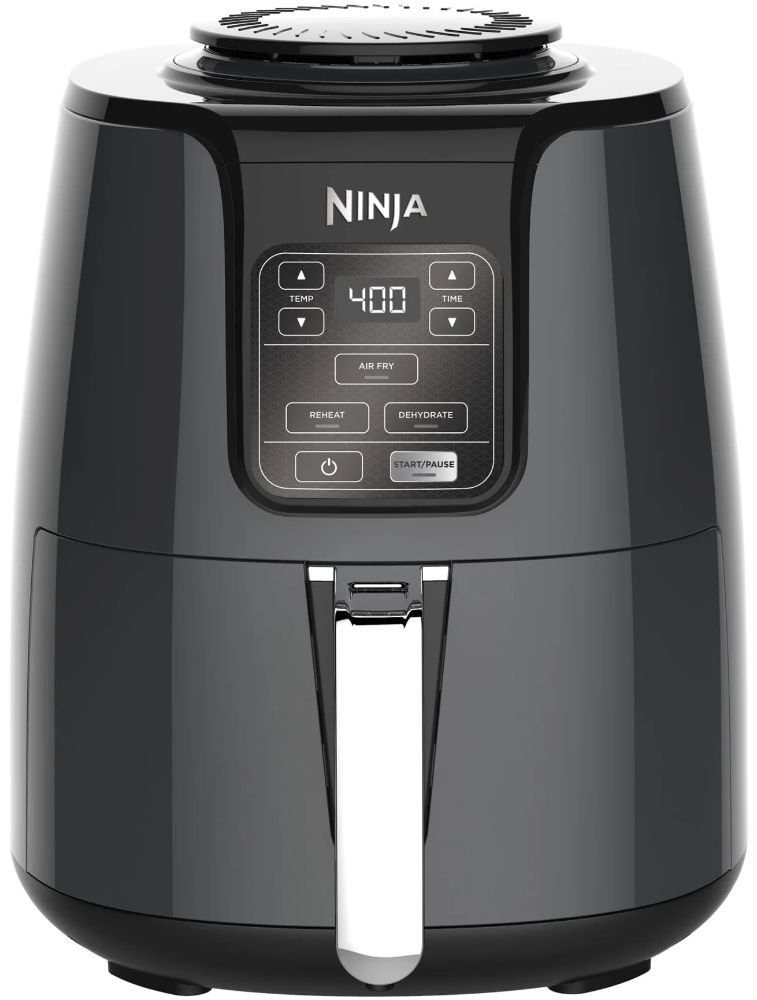
Ninja AF100
- The identical 1550W, 4-quart fryer as the AF101
- Ceramic-coated nonstick basket and crisper plate
- 10-recipe inspiration guide in the carton
- Multi-layer rack not included
- Walmart AF100WM variant drops the Roast function
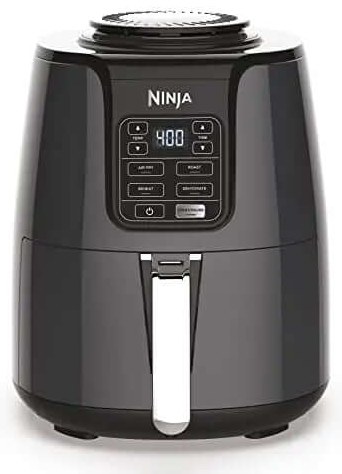
Ninja AF101
- The identical 1550W, 4-quart fryer as the AF100
- Four functions on every unit, Roast included
- Multi-layer rack included for two-tier cooking
- 20-recipe inspiration guide in the carton
- Black/gray high-gloss finish
Choose the AF100 if…
The saving on the day is real money, and the listing photograph shows the full four-button function row.
Your dehydrating ambitions are modest. A single layer of apple chips now and then does not need a rack.
Or the kitchen demands a finish the other badge never offered. The AF100 family stretches to white and navy through its Walmart line.
Choose the AF101 if…
You would rather pay a little more than audit a listing. One specification, complete carton, no homework.
Dried snacks are a weekly habit in your house. The rack doubles the surface every batch can spread across.
Or the fryer is a gift. The complete box is the one you can hand over without a footnote about variants.
As an Amazon Associate I earn from qualifying purchases at no extra cost to you.
Specifications: The Specs That Actually Matter
Every figure below comes from SharkNinja’s published owner’s guides and manufacturer product data for the two models. Read the functions row with care: it is the one row where the AF100 badge splits into more than one machine, and the note under the table explains the split.
| Specification | Ninja AF100 | Ninja AF101 |
|---|---|---|
| Capacity | 4 qt basket — rated for 2 lbs of French fries | 4 qt basket — rated for 2 lbs of French fries |
| Basket & crisper plate | Ceramic-coated nonstick, dishwasher safe | Ceramic-coated nonstick, dishwasher safe |
| Wattage | 1550 watts | 1550 watts |
| Voltage | 120V, 60Hz | 120V, 60Hz |
| Temperature range | 105°F–400°F | 105°F–400°F |
| Cooking functions | Air Fry, Roast, Reheat, Dehydrate in the series guide — but see the variant note | Air Fry, Roast, Reheat, Dehydrate — on every unit |
| Controls | Digital touch panel, TEMP/TIME arrows, Start/Pause | Digital touch panel, TEMP/TIME arrows, Start/Pause |
| Included accessories | Basket, crisper plate, 10-recipe inspiration guide | Basket, crisper plate, multi-layer rack, 20-recipe inspiration guide |
| Dimensions | 13.6 × 11 × 13.3 in | 13.6 × 11 × 13.3 in |
| Weight | About 10.1 lb (published figure) | About 10.6 lb (published figure) |
| Dishwasher-safe parts | Basket, crisper plate and accessories | Basket, crisper plate and accessories |
| Power cord | Short cord; the guides advise against extension cords (length not published) | Short cord; the guides advise against extension cords (length not published) |
| Warranty | 1-year limited (SharkNinja) | 1-year limited (SharkNinja) |
Variant note: SharkNinja’s AF100 Series guide prints four function buttons, Roast among them. Yet the AF100WM that Walmart sells — the AF100 most American shoppers will ever meet — carries manufacturer data listing three functions only: Air Fry, Reheat and Dehydrate, and its photographed panel agrees, with no Roast button anywhere. The same family adds a white AF100WMWH and a navy AF100WM-N, plus Canadian AF100C and red AF100CRD versions. The AF101 holds a single specification in black/gray, with the AF101C as its Canadian twin.
Weight note: listings put this shared housing anywhere from roughly 10.1 to 10.6 lb. One body cannot have two weights; read the spread as packaging and rounding between channels, never as a lighter and a heavier machine.
The Differences That Actually Matter
1. Fries night — the basket both badges share
Start the week where every air fryer earns its counter space. A bag of frozen fries, a handful of wings, dinner in twenty minutes.
Ninja rates this basket at 2 lbs of French fries. Translated into households: a generous portion for two or three people, a side dish stretched across four plates, and an honest batch-cooking session for anything beyond that.
Both badges deliver that basket unchanged — the same ceramic-coated 4-quart tub, the same crisper plate, the same 1550W element driving the same fan programme. The guides even share the working method: preheat for three minutes, spread food in a single layer, shake partway through.
That last instruction deserves emphasis, because it caps what either badge can do. Crowd the basket and the crisping suffers identically on both. Capacity is a property of the tub, and the tub never changed.
2. Roast night — the button one badge can lose
Midweek, the menu turns to roasted vegetables and chicken pieces, and here the comparison finally finds a genuine fork.
Roast on this platform is a dedicated programme: fan behaviour and temperature tuned for browning tender food rather than blasting frozen food. The AF101 carries it on every panel it has ever shipped. Four buttons, always.
The AF100’s own series guide promises the same four buttons. But walk into the channel where the AF100 actually sells, and the promise frays. Walmart’s AF100WM is documented with three functions — Air Fry, Reheat, Dehydrate — and its panel photo backs the paperwork up. The Roast button simply is not there.
Can a determined cook work around it? Partly. Manual temperature and time on Air Fry approximates the result. But an approximation is not the programme, and nobody should pay for four functions and receive three with a workaround attached.
The defence takes seconds: study the panel in the listing photograph and count the function buttons. Four means the complete machine under either badge. Three means the Walmart panel — a fair buy for frying and reheating households, the wrong buy for roasters.
3. Jerky weekend — where the rack pays rent
Dehydrating is the slow art this little fryer does surprisingly well. The range reaches down to 105°F, gentle enough for herbs, fruit leathers and jerky without cooking them.
It is also the one job where surface area is everything. Thin slices dry in a single layer, so the batch size is set by how much floor the food can occupy — and that is precisely what the multi-layer rack changes.
The rack is a stainless-steel shelf that stacks a second tier inside the basket. Both owner’s guides describe cooking across two levels with it, food below and a second layer above. Jerky capacity effectively doubles; apple chips stop competing for floor space.
SharkNinja packs that rack into the AF101 carton and leaves it out of the AF100’s. The AF100 guide is gracious about the omission, noting the rack can be ordered from Ninja’s accessories store — which is true, and turns the AF100 plus a later rack order into a functional AF101.
Score the weekend honestly, then. Occasional dehydrating: the badge makes no difference. A household that dries food weekly should buy the badge with the rack already inside.
4. Leftover pizza night — a tie, down to the washing up
Friday’s test is humbler: cold pizza, yesterday’s fries, the snacks that a microwave turns to rubber.
Reheat is the one function no variant of either badge ever lost. It sits on the three-button Walmart panel and the four-button panels alike, running the same programme in the same basket. Slices come back with crisp bases and melted tops, identically, every time.
Afterwards, the sink routine matches too. Basket, crisper plate and accessories all go in the dishwasher on both models. Anything stubborn gets a warm soapy soak first, per both guides.
The main unit follows one rule in both manuals: never immerse it. Unplug, let it cool, wipe the body and panel with a damp cloth, brush crumbs away from the heating element. One machine means one cleaning habit, whichever badge faces the room.
5. The coating question — same ceramic, same care
Buyers comparing these two sometimes hope one hides a better nonstick. Neither does.
Basket and crisper plate wear the same ceramic-coated nonstick finish on both models. SharkNinja’s support team describes that coating as PTFE- and PFOA-free, and the guides treat it as a surface built for the machine’s service life.
Care instructions are shared word for word in spirit: soak before scrubbing, keep abrasives away, let the dishwasher do the routine work. The warranty text in the AF100 guide also files the basket, plate and racks under wearable parts, excluded for ordinary wear — a clause worth knowing before either purchase, and identical in effect for both badges.
Verdict on the coating: a dead tie, policed by the same gentle habits.
6. The counter and the cupboard — one footprint, one height warning
Kitchens do not care about badges; they care about centimetres. On that front the two are interchangeable.
Published manufacturer data gives both the same body: about 13.6 inches deep, 11 inches wide, 13.3 inches tall. Either one displaces the other on the counter without moving a single neighbouring appliance.
Height is the measurement to respect. These are tall machines that breathe from the top, and both guides ask for clear space above and around the unit while it runs. A low run of wall cabinets over the only free outlet can veto both badges in one stroke — measure before the box arrives, not after.
The published half-pound weight gap dissolves under the same logic. It is one housing weighed by different channels with different packaging habits. Nobody’s wrist will arbitrate this comparison.
And both live tethered: a short power cord, an explicit warning against extension cords in the guides, and no cord length published for the US models. Pick the outlet first. Then pick the badge.
7. The listing is part of the product now
These are 2018-era models selling through 2026 channels, and that changes what “buying one” involves. The listing itself has become part of the specification.
Start with the AF100’s current Amazon page. Its own product-information block names the item model number as AF100, quotes 1550 watts and 4 quarts — and then lists the brand as “Generic.” The listing first appeared in July 2025, years after the model launched, which marks it as a seller-relisted unit rather than SharkNinja’s original page.
None of that proves the fryer is wrong. It does mean the brand field cannot vouch for it. Buy that listing on its model-number field, its specification block and its seller’s record — or choose the AF101’s long-established page, which has tracked the model continuously since 2018.
Channel shapes the AF100 in colours, too. General retail took the AF101 in black/gray. The value channels took the AF100 and dressed it wider: black, white and navy across the Walmart line, red in Canada. If a colour is the point, the AF100 family is the only place it exists.
Renewed and factory-reconditioned units of both badges circulate widely at this age. Treat their shorter warranty terms — 90 days on one reconditioned AF100 listing, against a year on a new unit — as part of the price you are really paying.
Who Each Fryer Suits: Household & Use-Case Fit
Since the hardware refuses to separate, fit comes down to menus and shopping habits. Find the row that sounds like your kitchen.
| Your household / use case | AF100 | AF101 | Our call |
|---|---|---|---|
| Singles and couples living on fries, wings and nuggets | Excellent | Excellent | Whichever badge is cheaper that day |
| Roast vegetables or chicken most weeks | Risky — the Walmart panel has no Roast button | Excellent — Roast guaranteed | AF101, or a verified four-function AF100 |
| Jerky, dried fruit and herb projects on rotation | Workable — rack bought separately | Excellent — rack in the carton | AF101 |
| Family of four cooking side dishes | Good — one batch at a time | Good — one batch at a time | Tie; if this is nightly, look at 5-qt models |
| First apartment, dorm or RV galley | Excellent — value-channel pricing | Good | AF100, panel checked |
| A kitchen that runs on leftovers | Excellent | Excellent | Tie — Reheat survives on every variant |
| A white or navy appliance to match the room | Excellent — the WM line carries the colours | Not offered | AF100WM family |
The calls follow a simple rhythm. Menus that need the full function set or the rack point at the AF101. Menus built on frying and reheating leave the door open for a checked, discounted AF100. No row is decided by cooking power, because cooking power never differed.
Ready to check today’s price?
Both models sell through Amazon. Prices move, so check the live figure on the package that fits your kitchen.
View on Amazon — Ninja AF100View on Amazon — Ninja AF101The 30-Second Decision
| If this sounds like you… | Buy this |
|---|---|
| “Just sell me the complete one and let me cook.” | AF101 |
| “The deal is strong and the photo shows four function buttons.” | AF100 — the same fryer, better price |
| “Jerky and dried apple chips are a standing weekend plan.” | AF101 (rack included) |
| “Walmart has it on rollback; I fry and reheat, that is all.” | AF100WM — bought knowingly, without Roast |
| “The Amazon brand field says ‘Generic’ and that worries me.” | AF101’s established listing — or verify the AF100’s model field and seller first |
| “I found one refurbished, cheap.” | Either badge — after comparing its warranty term against a new unit’s year |
What You Gain. What You Give Up.
Ninja AF100
You gain: the identical fryer, usually for less money, sold through channels that discount aggressively. Colour options its sibling never offered — white and navy beside the black. And an open door to the same accessory shelf, rack included, whenever you decide you want it.
You give up: peace of mind at checkout. The badge covers a three-function Walmart variant and a four-function series model, so every order begins with a panel inspection. The rack and the larger recipe guide stay out of the carton, and the current Amazon listing’s scrambled brand field asks you to verify the model number yourself.
Ninja AF101
You gain: certainty, complete in one carton. Four functions on every panel, the multi-layer rack ready for the first jerky batch, the 20-recipe guide, and a listing with an unbroken history back to the model’s launch year.
You give up: the bargain ceiling and the colour chart. The AF101 generally holds a higher price than a discounted AF100WM, and black/gray is the whole palette. What the premium buys is completeness — never a hotter element or a bigger basket.
Pros and Cons
AF100 — Pros
- Cooking hardware identical to the AF101
- Usually the least expensive route to this fryer
- White and navy finishes in the Walmart line
- Same dishwasher-safe basket and crisper plate
- Rack available later to complete the package
Cons
- AF100WM deletes the Roast function
- No multi-layer rack in the carton
- Smaller 10-recipe inspiration guide
- Current Amazon listing is seller-relisted, brand field reads “Generic”
AF101 — Pros
- Four functions guaranteed on every unit
- Multi-layer rack included for two-tier dehydrating
- 20-recipe inspiration guide included
- One specification — nothing to verify at checkout
- Same 1-year SharkNinja warranty
Cons
- Typically costs more than AF100WM promotions
- Black/gray is the only US finish
- Cooks no better than the cheaper badge
- Ageing stock can attract scarcity pricing
Five Checks Before Either Badge Ships
Read the whole model number. “AF100” by itself describes a family. The suffix carries the channel, and at Walmart it carries the function set: AF100WM in black, AF100WMWH in white, AF100WM-N in navy.
Count the function buttons in the photograph. Four — Air Fry, Roast, Reheat, Dehydrate — means the full machine under either badge. Three means the Walmart panel. This single glance settles the only hardware question in the entire comparison.
Check the carton front for the rack line. SharkNinja prints accessory inclusion in small type on the packaging. Whether the multi-layer rack is inside is stated there, not on the shelf tag — one reason in-person buyers should read the box before the till.
Verify the listing, not just the fryer. The AF100’s current Amazon page is a seller-relisted unit: its brand field reads “Generic” while its model-number field states AF100 and the specification block quotes the right wattage and capacity. Buy it on those fields and the seller’s record if you buy it at all. The AF101’s established listing needs no such archaeology.
Price the warranty alongside the appliance. A new unit from an authorized retailer carries SharkNinja’s 1-year limited warranty. Factory-reconditioned stock has been seen carrying 90 days. On discontinued-era models, that gap is a real cost — count it before calling a refurbished unit a bargain.
Mind which side of the border the listing sits on. The AF101C and AF100C are Canadian twins with their own listings, and the European AF100 is a different appliance entirely — 3.8 litres, 220–240V. An imported bargain can arrive with the wrong plug and the wrong capacity in a single box.
The Upgrade Path Test
Judge the pair by year two, because day one is a photograph finish.
Both fryers will cook the same meals in the same basket for as long as their shared parts shelf stays stocked — and it is stocked: baskets, crisper plates and the multi-layer rack all sit in Ninja’s accessories store, fitting both badges because the body beneath them never changed.
The AF101 household starts complete. The AF100 household can reach the same completeness with a single accessory order. That is the whole long-term gap between them, and it is measured in one parcel.
The ceiling, though, is shared and immovable. Four quarts, one basket, a 400°F top temperature. The household that outgrows those numbers outgrows both badges on the same day.
Listen for that day in your own kitchen language: batches backing up at dinner, a wish for 450°F searing, two foods that need two temperatures at once. Ninja’s later 5-quart Pro, Max XL and DualZone models are the answers to those sentences. Neither badge in this comparison postpones them.
When to Skip Both
Fairness requires naming the kitchens this fryer — under either badge — will frustrate.
Skip both if five or more people eat from it nightly. A 4-quart basket cooks in batches, and batches send the first serving cold. Retailer support staff redirect family-of-five shoppers toward 6-quart machines for exactly that arithmetic.
Skip both if 450°F Max Crisp heat, a viewing window or app control sits anywhere on your must-have list. This platform dates from 2018 and is innocent of everything the category invented afterwards. It is excellent at its job and silent on the rest.
Skip both if discontinued-era pricing has drifted either badge up toward a current model’s price. Scarcity inflates old stock, and a newer 5-quart Ninja with a fresh warranty is the better purchase at equal money.
Everyone left — small households wanting the original, proven 4-quart Ninja — is choosing between two cartons, not two fryers. Choose the carton deliberately.
Final Verdict
The Ninja AF101 takes this comparison, and it never has to outcook anything to do it.
Its victory is administrative, and all the more decisive for it: the four-function panel on every unit, the rack inside every carton, the longer recipe guide, a listing whose history runs unbroken back to launch. When the products are one product, the verdict belongs to the version that asks nothing of the buyer.
Buy the AF101 for roasting households, dehydrating households, gifts, and any order you want to place exactly once.
Buy the AF100 when its discount is real and its panel passes inspection — four buttons visible, or three buttons accepted with open eyes at a Walmart price.
It remains the same fryer in a thriftier uniform. Just remember that with this badge, the listing details are not fine print around the product. They are the product.
Watch Out: Similar Names, Different Machines
Ninja’s AF numbering punishes hurried reading. Four warnings earn their place in this guide.
First: the AF100WM is not automatically the same package as the AF100. The WM suffix marks Walmart’s variant, and its panel drops Roast. Treat the suffix as part of the specification, because it is.
Second: AF101C is the Canadian AF101 under separate listings — same fryer, different catalogue. The European AF100 family is a genuinely different appliance: 3.8 litres on 220–240V, useless on a US outlet without conversion.
Third: the AF141 Air Fryer Pro and AF161 Max XL are younger, larger machines wearing a familiar face. A listing that trails off at “AF1” has told you nothing. Read the model number to its final digit.
Fourth: “Renewed” and “Factory Reconditioned” examples of both badges are the same hardware carrying shorter warranty terms and unknown histories. Price them as the used appliances they are.
Slow down on the product page. Match the full model number, inspect the panel, then look at the price — in that order, every time.
Counter, Clearance and Cabling Notes
Both machines stand tall and vent upward. The guides call for adequate space above and on every side while cooking, so a low cabinet run over the only socket can rule out the pair together.
The basket lands hot and loaded. Both manuals repeat the household liturgy: heat-safe surfaces, oven mitts on the handle, and roughly half an hour of cooling before cleaning or putting the unit away.
Both guides ask for a three-minute preheat before ingredients go in. It costs nothing, it improves browning, and it is the cheapest performance upgrade either badge will ever receive.
Finally, the shared tether. A short cord and an explicit no-extension-cord rule mean this fryer lives within easy reach of an outlet. Decide which outlet that is before you decide which badge parks beside it.
Warranty and Long-Term Support
Bought new from an authorized retailer, both models carry SharkNinja’s 1-year limited warranty. It covers the original unit and its non-wearable components against defects in materials or workmanship.
Learn the wearable-parts clause now, not on the day something flakes. The warranty text in the AF100 guide excludes normal wear and tear of the basket, crisper plate, racks and pans — precisely the parts your hands touch daily. The ceramic coating is a consumable surface. Handle it gently and it serves for years; scour it and the replacement bill is yours.
Support flows through identical channels for both badges: registration at registeryourninja.com, customer service at 1-877-646-5288, and replacement baskets, plates and racks through Ninja’s accessories store.
That shared parts shelf is the quiet longevity argument for this whole comparison. A discontinued fryer with live parts support ages gracefully. Both of these still have it, and it protects the cheaper badge exactly as much as the dearer one.
Frequently Asked Questions
Are the Ninja AF100 and AF101 actually different air fryers?
No. SharkNinja’s customer support states that the two are the same unit — same 1550W base, same 4-quart ceramic-coated basket, same 105°F–400°F span. The manufacturer-confirmed differences live in the carton: the AF101 adds a multi-layer rack and a 20-recipe guide, where the AF100 includes a 10-recipe guide.
Does the AF100 have a Roast function?
Which AF100? The series owner’s guide lists four function buttons, Roast included. Walmart’s AF100WM, however, is documented with three functions — Air Fry, Reheat and Dehydrate — and its panel carries no Roast button. Count the buttons in the listing photograph before any AF100 ships.
Which model comes with the multi-layer rack?
The AF101. Its stainless rack stacks a second cooking tier inside the basket, which matters most for dehydrating. AF100 owners can order the identical rack from Ninja’s accessories store — both guides say so — and checking the carton front for the inclusion line is still the smart habit on any purchase.
Is the AF101 more powerful than the AF100?
No. Both guides specify 1550 watts at 120V, 60Hz, driving the same function programmes across the same temperature span. Wattage gaps claimed for either badge — and they circulate in both directions — collapse on contact with the manuals.
Which one is bigger?
Neither. One shared body stands behind both badges: published manufacturer data puts each at about 13.6 × 11 × 13.3 inches. The small published weight spread, roughly 10.1 to 10.6 lb, tracks packaging and rounding between channels rather than two different housings.
Are the basket and parts dishwasher safe on both?
Yes. The ceramic-coated nonstick basket, crisper plate and accessories are dishwasher safe on both models. The main unit is not: both guides direct a damp-cloth wipe and forbid immersion. SharkNinja describes the coating itself as PTFE- and PFOA-free.
What warranty do the AF100 and AF101 carry?
SharkNinja’s 1-year limited warranty, when bought new from an authorized retailer, covering the unit and non-wearable components. Wearable parts — basket, crisper plate, racks — are excluded for normal wear and tear. Refurbished listings carry shorter terms, as low as 90 days on one reconditioned AF100, so read the term before the price seduces you.
Should I buy the AF100 or AF101 in 2026?
Buy the AF101 when prices sit close: the complete carton and guaranteed panel end the research. Buy the AF100 when the saving is substantial and the variant verifies — four function buttons in the photo, or the three-function Walmart panel accepted on purpose. If either badge drifts up to a current 5-quart model’s price, buy the newer machine instead.
Sources & Verification
Ninja AF100 Series Owner’s Guide (SharkNinja Operating LLC, © 2018) • Ninja AF101 Owner’s Guide (SharkNinja Operating LLC, © 2018) • SharkNinja Customer Support answer on the Best Buy AF101 product page (“the same unit”; rack and recipe-guide differences; PTFE/PFOA-free coating) • Walmart manufacturer product data for the AF100WM (three functions, 1550W, 4-qt) • Best Buy manufacturer data for the AF101 (model AF101, UPC 622356554572, 10.58 lb) • Amazon listing data used only to verify ASINs B07FDJMC9Q (AF101) and B0FGK1VDKC (AF100, seller-relisted; brand field reads “Generic”). Specifications verified November 2026.

James Wilson
James has been testing and comparing kitchen appliances and PC hardware for over a decade and writes Honestly Compared’s buying guides. His rule for every comparison: the verdict has to survive the spec sheet, not the marketing page.