
Ninja AF100 vs AF101: Which Should You Buy?
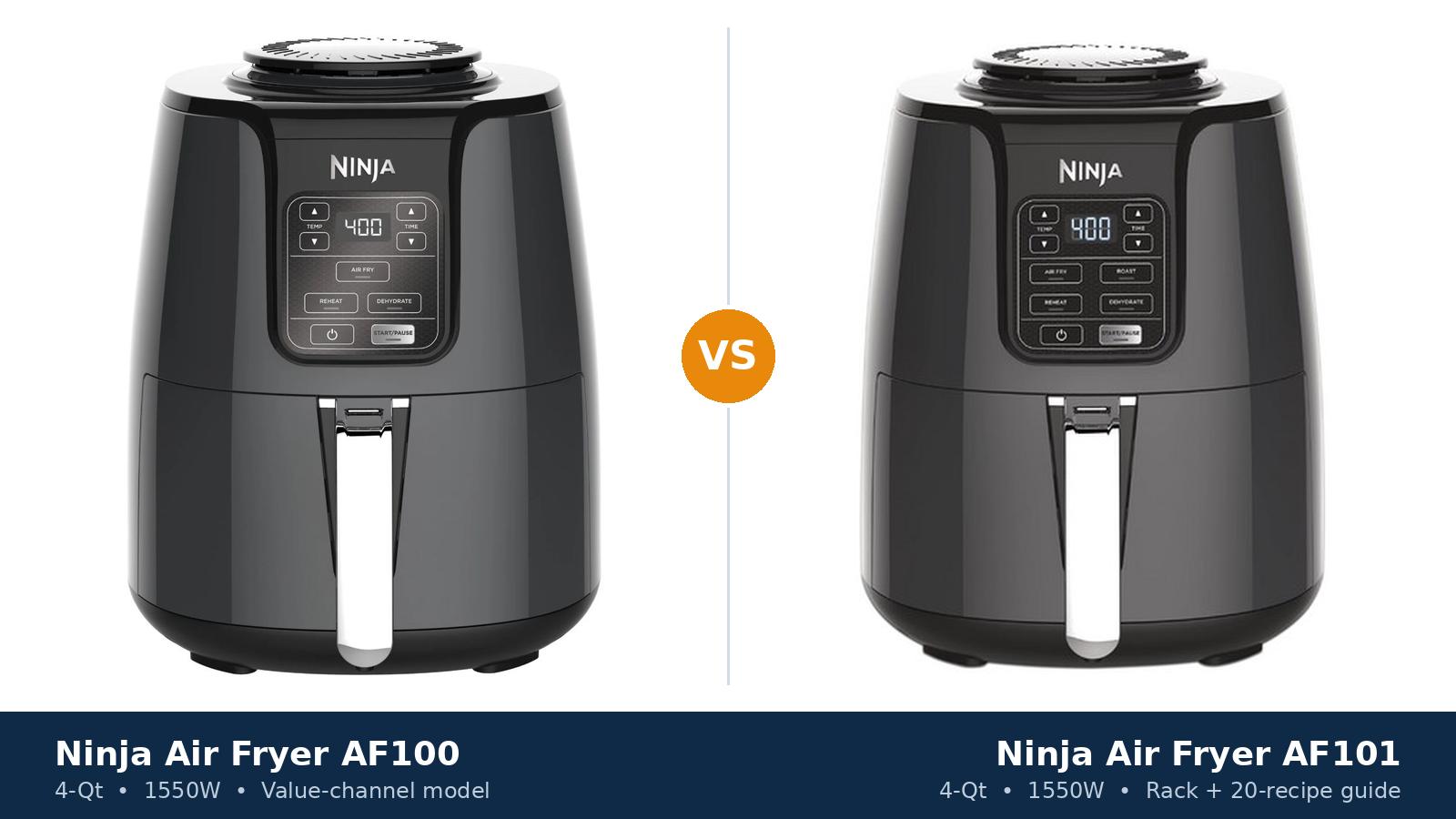
Two model numbers. One air fryer.
That is not our opinion. It is SharkNinja’s. Asked directly what separates the AF100 from the AF101, Ninja’s own customer support team answered that the two are “the same unit” — and then named the only real difference: what comes in the box.
So why does this comparison exist? Because the badge on the listing still changes what lands on your counter. One version includes a multi-layer rack and a bigger recipe guide. One widely sold version of the other quietly drops a whole cooking function from its control panel.
This guide separates the machine from the packaging. Every specification below comes from SharkNinja’s own owner’s guides and manufacturer product data. Where the AF100 name covers more than one variant, we say so — loudly, before you buy the wrong one.
Key Takeaways
- Same machine. Identical 1550W unit, 4-quart ceramic-coated basket, 105°F–400°F range, same body, same 1-year warranty. SharkNinja confirms it.
- The AF101 box is complete. It adds the stainless-steel multi-layer rack and a 20-recipe inspiration guide. The AF100 ships with a 10-recipe guide and no rack.
- Beware the AF100WM. The Walmart version of the AF100 is listed with three functions — Air Fry, Reheat, Dehydrate. The Roast button is gone. Check the panel before you buy any AF100.
- Cooking results are identical. Same heater, same fan logic, same basket. Nothing you cook will ever reveal which badge is on the front.
- Buy on box contents and price, not on the model number. A four-function AF100 with the rack is an AF101 in everything but name.
Quick Verdict
Buy the Ninja AF101 for most people. Not because it cooks better — it does not. Buy it because the badge guarantees the full package.
Every AF101 has the four-function panel: Air Fry, Roast, Reheat, Dehydrate. The box adds the multi-layer rack for two-layer dehydrating and a 20-recipe inspiration guide. There is exactly one AF101 specification, and it is the complete one.
Buy the Ninja AF100 if it is the cheaper listing and you have checked the panel. A four-function AF100 is the same fryer, and the rack is sold separately if you want it later.
But the AF100 name also covers Walmart’s AF100WM, which drops Roast entirely. If the price gap is small, the AF101’s certainty is worth more than the saving.
The Scorecard
Scores below are derived directly from the manufacturer specifications compared in this guide — capacity, function sets, included accessories and published dimensions. They are a reading aid, not benchmark results. One note matters: the AF100’s functions score reflects the AF100WM, the version US shoppers will actually find on shelves. A four-function AF100 matches the AF101 row for row.
| Category | Ninja AF100 | Ninja AF101 | ||
|---|---|---|---|---|
| Capacity & layered cooking | 8 / 10 | 9 / 10 | ||
| Cooking functions | 7 / 10 | 9 / 10 | ||
| Temperature & timer range | 9 / 10 | 9 / 10 | ||
| Ease of use | 9 / 10 | 9 / 10 | ||
| Cleaning | 9 / 10 | 9 / 10 | ||
| Footprint & storage | 9 / 10 | 9 / 10 | ||
| Value | 9 / 10 | 8 / 10 | ||
| Overall | 8.6 / 10 | 8.9 / 10 | ||
Read the table the way SharkNinja would. Five of seven rows are dead level, because the hardware is one product. The AF101 pulls ahead only where the box and the badge do the work: accessories included, and a function set you never have to second-guess.
At a Glance: Who Each Fryer Fits
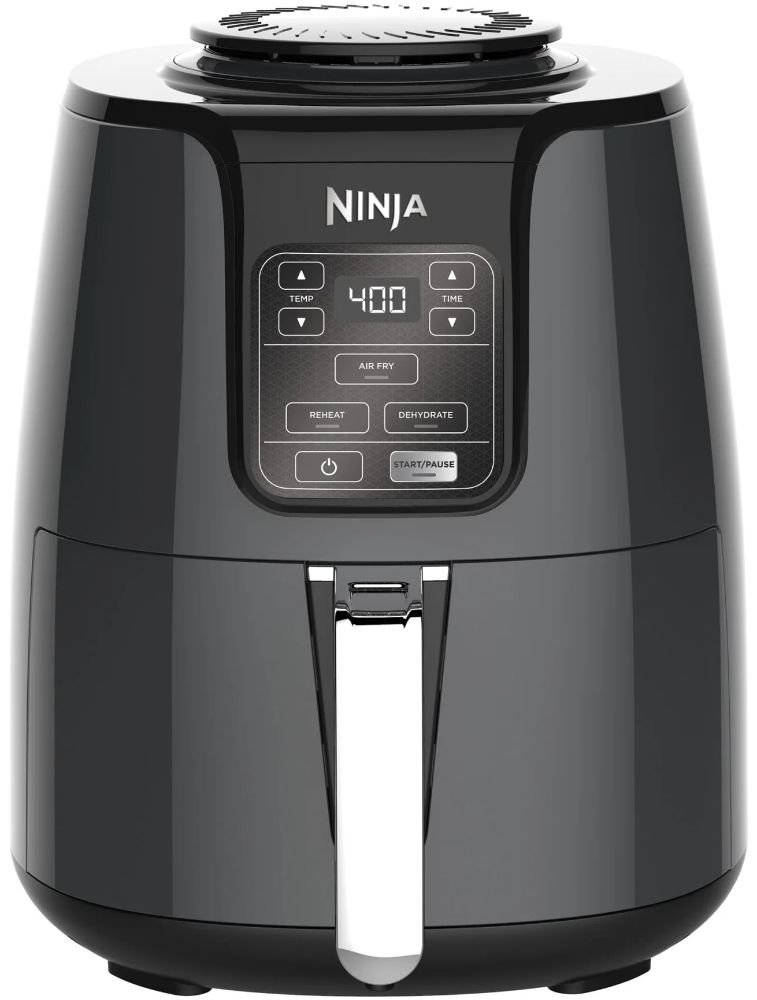
Ninja AF100
- The same 1550W, 4-quart unit as the AF101
- Ceramic-coated nonstick basket and crisper plate
- 10-recipe inspiration guide in the box
- No multi-layer rack included
- Walmart AF100WM variant drops the Roast function
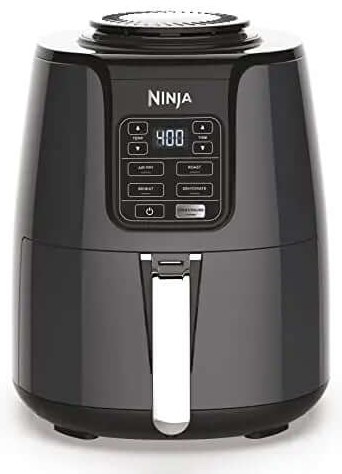
Ninja AF101
- The same 1550W, 4-quart unit as the AF100
- Four functions on every unit: Air Fry, Roast, Reheat, Dehydrate
- Multi-layer rack included for two-layer cooking
- 20-recipe inspiration guide in the box
- Black/gray high-gloss finish
Choose the AF100 if…
It is meaningfully cheaper than the AF101 on the day you buy, and the listing shows the full four-function panel.
You will never dehydrate in two layers, so the missing rack costs you nothing.
Or you are shopping Walmart anyway and the three-function AF100WM covers how you actually cook: fries, wings, reheated pizza, the odd batch of fruit chips.
Choose the AF101 if…
You want the complete package with no variant lottery. Four functions, the rack, the bigger recipe guide — every box, every time.
You plan to dehydrate regularly. The rack doubles the surface your jerky and apple chips can spread across.
Or the price gap between the two is small enough that certainty wins. With discontinued-era models, the complete box is also the easier one to resell or gift.
As an Amazon Associate I earn from qualifying purchases at no extra cost to you.
Specifications: The Specs That Actually Matter
Every figure below is taken from SharkNinja’s published owner’s guides and manufacturer product data. One warning before the table: “AF100” names a small family of channel variants, and the functions row is where they split. The note under the table explains.
| Specification | Ninja AF100 | Ninja AF101 |
|---|---|---|
| Capacity | 4 qt basket — fits 2 lbs of French fries | 4 qt basket — fits 2 lbs of French fries |
| Basket & crisper plate | Ceramic-coated nonstick, dishwasher safe | Ceramic-coated nonstick, dishwasher safe |
| Power | 1550 watts | 1550 watts |
| Voltage | 120V, 60Hz | 120V, 60Hz |
| Temperature range | 105°F–400°F | 105°F–400°F |
| Cooking functions | Air Fry, Roast, Reheat, Dehydrate on the AF100 series — but see the variant note | Air Fry, Roast, Reheat, Dehydrate — on every unit |
| Controls | Digital touch panel, TEMP/TIME arrows, Start/Pause | Digital touch panel, TEMP/TIME arrows, Start/Pause |
| Included accessories | Basket, crisper plate, 10-recipe inspiration guide | Basket, crisper plate, multi-layer rack, 20-recipe inspiration guide |
| Dimensions | 13.6 × 11 × 13.3 in | 13.6 × 11 × 13.3 in |
| Weight | About 10.1 lb (published figure) | About 10.6 lb (published figure) |
| Dishwasher-safe parts | Basket, crisper plate and accessories | Basket, crisper plate and accessories |
| Power cord | Short cord; manuals advise against extension cords (length not published) | Short cord; manuals advise against extension cords (length not published) |
| Warranty | 1-year limited (SharkNinja) | 1-year limited (SharkNinja) |
Variant note: the AF100’s owner’s guide lists four function buttons, including Roast. But the AF100WM sold at Walmart — the AF100 most US shoppers will meet — is listed in Walmart’s manufacturer-fed data with three functions only: Air Fry, Reheat and Dehydrate, and its control panel matches, with no Roast button. The AF100 also appears in white and navy as the AF100WMWH and AF100WM-N, and in Canada as the AF100C and red AF100CRD. The AF101 keeps one specification in black/gray; its Canadian twin is the AF101C.
Weight note: published weights for this shared body wander between roughly 10.1 and 10.6 lb depending on the listing. It is one housing. Weigh the difference in the table as rounding and packaging, not as two machines.
The Differences That Actually Matter
1. The hardware is identical — SharkNinja says so
Start with the fact that ends most arguments. SharkNinja’s customer support team, answering this exact question on a retailer’s product page, states that the AF100 and AF101 “are the same unit.”
The paper trail agrees. Both owner’s guides — AF100 Series and AF101, both dated 2018 — specify 120V, 60Hz and 1550 watts. Both describe the same ceramic-coated basket and crisper plate, the same touch panel, the same cooking method.
The secret both guides describe is a smart processor that adjusts fan speed to the selected function. Low and slow for dehydrating. Hard and fast for crisping. That processor does not know which badge is printed on the front.
So no section of this guide will pretend one fries better than the other. Fries, wings and reheats come out the same because the machine making them is the same. The real differences are smaller, stranger and entirely about retail packaging — starting with one missing button.
2. The Roast button — the one difference that changes dinner
Here is the trap in this comparison, and it is worth the whole visit. Look at the two panels in the photo at the top of this page.
The AF101’s panel carries four function buttons: Air Fry, Roast, Reheat, Dehydrate. The AF100WM’s panel carries three. There is no Roast button.
Walmart’s product data for the AF100WM says the same thing in words: three functions — air fry, reheat, dehydrate. The wide 105°F–400°F range survives, so the hardware can roast. The preset is simply not on the panel.
How much does that matter? Roast on these machines is a fan-and-temperature programme tuned for tender meats and roasted vegetables. A determined cook can approximate it with manual Air Fry settings.
But a preset you paid for should be on the machine you bought. If you roast weekly — vegetables, chicken pieces, baked treats — the AF100WM is the wrong SKU, and the AF101 (or a four-function AF100) is the right one.
The fix is a ten-second check: count the function buttons in the listing photo before you pay. Four buttons, any badge, and you have the full machine.
3. What’s in the box — a rack and ten extra recipes
This is the difference SharkNinja itself leads with. The AF101 includes the stainless-steel multi-layer rack. The AF100 does not.
It also includes a 20-recipe inspiration guide, where the AF100 includes a 10-recipe version. That is the whole of the official difference, confirmed by the manufacturer’s support team.
The rack is not a gimmick. It drops into the basket and adds a second cooking layer, which matters most for dehydrating — jerky, herbs, fruit and vegetable chips spread across two levels instead of one crowded floor.
Both owner’s guides acknowledge the arrangement. Each notes that if the rack is not included with your model, it is sold separately through Ninja’s accessories store. An AF100 plus a rack bought later is, functionally, an AF101.
One buyer’s caution, echoed in retailer Q&A: whether the rack is inside is printed in small type on the front of the box. Buying in person? Read the box, not the shelf tag.
4. Capacity — one basket, two stories
On paper this row is a tie, and on paper it stays one. Both machines cook in the same 4-quart ceramic-coated basket.
Ninja rates that basket at 2 lbs of French fries. In household terms: fries or wings for two to three people in one batch, a side dish for four, and batch cooking for anything bigger.
The rack changes the shape of the capacity rather than the size of it. With two layers, flat foods — the dehydrating loads, bacon, reheats — use the basket’s height as well as its floor. Without the rack, the same basket is a single layer with headroom.
For air frying proper, neither machine crisps better loaded past one layer. Crowding is crowding, whichever badge you bought. Judge capacity by the basket, and the basket is shared.
5. Cleaning and the coating — identical, and easy
No separation here either. On both models, the basket, crisper plate and any accessories can go in the dishwasher.
The coating is the same ceramic-coated nonstick on basket and plate. SharkNinja describes it as PTFE- and PFOA-free, and designed to last the life of the machine.
The main unit never goes near water. Both guides give the same routine: unplug, cool, wipe the body and panel with a damp cloth, brush residue off the heating element.
Stuck-on residue gets the same advice in both manuals — soak the basket or plate in warm, soapy water before washing. Two badges, one sink routine.
6. Size, weight and cord — one footprint
Both machines occupy the same counter space: roughly 13.6 inches deep, 11 inches wide and 13.3 inches tall in published manufacturer data.
That height matters more than the footprint. These are tall units with a top air intake, and both guides insist on clear space above and on all sides for circulation. Measure your under-cabinet gap before either badge comes home.
Published weights wander — about 10.1 lb in one listing’s data, about 10.6 lb in another’s — for what is a single shared housing. Treat the difference as packaging and rounding. Neither machine is the lighter one in any way a wrist would notice.
The cord story is also shared. Both guides specify a short power-supply cord and warn against extension cords. SharkNinja does not publish an exact cord length for the US models, so we will not invent one: plan for this fryer to live near an outlet.
7. Colors and channels — where each badge actually lives
The AF101 is the general-retail model. Black and gray with a high-gloss finish, sold through the big electronics and home retailers, with the Canadian AF101C as its twin.
The AF100 is the value-channel model, and it dresses accordingly. Walmart’s AF100WM comes in black, and the line stretches to white (AF100WMWH) and navy (AF100WM-N) versions. Canada gets the AF100C, including a red AF100CRD.
Color is the one place the AF100 genuinely out-choices the AF101. If your kitchen wants a white or navy fryer, the AF100 family is where those finishes live.
Just remember what travels with the AF100 badge: variant discipline. The color you want and the panel you want are separate checks, and the WM panel is the three-function one.
Who Each Fryer Suits: Household & Use-Case Fit
Because the machines are shared, this table is really about households and shopping channels. Find your row.
| Your household / use case | AF100 | AF101 | Our call |
|---|---|---|---|
| Solo cook or couple, weeknight fries and wings | Excellent | Excellent | Buy whichever is cheaper |
| Family sides for 3–4 people | Good — one batch at a time | Good — one batch at a time | Tie; consider a 5-qt+ model if this is daily |
| Dehydrating jerky, fruit and herbs | Workable — rack sold separately | Excellent — rack in the box | AF101 |
| Roasting vegetables and chicken pieces | Depends — the AF100WM has no Roast button | Excellent — Roast on every unit | AF101, or a four-function AF100 |
| Dorm, RV or first apartment on a budget | Excellent — value-channel pricing | Good | AF100 (check the panel) |
| Reheat-heavy kitchen: pizza, leftovers, snacks | Excellent | Excellent | Tie — Reheat is on every variant |
| Gift buying | Good — verify the variant first | Excellent — one spec, complete box | AF101 |
Notice the pattern in the calls. The AF101 wins the rows where certainty and accessories matter. The AF100 wins where price matters and the buyer is willing to check one panel photo. The cooking rows never separate them.
Ready to check today’s price?
Both models sell through Amazon. Prices move, so check the live figure on the package that fits your kitchen.
View on Amazon — Ninja AF100View on Amazon — Ninja AF101The 30-Second Decision
| If this sounds like you… | Buy this |
|---|---|
| “I just want the complete, no-surprises version.” | AF101 |
| “It’s cheaper, and the panel in the photo has four buttons.” | AF100 — same machine, better deal |
| “I dehydrate jerky and fruit chips regularly.” | AF101 (rack included) |
| “The Walmart one is on rollback and I mostly air fry and reheat.” | AF100WM — knowingly, without Roast |
| “I need a white or navy fryer to match the kitchen.” | AF100WM family (white / navy variants) |
| “I’m buying refurbished and want the longest cover.” | Whichever listing carries the better warranty term — check it |
What You Gain. What You Give Up.
Ninja AF100
You gain: the same fryer for typically less money, through value channels that discount it hard. Color choices the AF101 never offers — white and navy alongside black. And full access to the same accessory ecosystem, rack included, whenever you want it.
You give up: certainty. The badge covers a three-function Walmart variant and a four-function series model, so every purchase starts with a panel check. The rack and the bigger recipe guide are not in the box, and the rack costs extra if you want it later.
Ninja AF101
You gain: the complete, single-specification package. Four functions on every unit, the multi-layer rack in the box, the 20-recipe guide, and no variant homework before checkout.
You give up: the bargain and the palette. The AF101 usually asks more than the AF100WM on sale, and it comes in black/gray only. You are paying for completeness and certainty — not for one extra degree of heat or one extra fry.
Pros and Cons
AF100 — Pros
- Identical cooking hardware to the AF101
- Usually the cheaper way to buy this machine
- White and navy variants in the WM line
- Same dishwasher-safe basket and plate
- Rack available separately to complete the set
Cons
- AF100WM drops the Roast function
- No multi-layer rack in the box
- Smaller 10-recipe inspiration guide
- Variant suffixes demand a careful listing check
AF101 — Pros
- Four functions guaranteed on every unit
- Multi-layer rack included for dehydrating
- 20-recipe inspiration guide included
- One specification — no variant lottery
- Same 1-year SharkNinja warranty
Cons
- Typically priced above AF100WM deals
- Black/gray is the only US finish
- Cooks no better than the cheaper badge
- Discontinued-era stock can be priced by scarcity
Check the Suffix and the Panel, Not Just the Price
Check the suffix. “AF100” alone is an incomplete description. The letters after it tell you the channel and, at Walmart, the function set.
AF100WM is Walmart’s model, listed with Air Fry, Reheat and Dehydrate only. AF100WMWH is its white version; AF100WM-N is navy. In Canada, AF100C and the red AF100CRD carry the full series specification.
Count the buttons. This is the whole buying skill for this comparison. Four function buttons in the listing photo — Air Fry, Roast, Reheat, Dehydrate — means the full machine, whichever badge is attached.
Three buttons means the WM panel. Buy it knowingly, for air frying and reheating, or do not buy it at all.
Check the box front. SharkNinja prints the rack inclusion in small type on the packaging. One verified buyer’s whole AF100-versus-AF101 saga ended with that line of print. Read it before the box leaves the store.
Check new against renewed. Both models are discontinued-era stock now, and refurbished units circulate widely. A factory-reconditioned AF100 seen at Woot carried a 90-day warranty against the standard 1-year limited warranty on a new unit. On older models, the warranty term is part of the price — compare it, not just the number.
Mind the border. The AF101C is the Canadian twin and carries its own listings; the European AF100 is a different, 3.8-litre, 220–240V machine. A cheap import listing can be the wrong voltage and the wrong capacity in one box.
The Upgrade Path Test
Judge these two by what happens after the purchase, because the purchase itself is a coin flip.
Year one, both machines cook identically, because they are identical. The AF101 owner dehydrates on two layers from day one. The AF100 owner can close that gap with one accessory order — the rack, crisper plates and replacement baskets all live in Ninja’s accessories store, and the shared body means the ecosystem is one ecosystem.
The honest ceiling is also shared. Both are 4-quart, single-basket, 400°F machines. The day your household outgrows them, it outgrows both at once.
That upgrade sounds like this: a 5-quart-plus basket for family batches, a 450°F Max Crisp mode for harder searing, or two baskets cooking at once. Ninja’s later Pro, Max XL and DualZone models are those answers. Neither an AF100 nor an AF101 delays that day by a single meal.
When to Skip Both
Honesty cuts both ways. There are kitchens neither of these machines serves well.
Skip both if you regularly cook for five or more. A 4-quart basket means batches, and batches mean the first plate goes cold — retailer support staff steer family-of-five shoppers to 6-quart models for exactly this reason.
Skip both if you want 450°F Max Crisp heat, a viewing window, or app control. This is a 2018 design: superb at its job, innocent of everything invented since.
Skip both if a discontinued badge’s price has drifted up near a current model’s. Scarcity pricing on old stock is real, and a newer 5-quart Ninja with a full warranty is the better buy at the same money.
For everyone else — small households who want the original, proven 4-quart Ninja — one of these two is the right answer. The only question is which box it ships in.
Final Verdict
The Ninja AF101 is the one we would buy.
It wins this comparison without cooking a single fry better than its rival. It wins on completeness: the four-function panel on every unit, the multi-layer rack in the box, the 20-recipe guide, and a badge that means exactly one thing.
When two products are the same machine, the verdict goes to the version that removes doubt. That is the AF101.
Buy the AF101 for dehydrating, roasting, gifting, and any purchase you do not want to research twice.
Buy the AF100 when it is the deal in front of you and the panel checks out — four buttons, or three buttons knowingly accepted at a Walmart price.
It is the same fryer wearing a thriftier badge. Just buy it with your eyes open, because with this model number, the listing details are the product.
Watch Out: Similar Names, Different Machines
Ninja’s AF numbering rewards a slow reader. Four warnings belong in every version of this guide.
First: AF100 and AF100WM are not automatically the same package. The WM is Walmart’s variant, and its panel drops Roast. The suffix is the specification.
Second: AF101C is the Canadian AF101, sold under separate listings. Same fryer, different catalogue — and the European AF100 models are different again: 3.8 litres, 220–240V, unusable on a US outlet without conversion.
Third: the AF141 Air Fryer Pro and AF161 Max XL are later, larger machines that borrow this family’s face. A listing that says “AF1” and stops there has told you nothing. Read the whole model number.
Fourth: “Renewed” and “Factory Reconditioned” AF100s and AF101s are the same hardware with different warranty terms and unknown histories. Price them as used appliances, not as bargains on new ones.
Slow down on the product page. Match the full model number, count the function buttons, then check the price — in that order.
Counter, Clearance and Cabling Notes
Both machines are tall, top-venting units. The guides ask for adequate space above and on all sides while cooking, so a low cabinet over the only outlet can rule out both badges at once.
The basket comes out hot and heavy with food. Both manuals repeat the same cautions: heat-safe surfaces only, oven mitts for handling, and let the unit cool — around 30 minutes — before cleaning or storing.
Preheat like the guides say: three minutes before ingredients go in. It is the cheapest cooking upgrade either model offers, and it costs nothing.
One shared limitation to plan around: the short cord and the no-extension-cord rule mean this fryer lives within a short reach of an outlet. Decide which outlet that is before you decide which badge to buy.
Warranty and Long-Term Support
Both models carry SharkNinja’s 1-year limited warranty when bought new from an authorized retailer. It covers the original unit and non-wearable components found defective in materials or workmanship.
Know the wearable-parts clause, because it names the parts you touch daily: the warranty text in the AF100 guide excludes normal wear and tear of the basket, crisper plate, racks and pans. The coating is consumable. Treat it gently and it lasts; abuse it and the replacement is on you.
Support runs through the same channels for both badges: product registration at registeryourninja.com, customer service at 1-877-646-5288, and replacement parts and accessories — baskets, crisper plates, the multi-layer rack — through Ninja’s accessories store.
That shared parts shelf is the quiet longevity story here. A discontinued model with live parts support ages far better than a current model without it, and both of these still have it.
Frequently Asked Questions
Are the Ninja AF100 and AF101 actually different air fryers?
No. SharkNinja’s own customer support states that the AF100 and AF101 are the same unit — same 1550W base, same 4-quart ceramic-coated basket, same 105°F–400°F range. The official differences are the box contents: the AF101 adds a multi-layer rack and a 20-recipe inspiration guide, where the AF100 includes a 10-recipe guide.
Does the AF100 have a Roast function?
It depends which AF100. The AF100 Series owner’s guide lists four function buttons, including Roast. But the AF100WM sold at Walmart is listed with three functions — Air Fry, Reheat and Dehydrate — and its panel has no Roast button. Count the function buttons in the listing photo before buying any AF100.
Which model comes with the multi-layer rack?
The AF101. The stainless-steel multi-layer rack is part of the AF101 package and adds a second layer for dehydrating and cooking. AF100 owners can buy the same rack separately from Ninja’s accessories store — both owner’s guides say so — and AF101 packaging varies rarely enough that checking the box front for the inclusion note is still wise.
Is the AF101 more powerful than the AF100?
No. Both owner’s guides specify 1550 watts at 120V, 60Hz, and both use the same smart-processor fan logic across the same 105°F–400°F range. Claims of a wattage gap between them — in either direction — do not survive the manuals.
Which one is bigger?
Neither. It is one shared body: published manufacturer data puts both at about 13.6 × 11 × 13.3 inches. Published weights differ slightly by listing (roughly 10.1 to 10.6 lb), which reflects packaging and rounding rather than two different machines.
Are the basket and parts dishwasher safe on both?
Yes. On both models the ceramic-coated nonstick basket, crisper plate and accessories are dishwasher safe. The main unit is not — both guides say to wipe it with a damp cloth and never immerse it. SharkNinja describes the coating as PTFE- and PFOA-free.
What warranty do the AF100 and AF101 carry?
A 1-year limited warranty from SharkNinja when bought new from an authorized retailer, covering the unit and non-wearable components. Wearable parts such as the basket, crisper plate and racks are excluded for normal wear and tear. Refurbished units carry shorter terms — one factory-reconditioned listing offered 90 days — so check the term on any renewed listing.
Should I buy the AF100 or AF101 in 2026?
Buy the AF101 if prices are close: the complete box and guaranteed four-function panel remove all doubt. Buy the AF100 when it is clearly cheaper and you have verified the variant — four function buttons, or the three-function AF100WM accepted knowingly for air frying and reheating. If either badge costs near a current 5-quart model, buy the newer machine instead.
Sources & Verification
Ninja AF100 Series Owner’s Guide (SharkNinja Operating LLC, © 2018) • Ninja AF101 Owner’s Guide (SharkNinja Operating LLC, © 2018) • SharkNinja Customer Support answer on the Best Buy AF101 product page (“the same unit”; rack and recipe-guide differences; PTFE/PFOA-free coating) • Walmart manufacturer product data for the AF100WM (three functions, 1550W, 4-qt) • Best Buy manufacturer data for the AF101 (model AF101, UPC 622356554572, 10.58 lb) • Amazon listing data used only to verify ASINs B07FDJMC9Q (AF101) and B0FGK1VDKC (AF100). Specifications verified November 2026.

James Wilson
James has been testing and comparing kitchen appliances and PC hardware for over a decade and writes Honestly Compared’s buying guides. His rule for every comparison: the verdict has to survive the spec sheet, not the marketing page.