
Ninja AF101C vs AF100C: Which Should You Buy?
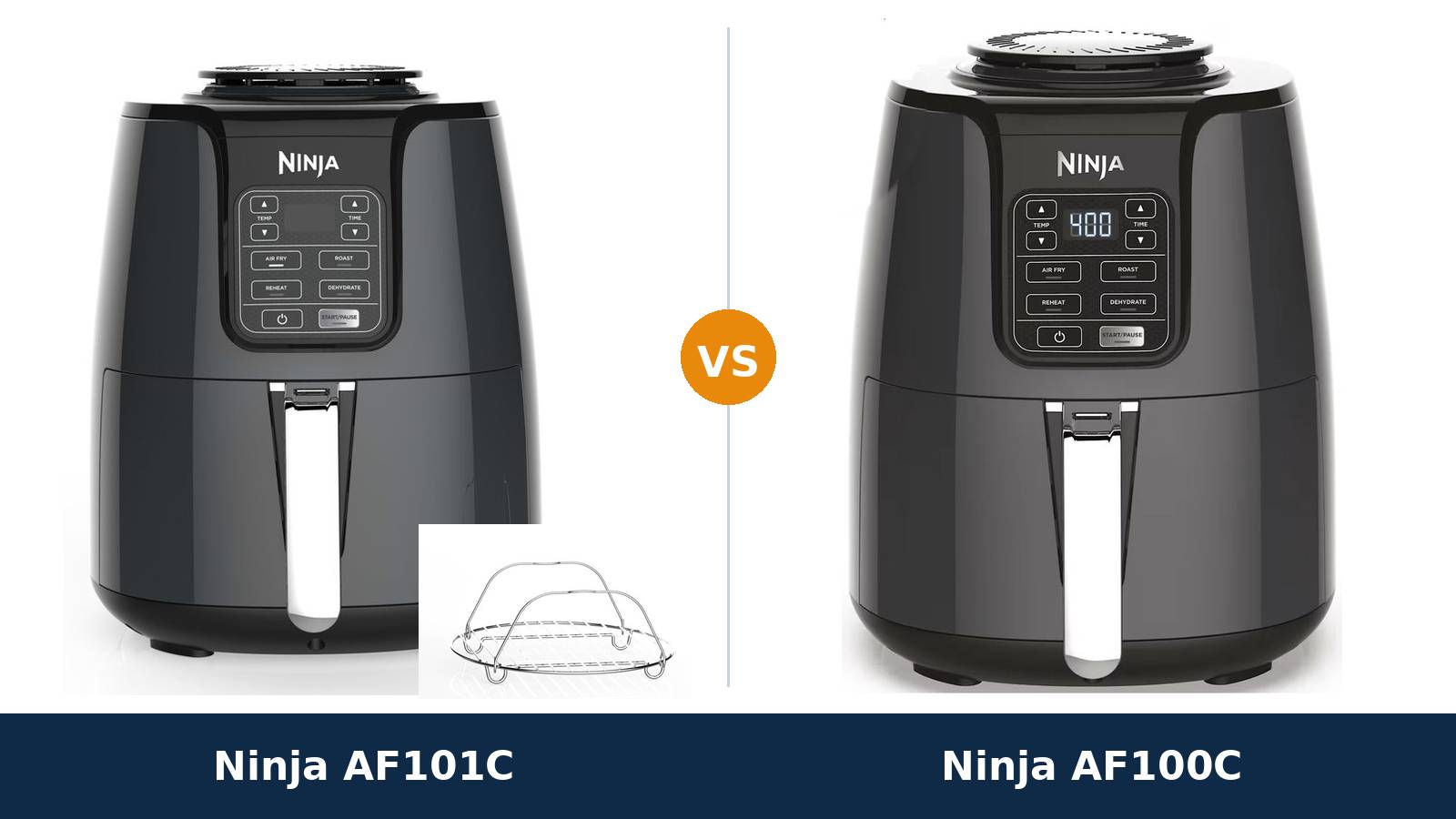
Most comparisons on this site are about choosing between two different machines. This one is about something slipperier: choosing between two listings for what is, underneath the badges, the same machine — and making sure the box that arrives matches the badge you paid for.
First, the determination, stated plainly: the AF101C and AF100C are SharkNinja’s Canadian-market models. The trailing C is the company’s Canadian suffix, the same one carried by the DZ201C, AF141C and SP101C. Both of these fryers were built for Canadian shelves — bilingual guides, 120V Canadian household supply, warranty administered by SharkNinja Canada out of Mississauga, Ontario. Neither model has ever had an Amazon.com listing, so the Amazon buttons on this page are honest placeholders rather than links. We do not point a US button at a Canadian listing, and we do not borrow the US models’ links either.
So why does this page exist? Because Canadian shoppers still meet these two badges side by side — one current, one older — and the gap between them is exactly the kind that resellers exploit. The AF100C is the configuration SharkNinja Canada stocks today. The AF101C is an earlier bundle configuration of the identical fryer, now circulating mostly through marketplace sellers and leftover stock. One includes a genuinely useful extra. The other is simply easier to buy new.
Everything below is drawn from SharkNinja’s own Canadian pages, the models’ owner’s guides and manufacturer data. Where the two machines tie, we score the tie. Where a listing tries to make one look bigger, hotter or newer than it is, we call that out too.
Key Takeaways
- Both badges are Canadian. The C suffix marks SharkNinja’s Canadian-market versions of its 4-quart AF100-series fryer. Sales, support and warranty all run through Canadian channels; there is no Amazon.com listing for either.
- There is one fryer here, not two. Identical 1550W unit, identical 105–400°F range, identical four functions — Air Fry, Roast, Reheat, Dehydrate — and the same ceramic-coated 4-quart basket and crisper plate.
- The entire product difference fits in one line of the parts list. The AF101C ships with a multi-layer rack for two-level cooking and larger dehydrating batches. The AF100C’s box contains no rack.
- Do not be fooled by “3.8 L” next to “4-Qt.” Those are two labels for the same basket — 4 US quarts is 3.78 litres — and both fryers are rated for about 2 lbs of fries.
- Only one of them is a current model. SharkNinja Canada sells the AF100C now, in Charcoal Grey, Navy (AF100CNV) and Red (AF100CRD). The AF101C dates from 2018 and survives mainly as marketplace stock.
Quick Verdict
Buy the Ninja AF101C if the rack is a tool you will actually use. It is the same fryer as its rival, plus a wire rack that adds a second cooking level and roughly doubles dehydrating surface. If you find one complete, in the box, at a sane price, it is the more capable purchase.
Buy the Ninja AF100C if you want the straightforward purchase. Same cooking, same cleaning, same countertop footprint — sold new by the manufacturer today, in three colours, with none of the stock archaeology the older badge now requires.
One warning before you order either: because the AF101C now trades mostly through third parties, the rack must be verified in the delivered box, not assumed from the listing title. An AF101C without its rack is just an AF100C wearing a longer name.
The Scorecard
| Category | AF101C | AF100C | ||
|---|---|---|---|---|
| Capacity & batch size | 8.5 / 10 | 8.5 / 10 | ||
| Cooking design & versatility | 8.4 / 10 | 8.0 / 10 | ||
| Ease of use | 8.6 / 10 | 8.6 / 10 | ||
| Cleaning & care | 8.6 / 10 | 8.6 / 10 | ||
| Countertop footprint | 8.2 / 10 | 8.2 / 10 | ||
| Value & availability | 6.5 / 10 | 7.0 / 10 | ||
| Overall | 7.5 / 10 | 7.3 / 10 | ||
Every score here is built from the compared specifications and box contents — capacity, function set, included accessories and present-day availability — never from prices or star ratings. One disclosure explains the low overalls: the missing Amazon.com listing costs both models marks with this site’s largely American readership. A Canadian shopper should mentally restore those marks, score the pair level with their US equivalents, and settle the choice on the rack alone.
At a Glance: Who Each Fryer Fits
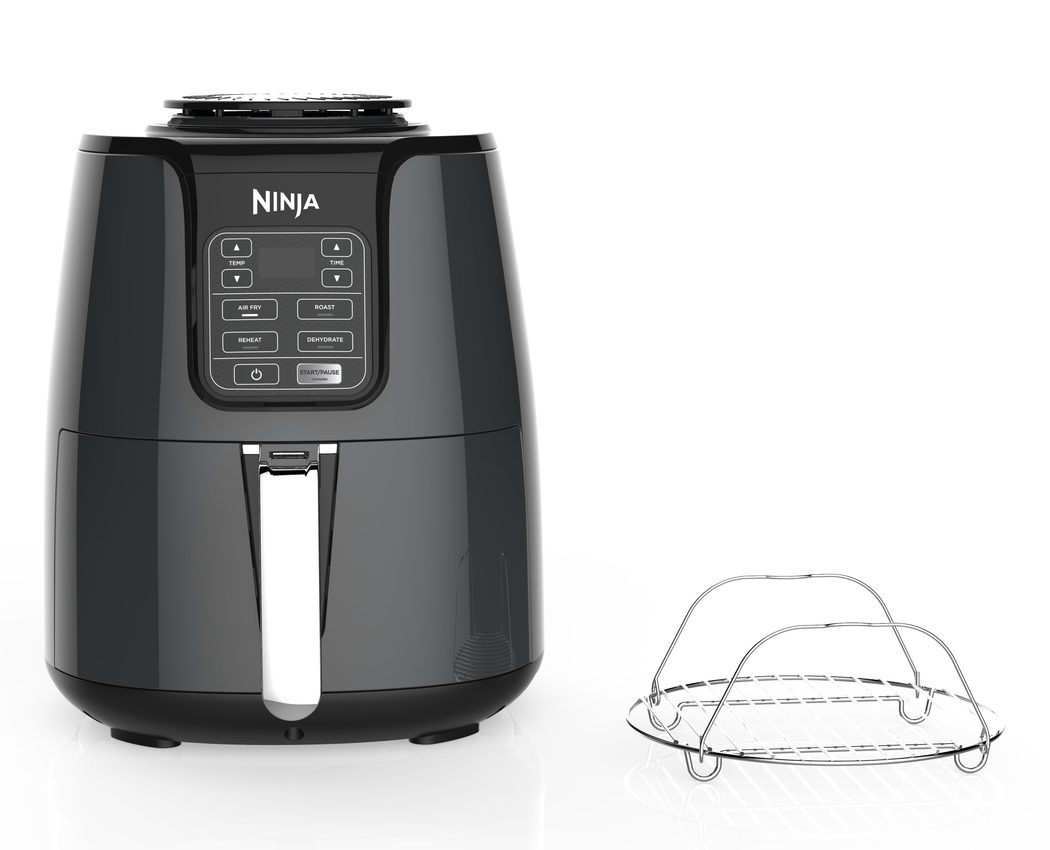
Ninja AF101C
- 4-qt (3.8 L) basket — rated for about 2 lbs of fries
- 1550W, 105–400°F, four functions including Roast
- Multi-layer rack included in the box
- Canadian-market model — black finish
- Basket, crisper plate and rack all dishwasher safe
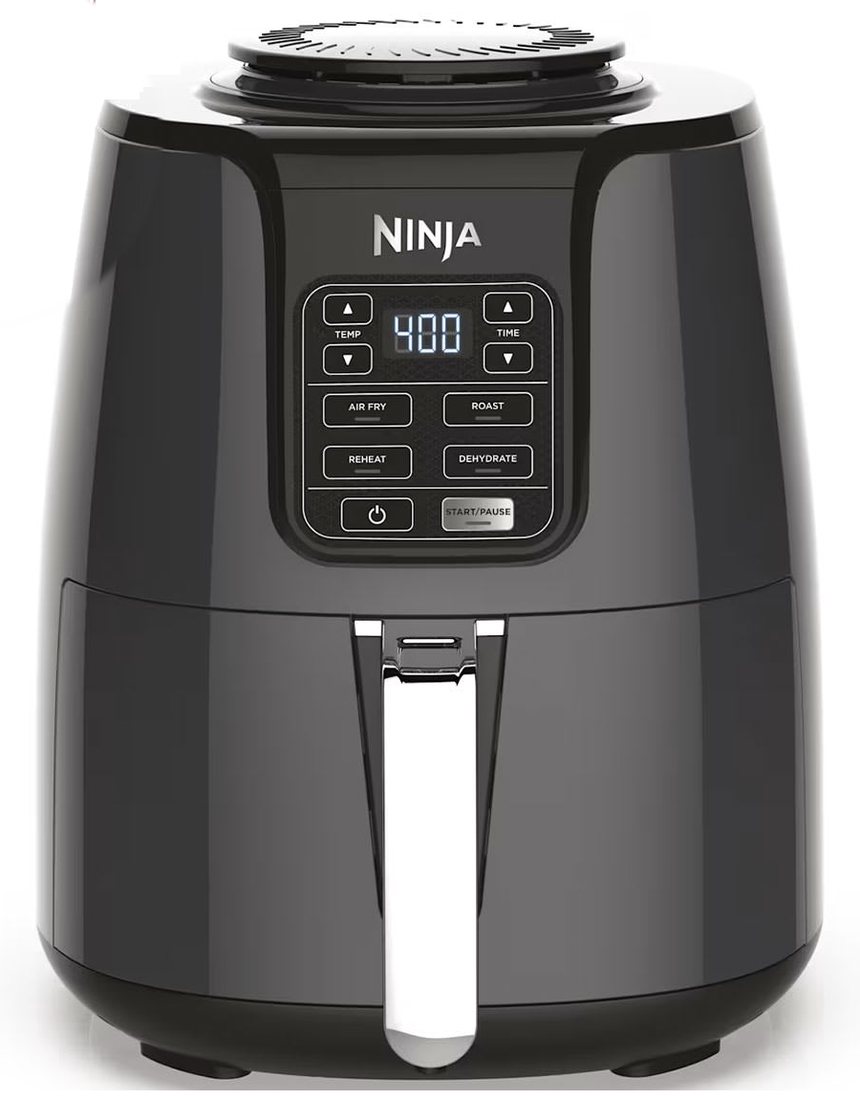
Ninja AF100C
- 4-qt (3.8 L) basket — rated for about 2 lbs of fries
- 1550W, 105–400°F, four functions including Roast
- No rack in the box — unit, basket, plate and cord
- Canadian-market model — Charcoal Grey, Navy or Red
- The configuration SharkNinja Canada currently sells
Choose the AF101C if…
Dehydrating and two-layer cooking are real habits in your kitchen, not aspirations. The rack turns one flat layer of food into two, and it is far easier to get it inside the original box than to chase the correct part afterwards.
Choose the AF100C if…
You would rather buy the current model from a first-party shelf and be done. It cooks identically, it comes in colours the AF101C never offered, and its supply chain is the manufacturer’s own. If a seller is charging a bundle premium for the AF101C name while the rack’s presence is vague, that premium is buying a story — decline it.
As an Amazon Associate I earn from qualifying purchases at no extra cost to you.
Specifications: The Specs That Actually Matter
| Specification | Ninja AF101C | Ninja AF100C |
|---|---|---|
| Capacity | 4 qt (3.8 L) — labelled 3.8 L in Canada | 4 qt (3.8 L) — labelled 4-Qt in Canada |
| Fits | About 2 lbs of French fries | About 2 lbs of French fries |
| Wattage | 1550W | 1550W |
| Voltage | 120V, 60Hz | 120V, 60Hz |
| Temperature range | 105–400°F | 105–400°F |
| Cooking functions | Air Fry, Roast, Reheat, Dehydrate | Air Fry, Roast, Reheat, Dehydrate |
| Basket type & material | Ceramic-coated nonstick basket | Ceramic-coated nonstick basket |
| Crisper plate | Ceramic-coated nonstick, included | Ceramic-coated nonstick, included |
| Included accessories | Multi-layer rack included; recipe guide (page count not published for the Canadian box) | 20-recipe booklet (SharkNinja Canada listing); no rack |
| Dishwasher-safe parts | Basket, crisper plate, multi-layer rack | Basket, crisper plate |
| Dimensions (D × W × H) | 13.7 × 11 × 13.2 in (34.8 × 28 × 33.5 cm) | 13.7 × 11 × 13.2 in (34.8 × 28 × 33.5 cm) |
| Weight | ≈10.1 lb (4.6 kg) | ≈10.1 lb (4.6 kg) |
| Cord length | Not published for this model | ≈36 in (91 cm) |
| Colour | Black | Charcoal Grey; also Navy (AF100CNV) and Red (AF100CRD) |
| Market | Canada — SharkNinja Canada, Canadian retail, Amazon.ca | Canada — SharkNinja Canada, Canadian retail, Amazon.ca |
| Warranty | 1-year limited (SharkNinja Canada) | 1-year limited (SharkNinja Canada) |
A word on where these numbers come from: the table follows SharkNinja Canada’s published figures for the family. Amazon.ca’s data fields record a slightly heavier unit (4.8 kg) and dimensions a few millimetres apart from the manufacturer’s — the kind of variance you get when a marketplace measures the shipping box instead of the appliance. Best Buy Canada rounds the body to roughly 14 × 11 × 13 inches. Three sources, one shared body; the manufacturer’s measurements govern here.
The Differences That Actually Matter
1. Where these badges meet now: a shelf versus a marketplace
The most important difference between these models is not in either box. It is in where the boxes sit.
The AF100C occupies the normal retail position. SharkNinja Canada lists it on its own store today, Best Buy Canada stocks it, and its three colourways — the standard Charcoal Grey plus Navy and Red editions under their own model codes — are ordinary current catalogue items.
The AF101C left that shelf years ago. It launched in Canada in 2018 as the bundle configuration, and the stock that remains now moves through marketplace sellers, warehouse channels and the occasional clearance listing. That does not make it a bad buy. It makes it a buy that needs auditing — which is exactly what the rest of this page does.
Underneath the channel difference sits the market determination: both are Canadian configurations of the US AF100-series fryer, built for 120V Canadian outlets, documented in bilingual guides, and warranted by SharkNinja Canada. American readers meet the same hardware as the AF100 and AF101, compared elsewhere on this site.
2. The hardware audit: line by line, a tie
Put the two specification sheets next to each other and read down. Wattage: 1550W, both. Temperature span: 105 to 400°F, both. Basket: the same 4-quart ceramic-coated nonstick basket with the same crisper plate, both. Body: the same shell, the same published dimensions, the same roughly ten-pound carry.
There is no hidden revision to hunt for here — no quieter fan, no improved heater, no second-generation panel separating an early unit from a late one. SharkNinja’s own support position on the US parents of these models is that the AF100 and AF101 are the same unit differentiated by box contents, and the Canadian pair inherits that arrangement exactly.
The practical consequence deserves emphasis. Any cooking claim made for one of these fryers is automatically true of the other: same fries rating, same roast performance, same reheating behaviour. A review or listing that credits the AF101C with better cooking is describing a wire rack’s effect, or nothing at all.
3. Litres versus quarts: the label that pretends to be a size difference
Canadian listings present the AF101C as a 3.8-litre fryer and the AF100C as a 4-quart fryer. Read quickly, the AF100C sounds like the larger appliance. Read with a conversion table, the illusion collapses: 4 US quarts equals 3.78 litres.
SharkNinja Canada gives the game away on its own AF100C page, calling the basket “family-sized 4-quart” in the description and “3.8 l” in the contents list of the same product. The two badges simply inherited different labelling habits — metric on the older listing, imperial on the current one.
So capacity scores a flat tie, in the table and in the kitchen. Both baskets hold about 2 lbs of fries by Ninja’s own measure, feed one to four people depending on the dish, and ask a family of five to cook in batches. Nobody who buys the “bigger” label gets a single extra fry.
4. Count the buttons: four functions, and Roast survives the border
The fastest identity check on this family takes five seconds. Look at the control panel in the manufacturer’s photos: beneath the temperature and time arrows sit four labelled keys — Air Fry, Roast, Reheat, Dehydrate — flanking a shared display. Both Canadian models carry all four, and the AF100C’s owner’s manual walks through each one.
This check matters because the family has a genuinely cut-down member, and its reputation travels. The US Walmart-channel AF100WM ships with three functions and no Roast button. Canadian buyers who read US forums sometimes assume the AF100C inherited the same cut. It did not: the manual, the panel photograph and Best Buy Canada’s specification all confirm the full set.
One honest footnote on the fourth button. Dehydrate on either model is a patient, low-temperature mode suited to jerky, apple chips and herbs in modest quantities. It is a useful extra, not a countertop dehydrator — and its usefulness is precisely where the next difference bites.
5. The rack: the only difference, and only if it is in the box
Here is the comparison’s whole hardware story. The AF101C’s box includes a multi-layer rack. The AF100C’s does not — its manual’s parts list runs to the main unit, the basket, the crisper plate and the cord, full stop. SharkNinja Canada’s current AF100C listing adds a 20-recipe booklet to that box, which is welcome, but paper is not equipment.
The rack itself is a simple wire frame that stands inside the basket and creates a second tier. Cooking on two levels means wings below and vegetables above in a single run. Dehydrating on two levels means roughly double the drying surface, turning a garnish-sized batch of herbs or fruit into one worth switching the machine on for. It is dishwasher safe, like the basket and plate it joins.
Now the audit point, and it is the reason this article is framed the way it is: the rack’s value exists only when the rack is physically present. On a current-model purchase that is guaranteed by the parts list. On a marketplace purchase of a discontinued bundle, it is guaranteed by nothing except the seller’s accuracy. Open the box before the return window closes. If the rack is missing, you hold an AF100C’s contents at an AF101C’s price, and the correct response is a return or a renegotiation — not a shrug.
Retrofitting later is a weak plan B. The rack physically fits the shared basket, but Canadian standalone supply is thin and cross-border parts listings are unreliable on fit and shipping costs. Buy the configuration that already contains the part.
6. Cleaning: identical rules, one extra item in the sink
Wash-up is a tie with a footnote. Both baskets and crisper plates carry the same ceramic nonstick coating and the same dishwasher clearance; the AF101C’s rack is cleared for the dishwasher as well under the family’s Canadian guide. The main unit of either fryer wipes down and never goes near water, as with every model in this line.
The coating is the long-term asset on both machines. Ceramic nonstick is not the PTFE of older fryers, but it still rewards the same handling: silicone or plastic tools, a soak before any scrubbing, nothing abrasive. Follow those rules and the surface serves for years; ignore them and both badges degrade at the same rate, because it is literally the same surface.
The footnote cuts in the AF101C’s favour. A second cooking level means less food pressed and baked directly onto the basket floor across a week of dinners, which is where the stubborn residue lives. It is a modest, real advantage — the sort that never appears on a spec sheet.
7. Vintage versus current: colours, stock and the value column
Scorecards need one column the spec sheet cannot supply, and here it is decisive enough to give the AF100C its only category win.
The AF100C is the living product. It can be ordered from the manufacturer today, it arrives with current stock and a clean warranty start, and it offers a choice the older model never had: Charcoal Grey as standard, or the same fryer finished in Navy (model AF100CNV) or Red (AF100CRD). For a visible countertop appliance, that choice is worth something real.
The AF101C is the discontinued bundle: black only, first sold in 2018, remaining units scattered across third-party sellers with all the variance in condition and completeness that implies. Its overall score is docked for that availability — and, as disclosed under the scorecard, both models are docked for lacking an Amazon.com listing at all. Strip the market penalties away and the hardware verdict is the simple one: the AF101C’s rack makes it the better-equipped box, full stop.
Household & Use-Case Fit Guide
| Your household / use case | Better fit | Why |
|---|---|---|
| Solo cook or couple, standard meals | Either — total tie | One shared basket, heater and function set; availability should decide |
| Family of 3–4, sides and snacks nightly | Either — total tie | The 2-lb fries rating is common to both, and so is the batching rhythm |
| Jerky, fruit and herb dehydrating | AF101C | Two rack levels roughly double the drying area in each run |
| Two-layer cooking (mains + veg together) | AF101C | Only this box contains the multi-layer rack |
| Colour-matching a navy or red kitchen | AF100C | Navy (AF100CNV) and Red (AF100CRD) editions exist; the AF101C comes in black alone |
| Buying new from the manufacturer today | AF100C | It is the configuration on SharkNinja Canada’s current catalogue |
| US shopper | Neither | Canadian-market machines with no Amazon.com presence; the AF101 and AF100 are your versions |
| Small counter, tight cupboards | Either — total tie | Identical 13.7 × 11 × 13.2 in shell at roughly ten pounds |
Ready to check today’s price?
Amazon.com carries neither of these Canadian models, so the buttons below stand as placeholders rather than links. Canadian readers can go straight to SharkNinja Canada or a Canadian retailer for live pricing on both.
View on Amazon — AF101CView on Amazon — AF100CThe 30-Second Decision
| If this sounds like you… | Buy this |
|---|---|
| You dehydrate often, or want two cooking levels from day one | Ninja AF101C — provided the rack is in the box |
| You want it new, in your colour, straight from the manufacturer | Ninja AF100C — the current Canadian model |
| Both are available at the same money | Ninja AF101C — same fryer, one more tool included |
| A seller wants a steep premium “because it’s the 101” | Ninja AF100C — the premium buys a badge, not a better fryer |
| You are shopping from the United States | Neither — look at the AF101 vs AF100 comparison instead |
What You Gain. What You Give Up.
Ninja AF101C
You gain: the fuller box. Alongside the shared 4-qt fryer you get the multi-layer rack — a second cooking tier for weeknight meals and a dehydrating surface worth using — with every washable part cleared for the dishwasher.
You give up: a clean transaction. The model is discontinued, finished in black only, and what remains for sale sits with marketplace sellers of varying reliability. There is no Amazon.com listing to fall back on.
Ninja AF100C
You gain: certainty. This is the fryer in its current Canadian form — on the manufacturer’s own shelves today, in Charcoal Grey, Navy or Red, carrying the complete four-function panel with Roast intact.
You give up: the second tier. Should layered cooking become a habit later, the rack you skipped becomes a scarce Canadian parts search.
Pros and Cons
AF101C — Pros
- Multi-layer rack included — two-level cooking, bigger dehydrate batches
- Identical 1550W, 105–400°F, four-function hardware
- Full function set — Roast included, no channel cut-downs
- Rack, basket and crisper plate all dishwasher safe
Cons
- Older configuration — mostly marketplace stock now
- Black only; no colour options
- No Amazon.com listing (Canadian-market model)
- Recipe-guide contents of the Canadian box are not published
AF100C — Pros
- Identical cooking hardware and 4-qt capacity
- The current model — sold by SharkNinja Canada today
- Three colours: Charcoal Grey, Navy (AF100CNV), Red (AF100CRD)
- Full function set — Roast included, unlike the US AF100WM
Cons
- No multi-layer rack in the box
- No Amazon.com listing (Canadian-market model)
- “4-Qt” label invites false size comparisons with the 3.8 L AF101C
- Rack is hard to source separately in Canada later
Buying the Badge Without Buying a Story: Checks That Matter
Audit the box, not the listing. Marketplace titles in this family are unreliable narrators. When an AF101C arrives, the parts check takes one minute: main unit, basket, crisper plate — and the multi-layer rack, without which the model has no reason to cost a cent more than its rival. Photograph the contents before the return window closes.
Count the function keys. Four labelled buttons — Air Fry, Roast, Reheat, Dehydrate — define the full machine on both badges. A three-key panel means a value-channel variant from another market has entered the supply chain, whatever the listing called it.
Convert the capacity yourself. Any seller presenting the 4-Qt AF100C as larger than the 3.8 L AF101C is retailing a unit conversion as an upgrade. The baskets are the same size; both are rated for roughly 2 lbs of fries.
Keep the purchase inside its market. A unit bought through Canadian channels carries the one-year limited warranty administered by SharkNinja Canada. A cross-border bargain re-points your warranty paperwork at another country’s support desk — the same lesson the DZ201C taught this site’s readers, unchanged here.
Price the rack, not the number. The honest ceiling on any AF101C premium is the value of the included rack plus your avoided parts hunt. Beyond that, the extra digit in the model name is doing all the work, and digits are free.
If You Outgrow Both: The Upgrade Path
These two fryers sit at the entry of Ninja’s range, and they share its ceiling: a 400°F top temperature, one basket, no exceptions. Outgrowing them points in three clear directions.
For harder searing, the Max Crisp generation — the AF161/AF181 class — runs to 450°F. For volume and independence, the DualZone family cooks two foods in two baskets at once; its Canadian badge is the DZ201C. For a single larger basket with a fuller function set, the Pro-class models badged AF141C in Canada are the natural step.
What does not count as an upgrade: paying AF101C money for AF100C contents. That is the same fryer with a part missing, and this page exists largely to keep that transaction from happening by accident.
When to Skip Both
American shoppers should pass on the pair entirely. Both models belong to the Canadian market; the US AF101 delivers the same appliance and the same bundle through ordinary American retail, and our AF100 vs AF101 comparison works through that decision in full.
Capacity can also rule both out. Five or more mouths, or a weekly whole chicken, turns a 4-quart basket into a batch-cooking treadmill. Buy the larger class of machine first rather than the wrong size twice.
Heat is the third exit. Cooking built around aggressive searing belongs to the 450°F generation of fryers. The 400°F ceiling on this page is a property of the platform, and no badge rearranges it.
Watch Out: Similar Names, Different Machines
AF101 and AF100 (no C). The American originals of this pair, sold through US retail. The AF101’s box carries the rack and a 20-recipe guide; what accompanies the AF100 depends on the channel selling it.
AF100WM. A Walmart-channel variant from the US range, trimmed to three functions with Roast removed. It is the family’s only genuinely reduced model — and it is a different product from the AF100C, despite the confusingly close names.
AF101CCO. The warehouse-channel sibling of the AF101C, documented by a Canadian owner’s guide of its own. The appliance matches; the bundle is a warehouse decision, so verify the rack before assuming the two boxes agree.
AF100CNV and AF100CRD. Colour codes, not new models: the AF100C finished in Navy and in Red. Specifications and contents carry over unchanged.
AF100UK. Britain’s edition of the fryer — the familiar 3.8 L, four-function machine rewired for 220–240V with a UK plug and Celsius markings. Keep it out of North American kitchens, and out of your specification research.
Warranty and Long-Term Support
Each model is covered by a one-year limited warranty, and for Canadian purchases the claim runs through SharkNinja Canada. Register the fryer and keep the receipt: coverage attaches to the market the unit was sold into, which is the entire practical point of the C suffix.
The platform behind both badges has been in production since 2018, so ownership support is well worn in — published guides, standard family wear parts, baskets and crisper plates that remain ordinary catalogue items. The single soft spot is the multi-layer rack bought on its own in Canada, where supply runs thin. Read that as an argument for choosing the AF101C bundle, not as a reliability concern about either machine.
Durability, in the end, is decided by the coating. The ceramic nonstick surface is what wears, and treated gently — soaked rather than scoured — it lasts for years of weekly cooking. The shared heater, fan and electronics come from one of the highest-volume air fryer designs ever sold; they are not where this purchase goes wrong.
Final Verdict
The Ninja AF101C takes this comparison, by a nose and for a single tangible reason. Everything mechanical is shared with the AF100C — the 1550W element, the 105–400°F working range, all four functions, the ceramic basket. What the AF101C adds is equipment: a rack that earns its place in weekly cooking, included from the start rather than chased afterwards.
Remove that rack from your plans and the verdict hands itself to the AF100C. It cooks identically, it is the version SharkNinja Canada stocks today, and it offers three finishes. Once a marketplace AF101C costs more than a new AF100C by anything beyond a wire rack’s fair value, the sensible money changes sides.
Leave with this, if nothing else: 3.8 litres and 4 quarts name the same basket. Decide by the rack and by the channel you are buying through — never by the number printed largest on the listing.
View on Amazon — AF101C View on Amazon — AF100C
Frequently Asked Questions
Are the Ninja AF101C and AF100C the same air fryer?
At the hardware level, yes. One shared 4-qt (3.8 L) basket, the same 1550W element, the same 105–400°F span, the same four functions and the same published dimensions. What separates the two Canadian configurations is the parts list: the AF101C adds a multi-layer rack, the AF100C does not.
What does the C at the end of AF101C and AF100C mean?
It marks the Canadian-market configuration. SharkNinja appends a C to many Canadian versions — DZ201C, AF141C, SP101C — which ship with bilingual documentation, sell through Canadian retailers, and are warranted by SharkNinja Canada rather than the US operation.
The AF100C is listed at 4 quarts and the AF101C at 3.8 litres. Is the AF100C bigger?
No — the numbers are the same quantity in different units. Four US quarts converts to 3.78 litres, and both models use the identical basket, rated by Ninja at about 2 lbs of fries. SharkNinja Canada’s own AF100C page uses both labels for the one basket.
I read that the AF100 has no Roast function. Does that apply to the AF100C?
It does not. The three-function variant is the AF100WM, a US Walmart-channel model. The AF100C carries the complete set — Air Fry, Roast, Reheat and Dehydrate — as its manual, control-panel photograph and Best Buy Canada listing each confirm.
Why are the Amazon buttons on this page placeholders?
Because neither model is listed on Amazon.com. Both are Canadian-market products, sold via Amazon.ca and Canadian retailers. Rather than link a US button to a Canadian listing — or substitute the US models’ links — the buttons stay placeholders until a US listing exists. American readers should start from the AF101 vs AF100 comparison.
Can an AF100C owner buy the multi-layer rack on its own?
The rack fits the shared basket, so physically it is a simple addition. Practically, Canadian standalone stock is scarce and imported parts listings are inconsistent about fit and shipping. Anyone who knows they want two-level cooking should buy the AF101C configuration that already includes it.
How does the AF101CCO relate to these two?
It is the AF101C’s Costco-channel sibling, covered by its own Canadian owner’s guide with the same 120V, 1550W specification and one-year limited warranty. The fryer matches; warehouse bundles vary, so confirm the rack is inside before assuming the boxes are equal.
Which of the two should a Canadian shopper actually buy?
Start with the rack question. If two-level cooking or serious dehydrating is on your list, the AF101C is the complete box — verify the rack on delivery. If not, the AF100C delivers identical cooking from current manufacturer stock, with Charcoal Grey, Navy and Red finishes to choose from. At price parity with the rack confirmed present, the AF101C is the better-equipped purchase.
Sources & Verification
Principal sources: SharkNinja Canada’s Ninja Air Fryer page for the AF100C family (sharkninja.ca), which publishes the family figures used throughout — 1550W, 120V, 105–400°F, the 4-qt/3.8 L ceramic-coated basket and crisper plate, 4.6 kg weight, 34.8 × 28 × 33.5 cm dimensions, 91 cm cord, one-year limited warranty and a contents list naming a 20-recipe booklet — and lists the Charcoal Grey AF100C alongside its Navy (AF100CNV) and Red (AF100CRD) editions • the AF100C owner’s manual as recorded at manuals.plus under Amazon.ca ASIN B0828CHKG3, confirming four functions across 105–400°F, dishwasher clearance for basket and plate, and a rack-free components list • Amazon.ca’s AF101C product data (ASIN B07JGF236Q), consulted for identification only and never linked, which records the “(Canadian Version)” model at 3.8 L and 1550W with crisper plate and multi-layer rack included, first available October 15, 2018 • Best Buy Canada’s AF100C listing, confirming four cooking programs with Roast among them, 4-qt capacity, approximate 14 × 11 × 13 in dimensions and Canadian-version status • the AF101CCO Owner’s Guide (SharkNinja’s Costco-channel document, via manuals.plus) for its 120V/1550W rating, one-year limited warranty and Canadian support terms • SharkNinja’s support position on the US AF100 and AF101 — one unit, differentiated by box contents — carried in this project’s verified AF100 vs AF101 comparison. Listing status: no Amazon.com listing exists for either C model (checked November 2026); the page’s buttons are therefore placeholders, and the Amazon.ca ASINs cited above serve identification purposes only. Recorded conflicts: Amazon.ca data puts the weight at 4.8 kg where SharkNinja Canada publishes 4.6 kg (manufacturer figure used), and the shared basket is labelled 3.8 L under the AF101C and 4-Qt under the AF100C. Specifications verified November 2026.

James Wilson
James has been testing and comparing home appliances for over a decade and writes Honestly Compared’s kitchen and home guides. His rule for every comparison: the verdict has to survive the spec sheet, not the marketing page.