
Ninja Air Fryer Max XL (AF161) vs Ninja Foodi 2-Basket (DZ401): Which Should You Buy?
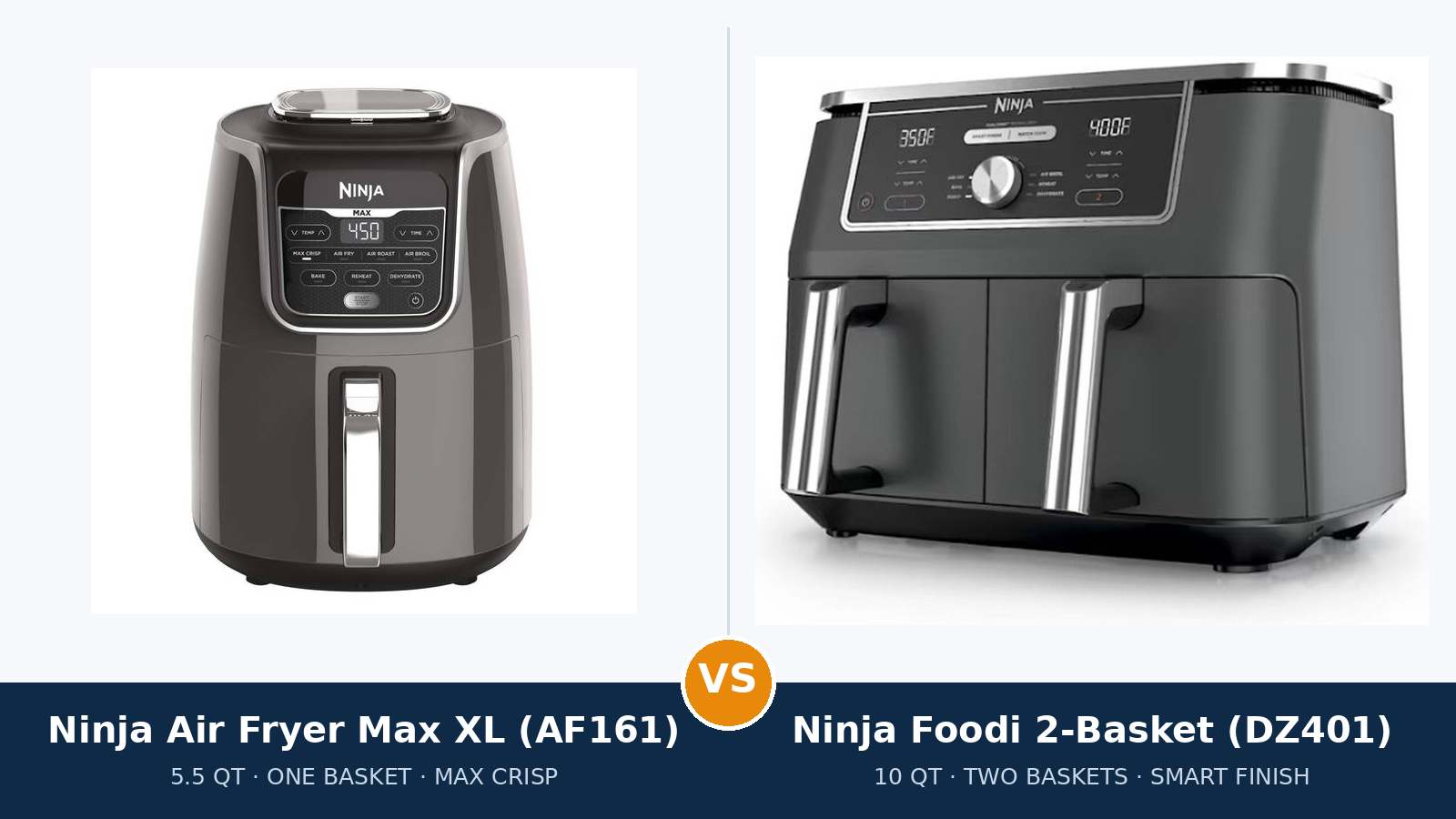
If you arrived here from a “2 basket” search, you have probably half-decided already. Two baskets sounds like twice the air fryer. This guide audits that instinct before it costs you seventeen inches of counter.
First, the models behind the badges, stated plainly. “Ninja Air Fryer Max XL” is the AF161 — a 5.5-quart single-basket tower, and the model SharkNinja’s own owner’s guide names on its cover. The AF160 in some listings is the series designation behind the same platform, not a different US fryer.
“Ninja Foodi 2 Basket” is the DZ401 — sold in full as the Foodi 6-in-1 10-Qt XL 2-Basket Air Fryer with DualZone Technology. Ninja stamps the Foodi badge on pressure cookers and countertop ovens too, but the two-basket air fryer is the DZ401.
So the contest is this: the strongest single basket Ninja makes against the same brand’s two-basket flagship. One dinner, cooked two ways, tells you more about these machines than any spec sheet — so that is where the differences section begins.
Every figure below comes from SharkNinja’s manuals and manufacturer product data for the US models. No prices, no star ratings, no borrowed benchmarks.
Key Takeaways
- The second basket buys you one thing: simultaneity. Two foods, two programmes, one finish time, via Smart Finish. Nothing else on either machine replicates it.
- On points, the Max XL wins. It scores 8.6 overall to the Foodi’s 8.0 — more watts in the active basket, a seventh function and half the washing-up.
- The Foodi’s 10 quarts come with an asterisk. The volume is split into two 5-quart baskets, each slightly smaller than the Max XL’s single basket. More food, yes; bigger food, no.
- Both headline 450°F; only one means it everywhere. The Foodi’s range is adjustable on every function. The Max XL reaches 450°F only in Max Crisp (fixed) and Air Broil.
- The Foodi is furniture; the Max XL is an appliance. 17.1 inches wide and 19.8 lb against an 11-inch-wide tower at about 11.7 lb. Measure first.
Quick Verdict
Buy the Ninja Foodi DZ401 if your dinners come in pairs. It is the only machine here that can run them at once.
Chicken in zone 1, wedges in zone 2, different temperatures, both finished at the same minute. If that sentence describes your Tuesdays, no single-basket fryer is a substitute.
Buy the Ninja Air Fryer Max XL AF161 if most of your cooking is one food at a time. It is the better fryer in isolation.
All 1,750 of its watts work on the load in front of it. It adds a Max Crisp mode the Foodi lacks, washes up in half the pieces, and lifts into a cupboard between uses.
The Scorecard
Scores below are derived directly from the manufacturer specifications compared in this guide — capacities, wattages, temperature ranges, function lists and dimensions. They are a reading aid, not benchmark results. One caveat we print rather than bury: no row in this table can award points for cooking two foods at once, which is precisely the Foodi’s reason to exist.
| Category | Max XL AF161 | Foodi 2-Basket DZ401 | ||
|---|---|---|---|---|
| Capacity | 8 / 10 | 10 / 10 | ||
| Cooking design | 9 / 10 | 9 / 10 | ||
| Ease of use | 8 / 10 | 8 / 10 | ||
| Cleaning | 8 / 10 | 7 / 10 | ||
| Footprint | 7 / 10 | 3 / 10 | ||
| Value | 8 / 10 | 8 / 10 | ||
| Overall | 8.6 / 10 | 8.0 / 10 | ||
Notice where the Foodi loses its points: footprint and cleaning, the daily-friction rows. Notice where it wins: the one row that describes total volume. The sections below walk through both ownership experiences.
At a Glance: Who Each Fryer Fits
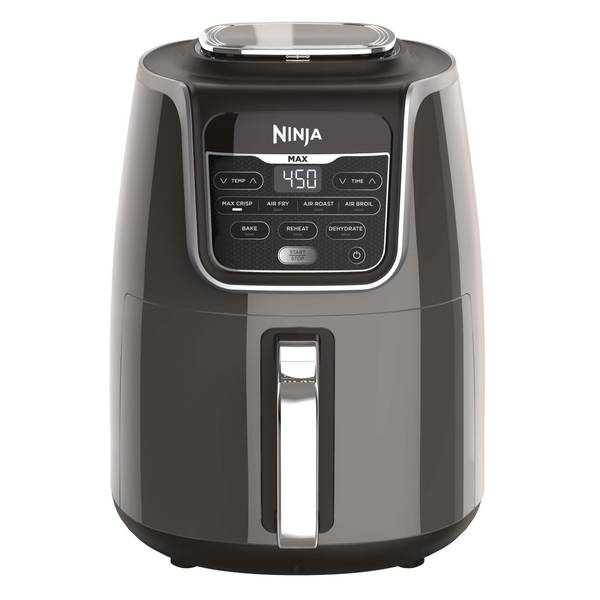
Ninja Air Fryer Max XL AF161
- One 5.5 qt basket; rated load 3 lb of fries or wings
- 1,750 W behind a single cooking zone
- 7 functions, including Max Crisp at a fixed 450°F
- Ceramic-coated nonstick basket and crisper plate
- Tower shape: roughly 11 in wide, about 11.7 lb
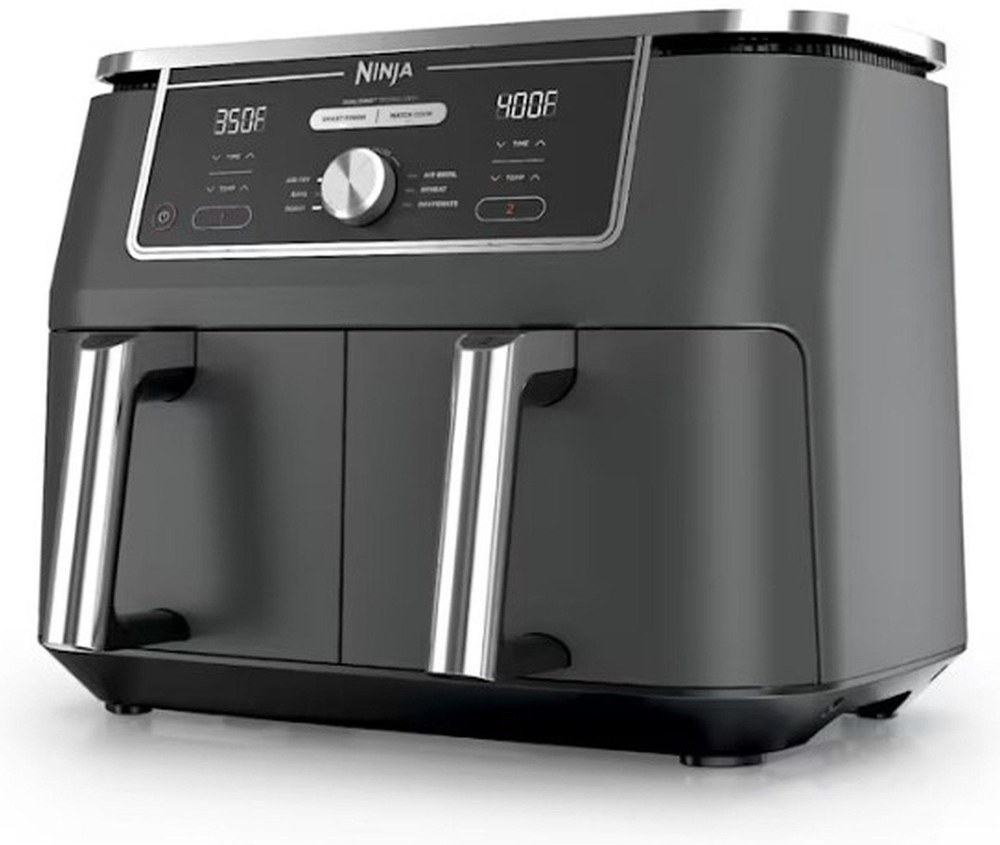
Ninja Foodi 2-Basket DZ401
- 10 qt in total: two independent 5 qt baskets
- Smart Finish syncs two programmes to one finish; Match Cook mirrors them
- 6 functions per zone, 105–450°F adjustable on all of them
- Rated for a 6 lb whole chicken or 8 lb of wings
- Slab shape: 17.1 in wide, 19.8 lb
Choose the Max XL AF161 if…
Your air fryer mostly sees one food per session: a batch of wings, a tray of sprouts, frozen fries for the table.
Counter width is the scarce resource in your kitchen, or the fryer needs to live in a cupboard between uses.
You would rather wash two parts than four, every single time, including the nights you only cooked one thing.
Choose the Foodi 2-Basket DZ401 if…
Your standard dinner is a protein plus a side, and you are tired of sequencing them or keeping one warm.
You cook for four or more most nights, or you meal-prep in full-capacity batches.
You have a wide, permanent stretch of counter to surrender — because surrender it you will.
As an Amazon Associate I earn from qualifying purchases at no extra cost to you.
Specifications: The Specs That Actually Matter
Every figure below comes from SharkNinja’s owner’s guides and manufacturer product data for these two US models.
| Specification | Ninja Air Fryer Max XL AF161 | Ninja Foodi 2-Basket DZ401 |
|---|---|---|
| Model number | AF161 (AF160 series) | DZ401 (DZ400 series) |
| Capacity | 5.5 qt in a single basket | 10 qt total: two 5 qt baskets |
| Rated food load | 3 lb of fries or wings | 6 lb whole chicken; 8 lb of wings across both baskets |
| Rated power | 1,750 W, dedicated to the one zone | 1,690 W shared; IQ Boost distributes power between zones |
| Temperature range | 105–400°F adjustable; 450°F in Max Crisp (fixed) and Air Broil only | 105–450°F, adjustable on every function, independently per zone |
| Cooking functions | 7: Max Crisp, Air Fry, Air Roast, Air Broil, Bake, Reheat, Dehydrate | 6 per zone: Air Fry, Air Broil, Roast, Bake, Reheat, Dehydrate |
| Two-food modes | None — one basket runs one programme | Smart Finish (two programmes, one finish time); Match Cook (one programme copied to both zones) |
| Basket configuration | Single deep pull-out basket with crisper plate | Two pull-out baskets, each with its own crisper plate |
| Basket material | Ceramic-coated nonstick, basket and crisper plate | Nonstick-coated baskets and crisper plates (SharkNinja’s wording for this model) |
| Dishwasher-safe parts | Basket and crisper plate | Both baskets and both crisper plates — the only dishwasher-safe parts |
| Dimensions | About 14 × 11 × 14.75 in (D × W × H) | 17.1 × 13.9 × 12.8 in (W × D × H) |
| Weight | About 11.7 lb | 19.8 lb |
| Cord length | 2.6 ft | Not published (the guide specifies a short cord) |
| In the box | Unit, basket, crisper plate, 20-recipe book; broil rack varies by bundle | Unit, two baskets, two crisper plates, 15-recipe inspiration guide |
| Warranty | 1-year limited | 1-year limited |
Temperature note: the Max XL’s 450°F headline needs its footnote. SharkNinja’s guide states the temperature cannot be adjusted in Max Crisp — a fixed blast for frozen food — and only Max Crisp and Air Broil reach 450°F at all. Air Fry, Air Roast, Bake, Reheat and Dehydrate stop at 400°F. The Foodi carries no equivalent footnote: the full range is on the dial, on every function.
Dimension note: the AF161’s dimension axes are scrambled in Amazon’s product-information field; manufacturer data agrees on the tall-tower shape in the table. Check cabinet height against the tower figure.
Broil rack note: SharkNinja’s AF161 guide warns the broil rack is “not included on all models,” and the standard box lists only the unit, basket, crisper plate and recipe book. If broiling on the rack is part of your plan, confirm it is in your bundle.
The Differences That Actually Matter
1. One Tuesday dinner, timed two ways
Take the meal this comparison is really about: chicken thighs and potato wedges. Both cook in roughly 25 minutes — the thighs roasted, the wedges air fried hotter and a little shorter. The machines diverge on what that means for your evening.
On the Foodi, the thighs go in zone 1 and the wedges in zone 2. You set each programme, press Smart Finish, and the machine holds the shorter cook back so both baskets finish in the same minute. Wall-clock time: roughly the longer programme. Everything hot at once.
On the Max XL, the same dinner is a relay. Thighs first, because they take longest and rest well. Wedges second, while the chicken sits covered — resting, cooling slightly, its skin softening a little. Or crowd both foods into the single basket on one shared programme, at a compromise setting neither food would have chosen.
Wall-clock time on the single basket: roughly the two programmes added together. That is the whole two-basket argument — a strong one, for households that cook this shape of dinner often. If your typical session is one food, the relay never happens, and the Foodi’s party trick sits unused while its costs charge rent daily.
2. Capacity — the partition problem
Ten quarts beats 5.5 quarts on the box. In the baskets, the geometry argues back.
The Foodi’s ten quarts arrive pre-divided. Each basket holds 5 qt — a half-quart less than the Max XL’s single basket. Any individual load must fit within one basket’s walls; there is no borrowing space across the divider.
The Max XL’s 5.5 qt is one deep, uninterrupted well, rated for 3 lb of fries or wings. Tall, awkward, single items get the full height and width of it.
Where the Foodi’s arithmetic wins is throughput. Match Cook turns both baskets into one 10-quart batch — 8 lb of wings for a crowd — and a 6 lb whole chicken fits in a single zone while the other stays free for the side. The honest summary: the Foodi moves more food per session; the Max XL swallows the bigger single load.
3. Heat — two different meanings of 450°F
Both panels can show 450. The manuals underneath them say different things.
The Max XL spends its 450°F in exactly two places. Max Crisp is a fixed, non-adjustable setting built to hit frozen food with superheated air; SharkNinja rates it up to 30% faster than its smaller AF100. Air Broil also reaches 450°F. Everything else on the panel tops out at 400°F.
The Foodi treats 450°F as the top of a range rather than a destination. Any function, in either basket, can be set there — or at 390°F in one basket and 450°F in the other, simultaneously. If you cook by dialling precise temperatures, the Foodi gives you the wider instrument.
Wattage rhymes with the same theme. The Max XL’s 1,750 W all serve the basket that is cooking. The Foodi’s 1,690 W are a shared budget: run one zone and IQ Boost leans the power into it; run both and the machine divides the supply. Concentration versus distribution — the two philosophies, stated in watts.
4. Functions — seven presets against six, twice
Counted coldly, the function lists are closer than the badges imply. Six of the Max XL’s seven have direct equivalents on the Foodi (which spells one of them simply Roast). The genuine difference is a single button: Max Crisp, the frozen-food preset the Foodi does without.
But button-counting undersells the Foodi’s panel in the other direction. Smart Finish and Match Cook are not cooking functions, so they never appear in the six — yet they change what the six can do, because each runs independently per zone and can be synchronised or mirrored at will.
Score it honestly: if you cook from frozen several times a week, Max Crisp is a real, weekly advantage for the Max XL. If you rarely do, the function lists are level, and the Foodi’s coordination layer puts it ahead on capability while trailing on the printed count.
5. Footprint — a tower and a slab walk into a kitchen
These two machines fail different kitchens. Measuring is the only honest way to choose between them on size.
The Max XL is vertical: about 11 inches wide and 14 deep, standing 14.75 inches tall. Its question is overhead — does it clear your wall cabinets, with the working space above the unit that SharkNinja’s guide asks for?
The Foodi is horizontal: 17.1 inches wide, 13.9 deep, a lower 12.8 inches tall. Its question is frontage — can your counter give up a foot and a half of width, permanently, plus elbow room for two basket handles?
Weight settles where each machine lives: at about 11.7 lb the Max XL is a plausible cupboard appliance — out for dinner, away by dessert. At 19.8 lb the Foodi is a countertop resident by design.
6. Cleaning — two parts against four
Both manufacturers limit dishwasher duty to the baskets and crisper plates; both main units are wipe-down only. Within that shared rule, the part counts decide the chore.
A Max XL session dirties two pieces: one basket, one crisper plate, both ceramic-coated nonstick, both dishwasher-safe. A two-zone Foodi session dirties four: two baskets, two crisper plates — all dishwasher-safe too, but twice the rack space and twice the sink time on hand-wash nights.
The subtle point is the single-food night. Cook one dish in the Foodi — one zone only — and you wash the same basket and plate, but you have spent the evening wiping down a machine twice the size for the same output. Cleaning scores 8 against 7 rather than something wider, because the Foodi’s four parts genuinely do all go in the dishwasher. The gap is arithmetic, not hygiene.
On coating care the manuals agree: no abrasive pads, no metal utensils, dishwasher permitted but hand-washing gentler on the finish over the years.
7. Controls — one panel, or a dial with two dashboards
The Max XL keeps its whole world on one touch panel: seven function buttons, temperature and time arrows, one display. There is nothing to coordinate, so there is nothing to learn beyond the panel itself.
The Foodi runs a small control room. A central dial picks the function; each zone carries its own display and its own temperature and time controls; Smart Finish and Match Cook sit in the middle as the coordination layer. The first two-zone dinner takes a manual consultation. By the fifth, the layout earns it.
We score ease of use a tie, deliberately. Each panel’s complexity is proportionate to the machine behind it — and the Foodi’s twin displays genuinely help mid-cook, when two programmes are running and you want a status check without opening a basket.
Which Fryer Fits Your Household?
Find your kitchen in the rows. This table compresses the whole comparison into the calls we would actually make.
| Your household / cooking style | Max XL AF161 | Foodi 2-Basket DZ401 | Our call |
|---|---|---|---|
| One or two people, single-dish cooking | Excellent — sized for exactly this | Oversized for the meals | Max XL AF161 |
| Families of 3–4, one main dish per night | Excellent — 3 lb loads cover most nights | Excellent — with headroom to spare | Either; Max XL for simplicity |
| Protein plus a side, several nights a week | Sequential cooking or shared settings | Excellent — Smart Finish is built for it | Foodi DZ401, outright |
| Families of 5+, parties, Sunday batch cooking | Workable — in back-to-back rounds | Excellent — full 10 qt with Match Cook | Foodi DZ401 |
| Frozen staples: fries, wings, nuggets weekly | Excellent — Max Crisp preset at 450°F | Good — no dedicated frozen preset | Max XL AF161 |
| Narrow counter, generous cabinet height | Excellent — about 11 in wide | Strained — 17.1 in of permanent width | Max XL AF161 |
| Low wall cabinets, wide open counter | Strained — 14.75 in tower | Excellent — 12.8 in profile | Foodi DZ401 |
| Minimal washing-up, always | Excellent — two parts | Fair — four parts, all dishwasher-safe | Max XL AF161 |
The protein-plus-side row is the only absolute verdict in the table. Everywhere else the machines trade advantages of degree — on that row, one of them simply cannot perform the task.
Ready to check today’s price?
Both fryers sell through Amazon. Prices move, so check the live figure on the one that fits your kitchen.
View on Amazon — Max XL AF161View on Amazon — Foodi DZ401The 30-Second Decision
| If this sounds like you… | Buy this |
|---|---|
| “My dinners are one dish, cooked well, most nights.” | Max XL AF161 |
| “I am done keeping one food warm while the other finishes.” | Foodi 2-Basket DZ401 |
| “Half my air frying starts from frozen.” | Max XL AF161 (Max Crisp) |
| “I feed five or more, or I batch-cook for the week.” | Foodi 2-Basket DZ401 |
| “The fryer has to go back in a cupboard after use.” | Max XL AF161 |
| “I set exact temperatures for everything I cook.” | Foodi 2-Basket DZ401 (full range, every function) |
What You Gain. What You Give Up.
Ninja Air Fryer Max XL AF161
You gain: the most concentrated single-basket cooking in Ninja’s range — 1,750 W in one zone, a seventh function, a ceramic-coated basket — in a tower that takes half the counter width and half the sink. It is also the only one you can reasonably put away.
You give up: parallel cooking, completely. Two foods means a relay or a compromise programme. You also give up total volume, and 450°F is confined to two functions, one of them fixed.
Ninja Foodi 2-Basket DZ401
You gain: a genuinely different capability — two independent zones with synchronised finishing — plus 10 qt of batch capacity, a whole-chicken rating, and a fully adjustable temperature range in both baskets.
You give up: counter frontage and lightness: 17.1 inches and 19.8 lb is a permanent installation. You also accept a shared wattage budget, four parts to wash after full sessions, and no Max Crisp preset.
Pros and Cons
Max XL AF161 — Pros
- 1,750 W dedicated to a single basket
- Max Crisp: fixed 450°F blast for frozen food
- Seven functions, the wider preset list
- Ceramic-coated basket and crisper plate
- About 11.7 lb and 11 in wide — storable
- Only two parts to wash per session
Cons
- One programme at a time — no second zone
- 450°F confined to Max Crisp and Air Broil
- Broil rack missing from some bundles
- 14.75 in tall — verify cabinet clearance
- 5.5 qt ceiling on single-food batches
Foodi 2-Basket DZ401 — Pros
- Two independent 5 qt baskets
- Smart Finish lands two programmes together
- 105–450°F adjustable on every function
- 6 lb whole-chicken and 8 lb wing ratings
- Low 12.8 in profile suits low cabinets
- All four cooking parts are dishwasher-safe
Cons
- 17.1 in wide, 19.8 lb — lives on the counter
- 1,690 W shared when both zones run
- No Max Crisp preset
- Four parts to wash after two-zone meals
- No single cooking space larger than 5 qt
Check the Model Number, Not Just the Badge
Pin down the Max XL. The US model here is the AF161: 120V, model AF161 on the rating label. “AF160” is the same platform’s series designation — and the UK version of this fryer, on 220–240V. A cheap AF160 import is the wrong voltage with a warranty you cannot use. Walk past it.
Pin down the 2-Basket. The DZ401 is the 10-quart model: two 5-quart baskets, a central dial, Smart Finish, Match Cook and IQ Boost. Read listings for those terms together; the Foodi badge alone guarantees none of them.
Its own family is the main source of confusion. The DZ201 is the same idea at 8 quarts; the DZ550 keeps the DZ401’s size and adds a Smart Cook thermometer. Three legitimate machines, three different checkouts — only one is this article’s subject.
Check the bundle, both sides. On the Max XL, the broil rack is the variable part: SharkNinja’s own guide says it is not included on all models, so confirm it if you plan to broil on it. On the Foodi, the box should list two baskets, two crisper plates and the 15-recipe inspiration guide — count the plates; a two-basket fryer with one plate is a listing error, not a saving.
Check what “Foodi” means in the listing title. Throughout this article, “Max XL” means the AF161 and “Foodi 2-Basket” means the DZ401. Listings that say Foodi and show a single round pot, or a wide oven with doors, are selling the other Foodi lines — capable machines, wrong comparison.
The Second-Year Test
Both fryers delight in month one. Judge them by month thirteen.
By then, the ownership patterns have settled. Max XL owners have a two-part wash and a counter that reverts to workspace between meals. Foodi owners have a permanent appliance whose second basket is either a weekly habit or a monument to good intentions — rarely a middle state.
Coatings are the shared long-term variable. Both machines rely on nonstick-family surfaces, and both manuals prescribe the same regime: non-abrasive sponges, no metal utensils, dishwasher allowed, hand-washing kinder. Replacement baskets and crisper plates are catalogue items for both models — a running cost that lands twice as often on the Foodi, with four coated parts ageing instead of two.
The step-up map is honest in both directions. The Max XL owner whose dinners grow a second component is the DZ401’s natural buyer — or the DZ550’s, if a built-in thermometer appeals. The Foodi owner almost never downsizes; the typical move is sideways into a countertop oven. Neither machine strands you.
When to Skip Both
Some kitchens should buy neither of these, and saying so is part of the job.
Skip both if your cooking is wide and flat — sheet-pan bakes, casseroles, a 13-inch pizza. That is countertop-oven territory; Ninja’s own Foodi oven line exists there. Baskets are the wrong shape for it.
Skip both if you cook small portions for one or two people. A 4-quart fryer from Ninja’s smaller lines heats a smaller space, washes faster, and leaves the rest of your counter alone.
Skip both if connected features matter to you. Neither machine offers Wi-Fi or an app; if remote start and phone notifications are the point of the purchase, look at the connected ranges from COSORI or Philips instead.
And two targeted skips that restate the verdict: skip the Max XL if two-component dinners are your default, and skip the Foodi if your counter cannot spare 17.1 inches. Everything else here refines those two sentences.
Final Verdict
On the spec sheet, the Max XL AF161 wins this comparison — and for pair-cooking households, it loses anyway. Both halves of that sentence are the verdict.
The Max XL is the better-scoring fryer: more power per basket, an extra function, the more modern coating, half the footprint and half the washing-up — 8.6 overall against 8.0. If your cooking is one food at a time, it is the machine we would buy, and it is not a close call.
But a scorecard cannot credit the Foodi’s defining feature, because simultaneity is not a specification. It is a schedule. If your dinners are built from two foods on two programmes, the DZ401 does not finish second here; it is the only entrant.
Buy the Max XL AF161 for single-dish households, frozen-food regulars, narrow counters and anyone who wants the fryer to disappear into a cupboard.
Buy the Foodi 2-Basket DZ401 for main-plus-side cooking, families of four and up, and batch cooks who will use both zones weekly.
Watch Out: Similar Names, Different Machines
Ninja’s badge system generates most of the confusion in this corner of the catalogue. Four separations matter here.
First: “Foodi” names a family, not a fryer. The same badge sits on pressure cookers that crisp under a lid and on a countertop oven range. This article’s Foodi is only the DZ401 two-basket air fryer.
Second: AF160 and AF161 are one Max XL platform wearing two labels. AF160 is the series designation, and the name on the UK model (220–240V). The US retail model compared here is the AF161. The distinction should never cost you money.
Third: “Max” drifts across the range. The AF181 Pro XL runs a Max Crisp button but is sold as the Pro XL, while in the UK the “Foodi MAX Dual Zone” line (the AF400UK family: 9.5L, 2,470W, 220–240V) fuses this article’s two badges into one British product. Neither is compared here.
Fourth: the DZ401’s relatives crowd its own listings. The DZ201 is the 8-quart sibling, the DZ550 the thermometer upgrade, and DZ400-series numbers share one manual family. Match the full model number on the rating label before you pay.
Counter, Storage and Cabling Notes
Placement, in one line: the Max XL needs height, the Foodi needs width, and both need an outlet they can reach without an extension cord — each guide rules extension cords out.
For the Max XL, the ritual is vertical. At 14.75 inches tall it squeezes under most wall cabinets on paper, but steam leaves upward, so the clearance SharkNinja specifies above and behind the unit is part of the fit, not fine print.
For the Foodi, the ritual is frontage. Seventeen inches of width plus working room at both flanks for the basket handles, on a counter it will occupy full-time.
Storage follows from weight and cord. The Max XL, at about 11.7 lb with a published 2.6 ft cord, can live in a cupboard near its outlet. The Foodi, at 19.8 lb with a short cord of unpublished length, is designed to stay where it cooks.
Warranty and Long-Term Support
A clean tie; only the paperwork varies.
Both fryers carry SharkNinja’s One (1) Year Limited Warranty, as printed in their owner’s guides, covering the original purchaser buying from an authorised seller — a clause that makes the seller’s identity on a listing worth thirty seconds of attention.
Both models sit on the same support infrastructure — owner’s guides, replacement baskets and crisper plates sold against the model number, and the support line printed across both manual families (1-877-646-5288).
Register the fryer when it arrives and keep the order confirmation. On a one-year warranty, the start date is the substance of the policy.
Frequently Asked Questions
Which model is the “Ninja Foodi 2 Basket” in this comparison?
The DZ401 — sold in full as the Foodi 6-in-1 10-Qt XL 2-Basket Air Fryer with DualZone Technology. Ninja applies the Foodi badge to pressure cookers and countertop ovens too, but the DZ401 is the two-basket air fryer meant by the name throughout this guide.
Is the Max XL the AF161 or the AF160?
One platform, two labels. AF160 is the series designation — and the model name used in the UK, where the fryer runs on 220–240V. The US retail model compared here is the AF161; SharkNinja’s owner’s guide is titled “AF161 Air Fryer Max XL.” A US listing should show model AF161 and 120V.
Does two baskets mean double the capacity?
Not quite. The Foodi totals 10 quarts against the Max XL’s 5.5, but the volume is split into two 5-quart baskets — each marginally smaller than the Max XL’s single basket. Total throughput is far higher on the Foodi; the largest single load belongs to the Max XL.
What does Smart Finish actually do?
It synchronises two different programmes. Set the zones to different functions, temperatures and times, and Smart Finish delays the shorter programme’s start so both baskets finish in the same minute. Match Cook is the simpler sibling: it copies one programme across both zones for a full 10-quart batch. The Max XL has neither — it has one zone to coordinate.
Can the Max XL really cook at 450°F?
Yes, in two functions. Its guide states that Max Crisp runs at a fixed 450°F that cannot be adjusted, and Air Broil also reaches 450°F. Air Fry, Air Roast, Bake, Reheat and Dehydrate cap at 400°F. The Foodi’s 105–450°F range, by contrast, is adjustable on every function in both baskets.
Which one is easier to clean?
The Max XL, on arithmetic. Both machines make their baskets and crisper plates dishwasher-safe, but a session dirties two parts on the Max XL and up to four on the Foodi. The Max XL’s basket is also ceramic-coated; the Foodi’s are nonstick-coated.
Will either fryer fit under my wall cabinets?
It depends which measurement your kitchen constrains. The Max XL is the tall one — 14.75 inches — but only about 11 inches wide. The Foodi is lower at 12.8 inches tall, yet 17.1 inches wide. Measure height for the tower, width for the slab.
Which should a family of five buy?
Usually the Foodi DZ401: 10 quarts across two zones, an 8 lb wing rating, and Smart Finish for the protein-plus-side pattern family dinners follow. The exception is the single-dish family whose counter cannot give up 17.1 inches — for them, the Max XL plus a second quick batch is the answer.
Sources & Verification
Ninja AF161 Air Fryer Max XL Owner’s Guide (SharkNinja Operating LLC) • Ninja Foodi DZ401 instruction manual and DZ400 Series owner’s guide • SharkNinja manufacturer product data via Amazon.com, Best Buy and Blain’s Farm & Fleet listings for the AF161 (UPC 622356559133) and the DZ401 (UPC 622356571562) • UK “Foodi MAX Dual Zone” naming checked against UK retailer listings for the AF400UK. Specifications verified November 2026.

James Wilson
James has been testing and comparing home appliances for over a decade and writes Honestly Compared’s kitchen and home guides. His rule for every comparison: the verdict has to survive the spec sheet, not the marketing page.