
Ninja Air Fryer Max XL vs Ninja Air Fryer Pro XL: Which Should You Buy?
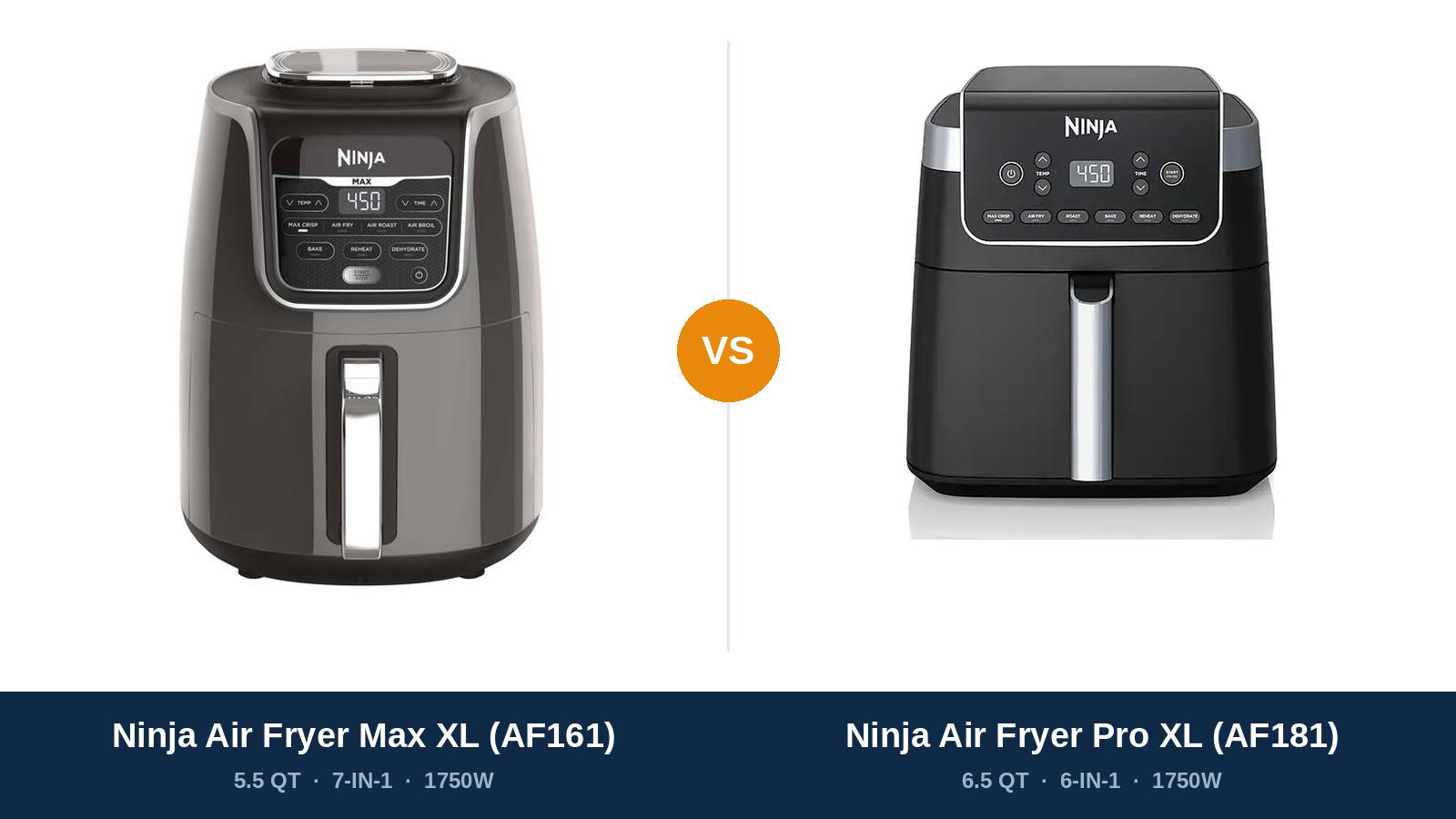
Max XL. Pro XL. Read those two badges quickly and your brain builds a ladder: Max is the big one, Pro is the better one, so Pro XL must sit a rung above Max XL.
Ninja never built that ladder. The two badges belong to two separate product lines that share a shelf, a wattage and a “450°F” headline.
“Max” describes a cooking philosophy: Max Crisp heat and the longest function list of its generation, packed into a tall tower. “Pro” describes a body redesign: lower, wider, family-sized.
Follow the badges naively and you get a surprise: the supposedly higher model holds more food — and does less with it. A whole cooking function on the Max XL is absent from the Pro XL.
This guide untangles the naming first, then the hardware — every figure from SharkNinja’s own guides and product data, and a verdict the spec sheets support.
Key Takeaways
- There is no trim ladder. Max XL (AF161) and Pro XL (AF181) are parallel lines — a tower and a low, wide body — not a standard model and its upgrade.
- The Pro XL carries more. 6.5 quarts, rated for 5 lb of fries or 9 lb of wings, against 5.5 quarts and a 3 lb rating for the Max XL.
- The Max XL cooks more ways. Seven functions against six. It keeps Air Broil — a true top-heat mode the Pro XL drops completely.
- Both 450°F claims shrink on inspection. On the Pro XL the number lives in Max Crisp alone; on the Max XL it lives in Max Crisp and Air Broil. Every other function on both machines stops at 400°F.
- Almost everything else ties. Identical 1,750W draw, dishwasher-safe basket and crisper plate on both, the same one-year warranty — and cords that are the same length, published in different units.
Quick Verdict
Buy the Ninja Air Fryer Pro XL (AF181) for most family kitchens. Not because “Pro” outranks “Max” — because a quart of extra basket and a body short enough to live under wall cabinets are advantages you will feel every weeknight.
Buy the Ninja Air Fryer Max XL (AF161) if broiling is part of how you cook. It is the only one of the two with Air Broil, the only one that reaches 450°F outside the frozen-food mode, and the one that fits a narrow counter.
Cooking for one to three? The Max XL’s smaller basket and fuller function list make it the more interesting machine per inch of counter.
The Scorecard
Scores below are derived directly from the manufacturer specifications compared in this guide — capacities, function lists, temperature behaviour and published dimensions. They are a reading aid, not benchmark results.
| Category | AF161 Max XL | AF181 Pro XL | ||
|---|---|---|---|---|
| Capacity | 7 / 10 | 9 / 10 | ||
| Cooking design | 9 / 10 | 8 / 10 | ||
| Ease of use | 8 / 10 | 8 / 10 | ||
| Cleaning | 8 / 10 | 8 / 10 | ||
| Footprint | 7 / 10 | 8 / 10 | ||
| Value | 8 / 10 | 8 / 10 | ||
| Overall | 8.1 / 10 | 8.3 / 10 | ||
A note for readers arriving from our smaller-fryer comparisons: the AF161 scores higher there. That is not an error, and nothing about the machine has changed.
Capacity is scored against the rival on the same page. Against 4-quart fryers, 5.5 quarts is a rout. Against a 6.5-quart rival drawing the same 1,750 watts, the same basket is the smaller one — while the Max XL’s function lead survives untouched.
At a Glance: Who Each Fryer Fits
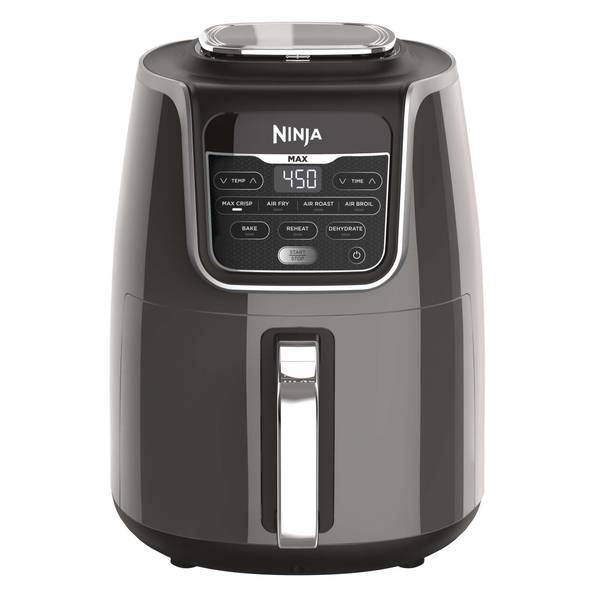
Ninja Air Fryer Max XL (AF161)
- 5.5 qt basket; Ninja rates the load at 3 lb of fries or wings
- 7 functions: Max Crisp, Air Fry, Air Roast, Air Broil, Bake, Reheat, Dehydrate
- 450°F reachable in two modes: Max Crisp and Air Broil
- Ceramic-coated nonstick basket and crisper plate
- Tower body, roughly 14 × 11 × 14.75 in
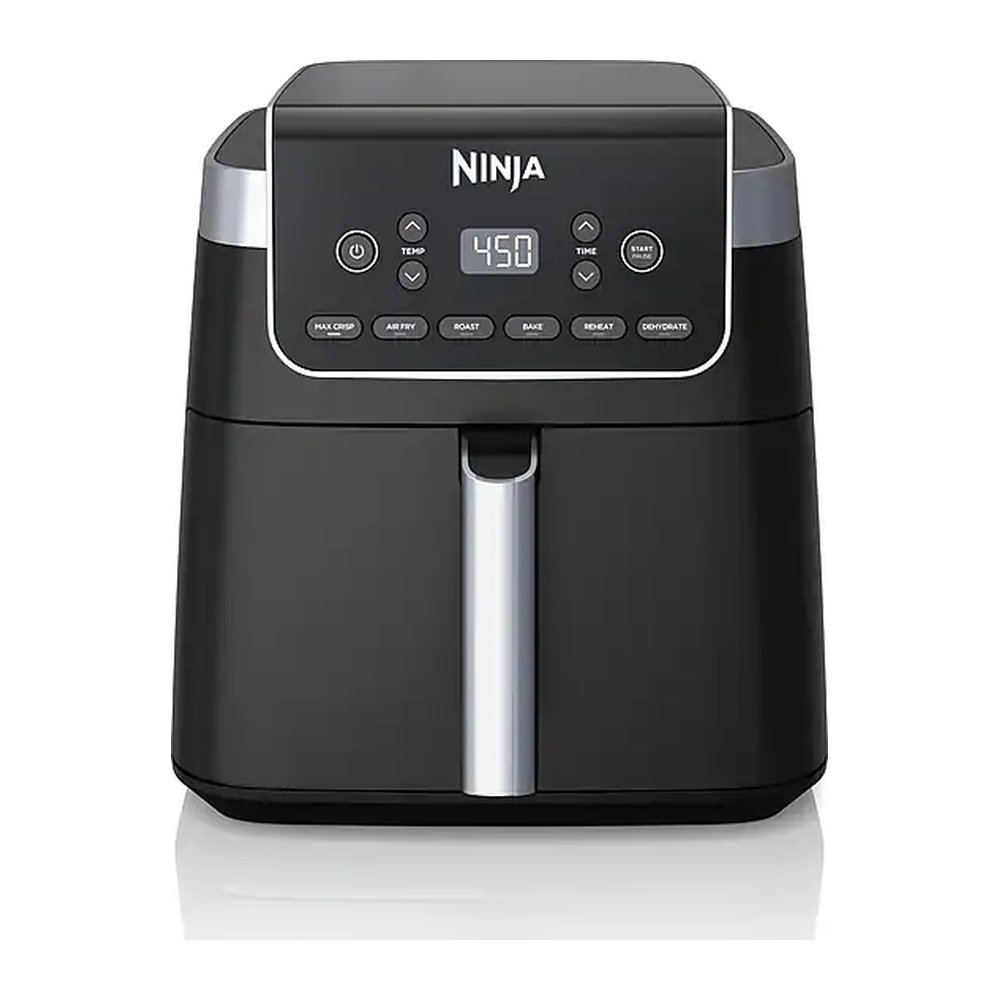
Ninja Air Fryer Pro XL (AF181)
- 6.5 qt basket; rated for up to 5 lb of fries or 9 lb of wings
- 6 functions: Max Crisp, Air Fry, Roast, Bake, Reheat, Dehydrate
- 450°F reachable in Max Crisp only
- Nonstick basket and crisper plate, per the guide’s parts list
- Low, wide body, roughly 14.9 × 11.3 × 12 in
Choose the Max XL (AF161) if…
You finish food under hard top heat. Salmon skin, steak crust, cheese browned on a gratin — Air Broil is built for exactly that, and the Pro XL has no answer to it.
Your counter is a narrow strip. The tower takes up the least width of the two and leaves worktop in front.
You cook for one to three. A 5.5-quart basket is honestly sized for small households, and you get the longer function list as a bonus.
Choose the Pro XL (AF181) if…
You feed four or more, or you meal-prep in batches. The bigger basket and its wider floor turn two cooking rounds into one.
Your wall cabinets hang low. At roughly a foot tall, this is the XL Ninja designed to slide underneath them.
Frozen food is the main event in your house. Max Crisp plus the largest basket in this comparison is the strongest frozen-snack combination here.
As an Amazon Associate I earn from qualifying purchases at no extra cost to you.
Specifications: The Specs That Actually Matter
Every figure below is taken from SharkNinja’s owner’s guides and the manufacturer product data published with each model’s listings.
| Specification | Ninja AF161 Max XL | Ninja AF181 Pro XL |
|---|---|---|
| Model number | AF161 | AF181 |
| Capacity | 5.5 qt | 6.5 qt |
| Rated food load (Ninja) | 3 lb of fries or wings | Up to 5 lb of fries or 9 lb of wings |
| Rated power | 1,750 W (120V / 60Hz) | 1,750 W (120V / 60Hz) |
| Temperature range | 105–450°F (see temperature note) | 105–450°F (see temperature note) |
| Where 450°F is available | Max Crisp and Air Broil | Max Crisp only |
| Cooking functions | 7: Max Crisp, Air Fry, Air Roast, Air Broil, Bake, Reheat, Dehydrate | 6: Max Crisp, Air Fry, Roast, Bake, Reheat, Dehydrate |
| Basket and crisper plate | Ceramic-coated nonstick | Nonstick-coated (per the guide’s parts list) |
| Dishwasher-safe parts | Basket and crisper plate | Basket and crisper plate |
| Dimensions (W × D × H) | About 14 × 11 × 14.75 in (see note) | About 14.9 × 11.3 × 12.0 in (see note) |
| Weight | About 11.7 lb | About 11.4 lb |
| Cord length | 2.6 ft | 31.2 in (2.6 ft) |
| In the box | Unit, basket, crisper plate, 20-recipe book; broil rack depends on the bundle | Unit, basket, crisper plate, 20-recipe guide |
| Warranty | 1-year limited | 1-year limited |
Temperature note: both boxes lead with 450°F, and both guides quietly fence that number in. On the Pro XL, SharkNinja’s troubleshooting text states the maximum is 450°F for Max Crisp and 400°F for everything else.
The Max XL’s guide tells the same story with one extra door left open. Max Crisp runs at 450°F at a fixed temperature you cannot adjust — and Air Broil, a mode you choose on purpose, also runs to 450°F. Air Fry, Air Roast, Bake, Reheat and Dehydrate cap at 400°F.
Dimension note: treat both models’ listing dimensions with suspicion. The product-information field attached to the Max XL prints figures whose proportions describe a low, wide machine — the axes are evidently scrambled. Manufacturer-data reproductions and independent measurements agree the tower stands about 14.75 inches tall, and those are the figures used above.
The Pro XL has the opposite problem: Ninja’s own page prints a larger set that appears to describe the boxed product, not the appliance. The table uses the listing and measured set. If your cabinet gap is within an inch of either machine, measure for the larger set.
The Differences That Actually Matter
1. Two badges, two philosophies — the naming trap, explained
Start here, because every wrong purchase in this comparison starts here: the assumption that “Pro” is Ninja’s word for “better than Max.” The model numbers tell a different story.
The AF161 Max XL comes from the generation that sold heat and versatility: Max Crisp branding, the fullest button panel Ninja put on a single basket, a tall tower body. The AF181 Pro XL comes from a later redesign that sold space: a wider basket, a shorter body, a calmer panel.
Neither machine is the other’s trim level. They were aimed at different kitchens; the overlap in price and wattage creates the confusion.
The translation: choose by shape and function list, never by badge.
2. The missing button — Air Broil
Count the buttons in the hero image. Seven on the left, six on the right. The absent button is Air Broil, and its absence is the single largest functional difference between these machines.
Air Broil is not a renamed preset. It drives intense heat from above, the way a grill element or an oven broiler does, and it exists for finishes: crust on a steak, skin on salmon, browned cheese on anything that wants a top rather than an all-over roast.
It also runs at the full 450°F — making the Max XL the only machine here that reaches its headline temperature in a mode meant for fresh food.
One caveat, quoted from the Max XL’s own guide: the Air Broil function and broil rack are “not included on all models.” The standard retail box lists the unit, basket, crisper plate and recipe book. If broiling is your reason to buy, confirm the rack is named in the bundle before you order.
Can the Pro XL improvise? Max Crisp will brown a chop’s top, and Air Fry at 400°F will cook it through. But Max Crisp is a fixed programme tuned for frozen food. It is a workaround wearing a broil’s clothes.
If you never broil, this section is a footnote. If you broil weekly, it settles the comparison by itself.
3. Capacity — one quart on paper, a whole batch in practice
The Pro XL’s case rests on a single number: 6.5 quarts against 5.5. One quart sounds like a rounding difference. Ninja’s own load ratings show what it buys.
The Pro XL is rated for up to 5 lb of fries or 9 lb of wings. The Max XL is rated for 3 lb of fries or wings. For a family’s wing night, that is the difference between one round and two — and two rounds means half the food cooling on a plate while the rest finishes.
Geometry matters as much as volume. The Pro XL’s basket spreads its load across a wider, shallower floor, so more pieces sit in a single layer facing the fan.
The Max XL’s basket is deeper than it is wide. Food stacks — and stacked food steams where it touches.
None of this punishes small households: for one to three people, 5.5 quarts is generous, and the smaller basket heats a right-sized load without warming empty room.
Verdict: the Pro XL takes this section, and it is not close.
4. The 450°F audit — what the headline number really covers
Both displays glow “450” in the brochure photography. Both owner’s guides confine that number to a corner of the machine.
On the Pro XL, 450°F exists in exactly one programme: Max Crisp, the frozen-food mode. Air Fry, Roast, Bake, Reheat and Dehydrate all stop at 400°F. SharkNinja says so in the guide’s troubleshooting section.
The Max XL confines it too — but to two programmes. Max Crisp reaches 450°F at a fixed temperature the guide says cannot be adjusted. Air Broil reaches it as a working cooking mode.
For everyday cooking the machines are identical at the extremes: a 105°F floor, a 400°F ceiling across the ordinary functions, the same frozen-food escape hatch.
The gap opens only where Difference 2 lives: at the top end, doing deliberate high-heat work on fresh food. One machine can. One cannot.
5. Shape — the tower and the wedge
These fryers claim kitchen territory in opposite directions. The Max XL stands tall: about 11 inches of width, but roughly 14.75 inches of height. The Pro XL stays low — about 12 inches tall — and pays for it in depth, at nearly 15 inches front to back.
Height decides where a fryer lives. A tower that cannot slide under the wall cabinets stays out permanently, competing with everything else you own.
The Pro XL was clearly drawn for that under-cabinet slot, and in most kitchens it takes it with headroom to spare.
Depth is the quieter tax. With the clearance both manuals ask for behind the unit, the Pro XL’s footprint reaches deep into a shallow counter. The Max XL’s slimmer depth leaves a working strip in front.
Weight settles nothing: about 11.7 lb against 11.4 lb is a difference you will never feel carrying either to the sink.
Measure two things before you choose — the gap beneath your cabinets, and your counter’s usable depth. One of these machines fits your answers; the other fights them.
6. Coatings — read the parts list, not the marketing
Cleanup hardware ties: on both machines, the basket and crisper plate are cleared for the dishwasher by their own guides.
The coating story splits on wording. For the Max XL, SharkNinja consistently describes a ceramic-coated nonstick basket and plate — the surface many buyers now actively look for.
For the Pro XL, the guide argues with itself. Its parts list describes nonstick-coated pieces; a single safeguard line elsewhere in the same manual says ceramic-coated.
We follow the parts list, as this site always does when a manual contradicts itself: treat the Pro XL’s basket as conventional nonstick.
Day to day, the gap is small. Both surfaces release food well when new, both last longer hand-washed with soft tools, and both eventually wear — coating wear, not electronics, is what retires most air fryers.
One size effect cuts in: the Pro XL’s larger basket is more surface to wash and takes more dishwasher room. Cleaning scores level; the coating note stands as a small, genuine point for the Max XL.
7. The long list of ties — and why it simplifies your decision
It is worth listing everything that does not separate these machines, because it is most of the spec sheet.
Same rated power: 1,750W on a 120V circuit. Same dishwasher ruling. Same one-year warranty, with the same registration advice in both guides.
Controls tie as well: no app, no Wi-Fi, no voice control on either — a display, temperature and time controls, and a row of function buttons. The Pro XL’s slanted panel is marginally easier to read and wipe; an ergonomic nod, not a category.
Even the cords conspire to tie. The Max XL’s is published as 2.6 feet; the Pro XL’s as 31.2 inches. Different units, identical reach.
When power, cleaning, warranty, controls and cords all tie, the decision compresses to three questions. How much food? Which shape fits? Do you broil? Answer those and the badges can say whatever they like.
Which Fryer Fits Your Household?
The fastest route through this comparison runs from your household and habits, not the spec sheet. This table is the whole argument in one view.
| Your household / cooking style | AF161 Max XL | AF181 Pro XL | Our call |
|---|---|---|---|
| Singles and couples | Excellent — batches sized to the basket | Good — capacity you will rarely use | Max XL |
| Families of four to six | Good — large loads run to two rounds | Excellent — one round, one layer | Pro XL |
| Broiled steaks, fish and gratins | Excellent — Air Broil at 450°F | Fair — workarounds only | Max XL, outright |
| Frozen snacks and wings in bulk | Good — 3 lb rated load | Excellent — Max Crisp, 9 lb wing rating | Pro XL |
| Low wall cabinets | Tight — roughly 14.75 in tall | Excellent — roughly 12 in tall | Pro XL |
| Narrow or shallow counters | Excellent — the slimmer depth | Tight — nearly 15 in deep, plus clearance | Max XL |
| Dehydrating, jerky and low-and-slow jobs | Excellent — Dehydrate from 105°F | Excellent — Dehydrate from 105°F | Dead tie |
Study the broiling row before the capacity row. Capacity gaps can be managed with a second batch; a missing cooking mode cannot be managed at all.
Ready to check today’s price?
Both fryers sell through Amazon. Prices move, so check the live figure on the one that fits your kitchen.
View on Amazon — AF161 Max XLView on Amazon — AF181 Pro XLThe 30-Second Decision
| If this sounds like you… | Buy this |
|---|---|
| “Family dinners, one batch, no second round.” | Pro XL (AF181) |
| “I assumed Pro was just the upgraded Max. I broil a lot.” | Max XL (AF161) — the assumption is the trap |
| “The fryer has to live under my wall cabinets.” | Pro XL (AF181) |
| “My counter is a galley strip with no depth to spare.” | Max XL (AF161) |
| “Game day means wings by the pile.” | Pro XL (AF181) |
| “I want the fullest function panel Ninja sells in one basket.” | Max XL (AF161) |
What You Gain. What You Give Up.
Ninja Air Fryer Max XL (AF161)
You gain: the broader kitchen. Seven functions including the only genuine broil mode here, a ceramic-coated basket, the narrower footprint, and years of production behind it, so racks, baskets and plates are stocked everywhere parts are sold.
You give up: a quart of room and the single-layer cooking that comes with it. And carefree storage: at nearly 15 inches tall, this tower demands you measure the cabinet gap first.
Ninja Air Fryer Pro XL (AF181)
You gain: the family-sized basket with the 5 lb fries and 9 lb wings ratings, a wide shallow floor that crisps in one layer, a body short enough for under-cabinet life, and the current design’s long support horizon.
You give up: Air Broil, entirely, and with it any path to 450°F outside the frozen-food programme. You also give up counter depth — nearly 15 inches of it, before clearance.
Pros and Cons
Max XL (AF161) — Pros
- Seven functions, including Air Broil
- 450°F available in two modes
- Ceramic-coated basket and crisper plate
- Slimmest depth of the two
- Deep pool of parts, racks and accessories
Cons
- 5.5 qt basket; 3 lb rated load
- Tall body — cabinet gap must be measured
- Max Crisp temperature is fixed, not adjustable
- Broil rack missing from some bundles
- Listing dimensions printed with axes scrambled
Pro XL (AF181) — Pros
- 6.5 qt basket; 5 lb fries / 9 lb wings ratings
- Wide, shallow basket floor for single layers
- Roughly 12 in tall — under-cabinet friendly
- Angled, easy-read front panel
- Current model, long parts runway ahead
Cons
- No Air Broil at any setting
- 450°F confined to Max Crisp
- Nearly 15 in deep before rear clearance
- Parts list describes nonstick, not ceramic
- A near-identical Renewed listing invites mistakes
Buy the Model Number, Not the Badge
Match the digits first. “AF” plus three numbers is the identity — AF161 for the Max XL tower, AF181 for the Pro XL. Listings swap badges, borrow each other’s photos and headline the wrong capacity. The product-information block’s model number and UPC — 622356559133 (AF161), 622356635660 (AF181) — are the ground truth.
Check the condition line. The Pro XL also sells through a separate Amazon Renewed listing: refurbished units under a title nearly identical to the new one. Renewed is a legitimate way to save money when chosen deliberately. It is a nasty surprise when chosen by accident.
The Max XL needs the same care from the other direction: years on sale mean a deep marketplace pool, so confirm a listing is a new US unit — 120V on the rating label — not an import or a return.
If broiling decides it, check the box contents. SharkNinja’s guide warns that the Air Broil function and its rack are not included on all AF161 models. The standard box holds the unit, basket, crisper plate and a 20-recipe book. A bundle that names the broil rack explicitly is the one to buy.
Mind the region. The AF181C is the Canadian edition of the Pro XL — same machine, Canadian paperwork. Genuine imports wearing similar numbers, including the regional Max-series variants, run on 220–240V and carry no US warranty. The similar-names section below maps the worst offenders.
Measure with the pessimistic numbers. As the dimension note explains, the published figures for both machines conflict. Plan your shelf and cabinet space around the larger set for whichever fryer you choose, and the appliance will fit on the first try.
The Two-Year Test
Air fryers rarely die electronically. They retire when the basket coating gives up — which makes the coating, and the parts pipeline behind it, the real longevity question for both machines.
On replaceability, both score well. Baskets and crisper plates are sold by model number through SharkNinja and the usual parts retailers, so a worn surface is a parts order rather than a new appliance.
Care sets the timetable. Both guides clear the basket and plate for the dishwasher, and both coatings will still last longer washed by hand, with soft sponges and no metal tools.
The Max XL’s advantage is depth of stock: years in production have filled warehouses with its baskets, racks and plates at every price point. The Pro XL’s advantage is time: as the current design, its parts listings have the longer future.
Neither machine carries an app, a subscription or a firmware roadmap — nothing for a manufacturer to discontinue or switch off. The fan, the element and the coating are the whole product, and all three are proven hardware.
When to Skip Both
Some kitchens are asking a question neither of these machines answers. Better to say so plainly.
Skip both if you regularly cook a main and a side at different temperatures at the same time. That is dual-basket work — Ninja’s DZ-series exists for it — and no single basket, however wide, can run two programmes at once.
Skip both if you want 450°F available across the whole function list. Neither Ninja offers it; some rivals do — COSORI’s TurboBlaze, for one, runs its full range to 450°F.
Skip both if 6.5 quarts is still too small, or if you want to watch dinner cook. Oven-style fryers with windows answer both wishes; these two answer neither.
And skip both if you cook small portions for one and your counter is precious. A good 4-quart fryer heats faster, washes easier and leaves room for everything else.
For the large middle — households of two to six picking between Ninja’s two XL badges — one of these is the right machine. The only real question is whether your cooking values room or range.
Final Verdict
For most kitchens, buy the Ninja Air Fryer Pro XL (AF181) — 8.3 against 8.1, and the badges have nothing to do with it.
It wins on the two advantages a household feels daily: how much food fits in one round, and whether the machine fits under the cabinets afterwards. Its losses — no broil mode, a fenced-in 450°F — are real, but most kitchens will never go looking for them.
Buy the Pro XL for family batches, frozen-food cooking, low cabinets and a long, simple ownership run.
Buy the Max XL (AF161) if broiling belongs in your week, if your counter is narrow, or if you cook for one to three people and would trade a quart for a fuller panel.
It is the older machine and the more capable one per square inch of counter. Just measure the cabinet gap before it arrives, and make sure the broil rack is in the box you order.
Watch Out: Similar Names, Different Machines
Ninja’s model numbers reward slow reading. Four traps surround this pair.
First: “AF160” is the series designation behind the Max XL’s platform, not a separate US model. The literal AF160 SKUs sold abroad — AF160UK, AF160EU and their siblings — are 220–240V machines of 5.2 litres with six functions and no Air Broil. A bargain “AF160” listing is the wrong voltage with the wrong paperwork.
Second: the AF180 Max Pro is not this Pro XL. It is a regional 6.2-litre, 220–240V machine. Similar badge family, different market, different plug, different fryer.
Third: the AF141 Air Fryer Pro — 5 quarts, four functions, low wide body — shares the word “Pro” with the AF181 and nothing else. It is a smaller, simpler machine from a different branch of the range.
Fourth: suffixes breed. AF181C denotes the Canadian edition; club and bundle variants add their own letters. The identity is the three digits after “AF.” Match those, then the voltage, then the condition — in that order.
Counter, Power and Cleaning Notes
Both baskets pull toward you like drawers. Height matters for storage and cabinet clearance, not for opening either machine mid-cook.
Both guides ask for breathing room around the unit, and both vent hot air worth keeping off cabinet faces and walls. The Pro XL’s depth makes its rear clearance the easier one to forget.
Power is a shared constraint. At 1,750W, either fryer pulls roughly 14.6 amps at full tilt, which is most of a standard 15-amp kitchen circuit. Run one at a time alongside the kettle or the microwave. Both cords are the same length — 2.6 feet, however the listing phrases it — so neither reaches a distant socket, and neither should meet an extension cord.
Cleaning rhythm is shared. Wipe the main unit; never immerse it. Wash the basket and crisper plate after fatty cooks instead of letting residue bake on through the next three dinners.
Warranty and Support
A clean tie, and a modest one: both machines carry SharkNinja’s one-year limited warranty, and neither badge buys a longer term.
Both guides give identical advice — register the purchase, keep the invoice and order details, and talk to SharkNinja support before disposing of a faulty unit.
Coverage applies to units bought through authorised channels — one more reason the Renewed and grey-import warnings above matter.
If a two-year warranty is a priority, that is a reason to look outside this pair; some rivals include one as standard. Inside this comparison, support separates nothing.
Frequently Asked Questions
Is the Pro XL an upgraded version of the Max XL?
No — parallel product lines, not two rungs of one ladder. The AF181 Pro XL is a later, larger redesign; the AF161 Max XL belongs to the earlier Max line and remains on sale. That is how the newer machine can be bigger while offering fewer functions.
Which one is bigger?
The Pro XL. Its basket holds 6.5 quarts and is rated by Ninja for up to 5 lb of fries or 9 lb of wings. The Max XL holds 5.5 quarts with a 3 lb rating. The Pro XL’s body is also wider and deeper, though considerably shorter.
Why does the newer fryer have fewer functions?
Because the Pro XL’s redesign prioritised capacity and a low profile over the panel. In the reshuffle, Air Broil was dropped. The Max XL keeps seven functions — Max Crisp, Air Fry, Air Roast, Air Broil, Bake, Reheat, Dehydrate — against the Pro XL’s six.
Which fryer gives me 450°F in more situations?
The Max XL. It reaches 450°F in Max Crisp and in Air Broil. The Pro XL reaches it in Max Crisp alone; on both machines, every ordinary function caps at 400°F, according to their owner’s guides.
Will the Max XL fit under my wall cabinets?
Only if your counter-to-cabinet gap clears roughly 15 inches — the tower stands about 14.75 inches tall. The Pro XL, at about 12 inches, fits most under-cabinet slots. Measure before ordering, and distrust the Max XL’s listing dimensions, which are printed with the axes scrambled.
Does the Max XL include the broil rack?
Not in every box. SharkNinja’s guide states that the Air Broil function and broil rack are not included on all models, and the standard retail box lists the unit, basket, crisper plate and recipe book. If broiling is your reason to buy, choose a bundle that names the rack explicitly.
Are both baskets dishwasher-safe? Are they the same coating?
Dishwasher-safe, yes — both guides clear the basket and crisper plate. The coatings differ on paper: ceramic-coated on the Max XL, while the Pro XL’s guide parts list says nonstick-coated (one safeguard line elsewhere in that manual says ceramic; we follow the parts list). Both last longer hand-washed with non-metal utensils.
Which should a family of five buy?
The Pro XL. Family portions are where the extra quart and the 9 lb wing rating pay off — one round instead of two, in a basket wide enough to cook in a single layer. Choose the Max XL instead only if broiling is a weekly habit in your house.
Sources & Verification
Ninja AF161 Air Fryer Max XL Owner’s Guide, SharkNinja Operating LLC (technical specifications, function list, cleaning and warranty) • Ninja AF181 Series Air Fryer Pro XL Owner’s Guide, SharkNinja Operating LLC (technical specifications, function list, 450°F troubleshooting note, cleaning and warranty) • SharkNinja manufacturer product data for AF161 (UPC 622356559133) and AF181 (UPC 622356635660) as published with retail listings • Independent measured dimensions for the AF161 tower body. Specifications verified November 2026.

James Wilson
James has been testing and comparing home appliances for over a decade and writes Honestly Compared’s kitchen and home guides. His rule for every comparison: the verdict has to survive the spec sheet, not the marketing page.