
Ninja Crispi Pro vs Ninja Crispi 4-in-1: Which Should You Buy?
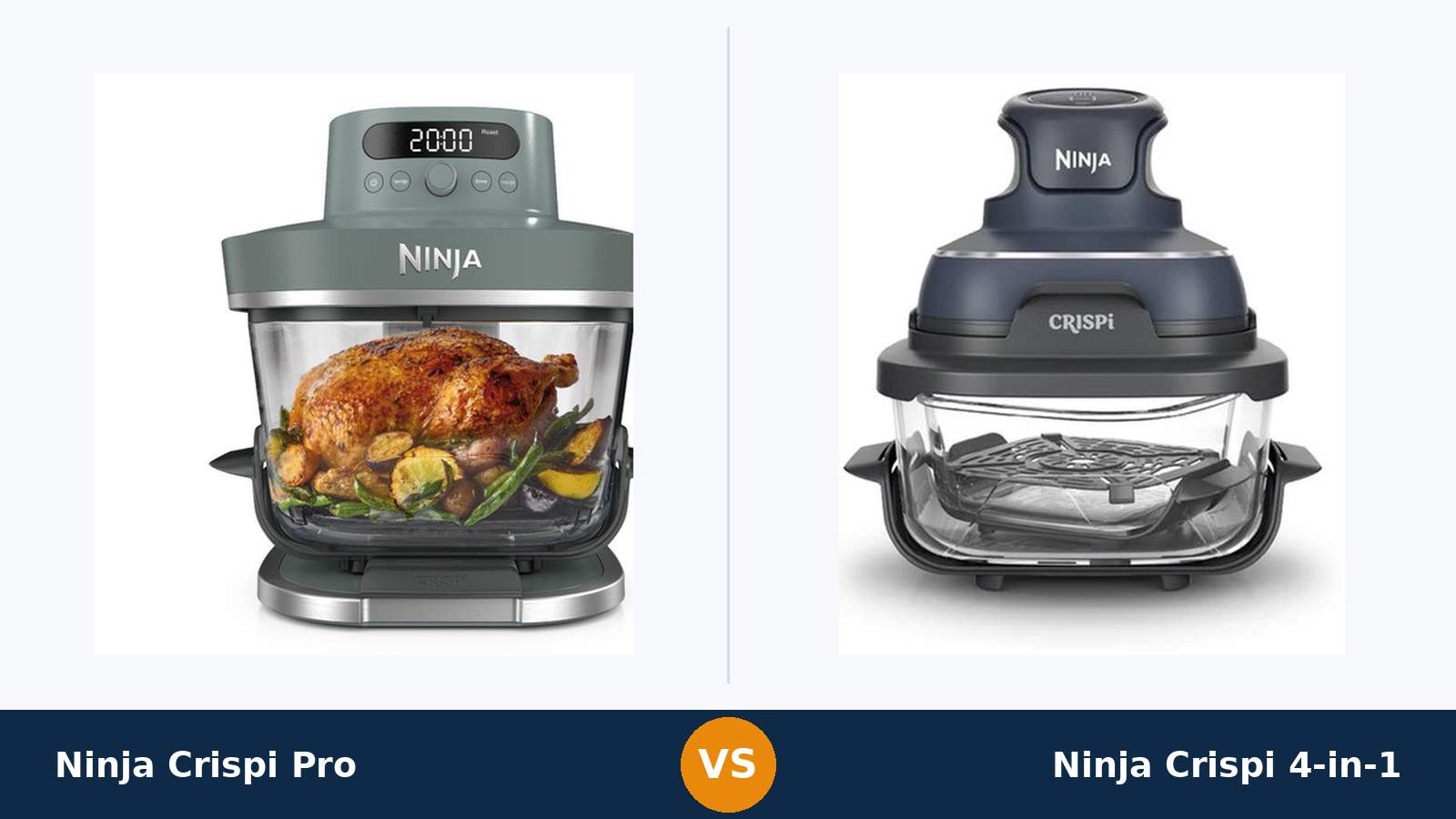
Same glass. Same promise. Two very different machines.
The Ninja Crispi Pro and the original Ninja Crispi 4-in-1 both cook in clear borosilicate glass instead of a coated metal basket. You watch the food brown. Nothing nonstick touches it. Leftovers store in the same dish they cooked in.
After that shared idea, they split hard. The Crispi Pro is a stationary countertop appliance with a 6-quart container, 1,800 watts and a temperature dial. The 4-in-1 is a portable pod that lifts off its containers, packs into a cabinet and runs on preset temperatures only.
One naming point first, because it decides what you are actually buying. The “4 in 1” in this comparison is the original Ninja Crispi 4-in-1 Portable Glass Air Fryer Cooking System, model FN101 — the name SharkNinja itself prints on the product. Its four functions are Max Crisp, Air Fry, Bake and Recrisp, and it ships with two glass containers. It is not the 5-in-1 system, and it is not the Pro. The evidence for that identification sits in the buying guide below.
Every specification in this guide comes from SharkNinja’s own product pages, comparison data and owner’s guides. Where the two machines tie, we say so. Where one wins, we say by how much it matters.
Key Takeaways
- Temperature control is the real dividing line. The Pro adjusts temperature across a 105–450°F span. The 4-in-1 runs fixed presets by function — SharkNinja itself lists adjustable temperature as a Pro-only feature.
- Capacity is not close. The Pro’s 6-qt container serves up to 10 and fits a 7.5-lb chicken. The 4-in-1 tops out at a 4-qt container and a 4-lb chicken.
- The 4-in-1 is the only one that leaves the counter. Its PowerPod detaches, the containers nest, and dinner stores in the cooking dish with a lid on.
- The Pro adds Roast, Dehydrate and Proof. The 4-in-1 covers the everyday four: Max Crisp, Air Fry, Bake, Recrisp.
- Glass, materials and warranty are a genuine tie. Same borosilicate glassware family, same nano-ceramic crisper plates, same 1-year warranty.
Quick Verdict
Buy the Ninja Crispi Pro if this will be your main air fryer. It is the bigger, stronger, more controllable machine.
Its 6-qt container handles family batches. Its temperature adjusts instead of guessing in preset bands. Roast and Dehydrate widen what it can do beyond weeknight crisping.
For a household of three or more, this is the Crispi to own.
Buy the Ninja Crispi 4-in-1 if your kitchen, household or life is smaller than that. One or two people. Limited counter space. Meals that go from pod to plate to fridge in the same glass dish.
It gives up capacity and control. It gives back portability, storage and simplicity that the Pro simply does not offer.
The Scorecard
Scores below are derived directly from the manufacturer specifications compared in this guide — capacities, wattages, function lists, temperature ranges and included parts. They are a reading aid, not benchmark results.
One honest note on context: scores are set for the pairing on this page. The Crispi Pro’s 8.3 matches its established score across our Crispi comparisons. The 4-in-1 scores 7.8 here — a touch higher than it manages against conventional basket fryers — because in this matchup portability and food storage are headline categories, and they are exactly what it was built for.
| Category | Crispi Pro | Crispi 4-in-1 | ||
|---|---|---|---|---|
| Capacity | 9 / 10 | 6 / 10 | ||
| Temperature & function control | 9 / 10 | 5 / 10 | ||
| Power | 9 / 10 | 7 / 10 | ||
| Ease of use | 8 / 10 | 8 / 10 | ||
| Cleaning & food storage | 8 / 10 | 10 / 10 | ||
| Footprint & portability | 5 / 10 | 10 / 10 | ||
| Value | 7 / 10 | 9 / 10 | ||
| Overall | 8.3 / 10 | 7.8 / 10 | ||
The pattern is clean. The Pro wins everything about cooking at scale: capacity, power, control. The 4-in-1 wins everything about living with the machine afterwards: storing it, storing food in it, taking it somewhere else.
At a Glance: Who Each Crispi Fits
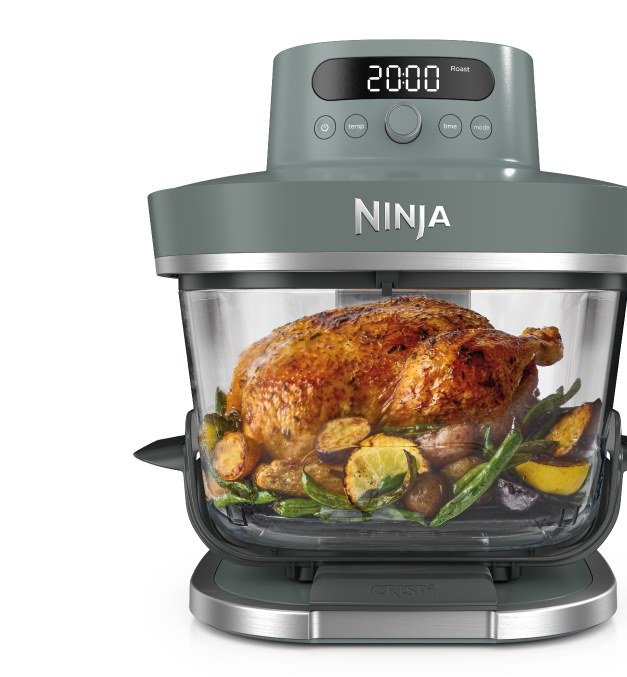
Ninja Crispi Pro (AS101)
- 6-in-1: Air Fry, Max Crisp, Bake/Proof, Roast, Recrisp, Dehydrate
- Adjustable temperature, 105–450°F by function
- 6-qt + 2.5-qt CleanCrisp glass containers; serves up to 10
- 1,800W stationary countertop design
- Borosilicate glass, PFAS- and PTFE-free cooking surface
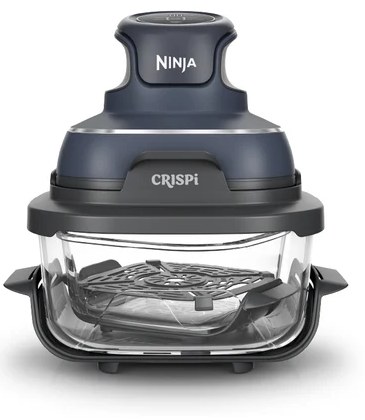
Ninja Crispi 4-in-1 (FN101)
- 4-in-1: Max Crisp, Air Fry, Bake, Recrisp — preset temperatures
- Portable PowerPod lifts off; containers nest for storage
- 6-cup + 4-qt glass containers with storage lids
- 1,500W; 4-qt fits a 4-lb chicken with vegetables
- Cook, serve and store in the same glass dish
Choose the Crispi Pro if…
You cook for three or more people most nights. Batch size is a real constraint in your kitchen, not a theoretical one.
You want to set an exact temperature — low for dehydrating, gentle for proofing dough, precise for baking — instead of accepting the preset a function gives you.
You have the counter space to give a full-size appliance a permanent home, and you will use Roast and Dehydrate, not just admire them on the panel.
Choose the Crispi 4-in-1 if…
You cook for one or two. A 4-qt container is your batch size, and the 6-cup container handles personal meals in minutes.
Your counter is small, shared or already full. The pod and containers pack away in a cabinet between uses, and the whole system can travel — to a dorm, an RV, a second home, a friend’s kitchen.
You meal-prep. Cooking, serving and storing in one lidded glass dish is the workflow this system was designed around.
As an Amazon Associate I earn from qualifying purchases at no extra cost to you.
Specifications: The Specs That Actually Matter
Every figure below is taken from SharkNinja’s published specifications, product pages and owner’s guides, cross-checked against the manufacturer’s product data.
Naming note: the product on the right is the Ninja Crispi 4-in-1 Portable Glass Air Fryer Cooking System, model FN101. SharkNinja sells it under exactly that “4-in-1” name, with the four functions listed in the table. The later 5-in-1 (FN103) adds Keep Warm and a third container; it is a different product and gets its own warning in the buying guide.
| Specification | Ninja Crispi Pro (AS101) | Ninja Crispi 4-in-1 (FN101) |
|---|---|---|
| System type | Stationary countertop glass air fryer | Portable PowerPod + removable glass containers |
| Functions | 6-in-1: Air Fry, Max Crisp, Bake/Proof, Roast, Recrisp, Dehydrate | 4-in-1: Max Crisp, Air Fry, Bake, Recrisp |
| Temperature control | Adjustable within each function; 105–450°F overall | Preset bands by function (380–450°F); time adjusts, temperature does not |
| Power | 1,800W, 120V | 1,500W, 120V |
| Containers included | 6-qt + 2.5-qt CleanCrisp glass | 6-cup + 4-qt glass, with adapter and storage lids |
| Largest batch | 6-qt — serves up to 10; fits a 7.5-lb chicken | 4-qt — fits a 4-lb chicken with vegetables |
| Container material | Borosilicate CleanCrisp glass, PFAS- and PTFE-free | Borosilicate glass, PFAS- and PTFE-free |
| Crisper plates | Aluminium, nano-ceramic coated | Aluminium, nano-ceramic coated |
| Dimensions | 11.8″ D × 12.2″ W × 11″ H | 11.5″ × 9.76″ × 11.81″ (4-qt setup; footprint changes with container) |
| Weight | 11.4 lbs (unit) | 14.55 lbs (full system: pod + both containers) |
| Dishwasher-safe parts | Glass containers and crisper plates | Glass containers, crisper plates and storage lids; PowerPod never |
| Storage | Lives on the counter as a full-size appliance | Pod and containers nest; packs into a cabinet |
| Cord | Fixed countertop cord | 36 in |
| Warranty | 1-year limited | 1-year limited |
Variant note: the FN101’s specification is the standard US version above. SharkNinja notes that retailer-specific editions exist — some US retailer versions are 3-in-1 without Max Crisp — and the UK/EU FN101 runs 1,700W with different functions. The Pro also changes by region: overseas versions run up to 2,050W and the UK model is marketed as a 7-in-1. The buying guide below covers how to check.
Weight note: read the weight row carefully. The portable system’s figure covers the pod plus both glass containers; the Pro’s covers the countertop unit. It does not make the 4-in-1 heavier to live with — it breaks down and packs away, which is the entire point of it.
The Differences That Actually Matter
1. Temperature control — the difference SharkNinja itself draws
This is the cleanest split between the two machines, and it is not a matter of interpretation. SharkNinja’s own Crispi-versus-Crispi-Pro guidance lists adjustable temperature control as a Pro feature that the base Crispi does not have.
On the Pro, each function carries a real temperature range you can set: Max Crisp at 425–450°F, Air Fry at 400–425°F, Bake/Proof at 375–400°F, Recrisp at 380–400°F, and Dehydrate all the way down at 105–195°F.
On the 4-in-1, you choose a function and a time. The temperature comes with the function: Max Crisp runs 425–450°F, Air Fry 400–425°F, Bake 375–400°F, Recrisp 380–400°F. Those bands come straight from the FN101 owner’s guide.
For fries, wings, nuggets and leftovers, the presets are honestly fine. They cover the temperatures everyday crisping actually uses, and they remove a decision from a weeknight cook.
The presets run out of road at the edges. Drying herbs or making jerky needs low, steady heat the 4-in-1 cannot reach. Proofing dough needs gentle warmth it does not offer. A recipe that specifies 365°F gets whatever the nearest band gives it.
If your cooking stays inside the four functions, you will rarely feel this limit. The moment a recipe hands you an exact temperature, you will feel it every time.
2. Capacity — one cooks for a crowd, one cooks for a couple
The Pro’s main container holds 6 quarts. SharkNinja rates it for up to 10 servings and a 7.5-lb chicken. A 2.5-qt second container rides along for smaller jobs.
The 4-in-1’s largest container holds 4 quarts, sized around a 4-lb chicken with vegetables. Its second container is a 6-cup personal vessel that SharkNinja pitches at single meals cooked in as little as 7 minutes.
Translate that into real cooking. A family batch of wings, a tray’s worth of roasted vegetables for six, a whole chicken for Sunday plus leftovers — that is Pro territory, done in one run.
In the 4-in-1, the same food goes in two runs — a recurring tax on exactly the nights you bought an air fryer to make easier.
For one or two people, the tax never applies. A 4-qt container is the right size, and the 6-cup container is arguably the best single-serving vessel in the whole Crispi line.
Capacity is the least subtle difference here. Count your household, and this section has probably made your decision already.
3. Functions — Roast and Dehydrate live only on the Pro
Both machines share a core four in spirit: crisping, air frying, baking and reviving leftovers. The 4-in-1 names them Max Crisp, Air Fry, Bake and Recrisp.
The Pro keeps all of that and adds three more jobs: Roast, a Dehydrate mode running down to 105°F, and Proof folded into its Bake function for dough.
Roast matters most. It is the difference between an appliance that crisps and an appliance that cooks a chicken dinner properly, with the slower, steadier heat a roast wants.
Dehydrate is a genuine second hobby in a box — jerky, dried fruit, herbs — and it is completely absent from the 4-in-1. There is no preset workaround, because the portable pod cannot hold those low temperatures.
Keep Warm belongs to the 5-in-1, not to either machine here — a shared absence, not a point for anyone.
4. Power — 1,800 watts against 1,500, and where it shows
The Pro draws 1,800 watts. The portable PowerPod draws 1,500. Both are serious power for glass cooking — the pod’s figure matches plenty of full-size basket fryers.
Wattage shows itself in two places: recovery and load. Open the container mid-cook to turn food, and the stronger heater pulls the temperature back faster.
Fill the container to the top, and the stronger heater keeps crisping instead of steaming. A full 6-qt batch is exactly the situation the Pro’s extra 300 watts were bought for.
In the 6-cup container, cooking for one, the 4-in-1 wants for nothing. Its power-to-volume ratio is excellent.
Score power to the Pro, with an honest caveat: at the 4-in-1’s intended portion sizes, you will not feel the gap.
5. Portability and storage — the 4-in-1’s home turf
Here the comparison inverts completely. The Pro is a countertop appliance: 11.8 by 12.2 by 11 inches, living where it sits, used where it lives.
The 4-in-1 is a system. The PowerPod lifts off its adapter. The containers nest. The whole kit packs into a cabinet, a drawer-adjacent shelf, a car boot.
That changes who can own an air fryer at all. Renters with no spare counter. Students. RV and boat kitchens. Anyone whose counter already hosts a coffee machine, a stand mixer and an argument.
The pod also travels — to a holiday rental or a family kitchen — in a way no countertop unit reasonably can.
The Pro’s footprint is not unreasonable for its class. But it is a commitment of permanent counter space, and the 4-in-1 asks for none.
6. Cleaning and food storage — cook, serve, store
Both machines put the glassware and crisper plates in the dishwasher. Both keep their heating elements out of it — the Pro’s head and the 4-in-1’s PowerPod are wipe-clean only, and the pod must never be immersed.
The 4-in-1 pulls ahead on what happens after cooking. Its containers take storage lids. Dinner goes from pod to table to fridge in the same dish, with no decanting into plastic tubs.
Its containers are also freezer- and microwave-friendly glassware, so the system doubles as your food-storage set. Fewer dishes, fewer transfers, less washing overall.
The Pro’s containers serve and store too, and a 6-qt glass vessel is a genuinely useful thing. But a container that size is a commitment in a fridge and a sink; the portable system’s dishes behave like ordinary kitchenware.
One shared piece of glass discipline applies to both: let containers cool before washing, and do not shock hot glass with cold water or cold food. The owner’s guides are explicit, and borosilicate rewards the habit with a long life.
7. The honest tie — glass, materials and warranty
Some comparisons are won in the details. This one’s foundation is shared, and we will not manufacture a difference where none exists.
Both cook in borosilicate glass that SharkNinja markets as free of PFAS and PTFE — no nonstick coating on the cooking vessel itself. Both sit food on aluminium crisper plates with a nano-ceramic coating.
Both let you watch food brown through the glass, which sounds like a novelty until the first time you catch a batch at exactly the right colour without opening anything and dumping the heat.
Both carry the same 1-year limited warranty from SharkNinja. Both are, underneath the format fight, the same cooking idea executed at two sizes.
That is what makes this a clean decision: you are not choosing between a good Crispi and a compromised one. You are choosing between a bigger, controllable Crispi and a smaller, portable one.
Who Each Crispi Suits: Household and Use-Case Fit
The fastest way to choose between these two is to start from your household and your counter, not from the spec sheet. This table is the whole comparison in one view.
| Your situation | Crispi Pro | Crispi 4-in-1 | Our call |
|---|---|---|---|
| Household of 4–10, family dinners | Excellent — 6-qt, serves up to 10 | Stretched — batches split in two | Crispi Pro |
| Whole chicken / Sunday roast | Excellent — 7.5-lb fit, Roast mode | Good — 4-lb fit, no Roast mode | Crispi Pro |
| 1–2 people, everyday meals | Good — 2.5-qt container helps | Excellent — sized exactly for it | Crispi 4-in-1 |
| Meal prep with fridge storage | Good — containers store food | Excellent — lids, nesting, same-dish storage | Crispi 4-in-1 |
| Dorm, RV, tiny or shared kitchen | Poor — needs permanent counter | Excellent — packs away, travels | Crispi 4-in-1 |
| Dehydrating, proofing, exact temperatures | Excellent — 105–450°F adjustable | Not offered — presets only | Crispi Pro |
| Second home / taking it with you | Poor — a fixed appliance | Excellent — the pod is the fryer | Crispi 4-in-1 |
| Counter space is genuinely unlimited | Excellent — no compromise needed | Good — portability you may not need | Crispi Pro |
Read the first and fifth rows together. They are the two questions that decide this comparison for almost everyone: how many mouths, and how much counter.
Ready to check today’s price?
Both Crispis sell through Amazon. Prices move, so check the live figure on the model that fits your kitchen.
View on Amazon — Crispi ProView on Amazon — Crispi 4-in-1The 30-Second Decision
| If this sounds like you… | Buy this |
|---|---|
| “I want one glass air fryer that does everything, for the whole family.” | Crispi Pro |
| “I cook for one or two and my counter is already full.” | Crispi 4-in-1 |
| “I follow recipes with exact temperatures, and I dehydrate.” | Crispi Pro |
| “Leftovers should store in the dish they cooked in.” | Crispi 4-in-1 |
| “It needs to live in a cabinet, a dorm or an RV.” | Crispi 4-in-1 |
| “Whole chickens and big batches, every week.” | Crispi Pro |
What You Gain. What You Give Up.
Ninja Crispi Pro
You gain: the full Crispi idea at family scale. A 6-qt container, 1,800 watts, adjustable temperature from dehydrating lows to a 450°F ceiling, and Roast and Proof alongside the crisping core.
You give up: portability and easy storage. This is a permanent countertop resident with a full-size footprint, and its big glass vessel is the heaviest wash-up in the line.
Ninja Crispi 4-in-1
You gain: the glass-cooking experience in a system that packs away, travels, and turns its cooking dishes into storage dishes. The simplest controls in the family: pick a function, set a time.
You give up: temperature control, entirely — presets decide for you. You also give up Roast and Dehydrate, and your batch ceiling is 4 quarts, forever.
Pros and Cons
Crispi Pro — Pros
- Adjustable temperature, 105–450°F
- 6-qt capacity serves up to 10
- Roast, Dehydrate and Proof beyond the core four
- 1,800W — strongest heater in the Crispi line
- Same clean glass cooking as the portable
Cons
- Stationary; claims permanent counter space
- 6-qt glass vessel is bulky to wash and store
- No Keep Warm mode
- Costs more to own than the portable system
Crispi 4-in-1 — Pros
- Pod detaches; whole system nests and packs away
- Cook, serve and store in the same lidded dish
- 6-cup container is ideal for single meals
- Dead-simple controls — function plus time
- The lowest-cost way into glass air frying
Cons
- No adjustable temperature — presets only
- No Roast or Dehydrate
- 4-qt batch ceiling; big households cook in rounds
- Retailer variants confuse the function list (see guide)
- PowerPod can never be immersed or dishwashed
Buying Guide: Get the Exact Crispi You Meant to Buy
Confirm which “in-1” you are looking at. This comparison exists because the counts are product names, not descriptions. The 4-in-1 is the FN101: four functions, two containers, no Keep Warm.
The 5-in-1 is the FN103: it adds Keep Warm and a third, 2.5-qt container. The 6-in-1 is the Crispi Pro, AS101. Sellers do not always help — some listings borrow a sibling’s name — so match the model number on the listing to the model you decided on.
That is also how we identified the 4-in-1 for this guide. SharkNinja’s own store sells the FN101 under the exact name “Ninja Crispi 4-in-1 Portable Glass Air Fryer Cooking System”, and the FN101 owner’s guide lists the same four functions: Max Crisp, Air Fry, Bake, Recrisp. Nothing else in the range carries the 4-in-1 name.
Check the function list on the box, not just the title. SharkNinja itself notes that retailer-specific FN101 editions exist, and some US retailer versions drop to 3-in-1 without Max Crisp.
If the price looks unusually good, this is usually why. Four named functions on the box — Max Crisp, Air Fry, Bake, Recrisp — is the genuine standard US model.
Mind the region. The figures in this guide are the US models: 1,800W Pro, 1,500W 4-in-1, both 120V. UK and European Crispis run different wattages and, in the UK Pro’s case, an extra function.
An imported listing is not a bargain version of this comparison. It is a different appliance with a plug problem.
TempWare versus CleanCrisp is a rename, not a downgrade. FN101-era materials call the glassware TempWare; current SharkNinja copy calls the same borosilicate line CleanCrisp. Either name on the glass is the genuine article.
Check the colours carry the same specs. FN101 colours — Cyber Space, Stone, Butter Yellow and others — are cosmetic; each colour simply has its own listing. The Pro’s finishes are the same story. Buy the colour you like; verify the model number, not the paint.
The Upgrade Path Test
These two are stablemates, which makes the upgrade question unusually practical: what carries over if you start portable and later go Pro?
More than you might expect. SharkNinja’s container compatibility guidance puts the 4-qt and 2.5-qt containers across both the portable FN100 series and the Pro’s AS100 series. An FN101 owner stepping up keeps the 4-qt dish in service.
The 6-cup small container is portable-series only. And the step is one-directional in the way that matters: no accessory adds temperature adjustment, Roast or Dehydrate to the FN101. Control is hardware, and it lives in the Pro.
Replacement glassware is sold separately for both systems, which softens the one real ownership risk of cooking in glass. A chipped container is a spare part, not a dead appliance.
Judge the pair by your second year. If the household is growing, the Pro is the one that grows with it. If the kitchen is shrinking — or moving — the 4-in-1 is the one that fits the life around the food.
When to Skip Both
Honesty cuts both ways. Some kitchens are wrong for glass air frying altogether.
Skip both if you need two independent zones cooking different foods at once — that is a DualZone basket fryer’s job, and neither Crispi pretends otherwise. Skip both if you want a broiler’s top heat or a toaster oven’s shape for sheet-pan cooking.
Skip both if glass care rules will annoy you daily. These containers want cooling before washing and no thermal shocks; a household that will resent that should buy metal.
And skip both if capacity beyond 6 quarts is the whole point. The Pro is the ceiling of this line, not the start of a bigger one.
For everyone cooking in the one-to-ten-serving range who likes the idea of watching dinner brown in glass, one of these two is the right answer. The only question is which format your kitchen can hold.
Warranty and Long-Term Support
Both machines carry SharkNinja’s 1-year limited warranty in the US. Neither side wins on paperwork.
Long-term, the ownership facts are shared too: glassware and crisper plates are replaceable parts, the containers double as ordinary kitchen glassware, and the heating units — pod and Pro head alike — are sealed units you wipe down rather than service.
Two habits from the owner’s guides protect both machines. Give the pod its clearance — the FN101 guide specifies 6 inches of vent space around it. And treat hot glass gently: cool before washing, no cold water on a hot container, no hot container on a cold wet surface.
Follow those, and the wear item in either system is a replaceable dish, not the appliance.
Final Verdict
The Ninja Crispi Pro is the better air fryer.
It wins this comparison on the fundamentals of cooking: more capacity, more power, more functions, and the temperature control the portable simply does not have. For a household feeding three or more people most nights, it is the Crispi that behaves like a primary appliance.
Buy the Crispi Pro for family batches, whole chickens, exact temperatures, dehydrating and proofing — and for any kitchen with the counter to hold it.
Buy the Crispi 4-in-1 if you cook for one or two, if counter space is the scarcest thing in your kitchen, or if the fryer needs to pack away, travel, and store dinner in its own cooking dish.
It is not a lesser Crispi. It is the same idea, aimed at a smaller, more mobile life — and for that life, the Pro’s advantages are the ones that do not matter.
View on Amazon — Crispi 4-in-1
Watch Out: Similar Names, Different Crispis
The Crispi family name is a trap for the hurried buyer. Four warnings belong in every version of this guide.
First: the count is the model. 4-in-1 means FN101. 5-in-1 means FN103, which adds Keep Warm and a mid-size container. 6-in-1 means the Crispi Pro. A listing that mixes a count with the wrong function list is a listing to walk away from.
Second: there is an older FN100. It is a 3-in-1 with a smaller 5-cup container and no Bake function. It still surfaces in marketplaces wearing the family name.
Third: “Crispi Pro” without a model check can mean a regional variant — up to 2,050W, or a UK 7-in-1. The genuine US Pro is the AS101 series at 1,800W.
Fourth: third-party listings exist that borrow Crispi names with specifications SharkNinja never published — wrong wattages, invented functions. If the seller is not selling a model number you can find on SharkNinja’s site, it is not this product.
Slow down on the product page. Match the model number, then the function list, then the price — in that order.
Frequently Asked Questions
What exactly is the Ninja Crispi “4 in 1” in this comparison?
It is the original Ninja Crispi 4-in-1 Portable Glass Air Fryer Cooking System, model FN101 — the name SharkNinja itself uses. Its four functions are Max Crisp, Air Fry, Bake and Recrisp, delivered by a portable PowerPod over two glass containers (6-cup and 4-qt). It is not the 5-in-1 FN103, which adds Keep Warm and a third container.
Can the Crispi 4-in-1 adjust its temperature?
No. The FN101 adjusts time only; each function runs a preset temperature band (Max Crisp 425–450°F, Air Fry 400–425°F, Bake 375–400°F, Recrisp 380–400°F). SharkNinja’s own Crispi-versus-Pro guidance lists adjustable temperature as a Crispi Pro feature — that is the single biggest functional gap between the two.
Which Crispi is better for a family?
The Crispi Pro. Its 6-qt container serves up to 10 and fits a 7.5-lb chicken, where the 4-in-1 tops out at 4 quarts and a 4-lb chicken. Larger households would cook most family meals in two rounds on the portable system.
Are the glass containers interchangeable between the two?
Partly. SharkNinja’s compatibility guidance lists the 4-qt and 2.5-qt containers as fitting both the portable FN100 series and the Pro’s AS100 series. The 6-cup small container fits the portable series only, and the Pro’s 6-qt container belongs to the Pro.
Is the glass safe, and what is it made from?
Both systems cook in borosilicate glass that SharkNinja markets as PFAS- and PTFE-free, with aluminium nano-ceramic crisper plates. The care rules are real: let containers cool before washing, and avoid sudden temperature changes such as cold liquid in hot glass — the owner’s guides are explicit on thermal shock.
Which one is easier to clean and store?
The 4-in-1. On both machines the glassware and crisper plates are dishwasher-safe and the heating unit is wipe-only — the PowerPod must never be immersed. The portable system adds storage lids, so food stores in the cooking dish, and the pod and containers nest away in a cabinet. The Pro lives on the counter.
Some Crispi listings show 3 functions, or Roast. Which is right?
Retailer and regional variants. SharkNinja notes that some US retailer editions of the FN101 are 3-in-1 without Max Crisp, and overseas models differ in wattage and functions — the UK Pro is even a 7-in-1. The standard US models in this comparison are the 4-in-1 FN101 and the 6-in-1 Pro AS101; check the function list and model number on any listing before buying.
Does either Crispi need preheating?
The portable system is designed to cook without preheating — the PowerPod goes straight to work on the container. That, plus the 6-cup container’s small volume, is how SharkNinja gets personal meals cooked in as little as 7 minutes.
Sources & Verification
SharkNinja US Ninja Crispi Pro AS101 product page and official Crispi model comparison data (functions, serves, temperature control) • SharkNinja official store AS101 materials (materials, container compatibility, warranty) • SharkNinja US Ninja Crispi FN101 product page — sold as the “4-in-1 Portable Glass Air Fryer Cooking System” (1500W, containers, dimensions, weight, cord) • Ninja FN101 owner’s guide (per-function preset temperature bands, dishwasher and glass-care rules) • AS101 instruction manual data (per-function temperature ranges, 1800W, dimensions) • SharkNinja Crispi vs Crispi Pro FAQ (adjustable temperature is a Pro feature). Specifications verified November 2026.

James Wilson
James has been testing and comparing home and kitchen appliances for over a decade and writes Honestly Compared’s small-appliance guides. His rule for every comparison: the verdict has to survive the spec sheet, not the marketing page.