
Ninja Crispi Pro vs Ninja Foodi: Which Should You Buy?
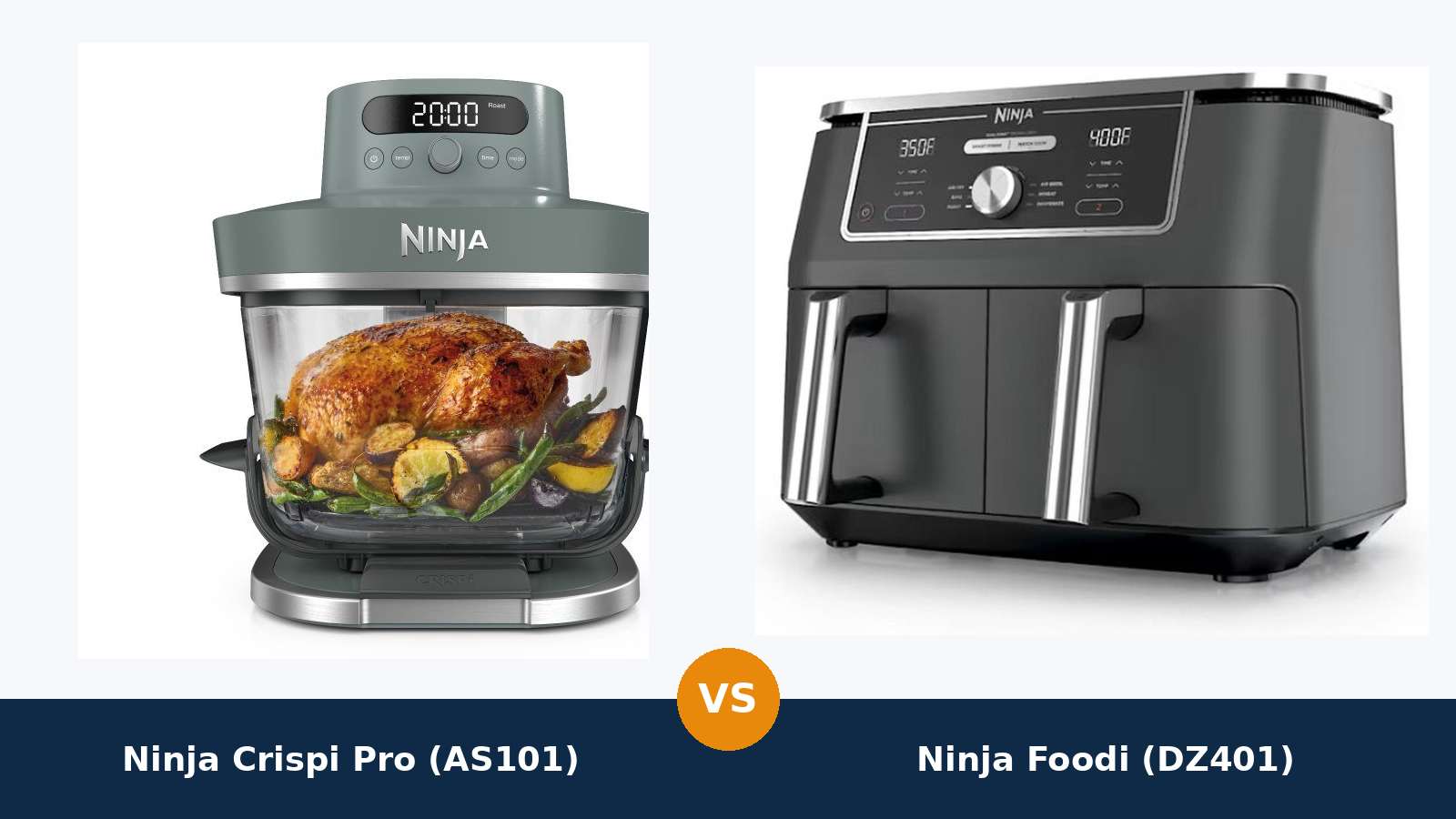
One of these air fryers is a glass bowl on a powered base. The other is a two-drawer machine wide enough to anchor a counter.
Both wear the Ninja name. Both top out at 450°F. And both get described online as the one to buy for families — which should tell you how loosely that word gets used.
First, a naming point, stated openly. “Ninja Foodi” is a whole product family, not one machine. It includes pressure-cooker multi-cookers and countertop ovens.
Against a basket-style glass fryer, the Foodi that belongs in this head-to-head is the one sold under that name as a basket air fryer: the Ninja Foodi 6-in-1 10-Qt XL 2-Basket Air Fryer with DualZone Technology, model DZ401. The Crispi Pro side is exact: the Ninja Crispi Pro 6-in-1 Glass Air Fryer, model AS101.
So this is glass against drawers. One big see-through container against two independent baskets. The right answer depends on how your household actually cooks — and this guide works through it from SharkNinja’s own specifications.
Key Takeaways
- The Foodi DZ401 is the family production line. Ten quarts split across two independent 5-qt baskets that can run different programs and finish together.
- The Crispi Pro is the glass alternative. A 6-qt CleanCrisp glass container you can watch, serve from and store leftovers in — no nonstick cooking vessel.
- Capacity is not the tie it looks like. The Crispi’s full 6 quarts work in one dish; the Foodi’s 10 quarts are split in two, and nothing crosses between baskets.
- The Crispi Pro is the easier clean and the smaller footprint. Glass goes in the dishwasher and does not wear out; the unit is roughly 8 lbs lighter and 5 inches narrower.
- Check the Crispi Pro’s function count before buying. SharkNinja confirms it varies from four to six functions depending on the retailer.
Quick Verdict
Buy the Ninja Foodi DZ401 for most households. It is the more capable primary air fryer.
Two independent baskets mean a main and a side cook at the same time, at different temperatures, and land on the plate together. No other arrangement on this page can do that.
Across a week of family dinners, that flexibility beats everything the glass system offers. It is why the Foodi takes this comparison overall.
Buy the Ninja Crispi Pro if you cook in one dish and want to watch it happen. Smaller households, glass instead of coated metal, leftovers stored in the cooking container itself.
If your dinners are one generous dish rather than two coordinated ones, the Crispi Pro is not the compromise pick. It is the better tool.
The Scorecard
Scores below are derived directly from the manufacturer specifications compared in this guide — capacities, function lists, temperature ranges, dimensions and published cleaning instructions. They are a reading aid, not benchmark results.
| Category | Crispi Pro AS101 | Foodi DZ401 | ||
|---|---|---|---|---|
| Capacity | 6 / 10 | 10 / 10 | ||
| Cooking design & versatility | 8 / 10 | 10 / 10 | ||
| Temperature control & range | 9 / 10 | 8 / 10 | ||
| Ease of use | 8 / 10 | 9 / 10 | ||
| Cleaning & materials | 9 / 10 | 7 / 10 | ||
| Footprint & storage | 9 / 10 | 5 / 10 | ||
| Value | 7 / 10 | 8 / 10 | ||
| Overall | 8.0 / 10 | 8.1 / 10 | ||
Read the pattern, not just the totals. The Foodi wins everything about cooking volume and coordination. The Crispi Pro wins everything about the vessel itself — what it is made of, how it cleans, and how much counter it asks for.
At a Glance: Who Each Fryer Fits
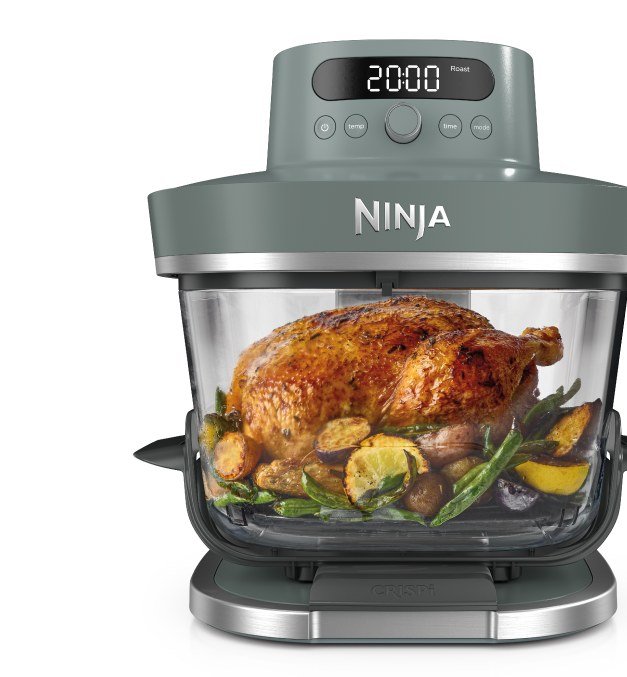
Ninja Crispi Pro (AS101)
- 6-qt CleanCrisp glass container, plus a 2.5-qt container in the box
- Six functions incl. Bake/Proof and Dehydrate (build varies by retailer)
- Fully adjustable temperature, 105–450°F
- Glass containers and crisper plates are dishwasher-safe
- Compact footprint: 11.8 × 12.2 × 11 in, 11.4 lbs
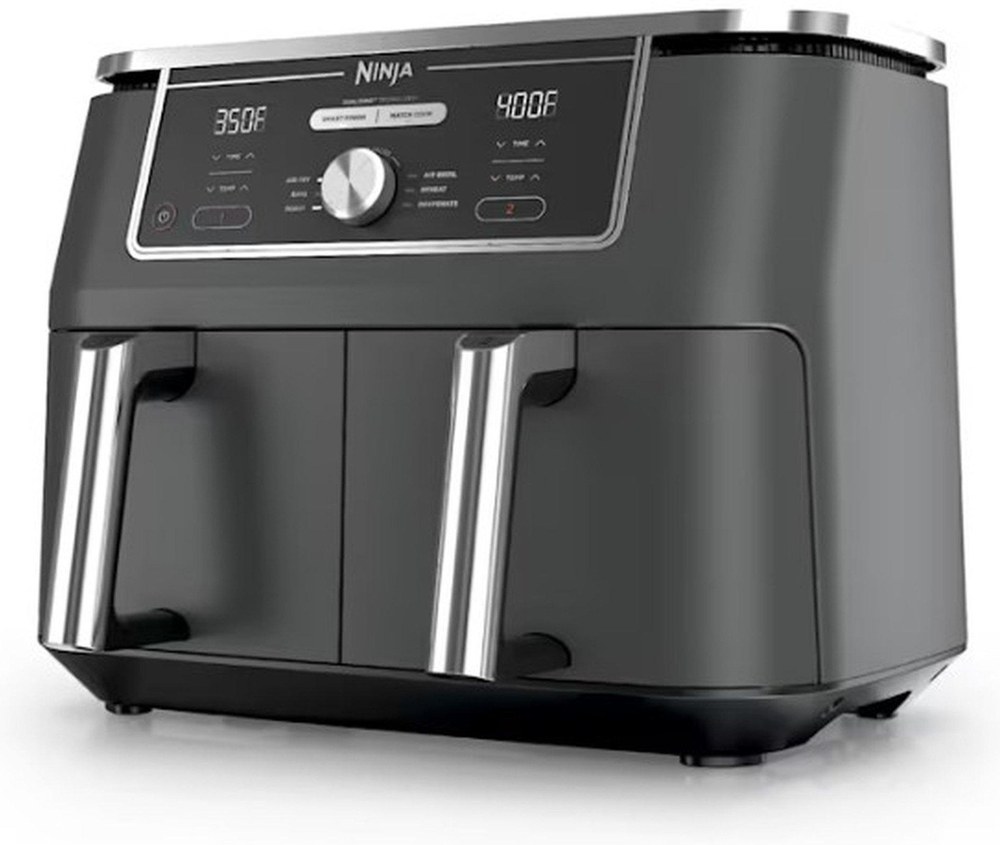
Ninja Foodi (DZ401)
- 10 qt total: two independent 5-qt baskets
- DualZone tech — Smart Finish syncs two programs, Match Cook copies settings
- Six functions incl. Air Broil and Reheat
- Adjustable 105–450°F in each zone separately
- Nonstick baskets and crisper plates are dishwasher-safe
Choose the Crispi Pro if…
You cook for one to four people, usually in a single dish. A roast with vegetables around it. A traybake-style dinner in one vessel.
You want to see the food while it cooks — browning, bubbling, done — without opening anything and dumping the heat.
You are done with nonstick coatings on the vessel itself, or your counter space is genuinely tight.
Choose the Foodi DZ401 if…
Your dinners come in two parts. Protein in one basket, sides in the other, both finished at the same moment.
You feed five or more people regularly, or you batch-cook for the week.
You have the counter width for a 17-inch machine — and a cupboard or counter run where it can live permanently.
As an Amazon Associate I earn from qualifying purchases at no extra cost to you.
Specifications: The Specs That Actually Matter
Every figure below is taken from SharkNinja’s published specifications, manuals and product data for the US models. Where a number varies by retailer build or region, the note under the table says so.
| Specification | Ninja Crispi Pro (AS101) | Ninja Foodi (DZ401) |
|---|---|---|
| Capacity | 6 qt in one container (6-qt and 2.5-qt glassware included; 4-qt available separately) | 10 qt total — two independent 5-qt baskets |
| Wattage | 1,800W | 1,690W |
| Temperature range | 105–450°F, fully adjustable | 105–450°F, adjustable per zone |
| Cooking functions | 6: Max Crisp, Air Fry, Roast, Bake/Proof, Recrisp, Dehydrate | 6: Air Fry, Air Broil, Roast, Bake, Reheat, Dehydrate |
| Simultaneous cooking | One container at a time | Two zones at different settings; Smart Finish syncs finish times, Match Cook mirrors settings, IQ Boost manages power |
| Container / basket material | CleanCrisp borosilicate glass containers; aluminium nano-ceramic crisper plates | Nonstick-coated metal baskets and crisper plates |
| Dimensions | 11.8 × 12.2 × 11 in | 17.1 W × 13.9 D × 12.8 H in |
| Weight | 11.4 lbs | 19.8 lbs |
| Dishwasher-safe parts | Glass containers, crisper plates, storage lids (base: never immerse) | Baskets and crisper plates (the only dishwasher-safe parts) |
| Warranty | 1-year limited | 1-year limited |
Which Foodi is this? The DZ401 — the Foodi 6-in-1 10-Qt XL 2-Basket model. It is not the FD401 pressure-cooker multi-cooker and not the SP101 Foodi oven. Those are different machines that share the family name; the similar-names section below untangles them.
Crispi Pro function counts vary. SharkNinja’s own comparison FAQ states the Crispi Pro ships with four to six functions depending on the retailer. The full six-function build adds Roast and Dehydrate; some large-retailer builds list only Max Crisp, Air Fry, Recrisp and Bake/Proof. The table above reflects the full US build — check the panel on the listing you buy from.
Container notes. The Crispi Pro’s modular base adapts to the 2.5-qt, 4-qt and 6-qt CleanCrisp containers, but it cooks in one container at a time — the two included sizes are alternatives, not a pair. SharkNinja rates the 6-qt container for a 7.5-lb chicken. The Foodi’s cord length is not published by SharkNinja, so no figure is printed here rather than guessed.
The Differences That Actually Matter
1. One big dish vs two coordinated baskets — the deciding difference
Everything else in this comparison is a footnote to this section. These machines organise dinner differently.
The Foodi splits its 10 quarts into two sealed 5-qt baskets. Each has its own heater, fan, temperature and timer.
That buys the one trick no single-container fryer can copy: chicken at 390°F in zone one, green beans at 350°F in zone two, with Smart Finish holding the faster dish so both end together.
The Crispi Pro puts its capacity in one 6-qt glass vessel. Nothing cooks simultaneously — but nothing is fenced off, either.
A whole chicken sits in the Crispi surrounded by its vegetables, all in one dish, juices and all. In the Foodi, that same meal is a negotiation between two 5-qt boxes.
So the real question is not “how much capacity?” It is “how many separate things do you cook at once?” Two or more, most nights: Foodi. One generous dish: Crispi Pro, and it is not close the other way.
2. Glass you can see through — and serve from
The Crispi Pro’s container is borosilicate glass on every side. You watch food brown in real time, from any angle, without opening a drawer and losing the heat you just paid for.
That visibility changes behaviour. You stop overcooking “to be safe,” because done is something you can see.
Then the meal ends and the same dish keeps working. Storage lids are included: the container goes from base to table to fridge without decanting anything into a second box.
The Foodi’s baskets are opaque coated metal, and its workflow is the conventional one — cook, tip out, serve, wash. Perfectly workable. Just one more vessel in the sink and no window on the cooking.
Call this a clear Crispi Pro win for anyone who cooks by eye. If you cook strictly by timer and probe, it matters far less.
3. The function lists — same count, different tools
Both machines list six functions. The overlap is smaller than the matching number suggests.
Shared ground: Air Fry, Roast and Dehydrate appear on both panels. Both span 105–450°F.
The Crispi Pro adds Max Crisp for frozen food, Recrisp for leftovers, and Bake/Proof — the only dough-proofing option here, and a genuine point of difference for bakers.
The Foodi answers with Air Broil, Ninja’s high-heat top-down finish, and Reheat. Broiling is the function glass owners most often say they miss; there is no equivalent on the Crispi Pro’s panel.
Temperature control also differs in kind. The Crispi Pro is fully adjustable — a headline upgrade over the original portable Crispi, whose temperatures are fixed presets per function.
The Foodi matches the adjustment, then doubles it: two zones, each set independently. On range alone, an honest tie. On what the functions let you do, the Foodi’s list is the more useful one for savoury weeknight cooking, and the Crispi’s is the more interesting one for baking.
4. Cleaning and materials — glass does not wear out
Both machines route most of the washing-up through a dishwasher. The difference is what the dishwasher is washing.
The Crispi’s cooking vessel is glass. There is no coating on it to scratch, bubble or thin out over years of metal utensils and dishwasher cycles. The crisper plates are aluminium with a nano-ceramic nonstick finish; the base itself is wiped down and never immersed.
The Foodi’s baskets and crisper plates are nonstick-coated metal. SharkNinja clears them — and only them — for the dishwasher.
That clearance is real, and owners should use it. But coated baskets live a harder life than glass: coatings age, and an ageing basket is the most common reason a basket fryer gets replaced.
Glass has its own discipline. It is thermal-shock resistant, not indestructible, and it wants to cool before a cold rinse. Treat it like the glassware it is and it outlasts the machine around it.
5. Footprint, weight and where each machine lives
The Foodi is 17.1 inches wide and weighs 19.8 lbs. That is not a machine you fetch from a cupboard on a Tuesday.
It needs a permanent counter run, clearance for two drawers to open, and a household that accepts it as furniture. Most owners never move it again — by design.
The Crispi Pro occupies an 11.8 × 12.2-inch patch and weighs 11.4 lbs. Its containers nest and stack with their lids, so the system stores like the glassware it mostly is.
In a small kitchen this section alone can settle the comparison. A fryer that does not fit your counter has a capacity of zero, whatever the box says.
Be honest about which kitchen you have. The Foodi’s advantages are all real, and all of them assume the counter space exists.
6. Power — 1,800 watts in one place vs 1,690 shared
On paper the Crispi Pro has the stronger heater: 1,800W against the Foodi’s 1,690W.
Context matters more than the headline. Every one of the Crispi’s watts serves a single container, which is why it preheats fast and hits frozen food hard on Max Crisp.
The Foodi’s 1,690W is a household total. Run one zone and it gets the machine’s full attention; run both and IQ Boost distributes power between them, which is the honest price of cooking two things at once.
Neither machine is underpowered for its design. But if your comparison is a single dish cooked as fast as possible, the Crispi Pro’s concentrated power is a small, real edge — and if your comparison is a whole dinner, simultaneous beats concentrated.
7. Noise, heat and the rest of the evening
Neither manufacturer publishes a noise figure, so none is invented here. What the designs tell you is this: the Foodi encloses its fans inside a large insulated body, while the Crispi Pro’s fan sits in the head unit directly above an open glass vessel.
Heat behaviour differs the same way. The Crispi’s glass radiates the cooking temperature into the room and stays hot to handle — it is, visibly, a hot glass dish.
The Foodi keeps its heat behind drawer fronts. Baskets still come out hot; the machine around them is easier to live beside in a small, warm kitchen.
Small points, honestly scored: a slight daily-living edge to the Foodi, bought with the size from section five. There is no free lunch in either direction.
Household & Use-Case Fit Guide
Start from who is eating and what a normal dinner looks like. This table is the whole comparison in one view.
| Your household / use case | Crispi Pro AS101 | Foodi DZ401 | Our call |
|---|---|---|---|
| 1–2 people, one-dish dinners | Excellent — 6-qt glass is generous | More machine than needed | Crispi Pro |
| 3–4 people, single main dish | Excellent | Very good — one basket idles | Crispi Pro, unless sides join in |
| Main + side, ready at the same time | Sequential cooking only | Excellent — Smart Finish was built for this | Foodi DZ401 |
| 5+ people, family dinners | Works in batches | Excellent — 10 qt across two zones | Foodi DZ401 |
| Whole chicken with vegetables around it | Excellent — fits a 7.5-lb chicken in one dish | Chicken and veg must split across baskets | Crispi Pro |
| Batch cooking / meal prep | Good — one container at a time | Excellent — two programs in parallel | Foodi DZ401 |
| Avoiding nonstick cooking vessels | Excellent — glass vessel, ceramic-coated plates | Coated baskets throughout | Crispi Pro |
| Baking and proofing dough | Excellent — Bake/Proof, visible rise | Bake function, no proofing | Crispi Pro |
| Small kitchen, limited counter | Excellent — 11.4 lbs, nests away | Permanent 17-inch counter commitment | Crispi Pro |
Notice the split. Household size alone does not decide it — dinner shape does. Two-part dinners pull one way at any headcount; one-dish cooking pulls the other.
Ready to check today’s price?
Both machines sell through Amazon. Prices move, so check the live figure on the fryer that fits your kitchen.
View on Amazon — Ninja Crispi ProView on Amazon — Ninja Foodi DZ401The 30-Second Decision
| If this sounds like you… | Buy this |
|---|---|
| “Dinner is a main and a side, and both should land together.” | Foodi DZ401 |
| “I cook one good dish at a time and like watching it cook.” | Crispi Pro |
| “Five of us, most nights, and seconds are expected.” | Foodi DZ401 |
| “No more coated baskets. Glass or nothing.” | Crispi Pro |
| “My counter is small and appliances earn their place.” | Crispi Pro |
| “Sunday batch cooking sets up my whole week.” | Foodi DZ401 |
What You Gain. What You Give Up.
Ninja Crispi Pro (AS101)
You gain: a glass cooking vessel you can watch, serve from and store leftovers in, with no coating on the dish itself. A footprint and weight a small kitchen can absorb. Fully adjustable temperature, a Proof function, and 1,800W concentrated on one dish.
You give up: simultaneous cooking, entirely. Four quarts of headline capacity against the Foodi. Air Broil. And you accept glass’s handling rules — let it cool, keep it out of cold water while hot.
Ninja Foodi (DZ401)
You gain: the most flexible cooking arrangement in this comparison — two independent zones, synchronised finishing, 10 quarts of total room. Air Broil for high-heat finishes. A machine that runs a family’s whole dinner at once.
You give up: counter space, permanently — 17.1 inches of it. Any view of the food while it cooks. And you take on coated baskets whose nonstick finish will age years before the rest of the machine does.
Pros and Cons
Crispi Pro — Pros
- Glass vessel: see the food, serve from it, store in it
- Dishwasher-safe glassware with no coating to wear out
- Fully adjustable temperature — the original Crispi’s big gap, fixed
- Bake/Proof function for dough work
- Light, compact, containers nest for storage
- Modular base fits 2.5-qt, 4-qt and 6-qt containers
Cons
- One container at a time — no simultaneous cooking
- Function count varies by retailer (4–6) — check the build
- No Air Broil equivalent
- Glass needs cool-before-washing discipline
- 6-qt ceiling is real for large households
Foodi DZ401 — Pros
- Two independent zones with Smart Finish sync
- 10 qt total capacity for family cooking
- Air Broil plus Reheat on the function list
- Match Cook for running both zones identically
- Baskets and plates cleared for the dishwasher
- Long-established model with deep accessory support
Cons
- 17.1 in wide, 19.8 lbs — a permanent counter fixture
- Nonstick basket coatings age with use
- No way to watch food while it cooks
- Capacity is split: no single space larger than 5 qt
- 1,690W is shared when both zones run
Check the Build and the Box, Not Just the Model Name
Check the Crispi Pro’s function count. This is the single most important check on either product.
SharkNinja’s own FAQ confirms the Crispi Pro ships in builds of four to six functions depending on the retailer. The full build carries Max Crisp, Air Fry, Roast, Bake/Proof, Recrisp and Dehydrate.
Some big-box builds drop Roast and Dehydrate. If either matters to you, read the function list on the exact listing — not the headline — before ordering.
Check which Crispi containers are included. The standard Pro system includes the 6-qt and 2.5-qt CleanCrisp containers, their crisper plates and storage lids. The 4-qt container fits the same base and is sold separately.
Note the system boundary: the 6-qt container works with the Pro base only, while the smaller containers are shared with the portable Crispi line. And be wary of third-party listings using the Crispi name with specifications that contradict the owner’s guide — they exist, and genuine units are SharkNinja-manufactured with model AS101 on the rating label.
Check the Foodi’s model number, not its name. “Foodi” covers several machines. The DZ401 in this comparison is the 10-qt, two-basket model with model number DZ401 on the box.
The DZ550 is its step-up sibling with a leave-in smart thermometer. The DZ201 is the smaller 8-qt version. If simultaneous cooking is what sold you, any of the DualZone models delivers it; the DZ401 is the 10-qt reference point.
Check the colour listing. Both machines sell in colour variants under separate listings. Match the model number first, then choose the finish — never the other way round.
The Upgrade Path Test
Judge both systems by year two. That is where their designs diverge again.
The Crispi Pro grows by glassware. An extra container turns it into a two-dish system in sequence — one cooking, one prepped or stored — and replacement glass is a catalogue item, not a repair.
Its ceiling is structural, though. No accessory adds a second simultaneous zone. The day your dinners regularly need two temperatures at once, the Pro has nothing left to sell you.
The Foodi grows by workload. A second basket’s worth of accessories, liners and racks all exist for a model this established, and the step-up path to the thermometer-equipped DZ550 stays inside the same cooking logic.
Its ageing point is the baskets’ coating. Glass owners replace a container when they want another size; Foodi owners eventually replace baskets because they have to.
Neither path is a trap. Just know which one you are buying into: expandable glassware, or a bigger fixed machine.
When to Skip Both
Honesty cuts both ways. Some kitchens are served by neither machine here.
Skip both if you want one very large single basket and nothing else — Ninja’s single-drawer XL models do that job with less width than the Foodi and more simplicity than a glass system.
Skip both if you want an oven format with a door and racks — the Foodi oven line and Ninja’s flip-up models are built for sheet-pan cooking in a way neither of these is.
Skip both if pressure cooking is on your list. That is the FD401’s territory, and neither machine here goes near it.
And skip both if the fryer will travel — to a dorm, an RV, another kitchen. The portable Crispi pod exists for exactly that, and it packs into a fraction of either footprint here.
Warranty and Long-Term Support
Both machines carry SharkNinja’s one-year limited warranty, and both sit on the same support infrastructure: registered manuals, replacement parts catalogues and a mature US service network.
The practical difference is what you will order from that catalogue. For the Crispi Pro it is glassware and crisper plates — wear-free parts bought for capacity, not failure.
For the Foodi it is baskets and crisper plates, bought when coatings tire. Price a spare basket set into your long-term view of the Foodi and the comparison stays honest.
One habit serves both machines: register the purchase, keep the model number (AS101 or DZ401) with your records, and check function lists against the manual for your exact build before assuming a feature exists.
Final Verdict
The Ninja Foodi DZ401 is the air fryer we would buy for most households.
It wins this comparison on the capability that changes daily cooking: two independent zones that finish together. Ten quarts, six useful functions, synchronised timing — it is the complete primary fryer.
The margin is narrow, and it is honest about why. The Foodi gives up the counter, the view of the food, and the permanence of glass to get there.
Buy the Foodi DZ401 for families, two-part dinners, and batch cooking — anywhere simultaneous cooking earns its counter space.
View on Amazon — Ninja Foodi DZ401
Buy the Crispi Pro if you cook one dish at a time for one to four people. If you want to watch it cook, serve from the vessel, and store leftovers in it.
It is the better small-kitchen machine and the better materials story, and for that household it is not the runner-up — it is the right answer.
View on Amazon — Ninja Crispi Pro
Watch Out: Similar Names, Different Machines
The word “Foodi” causes more wrong purchases than any spec on this page. Three warnings belong in every version of this guide.
First: the Foodi in this comparison is the DZ401 basket fryer. The FD401 is a pressure-cooker multi-cooker with a separate crisping lid, and the SP101 is a countertop oven. All three are “Ninja Foodi” products. They share almost no parts and no cooking logic.
Second: the Crispi Pro is not the Crispi. The original Crispi (FN101/FN103) is a portable pod that clamps onto glass containers, with preset temperatures. The Pro (AS101) is a stationary countertop base with fully adjustable temperature and the larger 6-qt container. Similar glass, different machines.
Third: DZ401 listings sit alongside the DZ400 series name, the smaller DZ201, and the thermometer-equipped DZ550. All are DualZone basket fryers; capacity and features differ. Match the exact model number on the rating label or box.
Slow down on the product page. Match the model number, then the function list, then the price — in that order.
Frequently Asked Questions
Which is bigger, the Crispi Pro or the Foodi DZ401?
The Foodi, on total volume: 10 quarts against 6. But the shapes differ. The Foodi’s capacity is two separate 5-qt baskets, while all 6 of the Crispi Pro’s quarts are one container — which fits a 7.5-lb chicken with vegetables around it, a job the Foodi has to split across baskets.
Can the Crispi Pro cook two different foods at the same time?
No. The Pro cooks in one container at a time; the included 2.5-qt and 6-qt containers are alternatives you swap between, not a pair. Cooking two dishes at different temperatures simultaneously is the Foodi DZ401’s defining feature, via its two independent zones.
Which Ninja Foodi is compared here?
The DZ401 — the Foodi 6-in-1 10-Qt XL 2-Basket Air Fryer with DualZone Technology. “Foodi” is a family name that also covers the FD401 pressure-cooker multi-cooker and the SP101 oven; against a basket-style glass fryer, the DZ401 is the like-for-like model sold under the Foodi name.
Is the Crispi Pro really nonstick-free?
The cooking vessel is. The CleanCrisp containers are borosilicate glass with no coating, which is the surface food sits in. The crisper plates are aluminium with a nano-ceramic nonstick finish, per SharkNinja — a smaller, cheaper wear part than a whole coated basket.
Does the Crispi Pro have adjustable temperature?
Yes. Adjustable temperature control is one of the Pro’s headline upgrades over the original Crispi, whose temperatures are preset by function. The Pro adjusts across its 105–450°F range; per-function bands are listed in its manual (Dehydrate, for example, runs 105–195°F).
Why do some Crispi Pro listings show fewer functions?
Because SharkNinja builds it that way. Its own FAQ states the Crispi Pro ships with four to six functions depending on the retailer; some large-retailer builds omit Roast and Dehydrate. Check the function list on the exact listing before buying if either matters to you.
Which is easier to clean?
The Crispi Pro, on materials. Its glass containers, crisper plates and lids are dishwasher-safe and the glass has no coating to degrade. The Foodi’s baskets and crisper plates are also dishwasher-safe — the only parts that are — but their nonstick coating ages with washing and use in a way glass does not.
Which should a family of five buy?
The Foodi DZ401, in most cases. Ten quarts across two zones handles a main and a side at once, which is the shape of most family dinners. The exception: if that family eats one-dish meals — roasts, traybakes, casseroles crisped on top — the Crispi Pro’s single 6-qt glass dish serves the meal in the vessel it cooked in.
Sources & Verification
SharkNinja US Crispi Pro AS101 product page and Crispi vs Crispi Pro comparison FAQ (functions by retailer, container compatibility, 1,800W, serves data) • AS101 instruction-manual data (per-function temperature ranges, 11.8 × 12.2 × 11 in, 11.4 lbs, 1-year warranty) • SharkNinja official store materials (CleanCrisp glassware, nano-ceramic crisper plates, dishwasher guidance) • Ninja DZ401 instruction manual via manuals.plus (10 qt, 1,690W, 105–450°F, 13.9 × 17.1 × 12.8 in, 19.8 lbs, dishwasher-safe parts) • Amazon.com manufacturer product data for ASINs B0FPPJBKLS (AS101DG) and B096X9LGJ1 (DZ401), opened untagged for verification only. Specifications verified November 2026.

James Wilson
James has been testing and comparing kitchen appliances and PC hardware for over a decade and writes Honestly Compared’s air fryer and component guides. His rule for every comparison: the verdict has to survive the spec sheet, not the marketing page.