
Ninja Crispi vs COSORI TurboBlaze: Which Should You Buy?
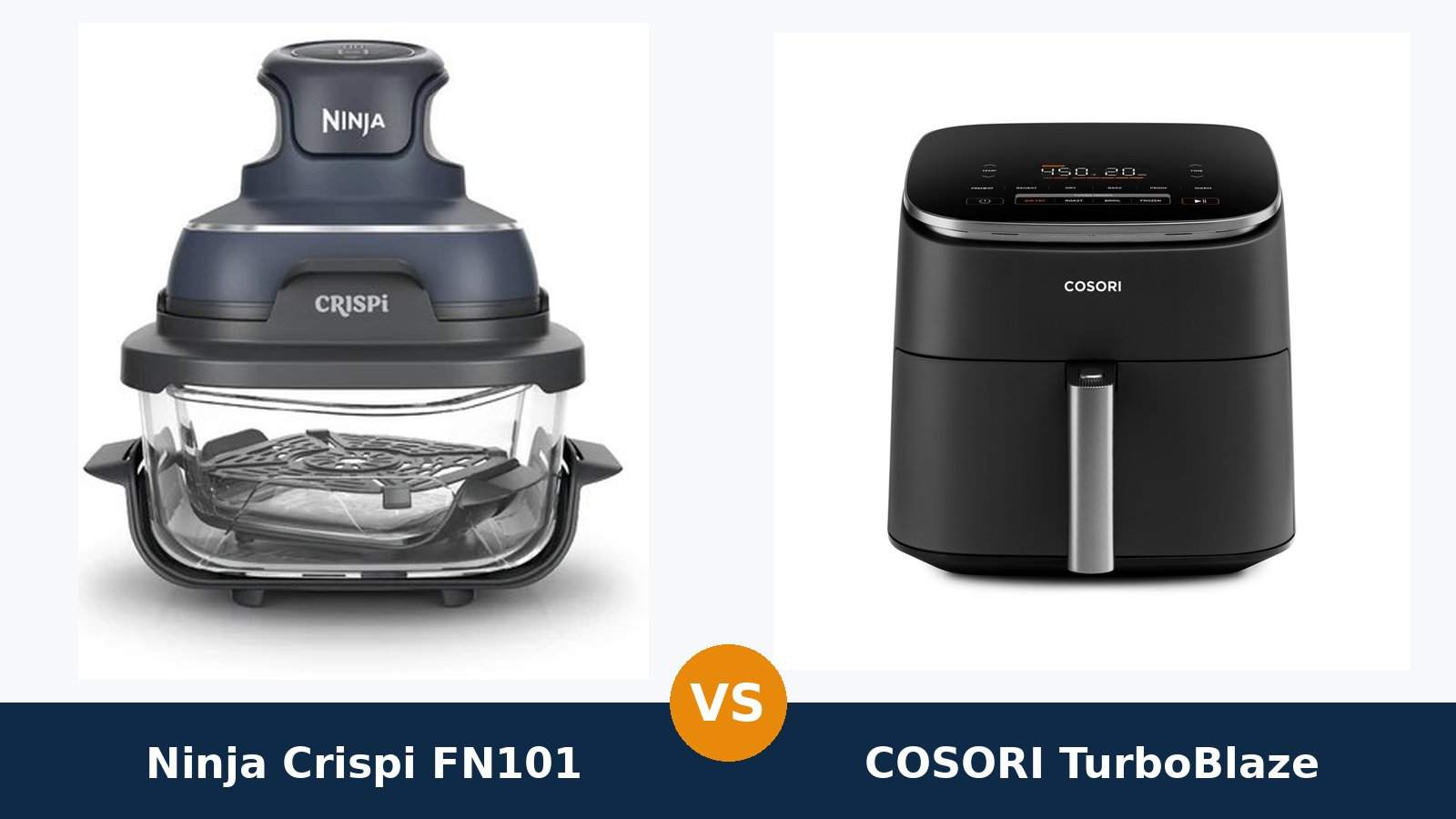
One of these air fryers is not really an air fryer. Not in the usual sense, anyway.
The COSORI TurboBlaze is the classic formula done well: a 6-quart basket, a powerful DC-motor fan, and a temperature dial that runs from a 90°F proof to a 450°F broil.
The Ninja Crispi throws the formula away. There is no basket and no cavity. A small heating pod clamps onto glass containers, cooks in them, and then those same containers go in the fridge with a lid on.
So this is not really a spec fight. It is a lifestyle fight. One machine is built to cook dinner for a household. The other is built to disappear into a cabinet and never coat your food in nonstick anything.
This guide settles it properly. Every specification below comes from Ninja’s and COSORI’s own published data. And the verdict at the end is the one we would give a friend spending their own money.
Key Takeaways
- The TurboBlaze is the better all-round cooker. Bigger basket, nine functions, full 90–450°F control and a 24-hour timer.
- The Crispi is the better small-kitchen system. Glass containers you cook, serve and store in — and the whole kit nests away in a cabinet.
- Capacity is not close. A 6-quart single basket against a 4-quart glass container used one at a time.
- Temperature control is not close either. The Crispi’s temperatures are fixed presets by function; the TurboBlaze lets you set any temperature you like.
- Both cook on PFAS-free surfaces. Glass and nano-ceramic plates on the Ninja; a PFAS-free ceramic coating on the COSORI.
Quick Verdict
Buy the COSORI TurboBlaze for most households. It is the more complete air fryer.
Its 6-quart basket swallows a family batch in one layer. Its DC motor drives five fan speeds, which is how one machine honestly covers proofing dough at 90°F and broiling at 450°F.
It dehydrates, it roasts, it keeps food warm for up to a day on the timer. And COSORI backs it for two years, twice the Crispi’s warranty.
Buy the Ninja Crispi if you cook for one or two and your kitchen is small. It cooks in borosilicate glass you can watch from every side.
When dinner is done, the lid snaps on and the container goes straight into the fridge. When the week is done, the whole system nests into a cabinet instead of living on your counter.
The Scorecard
Scores below are derived directly from the manufacturer specifications compared in this guide — capacities, function counts, temperature ranges and supported features. They are a reading aid, not benchmark results. The Overall weights capacity and cooking control most heavily, because those are what decide daily use.
| Category | Ninja Crispi FN101 | COSORI TurboBlaze | ||
|---|---|---|---|---|
| Capacity & batch size | 5 / 10 | 7 / 10 | ||
| Cooking versatility & airflow | 6 / 10 | 8 / 10 | ||
| Temperature & timer range | 5 / 10 | 10 / 10 | ||
| Ease of use | 9 / 10 | 8 / 10 | ||
| Cleaning & materials | 10 / 10 | 9 / 10 | ||
| Footprint, storage & portability | 10 / 10 | 9 / 10 | ||
| Value | 7 / 10 | 9 / 10 | ||
| Overall | 7.6 / 10 | 8.6 / 10 | ||
The pattern is clean. The TurboBlaze wins everything about cooking. The Crispi wins everything about living with the machine afterwards.
At a Glance: Who Each Fryer Fits
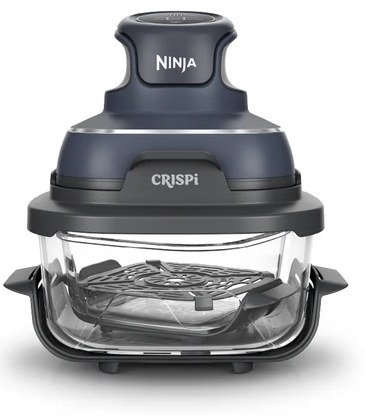
Ninja Crispi FN101
- PowerPod clamps onto 4-qt and 6-cup glass containers
- 4 functions: Max Crisp, Air Fry, Bake, Recrisp
- Watch food cook through 360° glass
- Snap-on lids: serve, refrigerate and freeze in the container
- Whole system nests into a cabinet
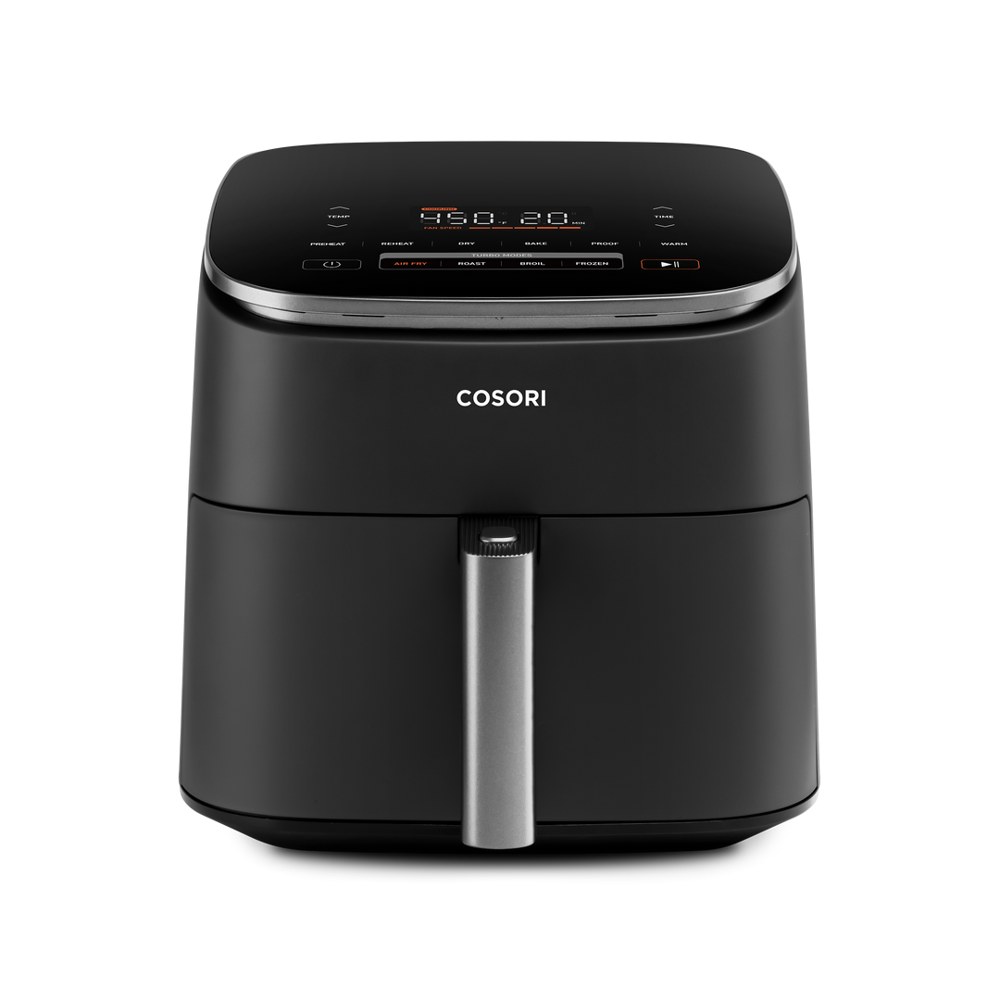
COSORI TurboBlaze
- 6.0-qt square basket with ceramic-coated crisper plate
- 9 functions plus Preheat, 5 fan speeds, DC motor
- 90–450°F range, timer up to 24 hours
- PFAS-free ceramic nonstick basket
- 2-year limited warranty
Choose the Ninja Crispi if…
You cook for one or two people. Most nights, most of the time.
Your counter space is precious and your cabinets have room. The Crispi is designed to be put away, not displayed.
You meal-prep. Cooking tonight’s chicken in the same container it will sit in until Thursday is the whole point of this machine.
Or you simply do not want your food touching a nonstick coating. Glass is glass.
Choose the COSORI TurboBlaze if…
You cook for three to five people and want it done in one batch, in one layer.
You use an air fryer for more than fries: roasting, baking, dehydrating, proofing dough, reheating without a microwave’s sogginess.
You set temperatures deliberately. 325°F for the salmon, 450°F for the broil, 135°F overnight for the jerky.
Or you keep appliances for years and like a two-year warranty standing behind them.
As an Amazon Associate I earn from qualifying purchases at no extra cost to you.
Specifications: The Specs That Actually Matter
Every figure below is taken from SharkNinja’s and COSORI’s published specifications and manuals, cross-checked against the manufacturers’ product data.
Two naming notes before the table. The Crispi compared here is the standard US FN101 (1,500W); Ninja sells regional and retailer variants that differ, and they get a warning under the table. The TurboBlaze is the base CAF-DC601-KUS — not the separate Smart variant.
| Specification | Ninja Crispi FN101 | COSORI TurboBlaze |
|---|---|---|
| Model | FN101 (per-color SKUs, e.g. FN101GY Cyber Space, FN101ST Stone) | CAF-DC601-KUS |
| Capacity | 4-qt glass container + 6-cup glass container, used one at a time | 6.0 qt / 5.7 L (serves 3–5) |
| Wattage | 1,500 W | 1,725 W |
| Temperature & time range | Temperatures preset by function, up to 450°F on Max Crisp | 90–450°F fully adjustable; 1 minute to 24 hours |
| Cooking functions | 4: Max Crisp, Air Fry, Bake, Recrisp | 9 plus Preheat: Air Fry, Roast, Bake, Broil, Frozen, Dehydrate, Proof, Reheat, Keep Warm |
| Fan / airflow | Single PowerPod heater and fan; cooks in one container at a time | DC motor, 5 fan speeds, up to 3,600 rpm |
| Cooking vessel | Borosilicate glass containers; aluminium crisper plates with nano-ceramic coating; food-contact surfaces designed without PFAS or PTFE | Square pull-out basket with crisper plate; PFAS-free ceramic nonstick coating |
| Single-batch cooking space | One container at a time: 4 qt for batches, 6-cup for personal meals | Basket floor 9.31 × 9.31 in; 3.48 in deep with crisper plate |
| Visibility while cooking | 360° glass — watch food brown without opening anything | Closed basket — pull it out to check |
| Dishwasher-safe parts | Containers, crisper plates, adapter and storage lids — everything except the PowerPod | Basket and crisper plate |
| Serve & store | Snap-lock lids included — serve, refrigerate and freeze in the cooking container | Basket is a cooking vessel only; food moves to a dish or storage tub |
| Controls | Touch controls and display on the PowerPod; no app | Angled touch panel on the unit; no app on this model |
| Dimensions | 11.5 × 9.76 × 11.81 in (with 4-qt container); nests for storage | 11.8 × 14.4 × 11.9 in (W × D × H, with handle) |
| Weight | 14.55 lb for the full system — pod, both containers, plates and lids | 13.2 lb / 6 kg |
| Warranty | 1-year limited | 2-year limited |
Variant note: “Crispi FN101” is not one fixed specification worldwide. The UK/EU version runs 1,700W with different containers and a different function list, and SharkNinja confirms some US retailer versions are 3-in-1 models without Max Crisp.
The TurboBlaze has a trap of its own: a separate TurboBlaze Smart variant adds VeSync app control and a tenth function. It is a different product from the CAF-DC601-KUS compared here.
On either machine, match the full model number before you pay. The buying guide below explains what to check.
The Differences That Actually Matter
1. Two philosophies — a cooking system against a cooking appliance
Start with what these things physically are. The TurboBlaze is a self-contained box: heater, fan, basket, done.
The Crispi is a system. One PowerPod — the heater, fan and controls in a single unit — clamps onto whichever glass container the meal needs. The 4-quart container takes the adapter ring; the 6-cup container takes the pod directly.
That design buys the Crispi something no basket fryer can copy: the cooking vessel never stops being useful. It is the serving dish. With the snap-lock lid on, it is the storage tub and the freezer box.
It also costs the Crispi something. One pod means one container cooking at a time. There is no second zone, no sync finish, no cooking the main and the side simultaneously.
Neither philosophy is wrong. They are answers to different questions: “how do I cook the most food well?” against “how do I cook, serve and store with the least washing up?”
2. Capacity — the widest honest gap in this comparison
The TurboBlaze’s basket is 6.0 quarts with a square 9.31-inch floor. Square matters: food spreads in a single layer instead of mounding, and a single layer is what crisps.
COSORI rates it for three to five people. That rating is believable for a basket this shape.
The Crispi’s big container is 4 quarts. Its small one is 6 cups — a personal meal, a side dish, a portion of leftovers to recrisp.
And the two containers are alternatives, not additions. You cook in one while the other waits. A household of four eating one Crispi-cooked main course means batches, or a second cooking method helping out.
For one or two people this gap simply never appears. For a family, it appears every single night. Score this section by your household size and the rest of the comparison gets much easier.
3. Temperature control — a dial against a set of presets
The TurboBlaze gives you the full range: 90 to 450°F, set to the degree, with a timer that runs from one minute to 24 hours.
The low end is not a gimmick. 90°F proofs dough. 135°F dehydrates. Those jobs exist because the DC motor can turn its fan down as well as up.
The Crispi takes the opposite approach. Pick a function — Max Crisp, Air Fry, Bake, Recrisp — and the temperature is the preset Ninja assigned to it, topping out at 450°F on Max Crisp.
SharkNinja is open about this: in its own Crispi-versus-Crispi-Pro guidance, adjustable temperature control is a Pro feature the base Crispi does not have.
Is that a real loss? For fries, wings and leftovers, no — the presets are the temperatures you would have dialled anyway. For a recipe that specifies 325°F, or a long slow dry, yes. The TurboBlaze follows recipes. The Crispi follows its four buttons.
4. Functions — nine plus Preheat against four
Count the TurboBlaze’s list: Air Fry, Roast, Bake, Broil, Frozen, Dehydrate, Proof, Reheat, Keep Warm — plus a dedicated Preheat.
Now the Crispi’s: Max Crisp, Air Fry, Bake, Recrisp. Four.
The overlap is smaller than it looks. The Crispi has no Roast, no Broil, no dedicated Frozen mode, no Dehydrate and no Keep Warm. Its Recrisp is a specialised reheater for fried food, not a general one.
In fairness, the four it has are the four a small household uses most. Max Crisp is a genuinely aggressive frozen-food mode, and Recrisp resurrects takeaway fries better than a generic reheat.
But breadth is breadth. If your air fryer is also your dehydrator, your proofing box and your second oven, only one of these machines is applying for those jobs.
5. Airflow and power — the DC motor is a real difference
The TurboBlaze draws 1,725 watts and moves air with a DC motor running five fan speeds, up to 3,600 rpm.
Variable speed is the point, not the wattage. Speed five blasts moisture off a chicken skin. Speed one whispers over dough and drying herbs without blowing them around the basket.
COSORI rates the result as up to 46% faster cooking than its own previous-generation Pro model. That is a manufacturer figure against its own older machine, and we repeat it as exactly that — but the mechanism behind it, a stronger and more controllable fan, is real hardware.
The Crispi’s PowerPod runs 1,500 watts through a single fixed cooking setup. In a small glass container, that is plenty of power density — the food sits close to the element and crisps fast.
What it cannot do is change character. One airflow personality, four temperature presets. Simple, effective, and deliberately limited.
6. Cleaning and materials — glass against coatings
Both machines cook on PFAS-free surfaces. Neither should be sold to you as the “toxic” one. The difference is subtler than that.
The Crispi’s containers are borosilicate glass. Glass does not have a coating to wear out, scratch through or baby with wooden spoons. Its crisper plates are aluminium with a nano-ceramic coating, and everything except the PowerPod — containers, plates, adapter, lids — goes in the dishwasher.
The TurboBlaze’s basket and crisper plate carry a PFAS-free ceramic nonstick coating. It is an easy hand-wash and both parts are dishwasher-safe too.
Ceramic coatings are good. They are still coatings. Years of metal tongs and dishwasher cycles will mark one in a way they will never mark a glass wall.
One Crispi discipline to know: glass wants to cool before it meets cold water. Ninja’s guide is clear on letting containers cool before washing. It is a small habit, and the only real care rule this system asks of you.
7. Footprint and storage — the counter against the cabinet
Measure the counters first. The Crispi, wearing its 4-quart container, occupies about 11.5 by 9.76 inches — roughly 112 square inches of counter.
The TurboBlaze occupies about 11.8 by 14.4 inches — roughly 170 square inches. In its defence, that is compact for a 6-quart machine; COSORI designed the body around the basket instead of styling around it.
But the Crispi’s real trick happens after cooking. Pod, adapter and containers nest together and go in a cabinet. Your counter gets its space back, permanently.
It also sits safely on more surfaces while it works: the pod’s fixed heat-protection feet are rated by Ninja for granite, laminate, quartz, butcher block and marble.
One honest footnote: the full Crispi system weighs 14.55 lb, more than the TurboBlaze’s 13.2 lb. Glass is heavy. You just never lift all of it at once — the pod and one container are all a meal ever asks you to carry.
Household & Use-Case Fit Guide
The fastest way to choose between these two is to start from your household, not the spec sheet. This table is the whole comparison in one view.
| Your situation | Ninja Crispi FN101 | COSORI TurboBlaze | Our call |
|---|---|---|---|
| Cooking for 1–2 people | Excellent — 6-cup container is made for it | Good — basket half-empty most nights | Ninja Crispi |
| Cooking for 3–5 people | Stretched — batches in the 4-qt container | Excellent — 6-qt single-layer basket | COSORI TurboBlaze |
| Meal prep for the week | Excellent — cook, lid, refrigerate in one container | Workable — cook, then transfer to tubs | Ninja Crispi |
| Tiny kitchen, no spare counter | Excellent — nests into a cabinet | Tight — compact for 6 qt, still a counter resident | Ninja Crispi |
| Avoiding nonstick coatings | Excellent — glass cooking vessel | Good — PFAS-free ceramic, still a coating | Ninja Crispi |
| Baking, dehydrating, proofing | Limited — Bake preset only | Excellent — 90°F floor and 24-hour timer | COSORI TurboBlaze |
| Frozen food, most nights | Excellent — Max Crisp at 450°F | Excellent — Frozen mode plus full control | Dead heat — size of batch decides |
| Watching food cook (new cooks, fussy bakes) | Excellent — 360° glass | Poor — open the basket and lose the heat | Ninja Crispi |
Read the first two rows together. Household size is the trunk of this decision; everything else is branches.
Ready to check today’s price?
Both machines sell through Amazon. Prices move, so check the live figure on the one that fits your kitchen.
View on Amazon — Ninja CrispiView on Amazon — COSORI TurboBlazeThe 30-Second Decision
| If this sounds like you… | Buy this |
|---|---|
| “I cook for my family and I am tired of batches.” | COSORI TurboBlaze |
| “It is just me, or me and one other. Small kitchen.” | Ninja Crispi |
| “I meal-prep on Sundays and hate washing up.” | Ninja Crispi |
| “I dehydrate, proof dough and follow recipes to the degree.” | COSORI TurboBlaze |
| “I want to see my food cooking, not guess.” | Ninja Crispi |
| “I want one machine that replaces the most countertop rivals.” | COSORI TurboBlaze |
What You Gain. What You Give Up.
Ninja Crispi FN101
You gain: a cook-serve-store system in glass, with no nonstick vessel to wear out. A footprint that vanishes into a cabinet. Sight of your food at all times. And the easiest full-system dishwasher load in the category.
You give up: capacity — 4 quarts at a time, one container at a time. Temperature control — presets only. Five functions the COSORI has and this does not. And a year of warranty cover.
COSORI TurboBlaze
You gain: a 6-quart single-layer basket, nine functions plus Preheat, a 90–450°F dial with a 24-hour timer, five fan speeds, and two years of warranty.
You give up: visibility — the basket is a black box until you open it. The serve-and-store trick — cooked food still needs a dish and a tub. And counter space, every day, whether it cooks or not.
Pros and Cons
Ninja Crispi — Pros
- Cook, serve and store in the same glass container
- No coating on the cooking vessel to wear or scratch
- Everything but the pod is dishwasher-safe
- Nests away — the smallest stored footprint here
- 360° visibility while cooking
Cons
- 4-qt maximum, one container at a time
- Temperatures are fixed presets — no dial
- Only 4 functions; no Roast, Broil or Dehydrate
- Glass must cool before washing
- 1-year warranty
COSORI TurboBlaze — Pros
- 6-qt square basket cooks a family batch in one layer
- 90–450°F range and 24-hour timer
- 9 functions plus Preheat; 5 fan speeds
- PFAS-free ceramic coating, dishwasher-safe basket
- 2-year limited warranty
Cons
- Closed basket — no view of the food
- Food must transfer out to serve or store
- Lives on the counter full-time
- No app control on this model
- Ceramic coating will age in a way glass will not
Check the Variant and the Colour, Not Just the Name
Check the Crispi’s function list. “FN101” covers more than one specification.
The standard US model is the 1,500W 4-in-1 in this guide. SharkNinja itself notes that some US retailer versions are 3-in-1 machines without Max Crisp, and the UK/EU version is a 1,700W model with different containers and functions.
Four functions — Max Crisp, Air Fry, Bake, Recrisp — on the box is the confirmation you want. Anything fewer is a different deal.
Check the Crispi’s colour listing. Ninja sells the FN101 under per-colour SKUs — Cyber Space (FN101GY) and Stone (FN101ST) among them — and each colour carries its own Amazon listing.
The buttons in this guide point to the standard US FN101 listing. If you prefer another colour, you are choosing the same machine in a different finish; just confirm the model number still reads FN101.
Check which TurboBlaze you are looking at. The CAF-DC601-KUS here has no Wi-Fi and no app. A separate TurboBlaze Smart variant adds VeSync app control and a tenth function.
Neither is a trick — but they are different products at different prices, and listings do not always make the distinction loudly. If app control matters to you, buy the Smart on purpose, not by accident.
Check the box contents. The Crispi should arrive with the PowerPod, both glass containers, two crisper plates, the container adapter and two storage lids. The lids and adapter are the system; a box missing them is a box to return.
The TurboBlaze box is simpler: the unit, its basket and the crisper plate. If a listing bundles liners or accessories, that is a retailer bundle, not a different model.
The Two-Year Test: Coatings, Glass and Second Containers
Judge these machines by their second year, not their first week.
The TurboBlaze’s question is its coating. Ceramic nonstick starts slick and easy. Two years of nightly use, dishwasher cycles and utensil contact will dull it — gradually, not catastrophically, and the basket stays usable long after it stops being pristine.
The Crispi’s question is its glass. Borosilicate does not wear, fade or lose a coating, because there isn’t one. Its aging risk is different: a dropped container is a finished container. Treat it like the good glassware it is.
There is also a genuine upgrade path on the Crispi side. A second 4-quart container turns the system into a pipeline: tonight’s dinner stores in one while tomorrow’s cooks in the other, the single pod serving both.
The TurboBlaze’s upgrade path is the opposite direction — COSORI’s wider range. If the 6-quart basket becomes the constraint, the brand’s larger and dual-basket models reuse the same controls logic you already know.
Neither machine is a dead end. One grows by adding glassware. The other by trading up within a family.
When to Skip Both
Honesty cuts both ways. There are kitchens neither of these machines serves best.
Skip both if you routinely cook two different foods at once. That is a dual-basket machine’s job — Ninja’s DualZone line or COSORI’s dual-basket models — and neither a single basket nor a single pod will fake it.
Skip both if app control is non-negotiable. The TurboBlaze Smart and COSORI’s Dual Blaze exist precisely for phone-first cooks; this TurboBlaze is deliberately not one of them.
Skip both if you want adjustable temperature in a glass system. That combination exists one rung up Ninja’s ladder, in the Crispi Pro, which adds the dial the base Crispi lacks.
And skip both if you are feeding six or more every night. Both of these top out at family-of-five territory; oven-style and 10-quart-class fryers own the rung above.
Warranty and Support
The warranty gap is the plainest number in this comparison. COSORI covers the TurboBlaze for two years; Ninja covers the Crispi system for one.
Both are limited warranties in the usual sense — defects in materials and workmanship, not dropped glass or a basket you attacked with a scouring pad.
Support runs through each maker’s own channels: SharkNinja’s product registration and support pages for the FN101, COSORI’s US-based customer service and the VeSync ecosystem for the TurboBlaze.
Two habits protect you on either machine. Register the product when it arrives. And keep the model number — FN101 or CAF-DC601-KUS — with your records, because both brands key every part and claim to it.
Final Verdict
The COSORI TurboBlaze is the air fryer we would buy for most kitchens.
It wins this comparison the way versatile appliances usually do: more capacity in a single layer, more functions, a temperature dial with no gaps in it, and a timer measured in hours where the rival counts presets.
Add the two-year warranty and the verdict is not really in doubt. If one machine must handle family dinners, weekend baking and a tray of jerky, this is the one.
Buy the TurboBlaze for households of three to five, recipe-followers, and anyone whose air fryer is a daily workhorse.
View on Amazon — COSORI TurboBlaze
Buy the Crispi if your household is one or two people and your kitchen is short on counter. If you meal-prep and love the idea of the cooking pot becoming the storage tub. Or if glass — visible, coating-free, dishwasher-everything glass — is simply how you want to cook.
It is the narrower machine and the cleverer one. Just buy it knowing its limits are deliberate: Ninja traded capacity and control for a system that disappears when dinner is over.
Frequently Asked Questions
Which is better for a family of four?
The COSORI TurboBlaze. Its 6-quart square basket cooks a family batch in a single layer, and COSORI rates it for three to five people. The Crispi’s largest container is 4 quarts and cooks one container at a time, so family dinners mean batches or a second dish cooked another way.
Can you adjust the temperature on the Ninja Crispi?
Not freely. Each of the four functions — Max Crisp, Air Fry, Bake, Recrisp — carries its own preset temperature, rising to 450°F on Max Crisp. SharkNinja’s own Crispi comparison guidance lists adjustable temperature control as a feature of the Crispi Pro, not the base FN101. The TurboBlaze, by contrast, sets any temperature from 90 to 450°F.
Which one is easier to clean?
The Crispi, on total effort. Its containers, crisper plates, adapter and lids all go in the dishwasher — everything except the PowerPod, which wipes down. The TurboBlaze’s basket and crisper plate are also dishwasher-safe, but there is a whole appliance body to wipe around them. One Crispi rule: let the glass cool before washing it.
Are both cooking surfaces PFAS-free?
Yes, per the manufacturers. The Crispi cooks in borosilicate glass designed without PFAS or PTFE on food-contact surfaces; its crisper plates use a nano-ceramic coating. The TurboBlaze’s basket and crisper plate use a PFAS-free ceramic nonstick coating. The difference is that glass has no coating to wear over time.
Can the Crispi cook two things at once?
No. One PowerPod cooks in one container at a time — either the 4-quart or the 6-cup. The second container is for serving, storing or the next batch, not simultaneous cooking. If cooking a main and a side to finish together is a priority, look at a dual-basket fryer instead.
Does the COSORI TurboBlaze have an app?
This model does not. The CAF-DC601-KUS is controlled from its angled touch panel only. COSORI sells a separate TurboBlaze Smart variant with VeSync app control and an extra function; it is a different product, so check the model name if app control is on your list.
Which takes up less space?
The Crispi, twice over. On the counter it covers roughly 112 square inches against the TurboBlaze’s 170, and after cooking it nests into a cabinet — pod, adapter and containers together — while the COSORI stays out full-time. The trade: the full Crispi system weighs 14.55 lb in glass, a little more than the TurboBlaze’s 13.2 lb, though you never carry it all at once.
What can the TurboBlaze do that the Crispi cannot?
Three things stand out. Roast and Broil as dedicated functions. Dehydrate and Proof, thanks to its 90°F floor and 24-hour timer. And Keep Warm, for holding a finished dish. The Crispi’s four functions cover the everyday core — crisping, air frying, small bakes and reheating leftovers — and stop there.
Sources & Verification
SharkNinja official product page, Ninja Crispi FN101 (sharkninja.com): 1500W, 120V, 4-in-1 functions, container set, dimensions 11.5 × 9.76 × 11.81 in, weight 14.55 lb, cord 36 in, 1-year warranty, retailer function variants • Ninja FN101 owner’s guide: container care and cooling before washing, dishwasher-safe components (containers, crisper plates, adapter, lids), 450°F maximum • SharkNinja Crispi vs Crispi Pro guidance: adjustable temperature reserved for the Pro • COSORI TurboBlaze official product page and CAF-DC601-KUS user manual (cosori.com): 6.0-qt capacity, 1,725W, 90–450°F, 1 min–24 hr timer, 9 functions plus Preheat, DC motor with 5 fan speeds, ceramic-coated basket and crisper plate (dishwasher-safe), dimensions, 13.2 lb weight, 2-year limited warranty • Amazon US listing data for FN101GY and CAF-DC601-KUS (model numbers and UPCs cross-checked against manufacturer data) for ASIN verification. Specifications verified November 2026.

James Wilson
James has been testing and writing about kitchen appliances for over a decade and writes Honestly Compared’s small-appliance guides. His rule for every comparison: the verdict has to survive the spec sheet, not the marketing page.