
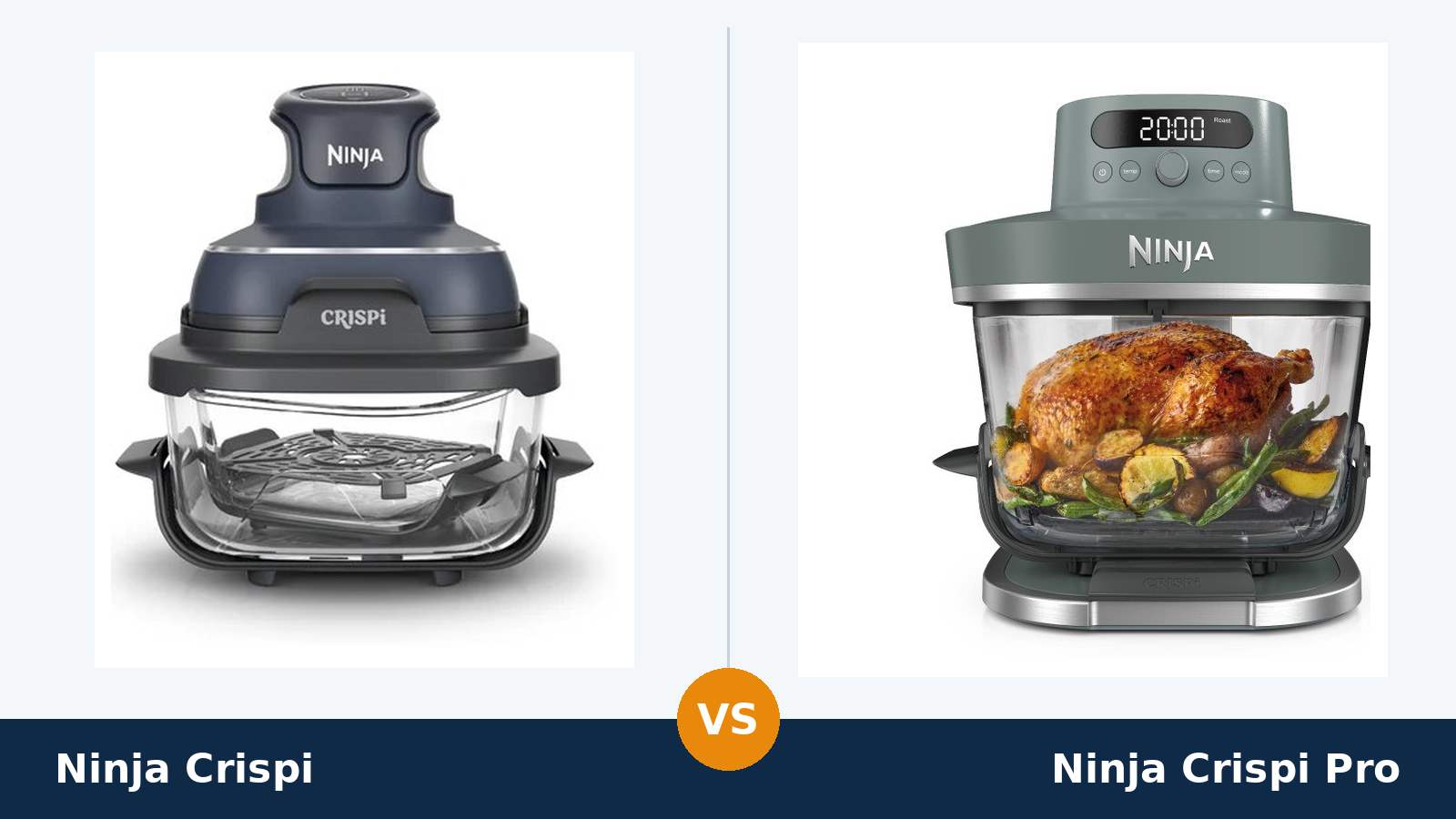
Ninja Crispi vs Ninja Crispi Pro: Which Should You Buy?
You added “reddit” to your search for a reason. You wanted the unfiltered version.
Fair enough. But spend an hour in the owner threads and a pattern shows up fast: the same handful of questions, asked over and over. Is glass a genuine advance or a gimmick? Is the Pro worth the extra money? Does “portable” survive contact with a real kitchen? And what is cleaning actually like once the honeymoon ends?
This guide answers those exact questions — but from SharkNinja’s own product pages, comparison data and owner’s guides, not from anecdotes. Where Reddit wisdom and the spec sheet agree, we say so. Where they part company, the spec sheet wins.
The short version: the original Ninja Crispi (FN101) is a detachable PowerPod that cooks on glass containers and then packs away. The Ninja Crispi Pro (AS101) bolts the same glass idea to a countertop base, and adds the two things the original deliberately leaves out — size and temperature control.
Key Takeaways
- The most-asked Reddit question has a one-line answer: yes, the Pro is worth it if you cook for three or more — its 6-qt container and adjustable temperature are structural upgrades.
- Glass is not the difference between them. Both cook in the same borosilicate glass. The difference is format: portable pod versus countertop appliance.
- The original Crispi cannot be set to a temperature. Four functions, four preset bands. The Pro adjusts temperature inside every function, from 105°F dehydrating to a 450°F ceiling.
- “Portable” means packs away, not featherlight. The full FN101 system weighs 14.55 lbs on SharkNinja’s spec sheet — it travels between kitchens, but it is no backpack appliance.
- Cleaning is a split verdict on both. Glassware, plates and lids go in the dishwasher; the heating unit is wiped by hand and never immersed.
Quick Verdict
Buy the Ninja Crispi Pro if the Crispi will be your household’s main air fryer. Six quarts, 1,800 watts, six functions and a temperature you can actually set.
It roasts a 7.5-lb chicken, dehydrates at 105°F, proofs dough, and feeds a crowd from one container. For families, it is the complete version of the idea.
Buy the original Ninja Crispi if you cook for one or two and your counter is spoken for. The pod lifts off, the containers nest into a cabinet, and dinner stores in the dish it cooked in. You give up capacity and control; you gain a machine that fits a smaller life.
The Scorecard
Every score below is read off the manufacturer specifications compared in this guide — capacities, wattages, function lists, temperature ranges, included parts. Treat them as a map of the spec sheet, not as lab results.
A note on context, because the forums will argue about it: the Pro’s 8.3 matches its established score everywhere we compare it. The original scores 7.8 here — slightly better than it fares against conventional basket fryers — because this scorecard counts portability and storage as headline categories, the ground it was designed to win. Its two losing categories are the ones that decide what you can cook in the first place.
| Category | Ninja Crispi | Ninja Crispi Pro | ||
|---|---|---|---|---|
| Capacity | 6 / 10 | 9 / 10 | ||
| Temperature & function control | 5 / 10 | 9 / 10 | ||
| Cooking design & portability | 10 / 10 | 5 / 10 | ||
| Ease of use | 8 / 10 | 8 / 10 | ||
| Cleaning | 9 / 10 | 8 / 10 | ||
| Storage | 10 / 10 | 7 / 10 | ||
| Value | 9 / 10 | 7 / 10 | ||
| Overall | 7.8 / 10 | 8.3 / 10 | ||
Read the table as two arguments. The Pro’s is about cooking: more food, more heat, more say over both. The original’s is about everything after cooking: storing the machine, storing the meal, owning less kitchen.
At a Glance: Who Each Crispi Fits
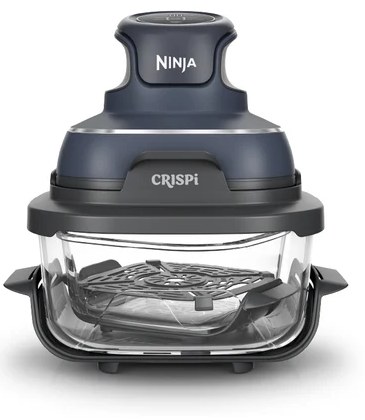
Ninja Crispi (FN101)
- 4-in-1: Max Crisp, Air Fry, Bake, Recrisp — preset temperatures
- Detachable 1,500W PowerPod; containers nest for storage
- 6-cup + 4-qt glass containers with storage lids
- 4-qt fits a 4-lb chicken with vegetables; serves up to 4
- Cook, serve and store in the same glass dish
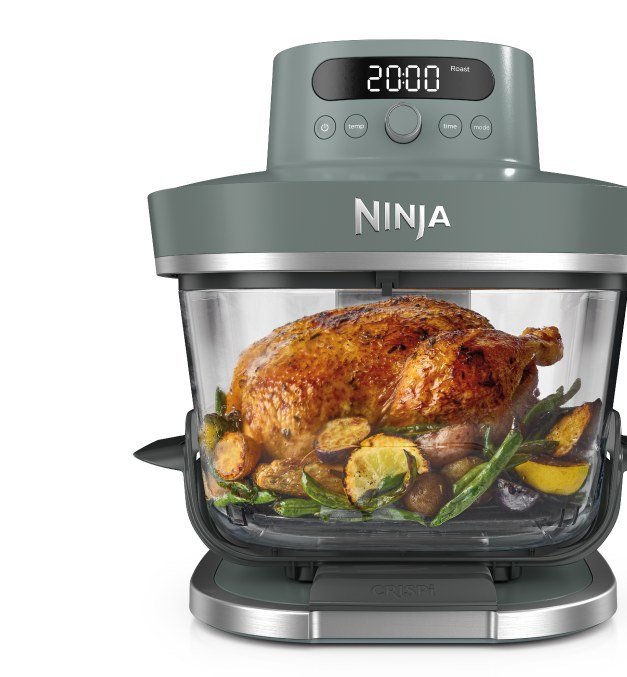
Ninja Crispi Pro (AS101)
- 6-in-1: Max Crisp, Air Fry, Bake/Proof, Roast, Recrisp, Dehydrate
- Adjustable temperature, 105–450°F by function
- 6-qt + 2.5-qt CleanCrisp glass containers; serves up to 10
- 1,800W stationary countertop design
- Modular base also fits the 4-qt container (sold separately)
Choose the Ninja Crispi if…
Your household is one or two people, and a 4-qt batch is a full meal rather than a first round.
Counter space is the constraint you actually live with. The pod and containers go in a cabinet, and the counter stays clear.
You meal-prep or reheat often. A lidded glass dish that cooks, serves, stores and reheats is the whole workflow, with no extra washing-up.
Choose the Ninja Crispi Pro if…
You feed three to ten people and batch size decides your evenings. One 6-qt run replaces two 4-qt runs.
You follow recipes as written — a stated temperature, a low dehydrate, a gentle proof — and want the machine to obey the number, not approximate it.
You have a permanent stretch of counter to give it, and you will genuinely use Roast and Dehydrate.
As an Amazon Associate I earn from qualifying purchases at no extra cost to you.
Specifications: The Specs That Actually Matter
Every figure in the table comes from SharkNinja’s own published specifications, product pages and owner’s guides. Nothing here is estimated, and nothing is borrowed from review sites.
Model note: “Ninja Crispi” on its own means the original portable system, model FN101 — sold as the Crispi 4-in-1 Portable Glass Air Fryer Cooking System. “Crispi Pro” is the separate countertop model, AS101. The later 5-in-1 (FN103) is a third product; the buying guide untangles all three.
| Specification | Ninja Crispi (FN101) | Ninja Crispi Pro (AS101) |
|---|---|---|
| System type | Portable PowerPod + removable glass containers | Stationary countertop glass air fryer |
| Capacity | 6-cup + 4-qt containers; largest batch 4 qt | 2.5-qt + 6-qt containers; largest batch 6 qt |
| Power | 1,500W, 120V | 1,800W, 120V |
| Functions | 4-in-1: Max Crisp, Air Fry, Bake, Recrisp | 6-in-1: Max Crisp, Air Fry, Bake/Proof, Roast, Recrisp, Dehydrate |
| Temperature range | Preset bands by function, 380–450°F; temperature does not adjust | Adjustable within each function; 105–450°F overall |
| Container type & material | Borosilicate glass, PFAS- and PTFE-free; aluminium nano-ceramic crisper plates | Borosilicate CleanCrisp glass, PFAS- and PTFE-free; aluminium nano-ceramic crisper plates |
| Largest batch | 4-qt — fits a 4-lb chicken with vegetables | 6-qt — serves up to 10; fits a 7.5-lb chicken |
| Dimensions / footprint | 11.5″ × 9.76″ × 11.81″ (4-qt setup; changes with container) | 11.8″ D × 12.2″ W × 11″ H, fixed |
| Weight | 14.55 lbs (full system: pod + both containers) | 11.4 lbs (countertop unit) |
| Dishwasher-safe parts | Glass containers, crisper plates and storage lids; PowerPod never | Glass containers, crisper plates and storage lids; base and head never |
| Storage | Pod and containers nest; packs into a cabinet | Lives on the counter as a full-size appliance |
| Cord | 36 in | Fixed countertop cord (length not published) |
| Warranty | 1-year limited | 1-year limited |
Weight note: the two figures measure different things, and forum threads routinely compare them as if they did not. The original’s 14.55 lbs is the entire system — pod plus both containers; the Pro’s 11.4 lbs is the countertop unit. Neither changes the lived reality: one system packs away, the other stays where it sits.
Variant note: the figures above are the standard US models. SharkNinja notes that retailer editions of the FN101 exist — some US versions drop to 3-in-1 without Max Crisp — and that Pro function counts vary by retailer too. Overseas versions differ again: the UK FN101 runs 1,700W, and overseas Pros reach 2,050W with, in the UK, a 7-in-1 badge.
The Differences That Actually Matter
1. “Is the glass just a gimmick?” — the question that starts most threads
Start here, because it is the honest foundation of both machines. Neither Crispi cooks in a coated metal basket. Both cook in borosilicate glass that SharkNinja markets as free of PFAS and PTFE.
The vessel is what touches your food at 450°F, and for buyers moving away from nonstick coatings, glass is the entire point of the product line.
Glass also changes the cooking itself. You watch food brown through the container wall, and catch the moment a batch is done without lifting anything and dumping the heat.
Now the nuance the marketing skips, and the forums are right to raise: the food sits on a crisper plate, and that plate is aluminium with a nano-ceramic coating — on both machines. The vessel is uncoated glass; the plate is not bare metal. If your goal is zero coatings anywhere near food, read that line twice.
Verdict on the gimmick question: the glass is real, and it is identical. It is a reason to buy into the Crispi line — not a reason to choose one Crispi over the other.
2. Temperature control — the upgrade the arguments are really about
Ask the threads what separates these machines and the loudest answer is also the correct one. SharkNinja’s own Crispi-versus-Pro guidance lists adjustable temperature control as a feature the Pro has and the original does not.
On the FN101, you pick a function and a time, and the temperature arrives with the function: Max Crisp 425–450°F, Air Fry 400–425°F, Bake 375–400°F, Recrisp 380–400°F. There is no dial to argue with.
On the Pro, every function carries a range you set yourself — the same bands, plus Roast at 350–400°F and Dehydrate down at 105–195°F.
For fries, wings and reheated pizza, the presets are genuinely adequate — they sit where everyday crisping happens, and they delete a decision from a tired weeknight.
Where presets run out is the edges: a recipe written for 365°F, dough that wants gentle warmth, herbs and jerky that need hours of low heat. The FN101 cannot go there at all. The Pro was built for it — and the first recipe that hands you an exact number is when you would miss the dial.
3. “Does 6 quarts actually mean more food?” — capacity, answered honestly
Quarts measure volume, and air frying rewards a single, uncrowded layer. Skeptical threads make this point constantly, and they are half right — so let’s use SharkNinja’s own anchors instead of the badge.
The Pro’s 6-qt container is rated to serve up to 10 and to fit a 7.5-lb chicken. The original’s 4-qt container is sized around a 4-lb chicken with vegetables, in a system rated for up to 4 servings. Those are whole-bird numbers, not marketing fog: a chicken nearly twice the weight fits in one and not the other, and family batches that take two rounds in the 4-qt take one in the 6-qt.
The honest half of the skepticism: a taller container does not widen the crisping layer, so piling food deeper buys volume, not extra crispy surface. Deep loads need shaking and turning on any air fryer, this one included.
Net answer: yes, the Pro cooks meaningfully more per batch. No, it does not repeal the single-layer rule. Size your purchase by headcount, not by the biggest number on the box.
4. “Portable” — what the word does and does not promise
The original’s defining trick is real: the PowerPod lifts off its adapter, the containers nest, and the entire fryer goes into a cabinet. That buys genuine range — dorm rooms, RVs and boats, holiday rentals, a counter that must return to empty every night.
But hold the spec sheet against the romance. The full system weighs 14.55 lbs, glass included. It needs a mains outlet and, per the owner’s guide, 6 inches of vent clearance around the pod while it runs. Portable means it moves between kitchens and stores in a cupboard. It does not mean light, cordless or carefree.
The Pro makes no such promise. It is 11.8 by 12.2 by 11 inches of permanent countertop — unremarkable for its class, but a commitment.
So the portability question answers itself with one test: will this machine ever need to leave the counter, or the house? If yes, only one of these two can follow.
5. Cleaning — the part the marketing skips
Here is the recurring complaint pattern in owner discussions: the glass is easy, the heating unit is the chore. The manuals back the owners up.
On both machines, everything that touches food goes in the dishwasher — containers, crisper plates, lids. That part of the promise is fully real, and a genuine step up from scrubbing a dark coated basket by hand.
On both machines, the part with the heating element never goes near water. The PowerPod must never be immersed; the Pro’s head and base are wipe-clean only. Grease that migrates into the pod comes out with a cloth and patience, exactly as the guides prescribe.
Between the two, the original edges it: smaller, lighter dishes. The Pro’s 6-qt vessel is the biggest single wash-up item in the line, and its base lives where splashes land.
One shared discipline matters more than the difference: let hot glass cool before washing, and never shock it with cold water — thermal shock is how you find borosilicate’s limit.
6. Storage — and the Pro’s missing middle container
Storage is where the original stops defending and starts winning outright. Its containers take lids: dinner is cooked, served, sealed and refrigerated in one dish, then reheated in it later. The pod nests with the containers and the whole system disappears into a cabinet.
The Pro’s glassware stores food too, but the appliance never goes away, and a 6-qt dish claims serious fridge territory.
One genuine grievance from the threads checks out against the box contents: the Pro ships with the 6-qt and 2.5-qt containers, and the mid-size 4-qt — the everyday size for many households — is a separate purchase, even though the modular base is built to fit it.
The original includes its 4-qt in the box. If your cooking is mostly mid-size batches, that omission narrows the Pro’s capacity advantage in daily use more than the spec table suggests.
7. The extra functions — Roast, Dehydrate, Proof — and the honest ties
Beyond the shared core, the Pro carries three jobs the original does not have. Roast is the significant one: slower, steadier heat in the 350–400°F band turns a crisping appliance into one that cooks a chicken dinner properly.
Dehydrate is a second hobby in the price — jerky, dried fruit, herbs — running down to 105°F, a temperature the preset-only pod cannot reach at any setting. Proof, folded into the Bake function, covers the dough makers.
Neither machine has Keep Warm; that function belongs to the 5-in-1. A shared gap, scored to nobody.
And the ties are worth stating, because threads keep trying to award them: same glass, same crisper-plate construction, same 1-year limited warranty. Underneath the format fight, this is one cooking concept at two scales — which is why the decision is clean. You are picking the Crispi that matches your household and your kitchen, not the “better” one.
Who Each Crispi Suits: Household and Use-Case Fit
Start from your household and your counter, not the spec sheet, and this comparison mostly decides itself.
| Your situation | Ninja Crispi | Ninja Crispi Pro | Our call |
|---|---|---|---|
| 1–2 people, everyday meals | Excellent — sized exactly for it | Good — 2.5-qt container helps | Ninja Crispi |
| Household of 4–10, family dinners | Stretched — batches split in two | Excellent — 6-qt, serves up to 10 | Ninja Crispi Pro |
| Whole chicken / Sunday roast | Good — 4-lb fit, no Roast mode | Excellent — 7.5-lb fit, Roast mode | Ninja Crispi Pro |
| Meal prep with fridge storage | Excellent — lids, nesting, same-dish storage | Good — containers store food | Ninja Crispi |
| Dorm, RV, tiny or shared kitchen | Excellent — packs away, travels | Poor — needs permanent counter | Ninja Crispi |
| Dehydrating, proofing, exact temperatures | Not offered — presets only | Excellent — 105–450°F adjustable | Ninja Crispi Pro |
| Second home / taking it with you | Excellent — the pod is the fryer | Poor — a fixed appliance | Ninja Crispi |
| Counter space is genuinely unlimited | Good — portability you may not need | Excellent — no compromise needed | Ninja Crispi Pro |
Read the second and fifth rows together: headcount and counter space settle this comparison for almost everyone.
Ready to check today’s price?
Both Crispis sell through Amazon. Prices move, so check the live figure on the model that fits your kitchen.
View on Amazon — Ninja CrispiView on Amazon — Crispi ProThe 30-Second Decision
| If this sounds like you… | Buy this |
|---|---|
| “I cook for one or two and my counter is already full.” | Ninja Crispi |
| “I want one glass air fryer that does everything, for the whole family.” | Ninja Crispi Pro |
| “Leftovers should store in the dish they cooked in.” | Ninja Crispi |
| “I follow recipes with exact temperatures, and I dehydrate.” | Ninja Crispi Pro |
| “It needs to live in a cabinet, a dorm or an RV.” | Ninja Crispi |
| “Whole chickens and big batches, every week.” | Ninja Crispi Pro |
What You Gain. What You Give Up.
Ninja Crispi (FN101)
You gain: a fryer that packs away, travels, and turns its cooking dishes into storage dishes. The simplest controls in the line — pick a function, set a time — and the lowest-cost entry into glass air frying.
You give up: temperature control, completely, plus Roast and Dehydrate. And your batch ceiling is 4 quarts, permanently.
Ninja Crispi Pro (AS101)
You gain: the glass idea at full appliance scale: a 6-qt container, 1,800 watts, six functions, and temperature you set yourself from dehydrating lows to 450°F.
You give up: any claim on your cabinet. This is a permanent countertop resident, its biggest vessel is a serious wash-up, and the mid-size 4-qt container costs extra.
Pros and Cons
Ninja Crispi — Pros
- Pod detaches; whole system nests and packs away
- Cook, serve and store in the same lidded dish
- 6-cup container is ideal for single meals
- Dead-simple controls — function plus time
- The lowest-cost way into glass air frying
Cons
- No adjustable temperature — presets only
- No Roast or Dehydrate
- 4-qt batch ceiling; big households cook in rounds
- Retailer variants muddy the function list (see guide)
- PowerPod can never be immersed or dishwashed
Ninja Crispi Pro — Pros
- Adjustable temperature, 105–450°F
- 6-qt capacity serves up to 10
- Roast, Dehydrate and Proof beyond the core four
- 1,800W — strongest heater in the Crispi line
- Same clean glass cooking as the portable
Cons
- Stationary; claims permanent counter space
- 6-qt glass vessel is bulky to wash and store
- 4-qt mid-size container sold separately
- No Keep Warm mode
- The priciest way into the Crispi line
Buying Guide: Get the Exact Crispi You Meant to Buy
Match the model number, not the nickname. Three different products answer to “Crispi”. The original portable is the FN101, sold as the 4-in-1. The FN103 is the 5-in-1 — same pod concept, adds Keep Warm and a third, 2.5-qt container. The Crispi Pro is the AS101, a countertop appliance. A listing that pairs a familiar name with an unfamiliar function count is a listing to leave.
Count the functions on the box. SharkNinja itself notes that function counts vary by retailer on both lines. Some US retailer editions of the FN101 run 3-in-1 without Max Crisp, and some Crispi Pro listings carry four functions instead of six. The standard US models here are the 4-in-1 FN101 (Max Crisp, Air Fry, Bake, Recrisp) and the 6-in-1 Pro. If the box disagrees, it is a different configuration, whatever the title says.
Mind the region. Everything here is the US specification: 120V, 1,500W portable, 1,800W Pro. The UK original runs 1,700W with different functions; overseas Pros reach 2,050W and the UK Pro wears a 7-in-1 badge. An import is not a discount version of either machine here.
TempWare and CleanCrisp are the same glassware family. Earlier FN101-era materials call the containers TempWare; current SharkNinja copy calls the line CleanCrisp. It is a rename, not a redesign — either name on the glass is genuine borosilicate.
Colours are cosmetics; listings are per colour. Cyber Space, Stone and the other FN101 finishes share one specification, each with its own product listing — the same holds for the Pro’s finishes. Choose the colour you like, then verify the model number and function list on that listing.
Budget the Pro’s missing container. If your everyday batch is mid-size, price in the 4-qt container alongside the machine. The base is built for it; the box does not include it.
The Upgrade Path Test
Because these two are stablemates, the upgrade question is concrete: start portable, later go Pro — what carries over?
More than the format change suggests. SharkNinja’s compatibility guidance puts the 2.5-qt and 4-qt containers on both families — the portable FN100 series and the Pro’s AS100 series. An FN101 owner who steps up keeps the 4-qt dish in daily service.
The exceptions run each way: the 6-cup container fits the portable series only, and the Pro’s 6-qt belongs to the Pro. And no accessory narrows the real gap — temperature adjustment, Roast and Dehydrate are built into the Pro’s hardware, not bolted on.
Replacement glassware is sold separately for both systems, softening the standing risk of cooking in glass: a chipped dish is a spare part, not a written-off appliance.
Judge by year two, not day one. A growing household grows into the Pro. A shrinking — or moving — kitchen is exactly the life the original was designed around.
When to Skip Both
Glass air frying is a genuine idea, and it is still the wrong idea for some kitchens.
Skip both if you need two zones cooking different foods at once — that is a dual-basket fryer’s job, and no Crispi attempts it. Skip both if your cooking is sheet-pan shaped; a toaster-oven format fits that food better than any round container.
Skip both if the glass-care rules will grate daily. These containers want cooling before washing and no sudden temperature shocks. A household that will resent that should buy a metal basket and be happy.
And skip both if even 6 quarts is too small, or if budget is the whole story — a basic coated-basket fryer crisps fries for less, and the honest reason to pay Crispi money is the glass, not the crisping.
Warranty, Support and the “ADD POT” Question
Both models carry SharkNinja’s 1-year limited warranty in the US — same maker, same parts channel, same replaceable glassware programme.
One behaviour generates a steady stream of puzzled Reddit posts, so it deserves a straight answer: if a Crispi Pro pauses or shows ADD POT, the unit has not detected a container seated on its base. SharkNinja documents this as designed behaviour — the machine waits until the glassware is properly in place. Reseat the container and it cooks. A detection pause is not, by itself, a fault.
Two habits from the guides protect either machine. Give the pod or unit its specified clearance — 6 inches of vent space for the FN101. And handle hot glass the borosilicate way: cool before washing, nothing cold against it while hot, nothing hot set down on a cold, wet surface.
Do that, and the wear item in either system is a replaceable dish — the appliance itself has nothing scheduled to wear out.
Final Verdict
The Ninja Crispi Pro is the better air fryer — for the households it was built for.
It wins on the fundamentals of cooking: half again the capacity, more power, two extra functions that matter, and the temperature control SharkNinja reserved for it. As a primary appliance feeding three or more, it is the complete Crispi.
Buy the Crispi Pro for family batches, whole chickens, dehydrating, proofing and exact-temperature recipes — and for any kitchen with the counter to hold it.
Buy the original Ninja Crispi if you cook for one or two, if your counter is full, or if the fryer has to pack away, travel, and store dinner in its own cooking dish.
It is not the budget compromise the threads sometimes paint it as — it is the same glass-cooking idea aimed at a smaller, more mobile life, and on that ground the Pro’s advantages stop mattering.
Watch Out: Similar Names, Different Machines
The Crispi shelf is crowded with near-identical names. Four traps catch buyers every week.
First: the count is the model. 4-in-1 is the FN101. 5-in-1 is the FN103, which adds Keep Warm and a 2.5-qt container. 6-in-1 is the Pro. If a listing mixes a count with the wrong functions, walk away.
Second: an older FN100 still circulates — a 3-in-1 with a 5-cup container and no Bake. It wears the family name and undercuts the FN101 for a reason.
Third: “Ninja Air Fryer Pro” is a different product entirely — a conventional coated-basket fryer (the AF141 family), not a Crispi at all. The word “Pro” does a lot of unpaid work in Ninja’s catalogue; the glass is what makes a Crispi Pro.
Fourth: regional Crispis wear the same names with different wattages and function lists, and third-party listings borrow Crispi branding with specifications SharkNinja never published. If the seller cannot show a model number that exists on SharkNinja’s site, it is not this product.
Slow down on the product page. Model number first, function list second, price last — checking them in any other order is how the wrong Crispi ends up in the box.
Frequently Asked Questions
Is the Crispi Pro worth it over the original Crispi?
For households of three or more, yes — the upgrades are structural, not cosmetic: a 6-qt container against 4-qt, adjustable temperature against fixed presets, plus Roast and Dehydrate. For one or two people in a small kitchen, the Pro’s advantages mostly go unused, and portability and storage win instead.
Is glass actually better than a nonstick basket?
It is different in ways that matter to some buyers. Both Crispis cook in borosilicate glass marketed as PFAS- and PTFE-free, so no nonstick coating lines the vessel, and you can watch food brown without opening anything. The trade-offs: glass wants cooling before washing and protection from thermal shock, and the food still sits on a nano-ceramic coated aluminium plate in both machines.
Can the original Ninja Crispi be set to a specific temperature?
No. The FN101 adjusts time only. Each function runs its preset band from the owner’s guide: Max Crisp 425–450°F, Air Fry 400–425°F, Bake 375–400°F and Recrisp 380–400°F. Adjustable temperature is the feature SharkNinja reserves for the Crispi Pro, whose range runs from 105°F on Dehydrate to 450°F.
Does the Pro’s 6-qt container really cook more in one batch?
By SharkNinja’s own anchors, yes: the 6-qt fits a 7.5-lb chicken and serves up to 10, against a 4-lb chicken and up to 4 servings for the 4-qt. The honest caveat is that quarts measure volume — the extra room is largely height, so single-layer crisping still rewards uncrowded loads and a mid-cook shake on both machines.
How portable is the original Crispi, really?
Portable in the packing sense, not the featherweight sense. The PowerPod detaches and the containers nest, so the system stores in a cabinet and moves between kitchens, dorms and RVs. But it weighs 14.55 lbs as a system, needs a mains outlet, and wants 6 inches of vent clearance while cooking. It travels; it does not disappear.
Which Crispi is easier to clean?
The original, narrowly. On both machines the glass containers, crisper plates and lids are dishwasher-safe, and on both the heating unit is wipe-clean only — the PowerPod must never be immersed. The FN101’s smaller, lighter dishes and simple pod give it the edge; the Pro’s 6-qt vessel is a bigger wash-up and its base lives on the counter where splashes land.
Do the containers swap between the Crispi and the Crispi Pro?
Partly. SharkNinja’s compatibility guidance lists the 2.5-qt and 4-qt containers as fitting both the portable FN100 series and the Pro’s AS100 series. The 6-cup container is portable-series only, and the Pro’s 6-qt container fits the Pro only. On the Pro side, that shared 4-qt is a separate purchase.
Why does the Crispi Pro say ADD POT and pause?
Because it has not detected a container seated on its base. SharkNinja documents this as designed behaviour — the unit waits for the glassware to be properly in place before it will run. Reseat the container squarely on the modular base and the cycle can start. The message is the detection system working, not evidence of a defect on its own.
Sources & Verification
SharkNinja US Ninja Crispi FN101 product page — sold as the “4-in-1 Portable Glass Air Fryer Cooking System” (1,500W, containers, dimensions, system weight, cord, servings) • Ninja FN101 owner’s guide (per-function preset temperature bands, dishwasher rules, glass-care and 6-inch clearance guidance) • SharkNinja US Ninja Crispi Pro AS101 product page and official Crispi comparison data (1,800W, functions, adjustable temperature, serves, container compatibility) • AS101 instruction manual data (per-function temperature ranges, dimensions, dishwasher-safe parts) • SharkNinja Crispi vs Crispi Pro FAQ (adjustable temperature is a Pro feature; container compatibility; ADD POT detection behaviour; retailer function variants). Specifications verified November 2026.

James Wilson
James has been testing and comparing home and kitchen appliances for over a decade and writes Honestly Compared’s small-appliance guides. His rule for every comparison: the verdict has to survive the spec sheet, not the marketing page.