
Ninja DZ401 vs DZ550: Which Should You Buy?
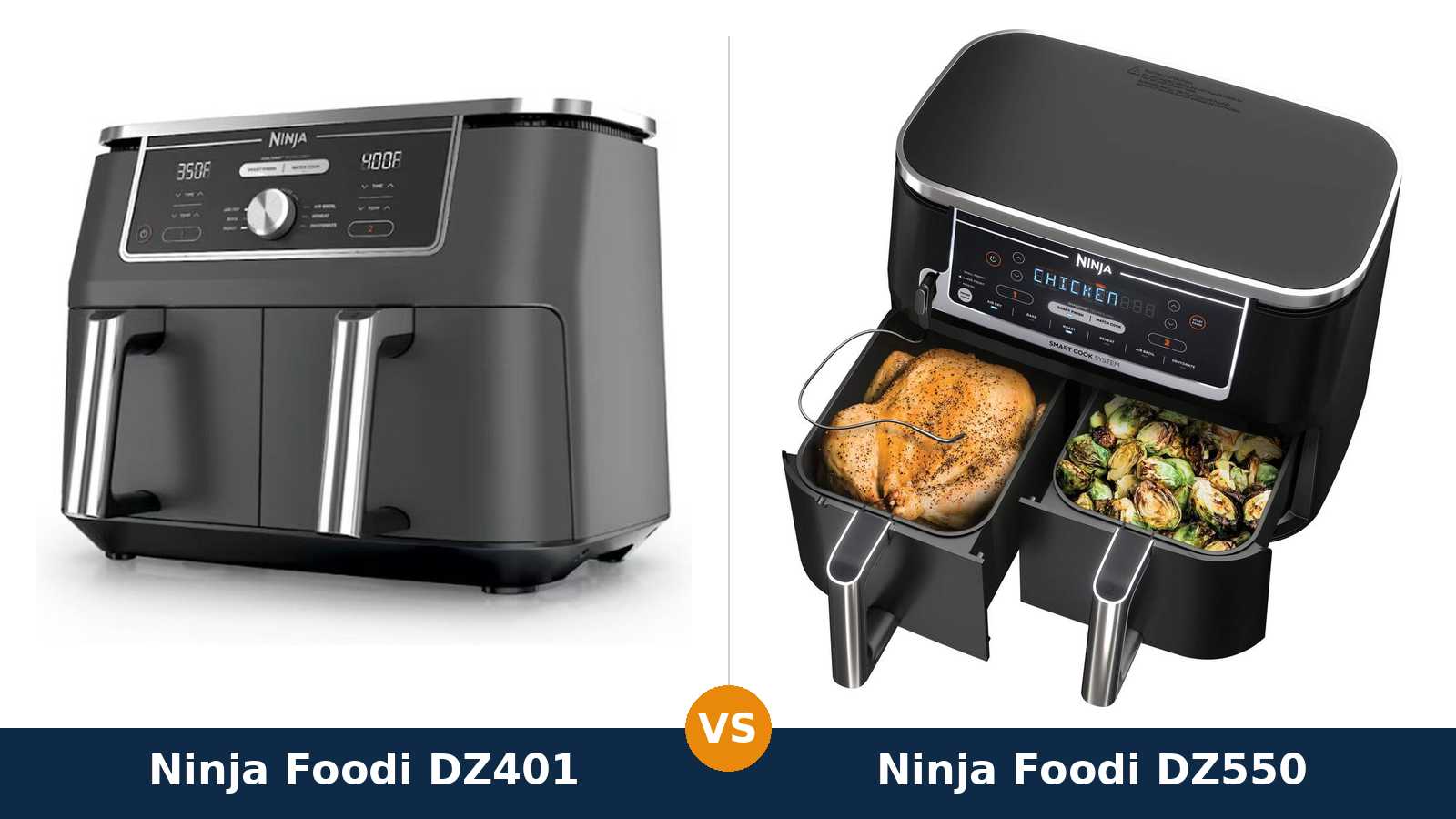
Most people meet the DZ401 first. It is the volume model, the one in the adverts, the one already sitting on a neighbour’s counter.
Then the DZ550 appears beside it, wearing a bigger number. Bigger numbers usually mean a newer generation, a larger machine, a step up in power. Here they mean none of those things.
The DZ550 is the DZ401’s platform with one instrument added: an integrated cooking thermometer and the Smart Cook System that runs on it. Capacity, baskets, functions, wattage and footprint are carried over untouched.
So the real question is narrower than the model numbers suggest. Do you cook enough thick protein for a built-in probe to earn its premium — or would you be paying extra for a feature that stays in its storage slot? We compared both owner’s guides and SharkNinja’s published data to answer it.
Key Takeaways
- Underneath, these are the same air fryer. Two 5-qt baskets, six functions, a 105–450°F range and 1,690 watts — the figures match across both owner’s guides.
- The DZ550’s thermometer cooks protein to a chosen internal temperature, then stops the cook itself. That is the whole of its advantage — and for steak and chicken, a real one.
- The probe has strict borders. Zone 1 only, a single protein at a time, cuts an inch thick or more, and nothing frozen — SharkNinja’s limits, printed in its own guide.
- The DZ401 gives up nothing else. Same cleaning, same DualZone modes, same warranty. Only the probe, its jack and its controls are missing.
- Crisping households should buy the DZ401. Fries, wings and frozen snacks have no internal temperature to track, so the premium buys nothing there.
Quick Verdict
Buy the Ninja Foodi DZ401 if your air fryer mostly crisps, roasts and reheats. That describes the majority of weeknight cooking, and on all of it the two machines perform identically.
You keep the 10-qt DualZone platform — two independent baskets, Smart Finish, Match Cook — and you skip paying for an instrument your food never needs. Put the saving towards a decent instant-read thermometer and the DZ401 lacks nothing.
Buy the Ninja Foodi DZ550 if thick protein is a weekly event and doneness is where your cooking goes wrong. Its Smart Cook System watches the inside of the food rather than the clock, and ends the cook when the target temperature arrives.
For households that regularly serve steak, chops, chicken breast or a roast, that single capability justifies the step up. For everyone else, it is a well-made answer to a problem they do not have.
The Scorecard
Every score here is read off the manufacturer specifications set out in this guide — capacities, function lists, temperature ranges, materials and published dimensions — rather than bench testing. The overall marks lean towards capacity and cooking two things at once, because that is the job a main household fryer is bought to do; the DZ550’s margin comes entirely from guided protein cooking, so households that seldom cook thick cuts should treat the overalls as level.
| Category | Ninja Foodi DZ401 | Ninja Foodi DZ550 | ||
|---|---|---|---|---|
| Capacity & batch size | 10 / 10 | 10 / 10 | ||
| Cooking versatility | 9 / 10 | 10 / 10 | ||
| Materials & visibility | 6 / 10 | 6 / 10 | ||
| Ease of use | 8 / 10 | 9 / 10 | ||
| Cleaning | 7 / 10 | 7 / 10 | ||
| Footprint, storage & portability | 3 / 10 | 3 / 10 | ||
| Overall | 8.0 / 10 | 8.4 / 10 | ||
Scan the rows and the story tells itself: four categories level, two tipped by one component — a probe that one machine has and the other does not.
At a Glance: Who Each Fryer Fits
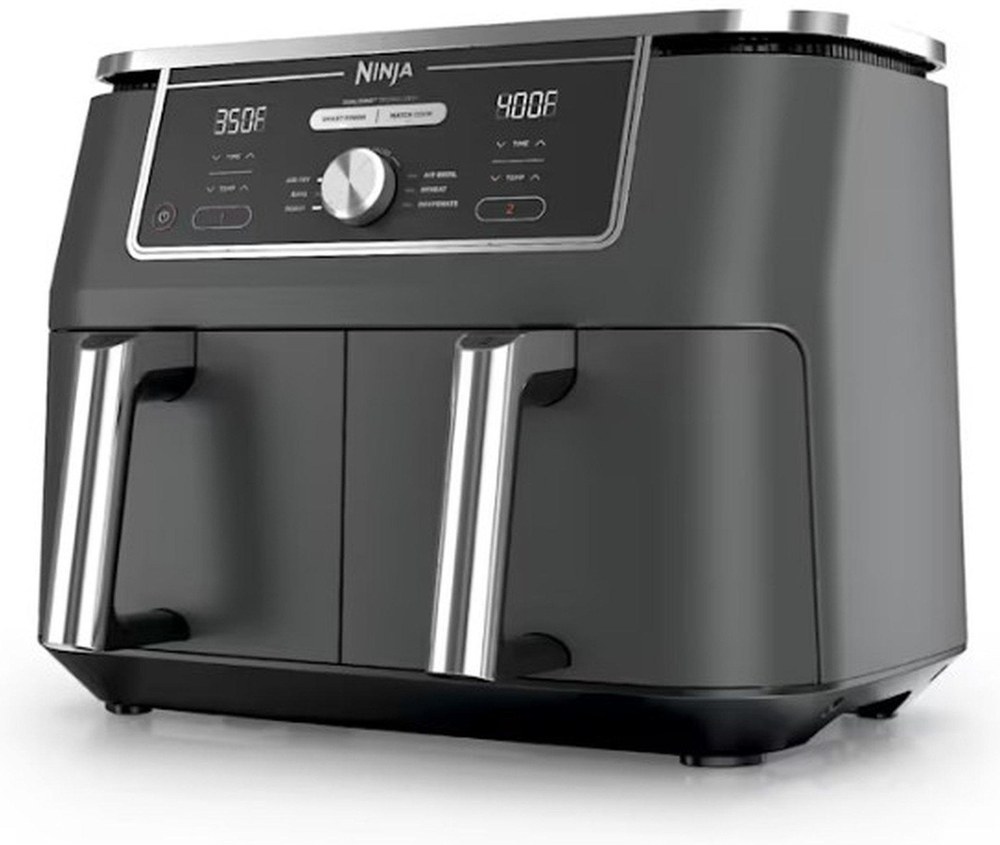
Ninja Foodi DZ401
- 10-qt capacity across two independent 5-qt baskets
- Smart Finish and Match Cook DualZone modes
- 6 functions: Air Fry, Air Broil, Roast, Bake, Reheat, Dehydrate
- 105–450°F range, 1,690 watts
- The same platform as the DZ550, without the thermometer system
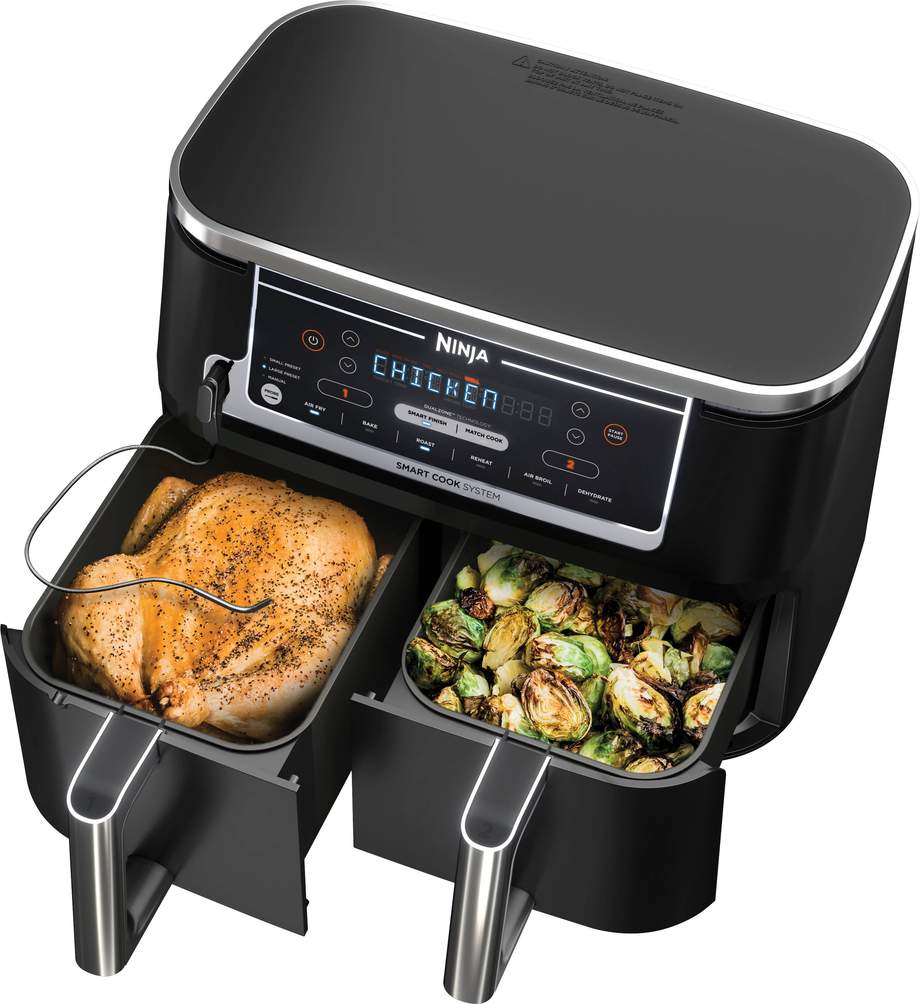
Ninja Foodi DZ550
- Integrated Foodi Smart Thermometer with Smart Cook System
- Same 10-qt capacity: two independent 5-qt baskets
- Same 6 functions and 105–450°F range
- Same 1,690 watts, dimensions and weight
- Probe stores in a compartment built into the unit
Choose the DZ401 if…
Your weekly rotation is fries, wings, nuggets, roasted vegetables and leftovers brought back to life. Food like that is judged by crispness and timing, and both are identical here.
You already cook with an instant-read thermometer and trust it. A probe of your own does the same job, in both baskets, on proteins of any thickness.
Or the DZ550’s premium is steep on the day you order. Nothing about the underlying fryer changes with the cheaper badge.
Choose the DZ550 if…
Steak, pork chops, chicken breast or a Sunday roast pass through your fryer most weeks, and the centre of the meat is where results vary.
You cook alongside someone less experienced. “Choose chicken, choose the doneness, wait for it to stop” is a far simpler brief than judging minutes and colour.
You like protein in one basket and a side in the other, timed to finish together. The probe cooperates with Smart Finish rather than replacing it, so the pairing still lands at once.
As an Amazon Associate I earn from qualifying purchases at no extra cost to you.
Specifications: The Specs That Actually Matter
All figures are drawn from SharkNinja’s published specifications and the two owner’s guides, checked against the manufacturer’s product data.
Approach the table expecting sameness. Two rows carry the entire difference, and both are about the thermometer.
| Specification | Ninja Foodi DZ401 | Ninja Foodi DZ550 |
|---|---|---|
| Capacity | 10 qt total — two 5-qt baskets | 10 qt total — two 5-qt baskets |
| Cooking zones | 2 independent zones, each with its own heater and fan | 2 independent zones, each with its own heater and fan |
| Cooking functions | Air Fry, Air Broil, Roast, Bake, Reheat, Dehydrate | Air Fry, Air Broil, Roast, Bake, Reheat, Dehydrate |
| Temperature range | 105–450°F | 105–450°F |
| Smart thermometer | Not fitted — no probe, no jack, no Smart Cook controls | Foodi Smart Thermometer, integrated — cooks to a target internal temperature and stops automatically |
| Doneness presets | None — time and temperature only | Small and Large presets plus Manual mode; beef, pork, poultry and fish targets |
| DualZone modes | Smart Finish and Match Cook | Smart Finish and Match Cook — both also work with the thermometer |
| Wattage | 1,690 W (120V, 60Hz) | 1,690 W (120V, 60Hz) |
| Baskets & plates | Nonstick baskets, nonstick crisper plates | Nonstick baskets, nonstick crisper plates |
| Dishwasher-safe parts | Baskets and crisper plates only | Baskets and crisper plates only — thermometer is wipe-clean, never immersed |
| Dimensions | 17.1 × 13.9 × 12.8 in | 17.1 × 13.9 × 12.8 in |
| Weight | 19.8 lb | 19.8 lb |
| Power cord | Short power-supply cord; length not published in the owner’s guide | Short power-supply cord; length not published in the owner’s guide |
| In the box | Main unit, (2) 5-qt baskets, (2) crisper plates | Main unit, (2) 5-qt baskets, (2) crisper plates, Foodi Smart Thermometer, 15-recipe guide |
| Warranty | 1-year limited warranty | 1-year limited warranty |
Dimension note: listings swap the width and depth labels freely — 13.9 × 17.1 appears as often as 17.1 × 13.9. The three numbers, and the counter space either machine takes, are the same under both orderings.
Colour note: this comparison covers the black DZ550. A grey finish is sold under its own model number, DZ550GY, on separate listings — the identical machine in another colour. Judge a listing by its model number, not its headline.
Load note: SharkNinja rates each 5-qt zone at roughly 3 lb of wings or fries per batch, and the rating is shared, because the baskets are shared.
The Differences That Actually Matter
1. Capacity and cooking power — nothing between them
Begin with the tie, because it frames everything else.
Each machine splits its cooking across two 5-qt baskets, 10 qt in all, and every zone carries its own heating element and fan. Loads match too: a zone handles around 3 lb of wings or fries, and Match Cook turns the pair into one large batch.
Electrical appetite is identical — 1,690 watts apiece. The guides for both models carry the same warning: this load wants a 15-amp circuit, and the fryer should be the only appliance running on that outlet.
Smart Finish behaves the same on both panels. Two foods, two programs, one shared finishing moment. Match Cook likewise copies a single setting across both zones.
Feeding a family on a weeknight, then, is the same experience on either badge. Do not let capacity or power push the decision. Only the thermometer can.
2. The Smart Cook System — what the DZ550’s premium actually buys
Here is the one place the machines diverge, so it deserves a precise description.
The thermometer lives in a storage compartment on the DZ550’s left flank. You draw it out, seat it horizontally through the thickest part of the meat, and connect it to the jack by the panel.
The PROBE control then offers Small or Large presets sized to the cut, or a Manual mode. Arrows on the panel step through the protein — beef, pork, chicken or turkey, fish — and then the doneness you want.
Targets are set by SharkNinja’s guide. Beef runs from Rare at 115°F up to Well Done at 150°F, with the beef figures deliberately sitting below final serving temperatures because the meat keeps climbing 10–15°F as it rests. Chicken and turkey peak at 165°F for Well Done; pork tops out at 160°F.
Once cooking starts, the panel tracks the probe’s reading against the target. Reach the target and the machine ends the cook on its own, leaving the protein to rest up to temperature.
The DZ401 offers no version of this: no jack in its casing, no Smart Cook logic in its panel. Internal temperature is something its owner measures separately — or estimates.
Strip away the shared platform and this system is the entire case for the DZ550. How much it is worth depends on the next section as much as this one.
3. One probe, one zone — the borders around the headline feature
Credit SharkNinja with unusual honesty here: the limitations are printed in its own guide, and they shape who should pay for the feature.
Zone 1 is the only probed basket. The jack serves the left zone. Move the steak to Zone 2 and it cooks by the clock, exactly as it would in the DZ401.
One protein gets the probe. A pair of steaks ordered to different doneness levels cannot both be tracked. The thermometer follows one; experience follows the other.
Thickness and starting state are restricted. Readings can turn unreliable on cuts under an inch thick, and frozen protein is ruled out altogether. Cutlets, thin fillets and freezer-to-fryer burgers remain clock-based foods even on the DZ550.
The manufacturer keeps a hand thermometer in the picture anyway. The guide states plainly that the Foodi Smart Thermometer does not replace an external food thermometer, and tells owners to confirm final temperatures with a separate instrument.
Read together, the limits do not diminish the feature so much as locate it. Thick, fresh, single-centrepiece protein is its home ground. Outside that ground, the DZ550 cooks precisely like its cheaper twin.
4. Functions and temperature range — level, with platform fine print
The function lists are copies of each other: Air Fry, Air Broil, Roast, Bake, Reheat, Dehydrate. The thermostat span matches too, running from 105°F to 450°F.
Dehydrate owns the low end. The DZ550’s guide gives it a 1-to-12-hour window, aimed at jerky, dried fruit and herbs. Air Fry and Air Broil own the 450°F ceiling.
The operating fine print in the guide applies to the platform generally. Air Broil runs in one zone at a time and disappears entirely under Match Cook. Run two different programs without Smart Finish and the machine redistributes power as zones finish, which can bring the longer program home ahead of its timer; check food near the end.
One asterisk does favour the DZ550. Its thermometer is woven into the DualZone system instead of sitting alongside it: a probed roast in Zone 1 can run under Smart Finish, and dinner still lands together.
Section verdict: a draw for crisping, baking and reheating, which is the bulk of air fryer work across a year.
5. Cleaning — the same dishwasher story, plus one careful wipe
Platform twins tend to clean alike, and these do.
Both owner’s guides restrict dishwasher-safe parts to the baskets and crisper plates — the wording is near-identical in each. The main unit itself is wiped down with a damp cloth and kept away from immersion.
The DZ550’s guide adds a soft steer: hand-washing the baskets is the kinder route if you want the nonstick surface to last. The dishwasher stays permitted; the sink stays gentler.
Its probe then adds the only new chore in this comparison. The thermometer stays out of the dishwasher and out of the sink — a wipe with a damp cloth, a dry, and it winds back into its compartment.
That is perhaps half a minute after a protein cook. Set against it, the DZ401 household washes a separate thermometer of its own. Cleaning scores a tie with different footnotes.
6. Footprint, storage and the cost of one extra part
Counter demands are indistinguishable. Both machines measure 17.1 × 13.9 × 12.8 inches and weigh 19.8 lb, and both ask for six inches of room above and around while they run. Neither qualifies as compact — check your counter depth and the clearance under your cabinets before choosing either.
On storage, the DZ550 is neater than its extra hardware suggests. The probe’s cable coils into the compartment moulded into the unit’s left side, so the thermometer travels with the machine instead of rattling in a drawer.
Ownership tilts the other way. The DZ550 carries a component the DZ401 simply lacks: a wired probe whose cable must not be kinked, knotted or soaked. Spares exist — SharkNinja sells parts, thermometer included, through ninjaaccessories.com — and the warranty behind both machines is the same single year.
Still, a component that exists can be mislaid or damaged, and one that does not exist cannot. The DZ401’s plainness never appears on a spec sheet, yet for some households it settles the argument.
Household & Use-Case Fit Guide
Find your household below. Most rows tie — deliberately, because the hardware does — and the few that do not are where the money should go.
| Your household & cooking | DZ401 | DZ550 | Our call |
|---|---|---|---|
| 1–2 people, mostly frozen snacks and sides | Excellent | Excellent — probe rarely used | DZ401 — keep the difference |
| Family of 3–4, protein and a side most nights | Excellent — with your own thermometer | Excellent — probe in Zone 1, side in Zone 2 | DZ550 if doneness is your pain point |
| Family of 5+, big batch cooking | Excellent — Match Cook across 10 qt | Excellent — Match Cook across 10 qt | Dead tie — capacity is identical |
| Steak, chops and roasts every week | Good — timing plus a separate thermometer | Excellent — cook-to-temperature presets | DZ550, clearly |
| Whole chicken with vegetables | Good — check the bird manually | Excellent — probe in the breast, veg alongside | DZ550 |
| Meal prep and dehydrating | Excellent | Excellent — 1–12 hr Dehydrate | Tie — buy on price |
| First dual-basket fryer, keep-it-simple cook | Excellent — nothing extra to learn | Good — one more system to learn | DZ401 |
| Small kitchen, tight counter | Oversized for the space | Oversized for the space | Neither — see Skip Both |
Ready to check today’s price?
Both machines sell through Amazon. Prices shift from week to week — check the current figure on the model your cooking points to.
View on Amazon — Ninja DZ401View on Amazon — Ninja DZ550The 30-Second Decision
| If this sounds like you… | Buy this |
|---|---|
| “Chicken breast and steak keep coming out overdone at the centre.” | Ninja DZ550 |
| “Four nights a week it is fries, wings and freezer food.” | Ninja DZ401 |
| “I want the protein and its side ready at the same moment.” | Either — Smart Finish matches; DZ550 if the protein is thick |
| “Two proteins, two different doneness levels, one meal.” | DZ401 plus a good instant-read thermometer — one probe cannot track both |
| “The fewer parts and settings, the better.” | Ninja DZ401 |
| “Someone in the house worries about undercooked meat.” | Ninja DZ550 — set the doneness and let it stop itself |
What You Gain. What You Give Up.
Ninja Foodi DZ401
You gain: the complete DualZone proposition — two 5-qt baskets, six functions, the full 105–450°F span, Smart Finish and Match Cook — with no extra system to learn, house or maintain. Typically the lower price of the pair, for the same capacity and the same everyday cooking.
You give up: guided doneness. Protein runs on time and temperature, judged by you and whatever thermometer you own. The machine has no probe jack, so the DZ550’s system can never be bolted on afterwards.
Ninja Foodi DZ550
You gain: protein cooked to a chosen internal temperature with presets and an automatic stop, integrated with Smart Finish and Match Cook rather than improvised beside them. The probe stores on the machine itself. Everything else about the DZ401 platform comes along unchanged.
You give up: probing is confined to Zone 1, to one protein, and to fresh cuts at least an inch thick. There is one more part to wipe carefully, store correctly and one day replace — plus the premium the Smart Cook System adds over its twin.
Pros and Cons
DZ401 — Pros
- The full 10-qt, two-basket DualZone platform
- Six functions across a 105–450°F range
- Dishwasher-safe baskets and crisper plates
- Plainer panel — nothing extra to store or replace
- Usually the cheaper route to the identical machine
Cons
- No thermometer, probe jack or Smart Cook System
- Doneness rests on timing and your own thermometer
- The same large footprint and 19.8 lb weight
- One-year warranty — no edge over the DZ550 there
DZ550 — Pros
- Smart Cook System cooks protein to a set doneness, then stops
- Beef, pork, poultry and fish presets, plus Manual mode
- Thermometer works alongside Smart Finish and Match Cook
- Probe stores in a compartment on the unit
- Capacity and functions identical to the DZ401
Cons
- Probe serves Zone 1 only, one protein at a time
- Needs cuts at least 1 inch thick; frozen protein excluded
- Thermometer is wipe-clean only — no soaking, no dishwasher
- One extra component to lose or damage
- Usually the pricier of the two
Check the Model Number, the Colour and the Condition
Start from the model number. Titles on this platform run long and say a lot. The machine this guide is about is the DZ401 — Foodi 6-in-1, 10-qt, DualZone — and its thermometer-equipped twin is the DZ550.
Colour creates its own listings. The DZ550’s grey finish answers to DZ550GY and sits on separate pages; it is the same hardware in another finish, so know which page you are standing on before comparing figures.
Condition matters more than usual here. Renewed DZ550 units circulate next to new stock under near-identical titles. A renewed fryer can be a sensible saving — but confirm the Foodi Smart Thermometer is in the box, since on the DZ550 the probe is not an accessory. It is the reason the model exists.
Inventory the box before the packaging leaves. A new DZ550 should arrive with the main unit, two 5-qt baskets, two crisper plates, the thermometer and a 15-recipe guide. A missing probe or storage compartment is grounds for a return, not a shrug.
Check the circuit while you check the listing. Each machine pulls 1,690 watts. SharkNinja’s guidance: a 15-amp circuit, the fryer as the only appliance on that outlet during a cook, and no extension cord, ever.
A practical bonus of the shared shell: basket-sized accessories — liners, racks, insert pans — are listed against both model numbers, because the baskets themselves are the same. Whatever fits a DZ401 basket fits a DZ550 basket.
The Upgrade Path Test
Assess the pair across year two rather than week one — and notice the test behaves oddly here, because so much hardware is shared.
Through the first year, most meals cannot tell the machines apart. Fries, wings, roast vegetables, reheated pizza: no thermometer is involved, and the plates come out the same.
Year two is where the DZ550’s single addition either embeds itself or gathers dust. Cooking that drifts towards centrepiece protein — weekly steaks, a roast on rotation, chicken breasts several nights running — keeps the probe busy, and cooking to temperature becomes habit.
Cooking that stays where it began leaves the probe parked in its compartment. The DZ550 then functions as a DZ401 that simply cost more to arrive.
Neither mistake can be corrected later. A DZ401 cannot grow a probe jack or Smart Cook logic; a DZ550 owner who abandons the probe just owns a longer feature list.
So judge by the meals you genuinely make each week, not the ones you make for occasions.
When to Skip Both
Plenty of kitchens are badly served by both machines. Say so plainly.
Skip both if you cook for one or two in a small kitchen. A machine 17 inches wide and close to 20 lb is a heavy tenant for two people’s dinners; a compact single-basket fryer handles the same food in about half the footprint.
Skip both if your cooking centres on single wide items — a whole pizza, a traybake, a sheet of nachos. Twin 5-qt baskets divide food into zones; they never merge into one big cavity. Single-cavity and removable-divider designs exist for that cooking.
Skip both if you want a viewing window or an oven-style unit. Neither machine has a window; both are basket fryers, with a basket fryer’s strengths and blind spots.
And skip both where the kitchen wiring is already stretched. A 1,690-watt appliance that asks for a 15-amp outlet to itself is a genuine constraint in older homes.
Households outside those cases — families cooking two things at once, most nights — are exactly who this platform was built for. For them the choice narrows to the thermometer.
Final Verdict
The Ninja Foodi DZ550 is the better machine — where protein is concerned.
Its victory rests on one component, and the component carries the weight. Cooking a thick steak, chop or chicken breast to a set internal temperature, with the machine stopping itself at the target, is the most dependable method available in any fryer — and the DZ550 builds it into hardware you were already giving counter space to.
Everything around that component is level, checked against both owner’s guides: capacity, functions, temperature span, cleaning, footprint, warranty. A claim that the DZ550 crisps fries better than the DZ401 is marketing, not comparison.
Buy the DZ550 if thick protein is a weekly fixture, if doneness is the variable you keep missing, or if a less confident cook will use the machine and benefits from instructions that end with a beep.
Buy the DZ401 if your fryer’s workload is crisping, roasting vegetables and reheating — or if an instant-read thermometer already lives in your hand when you cook. Everything else stays in place — the baskets, the functions, the fryer itself.
It is the pair’s honest value pick. Just order it knowing that the one capability it lacks can never be added later.
Watch Out: Similar Names, Different Machines
The DualZone range is a naming maze, and three traps catch buyers regularly.
First: the DZ401 and DZ550 are the 10-qt models. The DZ201 wears a similar face with less inside — an 8-qt machine with two 4-qt baskets. Any listing that says only “DualZone” needs its model number verified before anything else.
Second: the DZ550 also trades as the DZ550GY in grey, and surfaces in Renewed listings at lower figures. Finish and condition change the listing, not the machine — but on a Renewed unit, the thermometer’s inclusion deserves explicit confirmation.
Third: “Ninja Foodi” names a family, not a product. The same badge covers pressure-cooker multi-cookers. A listing that mentions a pressure lid has wandered off the air fryer shelf altogether.
Take the product page slowly. Model number first, then capacity, then condition — in that order.
Counter, Circuit and Cabling Notes
Whichever badge you choose, the machine that arrives measures 17.1 × 13.9 × 12.8 inches and weighs 19.8 lb. Treat it as a permanent counter fixture rather than something hauled out of a cupboard.
SharkNinja specifies six inches of open space above and on every side during cooking. Under-cabinet clearance is the measurement buyers most often skip — take it before the delivery, not after.
Both models run on a short power-supply cord; the guides call it short without printing a length, and both prohibit extension cords. The fryer therefore has to live within easy reach of a suitable outlet.
That outlet belongs on a 15-amp circuit, with the fryer the sole appliance running on it. A kettle joining mid-cook is the classic way to meet your breaker.
One note belongs to the DZ550 alone: its probe jack and storage compartment sit on the unit’s left side. Keep that flank accessible — wedging the machine hard against a left-hand wall makes its headline feature fiddly to use.
Warranty and Long-Term Support
Each machine carries SharkNinja’s one-year limited warranty, extended to the original owner and the original product, covering defects in materials and workmanship in normal household use.
Register the purchase and keep the receipt. Warranty help begins with the support line printed in both guides, 1-877-646-5288.
Spares — baskets, crisper plates and the DZ550’s thermometer among them — are sold through ninjaaccessories.com. Wearable parts are treated as normal wear rather than warranty items, which is standard across the category.
The platform itself is the reassurance: DualZone is a mature, high-volume line with deep published documentation behind it, and neither model risks orphan status.
Frequently Asked Questions
What separates the Ninja DZ401 from the DZ550?
A single feature. The DZ550 integrates the Foodi Smart Thermometer and Smart Cook System — presets plus a Manual mode that cook protein to a target internal temperature and stop on their own. The rest of the specification is shared: 10-qt capacity, two 5-qt baskets, six functions, a 105–450°F range, 1,690 watts, the same dishwasher-safe parts and the same one-year warranty.
Can a thermometer be added to the DZ401 later?
No. The DZ401 ships without a probe, a jack or Smart Cook controls, and the DZ550’s system is built in rather than bolt-on. DZ401 owners track doneness through time and temperature, ideally confirmed with a separate instant-read thermometer.
Which model handles steak and chicken better?
The DZ550. Its presets span beef, pork, poultry and fish, with doneness targets running from Rare — 115°F for beef — through to Well Done, and the cook ends automatically when the target internal temperature is reached. Reliable readings need cuts at least an inch thick, and the probe cannot be used with frozen protein.
Does the probe work in both baskets?
No — Zone 1 only, and one protein at a time. Whatever cooks in Zone 2 runs on time and temperature, as it would in the DZ401. The thermometer does pair with Smart Finish, so the un-probed side can still be synchronised to finish alongside the probed one.
Can the baskets go in the dishwasher on either model?
Yes. Baskets and crisper plates are the only dishwasher-safe parts on either machine, although the DZ550’s guide suggests hand-washing baskets to give the coating its longest life. The DZ550’s thermometer is never dishwashed or immersed — wipe it clean with a damp cloth.
Will liners and accessories for one model fit the other?
Basket-sized accessories, yes. The two machines share a shell and use the same 5-qt baskets, and liners, racks and pans for this platform are listed against both model numbers. The exception is the thermometer system itself, which belongs to the DZ550 alone.
Can the Foodi Smart Thermometer stand in for a meat thermometer?
By SharkNinja’s own account, no. The DZ550’s owner’s guide states that the Foodi Smart Thermometer does not replace an external food thermometer, and directs users to verify with a separate thermometer that food reached recommended temperatures. Use the probe for convenience; keep an instant-read thermometer in the drawer regardless.
Is the DZ550 worth the extra over the DZ401?
For thick protein two or three times a week, yes — cooking to temperature is a genuine capability gap, and no accessory closes it afterwards. Where the fryer’s diet is fries, wings, frozen snacks and vegetables, no: those foods run on time in both machines, and the DZ401 is the same appliance for less money.
Sources & Verification
Ninja Foodi DZ550 Series Smart XL 2-Basket Air Fryer Owner’s Guide (SharkNinja): technical specifications (120V, 1,690W), Smart Thermometer use and limits, cleaning table, one-year limited warranty • Ninja DZ401 / DZ400-series owner’s guide and instruction manual: capacity, dimensions, weight, 1,690W, 105–450°F, dishwasher-safe baskets and crisper plates, one-year limited warranty • SharkNinja product data for DZ401 and DZ550 (functions, DualZone modes, per-zone loads) • Amazon listing data used for ASIN verification only (DZ401: model DZ401, UPC 622356571562; DZ550: model DZ550, UPC 622356587150). Specifications verified November 2026.

James Wilson
James has been testing and writing about kitchen appliances for over a decade and writes Honestly Compared’s small-appliance guides. His rule for every comparison: the verdict has to survive the spec sheet, not the marketing page.