
Ninja Foodi vs Ninja Speedi: Which Should You Buy?
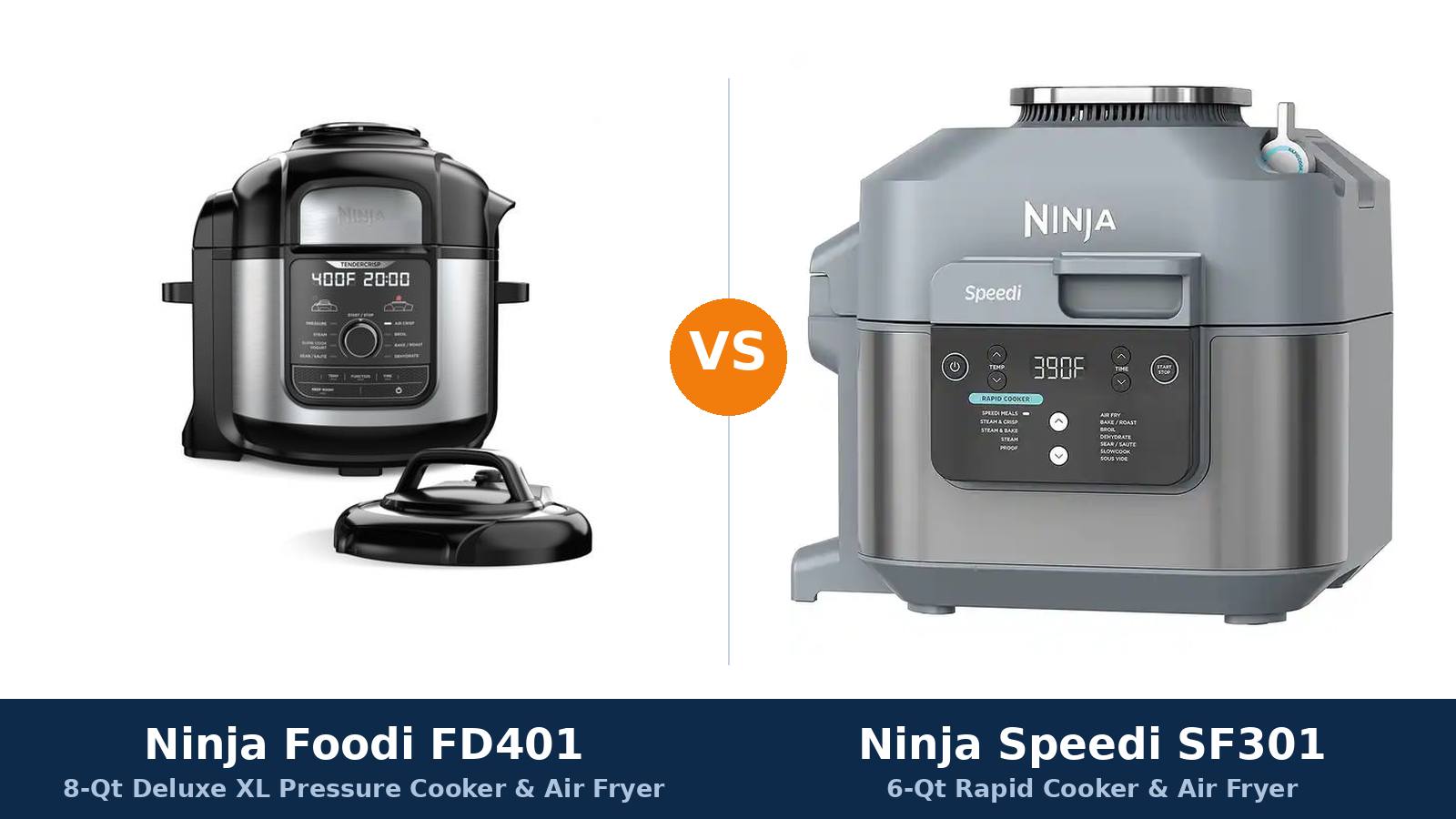
Two Ninja multi-cookers. Two opposite answers to the same question: how do you get a complete dinner out of one pot, fast?
The Foodi’s answer is pressure. Cook under pressure to lock in moisture and speed, then swap lids and crisp. The Speedi’s answer is steam and hot air at the same time, in the same pot, with no pressure and no lid swap at all.
First, a naming decision, stated openly, because it decides everything else. “Ninja Foodi” is a family name, not a product. Elsewhere in this niche — our Foodi vs Crispi comparison, for instance — “Foodi” resolves to the DZ401 DualZone basket air fryer, because the Crispi is a basket-style fryer and that is the like-for-like rival. Here it cannot be. The Speedi is a multi-cooker, and every published Speedi head-to-head pairs it against the Foodi multi-cooker line. So in this comparison, the Ninja Foodi is the Ninja Foodi 12-in-1 Deluxe XL 8-Qt Pressure Cooker & Air Fryer, model FD401 — the two-lid TenderCrisp machine. The Speedi side is exact: the Ninja Speedi Rapid Cooker & Air Fryer, model SF301, in Sea Salt Gray.
That makes this a comparison of two cooking systems, not two baskets: one pressure-cooks, the other pointedly does not; one holds 8 quarts at 26 pounds, the other 6 quarts at 16.
Every specification below comes from SharkNinja’s own owner’s guides, support documentation and product data. No invented prices. No borrowed benchmark scores. The verdict is the one we would give a friend spending their own money.
Key Takeaways
- Only one of these pressure-cooks. The Foodi FD401 is a true pressure cooker that also air fries. The Speedi SF301 has no pressure function at all — its speed comes from steam and crisping happening simultaneously.
- The Speedi cooks complete meals faster. Its Speedi Meals function layers a grain, vegetables and a protein in one pot and finishes them together in as little as 15 minutes. The Foodi’s pressure-then-crisp routine is sequential, with pressurizing and release on the clock.
- The Foodi is the bigger, broader machine. An 8-qt pot and 5-qt basket against 6 quarts; pressure cooking and yogurt the Speedi cannot match; a 7-lb chicken fits the basket.
- The Speedi is the simpler daily driver. One lid, one SmartSwitch, no pressure to build or release, 10 lbs lighter and a smaller footprint.
- Both draw 1,760 watts and carry the same one-year warranty. Power and coverage do not separate them. Cooking method, capacity and complexity do.
Quick Verdict
Buy the Ninja Foodi FD401 if pressure cooking is part of your cooking — or you feed more than four. It is the more capable appliance, and the capability gap is real.
It is the only machine here that pressure-cooks: dried beans without a soak, tough cuts tender fast, stocks, stews, yogurt. Then the crisping lid finishes what pressure started. Its 8-qt pot and 5-qt basket out-cook the Speedi on volume in every mode they share.
Buy the Ninja Speedi SF301 if your weeknight problem is time, not repertoire.
Grains, vegetables and protein go in raw and come out a finished meal, steamed and crisped at once — no lid swap, no pressure release, almost nothing to learn. For households of four or fewer that do not pressure-cook, it is the machine that gets used on a Tuesday.
The Scorecard
Scores below are derived directly from the manufacturer specifications compared in this guide — capacities, function lists, temperature ranges, lids, dimensions and weights. They are a reading aid, not benchmark results. The overall score weights capacity and cooking versatility most heavily, because that is what a multi-cooker is bought for. Weight one-pot meal speed and ease of use first instead, and the Speedi wins this table.
| Category | Ninja Foodi FD401 | Ninja Speedi SF301 | ||
|---|---|---|---|---|
| Capacity & batch size | 9 / 10 | 7 / 10 | ||
| Cooking versatility | 10 / 10 | 8 / 10 | ||
| One-pot meal speed | 6 / 10 | 10 / 10 | ||
| Ease of use | 6 / 10 | 9 / 10 | ||
| Cleaning | 7 / 10 | 8 / 10 | ||
| Footprint & weight | 4 / 10 | 8 / 10 | ||
| Value | 8 / 10 | 8 / 10 | ||
| Overall | 8.3 / 10 | 8.1 / 10 | ||
Read the pattern, not just the totals. The Foodi’s wins are about range: more quarts, more cooking methods, the entire pressure-cooking repertoire. The Speedi’s wins are about the clock and the learning curve. Neither is a compromise version of the other.
At a Glance: Who Each Machine Fits
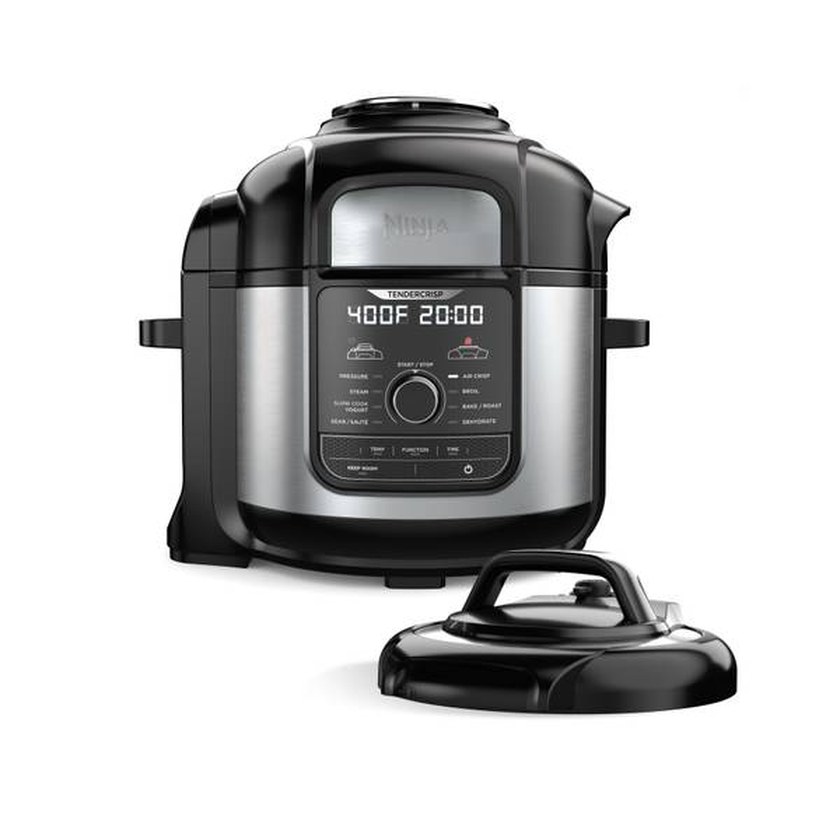
Ninja Foodi FD401
- 8-qt ceramic-coated pot plus 5-qt Cook & Crisp Basket — fits a 7-lb chicken
- True pressure cooking with TenderCrisp finish: pressure lid plus hinged crisping lid
- 12 functions including Pressure Cook, Yogurt and Sous Vide
- 1,760W; 80–400°F across its functions
- Pot, basket, rack, pressure lid and ring are dishwasher safe
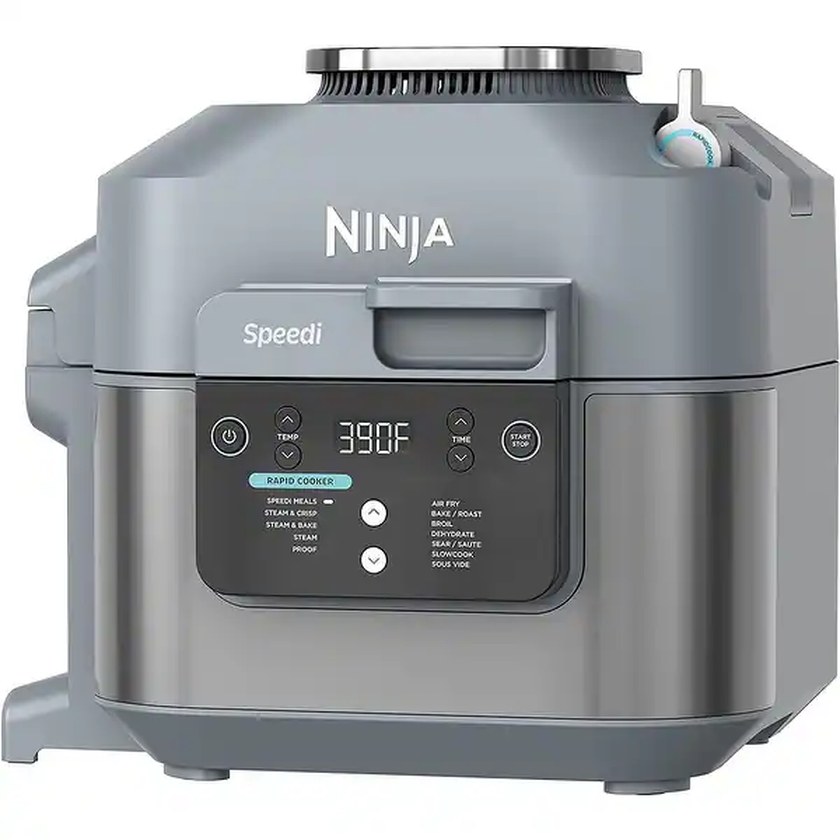
Ninja Speedi SF301
- 6-qt nonstick pot plus multi-functional crisper tray; cooks for up to 4
- Rapid Cooker system: steam and crisp at the same time in one pot — no pressure
- 12 functions including Speedi Meals, Steam & Crisp and Proof
- 1,760W; 90–450°F across its functions
- Pot and crisper tray are dishwasher safe; one lid, no swaps
Choose the Ninja Foodi FD401 if…
You pressure-cook, or want to: beans, tough cuts, stocks, stews, whole chickens rendered tender fast.
You cook for five or more, or batch-cook on weekends. The 8-qt pot and 5-qt basket are the largest vessels in this comparison by a clear margin.
You make yogurt, or you want one appliance to retire a separate pressure cooker and air fryer.
Choose the Ninja Speedi SF301 if…
Your weeknight goal is a complete meal — grain, vegetable, protein — from one pot in about a quarter of an hour of cooking.
You have never wanted a pressure cooker and do not intend to start. The Speedi never asks you to manage pressure, valves or release times.
Counter space and lifting weight matter. At 16 lbs with a single lid to store, it is the easier machine to live around.
As an Amazon Associate I earn from qualifying purchases at no extra cost to you.
Specifications: The Specs That Actually Matter
Every figure below comes from SharkNinja’s published specifications, owner’s guides and support documentation for the US models. Variants with different specifications are flagged under the table.
| Specification | Ninja Foodi FD401 | Ninja Speedi SF301 |
|---|---|---|
| Model | FD401 (listing suffix FD401 LP3), Deluxe XL | SF301 (SF300 series), Sea Salt Gray |
| Capacity | 8-qt cooking pot; 5-qt Cook & Crisp Basket fits a 7-lb chicken | 6-qt cooking pot; fits 4 chicken breasts plus 1 lb of pasta; cooks for up to 4 |
| Cooking system | TenderCrisp: pressure cook first, then crisp — plus conventional air frying | Rapid Cooker: steam and crisp simultaneously in one pot; no pressure cooking |
| Wattage | 1,760 watts | 1,760 watts |
| Temperature range | 80–400°F across functions (Air Crisp 300–400°F) | 90–450°F across functions (Speedi Meals and Steam & Crisp to 450°F) |
| Cooking functions | 12: Pressure Cook, Air Fry/Air Crisp, Steam, Slow Cook, Yogurt, Sear/Sauté, Bake, Roast, Broil, Dehydrate, Sous Vide, Keep Warm | 12: Speedi Meals, Steam & Crisp, Steam & Bake, Steam, Proof, Air Fry, Bake/Roast, Air Broil, Dehydrate, Sear/Sauté, Slow Cook, Sous Vide |
| Cooking vessels & materials | Ceramic-coated 8-qt pot (nonstick, PTFE/PFOA-free), ceramic-coated 5-qt basket, stainless steel Deluxe Reversible Rack for two-layer cooking | Aluminum 6-qt pot with nonstick nano-ceramic coating; multi-functional crisper tray (raised for Speedi Meals, low for air frying) |
| Lids & controls | Two lids: hinged crisping lid (attached) plus a separate pressure lid; dial and touch controls | One lid; SmartSwitch lever selects Rapid Cooker or Air Fry/Stovetop mode |
| Dimensions | 16.1 in L × 14.57 in W × 14.29 in H | 14.1 in L × 13.8 in W × 12.4 in H (about 20 in tall with lid open) |
| Weight | 26 lbs | 16 lbs |
| Dishwasher-safe parts | Pressure lid, cooking pot, silicone ring, reversible rack, Cook & Crisp Basket, detachable diffuser (crisping lid is wipe-clean only) | Cooking pot, crisper tray, condensation collector |
| Warranty | 1-year limited | 1-year limited |
| In the box | 1760W base, 8-qt pot, 5-qt Cook & Crisp Basket, Deluxe Reversible Rack, crisping lid, pressure lid, recipe book | Base with lid, 6-qt cooking pot, multi-functional crisper tray |
Variant note — Foodi: the FD401 has worn two badges over its production life. Early units were sold as 9-in-1; the current listing is 12-in-1, counting Bake and Roast separately and including Sous Vide. Check the function list on the exact listing, not the badge. The FD402 is a Best Buy variant with the same hardware plus mitts; the FD401C is the Canadian version; “Renewed” listings are refurbished units. The older OP401 is the previous generation, not this machine.
Variant note — Speedi: the SF301 is the current US model. The SF300 that preceded it is now found mostly as renewed stock; the SF302A is an 11-in-1 variant; and the UK Speedi (ON400UK) is a different 10-in-1 specification — not the machine compared here. One data conflict worth naming: some retailer data lists the SF301 at 1,250 watts. SharkNinja’s owner’s guide and support documentation both state 1,760 watts, and that is the figure used throughout this guide.
The Differences That Actually Matter
1. Pressure versus steam — the fundamental split
Everything else in this comparison flows from one fact: the Foodi cooks with pressure and the Speedi does not cook with pressure at all.
Pressure changes what food can do. It forces moisture into dried beans without an overnight soak and breaks down a pork shoulder in a fraction of braising time. An entire pressure-cooker recipe library — decades of it — is open to the Foodi and closed to the Speedi.
The Speedi’s moist heat is steam at atmospheric pressure. Steam cooks fast and keeps food juicy — but it cannot replicate pressure’s effect on dense, tough or dried ingredients.
If beans, stocks, tough cuts and yogurt are weekly events, this section decides the comparison on its own. If they are not, pressure is a feature you would pay for, store and never use — and the Speedi’s case gets much stronger.
2. How a complete meal actually gets cooked — simultaneous versus sequential
The Speedi’s signature move is layering. Liquid and a grain go in the bottom of the pot, the crisper tray sits raised above them, vegetables and a protein go on the tray. One cycle steams the grain below while crisping what sits above. SharkNinja’s claim — a complete meal in as little as 15 minutes — is one the architecture genuinely supports.
The Foodi’s TenderCrisp routine is a relay, not a duet. Pressure-cook first. Release the steam. Swap lids. Then crisp. Each stage is effective — pressure followed by crisping is still the best route to a juicy whole chicken with real skin — but the stages queue, and the clock includes coming up to pressure and letting it back down. Testers have put a quick release at around two minutes and a full natural release at twenty minutes or more on this class of machine.
The Foodi can still cook a meal’s components together under pressure, and its rack layers food for crisping. What it cannot do is steam the base and crisp the top in the same minute.
So the Speedi is faster at finishing a complete one-pot meal, and it is not close. The Foodi is better at the individual hard jobs the Speedi cannot attempt.
3. Capacity — 8 quarts, 5 quarts, and the shape of a batch
The Foodi’s pot holds 8 quarts to the Speedi’s 6. Its crisping basket holds 5 quarts and swallows a 7-lb chicken; the Speedi’s claim is four chicken breasts plus a pound of pasta.
SharkNinja pitches the Speedi at up to four people. The Foodi is the machine for five or six — for doubling a chili, for the batch that fills freezer tubs.
Batch logic differs too. The Foodi’s rack allows two-layer crisping — protein above, vegetables below. The Speedi’s raised tray layers inside its steam modes, but its pure air-fry capacity is one tray’s worth.
If you regularly cook for more than four, this section outweighs the Speedi’s speed: a 15-minute meal that feeds four does a household of six no good in a single run.
4. Lids, switches and the daily learning curve
The Foodi asks you to manage two lids. The crisping lid is hinged to the base and lives there. The pressure lid comes off and needs a home — a cabinet shelf, standing on its side, every day you own the machine.
It also asks you to learn pressure discipline: sealing the valve, waiting for the float, choosing a release. None of it is hard, but it is a body of knowledge the Speedi simply never requests.
The Speedi has one lid and a lever. Flip the SmartSwitch to Rapid Cooker or Air Fry/Stovetop, pick a function, set time and temperature. The panel lights only the functions available in the mode you chose, which quietly prevents most wrong turns.
For a confident cook this section is a shrug. For a first multi-cooker, or a household where several people cook, it is the difference between a machine that gets used and one that gets respected from a distance.
5. Temperature range and the precision jobs
The Speedi owns the top end: 450°F in its Rapid Cooker modes, where the Foodi tops out at 400°F. That headroom matters for aggressive crisping — its Air Broil runs 400–450°F.
The Foodi owns the repertoire around the range: it alone makes yogurt, and its dehydrate range starts lower, at 80°F.
The Speedi counters with a genuine Proof function, 90–105°F, for bread dough — a trick the Foodi can only approximate. Both machines sous vide, both slow cook, both dehydrate.
The Speedi’s range is wider on paper and hotter where crisping happens. The Foodi’s list covers two jobs — pressure and yogurt — that no temperature range can substitute for.
6. Cleaning — more safe parts, or fewer parts altogether
Counted part by part, the Foodi wins the dishwasher row. Its pressure lid, pot, silicone ring, reversible rack, crisping basket and detachable diffuser can all go in. The Speedi sends its pot, crisper tray and condensation collector.
Counted as a whole job, the Speedi wins. It has a pot, a tray and a lid interior to wipe. The Foodi has those equivalents plus a second lid, a ring that wants periodic attention, and a crisping lid attached to the base that can only ever be wiped — never submerged, never dishwashed.
Both pots are nonstick-coated and both reward hand-washing if you want the coating to last, whatever the dishwasher permission says.
Realistically: the Speedi is a five-minute cleanup; the Foodi a ten-minute one with more pieces to dry and store.
7. Footprint, weight and where the second lid lives
The Foodi occupies roughly 16.1 by 14.6 inches of counter, stands 14.3 inches tall and weighs 26 lbs. Machines like this do not get put away; they take up permanent residence — and the pressure lid takes a second residence in a cabinet.
The Speedi occupies roughly 14.1 by 13.8 inches, stands 12.4 inches tall and weighs 16 lbs — ten pounds lighter. One caution from SharkNinja’s own figures: it needs about 20 inches of vertical clearance with the lid fully open, so measure under low cabinets first.
Sixteen pounds is a machine one person moves without thinking. Twenty-six is a machine that gets slid, not lifted, and mostly stays where it landed. In a small kitchen, the Speedi’s lighter, single-lid footprint is a daily advantage that spec-sheet shoppers consistently underrate.
Household & Use-Case Fit Guide
Work from your household outward, not from the spec sheet inward.
| Your household / use case | Ninja Foodi FD401 | Ninja Speedi SF301 | Our call |
|---|---|---|---|
| Family of 5–6, big dinners | Excellent — 8-qt pot, 5-qt basket, two-layer rack | Stretched — 6 qt, rated for up to 4 | Foodi FD401 |
| Weeknight complete meals, fast | Good — but pressure, release and a lid swap sit on the clock | Excellent — layered one-pot meals in as little as 15 minutes | Speedi SF301 |
| Beans, tough cuts, stocks, stews | Excellent — true pressure cooking | Cannot pressure-cook; slow cook only | Foodi FD401 |
| Yogurt making | Yes — dedicated Yogurt function | No yogurt function | Foodi FD401 |
| One or two people | More machine than the meals need | Excellent — right-sized, quick to clean | Speedi SF301 |
| Small kitchen, tight counters | Poor — 26 lbs, two lids to house | Excellent — 16 lbs, one lid, smaller footprint | Speedi SF301 |
| First multi-cooker / low learning curve | Pressure routine to learn and manage | Excellent — SmartSwitch, no pressure at all | Speedi SF301 |
| Weekend batch cooking | Excellent — the biggest pot and basket here | Good — within its 6-qt ceiling | Foodi FD401 |
The Foodi’s wins are about repertoire and volume. The Speedi’s wins are about time, simplicity and space. Your household already knows which list sounds like its week.
The 30-Second Decision
| If this sounds like you… | Buy this |
|---|---|
| “I pressure-cook — beans, tough cuts, stocks — and I crisp what I cook.” | Ninja Foodi FD401 |
| “Dinner for four, one pot, as fast as possible on a weeknight.” | Ninja Speedi SF301 |
| “We are five or six at the table, most nights.” | Ninja Foodi FD401 |
| “I have never used a pressure cooker and do not want to learn.” | Ninja Speedi SF301 |
| “I make yogurt and big weekend batches.” | Ninja Foodi FD401 |
| “My kitchen is small and the machine has to be easy to move.” | Ninja Speedi SF301 |
| “I want one appliance to replace my pressure cooker, slow cooker and air fryer.” | Ninja Foodi FD401 |
Ready to check today’s price?
Prices on both machines move with Amazon’s promotions. Pull up the live figure on the one your household picked.
View on Amazon — Foodi FD401View on Amazon — Speedi SF301What You Gain. What You Give Up.
Ninja Foodi FD401
You gain: the complete multi-cooker repertoire in one pot — true pressure cooking, yogurt, sous vide, slow cooking and a crisping finish, across the largest capacity in this comparison. One machine can retire a separate pressure cooker and air fryer, and cook for six.
You give up: speed on complete meals, because pressure and crisping happen in sequence with a lid swap between them. You also give up counter and cabinet space — 26 lbs, a 16-inch footprint, and a second lid that lives somewhere — plus the simplicity of a machine with no pressure to manage.
Ninja Speedi SF301
You gain: the fastest route from raw ingredients to a complete one-pot meal in this category — steam and crisp at once, layered in a single pot, under one lid. A machine a first-time multi-cooker owner can run confidently on day one, at 16 lbs with the smaller footprint.
You give up: pressure cooking entirely, and yogurt with it. You give up two quarts of pot capacity and the big-batch headroom. And its rapid modes work with liquid in the pot by design — count how often you would actually use the Rapid Cooker side before choosing it for them.
Pros and Cons
Foodi FD401 — Pros
- True pressure cooking plus a crisping finish in one pot
- Largest capacity here: 8-qt pot, 5-qt basket, 7-lb chicken
- 12 functions including Yogurt and Sous Vide
- Two-layer cooking on the Deluxe Reversible Rack
- Most dishwasher-safe parts of the two
Cons
- Pressure-then-crisp is sequential — pressurizing, release and a lid swap take time
- 26 lbs and a 16.1-in footprint; the pressure lid needs storage
- Crisping lid is attached and wipe-clean only
- Pressure routine is a real learning curve for beginners
- Design dates to 2019 — a mature platform, not the newest architecture
Speedi SF301 — Pros
- Steam and crisp simultaneously: complete layered meals in as little as 15 minutes
- One lid, one SmartSwitch — no pressure to build, vent or fear
- 450°F top end for harder crisping and broiling
- 16 lbs and the smaller footprint; easy to move and store
- Proof function for bread bakers; pot and tray are dishwasher safe
Cons
- No pressure cooking and no yogurt — ever
- 6-qt ceiling; rated for up to four people
- Rapid Cooker modes need liquid in the pot to make steam
- Fewer dishwasher-safe parts than the Foodi
- Needs about 20 inches of clearance with the lid open
Check the Exact Model, Not Just the Name
Check which “Foodi” you are looking at. This is the single most expensive mistake available in this comparison.
The machine here is the FD401, a pressure cooker with two lids. The DZ401 — a twin-basket air fryer that shares the Foodi name — cannot pressure-cook at all, and the newer SmartLid models (OL series) fold both lids into one. If a listing shows two drawer baskets, or one slider lid, it is a different machine.
Check the Foodi’s function badge. FD401 production spans a badge change: early units are labeled 9-in-1, current listings 12-in-1. The difference is counting, plus Sous Vide added on later production. If sous vide matters to you, confirm it in the listing’s function list before ordering.
Check the Speedi’s model number. The SF301 is the full 12-in-1 US model. The earlier SF300 is now mostly renewed stock, the SF302A drops to 11 functions, and listings for the UK ON400UK describe a 10-in-1 machine with a different function set and a UK plug. Match SF301 on the box.
Check the wattage figure skeptically. Some retailer data lists the Speedi at 1,250 watts. SharkNinja’s owner’s guide and support pages state 1,760 watts. The guide governs.
Check what’s in the box. The Foodi should include both lids, the 8-qt pot, the 5-qt Cook & Crisp Basket, the Deluxe Reversible Rack and the recipe book — a missing pressure lid turns it into a very large air fryer. The Speedi should include the 6-qt pot and crisper tray; without the tray, layered Speedi Meals cooking does not work.
The Longevity Test: Coatings, Lids and Product Lines
Day-one impressions flatter both machines. Year three is the fairer test.
The Foodi FD401 is a 2019 design, and that cuts both ways. The platform is proven, the accessory ecosystem is deep — replacement pots, baskets, rings and racks are easy to find. It is also the older architecture: SharkNinja’s newer Foodi multi-cookers use a single SmartLid design, so the two-lid FD401 is a mature end-of-line design rather than a growing platform.
The Speedi is the newer platform, built around a simpler idea with fewer failure points. No pressure valve assembly, no sealing ring to age, no second lid. Its wear items are the pot’s nano-ceramic coating and the crisper tray, both replaceable.
Coatings are the shared reality. Both pots are nonstick-coated — ceramic-coated on the Foodi, nano-ceramic on the Speedi — and both are wear items over years of use. Hand-washing is how either coating lasts longest.
The Foodi has one extra consumable: the silicone sealing ring, which absorbs odors and relaxes with age. It is inexpensive, replaceable, and worth owning as a spare. The Speedi asks for no equivalent.
Neither machine is a dead end — but the Speedi’s simpler mechanism gives it the cleaner maintenance story, and the Foodi’s maturity gives it the deeper parts shelf.
When to Skip Both
Neither machine is the right answer for every kitchen. Four situations point elsewhere.
Skip both if what you actually want is a basket air fryer. If your cooking is fries, wings, nuggets and reheated pizza in batches, the Foodi DZ401 DualZone or a single-basket fryer does that job with less bulk and no multi-cooker complexity you will never use.
Skip the FD401 specifically if the two-lid routine puts you off but you still want pressure: SharkNinja’s SmartLid Foodi models (the OL series) pressure-cook and crisp under one lid.
Skip both if you cook for one. A 6- or 8-quart multi-cooker is a lot of appliance to heat for a single portion; a compact basket fryer serves you better and cleans faster.
And skip both if your meals are mostly sheet-pan and oven work. Neither a pot-based multi-cooker nor a rapid cooker replaces an oven’s flat real estate.
Warranty and Long-Term Support
Both machines carry SharkNinja’s one-year limited warranty, per their owner’s guides, covering defects in materials and workmanship under normal household use. Warranty does not separate these two.
Practical support is strong on both sides. SharkNinja sells replacement pots, baskets, trays, racks and sealing rings directly, and both lines sell in the volume that keeps parts available for years.
Two habits extend either machine’s life. Register the product when it arrives. And respect the wipe-clean rule: the Foodi’s attached crisping lid and both machines’ bases never see dishwater.
Final Verdict
The Ninja Foodi FD401 is the multi-cooker we would buy for most households that cook seriously.
It wins this comparison on the work it can do: it pressure-cooks — a whole category the Speedi does not contain — and then it crisps, in the largest pot and basket here. Yogurt, sous vide, two-layer cooking, batches for six: the repertoire is complete in a way the Speedi’s is not.
If one machine has to carry a household’s slow Sundays and ambitious weeknights alike, this is it.
Buy the Foodi FD401 for pressure cooking, for households of five or more, and for batch cooking.
Buy the Speedi SF301 if the Foodi’s strengths are answers to questions you never ask. You do not pressure-cook. Dinner is for four or fewer. The weeknight enemy is the clock, not the recipe repertoire.
Then the Speedi is not the consolation prize. It is the machine shaped around your actual week — a first choice wearing a second-place label.
Watch Out: Similar Names, Different Machines
The Ninja catalogue rewards slow readers. Four traps account for most wrong purchases in this family.
First: “Ninja Foodi” in this comparison is the FD401 pressure-cooker multi-cooker — not the DZ401. The DZ401 is a 10-qt twin-basket air fryer with no pressure function and no pot. The names collide constantly in listings and search results; the model number is the only safe identifier.
Second: the FD401’s own family is crowded. The OP401 is the previous 8-qt generation, the FD402 is a retailer variant of this machine with extra mitts, the FD401C is Canadian, and the OL-series SmartLid models are the newer one-lid architecture. Only the FD401 is the machine compared here.
Third: the Speedi line has its own shadows. The SF300 is the earlier model, now mostly renewed stock. The SF302A is an 11-in-1 variant. The UK Speedi, ON400UK, is a 10-in-1 with a Grill function the US model lacks and without the US model’s Proof, Air Broil and Sous Vide. A cheap imported listing is a different appliance.
Fourth: badge counts drift. The FD401 has been sold as both a 9-in-1 and a 12-in-1 across its production life. Count functions on the listing, not the box art — and confirm Sous Vide if it is on your list.
Frequently Asked Questions
Is the Ninja Foodi in this comparison a pressure cooker?
Yes. Here, “Ninja Foodi” means the FD401 Deluxe XL — a pressure cooker and air fryer in one, with a separate pressure lid and a hinged crisping lid. It is not the DZ401 DualZone basket air fryer that carries the Foodi name in some of our other comparisons; that machine cannot pressure-cook.
Can the Ninja Speedi pressure cook?
No — the Speedi has no pressure function at all. Its Rapid Cooker modes use steam at atmospheric pressure combined with crisping, which is how it cooks complete meals quickly. If pressure cooking is essential, the Foodi FD401 is the only option here.
Which one cooks a complete dinner faster?
The Speedi, clearly. Its Speedi Meals function cooks a grain, vegetables and a protein at the same time in one pot — SharkNinja rates complete meals in as little as 15 minutes. The Foodi’s TenderCrisp routine runs in stages: pressurize, cook, release, swap lids, crisp. For a single dish like a tough cut, the Foodi’s pressure can still be the faster tool.
Which is better for a family of six?
The Foodi FD401. Its 8-qt pot and 5-qt crisping basket — which fits a 7-lb chicken — are built for that household. The Speedi’s 6-qt pot is rated for up to four people, so six means two runs.
Can both machines air fry on their own?
Yes. The Foodi air fries (Air Crisp) in its 5-qt basket at 300–400°F. The Speedi air fries with its crisper tray in the lowered position, separate from its steam modes. The Foodi holds more per batch; the Speedi reaches 450°F across its range for harder crisping.
Which one makes yogurt?
Only the Foodi FD401 — Yogurt is one of its 12 functions. The Speedi has no yogurt function, though its Proof mode (90–105°F) covers the neighboring job of rising bread dough.
What goes in the dishwasher?
On the Foodi: the pressure lid, cooking pot, silicone ring, reversible rack, Cook & Crisp Basket and detachable diffuser — but never the attached crisping lid, which is wipe-clean only. On the Speedi: the cooking pot, crisper tray and condensation collector. Neither base unit is ever submerged or dishwashed.
FD401 or a newer SmartLid Foodi — does the two-lid design still make sense?
For many buyers, yes. The FD401’s two lids are a proven, mechanically simple system with deep parts availability and generous 8-qt capacity. The SmartLid models trade that for one-lid convenience. Choose the FD401 for capacity; choose SmartLid if the single lid matters more.
Sources & Verification
SharkNinja FD400-series owner’s guide (FD401 platform): 1,760W, 120V, TenderCrisp workflow, dishwasher-safe parts list, one-year limited warranty • SharkNinja SF300-series owner’s guide (SF301): 1,760W technical specifications, function temperature ranges, dishwasher-safe parts, one-year limited warranty • SharkNinja support documentation, SF300 series: dimensions 14.1 × 13.8 × 12.4 in, weight 16 lbs, maximum power 1,760 watts, aluminum pot with nonstick nano-ceramic coating • Amazon US product data for the FD401 and SF301 (ASINs, model numbers and UPCs cross-checked against SharkNinja data) • Published Speedi-versus-Foodi head-to-head comparisons (BestReviews, Top Ten Reviews) for the model pairing determination described in the introduction. Specifications verified November 2026.

James Wilson
James has been testing and writing about kitchen appliances for over a decade and writes Honestly Compared’s small-appliance guides. His rule for every comparison: the verdict has to survive the spec sheet, not the marketing page.