
Philips Airfryer 3000 Series (NA330/00) vs Philips Airfryer 5000 Series (HD9280/91): Which Should You Buy?
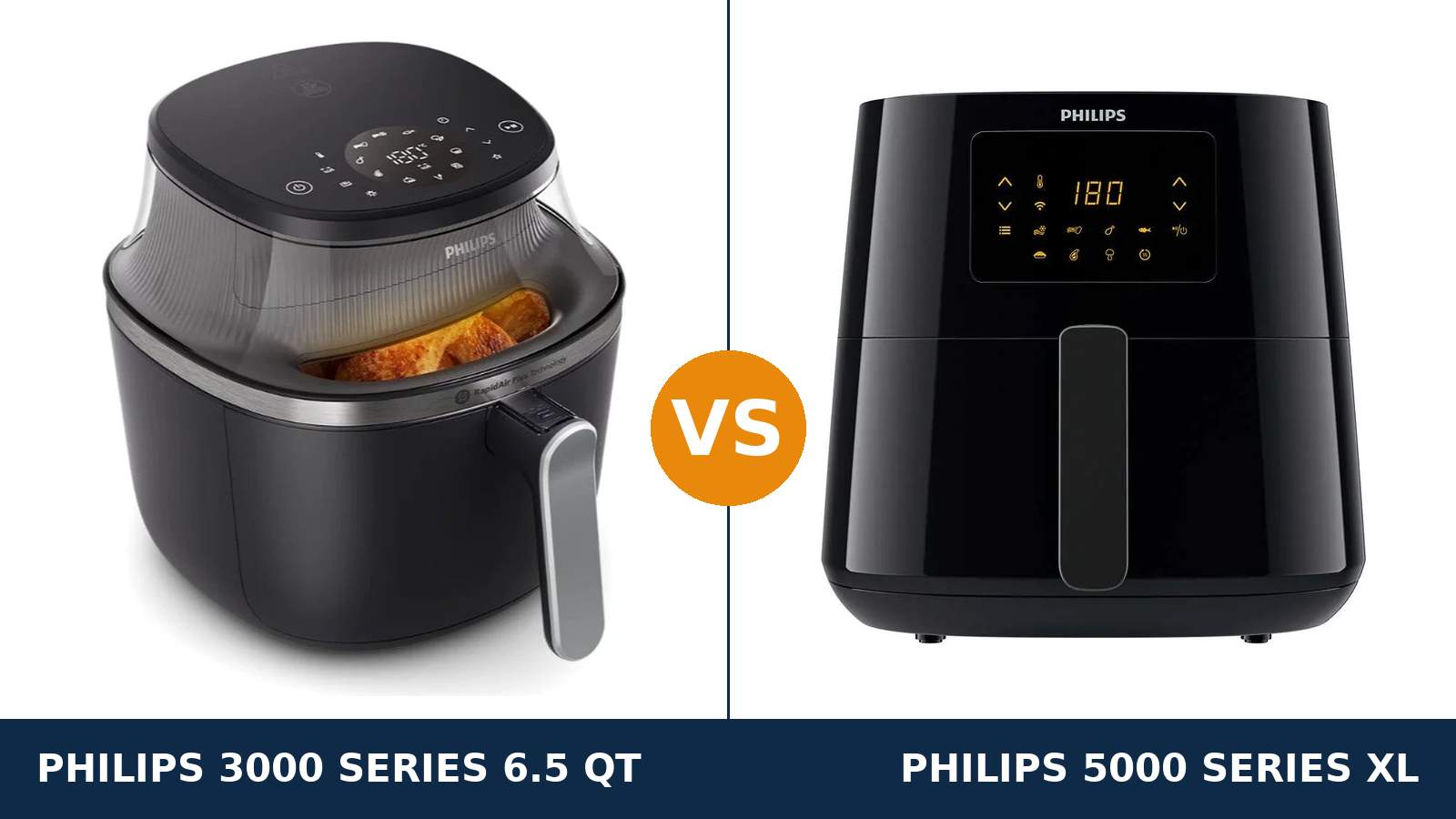
Here is the trap in this comparison: the bigger number is the older machine.
Philips renumbered its Airfryer range, and the badges no longer climb the way you would expect. The 3000 Series is the current design — the window line, with Philips’ newest airflow. The 5000 Series is the outgoing flagship: the connected generation before it.
Series names still are not model numbers, so let us pin both sides down. The 3000 Series here is the mainstream 6.5 qt (6.2L) window model: Amazon.com sells it as the NA330/00; Philips’ own US store lists the identical machine as the NA331/00. The 5000 Series here is the 5000 Series XL Connected, model HD9280/91 — the only model Philips sold under that name in the US.
One more thing belongs up front. Philips has discontinued the HD9280/91, and at the time of writing its Amazon.com listing shows no featured offers. We compare the machines on their merits — and flag, in plain terms, what that status means if the 5000 is the one you want.
Both fryers share the same 6.2-litre pan, so this verdict turns on design, not size. Every specification that follows comes from Philips’ own pages, datasheets and manuals.
Key Takeaways
- The 3000 Series is the newer cooking machine. RapidAir Plus airflow, a viewing window, 16 functions, a 100°F–400°F range and timers that run to 24 hours.
- The 5000 Series is the only connected one. Wi-Fi, HomeID app control and Amazon Alexa — plus the larger rated basket load, 1.2 kg against 1.0 kg.
- The pans are the same size. Both hold 6.2 litres; the 3000’s US “6.5 qt” label is that same volume in different units, not a bigger fryer.
- The 5000 carries an availability asterisk. Philips flags the HD9280/91 discontinued, and its Amazon listing currently shows no featured offers. Check the stock position before you set your heart on it.
- The everyday basics tie. Both pans and baskets are non-stick and dishwasher-safe, and both machines carry a 2-year Philips warranty.
Quick Verdict
On the machines alone, the 5000 Series XL Connected still edges this comparison. A basket rated a fifth higher, the easier-cleaning QuickClean design, the shallower body, and remote control nothing else in the Philips range offers.
In the real world, the 3000 Series is the one most buyers should take home. It is the model Philips currently makes. Its window ends the open-and-check habit, its low settings unlock cooking the 5000 cannot attempt, and you can buy it new today, with a full support runway ahead.
So: chase the 5000 only if you find genuine stock at a sane price and remote control is the feature you truly want. Everyone else, buy the 3000 and do not look back.
The Scorecard
Scores below are derived directly from the manufacturer specifications compared in this guide — capacities, rated loads, temperature ranges, function lists, dimensions and cleaning design. They are a reading aid, not benchmark results.
| Category | 3000 Series | 5000 Series XL | ||
|---|---|---|---|---|
| Capacity | 8 / 10 | 9 / 10 | ||
| Cooking system | 9 / 10 | 8 / 10 | ||
| Functions & range | 9 / 10 | 7 / 10 | ||
| Ease of use | 8 / 10 | 9 / 10 | ||
| Cleaning | 8 / 10 | 9 / 10 | ||
| Footprint | 6 / 10 | 7 / 10 | ||
| Overall | 8.0 / 10 | 8.2 / 10 | ||
The pattern is a generational handover caught halfway. The 3000 wins every row about the cooking itself. The 5000 wins the rows about owning the machine. That split is exactly why the availability question matters so much here.
At a Glance: Who Each Fryer Fits
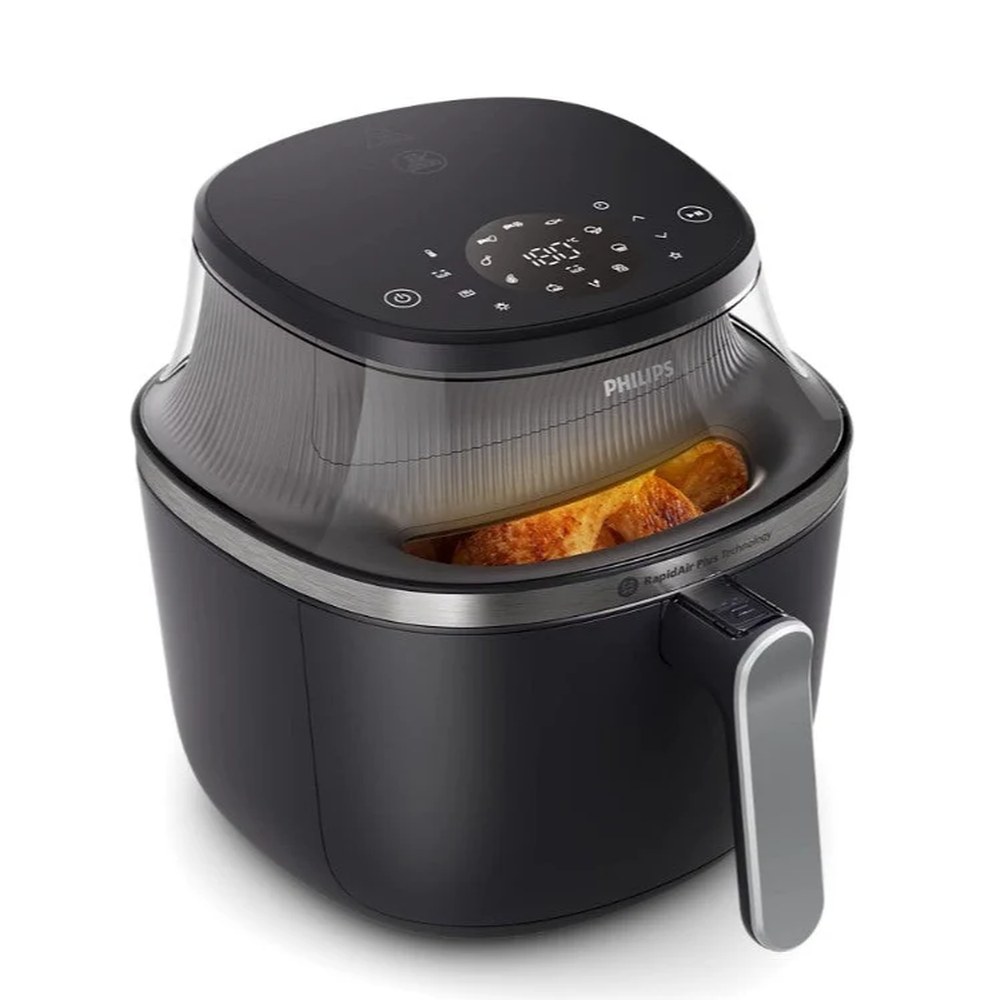
Philips 3000 Series with Window, 6.5 Qt (NA330/00)
- 6.2L (6.5 qt) pan behind a see-through cooking window
- RapidAir Plus technology with fat-removal design
- 16 functions and 12 touchscreen presets
- 100°F–400°F range; timers up to 24 hours
- Non-stick pan and basket, both dishwasher-safe
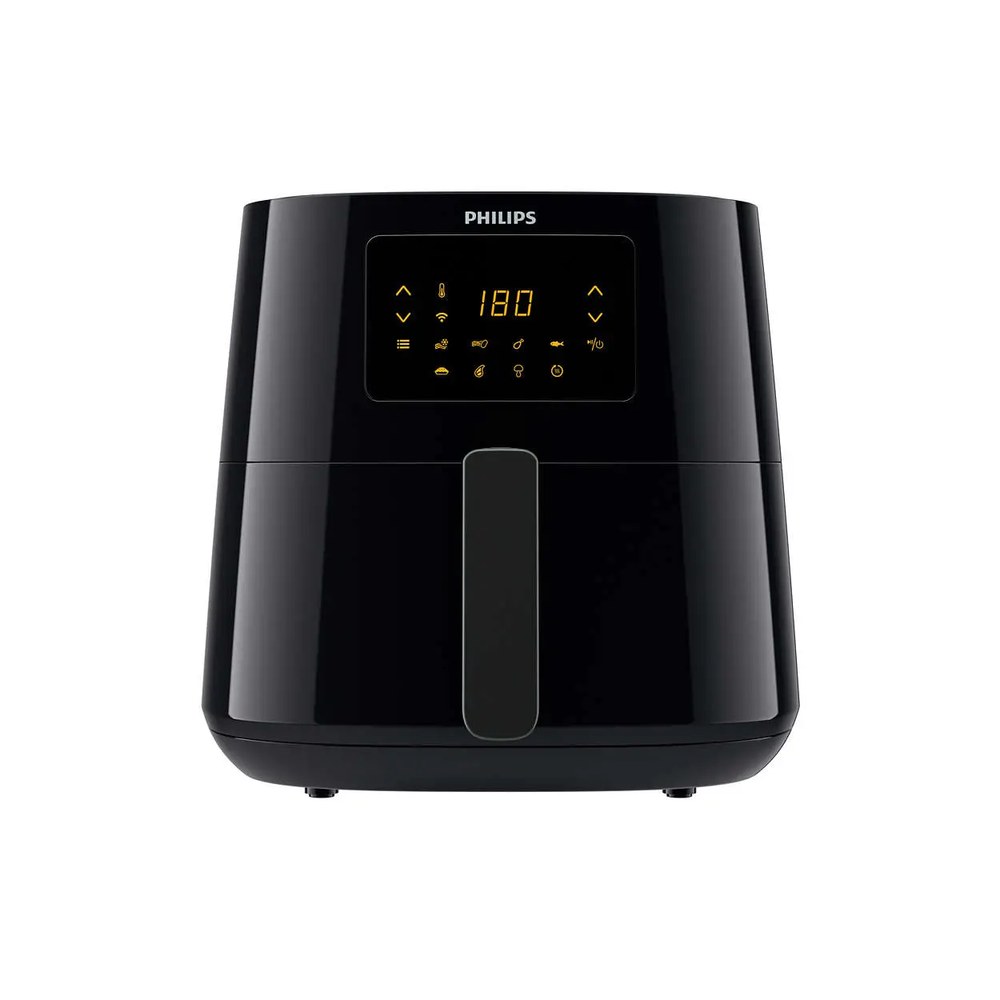
Philips 5000 Series XL Connected (HD9280/91)
- 6.2L pan, basket rated to 1.2 kg — up to 5 portions
- Wi-Fi connected: HomeID app control plus Amazon Alexa
- 13-in-1 functions, touchscreen with 7 presets
- QuickClean basket with removable non-stick mesh
- Discontinued by Philips — check listing stock before buying
Choose the 3000 Series if…
You cook by eye and want to watch food brown without opening the basket and dumping the heat.
You dehydrate, ferment or proof. The 100°F floor and 24-hour timers exist only on this side of the comparison.
Choose the 5000 Series XL Connected if…
You find one genuinely in stock, and starting dinner from your phone — or asking Alexa how long is left — is worth a hunt to you.
You load baskets heavily. Philips rates this basket at 1.2 kg, the most it allows in this pan size.
Your counter is shallow, and you would rather wipe a plain basket front than maintain a window.
As an Amazon Associate I earn from qualifying purchases at no extra cost to you.
Specifications: The Specs That Actually Matter
Every figure below is taken from Philips’ published specifications, official product datasheets and user manuals for these two US models.
| Specification | Philips 3000 Series (NA330/00) | Philips 5000 Series XL (HD9280/91) |
|---|---|---|
| Model number | NA330/00 on Amazon.com; NA331/00 at Philips’ US store | HD9280/91 (North America) |
| Capacity | 6.2 L pan (sold in the US as 6.5 qt) | 6.2 L pan |
| Rated food load | 1.0 kg; Philips illustrates 8 drumsticks, 5 salmon pieces or 7 muffins | 1.2 kg / 2.65 lb basket; up to 5 portions |
| Rated power | 1,700 W (120 V US model) | 2,000 W (Philips’ published platform rating — see note) |
| Temperature range | 100°–400°F (40–200°C) | 175°–400°F (80–200°C) |
| Time range | Up to 24 hours on dehydrate and ferment programs | Standard cooking cycles; keep warm fixed at 175°F for up to 30 min |
| Cooking functions | 16-in-1, including dehydrate and ferment | 13-in-1 (see note): fry, roast, grill, bake, reheat, defrost, dehydrate, toast, keep warm and more |
| Presets | 12 touchscreen presets, including breakfast, vegan, dehydrated fruits and a save-your-own favourite | 7 touchscreen presets: frozen snacks, fresh fries, drumsticks, whole fish, cake, meat chops, mixed vegetables |
| Air technology | RapidAir Plus, star-shaped design with faster airflow; fat drains away from food | Rapid Air, patented starfish pan design |
| Cooking window | Yes — full-width viewing window | No — closed basket |
| Controls & connectivity | Touchscreen on the unit; HomeID app offers recipes and content, but the fryer itself is not connected | Touchscreen plus Wi-Fi: HomeID app remote control and monitoring, Amazon Alexa voice control |
| Basket type & material | Pull-out pan and basket, non-stick coating; basket holds food above the fat collected in the pan | QuickClean basket with removable mesh bottom; non-stick coated pan and basket |
| Dishwasher-safe parts | Pan and basket | Pan and basket |
| Dimensions (D × W × H) | 436 × 324 × 303 mm (17.2 × 12.8 × 11.9 in) | 403 × 315 × 307 mm (15.9 × 12.4 × 12.1 in) |
| Weight | 5.6 kg (12.3 lb) | 5.55 kg (12.2 lb) |
| Cord length | 1.0 m | 0.8 m |
| Warranty | 2-year warranty | 2-year guarantee |
Model-number note: on the 3000 side, NA330/00 and NA331/00 are channel numbers for the same 6.2L window fryer, and NA332/00 is a regional sibling. The smaller 4.2L NA322/00 and the larger 7.2L NA341/00 wear the same series badge but are different machines. On the 5000 side, the HD9280/90 is the 220–240 V global twin of the /91 — and the non-connected HD9270/91 shares this body without Wi-Fi, so check any listing’s panel for the Wi-Fi symbol before assuming it is the Connected model.
Power note: Philips rates the HD9280 platform at 2,000 W on 220–240 V power and publishes no separate figure for the US /91, so the table carries the manufacturer’s platform rating rather than a retailer’s invention. The 3000’s 1,700 W is stated directly for its 120 V US model. Two ratings from two electrical systems are not a cooking contest.
Function-count note: Philips’ current leaflet headlines the 5000 as “13-in-1” while its own list names fourteen modes, and older US materials said 14-in-1. We use the current, conservative number. The count that matters in daily use is presets, and there the gap is undisputed: 12 against 7, in the 3000’s favour.
Availability note: Philips’ US website flags the HD9280/91 as discontinued, and its Amazon.com listing currently shows no featured offers — the state we found when this guide was checked in November 2026. The 2-year guarantee and Philips support still apply to units sold; what the status changes in practice is covered in the buying guide.
The Differences That Actually Matter
1. Current line against discontinued flagship — the status gap
Start with the difference that is not on any spec sheet. The 3000 Series is a living product line: Philips builds it, stocks its spares and sells it through its own US store today.
The 5000 Series XL is a closed chapter. Philips marks the HD9280/91 discontinued, and the Amazon listing that once anchored its US sales currently presents no featured offer.
Discontinued does not mean unsupported. The 2-year guarantee runs from your purchase date, the manuals and support pages stay up, and the HomeID service still drives the machine.
What it does mean is friction. Finding a genuinely new unit takes effort, prices from remaining sellers are unanchored, and the accessory shelf only empties from here.
None of that makes the 5000 a bad fryer. It makes it a fryer you have to want deliberately, rather than one you simply order.
2. Watching against streaming — two ways to keep an eye on dinner
The core frustration of every basket fryer is blindness: the food is in a drawer and you cannot see it. These two machines solve that problem in opposite directions.
The 3000 puts glass in the drawer front. A wide window lets you judge colour directly — fries blistering, salmon setting, cheese browning — without sliding the basket out and losing the heat you built up.
The 5000 puts data in your pocket instead. Its Wi-Fi link feeds time and temperature to the HomeID app, so the cook can be started, watched and adjusted from another room, and Alexa can report progress by voice.
Each method has a hole in it. The window cannot start dinner from the train home. The app cannot show you browning — a countdown timer is not a colour.
Decide by habit: kitchen-present cooks get more from glass, kitchen-absent cooks from the connection. No Philips gives you both.
3. RapidAir Plus against Rapid Air — one generation of airflow
Philips invented the air fryer category around a simple idea: a star-shaped pan floor that swirls hot air up through the food instead of blowing it down from a fan.
The 5000 runs the mature version of that idea — Rapid Air with the “starfish” pan, refined over a decade of models. It is even, proven and entirely adequate.
The 3000 runs the successor. RapidAir Plus reshapes the star and moves air faster, and the pan geometry holds food clear of the fat that drains from it; Philips quotes up to 40% of excess fat left behind in the pan on chicken legs, and cooking up to 30% faster than its previous generation.
Treat the percentages as the manufacturer’s own claims, not independent measurements. The point stands: this is Philips’ newer cooking system, in the lower-numbered box.
In the food, expect the clearest gap on crowded baskets, where airflow does the heavy lifting. On a single layer of fries, expect no gap worth describing.
4. The bottom of the dial — 100°F against 175°F
Both machines share the same 400°F ceiling. Philips has never needed more, and neither will you for frying.
The separation is at the floor. The 3000 works down to 100°F. The 5000 stops at 175°F — tellingly, the exact temperature of its fixed keep-warm setting.
That 75-degree gap is a whole category of cooking. Drying herbs and fruit leather, proofing dough, fermenting yoghurt: all of it lives below 175°F, and all of it is closed to the 5000.
The 5000 does list a dehydrate function, and it will dry sturdy foods at its lowest settings. But it is working at the very edge of its range, where the 3000 — backed by timers that run a full 24 hours — is working in the middle of its own.
If low-and-slow is even an occasional ambition, this one section settles the comparison by itself.
5. Presets — twelve against seven, and what that really means
Function counts are marketing’s favourite inflation, so judge presets by the weeknight rotation instead.
The 3000’s twelve cover it closely: frozen fries, fresh fries, drumsticks, meat, fish, breakfast, vegetables, muffins, vegan dishes, dehydrated fruits and keep warm — plus a favourite slot that remembers your own setting.
The 5000’s seven are an older, plainer set: frozen snacks, fresh fries, drumsticks, whole fish, cake, meat chops, mixed vegetables. Nothing missing that a weeknight needs; nothing extra, either.
Presets are only starting points — time and temperature stay adjustable on both. But a good preset is one less decision at 6 pm, and the newer machine makes more of them for you.
6. One pan, two promises — the rated-load gap
Do not be fooled by the shelf labels: “6.5 qt” against “6.2L” makes the newer fryer sound larger. It is not — both pans hold the same 6.2 litres, expressed in friendlier units.
The genuine difference is what Philips allows you to put in them. The 5000’s basket is rated for 1.2 kg of food — up to five portions. The 3000’s is rated for 1.0 kg.
Philips pictures the 3000’s working load as 35 oz of vegetables, eight drumsticks, five salmon pieces or seven muffins. Comfortable family cooking by any measure.
But for the heaviest single-layer jobs — a full bag of fries, a kilo and more of wings — the 5000’s basket carries the higher manufacturer rating.
Score it a real but narrow 5000 win: decisive for big-load cooks, invisible at most family tables.
7. Living with them — mesh, glass, depth and cord
The wash-up starts level. Both pans and both baskets are non-stick and cleared for the dishwasher in Philips’ manuals.
The 5000 then takes its turn in front. Its QuickClean basket has a removable mesh bottom: the panel that catches every crumb and fat droplet lifts out for the dishwasher or a scrub under the tap. Philips also specifies a BPA-free inner coating on this model, which its 3000 materials do not claim.
The 3000’s extra chore is the window itself. Glass facing frying fat fogs gradually, and keeping it a window rather than a frosted panel is a wiping job that belongs to you, not the dishwasher.
On the counter, depth separates them again: 436 mm front to back against 403 mm — over an inch, on machines that also need breathing room behind for hot air. Height and weight are too close to matter.
The 3000 claws back one small point: a 1.0 m cord against 0.8 m — on a deep counter with a distant socket, that decides where the fryer sits.
Which Fryer Fits Your Household?
The fastest route to a decision is to start from who is eating and how the cooking actually happens. This table compresses the whole comparison into one view.
| Your household / cooking style | 3000 Series | 5000 Series XL | Our call |
|---|---|---|---|
| Couples and small households (1–3 people) | Excellent — window suits small, watched batches | Excellent — right load rating, smaller box | Either; 5000 on footprint if you find one |
| Families of 3–5, weeknight dinners | Excellent — 12 presets cover the rotation | Excellent — 1.2 kg basket, app monitoring | 3000, unless remote control is a must |
| “I always open the basket to check” | Excellent — that habit is what the window ends | Fair — the app reports time, not browning | 3000 Series, outright |
| Dehydrating, proofing, fermenting | Excellent — 100°F floor, 24-hour timers | Not suited — 175°F floor | 3000 Series, outright |
| Smart-home cooks: app and voice control | Not available — recipes only, no connection | Excellent — HomeID app plus Alexa | 5000 Series, outright |
| Big single loads: fries and wings for a crowd | Good — same pan, rated to 1.0 kg | Excellent — basket rated to 1.2 kg | 5000 Series |
| Small kitchens, shallow counters | Tight — 436 mm deep | Excellent — 403 mm deep | 5000 Series |
Window, low temperatures, Wi-Fi: several rows end in a feature one machine simply has and the other lacks. No discount changes that.
The 30-Second Decision
| If this sounds like you… | Buy this |
|---|---|
| “I want the current model, in stock, with years of support ahead of it.” | 3000 Series with Window |
| “I cook by eye and hate losing heat to check.” | 3000 Series with Window |
| “I dehydrate fruit, dry herbs or proof dough.” | 3000 Series (100°F floor, 24-hour timer) |
| “I want to run dinner from my phone and hear about it when it is done.” | 5000 Series XL Connected — if you can find one |
| “My counter is shallow and my loads are big.” | 5000 Series XL Connected |
| “I just want the easiest basket to keep clean.” | 5000 Series (QuickClean mesh) |
Ready to check today’s price?
Both fryers are listed on Amazon — though the 5000’s listing may show no featured offers, so check its status carefully before ordering.
View on Amazon — 3000 SeriesView on Amazon — 5000 Series XLWhat You Gain. What You Give Up.
Philips 3000 Series with Window
You gain: the window, with Philips’ newest RapidAir Plus system behind it. Sixteen functions reaching down to 100°F, 24-hour timers and twelve presets that map to real food. Plus the security of the current line: in production, in stock, spares being made.
You give up: connected control in full — no app start, no progress pings, no voice. The top slice of rated load. Over an inch of counter depth. And some of your evenings to wiping a window.
Philips 5000 Series XL Connected
You gain: full remote command of a 6.2L fryer — HomeID app and Alexa — with the highest basket load rating Philips fits in this size, a QuickClean basket that is genuinely easier to keep clean, and the shallower body of the two.
You give up: any sight of the food while it cooks, and every degree below 175°F. You also take on discontinued status: a shrinking pool of new units, marketplace pricing, and an accessory shelf that thins every year.
Pros and Cons
3000 Series — Pros
- Cooking window — judge doneness without opening
- RapidAir Plus with fat-removal pan design
- 16 functions, 12 presets, 100–400°F range
- Timers to 24 hours for dehydrate and ferment
- The current Philips line; 1 m cord
Cons
- Not connected — no app control or voice
- Rated load lower: 1.0 kg against 1.2 kg
- Deepest body here: 436 mm front to back
- Window needs regular wiping to stay clear
- No QuickClean-style removable mesh
5000 Series XL — Pros
- Wi-Fi control via HomeID app, plus Amazon Alexa
- Basket rated to 1.2 kg — up to 5 portions
- QuickClean basket with removable mesh bottom
- Shallower body: 403 mm deep
- Bright touchscreen with 7 presets and keep warm
Cons
- Discontinued; Amazon listing shows no featured offers
- No window — open the basket to judge browning
- 175°F floor: no fermenting, limited dehydrating
- Only 7 presets against the 3000’s 12
- Remote features need an app account and 2.4 GHz Wi-Fi
Check the Model Number, Then Check the Stock
Match the model number first. The 3000 in this comparison is the NA330/00 at Amazon.com and the NA331/00 at Philips’ own US store — one 6.5 qt window machine, two channel numbers. The 5000 is the HD9280/91.
Beware the other 3000s. The same series badge covers a 4.2L compact (NA322/00) and a 7.2L large model (NA341/00). Both are legitimate machines; neither is the fryer compared here. If a price looks too good for this comparison, read the capacity in the specification block before anything else.
Beware the lookalike 5000. The HD9270/91 shares the body, the pan and the XL badge — but has no Wi-Fi. The Connected model shows a Wi-Fi symbol among its touch icons. No symbol in the listing photos, no connection in the kitchen.
Understand what the 5000’s listing is telling you. When we checked in November 2026, its Amazon page showed “No featured offers available” — no buyable featured offer from Amazon itself. Any route to a new unit runs through remaining or marketplace stock, so vet the seller, confirm the unit is new and US-spec, and keep the invoice for the warranty.
Mind the suffix. An HD9280/90 is the 220–240 V global version of this fryer. A cheap import is the wrong plug and a warranty argument, whatever the discount says.
Check the app name on the carton. The 5000 launched alongside the NutriU app, later Kitchen+, now HomeID. Older boxes may print any of the three names — one service in successive badges. Install HomeID, pair on a 2.4 GHz network, and ignore the printing.
Accessories, Parts and the Long View
An air fryer’s second five years rest on two things: how its coating ages, and whether you can still buy its basket.
On coatings, the machines start equal: non-stick on pan and basket, and the same care rules in both manuals — no metal utensils, no abrasive pads, dishwasher allowed but hand-washing kinder. Follow them and either basket should outlast its warranty; ignore them and both coatings fail on the same schedule.
On parts, the 3000 holds the structural advantage. As the current line, its pans, baskets and accessories are in active production and sold by model number through Philips and its retailers.
The 5000’s parts benefit from a large installed base of XL machines, which keeps common pieces circulating. But a discontinued model’s shelf never restocks — it only empties, slowly.
The 5000 also carries a dependency the 3000 never will: software. Its remote features live in the HomeID app and Philips’ cloud service.
The consolation is proven, not promised: Philips has renamed the app twice and the fryer shrugged both times, and the touchscreen runs everything the app can. Buy the Wi-Fi as a convenience for the years it is served, not as a fixture.
When to Skip Both
Honesty cuts both ways. Some kitchens need a different shape of machine entirely.
Skip both if dinner regularly means two foods at two temperatures at the same time. That is a dual-basket fryer’s job, and no single 6.2L pan — windowed or connected — can fake it.
Skip both if 6.2 litres is genuinely not enough. Philips sells the 7.2L NA341/00 inside this same 3000 Series line, and bigger rivals exist beyond Philips.
Skip both if you cook small portions for one or two. The 4.2L NA322/00 from the same family heats faster, washes easier and surrenders far less counter.
And skip the 5000 in particular if the hunt itself puts you off — if a listing with no featured offers and a discontinued flag feels like a warning rather than a bargain signal. The 3000 concedes remarkably little, and it removes the question entirely.
For everyone else, the answer is one of these two — the only question is whether you would rather watch dinner through a window or an app, and whether you can still find the one with the app.
Warranty and Support
On paper, this section is a dead heat — and a comforting one.
Both fryers carry a 2-year Philips guarantee, administered in the US by Versuni, with support through Philips’ US website: manuals, troubleshooting, registration and spare parts ordered by model number.
Both also live in the HomeID ecosystem, differently. For the 5000, the app is a remote control. For the 3000, it is a recipe and guidance library — useful, but it cannot touch the machine.
One habit matters more for the 5000: register it and complete the Wi-Fi pairing in the first week, while the return window is open. Connected features are the ones worth proving early, not discovering faulty in month thirteen.
And keep the paperwork for either fryer. A saved order confirmation is the difference between a smooth warranty claim and an archaeology project.
Final Verdict
Judged purely as machines, the Philips 5000 Series XL Connected wins this comparison — narrowly, 8.2 to 8.0.
Its case is built from unglamorous numbers: a basket rated a fifth higher, a body an inch and a quarter shallower, a QuickClean basket that lifts its dirtiest part out for washing, and the only remote control Philips has fitted to a fryer of this size.
But this verdict carries the largest asterisk in this guide. Philips has discontinued the model, and its Amazon listing currently shows no featured offers. A win on the scorecard is only worth something if you can buy the winner.
Buy the 5000 Series XL Connected if you find genuine new stock at a fair price, and app control, heavy loads or a shallow counter top your list.
View on Amazon — 5000 Series XL
Buy the 3000 Series if you cook by eye, if low-temperature work is on your menu, or if you simply want the fryer Philips is still making — which, in November 2026, is most people.
Its window is the best everyday feature on either machine, and RapidAir Plus is where Philips’ cooking technology lives now. It loses this comparison by two-tenths of a point and wins the ownership argument outright.
Frequently Asked Questions
What is the main difference between the Philips 3000 and 5000 Series Airfryers?
Generation and feedback. The 3000 Series (NA330/00) is Philips’ current design: a viewing window, the newer RapidAir Plus system, 16 functions and a 100°F floor. The 5000 Series XL Connected (HD9280/91) is the previous flagship: no window, but Wi-Fi control through the HomeID app and Alexa, a higher 1.2 kg rated load and a QuickClean basket. Both pans hold 6.2 litres.
Which exact models does this guide compare?
On the 3000 side, the 6.5 qt (6.2L) window model — NA330/00 at Amazon.com, and the same machine listed as NA331/00 by Philips’ US store. On the 5000 side, the HD9280/91, the connected XL model Philips sold in North America. Both series names also cover other sizes, so match the model number, not just the badge.
Is the Philips 5000 Series Airfryer discontinued?
Yes — Philips’ own US site carries a Discontinued flag on the HD9280/91, which means production has ended. When this guide was checked in November 2026, its Amazon.com listing showed no featured offers available. Sold units still carry the 2-year guarantee from purchase, and manuals and support remain published — what shrinks over time is the supply of new units and accessories.
Does the Philips 3000 Series connect to Wi-Fi or an app?
No. The 3000 Series window models are not connected: everything happens on the touchscreen. The HomeID app offers recipes and guidance but cannot start, stop or monitor it. Connected control belongs to the 5000 alone.
Which Philips fits more food, the 3000 or the 5000?
The 5000, on paper and narrowly. Both pans are 6.2 litres — the 3000’s US “6.5 qt” label is the same volume in different units — but Philips rates the 5000’s basket for 1.2 kg of food against 1.0 kg for the 3000. In practice both handle a family dinner comfortably; for a regularly larger load, the 7.2L NA341/00 in the 3000 line is the step up.
Can either fryer dehydrate or ferment food?
The 3000 can do both properly, with a 100°F starting temperature, timers up to 24 hours, and dehydrate and ferment among its 16 functions. The 5000 lists dehydrate among its functions, but its 175°F minimum and standard cooking cycles make it a weak substitute for low-and-slow work, and it cannot ferment at all.
Are both fryers dishwasher-safe?
Yes — on both machines the pan and basket are non-stick and dishwasher-safe, per Philips’ manuals. The differences are in the details: the 5000’s QuickClean basket has a removable mesh bottom that lifts out for cleaning, while the 3000’s window needs a regular hand wipe, or fat will slowly fog the glass.
Which fryer suits a small kitchen better?
On dimensions, the 5000: it is 403 mm deep against the 3000’s 436 mm, with near-identical height and width. Both need clear space behind and above for hot air to escape. In practice, weigh that inch and a quarter against the 5000’s stock situation — the 3000 is the deeper machine, but it is also the one you can simply order.
Sources & Verification
Philips 5000 Series Airfryer 5000 Series XL HD9280/91 official product and support pages, usa.philips.com (model carries a Discontinued flag) • Philips HD9280 product leaflet (13-in-1 functions, 7 presets, 1.2 kg, 403×315×307 mm, 5.55 kg, 0.8 m cord, 2-year worldwide guarantee), documents.philips.com • Philips HD9280/91 user manual (presets, keep warm at 175°F, dishwasher guidance) • Philips 3000 Series Airfryer with Window, 6.5 Qt (6.2L) official US product page, us.home-appliances.philips • Philips NA331/00 official product datasheet (6.2L, 1 kg load, 40–200°C, 1700 W, 324×436×303 mm, 5.6 kg, 1.0 m cord, 2-year warranty) • Manufacturer product data for the NA330/00 (120 V, 1700 W, ASIN-verified listing) • Listing availability and the Philips US product page re-checked November 2026.

James Wilson
James has spent more than a decade testing and comparing home appliances and writes Honestly Compared’s kitchen and home guides. His rule for every comparison: the verdict has to survive the spec sheet, not the marketing page.