
Philips Airfryer 2000 Series (NA230/00) vs Philips Airfryer 3000 Series (NA330/00): Which Should You Buy?
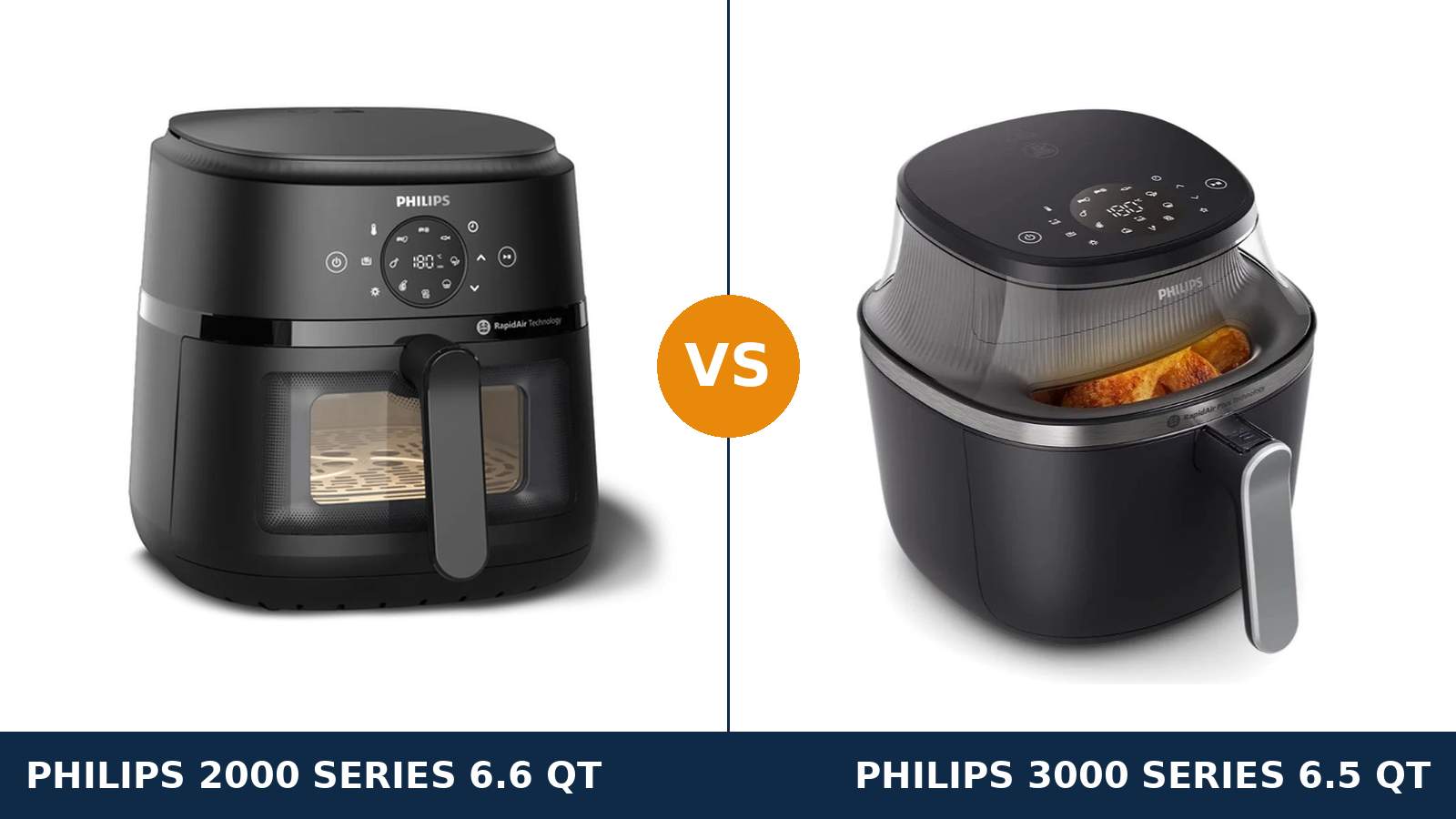
Same brand. Same 6.2-litre pan. Same 1,700 watts. Same cooking window, same two-year warranty.
Philips sells two airfryer ranges that look like a pricing ladder and read like a riddle. The 2000 Series and the 3000 Series share so much hardware that most buyers assume the extra money buys nothing but a badge.
It does not. The differences are real — they just hide in the places spec-sheet headlines skip: how much food Philips actually rates each pan to cook, how low the temperature goes, and how long the timer will run.
First, a necessary piece of housekeeping. “2000 Series” and “3000 Series” are range names, not models, so this comparison pins each one to the mainstream US machine Philips leads with. The 2000 Series here is the NA230/00 in black, the 6.2L model on Philips’ own US site. The 3000 Series is the NA330/00 with window — the same machine Philips’ US store lists as the NA331/00.
Every specification below comes from Philips’ published pages, manuals and product data. The verdict at the end is the one we would give a friend spending their own money.
Key Takeaways
- The pans are the same size; the ratings are not. Both hold 6.2 litres, but Philips rates the 3000 Series for a 1.0 kg load against the 2000 Series’ 0.8 kg.
- The 3000 Series is the low-and-slow machine. It reaches down to 100°F and runs up to 24 hours for dehydrating and fermenting. The 2000 Series stops at 140°F and 60 minutes.
- More presets, too. Sixteen cooking functions and 12 presets on the 3000, against 13 functions and 9 presets on the 2000.
- The 2000 Series is the smaller, lighter box. Narrower footprint, about a quarter-kilo lighter, same window and same warranty.
- Neither fryer is connected. Both work with the HomeID recipe app, but neither takes app commands. Philips’ connected model sits in a different range.
Quick Verdict
Buy the Philips 3000 Series (NA330/00) if you cook for a household. It is the more capable fryer.
Philips rates its pan for a full 1.0 kg load. Its temperature floor of 100°F and its 24-hour timer open up dehydrating and fermenting that the 2000 Series simply cannot do. Its RapidAir Plus design is the newer of the two airflow systems.
Buy the Philips 2000 Series (NA230/00) if the fryer is mostly for one or two people. It keeps the same 6.2L pan, the same power and the same window in a smaller, lighter body.
For fries, reheats and weeknight cooking for two, it gives up very little. It is Philips’ entry range doing exactly the job an entry range should do.
The Scorecard
Scores below are derived directly from the manufacturer specifications compared in this guide — rated loads, temperature and timer ranges, function and preset counts, dimensions and warranty terms. They are a reading aid, not benchmark results.
| Category | 2000 Series NA230/00 | 3000 Series NA330/00 | ||
|---|---|---|---|---|
| Capacity & rated load | 8 / 10 | 9 / 10 | ||
| Cooking design | 8 / 10 | 9 / 10 | ||
| Temperature & timer range | 6 / 10 | 10 / 10 | ||
| Ease of use | 8 / 10 | 9 / 10 | ||
| Cleaning | 8 / 10 | 8 / 10 | ||
| Footprint & storage | 9 / 10 | 7 / 10 | ||
| Value | 9 / 10 | 8 / 10 | ||
| Overall | 7.8 / 10 | 8.0 / 10 | ||
The pattern is consistent. The 3000 Series wins on capability — load, range, functions. The 2000 Series wins on size and on being the honest budget route into the same pan.
At a Glance: Who Each Fryer Fits
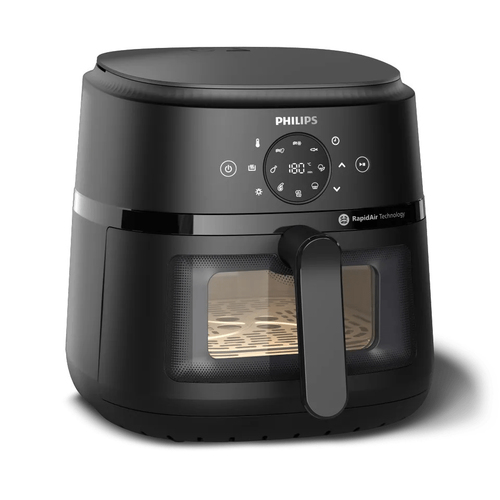
Philips Airfryer 2000 Series (NA230/00)
- 6.2L pan rated for 0.8 kg loads
- RapidAir technology with starfish design
- 13 cooking functions, 9 touchscreen presets
- Cooking window with lit interior view of the StarPlate
- Smallest footprint of the two; 5.35 kg
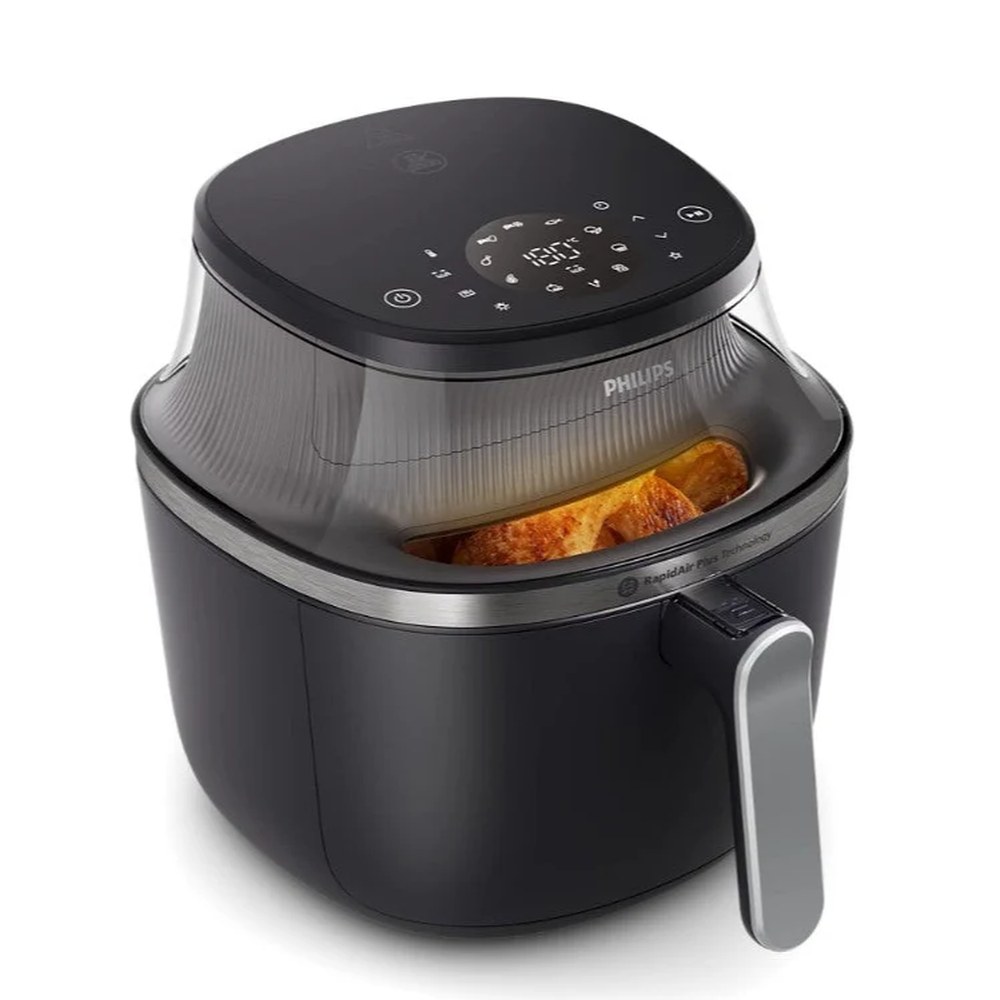
Philips Airfryer 3000 Series (NA330/00)
- Same 6.2L pan, rated for a full 1.0 kg load
- RapidAir Plus technology, star-shaped design
- 16 cooking functions, 12 touchscreen presets
- 100°F floor and up to 24-hour timer
- Full-width viewing window
Choose the 2000 Series (NA230/00) if…
You cook for one or two people most nights. Fries, wings, reheats, a couple of chicken breasts.
Your counter space is genuinely tight. This is the narrower, lighter machine, and it slides into smaller kitchens more easily.
You want Philips’ window and RapidAir cooking without paying for functions you will never open. Dehydrating and fermenting are not on your menu.
Choose the 3000 Series (NA330/00) if…
You cook for three or four. The 1.0 kg rated load is a real, manufacturer-stated advantage in the same size of pan.
You dehydrate fruit, make jerky, or ferment and proof dough. The 100°F floor and 24-hour timer are the whole ballgame there.
You use presets heavily. Twelve of them, including a save-your-own favourite, against nine fixed ones.
As an Amazon Associate I earn from qualifying purchases at no extra cost to you.
Specifications: The Specs That Actually Matter
Every figure below is taken from Philips’ published specifications, manuals and manufacturer product data, cross-checked between Philips’ US pages and its official datasheets.
Both keyword names are ranges, so the table names the exact US models being compared. A short note under the table covers the variants that share these range names.
| Specification | Philips 2000 Series (NA230/00) | Philips 3000 Series (NA330/00) |
|---|---|---|
| Model number | NA230/00 on Amazon.com (black); NA231/00 is the silver finish of the same machine | NA330/00 on Amazon.com; NA331/00 at Philips’ US store |
| Capacity | 6.2 L pan (sold in the US as 6.6 qt) | 6.2 L pan (sold in the US as 6.5 qt) |
| Rated food load | 0.8 kg — Philips rates it for 800 g of fries, 8 drumsticks or 800 g of vegetables | 1.0 kg; Philips illustrates 8 drumsticks, 5 salmon pieces or 7 muffins |
| Rated power | 1,700 W | 1,700 W (120 V US model) |
| Temperature range | 140°–400°F (60–200°C) | 100°–400°F (40–200°C) |
| Time range | Up to 60 minutes | Up to 24 hours on the dehydrate and ferment programs |
| Cooking functions | 13-in-1: fry, roast, grill, bake, one-pot cooking, stir-fry, sauté, cook from frozen, reheat, defrost, dehydrate, toast, keep warm | 16-in-1, including dehydrate and ferment |
| Presets | 9 touchscreen presets: frozen fries, fresh fries, drumsticks, meat, fish, breakfast, vegetables, cake, keep warm | 12 touchscreen presets, including breakfast, vegan, dehydrated fruits and a save-your-own favourite |
| Air technology | RapidAir, patented starfish design | RapidAir Plus, star-shaped design with faster airflow; fat drains away from food |
| Cooking window | Yes — window in the drawer front | Yes — full-width viewing window |
| Controls & connectivity | Touchscreen on the unit; HomeID app offers recipes, but the fryer itself is not connected | Touchscreen on the unit; HomeID app offers recipes, but the fryer itself is not connected |
| Basket type & material | Pan with a removable non-stick StarPlate; food cooks on the plate above the drained fat | Pull-out pan and basket, non-stick coating; basket holds food above the fat collected in the pan |
| Dishwasher-safe parts | Pan and StarPlate | Pan and basket |
| Dimensions (D × W × H) | 404 × 309 × 308 mm (15.9 × 12.2 × 12.1 in) | 436 × 324 × 303 mm (17.2 × 12.8 × 11.9 in) |
| Weight | 5.35 kg (11.8 lb) | 5.6 kg (12.3 lb) |
| Cord length | 0.8 m | 1.0 m |
| Warranty | 2-year warranty | 2-year warranty |
Model note: the 2000 Series also includes smaller 4.2L models (NA220/00 and NA221/00), and the 3000 Series includes a 4.2L NA322/00 and a larger 7.2L NA341/00. This comparison covers the mainstream 6.2L machines Philips leads each range with in the US.
Finish note: the NA231/00 is the silver-finish version of the same 6.2L 2000 Series machine — Philips publishes one user manual covering the NA230 and NA231 together, with identical specifications. The buttons in this guide point to the black NA230/00.
Dimension note: Philips’ datasheet dimensions are used for both fryers. Some retailer listings swap the width and depth axes; the figures above follow the manufacturer’s own product data for each model.
The Differences That Actually Matter
1. Rated load — the same pan, a different promise
Start with the number both ranges advertise: 6.2 litres. It is identical. If capacity is where you stop reading, these fryers are the same machine.
Keep reading. Philips rates the NA230/00 for a maximum load of 0.8 kg. It rates the NA330/00 for 1.0 kg.
That is a 25 percent difference in the amount of food Philips is willing to stand behind in a single batch. It is not a rounding error. It is printed in both product datasheets.
Why does the rating differ when the pan does not? Airflow headroom. An airfryer crisps by moving hot air around food; past a certain load, the air cannot circulate and the bottom layer steams.
The 3000 Series’ RapidAir Plus design is built to keep air moving under a heavier load. The 2000 Series, with the earlier RapidAir design, is rated more conservatively for the same volume.
In practice: 800 g of fries is a generous batch for two or three people. A full kilo is family territory. The rating gap only bites when you regularly cook at the pan’s limit.
2. Temperature floor and timer — the widest gap in this comparison
Both fryers top out at 400°F (200°C). At the bottom of the dial, they part company completely.
The 2000 Series adjusts from 140°F (60°C) upward, and its timer stops at 60 minutes. That covers every ordinary cooking job — frying, roasting, baking, reheating — with room to spare.
The 3000 Series reaches down to 100°F (40°C) and can run for up to 24 hours on its dehydrate and ferment programs. That is a different category of appliance behaviour.
Dehydrating fruit or making jerky needs low heat held for hours. Fermenting yogurt or proofing dough needs gentle warmth held steady. The 2000 Series cannot do either job, whatever its function list implies.
One honest wrinkle: the NA230/00’s 13 functions do include a dehydrate mode. But a dehydrate mode capped at 140°F and 60 minutes is a shadow of the real thing. For anything beyond the lightest drying, the 3000 Series is the only one of the two actually equipped.
If low-and-slow cooking is even a maybe for you, this section decides the comparison on its own.
3. Functions and presets — 13 against 16, 9 against 12
The 2000 Series offers 13 cooking methods: fry, roast, grill, bake, one-pot cooking, stir-fry, sauté, cook from frozen, reheat, defrost, dehydrate, toast and keep warm. Its touchscreen carries 9 presets, from frozen fries to cake.
The 3000 Series offers 16 functions and 12 presets. The additions that matter are ferment, a dedicated dehydrated-fruits preset, a vegan preset — and the ability to save your own favourite setting.
Preset counts are easy to mock and hard to live without. If your cooking is manual — set 400°F, set 15 minutes, shake once — the gap means nothing.
If your household cooks by tapping pictures, the 3000 Series’ wider preset library and the saved favourite genuinely shorten the path from fridge to plate.
Call this a real but second-tier difference. It changes daily convenience, not capability. Section 2 is where capability lives.
4. RapidAir vs RapidAir Plus — a generation apart
Philips built its airfryer reputation on the starfish-shaped pan bottom, which swirls hot air so food crisps without being drowned in oil. The 2000 Series uses that original RapidAir design, and it works well.
The 3000 Series uses RapidAir Plus: a star-shaped design Philips positions as the faster, more even evolution, shaped so fat drains away from the food into the pan below.
Philips does not publish a head-to-head between its own two systems, and we do not invent one. What the spec sheets show is structural: the Plus design is the newer one, and it is the design rated for the heavier load in section 1.
Both fryers carry the same 1,700 W rating. Neither has a power advantage. The difference is purely in how the air is moved.
For everyday frying, expect both to produce properly crisp results. The Plus system earns its keep at full loads and with fatty foods that benefit from fat draining clear.
5. The window — a genuine tie
Both of these fryers let you watch dinner happen. That was not true of Philips’ ranges a few years ago, and it is the feature owners praise most in daily use.
The 2000 Series puts its window in the drawer front. The 3000 Series fits a full-width viewing window across its upper section. The 3000’s is the larger pane of glass, and the easier one to read at a glance from across the kitchen.
But the job is the same: check browning without opening the drawer, dumping heat and restarting the crisp. Both do it.
Do not let the window decide this purchase in either direction. On this feature, Philips simply sells two good answers.
6. Size, footprint and weight — the 2000 fights back
Here is where the cheaper fryer wins outright.
The NA230/00 measures 404 × 309 × 308 mm and weighs 5.35 kg. The NA330/00 measures 436 × 324 × 303 mm and weighs 5.6 kg.
The 3000 Series is deeper and wider — roughly 13 percent more counter footprint for the same pan volume. In a small kitchen, that is the difference between a fryer that lives on the counter and one that lives in a cupboard.
The height is a near-tie — the 3000 is actually a touch shorter — so under-cabinet clearance rarely separates them. It is the width and depth that matter, and the 2000 Series wins both.
Weight follows the same pattern. A quarter-kilo is not much, but if the fryer is lifted in and out of storage weekly, the lighter machine is the kinder one.
One small counterpoint: the 3000 Series’ cord is 1.0 m against the 2000’s 0.8 m. On a deep counter with a rear socket, those 20 cm occasionally decide where the fryer can sit.
7. Basket design and cleaning — two ways to skin the same pan
The 2000 Series cooks in a pan fitted with a removable plate — Philips calls it the StarPlate. Food sits on the plate; fat drains through and collects below it. Fewer parts, and the plate plus pan are both dishwasher-safe.
The 3000 Series uses the classic two-piece layout: a basket that sits inside a pull-out pan. Lift the basket out and the fat stays behind in the pan. Pan and basket are both dishwasher-safe and non-stick coated.
Neither system is hard to live with. The 2000’s plate design has one less component to wash and a flatter pan to wipe. The 3000’s basket is better for shaking mid-cook and for lifting food clear of rendered fat.
Both interiors are non-stick and need the same gentle treatment: no metal scourers, and let the pan cool before cold water.
Score it a tie, with the choice coming down to whether you prefer a plate or a basket in your hands at the sink.
Which Fryer Fits Your Household?
Start from who you cook for and what you cook. This table is the whole comparison in one view.
| Your household / cooking | 2000 Series NA230/00 | 3000 Series NA330/00 | Our call |
|---|---|---|---|
| 1–2 people, weeknight fries and reheats | Excellent — 0.8 kg loads are ample | Excellent, more than you need | 2000 Series |
| 3–4 people, full meals in one batch | Workable — batch at the 0.8 kg limit | Excellent — rated for 1.0 kg | 3000 Series |
| Small kitchen, narrow counters | Excellent — smallest footprint | Tight — deepest and widest | 2000 Series |
| Dehydrating, jerky, fermenting, proofing | Not equipped — 140°F floor, 60-minute timer | Excellent — 100°F floor, 24-hour timer | 3000 Series, no contest |
| Meal prep and big weekend batches | Good — expect an extra batch | Excellent — heavier rated load | 3000 Series |
| Preset-driven, tap-and-go cooking | Good — 9 presets | Excellent — 12 presets plus a saved favourite | 3000 Series |
| First Philips, tightest budget | Excellent — same pan, same window, same warranty | Good — you pay for capability you may not use | 2000 Series |
Read the dehydrating row carefully. It is the one line where the cheaper fryer does not do less of the job — it cannot do the job at all.
The 30-Second Decision
| If this sounds like you… | Buy this |
|---|---|
| “Two of us, fries and reheats, small kitchen.” | 2000 Series (NA230/00) |
| “Family dinners, full pan, one batch.” | 3000 Series (NA330/00) |
| “I want to dehydrate fruit and make jerky.” | 3000 Series — the only one that can |
| “I just want a Philips with a window, for less.” | 2000 Series (NA230/00) |
| “I cook by presets and want my own saved favourite.” | 3000 Series (NA330/00) |
| “Counter space is my scarcest resource.” | 2000 Series — narrower, lighter, shorter cord aside |
Ready to check today’s price?
Both fryers sell through Amazon. Prices move, so check the live figure on the model that fits your kitchen.
View on Amazon — 2000 SeriesView on Amazon — 3000 SeriesWhat You Gain. What You Give Up.
Philips 2000 Series (NA230/00)
You gain: the same 6.2L pan, window, power and warranty as the 3000 Series in a narrower, lighter body — Philips’ entry range without the entry-level compromises that usually come with one. Plus a simpler plate-based pan with one less part to wash.
You give up: a fifth of the rated load. The entire low-temperature world — no real dehydrating, no fermenting. Three functions and three presets. And 20 cm of cord.
Philips 3000 Series (NA330/00)
You gain: the full 1.0 kg rated load, RapidAir Plus, a 100°F floor with a 24-hour timer, fermenting, 12 presets and a saved favourite — the most complete version of this pan Philips sells in a non-connected fryer.
You give up: counter space. It is the deepest and widest body here despite holding the same pan, and it is the heavier lift into storage. You also pay more for capability that only matters if you use it.
Pros and Cons
2000 Series NA230/00 — Pros
- Same 6.2L pan and 1,700 W as the 3000
- Smallest footprint and lightest body here
- Cooking window — rare at this level
- Simple StarPlate pan, dishwasher-safe
- 2-year warranty, same as the 3000
Cons
- Rated load is only 0.8 kg
- 140°F floor and 60-minute timer cap
- Dehydrate mode too limited for real drying
- Fewer presets, no saved favourite
- Shorter 0.8 m cord
3000 Series NA330/00 — Pros
- Full 1.0 kg rated load in the same pan
- 100°F floor, 24-hour timer, ferment program
- RapidAir Plus — the newer airflow design
- 12 presets including a saved favourite
- Full-width window; longer 1.0 m cord
Cons
- Largest footprint of the two
- Heaviest of the two at 5.6 kg
- Capability you pay for whether or not you use it
- Still not connected — no app control
- Basket and pan are two parts to wash
Check the Model Number, Not Just the Series Name
Check which 2000 Series you are looking at. The range name covers more than one machine.
The 6.2L NA230/00 in this comparison is the range’s mainstream US model. The NA220/00 and NA221/00 wear the same 2000 Series name with a smaller 4.2L pan. A listing that just says “2000 Series” can be either size — check the capacity and the model number before anything else.
Check the finish code. NA230/00 is black; NA231/00 is the silver finish of the identical machine.
Philips publishes a single manual for both, with identical specifications. Buy whichever finish suits your kitchen — but know that the two model numbers are one fryer, so do not pay a premium for the number itself.
Check the 3000 Series size, too. The NA330/00 here is the 6.2L window model — listed by Philips’ US store as the NA331/00, same machine, channel numbering.
The range also includes the 4.2L NA322/00 and the 7.2L NA341/00. If a 3000 Series listing’s capacity is not 6.2 litres (sold as 6.5 qt in the US), it is one of those, not this one.
Watch for suffixes. Philips’ own US site also lists R0-suffixed versions of these models alongside the standard retail versions. If a price looks out of line with the market, confirm the full model number on the listing matches the standard model — suffixes matter.
Check the quart conversion. Philips sells the identical 6.2L pan as 6.6 qt on the 2000 Series and 6.5 qt on the 3000 Series. That is rounding in the marketing, not a size difference. The pans are the same volume; the rated loads are what differ.
The Second-Year Test
Judge these fryers by the cooking you will be doing in year two, not week one.
In week one, both machines fry the same fries in the same pan at the same power. Side by side with normal loads, most households would struggle to tell them apart.
Year two is when the 3000 Series’ extra range tends to get discovered. The first tray of apple chips. The first batch of jerky. A dough proof on a cold morning.
None of those jobs can migrate to the 2000 Series later. Its 140°F floor and 60-minute timer are hardware limits, not settings.
The counter-argument is just as real. If year two looks exactly like week one — fries, wings, reheats for two — the 3000 Series’ extra range sits unused, and the 2000 Series’ smaller body keeps paying you back every single day.
Buy the range of cooking you will actually do. Not the range you might, in theory, one day consider.
When to Skip Both
Honesty cuts both ways. There are buyers neither of these fryers serves best.
Skip both if you want app control. Neither fryer is connected — the HomeID app gives both of them recipes and nothing more. Philips’ connected fryer is the 5000 Series XL Connected, which Philips currently flags as discontinued on its US site, so connected-Philips shoppers should look at rival brands instead.
Skip both if you regularly cook two different foods at once. These are single-pan machines; a dual-basket fryer from Philips’ rivals — or two of these — is the honest answer.
Skip both if you need more than a kilo per batch as a routine. The next step up is a different appliance class: a larger dual-drawer machine or an oven-style airfryer.
And skip the 3000 Series specifically if your kitchen is measured in centimetres of spare counter. Its capability is real, but so is its footprint.
Final Verdict
The Philips 3000 Series (NA330/00) is the fryer we would buy for a household.
It wins this comparison on substance, not badge. A 1.0 kg rated load against 0.8 kg in the same pan. A temperature floor 40 degrees lower and a timer that runs 24 hours against 60 minutes. The newer RapidAir Plus airflow design.
Those are not brochure differences. They decide what the machine can cook, and the 2000 Series cannot grow into them later.
Buy the 3000 Series for family cooking, meal prep, dehydrating, fermenting, and any kitchen where the fryer works hard most days.
Buy the 2000 Series if you cook for one or two, your counter is small, and your cooking is frying, roasting and reheating. It keeps the pan, the power, the window and the warranty, in a smaller and lighter body, for the entry-range position in Philips’ line-up.
It is not the lesser fryer. It is the same fryer with a shorter reach — and for plenty of kitchens, the reach it has is the whole job.
Watch Out: Similar Names, Different Fryers
Philips’ range names are a trap for the hurried buyer. Three warnings belong in every version of this guide.
First: “2000 Series” and “3000 Series” each cover several sizes. The models in this comparison are the 6.2L NA230/00 and NA330/00. The 4.2L and 7.2L machines wearing the same range names are different purchases.
Second: NA230 and NA231 are one machine in two finishes — black and silver. NA330 and NA331 are likewise one machine under Amazon and Philips-store numbering. A listing is not a different fryer because the last digit moved.
Third: the 5000 Series XL Connected is a different product again — bigger feature set, Wi-Fi control, and currently flagged discontinued by Philips in the US. Do not let a search result blur it into this comparison.
Slow down on the product page. Match the full model number, then the capacity, then the price — in that order.
Counter, Clearance and Power Notes
Both fryers are freestanding countertop units on standard US 120 V power. At 1,700 W each, give either one a circuit that is not already sharing a heavy load — a kettle or microwave on the same run is the usual tripping combination.
Leave clearance behind and above whichever you buy. Both vent hot air at the rear, and both stand just over 30 cm tall, so standard under-cabinet gaps clear them — but slide the fryer forward before long cooks so the vent is not firing into the cabinet face.
The 2000 Series’ shorter 0.8 m cord is worth planning around. On deep counters with rear sockets it can dictate placement; the 3000 Series’ 1.0 m cord is a little more forgiving. And neither machine should sit flush against a wall in use — Philips’ manuals ask for free space around the appliance for airflow.
Warranty and Long-Term Support
This section is a tie, and a pleasant one. Both fryers carry Philips’ 2-year warranty in the US.
Both are current models in Philips’ US line, sold and supported by Versuni, the Philips home-appliance business. Manuals, support pages and spare-part channels exist for both model families.
Both also share the same recipe ecosystem: the HomeID app serves recipes and cooking content to each. Neither fryer receives feature updates — there is no connected hardware to update — so the machine you buy is the machine you keep.
Frequently Asked Questions
What is the real difference between the Philips 2000 and 3000 Series?
Capability, not size. Both use a 6.2L pan at 1,700 W with a cooking window. The 3000 Series is rated for a 1.0 kg load against 0.8 kg, reaches down to 100°F against 140°F, runs up to 24 hours against 60 minutes, and adds functions (16 against 13) and presets (12 against 9). The 2000 Series is smaller, lighter and cheaper-positioned.
Which exact models does this comparison cover?
The mainstream US 6.2L machine from each range: the NA230/00 for the 2000 Series, and the NA330/00 for the 3000 Series — the same fryer Philips’ US store lists as the NA331/00. Both ranges also contain 4.2L models, and the 3000 Series a 7.2L model, which are not covered here.
Is the 3000 Series bigger than the 2000 Series?
The body is; the pan is not. Both pans hold 6.2 litres. The 3000 Series’ body is deeper and wider (436 × 324 mm footprint against 404 × 309 mm) and slightly heavier, and Philips rates its pan for a heavier 1.0 kg load against 0.8 kg.
Can the 2000 Series dehydrate food?
Only in a limited way. Dehydrate appears in its 13 functions, but the 140°F minimum temperature and 60-minute maximum timer rule out proper dehydrating, which needs lower heat held for hours. The 3000 Series, with a 100°F floor and 24-hour timer, is the one built for it.
Are the parts dishwasher-safe on both fryers?
Yes. On the 2000 Series, the pan and its removable StarPlate are dishwasher-safe. On the 3000 Series, the pan and basket are dishwasher-safe. All cooking surfaces are non-stick coated on both; Philips still recommends gentle cleaning to protect the coating.
Does either fryer connect to Wi-Fi or an app?
No. Both work with the HomeID app for recipes and content, but neither fryer accepts app control, remote start or monitoring. Philips’ connected model is the 5000 Series XL Connected, which Philips currently lists as discontinued in the US.
What is the difference between the NA230 and the NA231?
Finish only. The NA230/00 is black and the NA231/00 is silver; Philips publishes one user manual covering both, with identical capacity, power, temperature range and dimensions. Buy the colour you prefer.
Which one should a family of four buy?
The 3000 Series. Its 1.0 kg rated load is manufacturer-stated for exactly this use, and family cooking is where the 2000 Series’ 0.8 kg rating starts forcing extra batches. The wider temperature range and preset library are secondary benefits at family scale.
Sources & Verification
Philips NA230/00 official product page, usa.philips.com (2000 Series 6.2L, 2-year warranty) • Philips NA230/NA231 user manual (presets, 60–200°C manual temperature setting, two-year warranty) • Philips NA231/00 product leaflet (13 cooking methods, 9 presets, temperature control 60–200°C, time control up to 60 minutes, appliance weight 5.35 kg) • Philips manufacturer product data for NA230/00 via the official datasheet feed (6.2 L, 0.8 kg load, 1,700 W, 404 × 309 × 308 mm, 0.8 m cord) • Philips US store product page: 3000 Series Airfryer with Window 6.5 Qt (NA331/00) • Official Philips product datasheet for NA331/00 (6.2 L, 40–200°C, 1,700 W, 324 × 436 × 303 mm class dimensions, 5.6 kg, 1.0 m cord) • Manufacturer product data on the Amazon.com NA230/00 and NA330/00 listings. Specifications verified November 2026.

James Wilson
James has been testing and comparing kitchen appliances and PC hardware for over a decade and writes Honestly Compared’s buying guides. His rule for every comparison: the verdict has to survive the spec sheet, not the marketing page.