
Philips Airfryer 3000 Series (NA330/00) vs Philips Airfryer 2000 Series (NA230/00): Which Should You Buy?
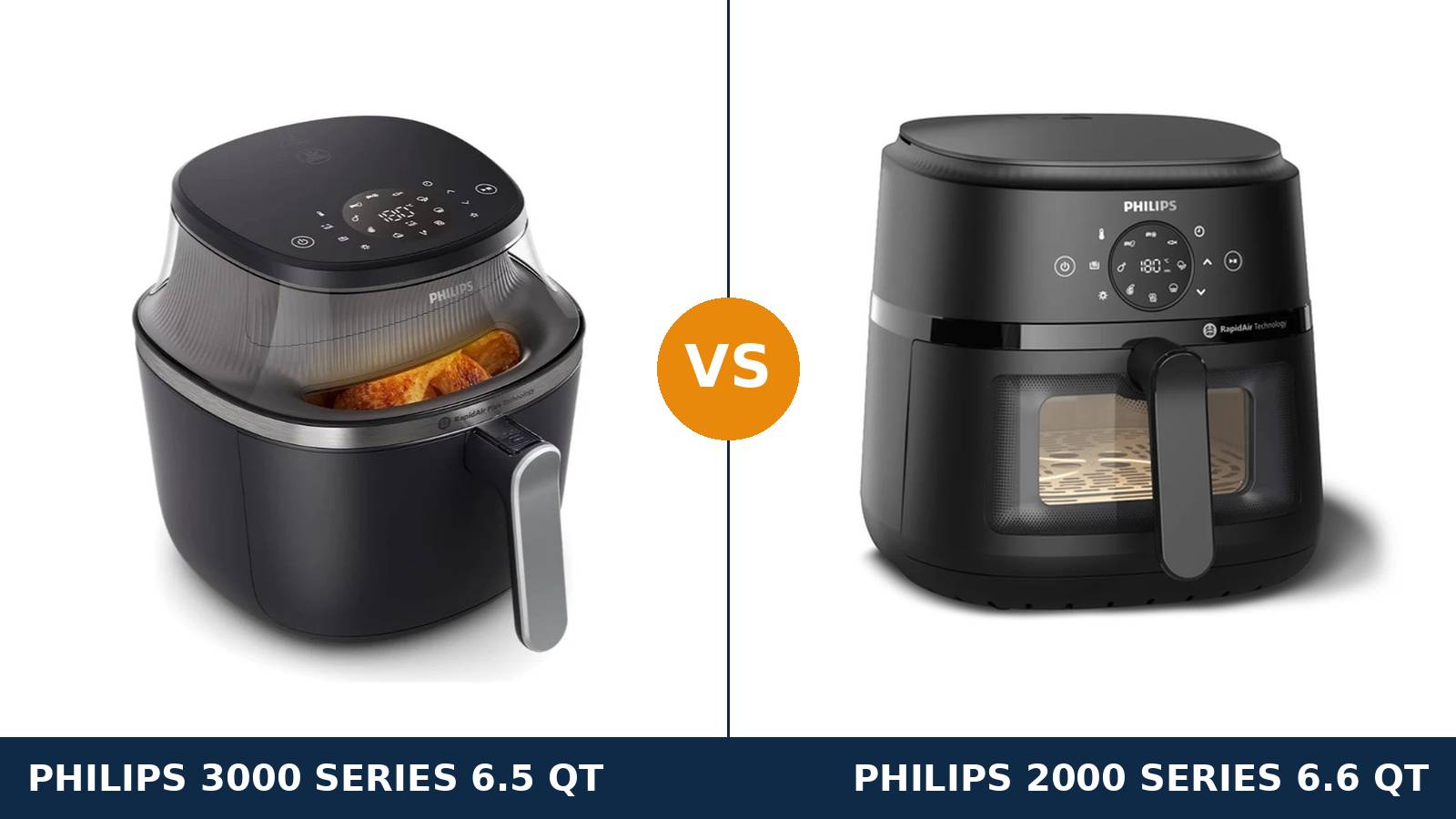
Most shoppers meet this matchup from the top down. They find the 3000 Series first, like what they see, then spot the 2000 Series one rung below it in Philips’ line-up, same pan size on the box.
That is when the honest question forms: what does stepping down actually cost? The same machine with a shorter feature list — or a lesser appliance?
The shared hardware makes the question worth asking. Both fryers cook in a 6.2-litre pan. Both run at 1,700 watts. Both let you watch the food through a window, and both carry the same two-year Philips warranty.
Here is the short answer this guide will back up. The step down costs you reach, not foundation: a lighter rated load, a higher temperature floor, a much shorter timer. In exchange, it hands back counter space. The pan, the power and the everyday frying stay put.
One clarification first, because Philips’ naming demands it. “3000 Series” and “2000 Series” are ranges spanning several sizes. This comparison pins each to the mainstream 6.2L machine Philips leads with in the US: the NA330/00 for the 3000 Series (sold by Philips’ US store as the NA331/00) and the black NA230/00 for the 2000.
Every figure that follows comes from Philips’ own product pages, user manuals and official datasheets — and where sources argue, Philips wins.
Key Takeaways
- The step down keeps the pan and loses the rating. Both pans hold 6.2 litres, but Philips clears the 3000 for 1.0 kg loads and the 2000 for 0.8 kg.
- Low-and-slow cooking is the real divide. The 3000 reaches 100°F and runs up to 24 hours; the 2000 stops at 140°F and 60 minutes. Serious dehydrating and fermenting live on one side only.
- The preset library widens with the 3000. Sixteen functions and 12 presets — including a favourite you can save — against 13 and 9.
- The 2000 pays you back in space. It is narrower, shallower and lighter, with the same window and the same warranty.
- Neither fryer takes app commands. The HomeID app feeds both of them recipes. Control stays on the touchscreen either way.
Quick Verdict
Buy the Philips 3000 Series (NA330/00) if the fryer works for a household. It is the complete version of this pan.
Philips rates it for a full kilo of food. Its dial runs from 100°F to 400°F and its timer stretches to 24 hours, which unlocks dehydrating, fermenting and proofing as real jobs rather than menu decorations.
Buy the Philips 2000 Series (NA230/00) if you cook for one or two and your counter is tight. It keeps the pan, the wattage, the window and the warranty in a smaller, lighter body.
What you surrender is a set of jobs many kitchens never attempt. If your airfryer’s life is fries, wings, roasts and reheats, you may never feel it.
The Scorecard
Every score below is read off the manufacturer specifications compared in this guide — rated loads, temperature and timer envelopes, function and preset counts, footprint, weight and warranty terms. They summarise the spec sheets; they are not lab measurements.
| Category | 3000 Series NA330/00 | 2000 Series NA230/00 | ||
|---|---|---|---|---|
| Capacity & rated load | 9 / 10 | 8 / 10 | ||
| Cooking design | 9 / 10 | 8 / 10 | ||
| Temperature & timer range | 10 / 10 | 6 / 10 | ||
| Ease of use | 9 / 10 | 8 / 10 | ||
| Cleaning | 8 / 10 | 8 / 10 | ||
| Footprint & storage | 7 / 10 | 9 / 10 | ||
| Value | 8 / 10 | 9 / 10 | ||
| Overall | 8.0 / 10 | 7.8 / 10 | ||
Read the table as a map of the step down. Capability rows lean toward the 3000; the rows about living with the machine — footprint, value — lean back toward the 2000.
At a Glance: Who Each Fryer Fits
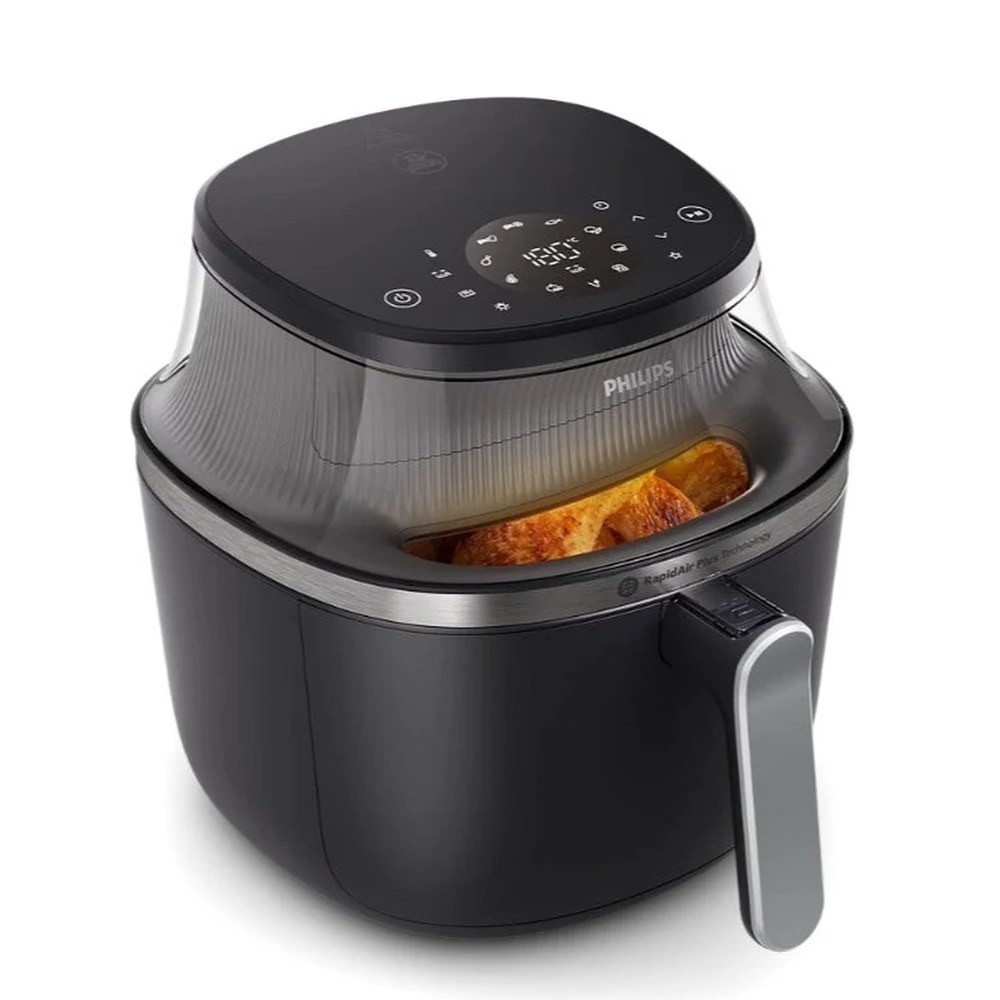
Philips Airfryer 3000 Series (NA330/00)
- 6.2L pan rated for a full 1.0 kg load
- RapidAir Plus technology, star-shaped design
- 16 cooking functions, 12 touchscreen presets
- 100°F floor and timer up to 24 hours
- Full-width viewing window across the upper body
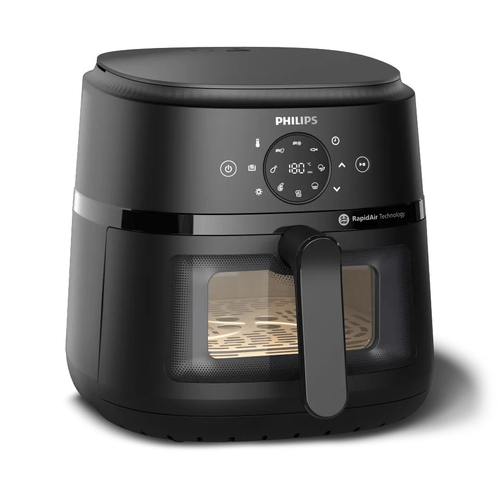
Philips Airfryer 2000 Series (NA230/00)
- Same 6.2L pan, rated for 0.8 kg loads
- RapidAir technology with starfish design
- 13 cooking functions, 9 touchscreen presets
- Cooking window in the drawer front, lit StarPlate view
- Narrowest footprint of the pair; 5.35 kg
Choose the 3000 Series (NA330/00) if…
You cook for three or four and want the whole meal in one batch. Philips’ 1.0 kg rating is written for exactly that habit.
You dehydrate, ferment or proof — or honestly think you might. Those jobs need the 100°F floor and long timer; no setting on the cheaper fryer fakes them.
You lean on presets. Twelve, with room to store your own favourite, against nine fixed ones.
Choose the 2000 Series (NA230/00) if…
Dinner is usually for one or two. At 0.8 kg per batch, the smaller rating stops mattering.
Counter space is genuinely scarce. This is the shallower, narrower machine, and the easier one to store between uses.
Your cooking is the airfryer core repertoire — frying, roasting, baking, reheating — and you would rather not pay for range you will never use.
As an Amazon Associate I earn from qualifying purchases at no extra cost to you.
Specifications: The Specs That Actually Matter
Every figure below comes from Philips’ published specifications, manuals and manufacturer product data, cross-checked between Philips’ US pages and its official model datasheets.
Because both names are ranges, the table names the precise US models compared here; notes beneath it cover the other machines sharing those names.
| Specification | Philips 3000 Series (NA330/00) | Philips 2000 Series (NA230/00) |
|---|---|---|
| Model number | NA330/00 on Amazon.com; NA331/00 at Philips’ US store | NA230/00 on Amazon.com (black); NA231/00 is the silver finish of the same machine |
| Capacity | 6.2 L pan (sold in the US as 6.5 qt) | 6.2 L pan (sold in the US as 6.6 qt) |
| Rated food load | 1.0 kg; Philips illustrates 8 drumsticks, 5 salmon pieces or 7 muffins | 0.8 kg — Philips rates it for 800 g of fries, 8 drumsticks or 800 g of vegetables |
| Rated power | 1,700 W (120 V US model) | 1,700 W |
| Temperature range | 100°–400°F (40–200°C) | 140°–400°F (60–200°C) |
| Time range | Up to 24 hours on the dehydrate and ferment programs | Up to 60 minutes |
| Cooking functions | 16-in-1, including dehydrate and ferment | 13-in-1: fry, roast, grill, bake, one-pot cooking, stir-fry, sauté, cook from frozen, reheat, defrost, dehydrate, toast, keep warm |
| Presets | 12 touchscreen presets, including breakfast, vegan, dehydrated fruits and a save-your-own favourite | 9 touchscreen presets: frozen fries, fresh fries, drumsticks, meat, fish, breakfast, vegetables, cake, keep warm |
| Air technology | RapidAir Plus, star-shaped design with faster airflow; fat drains away from food | RapidAir, patented starfish design |
| Cooking window | Yes — full-width viewing window | Yes — window in the drawer front |
| Controls & connectivity | Touchscreen on the unit; HomeID app offers recipes, but the fryer itself is not connected | Touchscreen on the unit; HomeID app offers recipes, but the fryer itself is not connected |
| Basket type & material | Pull-out pan and basket, non-stick coating; basket holds food above the fat collected in the pan | Pan with a removable non-stick StarPlate; food cooks on the plate above the drained fat |
| Dishwasher-safe parts | Pan and basket | Pan and StarPlate |
| Dimensions (D × W × H) | 436 × 324 × 303 mm (17.2 × 12.8 × 11.9 in) | 404 × 309 × 308 mm (15.9 × 12.2 × 12.1 in) |
| Weight | 5.6 kg (12.3 lb) | 5.35 kg (11.8 lb) |
| Cord length | 1.0 m | 0.8 m |
| Warranty | 2-year warranty | 2-year warranty |
Model note: the 3000 Series also includes a 4.2L NA322/00 and a larger 7.2L NA341/00, and the 2000 Series includes smaller 4.2L models (NA220/00 and NA221/00). The machines compared here are the mainstream 6.2L models Philips fronts each range with in the US.
Finish note: the NA231/00 is the same 6.2L 2000 Series fryer in a silver finish — one shared Philips user manual covers both codes, and the specifications are identical. This guide’s buttons lead to the black NA230/00.
Dimension note: Both sets of dimensions are Philips’ datasheet figures. Retailer listings occasionally transpose the width and depth; where they disagreed, the manufacturer’s product data settled it.
The Differences That Actually Matter
1. Same pan, different promise — the rated load
Begin where the boxes agree: 6.2 litres. If pan volume were the whole story, the step down would cost nothing at all.
It is not the whole story. Philips rates the NA330/00 to cook 1.0 kg of food at a time. It rates the NA230/00 at 0.8 kg.
Put plainly, the 3000 Series is manufacturer-cleared to cook a quarter more food per batch in a pan of identical volume. The gap sits in both datasheets — a specification, not a reviewer’s impression.
The reason is airflow headroom. Crowd a pan past its design load and the lower layer steams instead of frying — crisping needs hot air on every surface.
The 3000’s RapidAir Plus system is engineered to keep air moving under that heavier load. The earlier RapidAir design in the 2000 is rated more conservatively for the same space.
When does it bite? A 0.8 kg batch of fries feeds two or three people comfortably. Family-scale batches — the full kilo, the big meal-prep run — are where the 2000 starts asking for a second round.
2. The bottom of the dial — where the step down really costs
At the top of the dial the fryers match: 400°F (200°C) each. Travel to the bottom and they stop resembling each other.
The 2000 Series adjusts upward from 140°F (60°C), and its timer gives up at 60 minutes — an envelope that covers frying, roasting, baking and reheating with room to spare.
The 3000 Series starts at 100°F (40°C) and can hold a program for up to 24 hours on its dehydrate and ferment settings. That is not a wider comfort zone. It is a second appliance category bolted onto the first.
Drying fruit or making jerky means gentle heat sustained for hours; fermenting yogurt or proofing dough means warmth held steady without cooking. Neither fits a 140°F floor and a one-hour cap.
One wrinkle deserves honesty: dehydrate does appear among the 2000’s 13 functions. Capped at that floor and that timer, though, it handles only the lightest drying. For the real job, the 3000 is the only machine here equipped.
If low-and-slow cooking is on your list — even tentatively — this section settles the comparison by itself.
3. Functions and presets — 16 against 13, 12 against 9
The 3000 Series carries 16 cooking functions and a dozen touchscreen presets. The additions with substance: ferment, a dehydrated-fruits preset, a vegan preset — and a slot for saving your own favourite combination.
The 2000 Series carries 13 functions: fry, roast, grill, bake, one-pot cooking, stir-fry, sauté, cook from frozen, reheat, defrost, dehydrate, toast and keep warm. Its nine presets run from frozen fries to cake.
Notice how much of the 2000’s list survives. The core repertoire is intact. What the step down trims is the specialist shelf, not the daily one.
How much the preset gap matters depends on how you cook. Manual cooks — set a temperature, set a time, shake halfway — will barely register it.
Tap-and-go households will. A saved favourite earns its place quickly: one touch for the exact fries setting your family argues about least.
File this under daily convenience; section 2 holds the capability argument.
4. RapidAir Plus vs RapidAir — a generation of airflow
Philips made its name on the star-shaped pan floor that swirls hot air around food, crisping it with little or no oil. The 2000 Series runs that original RapidAir design, and its results are genuinely good.
The 3000 Series runs RapidAir Plus — the newer, star-shaped evolution Philips describes as moving air faster and more evenly, with rendered fat draining away into the pan beneath.
Philips publishes no controlled head-to-head between its own two systems, and we will not fabricate one. The datasheets support a narrower claim: the Plus design is the newer engineering, and the one Philips rates for the heavier load in section 1.
Power, notably, is not the difference. Both fryers are rated at 1,700 W. The contest is purely about how the air is handled.
For ordinary loads, expect honest crisping from either machine. The Plus design shows its value at full loads and with fatty foods, where drainage and circulation are doing real work.
5. The window — shared, differently placed
Both fryers let you watch dinner cook. A few model years ago that was a premium trick; here it is standard on both sides of the step down, and owners rank it among the most-used features.
The implementations differ. The 3000’s window stretches full-width across its upper body, readable from across the room. The 2000’s sits in the drawer front, framing the lit StarPlate below.
Of the two panes, the 3000’s is bigger and easier to read — credit where due.
But the function is identical: judge browning without sliding the drawer open, dumping the heat and interrupting the crisp. Both machines preserve that.
Verdict: a near-tie with a slight readability edge to the 3000. Do not let glass decide this purchase.
6. Where the cheaper fryer wins — footprint and weight
A step-down audit should record what the lower rung gives back. Here, it gives back counter.
The NA230/00 measures 404 × 309 × 308 mm. The NA330/00 measures 436 × 324 × 303 mm — deeper and wider around the same pan, roughly 13 percent more counter footprint.
In a generous kitchen that difference evaporates. In a small one it decides whether the fryer earns permanent counter residency or cupboard exile — and cupboard appliances cook less often.
Height, interestingly, is a wash — the 3000 stands a fraction shorter — so under-cabinet clearance almost never separates them. Width and depth do the separating, and the 2000 wins both.
Weight leans the same way: 5.35 kg against 5.6 kg. A quarter-kilo is trivial on paper and noticeable across a year of lifts into storage.
The 3000 lands one counter-punch: a 1.0 m cord against 0.8 m. On deep counters with rear sockets, that extra 20 cm occasionally dictates where the fryer may live.
7. Plate versus basket — the cleaning tie
The two fryers part company in how food sits inside the pan. The 2000 Series cooks on a removable plate — the StarPlate — with fat draining through it to collect underneath. One flat part to wash, plus the pan.
The 3000 Series uses the classic two-piece arrangement: a basket nested in a pull-out pan, lifting food clear of the rendered fat pooled below.
Dishwasher status is equal. The 2000’s pan and StarPlate are dishwasher-safe; so are the 3000’s pan and basket. Every cooking surface on both is non-stick coated.
Handling preferences differ more than effort does. The plate layout has fewer components and a flatter pan to wipe. The basket layout shakes mid-cook more naturally and lifts food out of its own fat more cleanly.
Both coatings ask for the same courtesies: no metal scourers, and let the pan cool before it meets cold water.
Score this section a tie, settled by which object you would rather hold at the sink.
Which Fryer Fits Your Household?
Work back from your table and your menu. The fit guide below compresses the entire comparison into a single view.
| Your household / cooking | 3000 Series NA330/00 | 2000 Series NA230/00 | Our call |
|---|---|---|---|
| 3–4 people, full meals in one batch | Excellent — rated for 1.0 kg | Workable — batch at the 0.8 kg limit | 3000 Series |
| 1–2 people, weeknight fries and reheats | Excellent, more than you need | Excellent — 0.8 kg loads are ample | 2000 Series |
| Dehydrating, jerky, fermenting, proofing | Excellent — 100°F floor, 24-hour timer | Not equipped — 140°F floor, 60-minute timer | 3000 Series, no contest |
| Small kitchen, narrow counters | Tight — deepest and widest | Excellent — smallest footprint | 2000 Series |
| Meal prep and big weekend batches | Excellent — heavier rated load | Good — expect an extra batch | 3000 Series |
| Preset-driven, tap-and-go cooking | Excellent — 12 presets plus a saved favourite | Good — 9 presets | 3000 Series |
| First Philips, tightest budget | Good — you pay for capability you may not use | Excellent — same pan, same window, same warranty | 2000 Series |
Pay attention to the dehydrating row. It is the single line in this table where the cheaper machine is not doing a smaller share of the work — the work is simply beyond it.
The 30-Second Decision
| If this sounds like you… | Buy this |
|---|---|
| “Family dinners, full pan, one batch.” | 3000 Series (NA330/00) |
| “I want to dehydrate fruit and make jerky.” | 3000 Series — the only one that can |
| “Two of us, fries and reheats, small kitchen.” | 2000 Series (NA230/00) |
| “I just want a Philips with a window, for less.” | 2000 Series (NA230/00) |
| “I cook by presets and want my own saved favourite.” | 3000 Series (NA330/00) |
| “Counter space is my scarcest resource.” | 2000 Series — narrower, lighter, shorter cord aside |
Ready to check today’s price?
Both fryers sell through Amazon. Prices move, so check the live figure on the model that fits your kitchen.
View on Amazon — 3000 SeriesView on Amazon — 2000 SeriesWhat You Gain. What You Give Up.
Philips 3000 Series (NA330/00)
You gain: everything Philips builds into this pan at its fullest — the 1.0 kg rating, RapidAir Plus airflow, the 100°F-to-400°F span, the day-long timer, fermenting, twelve presets and a favourite of your own on standby.
You give up: room. No fryer here asks for more counter in exchange for the same 6.2 litres, and none is heavier to haul out of a cupboard. Part of the price buys headroom you may never call on.
Philips 2000 Series (NA230/00)
You gain: the identical pan, wattage, window and warranty, folded into the smaller, lighter cabinet — an entry model that skips the usual entry-level penalties. Its plate-style pan also means one fewer piece waiting at the sink.
You give up: 200 g of rated load, every low-temperature discipline worth the name, three functions, three presets and a fifth of your cord length.
Pros and Cons
3000 Series NA330/00 — Pros
- Full 1.0 kg rated load in the shared pan
- 100°F floor, 24-hour timer, ferment program
- RapidAir Plus — the newer airflow design
- 12 presets including a saved favourite
- Full-width window; longer 1.0 m cord
Cons
- Largest footprint of the pair
- Heaviest here at 5.6 kg
- Capability you pay for whether or not you use it
- Still not connected — no app control
- Basket and pan are two parts to wash
2000 Series NA230/00 — Pros
- Same 6.2L pan and 1,700 W as the 3000
- Smallest footprint and lightest body here
- Cooking window — rare at this level
- Simple StarPlate pan, dishwasher-safe
- 2-year warranty, same as the 3000
Cons
- Rated load is only 0.8 kg
- 140°F floor and 60-minute timer cap
- Dehydrate mode too limited for real drying
- Fewer presets, no saved favourite
- Shorter 0.8 m cord
Check the Model Number, Not Just the Series Name
Check which 3000 Series you are looking at. The range name spans three sizes.
The 6.2L NA330/00 here is the range’s mainstream US window model. The NA322/00 wears the same name with a 4.2L pan; the NA341/00 stretches to 7.2L. If a listing’s capacity is not 6.2 litres — 6.5 qt in the US — it is one of those, not this one.
Check the store numbering. Philips’ own US store lists this fryer as the NA331/00. Same machine, channel numbering; the Amazon listing carries NA330/00. Do not pay a premium for the digit — or reject a listing over it.
Check which 2000 Series you are looking at. The same warning applies one rung down. The NA220/00 and NA221/00 share the 2000 Series name with a smaller 4.2L pan. A listing that just says “2000 Series” can be either size — confirm capacity and model number before anything else.
Check the finish code. The codes split by colour: NA230/00 is the black machine, NA231/00 the silver one. One Philips manual serves the pair, and the specification is shared line for line. Choose by colour.
Watch for suffixes. Philips’ US site shows R0-suffixed variants of these fryers next to the standard retail models. When a price looks suspiciously generous, read the listing’s full model number and make sure it is the standard version — the suffix is not decoration.
Check the quart conversion. Philips sells the identical 6.2L pan as 6.5 qt (3000 Series) and 6.6 qt (2000 Series) — marketing rounding, not a size difference. The pans match; the rated loads differ.
The Second-Year Test
Appliances like these are rarely regretted in month one. They are regretted — or vindicated — in year two, once habits have settled.
Month one is identical either way: the same fries from the same pan at the same wattage. Blindfolded, most households could not tell the two machines apart.
Year two is when curiosity tends to arrive. A glut of apples becomes a drying project. A sourdough habit wants a warm proofing corner. Jerky gets mentioned.
Every one of those detours runs into the 2000 Series’ ceiling. A 140°F floor and a one-hour timer are cast into the hardware; no menu unlocks them later.
Balance that with the opposite biography. If year two is week one on repeat — fries, wings, reheats, always for two — the 3000’s extra reach never gets used, while the 2000’s smaller footprint rewards you daily.
So forecast your cooking honestly, and buy the machine that matches the forecast — not the biography you briefly imagine for yourself.
When to Skip Both
Two good fryers can still be the wrong two. Some shoppers should walk past both.
Walk past if app control is the point. Neither machine is connected; HomeID supplies recipes to both and commands to neither. Philips’ connected option, the 5000 Series XL Connected, is presently marked discontinued on Philips’ US site — so app-first buyers are better served by rival brands for now.
Walk past if two different dishes must finish together nightly. A single pan cannot be in two temperatures at once; a dual-basket design — or a second fryer — is the truthful fix.
Walk past if batches above a kilo are your routine rather than your exception. That workload belongs to a larger class of appliance: a big dual-drawer model or an oven-format airfryer.
And give the 3000 Series a personal pass if your available counter is measured in centimetres. Capability cannot cook from inside a cupboard it barely fits in.
Warranty and Long-Term Support
Ownership terms are level. Philips covers each fryer with a 2-year US warranty.
Both models sit in the current US catalogue, sold and serviced through Versuni, the company behind Philips home appliances. Documentation, help pages and spare-part routes are in place for both families.
The recipe side is shared too: HomeID delivers cooking content to both. And because neither fryer has connected hardware, neither will gain or lose features over time — the specification you buy is the specification you retire.
Final Verdict
For a household kitchen, the Philips 3000 Series (NA330/00) is our pick.
The margin is built from specifications, not series prestige. A kilo of rated load where the other offers 800 g. A floor forty degrees lower. A timer measured in days where the other counts minutes.
Each of those widens what the machine can be asked to cook — and the 2000 Series has no path to any of them after purchase.
Buy the 3000 Series when the fryer serves a family, anchors meal prep, or will ever be asked to dry, ferment or proof.
Buy the 2000 Series when the cooking is for one or two, the counter is small, and the menu is the classic airfryer repertoire. It preserves the pan, the power, the window and the warranty inside a trimmer body at the range’s entry position.
Call it the same fryer on a shorter leash — and remember that for plenty of kitchens, the leash already reaches everything.
Watch Out: Similar Names, Different Fryers
Philips’ naming rewards slow readers. Three traps account for most mistaken orders.
Trap one: a series name is a family, not a model. “3000 Series” and “2000 Series” each span several capacities. This guide compares the 6.2L NA330/00 and NA230/00; their 4.2L and 7.2L relatives are separate purchases with separate strengths.
Trap two: the last digit lies quietly. NA330 and NA331 are a single fryer wearing Amazon and Philips-store numbers respectively, while NA230 and NA231 split one fryer into black and silver. A moved digit does not make a different appliance.
Trap three: the 5000 Series XL Connected keeps surfacing in searches for these two. It is a larger, Wi-Fi-controlled product — and one Philips currently marks discontinued in the US. Keep it out of this decision.
Read listings in a fixed order: full model number first, capacity second, price last.
Counter, Clearance and Power Notes
Both machines are countertop appliances for ordinary US 120 V circuits. At 1,700 W apiece, avoid sharing the run with another heavy hitter — the kettle-plus-airfryer combination is the classic breaker trip.
Give the rear vent room. Both fryers exhaust hot air backwards and stand a little over 30 cm tall, clearing typical under-cabinet gaps — but pull the unit forward for long programmes so the exhaust is not blasting the cabinet face.
Plan around the 2000’s 0.8 m cord on deep counters with sockets at the rear wall; the 3000’s extra 20 cm buys placement freedom. Philips also asks for open space around each appliance in use, so resist the urge to park either one flush to the wall.
Frequently Asked Questions
Is the Philips 3000 Series worth it over the 2000 Series?
For households, yes. In the same 6.2L pan it adds a 1.0 kg rated load against 0.8 kg, a 100°F floor against 140°F, a 24-hour timer against 60 minutes, and three more functions and presets. For one or two people cooking standard fare, the 2000 Series does the same core job in a smaller body.
Which exact models does this comparison cover?
One mainstream 6.2L machine per range: NA330/00 stands for the 3000 Series (Philips’ US store sells the identical fryer as the NA331/00), and NA230/00 stands for the 2000 Series. Smaller 4.2L siblings exist in both ranges and a 7.2L in the 3000; none of them is covered here.
Is the 3000 Series a bigger machine than the 2000?
Its cabinet is; its pan is not. The pans match at 6.2 litres. Around that pan, the 3000’s body spreads wider and deeper — a 436 × 324 mm footprint versus 404 × 309 mm — and carries a little more weight, while Philips certifies it for 1.0 kg of food against the 2000’s 0.8 kg.
Can the 2000 Series dehydrate or ferment food?
Fermenting, no. Dehydrating, only in a limited way: dehydrate appears in its 13 functions, but the 140°F floor and 60-minute timer rule out proper dehydrating, which needs lower heat held for hours. The 3000 Series — 100°F floor, 24-hour timer — is the one built for both jobs.
What is the difference between the NA330 and the NA331?
Numbering only. The NA330/00 is the model number on the Amazon.com listing; Philips’ own US store lists the identical 6.2L window fryer as the NA331/00 — same capacity, power, temperature range and dimensions.
Are the parts dishwasher-safe on both fryers?
Yes, on both. The 3000’s pan and basket can go through the dishwasher, as can the 2000’s pan and its removable StarPlate. Every cooking surface involved is non-stick; Philips nonetheless suggests gentle washing if you want the coating to last.
Can I control either fryer from an app?
No. HomeID supports both fryers with recipes and guidance, but neither accepts remote control, remote start or progress monitoring. Philips’ app-controlled model is the 5000 Series XL Connected — currently listed as discontinued in the US.
Which of the two suits a family of four?
The 3000 Series. Family portions are precisely what its manufacturer-rated 1.0 kg load is for; at that table size the 2000’s 0.8 kg ceiling begins splitting dinners into batches. The broader temperature span and preset library are welcome extras, not the reason.
Sources & Verification
Philips US store product page: 3000 Series Airfryer with Window 6.5 Qt (NA331/00) • Official Philips product datasheet for NA331/00 (6.2 L, 40–200°C, 1,700 W, 5.6 kg, 1.0 m cord, non-stick dishwasher-safe parts) • Manufacturer product data on the Amazon.com NA330/00 listing (100°F minimum setting, up to 24-hour dehydrate/ferment timing, 1,700 W at 120 V, UPC 196592001492) • Philips NA230/00 official product page, usa.philips.com (2000 Series 6.2L, 2-year warranty) • Philips NA230/NA231 user manual (presets, 60–200°C manual temperature setting, two-year warranty) • Philips NA231/00 product leaflet (13 cooking methods, 9 presets, temperature control 60–200°C, time control up to 60 minutes, appliance weight 5.35 kg) • Philips manufacturer product data for NA230/00 via the official datasheet feed (6.2 L, 0.8 kg load, 1,700 W, 404 × 309 × 308 mm, 0.8 m cord). Specifications verified November 2026.

James Wilson
James has spent more than a decade testing kitchen appliances and PC hardware and writes Honestly Compared’s buying guides. His rule for every comparison: the verdict has to survive the spec sheet, not the marketing page.