
Philips Airfryer 5000 Series (HD9280/91) vs Philips Airfryer 3000 Series (NA330/00): Which Should You Buy?
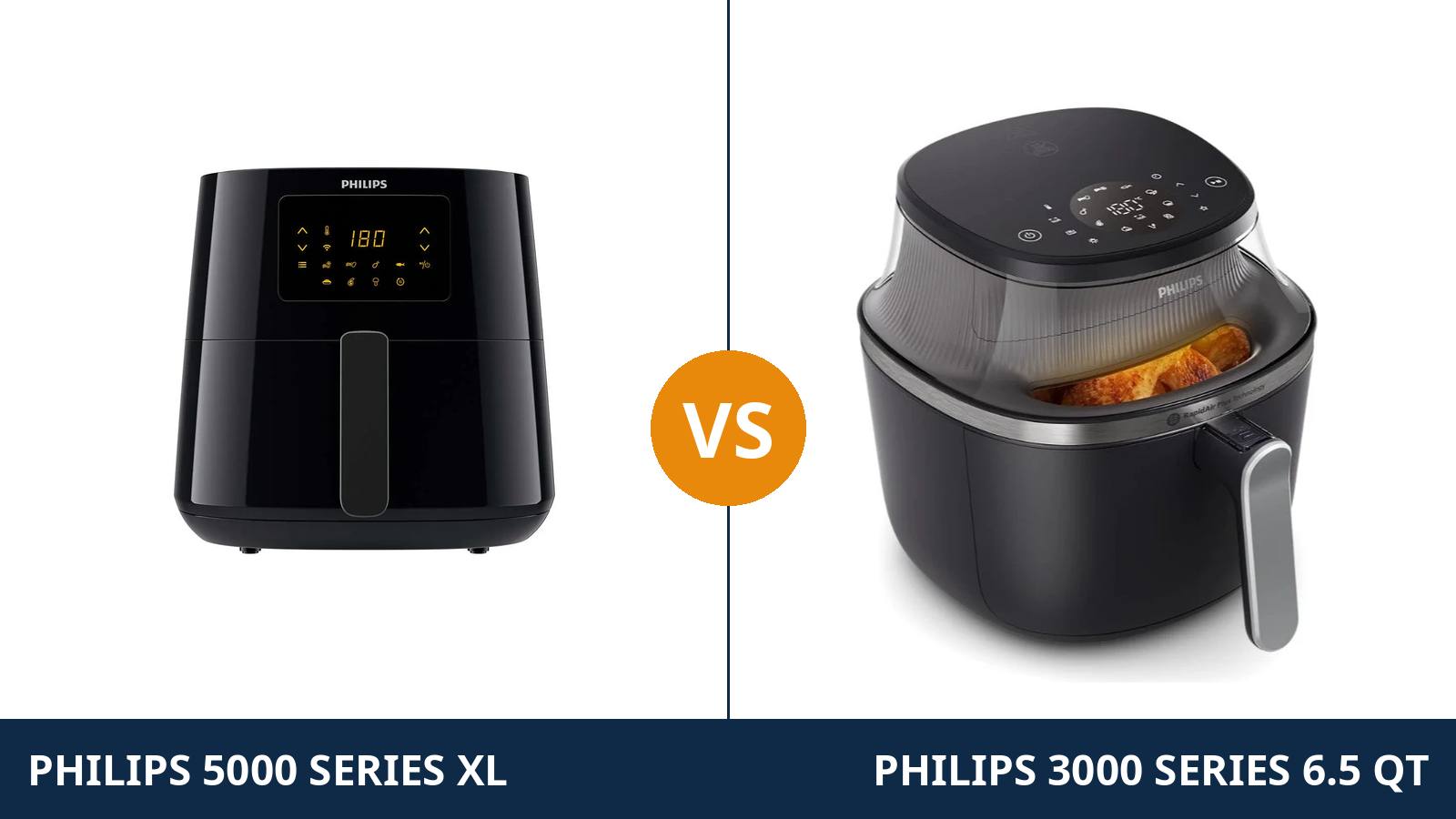
Same brand. Same 6.2-litre pan. Same star-shaped airflow idea, invented by the same company.
Yet these two Philips Airfryers disagree about almost everything else. One watches your food through a window. The other lets you run dinner from your phone.
First, a necessary piece of housekeeping. “5000 Series” and “3000 Series” are range names, not model numbers, and each covers several sizes.
In the US market, the 5000 Series name means the 5000 Series XL Connected, model HD9280/91 — the Wi-Fi model Philips sold as its connected flagship. The current 3000 Series is the window line, and this comparison anchors on its mainstream XL-class model: the 6.5 qt (6.2L) Airfryer with Window, sold on Amazon.com as the NA330/00 and listed by Philips’ own US store under the number NA331/00. Same machine, two channel numbers.
Both are 6.2-litre family fryers, so capacity cannot muddy this verdict. Every specification below comes from Philips’ own product pages, datasheets and manuals.
Key Takeaways
- The 3000 Series has the newer cooking hardware. RapidAir Plus airflow, a cooking window, 16 functions, a 100°F–400°F range and timers that run to 24 hours.
- The 5000 Series is the only one you can control remotely. Wi-Fi, the HomeID app and Amazon Alexa, on top of its touchscreen.
- Same pan, different rated load. Both pans hold 6.2 litres, but the 5000’s basket is rated for 1.2 kg of food against the 3000’s 1.0 kg.
- The 5000 is easier to house and to clean. It is the shallower unit, and its QuickClean basket has a removable mesh bottom. Both machines are dishwasher-safe and carry a 2-year warranty.
- Check availability before you fall for the 5000. Philips flags the HD9280/91 as discontinued on its own US site, though it remains on sale on Amazon.com. The 3000 Series is the current line.
Quick Verdict
Buy the Philips 5000 Series XL Connected for most households. It wins this comparison the grown-up way: a bigger rated basket load, a smaller counter footprint, an easier-cleaning basket, and the only remote control in the fight.
Start a cook from the couch, get pinged when it is done, ask Alexa how long is left. No window gives you that.
Buy the Philips 3000 Series if you cook by eye. The window ends the open-the-basket-to-check habit, RapidAir Plus is the newer airflow, and the low 100°F settings unlock dehydrating and fermenting the 5000 simply cannot do.
It is also the current model, with the longer support runway. If the 5000’s discontinued flag worries you, that is a legitimate reason to take the 3000 and lose nothing that matters at the table.
The Scorecard
Scores below are derived directly from the manufacturer specifications compared in this guide — capacities, temperature ranges, function lists, dimensions and cleaning design. They are a reading aid, not benchmark results.
| Category | 5000 Series XL | 3000 Series | ||
|---|---|---|---|---|
| Capacity | 9 / 10 | 8 / 10 | ||
| Cooking system | 8 / 10 | 9 / 10 | ||
| Functions & range | 7 / 10 | 9 / 10 | ||
| Ease of use | 9 / 10 | 8 / 10 | ||
| Cleaning | 9 / 10 | 8 / 10 | ||
| Footprint | 7 / 10 | 6 / 10 | ||
| Overall | 8.2 / 10 | 8.0 / 10 | ||
The pattern is a changing of the guard, half-finished. The 3000 Series wins every category about the cooking itself. The 5000 Series wins the categories about living with the machine — and takes the verdict by a nose.
At a Glance: Who Each Fryer Fits
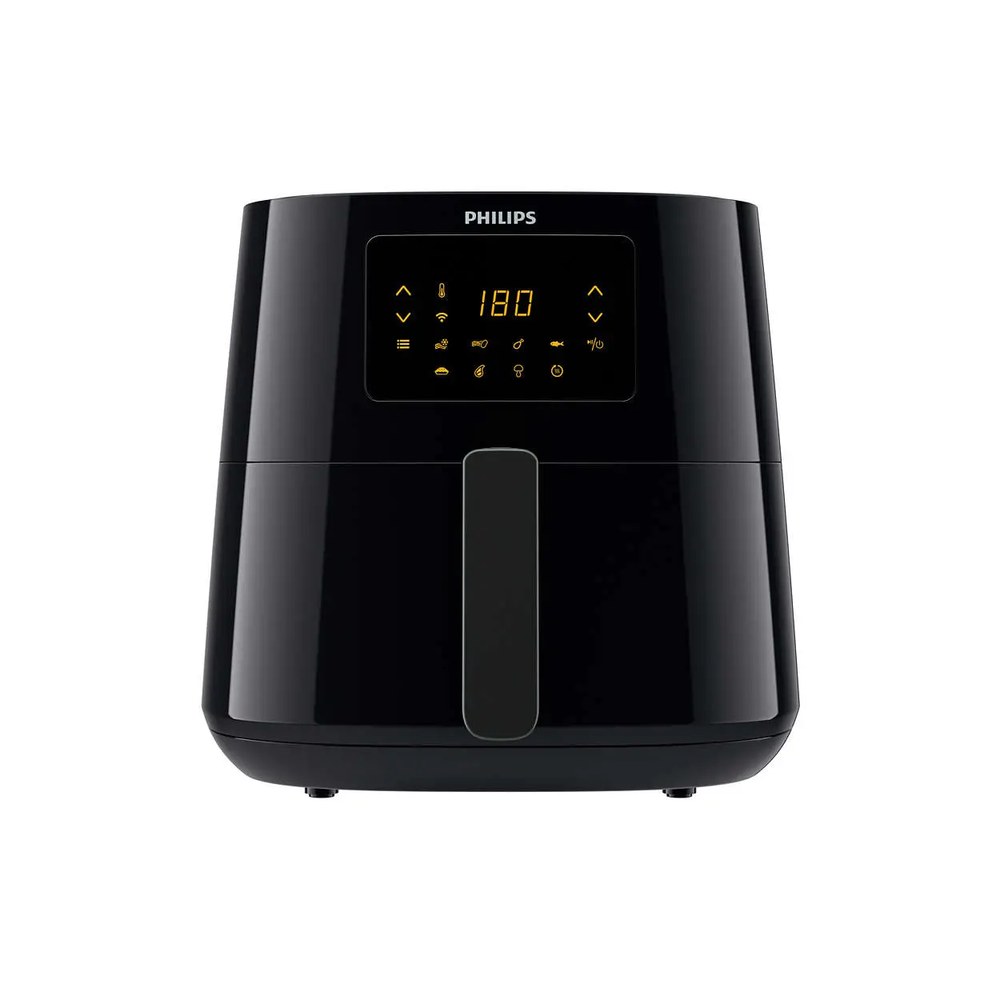
Philips 5000 Series XL Connected (HD9280/91)
- 6.2L pan, 1.2 kg basket — up to 5 portions
- Wi-Fi connected: HomeID app control plus Amazon Alexa
- 13-in-1 functions, touchscreen with 7 presets
- QuickClean basket with removable non-stick mesh
- Rapid Air technology, starfish design
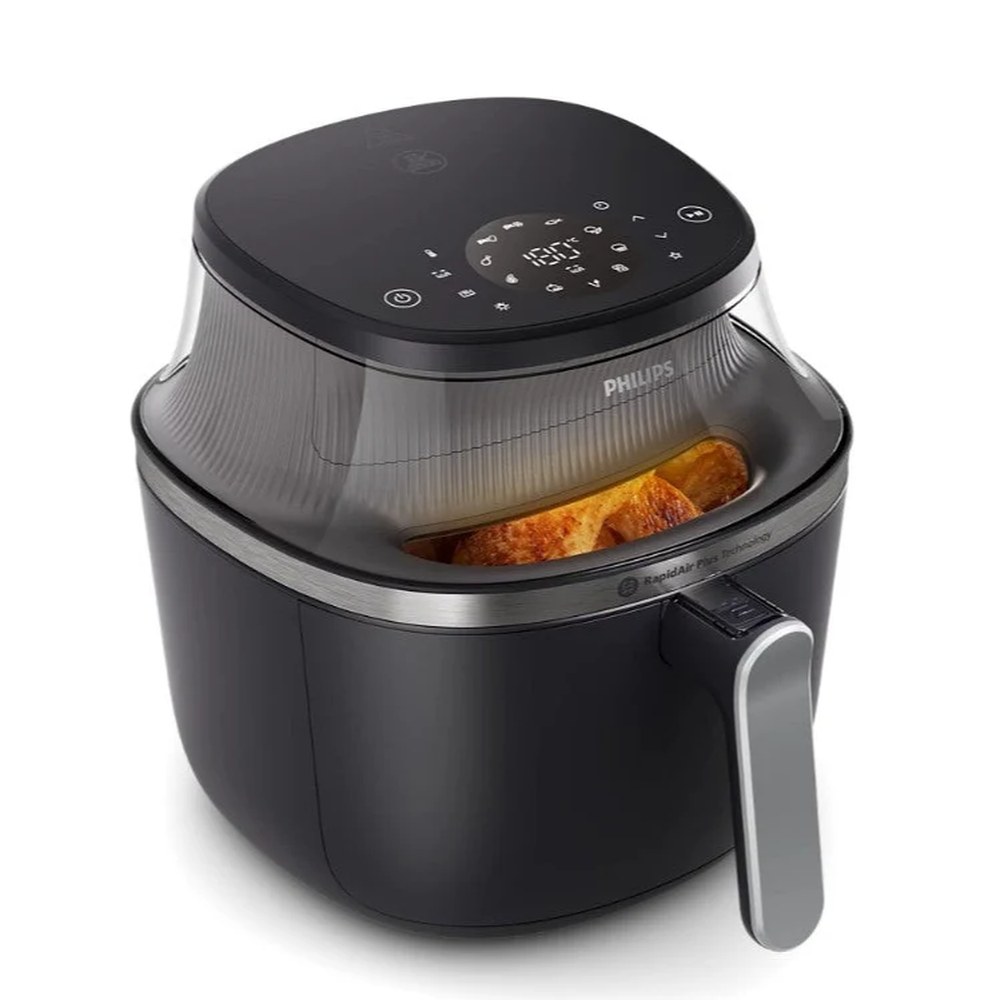
Philips 3000 Series with Window, 6.5 Qt (NA330/00)
- 6.2L (6.5 qt) pan with a see-through cooking window
- RapidAir Plus technology with fat-removal design
- 16 functions, 12 touchscreen presets
- 100°F–400°F range; timers up to 24 hours
- Non-stick pan and basket, both dishwasher-safe
Choose the 5000 Series XL Connected if…
You want to start, monitor and adjust dinner from your phone, or by voice through Alexa.
You cook full baskets. The 1.2 kg rated load is the biggest Philips fits in this pan size.
Your counter is shallow, or your cabinets are low on patience. This is the smaller box of the two.
Choose the 3000 Series if…
You judge doneness by looking, and you are tired of opening the basket and dumping the heat to do it.
You dehydrate, ferment, or cook low and slow. The 100°F floor and 24-hour timers are exclusive to this side.
You want the model Philips currently makes, with the longest parts and support runway ahead of it.
As an Amazon Associate I earn from qualifying purchases at no extra cost to you.
Specifications: The Specs That Actually Matter
Every figure below is taken from Philips’ published specifications, official product datasheets and user manuals for these two US models.
| Specification | Philips 5000 Series XL (HD9280/91) | Philips 3000 Series (NA330/00) |
|---|---|---|
| Model number | HD9280/91 (North America) | NA330/00 on Amazon.com; NA331/00 at Philips’ US store |
| Capacity | 6.2 L pan | 6.2 L pan (sold in the US as 6.5 qt) |
| Rated food load | 1.2 kg / 2.65 lb basket; up to 5 portions | 1.0 kg; Philips illustrates 8 drumsticks, 5 salmon pieces or 7 muffins |
| Rated power | 2,000 W (Philips’ published platform rating — see note) | 1,700 W (120 V US model) |
| Temperature range | 175°–400°F (80–200°C) | 100°–400°F (40–200°C) |
| Time range | Standard cooking cycles; keep warm fixed at 175°F for up to 30 min | Up to 24 hours on dehydrate and ferment programs |
| Cooking functions | 13-in-1 (see note): fry, roast, grill, bake, reheat, defrost, dehydrate, toast, keep warm and more | 16-in-1, including dehydrate and ferment |
| Presets | 7 touchscreen presets: frozen snacks, fresh fries, drumsticks, whole fish, cake, meat chops, mixed vegetables | 12 touchscreen presets, including breakfast, vegan, dehydrated fruits and a save-your-own favourite |
| Air technology | Rapid Air, patented starfish pan design | RapidAir Plus, star-shaped design with faster airflow; fat drains away from food |
| Cooking window | No — closed basket | Yes — full-width viewing window |
| Controls & connectivity | Touchscreen plus Wi-Fi: HomeID app remote control and monitoring, Amazon Alexa voice control | Touchscreen on the unit; HomeID app offers recipes and content, but the fryer itself is not connected |
| Basket type & material | QuickClean basket with removable mesh bottom; non-stick coated pan and basket | Pull-out pan and basket, non-stick coating; basket holds food above the fat collected in the pan |
| Dishwasher-safe parts | Pan and basket | Pan and basket |
| Dimensions (D × W × H) | 403 × 315 × 307 mm (15.9 × 12.4 × 12.1 in) | 436 × 324 × 303 mm (17.2 × 12.8 × 11.9 in) |
| Weight | 5.55 kg (12.2 lb) | 5.6 kg (12.3 lb) |
| Cord length | 0.8 m | 1.0 m |
| Warranty | 2-year guarantee | 2-year warranty |
Model-number note: the 5000 Series XL also exists as the HD9280/90, the 220–240 V global twin of the /91. The non-connected HD9270/91 shares the same body without Wi-Fi — check the panel for the Wi-Fi symbol before assuming a listing is the Connected model. On the 3000 side, NA331/00 and NA332/00 are the same 6.2L window fryer’s regional numbers; the smaller 4.2L NA322/00 and the larger 7.2L NA341/00 share the series name but are different machines, and neither is the model compared here.
Power note: Philips’ datasheets rate the HD9280 platform at 2,000 W on 220–240 V power, and Philips’ US materials do not publish a separate wattage for the /91, so the table uses the manufacturer’s platform figure rather than a retailer’s guess. The 3000 Series figure is cleaner: 1,700 W, stated in the manufacturer data for the 120 V US model and matching its global datasheet. Do not let the gap between those numbers decide anything — they are ratings from two different electrical systems, not a cooking test.
Function-count note: Philips’ current leaflet calls the 5000 Series “13-in-1” while its own function list names fourteen modes, and earlier US materials said 14-in-1. We use the current, conservative figure. Marketing departments count modes; cooks count presets, and on presets there is no dispute: 7 against 12.
Availability note: Philips’ US website currently flags the HD9280/91 as discontinued. It remains listed on Amazon.com, and the 2-year guarantee and Philips support apply as normal. What “discontinued” means in practice is covered in the buying guide below.
The Differences That Actually Matter
1. The window against the phone — two answers to the same question
Every basket fryer has the same flaw: you cannot see the food. Both of these machines attack it, from opposite directions.
The 3000 Series gives you a window. It is a wide, clear band across the front of the basket, and it genuinely changes how the machine feels to use.
Fries get checked without opening anything. Salmon gets watched, not guessed at.
The 5000 Series answers with information instead of glass. Its Wi-Fi connection streams time and temperature to the HomeID app, so the cook is checked from the couch, the garden, or the school run.
Alexa adds voice status and control. What the app cannot show you is browning — a countdown is not a colour.
Our call: cooks who trust their eyes will love the window more. Cooks who leave the kitchen will love the app more. Neither answer is wrong, and you cannot have both in one Philips.
2. Airflow, two generations: Rapid Air against RapidAir Plus
Philips invented this category, and both machines use its signature trick: a star-shaped pan floor that swirls hot air up through the food instead of blasting it from above.
The 5000 Series runs the original recipe — Rapid Air with the “starfish” design Philips has refined for a decade. It is proven, even, and entirely up to the job.
The 3000 Series runs RapidAir Plus. Philips says the redesigned star and faster airflow cook more evenly and up to 30% faster than its previous generation, and the pan geometry keeps food lifted away from the fat that drains off it — Philips quotes up to 40% of excess fat left behind on chicken legs.
Read those percentages as manufacturer claims, not lab results. But the direction is real: this is the newer, more developed cooking system, and it belongs to the cheaper-named series.
In the food itself, expect a small edge to the 3000 on evenness with crowded baskets. Expect no difference at all on a single layer of fries.
3. Functions and presets — 16 against 13, 12 against 7
Function counts are the most inflated numbers in air frying, so let us translate them into food.
The 3000 Series’ 16 functions include two the 5000 cannot imitate at all: fermenting (yoghurt, dough) and true low-temperature dehydrating, backed by timers that run to 24 hours.
Its 12 presets are equally practical: frozen fries, fresh fries, drumsticks, meat, fish, breakfast, vegetables, muffins, vegan, dehydrated fruits, keep warm — plus a favourite button that saves your own setting.
The 5000 Series counters with 13 functions and 7 presets: frozen snacks, fresh fries, drumsticks, whole fish, cake, meat chops, mixed vegetables. A solid, older-fashioned set that covers the weekly rotation without flourishes.
The honest summary: for frying, roasting and baking, the two are interchangeable. The 3000’s extra modes only matter if low-and-slow cooking is actually on your menu.
4. Temperature range — the bottom end is the story
Both machines top out at 400°F. That is the Philips ceiling, and it has never stopped an Airfryer cooking well.
The difference is underneath. The 3000 Series works down to 100°F. The 5000 Series stops at 175°F — which is, not coincidentally, exactly its fixed keep-warm temperature.
Seventy-five degrees does not sound like much. It is the difference between drying herbs, making fruit leather and proofing dough, and not doing any of those things.
The 5000 lists dehydrate among its functions, and at its lowest settings it can dry sturdier foods. But it is working at the edge of its range, where the 3000 is working in the middle of its own.
If low-temperature cooking is even a sometime thing for you, this section decides the comparison on its own.
5. Capacity — the same pan, a different promise
Here is the trap in the headline numbers: both pans are 6.2 litres. Philips markets the 3000 in the US as “6.5 qt” and the 5000 as “6.2L”, which makes the newer machine sound bigger. It is not. It is the same pan, measured in friendlier units.
The real difference is the rated load. Philips rates the 5000’s basket at 1.2 kg of food — up to five meal portions — against 1.0 kg for the 3000.
Philips illustrates the 3000’s working capacity as 35 oz of vegetables, 8 chicken drumsticks, 5 pieces of salmon or 7 muffins.
But for the biggest single-layer loads — a full bag of fries, a kilo-plus of wings — the 5000’s basket is the one Philips itself rates higher.
Call it a narrow 5000 win on paper, and a tie at most family tables.
6. Cleaning — QuickClean against a window to wipe
On the basics, this is a draw. Both pans and both baskets are non-stick coated and dishwasher-safe, per Philips’ own manuals.
The 5000 then pulls ahead on design. Its QuickClean basket has a removable mesh bottom: lift it out, and the part that catches every crumb and fat droplet goes straight in the dishwasher or under the tap.
Philips also specifies a BPA-free inner coating on this model, a detail the 3000’s materials do not claim.
The 3000’s cleaning bill is its window. Glass that faces frying fat needs a regular wipe to stay a window rather than a frosted panel, and that job is yours, not the dishwasher’s.
Neither machine is hard to live with. The 5000 is simply the lower-maintenance of the two, week in and week out.
7. Size on the counter — depth is the difference
These two look like peas from the same pod, but they do not occupy the same counter.
The 3000 Series is the deeper machine: 436 mm front to back against the 5000’s 403 mm. That is an extra inch and a quarter of counter depth, on a unit that already asks for clearance behind it for its air outlet.
The 5000 is a touch taller (307 mm against 303 mm) and a touch lighter (5.55 kg against 5.6 kg) — neither gap will ever be felt.
Width is close too: 315 mm against 324 mm. In a galley kitchen or under low wall cabinets, the 5000’s shallower cube is simply the easier fit.
One small, real point for the 3000: its power cord is a metre long against the 5000’s 0.8 m. On a deep counter with a shy socket, that can matter.
Which Fryer Fits Your Household?
The fastest way to choose between these two is to start from who is eating and how you cook. This table is the whole comparison in one view.
| Your household / cooking style | 5000 Series XL | 3000 Series | Our call |
|---|---|---|---|
| Couples and small households (1–3 people) | Excellent — right load rating, smaller box | Excellent — window suits small, watched batches | Either; 5000 on footprint |
| Families of 3–5, weeknight dinners | Excellent — 1.2 kg basket, app monitoring | Excellent — 12 presets cover the rotation | 5000 Series, narrowly |
| “I always open the basket to check” | Fair — the app shows time, not browning | Excellent — that is what the window is for | 3000 Series, outright |
| Dehydrating, proofing, fermenting | Not suited — 175°F floor | Excellent — 100°F floor, 24-hour timers | 3000 Series, outright |
| Smart-home cooks: app and voice control | Excellent — HomeID app plus Alexa | Not available — recipes only, no connection | 5000 Series, outright |
| Big single loads: fries and wings for a crowd | Excellent — basket rated to 1.2 kg | Good — same pan, rated to 1.0 kg | 5000 Series |
| Small kitchens, shallow counters | Excellent — 403 mm deep | Tight — 436 mm deep | 5000 Series |
The window, the low temperatures and the Wi-Fi are not matters of degree — each machine simply has one of them, and the other does not.
The 30-Second Decision
| If this sounds like you… | Buy this |
|---|---|
| “I want to run dinner from my phone and hear about it when it is done.” | 5000 Series XL Connected |
| “I cook by eye and hate losing heat to check.” | 3000 Series with Window |
| “I dehydrate fruit, dry herbs or proof dough.” | 3000 Series (100°F floor, 24-hour timer) |
| “My counter is shallow and my loads are big.” | 5000 Series XL Connected |
| “I want the current model with the longest support runway.” | 3000 Series |
| “I just want the easiest basket to keep clean.” | 5000 Series (QuickClean mesh) |
Ready to check today’s price?
Both fryers sell through Amazon. Prices move, so check the live figure on the one that fits your kitchen.
View on Amazon — 5000 Series XLView on Amazon — 3000 SeriesWhat You Gain. What You Give Up.
Philips 5000 Series XL Connected
You gain: full remote control — Wi-Fi, the HomeID app and Alexa — over a 6.2L fryer with the biggest rated basket load Philips offers in this size. The QuickClean removable-mesh basket. And the shallower, easier-to-house body.
You give up: any view of the food while it cooks, and every temperature below 175°F. You also accept a model Philips has flagged as discontinued in the US: still warranted and supported, but no longer the current line.
Philips 3000 Series with Window
You gain: the window, and the newer RapidAir Plus cooking system behind it. Sixteen functions with a 100°F floor and 24-hour timers. Twelve presets that map to real weeknight food. And current-model status.
You give up: connected control entirely — no app start, no notifications, no voice. The top slice of basket load (1.0 kg against 1.2 kg). Counter depth. And a pane of glass that needs wiping to stay useful.
Pros and Cons
5000 Series XL — Pros
- Wi-Fi control via HomeID app, plus Amazon Alexa
- Basket rated to 1.2 kg — up to 5 portions
- QuickClean basket with removable mesh bottom
- Shallower body: 403 mm deep
- Bright touchscreen with 7 presets and keep warm
Cons
- No window — open the basket to judge browning
- 175°F floor: no fermenting, limited dehydrating
- Flagged discontinued on Philips’ US site
- Only 7 presets against the 3000’s 12
- Remote features need an app account and 2.4 GHz Wi-Fi
3000 Series — Pros
- Cooking window — check food without opening
- RapidAir Plus with fat-removal pan design
- 16 functions, 12 presets, 100–400°F range
- Timers to 24 hours for dehydrate and ferment
- The current Philips line, with a 1 m cord
Cons
- Not connected — no app control or voice
- Rated load lower: 1.0 kg against 1.2 kg
- Deepest body here: 436 mm front to back
- Window needs regular wiping to stay clear
- No QuickClean-style removable mesh
Check the Model Number, Not Just the Series Name
Match the model number. The 5000 Series in this comparison is the HD9280/91. The 3000 Series is the NA330/00 on Amazon.com, and the NA331/00 on Philips’ own US store — the same 6.5 qt window machine carrying two channel numbers.
Beware the lookalike 5000. The HD9270/91 wears the same body and the same XL badge but has no Wi-Fi. It is a fine fryer and a different product.
The giveaway is on the control panel: the Connected model carries a Wi-Fi symbol among its touch icons. If a listing’s photos do not show it, you are looking at the wrong machine.
Beware the other 3000s. The series name also covers a 4.2L compact (NA322/00) and a 7.2L large model (NA341/00). Both are honest machines; neither is the 6.2L fryer compared here.
If a deal looks suspiciously good, check the capacity in the specification block before anything else. Series names are marketing. Litres are not.
Understand the discontinued flag. Philips lists the HD9280/91 as discontinued on its US website. That means production has ended, not that support has.
The 2-year guarantee still applies from your purchase date, Philips still publishes the manual and support pages, and the HomeID app still runs the machine.
Check the app name on the box. The 5000 Series launched with the NutriU app, which became Kitchen+ and is now HomeID. Older stock may name any of the three.
They are the same service wearing newer badges. Download HomeID, pair the fryer on a 2.4 GHz network, and ignore the name printed on the carton.
Check the suffix before importing anything. An HD9280/90 is the 220–240 V global version of the /91. A grey-import unit is a warranty problem with the wrong plug, at any discount.
Accessories, Parts and the Long View
An air fryer’s second five years are decided by two things: its coating, and whether you can still buy its basket.
Both machines wear non-stick coatings on pan and basket, and both manuals give the same care advice: no metal utensils, no abrasive pads, dishwasher permitted but hand-washing kinder over hundreds of cycles.
Treated that way, either basket should outlast its warranty comfortably. Treated badly, both will peel on the same schedule — coating chemistry does not care which series badge is on the front.
On parts, the 3000 Series holds the structural edge. It is the current line, so replacement pans, baskets and accessories are in active production, sold by model number through Philips and its retailers.
The 5000’s parts are shared with a large installed base of XL models, which helps. But a discontinued model’s accessory shelf only ever gets emptier.
The 5000 carries one more long-term dependency the 3000 does not: software. Its remote features live in the HomeID app and Philips’ cloud.
The fryer itself cooks perfectly well from its touchscreen if the app ever changes or disappears — Philips has already renamed that app twice, and the hardware shrugged both times. Buy the Wi-Fi as a convenience for today, not as an heirloom.
When to Skip Both
Honesty cuts both ways. Some kitchens are served better by a different shape of machine.
Skip both if you routinely cook two foods at two temperatures at once. That is a dual-basket fryer’s job, and no single 6.2L pan — however smart — can do it.
Skip both if 6.2 litres is not enough. Philips itself sells the 7.2L NA341/00 in this same 3000 Series line, and larger rivals exist beyond it.
Skip both if you cook for one or two in small portions. The 4.2L NA322/00 from this same family heats faster, cleans easier and costs less counter.
And skip the 5000 specifically if end-of-production status bothers you at any price. The 3000 gives up remarkably little to remove that worry entirely.
For everyone else, one of these two is the right answer — the only question is whether you prefer to keep an eye on dinner through glass or through an app.
Warranty and Support
This section is a genuine tie, and a reassuring one.
Both fryers are covered by a 2-year Philips guarantee, administered in the US by Versuni, with support through Philips’ US website: manuals, troubleshooting, product registration and spare-part ordering by model number.
Both sit inside the HomeID ecosystem for recipes and guidance — the 5000 as a connected appliance the app can drive, the 3000 as a product the app can teach you to use.
One practical note applies to the 5000: register it and complete the Wi-Fi pairing early, while your retailer’s return window is open. Connected features are the ones worth testing in week one, not month thirteen.
Keep the invoice for either machine. Philips’ warranty process asks for proof of purchase, and an Amazon order page counts.
Final Verdict
The Philips 5000 Series XL Connected is the fryer we would buy for most kitchens — while it remains on sale.
It wins this comparison on the unglamorous numbers: a basket rated a fifth higher, a body an inch and a quarter shallower, a QuickClean basket that is genuinely easier to keep clean, and the only remote control on the table.
Its cooking hardware is a generation older, and in a blind taste test you would struggle to convict it of anything. The spec sheet gives the 3000 the better airflow story; the countertop gives the 5000 the better ownership story.
Buy the 5000 Series XL Connected for app and voice control, for full baskets, for shallow counters, and for the easiest cleanup Philips offers in this size.
View on Amazon — 5000 Series XL
Buy the 3000 Series if you cook by eye, if low-temperature work is on your menu, or if you simply want the model Philips is still making.
Its window is the single best quality-of-life feature on either machine, and its RapidAir Plus system is where Philips’ cooking technology currently lives. Losing by 0.2 on our scorecard is no dishonour — for plenty of kitchens, it is the smarter long-term buy.
Frequently Asked Questions
What is the main difference between the Philips 5000 and 3000 Series Airfryers?
How each one keeps you in touch with the food. The 5000 Series XL Connected (HD9280/91) connects to Wi-Fi, so the HomeID app and Alexa can start, monitor and adjust the cook — but its basket is closed, so you judge browning by opening it. The 3000 Series (NA330/00) has a see-through window and the newer RapidAir Plus system, but no connection at all. Both are 6.2-litre machines.
Which exact models are compared in this guide?
The 5000 Series side is the HD9280/91, the connected XL model Philips sold in North America under the 5000 Series name. The 3000 Series side is the 6.5 qt (6.2L) window model: Amazon.com lists it as the NA330/00, and Philips’ own US store lists the same machine as the NA331/00. The series names also cover other sizes — a 4.2L and a 7.2L on the 3000 side — so always match the model number, not just the series.
Is the Philips 5000 Series Airfryer discontinued?
Philips flags the HD9280/91 as discontinued on its US website, meaning production has ended. It remains on sale on Amazon.com, the 2-year guarantee runs from your purchase date, and Philips still provides manuals, support and app service for it. What changes over time is accessory availability, which slowly thins for any discontinued model.
Does the Philips 3000 Series have Wi-Fi or app control?
No. The 3000 Series window models are not connected appliances: all control happens on the touchscreen. The HomeID app still offers recipes and guidance for it, but it cannot start, stop or monitor the fryer. In this comparison, connected control is exclusive to the 5000 Series XL.
Which Philips fits more food, the 5000 or the 3000?
On paper, the 5000 — narrowly. Both pans are 6.2 litres (Philips markets the 3000 as 6.5 qt in the US, which is the same volume in different units), but Philips rates the 5000’s basket for 1.2 kg of food against 1.0 kg for the 3000. In practice both cook a family dinner comfortably; if you regularly need more, the 7.2L NA341/00 in the 3000 Series line is the step up.
Can either fryer dehydrate or ferment food?
The 3000 Series can do both properly: its range starts at 100°F and its timers run to 24 hours, with dehydrate and ferment among its 16 functions. The 5000 Series lists dehydrate among its functions, but its 175°F minimum temperature and standard cooking cycles make it a poor substitute for low-and-slow work, and it cannot ferment at all.
Are both fryers dishwasher-safe?
Yes. On both machines the pan and basket are dishwasher-safe and non-stick coated, per Philips’ manuals. The 5000’s QuickClean basket adds a removable mesh bottom that lifts out for cleaning. The 3000’s window is the extra chore: wipe it regularly, or cooking fat will slowly fog the glass you bought it for.
Which one should I buy for a small kitchen?
The 5000 Series, on depth. It measures 403 mm front to back against the 3000’s 436 mm, and both are about 12 inches tall and similarly wide. Both need clear space behind and above for hot air to escape, so measure with clearance in mind — but in a shallow kitchen the 5000’s smaller footprint is a real, everyday advantage.
Sources & Verification
Philips 5000 Series Airfryer 5000 Series XL HD9280/91 official product page and support pages, usa.philips.com • Philips HD9280 product leaflet (13-in-1 functions, 7 presets, 403×315×307 mm, 5.55 kg, 2-year worldwide guarantee), documents.philips.com • Philips HD9280/91 user manual (presets, keep warm, cleaning, dishwasher guidance) • Philips 3000 Series Airfryer with Window, 6.5 Qt (6.2L) official US product page, us.home-appliances.philips • Philips NA331/00 official product datasheet (6.2L, 1 kg load, 40–200°C, 1700 W, 324×436×303 mm, 5.6 kg, 2-year warranty) • Manufacturer product data for the NA330/00 (120 V, 1700 W, ASIN-verified listing). Specifications verified November 2026.

James Wilson
James has been testing and comparing home appliances for over a decade and writes Honestly Compared’s kitchen and home guides. His rule for every comparison: the verdict has to survive the spec sheet, not the marketing page.