
Philips Sonicare ProtectiveClean 4100 vs ProtectiveClean 5100: Which Should You Buy?
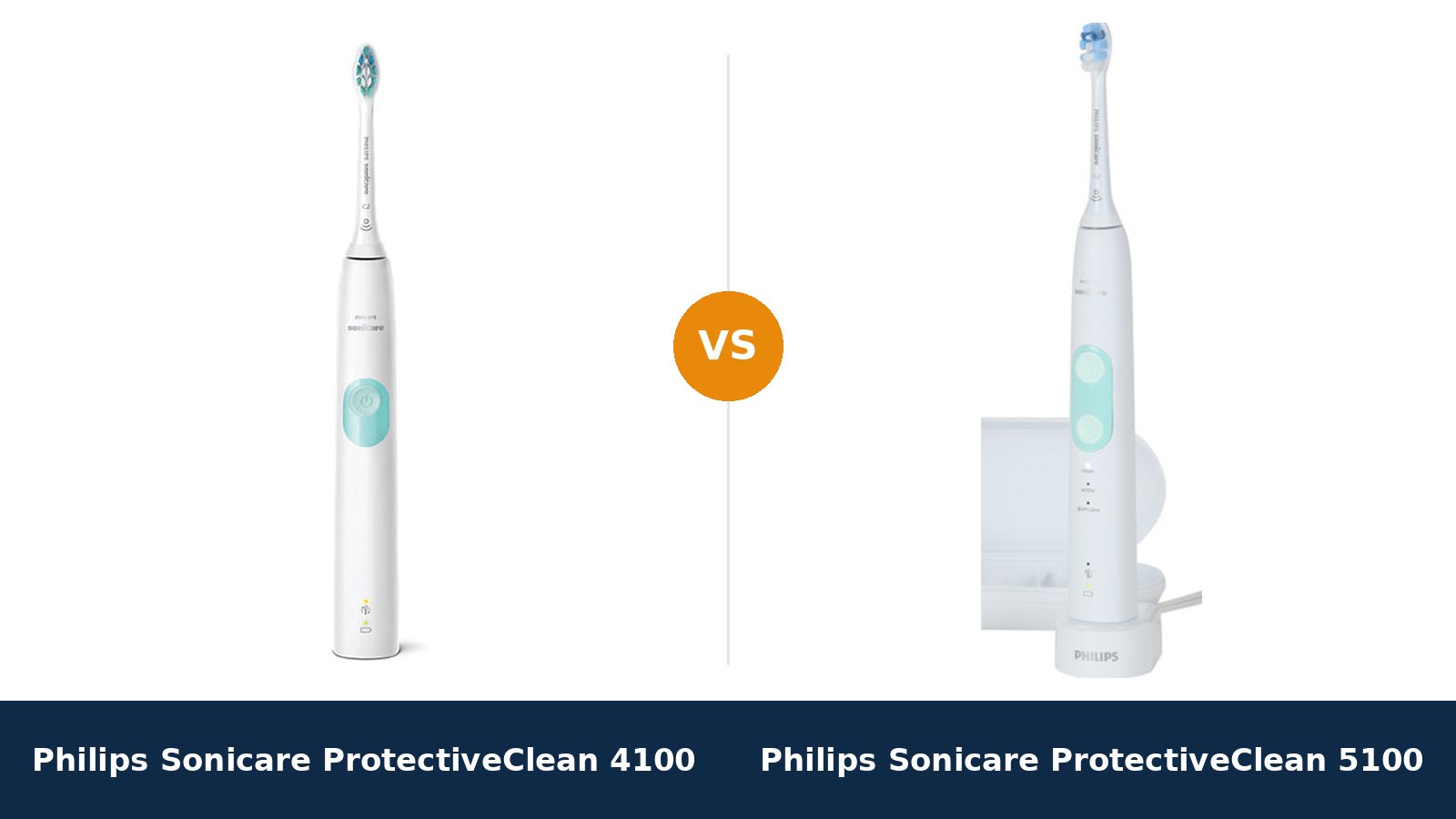
Same handle shape. Same sonic motor. Same two-week battery.
Put the Philips Sonicare ProtectiveClean 4100 and the ProtectiveClean 5100 side by side and they look like the same toothbrush at two prices. In the ways that decide how your teeth actually get cleaned, they nearly are.
What separates them is narrower and more specific: how many brushing programs the handle runs, which brush head sits in the box, and whether a travel case comes with it. Everything else — the pressure sensor, the timers, the battery, the warranty — is shared.
First, pin down which brushes these are. Philips has reused its series numbers across generations, and the names are a trap. This comparison covers the ProtectiveClean pair: the 4100 (US model HX6817/01 in White & Mint) and the 5100 (HX6857/11), the long-running US retail models behind the “4000 vs 5000” question.
A newer, unrelated Philips Sonicare 4100 Series (HX3681) and a newer Sonicare 5000 also exist. They are different brushes with different charging and different features, and they get their own warning in the Similar Names section below. Check the HX number on any listing before you buy.
Every specification in this guide comes from Philips’ own published data — its product pages and the ProtectiveClean manuals. The verdict at the end is the same one we would give a friend spending their own money.
Key Takeaways
- The core clean is identical. Same sonic drive at up to 62,000 brush movements per minute, same pressure sensor, same SmarTimer and QuadPacer.
- The 5100’s real upgrade is programs: three modes (Clean, White, Gum Care) against the 4100’s single Clean mode.
- The bundled head aims each brush at a different job — the 4100 ships with a C2 plaque-control head; the 5100 with a G2 gum-care head and a travel case.
- BrushSync does less than the marketing implies. On both brushes it is a replacement reminder only. Automatic mode pairing lives on the 6100 and 6500, not here.
- Battery, charger, heads and warranty are a dead tie. Do not let either brush be sold to you on those.
Quick Verdict
Buy the Philips Sonicare ProtectiveClean 5100 for the more complete brush. It adds the two programs that actually change a routine.
Its Gum Care mode runs a longer, gentler cycle built around the gumline. Its White mode is a dedicated stain-polishing program. It also bundles the gum-care head and the travel case the 4100 leaves out.
If your dentist keeps talking about your gums, this is the one. It is not close.
Buy the Philips Sonicare ProtectiveClean 4100 if you will only ever brush on Clean. Most people do.
You keep the same motor, the same pressure sensor, the same timers and the same battery for the lowest price in the ProtectiveClean line. What you give up is programs you may never touch — and a case you can buy separately.
The Scorecard
Scores below are derived directly from the manufacturer specifications compared in this guide — mode counts, included accessories, battery and compatibility data published by Philips. They are a reading aid, not clinical results.
| Category | ProtectiveClean 4100 | ProtectiveClean 5100 | ||
|---|---|---|---|---|
| Cleaning performance (spec basis) | 8 / 10 | 8 / 10 | ||
| Modes & features | 5 / 10 | 9 / 10 | ||
| Ease of use | 9 / 10 | 8 / 10 | ||
| Battery & charging | 8 / 10 | 8 / 10 | ||
| Brush-head ecosystem | 9 / 10 | 9 / 10 | ||
| Travel readiness | 6 / 10 | 8 / 10 | ||
| Value | 9 / 10 | 8 / 10 | ||
| Overall | 7.7 / 10 | 8.3 / 10 | ||
The pattern is consistent. The 5100 wins on the programs and the box contents. The 4100 wins on simplicity and price — and ties everywhere the hardware is actually doing the cleaning.
At a Glance: Who Each Brush Fits
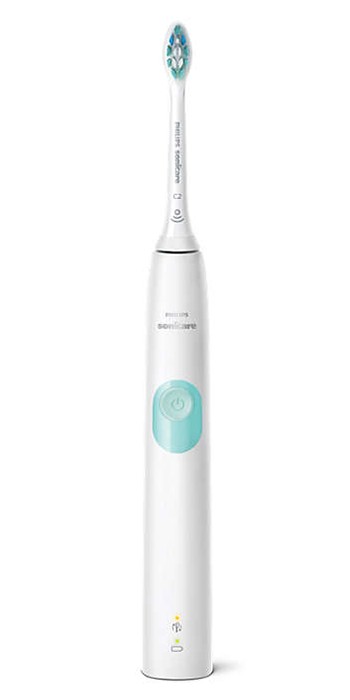
Philips Sonicare ProtectiveClean 4100
- One Clean mode — a single button, nothing to configure
- Pressure sensor and BrushSync replacement reminder
- C2 Optimal Plaque Control head in the box
- Up to 2 weeks per charge; multi-voltage charger
- No travel case included
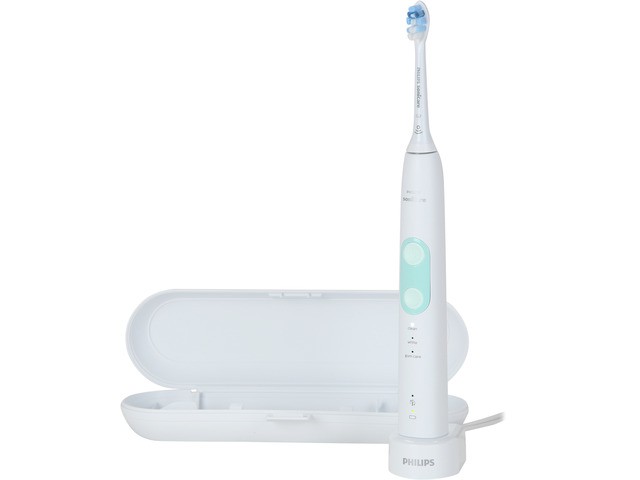
Philips Sonicare ProtectiveClean 5100
- Three modes: Clean, White and Gum Care
- Pressure sensor and BrushSync replacement reminder
- G2 Optimal Gum Care head in the box
- Travel case included, plus the same charger
- Up to 2 weeks per charge
Choose the ProtectiveClean 4100 if…
You brush twice a day on the standard program and have never once wished your toothbrush did more. You are switching from a manual brush and want the simplest possible landing.
You want the full ProtectiveClean safety net — pressure sensor, timers, head reminder — at the lowest price in the range.
Or your current brush lives on its charger at home and never travels. A case you will not use is worth nothing.
Choose the ProtectiveClean 5100 if…
Your dentist mentions your gums at every visit. The Gum Care program and the G2 head are aimed squarely at you.
You drink coffee, tea or red wine and want a dedicated White program for surface stains, not just a daily clean.
Or you travel with your brush and want the case in the box rather than as an afterthought.
As an Amazon Associate I earn from qualifying purchases at no extra cost to you.
Specifications: The Specs That Actually Matter
Every figure below is taken from Philips’ published specifications and the ProtectiveClean manuals, cross-checked against the manufacturer’s product data.
Both brushes are covered in several colour and packaging variants. The table reflects the mainstream US retail versions named in the introduction; the variants get their own note under the table.
| Specification | Philips Sonicare ProtectiveClean 4100 | Philips Sonicare ProtectiveClean 5100 |
|---|---|---|
| US model number | HX6817/01 (White & Mint) | HX6857/11 (White & Mint) |
| Brushing modes | 1 — Clean | 3 — Clean, White, Gum Care |
| Mode length | Clean: 2 minutes | Clean: 2 min • White: 2 min 30 sec • Gum Care: 3 min |
| Intensity settings | None — single intensity | None — the modes change the program, not a separate intensity dial |
| Sonic speed | Up to 62,000 brush movements/min | Up to 62,000 brush movements/min |
| Pressure sensor | Yes — handle changes its vibration when you press too hard | Yes — same system |
| Timers | SmarTimer (2-minute) + QuadPacer (30-second) | SmarTimer (2-minute) + QuadPacer (30-second) |
| BrushSync | Replacement reminder — smart head chip tracks use and brushing pressure | Replacement reminder — same system |
| BrushSync mode pairing | No | No — mode pairing is a ProtectiveClean 6100/6500 feature |
| Brush head included | C2 Optimal Plaque Control | G2 Optimal Gum Care |
| Philips’ headline claim (bundled head) | Removes up to 7× more plaque than a manual toothbrush | Improves gum health up to 100% more vs a manual toothbrush; up to 3× more plaque removal along the gumline |
| Battery | Lithium-ion, up to 2 weeks per charge | Lithium-ion, up to 2 weeks per charge |
| Charging | Charging base, 100–240 V multi-voltage | Charging base, 100–240 V multi-voltage |
| Battery indicator | Yes — charge light on the handle | Yes — charge light on the handle |
| Travel case | Not included | Included |
| Brush head compatibility | All Sonicare click-on heads | All Sonicare click-on heads |
| Water resistance | Handle rinses clean under the tap; Philips publishes no IP rating | Handle rinses clean under the tap; Philips publishes no IP rating |
| Warranty | 2-year limited warranty | 2-year limited warranty |
| In the box | Handle, C2 head, charger | Handle, G2 head, charger, travel case |
Variant note: the 4100 also comes in Black (HX6810/50) and Pink (HX6815/01); the 5100 in Black/Gray (HX6850/60). Colour changes nothing but colour — the handles, modes and batteries are identical within each model.
The 5100 additionally appears as the ProtectiveClean 5300, which is the same handle bundled with extra brush heads, and in a Frustration-Free Packaging variant (HX6857/32). Same brush, different box. The buying guide below explains how to price the difference.
The Differences That Actually Matter
1. Brushing modes — the whole ballgame
The 4100 runs one program: Clean, a two-minute cycle at full power. That is the entire menu. There is no mode button on the handle because there is nothing to switch to.
The 5100 runs three. Clean is the same two-minute standard. White runs two minutes thirty, working harder on the front teeth to polish away surface stains. Gum Care runs three minutes — the standard clean plus an extra minute at reduced power, massaging along the gumline.
Philips built the 5100 around gum health. Its product page leads with the claim that it improves gum health up to 100% more than a manual toothbrush, and the Gum Care mode is where that claim lives.
Be honest about your own habits before paying for modes. A mode you use twice and forget is worth nothing. A Gum Care cycle you run every evening because your hygienist told you to is worth a great deal.
2. The bundled head aims each brush at a different job
Each box opens on a different brush head, and it is not an accident. The 4100 ships with the C2 Optimal Plaque Control head — Philips’ plaque-focused head, and the one behind its claim of up to 7× more plaque removal than a manual brush.
The 5100 ships with the G2 Optimal Gum Care head, shaped and cushioned for work along the gumline. Philips credits that pairing with up to 3× more plaque removal along the gumline than a manual brush.
Here is what the box contents do not lock in: the heads are interchangeable. A G2 clicks onto the 4100 in one second; a C2 clicks onto the 5100.
So the bundled head is a starting direction, not a destiny. It matters most in the first three months — and it tells you plainly which buyer Philips thinks each brush is for.
3. Controls — one button against two
The 4100 has a single power button. Press it, brush, done. There is no setting to be wrong about, no mode to leave accidentally parked on White for a month.
The 5100 adds a mode button under the power button, with mode indicators down the handle. Cycling to the program you want takes a second once you know the order — Clean, White, Gum Care.
Neither handle has an intensity dial. That feature starts at the ProtectiveClean 6100. On both of these brushes, gentleness comes from the program and the head, not from turning the power down.
For a first-time electric brush user, the 4100’s simplicity is a genuine feature. For anyone who will actually use the programs, the 5100’s extra button earns its place within a week.
4. BrushSync — a reminder, not a co-pilot
Both handles carry BrushSync, and both do exactly the same job with it. BrushSync heads carry a microchip. The handle tracks how long the head has been in use and how hard you have been brushing.
When the head is due — around the three-month mark Philips recommends — the reminder light glows and the handle beeps. It is a genuinely useful nudge, because worn heads clean worse and almost nobody tracks the date.
What neither brush does is BrushSync mode pairing. On the ProtectiveClean 6100 and 6500, the handle reads the head and selects its mode automatically. On the 4100 and 5100, you pick the mode yourself.
Some retail copy blurs this distinction. Do not pay a 5100 premium expecting the brush to think for you. It reminds; it does not decide.
5. Travel — the case is the difference, not the charger
The 5100 includes a travel case. The 4100 does not. That is the visible gap, and for anyone who flies with their brush it settles this section on its own — a bare brush in a wash bag picks up lint and switches itself on.
Underneath, travel readiness is shared. Both chargers are multi-voltage (100–240 V), so either brush charges anywhere in the world with a simple plug adapter.
Both batteries run up to two weeks on a charge. For most trips, the correct travel accessory is no charger at all — charge before you leave and travel light.
Verdict: the 5100 wins travel on the case alone. If you never travel, this entire section is worth zero and should not move your decision.
6. Battery and charging — an honest tie
Same lithium-ion battery platform. Same Philips figure: up to two weeks of brushing per charge, at two two-minute sessions a day.
Same charging base in the box. Same battery charge light on the handle, so neither brush dies without warning.
Philips advises a full 24-hour charge before first use on this platform. After that, most owners simply live with the brush on its base and never think about the battery again.
One shared long-term truth: the battery is sealed inside the handle and is not a user-replaceable part. When it eventually fades years from now, it will be handle-replacement time for both brushes equally.
7. The clean itself — why the motor will not decide this
Strip away the programs and the packaging and both brushes are the same machine. Same sonic drive, rated by Philips at up to 62,000 brush movements per minute. Same pressure sensor, which changes the handle’s vibration when you push too hard. Same SmarTimer that ends the session at two minutes, same QuadPacer that nudges you to a new quadrant every 30 seconds.
Both carry Philips’ EasyStart feature, which ramps the power up gently over your first 14 brushings — a kindness if you are arriving from a manual brush.
Either handle, fitted with the same head and run on Clean, delivers the same clean. Philips’ own claims differ between the two because the bundled heads differ, not because one drive unit outpowers the other.
So buy the difference that exists: programs, head and case. Do not pay for a cleaning gap that the spec sheet does not contain.
Who Each Brush Suits: The Fit Guide
The fastest way to choose between these brushes is to start from your mouth and your routine. This table is the whole comparison in one view.
| Your situation | ProtectiveClean 4100 | ProtectiveClean 5100 | Our call |
|---|---|---|---|
| First electric toothbrush; you want zero fuss | Excellent — one button, nothing to set | Good — one extra button to learn | ProtectiveClean 4100 |
| Gum care is the priority — tender gums, hygienist keeps flagging the gumline | Good — a G2 head fits, but there is no Gum Care program | Excellent — Gum Care mode plus the G2 head in the box | ProtectiveClean 5100 |
| Sensitive teeth | Good — fit an S Sensitive head | Excellent — Gum Care runs a gentler program; S Sensitive head fits too | ProtectiveClean 5100 |
| Surface stains from coffee, tea or wine | Fair — no White mode; a W head helps only so far | Excellent — dedicated White program | ProtectiveClean 5100 |
| Frequent travel | Good — two-week battery, but no case | Excellent — case included, same battery | ProtectiveClean 5100 |
| Tightest budget | Excellent — the line’s entry price with the full safety net | Fair — you pay for programs and the case | ProtectiveClean 4100 |
| Braces or dental work | Excellent — Philips rates the platform safe on orthodontics and dental work; pressure sensor guards your gums | Excellent — same platform, same sensor | Either — choose on modes and budget |
Read the gum-care row carefully. It is the one need the 4100 genuinely cannot answer, because a program cannot be added with a brush head. Everything else on the table is a matter of degree.
Ready to check today’s price?
Both brushes sell through Amazon. Prices move, so check the live figure on the brush that fits your routine.
View on Amazon — ProtectiveClean 4100View on Amazon — ProtectiveClean 5100The 30-Second Decision
| If this sounds like you… | Buy this |
|---|---|
| “I just want a proper electric clean, as simple as possible.” | ProtectiveClean 4100 |
| “My dentist keeps talking about my gums.” | ProtectiveClean 5100 |
| “I want one brush that covers cleaning, stains and gum care.” | ProtectiveClean 5100 |
| “I travel for work and my brush comes with me.” | ProtectiveClean 5100 (case included) |
| “Lowest price, and I will never use extra modes.” | ProtectiveClean 4100 |
| “I keep forgetting to change my brush head.” | Either — both have the BrushSync replacement reminder |
What You Gain. What You Give Up.
Philips Sonicare ProtectiveClean 4100
You gain: the lowest price in the ProtectiveClean line with nothing about the core clean trimmed — same sonic drive, pressure sensor, timers, BrushSync reminder and two-week battery. Plus the simplest control layout Philips sells: one button.
You give up: the White and Gum Care programs, permanently — no head or accessory adds a mode later. And the travel case, which you will have to buy separately if you travel.
Philips Sonicare ProtectiveClean 5100
You gain: three programs that map to real routines — daily cleaning, stain polishing and a longer, gentler gum-care cycle. The gum-care head in the box. A travel case included instead of sold separately.
You give up: money, for features whose value depends entirely on your habits. And a little simplicity: a second button and a mode order to learn. If the handle lives on Clean forever, you bought the 4100’s clean at a higher price.
Pros and Cons
ProtectiveClean 4100 — Pros
- Same sonic drive and pressure sensor as the 5100
- One-button simplicity — nothing to misconfigure
- BrushSync replacement reminder included
- Two-week battery, multi-voltage charger
- Lowest price in the ProtectiveClean line
Cons
- One mode only — no White or Gum Care program
- No travel case in the box
- No intensity settings
- Bundled C2 head is plaque-focused; gum-focused users will swap it
ProtectiveClean 5100 — Pros
- Three modes, including a genuine gum-care program
- G2 gum-care head bundled
- Travel case included
- Same pressure sensor, timers and two-week battery
- Mode indicators on the handle
Cons
- Costs more for the same core clean
- No intensity settings — that step up is the 6100
- No BrushSync mode pairing, despite the smart heads
- Mode value depends entirely on your routine
Check the Model Number and the Bundle, Not Just the Name
Check the HX number. “Sonicare 4100” names more than one brush. This comparison is the ProtectiveClean 4100, HX6817/01 in White & Mint (Black is HX6810/50).
A different, newer brush is sold as the Philips Sonicare 4100 Series, HX3681. It charges over USB, runs one mode with two intensity settings, and is not the product reviewed here. A newer Sonicare 5000 (HX4042/81) also exists and is likewise a different product from the ProtectiveClean 5100.
Match the full model number on the listing to the brush you intend to buy. The HX code is printed on the bottom of every handle.
Price the 5300 bundle honestly. The ProtectiveClean 5300 is this same 5100 handle with extra brush heads in the box — typically three heads in total.
If a 5300 listing costs less than a 5100 plus the extra heads bought separately, it is the smarter buy of the identical brush. If it costs more, it is packaging, not an upgrade.
Check the packaging variant. The 5100 also ships as HX6857/32 in Frustration-Free Packaging. The brush, head, case and charger are the same; only the retail box changes.
Buy heads, not handles, for the long term. Philips recommends a new head every three months, and both handles take the full click-on range — C2 and C3 plaque heads, G2 and G3 gum heads, W white heads, S Sensitive.
The BrushSync reminder only works with BrushSync smart heads. Fit a plain compatible head and the brush still cleans; it simply cannot track that head’s age for you.
The Running-Cost and Longevity Test
Judge an electric toothbrush by its third year, not its first week.
Year one, both brushes feel identical on Clean with the same head fitted. Nobody could separate them blindfolded.
The running costs are identical too. Same heads at the same replacement rhythm — four heads a year, whichever handle you own. The 5100’s higher purchase price is a one-time event; it never widens.
What changes over time is the routine. Gums that are fine at 30 get comments from the hygienist at 40. The 5100’s Gum Care program is already in the handle when that conversation starts; the 4100 owner is shopping for a new brush.
And the honest ceiling for both: neither battery is user-replaceable, and neither handle offers intensity adjustment or app coaching. When you outgrow them, you outgrow them together — the step up is a new handle, not an accessory.
When to Skip Both
Honesty cuts both ways. There are buyers neither of these brushes serves best.
Skip both if you want intensity control. The ProtectiveClean 6100 adds three intensity levels to this same three-mode platform, and the 6500 adds a charging travel case on top.
Skip both if you want an app looking over your shoulder. Philips keeps its connected coaching in the DiamondClean Smart and ExpertClean lines; neither ProtectiveClean handle talks to your phone.
Skip both if you prefer a rotating-oscillating brush head. That is Oral-B’s design, and it is a legitimate preference — this comparison cannot settle it for you.
And skip both if the budget is truly minimal and a basic sonic clean is all you need. Philips’ own entry models below the ProtectiveClean line cover that ground for less.
For everyone else — which is most people moving up from a manual brush — one of these two is the right answer. The only question is whether your routine will use the 5100’s programs.
Final Verdict
The Philips Sonicare ProtectiveClean 5100 is the brush we would buy.
It wins this comparison on the only differences the spec sheet actually contains. Three programs instead of one — and one of them, Gum Care, answers the single most common instruction dentists give: look after your gumline.
The gum-care head and the travel case in the box complete the package. Nothing about the win is mysterious, and nothing about it is exaggerated: it is the same clean, with more ways to aim it.
Buy the 5100 for gum care, stain care, travel, and any routine that goes beyond the daily default.
View on Amazon — ProtectiveClean 5100
Buy the 4100 if Clean is the only program you will ever run. If the brush never travels. Or if the price gap on the day you order is wide enough to buy a year of replacement heads instead.
It is the same platform with the trimmings removed, and for a disciplined twice-a-day brusher, the trimmings are exactly that.
View on Amazon — ProtectiveClean 4100
Watch Out: Similar Names, Different Brushes
Sonicare naming is a trap for the hurried buyer. Four warnings belong in every version of this guide.
First: the ProtectiveClean 4100 is not the Philips Sonicare 4100 Series (HX3681). The Series brush is a newer, separate entry model with USB charging and two intensity settings on its single mode. The ProtectiveClean is the older platform with the charging base.
Second: the ProtectiveClean 5100 is not the newer Philips Sonicare 5000 (HX4042/81). Philips has launched a fresh 5000 with two modes and two intensities under a very similar name. Different brush, different box, different listing.
Third: the ProtectiveClean 5300 is not a better 5100. It is the same 5100 handle with extra brush heads bundled. Compare it on price per head, never on features.
Fourth: the rest of the family ladder is real. The ProtectiveClean 4300 is a one-mode sibling sold through some retailers; the 6100 adds three intensity levels; the 6500 adds a charging travel case. Each step exists — just know which one a listing is actually selling.
Slow down on the product page. Match the full model name, then the HX number, then the price — in that order.
Charging, Bathroom and Travel Notes
Both handles rinse clean under the tap after brushing. Philips publishes no IP rating for either handle, so treat them as bathroom-proof for rinsing and splashes, and keep the charger base dry — unplug it before you wipe it down.
The charger is the travel sleeper feature: 100–240 V input means either brush charges on any mains supply worldwide with a basic plug adapter. No converter needed.
Two weeks of battery is the other travel feature. For a trip shorter than a fortnight, leave the charger at home entirely — one less cable, and the 5100’s case earns its keep.
Store heads upright and let them air-dry. The BrushSync reminder assumes a head fitted to the handle it can track; swapping heads between two household handles will confuse nobody’s cleaning, but it does blur the reminder’s maths.
Warranty and Long-Term Support
Both brushes carry Philips’ 2-year limited warranty. Identical cover, identical terms — support is a tie.
Both sit on Philips’ standard support pages: manuals, FAQs and replacement-part listings keyed to the HX number on the handle. Registering the brush with Philips is a two-minute job and worth doing while the box is open.
Philips’ support answers the battery question plainly: the battery is built in and not replaceable by the user. Budget for these brushes as multi-year appliances, not lifetime tools — which, at this end of the range, is a fair trade.
One habit worth keeping: keep the model number somewhere other than the handle. If support ever asks, HX6817/01 and HX6857/11 are the two answers this guide is built on.
Frequently Asked Questions
What is the difference between the ProtectiveClean 4100 and 5100?
Programs and packaging. The 5100 has three brushing modes (Clean, White, Gum Care) against the 4100’s single Clean mode, and it bundles a G2 gum-care head and a travel case where the 4100 bundles a C2 plaque head and no case. The motor, pressure sensor, timers, battery, charger and warranty are the same on both.
Does the 5100 clean better than the 4100?
On the standard Clean program, no. Both handles use the same sonic drive at up to 62,000 brush movements per minute, and Philips’ different headline claims reflect the different bundled heads, not different power. The 5100’s advantage is its extra programs — Gum Care and White — not a stronger clean.
Does the 5100 select the right mode automatically with BrushSync heads?
No. That feature, BrushSync mode pairing, belongs to the ProtectiveClean 6100 and 6500. On the 4100 and 5100, BrushSync does one job: the smart head’s chip lets the handle track usage and remind you when the head is due for replacement.
Is the ProtectiveClean 5300 better than the 5100?
It is the same brush. The 5300 is the 5100 handle bundled with extra brush heads — typically three in the box. Buy whichever works out cheaper once you count the value of the spare heads; the features are identical.
How long does the battery last, and can it be replaced?
Philips rates both handles at up to two weeks per charge, based on two two-minute brushings a day. The battery is sealed into the handle and Philips does not offer a user replacement, so an exhausted battery years from now means a new handle for either brush.
Can I use any Sonicare brush head on both handles?
Yes — every standard Sonicare click-on head fits both, including the C2/C3 plaque, G2/G3 gum care, W white and S Sensitive heads. The exception is the separate Philips One line, which uses its own heads. The BrushSync replacement reminder only works with BrushSync smart heads.
Are these toothbrushes waterproof?
Philips designs both handles to be rinsed under the tap and lived with in the bathroom, but publishes no IP rating for either. Rinse the brush freely; keep the charger base dry and unplug it before cleaning it.
Is the newer Philips Sonicare 4100 Series the same as the ProtectiveClean 4100?
No. The 4100 Series (HX3681) is a newer, different entry-level brush with USB charging and two intensity settings. The ProtectiveClean 4100 in this comparison is HX6817/01, with a charging base and a single Clean mode. A newer Sonicare 5000 (HX4042/81) likewise differs from the ProtectiveClean 5100. Always check the HX number on the listing.
Sources & Verification
Philips Sonicare ProtectiveClean 5100 official product page, usa.philips.com (HX6857/11) • Philips Sonicare ProtectiveClean 4100/5100 user manuals (HX681/HX685 families) — modes, BrushSync, pressure sensor, charger ratings • Philips BrushSync brush head pages (C2, G2) for head claims and compatibility • Philips retail product data for HX6817/01 and HX6857/11 (ASIN-verified listings). Specifications verified November 2026.

James Wilson
James has been researching and comparing consumer products for over a decade and writes Honestly Compared’s head-to-head guides. His rule for every comparison: the verdict has to survive the spec sheet, not the marketing page.