
Vitamix Professional Series 750 vs Vitamix 7500: Which Should You Buy?
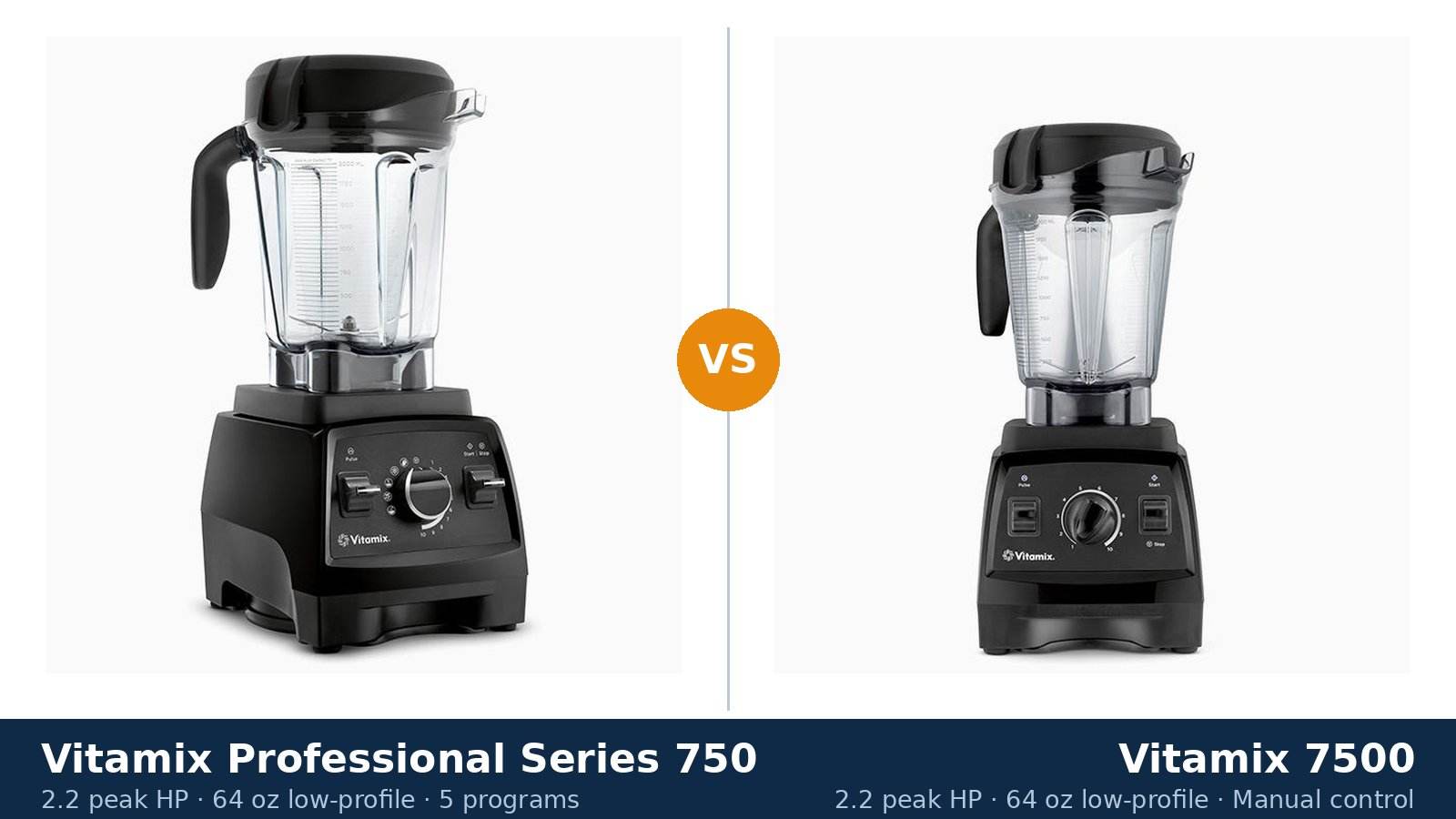
Three different Vitamix blenders answer to a name built around “750”. Only two of them are in this comparison, and telling them apart is half the battle.
The Professional Series 750 — model 1957 — is the flagship of Vitamix’s G-Series generation. The 7500 — model VM0158 — is its manual-control sibling from the same generation.
Under the control panels, they are the same machine. Same 2.2 peak horsepower motor. Same wide 64 oz low-profile container. Same 4-inch blade, same sound-dampened base, same 7-year full warranty.
The entire hardware difference sits in one dial. Turn the 750’s dial to the left and you get five automatic programs. The 7500’s dial only turns up the speed.
One warning before we start: the third namesake, today’s Propel Series 750, is a different, newer blender. It is not in this comparison, and it gets its own warning in the buying guide below.
Key Takeaways
- Same machine underneath. Identical 2.2 peak HP motor, 64 oz low-profile jar, 4-inch blades, dampened G-Series base and 7-year full warranty on new units.
- The 750 adds five programs. Smoothies, Frozen Desserts, Hot Soups, Purées and Cleaning — timed cycles that stop on their own.
- The 7500 is purely manual. Ten variable speeds and a Pulse switch. Nothing automatic, nothing to go wrong.
- Neither jar goes in the dishwasher. Both owner’s manuals say so, whatever retail listings claim.
- Both are legacy models now. You are buying remaining stock or a reconditioned unit, and the warranty answer depends on which route you take.
Quick Verdict
Buy the Professional Series 750 if you want the blender to do the timing. Its five programs ramp, hold and stop on their own — set a soup going and walk away.
It is the more complete machine, and on specifications it wins this comparison. Its Amazon listing is the original retail listing for the Black model 1957; the model is discontinued, so offers there are remaining stock.
Buy the 7500 if you blend by eye and ear. The motor, jar and blade doing the work are identical, so the results in the container are the same.
Know its channel before you buy: the 7500’s original listing currently shows no featured offers, so most buyers will meet this machine as marketplace stock or through Vitamix’s Certified Reconditioned programme — where the warranty is 5 years, not 7.
The Scorecard
Scores below are derived directly from the manufacturer specifications compared in this guide — motor ratings, program counts, container data and published dimensions. They are a reading aid, not benchmark results.
| Category | Professional Series 750 | 7500 | ||
|---|---|---|---|---|
| Power & motor | 9 / 10 | 9 / 10 | ||
| Capacity & container | 9 / 10 | 9 / 10 | ||
| Programs & automation | 10 / 10 | 4 / 10 | ||
| Ease of use | 9 / 10 | 8 / 10 | ||
| Cleaning | 8 / 10 | 7 / 10 | ||
| Footprint & storage | 8 / 10 | 8 / 10 | ||
| Value | 7 / 10 | 8 / 10 | ||
| Overall | 8.4 / 10 | 8.0 / 10 | ||
Read the table honestly and it tells one story: five tied rows, one rout, and a value row that runs the other way. The 750 wins because blending is the only row where the two machines actually differ in hardware.
At a Glance: Who Each Blender Fits
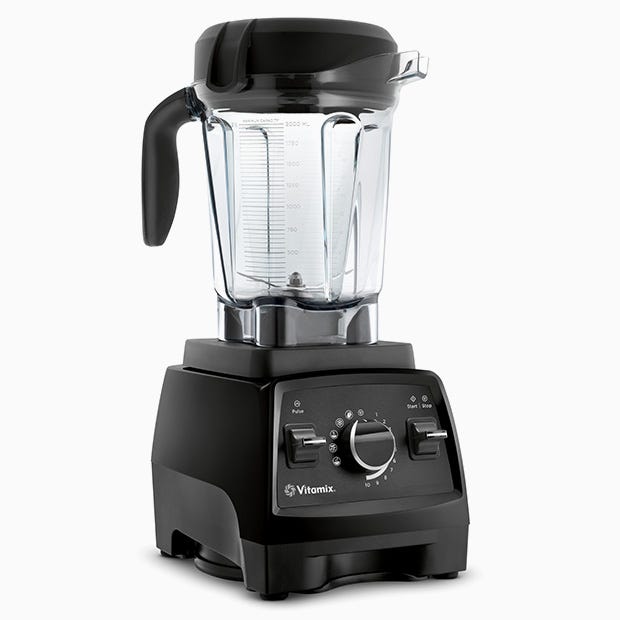
Vitamix Professional Series 750
- 2.2 peak HP motor, 12 A — same as the 7500
- Five programs: Smoothies, Frozen Desserts, Hot Soups, Purées, Cleaning
- Ten variable speeds plus Pulse that also works with programs
- 64 oz low-profile container, 4-inch stainless blades
- 7-year full warranty on new units
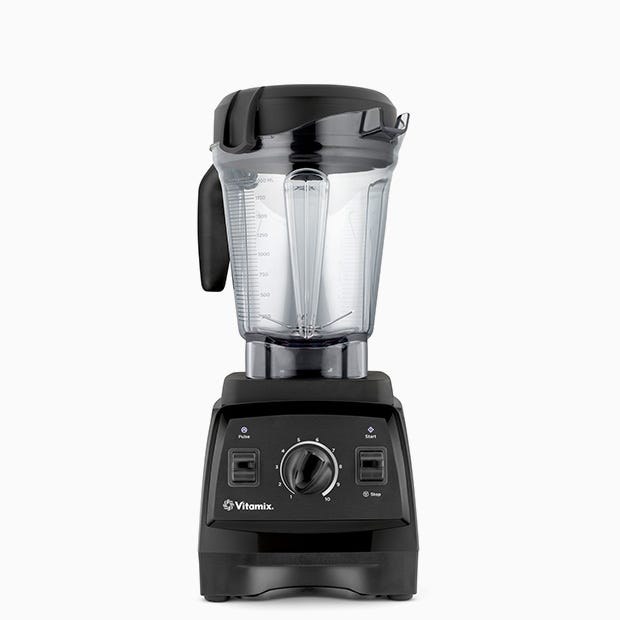
Vitamix 7500
- 2.2 peak HP motor, 12 A — same as the 750
- No programs: ten variable speeds and Pulse, fully manual
- 64 oz low-profile container, 4-inch stainless blades
- Sound-dampened G-Series base, metal drive system
- 7-year full warranty new; 5 years Certified Reconditioned
Choose the Professional Series 750 if…
You make soup, frozen desserts or purées often, and you want a timed cycle that stops itself.
You share the blender with a household. A program icon is easier to hand over than a feel for speed 6.
You are buying used or remaining stock anyway, and you would rather have the flagship version of this platform.
Choose the 7500 if…
You blend smoothies and sauces and judge doneness by looking at them.
You want the simpler control panel — one dial, two switches, nothing programmed to fail.
Or you are shopping the Certified Reconditioned route, where the 7500-class machine is the one that programme usually offers.
As an Amazon Associate I earn from qualifying purchases at no extra cost to you.
Specifications: The Specs That Actually Matter
Every figure below comes from Vitamix’s own G-Series owner’s manual (VM0158, which covers both machines) and Vitamix’s published product data for each model.
Where retail listings disagree with the manual, the manual wins — and the disagreements are noted under the table, because two of them are traps.
| Specification | Vitamix Professional Series 750 | Vitamix 7500 |
|---|---|---|
| Series / model | G-Series, model 1957 | G-Series, model VM0158 |
| Motor | 2.2 peak horsepower | 2.2 peak horsepower |
| Electrical | 120 V, 12 A (no wattage published; 1,440 W maximum draw) | 120 V, 12 A (no wattage published; 1,440 W maximum draw) |
| Programs | 5: Smoothies, Frozen Desserts, Hot Soups, Purées, Cleaning | None |
| Speed settings | 10 variable speeds + Pulse (Pulse also works with programs) | 10 variable speeds + Pulse |
| Controls | Dial turns left for programs, right for speeds; Pulse and Start/Stop switches; illuminated symbols | Central 1–10 dial; Pulse switch left, Start/Stop switch right |
| Container capacity | 64 oz low-profile | 64 oz low-profile |
| Container material | BPA-free Eastman Tritan copolyester | BPA-free Eastman Tritan copolyester |
| Blades | 4-inch laser-cut stainless steel, hammermill and cutting | 4-inch laser-cut stainless steel, hammermill and cutting |
| Drive system | Metal drive system | Metal drive system |
| Dimensions (H × W × D) | 17.4 × 7.7 × 9.4 in | 17.5 × 7.7 × 9.1 in |
| Weight | 12.5 lb | 12.5 lb |
| Cord | 6 ft, stores under the base | 6 ft, stores under the base |
| Dishwasher-safe parts | None per the manual — self-clean cycle only | None per the manual — self-clean only |
| Warranty | 7-year full (new); 5-year full Certified Reconditioned | 7-year full (new); 5-year full Certified Reconditioned |
Dishwasher note: Vitamix’s current 7500 product page calls the container dishwasher-safe, and retail copy repeats that claim for both machines. Both are contradicted by the G-Series owner’s manual, which instructs: do not put the container, lid, lid plug or tamper in the dishwasher. The manual governs — treat both jars as self-clean and hand-wash only.
Dimension note: the manual gives the 7500’s depth as 9.1 in; manufacturer-fed retail tables widely print 9.4 in. The 750’s height is 17.4 in in the manual and 17.5 in on a Vitamix-fed dealer spec sheet. Either way, both machines stand about 17.5 in tall and fit under standard wall cabinets.
Wattage note: Vitamix publishes no wattage for either machine — only 2.2 peak HP and a 12 A rating, a 1,440 W maximum draw. Retail copy variously claims 1,500 W, 1,600 W or 1,640 W for these models. None of those figures is Vitamix’s, and none is used here.
The Differences That Actually Matter
1. The name trap — three blenders, one number
Start here, because most bad purchases in this comparison happen before any blending does.
“750” on its own is the Professional Series 750 in this article: G-Series, model 1957, five programs, sold through the 2010s and now discontinued.
“7500” is a different G-Series model, VM0158, with no programs at all. It is not a newer or bigger version of the 750 — the numbers were never a sequence.
And the Propel Series 750, Vitamix’s current mid-range machine, is a third blender again: a G-Series 2.0 design with four programs plus a self-cleaning program. It is not compared here.
The practical test takes two seconds. Look at the dial. Program icons around the left of it: Professional Series 750. A plain 1-to-10 dial: the 7500. That single look settles any listing, photo or marketplace description.
2. Programs — the only real hardware difference
Everything else in this article is context. This section is the comparison.
The 750’s dial turns two ways. Right of centre: ten variable speeds, like the 7500. Left of centre: five programs — Smoothies, Frozen Desserts, Hot Soups, Purées and Cleaning.
Each program is a timed, self-managing cycle. The smoothie program runs about 45 seconds; frozen desserts about 55; purées about a minute; hot soups about five minutes forty-five, long enough for blade friction to bring the soup to serving temperature. Then the machine stops itself.
The 7500 asks you to do all of that by hand. Ramp the dial up, watch the texture, stop when it looks right.
To be clear about what programs are not: they are not more power. The 7500 reaches every speed the 750’s programs use, and its Pulse switch gives the same short bursts — the 750’s Pulse additionally works on top of a running program.
What programs buy is repeatability and absence. The same smoothie at 6 a.m. without watching it. A soup you can walk away from. A guest or teenager who can operate the blender from an icon instead of an apprenticeship.
What they cost is a more complex control board in a machine you may keep for fifteen years. Plenty of owners reasonably prefer the 7500’s position: there is no program to fail because there are no programs.
3. Motor, jar and blade — a genuine tie
Most comparisons hunt for a performance gap. Here, there isn’t one, and we will not invent one.
Both machines run the same 2.2 peak horsepower G-Series motor on a 12 A electrical rating, with the same radial cooling fan and thermal overload protection.
Both drive the same container: the wide 64 oz low-profile jar in BPA-free Tritan, with the same 4-inch laser-cut stainless-steel blade assembly and the same metal drive system.
That jar shape is the real performance story of this generation. It is wider and shorter than the classic tall container, so ingredients fold back into the blades with less tamper work, and the whole machine stands short enough for standard cabinets.
Both bases also carry the G-Series sound-dampening design — the quieter housing was this generation’s headline improvement over the older C-Series machines.
Same motor, same jar, same blade, same housing: anything one of these machines blends well, the other blends identically. Anyone who tells you the 750 blends “better” is selling you the dial, not the result.
4. Cleaning — a program against a habit
Neither container goes in the dishwasher. The manual is explicit for both, and the retail copy saying otherwise is one of the traps flagged under the spec table.
Day to day, both machines clean the Vitamix way: warm water, a drop of washing-up liquid, run, rinse.
The 750 automates even that. Its fifth program, Cleaning, runs the cycle for you and stops.
The 7500 owner does the same thing manually — half a minute or so at high speed does the identical job. The difference is a button’s worth of effort, which is why the cleaning scores sit one point apart rather than five.
One shared caution: the wide low-profile jar’s blade assembly is not a removable, dishwasher-friendly part on either machine. A bottle brush earns its place next to both.
5. Size and footprint — measure the depth, not the height
Both machines weigh 12.5 lb and stand about 17.5 in tall with the jar on — low-profile by design, and short enough for the standard 18-inch counter-to-cabinet gap.
The manual figures put the 750 at 17.4 in tall and 9.4 in deep, the 7500 at 17.5 in tall and 9.1 in deep. A third of an inch of depth is the whole difference, and retail tables blur even that by printing 9.4 in for both.
Both have a 6 ft cord that stores in the base, and the same wide stance on the counter.
Call it a tie. If either machine fails to fit your kitchen, the other one fails too.
6. How each one is sold now — the channel is part of the product
Neither blender is in Vitamix’s current new line-up. How you buy matters as much as which one you buy.
The Professional Series 750’s original Amazon listing is still tracked and carried, with no dead-listing signal in the latest data — but the model is discontinued, so offers are remaining and third-party stock that fluctuates. The buttons in this article point at that listing.
The 7500’s original listing tells a harder story: its latest crawl showed no featured offers available. The buttons here point at the same identity-verified listing, but most buyers will actually meet the 7500 through marketplace sellers or Vitamix’s own Certified Reconditioned programme.
Reconditioned changes the warranty maths for both machines. A new unit carried a 7-year full warranty; Vitamix’s Certified Reconditioned versions carry 5 years full, and ship with a new container, lid and tamper.
One more reconditioned trap: Vitamix sells the reconditioned 750 as a package called “Certified Reconditioned Next Generation Programs,” and the generic reconditioned G-Series package may ship a Pro 300 or Creations Elite instead of the exact model you wanted. Read the package name before you pay, not after.
Use-Case Fit Guide
The fastest way to choose between these two is to start from what actually goes in the jar. This table is the whole comparison in one view.
| What you blend | Professional Series 750 | 7500 | Our call |
|---|---|---|---|
| Daily smoothies for a family | Excellent — program runs itself | Excellent — a minute on the dial | 750, for hands-free mornings |
| Hot soups from raw ingredients | Excellent — timed 5:45 program | Good — same result, you time it | 750 |
| Frozen desserts and ice cream bases | Excellent — dedicated program | Good — Pulse and tamper work | 750 |
| Nut butters, hummus and thick purées | Excellent — Purées program | Excellent — full manual control | Tie — same jar, same blade |
| Sauces, dressings, small batches | Good — programs are full-jar sized | Excellent — dial finesse | 7500, marginally |
| Crushed ice and frozen drinks | Excellent | Excellent | Tie — identical power |
| A shared household blender | Excellent — icons anyone can use | Good — needs a quick lesson | 750 |
Notice how short the 7500’s win list is, and how honest it is: it wins where manual control itself is the point. Everywhere the task is a standard, repeatable blend, the program dial earns its keep.
Ready to check today’s price?
Both machines sell through Amazon as remaining or reconditioned stock. Check the live listing on the one that fits how you blend.
View on Amazon — Professional Series 750View on Amazon — 7500The 30-Second Decision
| If this sounds like you… | Buy this |
|---|---|
| “I want soup and smoothies that run themselves.” | Professional Series 750 |
| “I blend by eye. Programs are one more thing to break.” | 7500 |
| “The whole family uses it, including people who won’t read a manual.” | Professional Series 750 |
| “I’m buying Certified Reconditioned from Vitamix.” | Whichever the package actually names — check it |
| “I found one of them clearly cheaper, in good order.” | That one — the hardware underneath is identical |
| “I want programs and a brand-new machine with full support.” | Neither — see When to Skip Both |
What You Gain. What You Give Up.
Vitamix Professional Series 750
You gain: five self-stopping programs on top of the same motor and jar — repeatable smoothies, timed hot soups, and a cleaning cycle. Pulse that layers over programs. The flagship version of this platform, and the stronger scorecard.
You give up: the 7500’s simplicity. You also buy into the thinner channel: a discontinued model whose remaining stock comes and goes, so the exact listing may need patience.
Vitamix 7500
You gain: the same blending hardware with the simplest possible controls — a dial and two switches, nothing programmed. Historically the lower-priced way into this platform, and the natural fit for the reconditioned route.
You give up: every program. You time the soup, watch the smoothie, and run the cleaning cycle by hand — and its original listing currently shows no featured offers, so sourcing one takes a step more work.
Pros and Cons
Professional Series 750 — Pros
- Five programs: Smoothies, Frozen Desserts, Hot Soups, Purées, Cleaning
- Same 2.2 peak HP motor and 64 oz jar as the 7500
- Pulse works with programs as well as speeds
- Sound-dampened G-Series base, metal drive
- 7-year full warranty on new units
Cons
- Discontinued — remaining stock only
- More control electronics to age
- Container not dishwasher-safe, despite retail claims
- Easily confused with the 7500 and the Propel 750
7500 — Pros
- Same motor, jar and 4-inch blade as the flagship
- Dead-simple controls: dial, Pulse, Start/Stop
- Sound-dampened G-Series base, metal drive
- Well served by the Certified Reconditioned programme
- 7-year full warranty on new units
Cons
- No programs at all — everything is timed by you
- Original listing currently shows no featured offers
- Container not dishwasher-safe, despite Vitamix’s own page
- Reconditioned packages may substitute a sibling model
Read the Dial Before You Read the Price
Identify the machine by its panel, not its listing title. Marketplace titles mangle these names constantly.
Program icons printed around the left of the dial means the Professional Series 750, model 1957. A clean dial numbered 1 to 10 with a Pulse switch and a Start/Stop switch means the 7500, VM0158.
The model number is on the rating label under the base. Two minutes with a phone torch beats a return shipment.
Do not let a Propel 750 slip into the order. The current Propel Series 750 is a different blender — four programs plus self-cleaning, a different container family, and no relation to this comparison beyond the recycled number. If a listing shows a new machine at a current-model price, that is almost certainly what you are looking at.
Treat the finish as part of the identity. The Professional Series 750 sold in Black, Brushed Stainless and Copper; the links here pin the Black model. Other finishes live on other listings — and the 7500’s listings start with B00LQT too, which is exactly how a hurried buyer orders the wrong machine.
On the reconditioned route, buy the package name, not the shape. Vitamix’s “Certified Reconditioned Next Generation Programs” package is the reconditioned 750 route. The generic reconditioned G-Series package may ship a Pro 300 or Creations Elite instead of a 7500 — same platform family, different controls. If the model matters to you, confirm it in writing before paying.
Buying used, inspect the jar and the drive. The container is the wear part: look for clouding, cracks at the handle, and play in the blade assembly. Check the metal drive socket for rounding. Motors in this generation are rarely the problem; containers and couplings are.
The Upgrade Path Test
Judge these two by their tenth year, not their first week.
Both sit on the G-Series container platform. The 64 oz low-profile jar, the smaller G-Series containers and the tamper ecosystem are shared, so accessories bought for one fit the other.
Neither machine has SELF-DETECT container technology — that arrived with the Ascent Series. Containers from this generation do not carry the chips the newer bases read, and Ascent containers do not belong on these bases.
Ownership reality also favours the platform: this generation sold in large numbers for years, so containers, lids, tampers and drive sockets remain easy to source.
The honest divergence is electronic, not mechanical. The 7500’s panel is a dial and two switches. The 750’s adds a programmed control board. Both are long out of production, so a failed board on either means the used-parts market — but the 750 simply has one more board to fail.
That cuts both ways. The 750’s programs rest on that same board, and a 750 whose programs die is a 7500 with better graphics. Neither machine becomes useless; one just becomes more honest about it.
When to Skip Both
Honesty cuts both ways. There are buyers neither of these legacy machines serves well.
Skip both if you want a brand-new blender with a current warranty clock and full manufacturer support. That buyer should be looking at the Ascent Series — or at the Propel Series 750, the modern namesake, if programs on a new machine are the point.
Skip both if the dishwasher is non-negotiable. Both manuals forbid it for the container, whatever the listings say; Vitamix’s current Explorian and Ascent lines are where dishwasher-safe containers actually live.
Skip both if you want smart features — container detection, app timers, digital displays. This generation predates all of it, proudly.
And skip both if the listing in front of you cannot be tied to a model number. With names this tangled, an unidentified “750-something” at a bargain price is a gamble, not a deal.
For everyone else — buyers happy with remaining stock, reconditioned units or the used market — one of these two is the right G-Series answer. The only question is whether you want the programs.
Final Verdict
The Vitamix Professional Series 750 is the better buy of the two.
It wins the only way a machine can win an otherwise tied comparison: it does everything the 7500 does, and then it does five things on its own. Same motor, same jar, same blade, same warranty — plus programs that make the daily blends repeatable and the long blends walk-away.
Buy the Professional Series 750 if you use a blender daily, cook soups and frozen desserts in it, or share it with a household. Buy it knowing the channel: discontinued, remaining stock, its listing worth checking carefully against the model-1957 identity.
View on Amazon — Professional Series 750
Buy the 7500 if you blend manually by preference, if you find one cheaper in good order, or if you are buying through Certified Reconditioned — where its 5-year full warranty and new container make it the value play of this platform.
Its buttons here point to the original listing, which currently shows no featured offers; treat the reconditioned and marketplace routes as the realistic shelf, and the warranty asterisk as part of the price.
Watch Out: Similar Names, Different Machines
Vitamix’s numbering in this era is a trap for the hurried buyer. Four warnings belong in every version of this guide.
First: the Professional Series 750 and the 7500 are siblings, not a sequence. The 7500 is not newer, bigger or stronger; it is the same platform with the programs removed.
Second: the Propel Series 750 is a current, different blender that reuses the 750 number — four programs plus self-cleaning, on the later G-Series 2.0 platform. Nothing in this article describes it.
Third: the Professional Series 750 also appears as the “Pro 750” and, reconditioned, as “Next Generation Programs.” Same model 1957 underneath — but that reconditioned package name is the one to match, because the generic reconditioned G-Series package can ship a Pro 300 or Creations Elite instead.
Fourth: the Professional Series 300 (Pro 300) is the 750’s other sibling — same base family, fewer programs. A listing photographed from the wrong angle can pass for either of today’s machines; the dial check in the buying guide is the defence.
Slow down on the product page. Match the panel, then the model number, then the price — in that order.
Container, Tamper and Counter Notes
Both machines use the same 64 oz low-profile container and the same low-profile tamper. Swapping jars between them changes nothing.
The wide jar is why this generation blends thick mixtures with less tamper work than the tall classic containers — and why it is the jar to check hardest on a used unit, since it is also the expensive consumable.
Reconditioned units from Vitamix ship with a new container, lid and tamper. That detail quietly closes much of the risk gap between a reconditioned machine and remaining new stock of unknown storage history.
On the counter, both stand about 17.5 in tall and take the same footprint. The 6 ft cord stores under the base on both, so neither leaves a cable tail across the worktop.
One shared limit: minimum practical blends in the big jar are what they are. For small single servings, this platform’s answer was always a smaller secondary container, not a program.
Support and Long-Term Ownership
Both machines were covered by the same promise when new: a 7-year full warranty covering parts, labour and return shipping both ways.
On remaining new stock, ask what warranty actually attaches before you pay — a discontinued model’s cover depends on the seller and the sale date, not the era the machine was built in.
Certified Reconditioned units are clearer: 5-year full warranty from Vitamix, a documented inspection, and a new container in the box.
Beyond warranty, ownership is platform ownership. The G-Series sold for years in large numbers; manuals, containers, lids, tampers and drive parts remain widely available, and the VM0158 manual still sits on Vitamix’s own site.
Neither machine will receive new features, and neither needs them. On a mature platform, support means parts and paperwork — and both of these still have both.
Frequently Asked Questions
What is the actual difference between the Vitamix 750 and the 7500?
Programs, and only programs. The Professional Series 750 (model 1957) adds five self-stopping programs — Smoothies, Frozen Desserts, Hot Soups, Purées and Cleaning — to the same 2.2 peak HP motor, 64 oz low-profile container, 4-inch blade and dampened base that the 7500 (VM0158) has. Blending hardware is identical.
Is the 7500 a newer version of the 750?
No. They are siblings from the same G-Series generation, sold alongside each other. The numbers are not a sequence: the 750 was the flagship with programs; the 7500 was the manual version of the same platform.
Is the Professional Series 750 the same as the Propel 750?
No. The Propel Series 750 is a later, different blender that reuses the number — four programs plus a self-cleaning program on the G-Series 2.0 platform. This article covers only the discontinued Professional Series 750, model 1957.
Can I put the container in the dishwasher?
Not according to the manual that covers both machines, which says not to put the container, lid, lid plug or tamper in the dishwasher. Some retail pages — including Vitamix’s own 7500 product page — describe the container as dishwasher-safe. We follow the manual: use the self-clean cycle (a dedicated program on the 750) and hand-wash.
Are the two blenders equally powerful?
Yes. Both are rated at 2.2 peak horsepower on a 120 V, 12 A electrical supply, driving the same 4-inch blade in the same jar. Vitamix publishes no wattage for either; the 1,500 W, 1,600 W and 1,640 W figures in retail copy are not manufacturer figures.
What warranty do I get if I buy one today?
A new unit carried a 7-year full warranty. Certified Reconditioned units from Vitamix carry a 5-year full warranty and ship with a new container, lid and tamper. On remaining new stock from third-party sellers, confirm the cover with the seller before buying — it is not automatic on a discontinued model.
Why does the 7500 listing show no featured offers?
Because the model is discontinued and its original retail listing is down to remaining and marketplace stock, which comes and goes. The realistic routes are marketplace sellers and Vitamix’s Certified Reconditioned programme — noting that the generic reconditioned G-Series package may ship a sibling model such as the Pro 300, so check the package name.
Do the 750 and 7500 use the same containers?
Yes. Both are G-Series bases and share the 64 oz low-profile container fitted here, plus the wider G-Series container range. Neither base has SELF-DETECT, so Ascent Series containers — which rely on that system — are not interchangeable with these machines.
Sources & Verification
Vitamix G-Series Owner’s Manual VM0158 (covers the 7500 and the Professional Series 750: 2.2 peak HP, 120 V / 12 A electrical, dimensions, dishwasher prohibition, 7-Year Full Machine Warranty, Pro-750 programs) • Vitamix Professional Series 750 Owner’s Manual (five programs and timings, variable speeds, Pulse behaviour) • Vitamix official 7500 product page (2.2 HP, 64 oz low-profile container, ten variable speeds, Pulse) • Vitamix manufacturer product data via authorised retailers for the Professional Series 750 (model 1957) and 7500 • Amazon.com manufacturer product data for the Professional Series 750 Black (B00LFVV8CM) and 7500 Black (B00LQT6UB2) listings • Vitamix Certified Reconditioned programme documentation (5-year full warranty, new container, package naming). Specifications verified November 2026.

James Wilson
James has been building and benchmarking PCs for over a decade and writes Honestly Compared's motherboard and component guides. His rule for every comparison: the verdict has to survive the spec sheet, not the marketing page.