
Blendtec Total Blender vs Blendtec Classic 575: Which Should You Buy?
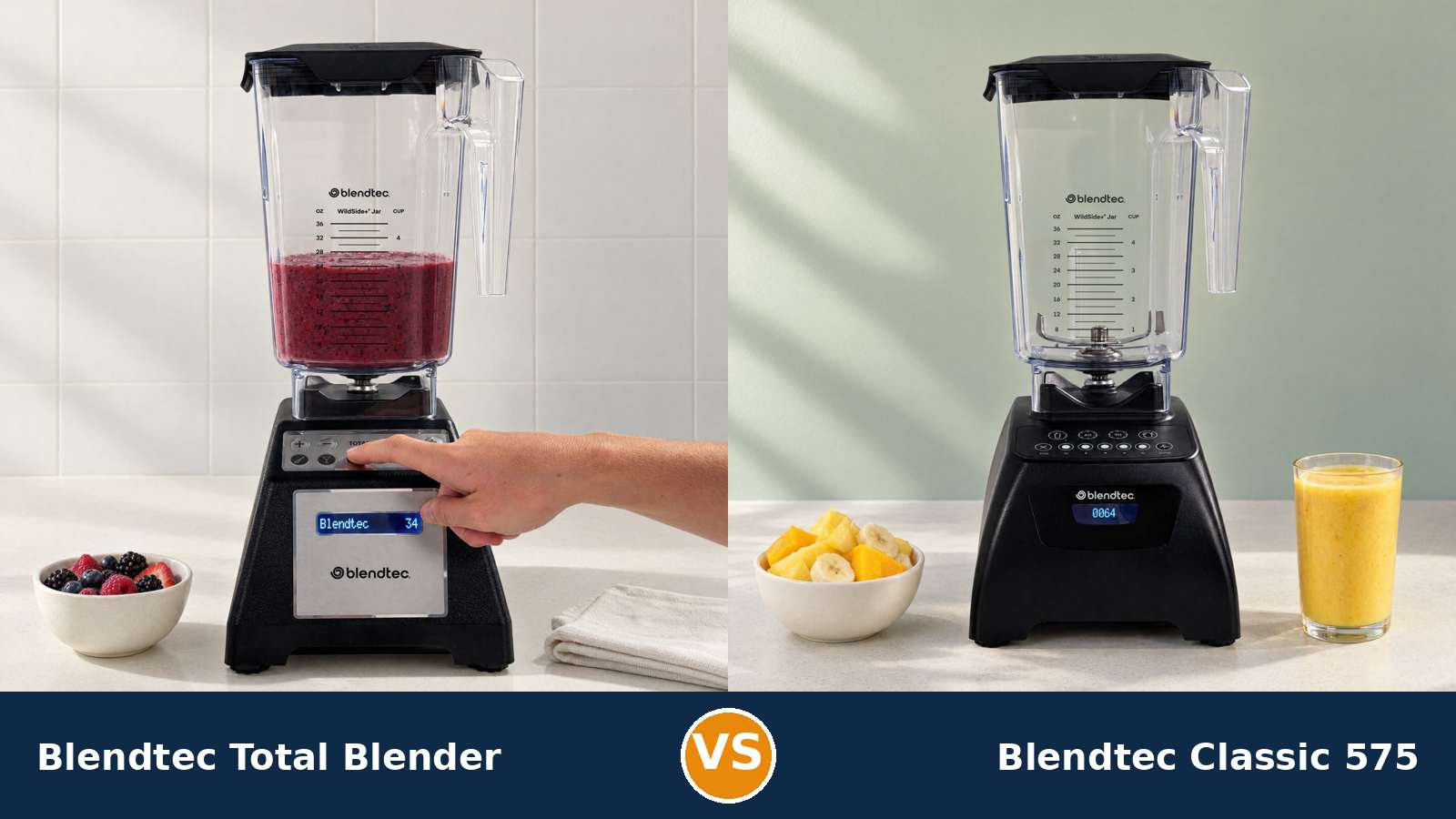
Same motor. Same watts. Same jar family. Same footprint on your counter.
The Blendtec Total Blender and the Blendtec Classic 575 are the two founding members of Blendtec's Classic line, and on a headline spec sheet they look like the same machine sold twice. Both run a 1,560-watt motor. Both carry Blendtec's blunt wingtip blade. Both stand 15 inches tall and weigh 7.28 pounds.
They are not the same machine. The difference is entirely in the control panel — and the control panel is the part of a blender you touch every single day.
The Total Blender gives you six food-specific preprogrammed cycles and ten manual speeds. The Classic 575 gives you four cycles — one of them a dedicated Clean cycle — and five manual speeds. One machine automates more recipes. The other automates less, but cleans up after itself at the touch of a button.
One honest warning before the verdict: both are legacy models from Blendtec's earlier Classic era. Blendtec still lists both on its own store, but Amazon availability now runs through marketplace sellers and Renewed stock rather than a steady factory-fresh supply. This guide handles that channel plainly, in the open, where it belongs.
Key Takeaways
- The motor is a dead tie. Both machines run 1,560 watts, 13 amps, and a 3.0 peak horsepower rating — a figure Blendtec itself footnotes as lab peak input power, not power at the blade.
- The Total Blender is the more capable controller. Six named food cycles (Smoothie, Batters, Hot Soup, Whole Juice, Ice Cream, Ice Crush) plus ten speeds and Pulse.
- The Classic 575 is the simpler daily driver. Four cycles — Smoothie, Clean, 60 seconds, 90 seconds — plus five speeds and Pulse. The Clean cycle is a feature the Total Blender does not have.
- Jars, blade, size and weight are shared. Both take the 90 oz WildSide+ jar (36 oz blending capacity) and the 75 oz FourSide jar (32 oz), in BPA-free Tritan copolyester, over the same blunt stainless blade.
- Both are legacy models on Amazon. Expect marketplace and Renewed listings, check the jar in the box, and verify the seller before you pay — the buying guide below shows how.
Quick Verdict
Buy the Blendtec Total Blender for most kitchens. It is the more complete Classic.
Its six cycles are named after foods, not timers. Smoothie, Batters, Hot Soup, Whole Juice, Ice Cream, Ice Crush — each one varies speed and stops on its own. Its ten manual speeds give you twice the texture steps of the 575 when you take over yourself.
Same motor, same jars, same counter space. More automation. That is the whole case, and it is enough.
Buy the Blendtec Classic 575 if you value simplicity and cleanup over recipe automation. Its panel is the easiest in the Classic line to learn: Smoothie, Clean, and two honest timed cycles.
The dedicated Clean cycle is a genuine daily convenience the Total Blender lacks. And its five speeds step through the same speed range in bigger jumps — fewer decisions, same destination.
The Scorecard
Scores below are derived directly from the manufacturer specifications compared in this guide — wattage, cycle counts, speed counts, jar capacities and published dimensions. They are a reading aid, not benchmark results.
| Category | Total Blender | Classic 575 | ||
|---|---|---|---|---|
| Power (from specs) | 9 / 10 | 9 / 10 | ||
| Capacity | 8.5 / 10 | 8.5 / 10 | ||
| Programs & manual control | 9 / 10 | 7 / 10 | ||
| Ease of use | 8 / 10 | 9 / 10 | ||
| Cleaning | 8 / 10 | 9 / 10 | ||
| Footprint & storage | 8 / 10 | 8 / 10 | ||
| Value | 8.5 / 10 | 8 / 10 | ||
| Overall | 8.4 / 10 | 8.0 / 10 | ||
Read the table the way it was built. Everything mechanical ties. The Total Blender's lead comes from exactly one place: what its buttons do.
At a Glance: Who Each Blender Fits
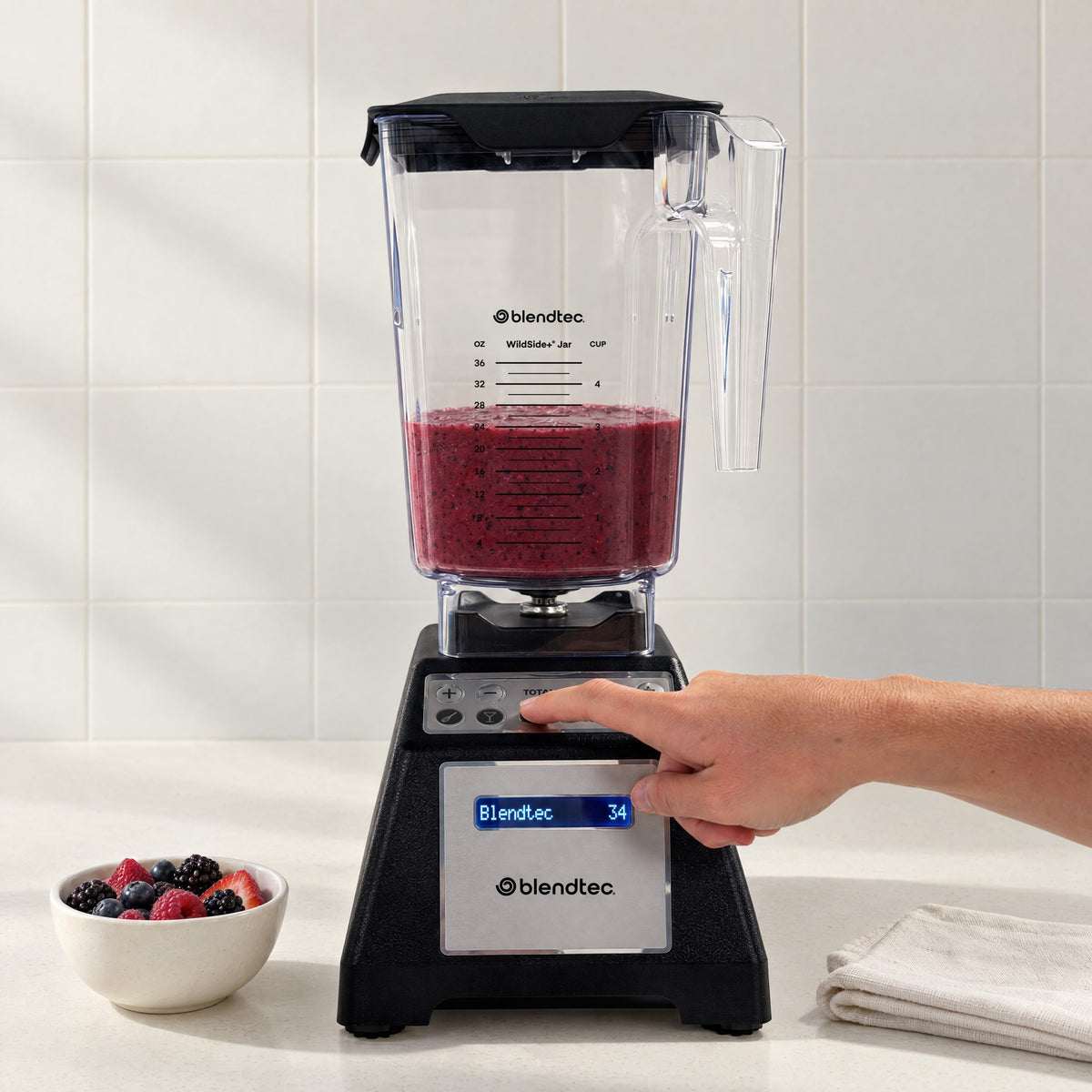
Blendtec Total Blender (Total Blender Classic)
- 1,560 W motor, 13 A — 3.0 peak HP (lab peak input rating)
- 6 preprogrammed cycles: Smoothie, Batters, Hot Soup, Whole Juice, Ice Cream, Ice Crush
- 10 incremental speeds + Pulse
- Illuminated LCD timer shows time remaining
- WildSide+ 90 oz jar (36 oz blending) or FourSide 75 oz (32 oz), depending on package
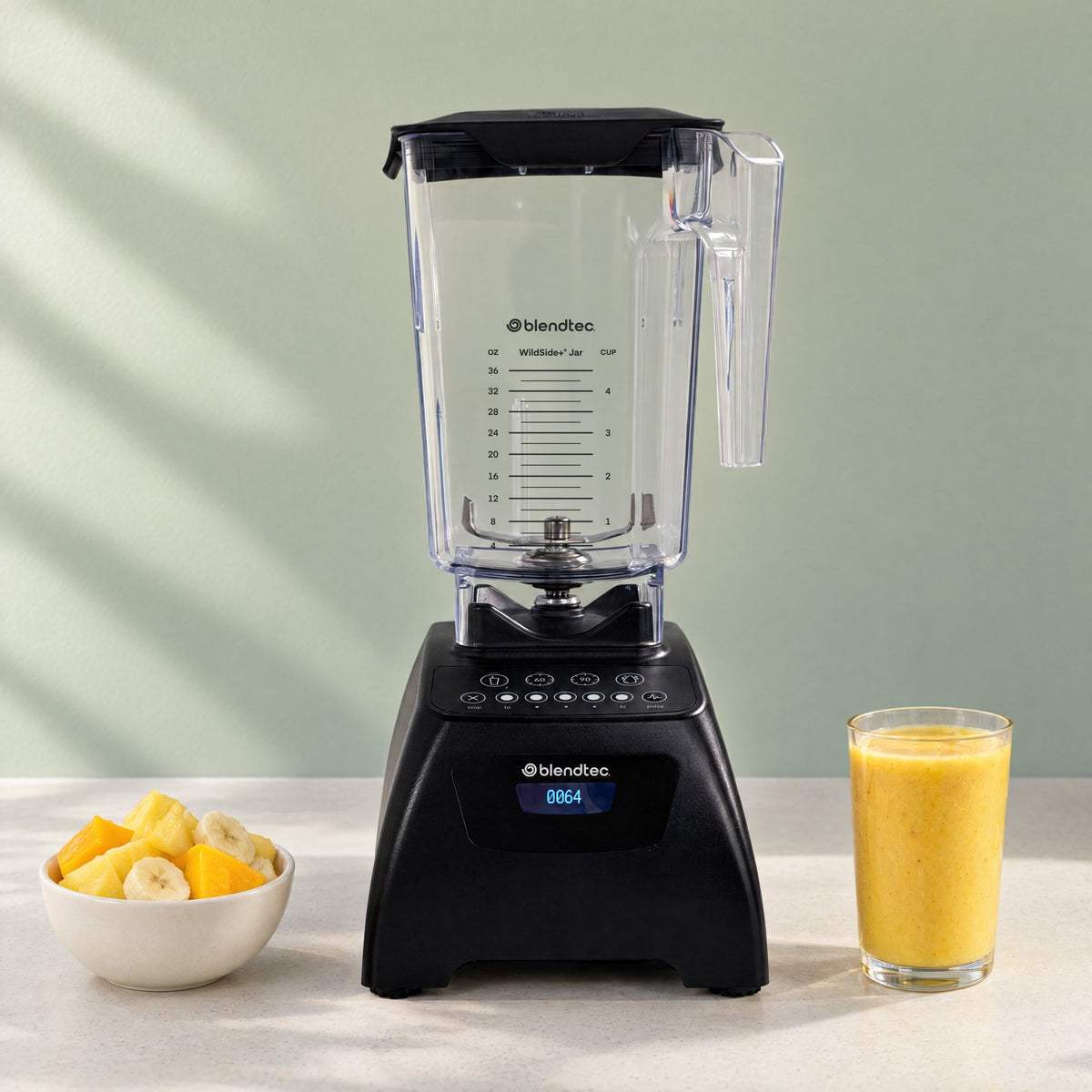
Blendtec Classic 575
- 1,560 W motor, 13 A — 3.0 peak HP (lab peak input rating)
- 4 preprogrammed cycles: Smoothie, Clean, 60-second, 90-second
- 5 incremental speeds + Pulse
- Illuminated LCD timer and cycle counter
- WildSide+ 90 oz jar (36 oz blending) or FourSide 75 oz (32 oz), depending on package
Choose the Total Blender if…
You blend a variety of foods, not just smoothies. Batters on weekends. Whole juice on weekdays. Hot soup when the weather turns.
You like a button named after the food in the jar. Six of them, each tuned to speed up, slow down and stop on its own.
You take manual control often and want finer steps. Ten speeds let you park a texture exactly where you want it.
Choose the Classic 575 if…
Your blending life is smoothies, shakes and the occasional soup. One great Smoothie cycle covers most of it.
You would rather press Clean than run a manual wash cycle. The 575's dedicated Clean program is the easiest cleanup routine in this comparison.
You prefer fewer choices on the panel. Five speeds, four cycles, nothing to memorise.
As an Amazon Associate I earn from qualifying purchases at no extra cost to you.
Specifications: The Specs That Actually Matter
Every figure below comes from Blendtec's own product pages, manuals and published product data, cross-checked against the manufacturer's listing data.
Both machines exist in more than one retail package — most importantly, with either the FourSide or the WildSide+ jar. The table reflects the standard US configurations; the package note under it explains what to check.
| Specification | Blendtec Total Blender | Blendtec Classic 575 |
|---|---|---|
| Motor | 1,560 W, 120 V, 13 A | 1,560 W, 120 V, 13 A |
| Peak horsepower (as published) | 3.0 peak HP* | 3.0 peak HP* |
| Speed settings | 10 incremental speeds + Pulse | 5 incremental speeds + Pulse |
| Preprogrammed cycles | 6 — Smoothie, Batters, Hot Soup, Whole Juice, Ice Cream, Ice Crush | 4 — Smoothie, Clean, 60-second, 90-second |
| Display | Illuminated LCD timer (time remaining) | Illuminated LCD timer (time remaining) + cycle count |
| Controls | Fully sealed push-button touchpad | Push-button touchpad |
| Standard jar options | WildSide+ 90 oz total / 36 oz blending, or FourSide 75 oz / 32 oz | WildSide+ 90 oz total / 36 oz blending, or FourSide 75 oz / 32 oz |
| Container material | Eastman Tritan copolyester, BPA-free | Eastman Tritan copolyester, BPA-free |
| Blade | Blunt wingtip blade, cold-forged hardened stainless steel, fixed in jar | Blunt wingtip blade, cold-forged hardened stainless steel, fixed in jar |
| Dimensions | 7 in W × 15 in H × 8 in D | 7 in W × 15 in H × 8 in D |
| Weight | 7.28 lb | 7.28 lb |
| Dishwasher-safe parts | Jar and lid (top rack recommended); self-clean with water + a drop of soap | Jar and lid (top rack recommended); dedicated Clean cycle |
| Warranty (current US schedule) | 2 years parts / 2 years labor, residential use† | 2 years parts / 2 years labor, residential use† |
| Use rating | Residential only — commercial use voids the warranty | Residential only — commercial use voids the warranty |
| Where it is sold today | Blendtec lists it direct; on Amazon, marketplace sellers (its original FourSide listing) and a Renewed WildSide+ listing | Blendtec lists it direct; its standard Amazon WildSide+ listing currently shows no featured offer — marketplace and bundle listings carry availability |
*The peak-HP footnote, in plain English: Blendtec's own documentation states that its horsepower figures are motor peak input power as measured in laboratory testing — not the operational horsepower delivered at the blade. Both machines are honestly described as 1,560-watt blenders. Judge them on watts, cycles and jars, not on the HP badge.
†Warranty note: older manuals, boxes and retailer pages for both models frequently cite an 8-year warranty — that was the schedule in force in their launch era. Blendtec's current US product pages and warranty schedule list 2 years parts and labor for these Classic models. A warranty runs from the terms in effect at the time of purchase, so check the schedule that applies to the unit you are actually buying, and confirm whether a Renewed or marketplace unit carries Blendtec cover at all.
Package note: the Total Blender launched with the 75 oz FourSide jar and is sold today by Blendtec with the 90 oz WildSide+. The Classic 575 has been sold both ways as well. The jar changes blending capacity (32 oz vs 36 oz) and vortex behaviour, so confirm which jar a listing includes before comparing two listings on price.
The Differences That Actually Matter
1. Power — a genuine tie, and the HP number proves nothing
Start where the marketing starts. Both machines carry a 3.0 peak horsepower badge.
Now read Blendtec's own footnote, the one this project applies to every Blendtec comparison: that figure is motor peak input power measured in a laboratory. It is not horsepower at the blade.
What is identical, and verifiable, is the electrical rating. 1,560 watts. 13 amps. 120 volts. The same motor platform drives both bases.
So no, the Total Blender is not stronger than the 575. The 575 is not a detuned Total Blender either. Anyone selling you either machine on power is selling you a badge.
Power decides nothing here. Everything below this section is where the decision actually lives.
2. The cycles — six recipes against four routines
This is the comparison. The Total Blender's panel carries six preprogrammed cycles, each named for a food.
Smoothie. Batters. Hot Soup. Whole Juice. Ice Cream. Ice Crush. Each cycle runs a speed profile tuned for that job — speeding up, slowing down, and shutting off on its own.
The Classic 575 carries four cycles, and only one is named for a food. Smoothie does the daily work. The other three are utilities: Clean, a 60-second timed cycle, and a 90-second timed cycle.
Timed cycles are not a poor substitute. Soup, dough and frozen desserts all finish happily inside 60 or 90 seconds of full-power blending. But you are choosing the duration. On the Total Blender, the machine already knows it.
If your blending week touches three or more of the Total Blender's six named jobs, its panel earns its keep every day. If your week is smoothies and little else, the 575's shorter menu loses you nothing.
3. Manual control — ten speeds against five
Below the cycles, both machines offer manual speeds plus Pulse. The counts differ by a factor of two.
The Total Blender gives you ten incremental speeds. The Classic 575 gives you five — and Blendtec's own documentation shows those five steps land on speeds 1, 3, 5, 7 and 9 of the same underlying range.
Translation: both machines reach the same top speed and the same low end. The 575 simply takes bigger steps between them.
For smoothies, sauces and soups, five steps are plenty. Texture work is forgiving at full power.
For fine work — easing a dressing to an exact consistency, or walking a thick batter up slowly — ten steps give you parking spots the 575 skips past. It is a real difference, but a narrow one, and it only matters to cooks who blend by feel.
Pulse is present and equal on both. Short bursts for chopping and refreshing a blend work the same way on either panel.
4. Cleaning — the 575's one clean win
Neither machine asks you to scrub a sharp blade. Blendtec's blade is blunt by design, and both jars self-clean the same way: warm water, a drop of dish soap, run the blender, rinse.
The difference is that the Classic 575 turns that routine into a button. Its Clean cycle runs the wash for you, at the right speed, for the right time.
On the Total Blender you run a manual speed instead. The result is the same clean jar. The 575 just removes the last small decision of the day.
Both jars and lids are dishwasher safe, with the top rack recommended. And both use the same fixed-blade jar design — nothing to unscrew, nothing to lose down the drain.
Score this one honestly for the 575. It is a small win, but it happens after every single blend.
5. Jars and blade — shared hardware, package-dependent
Mechanically, these machines wear the same equipment. The differences you will read about online are usually package differences, not model differences.
Both accept Blendtec's two classic jars. The FourSide is the original: 75 oz total volume, markings to 32 oz, a square profile that builds the vortex Blendtec built its name on.
The WildSide+ adds a fifth side and a wider base: 90 oz total, markings to 36 oz. The extra wall disrupts the flow and pulls ingredients down faster, especially in larger, thicker batches.
Both jars are Eastman Tritan copolyester — BPA-free, impact-resistant, and shared across the Classic line. The blade inside either is the same story: a blunt, cold-forged, hardened stainless-steel wingtip, around 80% thicker than a conventional blade, designed to pulverise rather than slice.
The buying consequence matters more than the physics. A Total Blender listed with a FourSide jar and a 575 listed with a WildSide+ are not the packages their model names suggest. Compare jar to jar before you compare price to price — the buying guide below returns to this.
6. Size, weight and the counter — identical twins
Both machines publish the same dimensions: 7 inches wide, 15 inches tall, 8 inches deep. Both weigh 7.28 pounds.
Fifteen inches matters. It slides under standard kitchen cabinets with room to spare — a trick taller high-power blenders cannot do without removing the jar.
At just over seven pounds, either machine is light enough to move one-handed and store in a cupboard. Neither needs a permanent counter home, though daily smoothie makers will give it one.
There is no storage argument for either side. If one fits your kitchen, the other does too.
7. The channel — two legacy models, sold honestly
Here is the part most comparisons skip. Both of these are legacy-era models, and their Amazon presence reflects it.
Blendtec still lists both machines on its own store. On Amazon, the Total Blender's original listing — the FourSide package, model TB-621-20, on Amazon since 2006 — is carried by marketplace sellers, and a Renewed WildSide+ version is listed separately. Active third-party availability exists; a steady Amazon-sold supply does not.
The Classic 575's standard Amazon listing, the WildSide+ package, currently shows no featured offer. Availability runs through bundle listings and marketplace sellers instead.
None of this makes either machine a bad buy. It makes the seller part of the product. A refurbished or marketplace unit can be excellent value — with the warranty caveat spelled out in the spec table, and the checks in the buying guide below.
What we will not do is pretend either listing is something it is not. The buttons on this page lead to the listings described here, Renewed and marketplace status included.
Use-Case Fit Guide
The fastest way to choose between these blenders is to start from what actually goes into your jar. This table is the comparison in one view.
| What you blend | Total Blender | Classic 575 | Our call |
|---|---|---|---|
| Daily smoothies for the household | Excellent — dedicated Smoothie cycle | Excellent — dedicated Smoothie cycle | Tie — buy on price and package |
| Whole juice from whole fruit and greens | Excellent — dedicated Whole Juice cycle | Good — manual speeds or timed cycles | Total Blender |
| Batters, pancakes and baking prep | Excellent — dedicated Batters cycle | Workable — 60-second cycle | Total Blender |
| Hot soup from raw ingredients | Excellent — dedicated Hot Soup cycle | Good — 90-second timed cycle | Total Blender |
| Frozen desserts and ice cream | Excellent — dedicated Ice Cream cycle | Good — 90-second timed cycle | Total Blender |
| Crushing ice for drinks | Excellent — dedicated Ice Crush cycle | Good — Pulse and high speeds | Total Blender |
| Small sauces, dips and dressings by feel | Excellent — 10 speeds to park a texture | Good — 5 wider speed steps | Total Blender, narrowly |
| One-button cleanup after every blend | Manual self-clean routine | Excellent — dedicated Clean cycle | Classic 575 |
| A first high-power blender, minimal learning curve | Good — six cycles to learn | Excellent — four cycles, five speeds | Classic 575 |
Read the pattern, not just the rows. The Total Blender wins wherever a named recipe exists. The 575 wins the two rows about the human, not the food: cleanup and simplicity.
Ready to check today’s price?
Both machines sell through Amazon, largely via marketplace and Renewed listings. Check the live figure — and the jar in the package — on the blender that fits your kitchen.
View on Amazon — Total BlenderView on Amazon — Classic 575The 30-Second Decision
| If this sounds like you… | Buy this |
|---|---|
| “I blend soups, batters, whole juice and frozen desserts, not just smoothies.” | Total Blender (six named cycles) |
| “Smoothies most days, and I hate washing up.” | Classic 575 (Clean cycle) |
| “I blend by feel and want fine control over texture.” | Total Blender (10 speeds) |
| “I want the simplest panel in the range.” | Classic 575 (4 cycles, 5 speeds) |
| “I found one of them with the WildSide+ jar at a fair price.” | That one — the jar matters more than the badge |
| “I want a brand-new machine with a long factory warranty.” | Neither — see When to Skip Both |
What You Gain. What You Give Up.
Blendtec Total Blender
You gain: six cycles named after real foods, each with its own speed profile. Ten manual speeds for fine texture work. The original Classic formula, with the broadest automation in this comparison.
You give up: a dedicated Clean cycle — you run the wash manually. On Amazon you also give up a tidy retail channel: expect marketplace sellers on its original listing, or a separate Renewed listing for the WildSide+ package.
Blendtec Classic 575
You give up: the named cycles for batters, whole juice, ice cream and ice crush. Half the manual speed steps. And, currently, a featured offer on its standard Amazon listing.
You gain: the simplest panel Blendtec made in this line. A dedicated Clean cycle that runs your cleanup. Timed 60- and 90-second cycles that quietly cover most of what the Total Blender's menu does.
Pros and Cons
Total Blender — Pros
- Six food-specific preprogrammed cycles
- 10 incremental speeds + Pulse
- Same 1,560 W motor and jar family as the 575
- Fits under standard cabinets at 15 in tall
- Blunt blade — safe to handle, nothing to sharpen
Cons
- No dedicated Clean cycle
- Current warranty schedule is 2 years, not the 8 years on older boxes
- Amazon supply is marketplace/Renewed, not steady retail
- Package varies — FourSide vs WildSide+ jar must be checked
Classic 575 — Pros
- Dedicated Clean cycle for one-button cleanup
- Simplest controls in the Classic line
- Same 1,560 W motor and jar family as the Total Blender
- 60- and 90-second timed cycles cover soups and desserts
- LCD shows time remaining and total cycle count
Cons
- Only four cycles, and only one is food-specific
- 5 speed steps where the Total Blender offers 10
- Current warranty schedule is 2 years, not the 8 years on older boxes
- Standard Amazon listing currently shows no featured offer
Check the Jar, the Seller and the Warranty — Not Just the Model
Check the jar first. Both model names hide two different packages.
The FourSide jar holds 75 oz in total, with markings to 32 oz. The WildSide+ holds 90 oz, with markings to 36 oz, and its fifth side pulls thick blends down faster.
A listing's headline rarely shouts which jar is inside. Read the package contents line. A cheaper listing with the smaller jar may be no bargain at all.
Check the seller second. These are legacy models. On Amazon, that means marketplace sellers, bundle listings and Renewed stock.
That is not a warning against buying. It is a checklist: seller history, condition description, return terms, and whether the jar and lid in the photos match the jar named in the text.
Check the warranty third. Blendtec's current US schedule lists 2 years parts and labor for these Classic models — and Blendtec's warranty terms cover products bought from Blendtec or its authorised dealers.
Older boxes advertising 8 years describe the schedule of their era. A Renewed unit's cover depends on the Renewed programme and the seller, not on the original box. Confirm which cover your specific unit carries before you rely on it.
Check the name last. “Total Blender” and “Total Blender Classic” are the same machine. The Classic 575 is not the Classic 570, and neither is a Designer model — those carry different panels, cycles and warranty schedules.
The Upgrade Path Test
These two machines sit on the same platform, so the upgrade story is shared — and unusually good.
Every Classic jar fits both bases. Start with whichever jar a good listing includes; add the other later if your batch sizes change. The Twister jar and other Blendtec accessories extend both machines the same way.
The honest ceiling is the panel, not the motor. Neither machine will ever gain cycles, a touchscreen, or a sound enclosure. Those live in the Designer and Professional lines above them.
So judge this purchase as a finished product, not a starter kit. If six cycles and ten speeds cover your cooking, the Total Blender will not feel dated. If they do not, no accessory fixes that — the upgrade is a different blender.
One longevity point in both machines' favour: the drive socket is hardened metal, the blade is fixed and blunt, and there is very little on either base to wear out cosmetically. These are simple machines, and simple machines age slowly.
When to Skip Both
Honesty cuts both ways. There are buyers neither of these legacy machines serves well.
Skip both if you want a long factory warranty on a brand-new machine. Blendtec's current range carries longer schedules on its newer lines; these Classics sit at 2 years on the current schedule, and marketplace or Renewed units may carry less.
Skip both if noise matters. Neither has a sound enclosure. If a quiet morning blend is the priority, Blendtec's enclosed Professional line exists for exactly that reason.
Skip both if you need commercial duty. Both are residential machines, and Blendtec voids the warranty if they are used commercially.
And skip both if you want modern controls — touchscreens, app support, or Blendtec's newer cycle libraries. For everyone else, one of these two is the right Classic. The only question is which panel you would rather press every day.
Support and Long-Term Ownership
Blendtec supports its Classic line with the things that actually matter over a decade: replacement jars, lids and parts, published manuals, and a US-based support line.
Because both machines share jars and drive hardware, parts availability is a platform question, not a model question. The WildSide+ and FourSide jars remain standard Blendtec catalogue items.
Two ownership habits are worth stating. Rinse the jar promptly rather than letting blends dry in it — the blunt blade makes a quick hand-wash safe. And keep the base dry: the manuals for this era are explicit that water should not be left standing in the jar on the base.
Finally, register and keep your proof of purchase. On legacy models bought through marketplace channels, that paperwork is what decides a warranty conversation years later.
Final Verdict
The Blendtec Total Blender is the Classic we would buy.
It wins this comparison the honest way: not on power, where the two machines are identical, but on the panel you will use every day. Six cycles named after foods. Ten speeds when you take over. The broadest automation Blendtec put in this line.
Buy the Total Blender if your blending goes beyond smoothies — batters, whole juice, hot soup, frozen desserts — or if you simply want the more capable of two otherwise identical machines.
View on Amazon — Total Blender
Buy the Classic 575 if your routine is smoothies plus cleanup. Its Clean cycle is the best single convenience in this comparison, its panel is the easiest to live with, and its timed cycles quietly cover most real cooking.
Either way, buy the listing, not just the model: check the jar in the package, the seller behind it, and the warranty that actually applies.
Frequently Asked Questions
What is the difference between the Blendtec Total Blender and the Classic 575?
The controls. Both share a 1,560 W motor, the same jars and blade, and the same 7 × 15 × 8 in footprint. The Total Blender offers six food-specific cycles (Smoothie, Batters, Hot Soup, Whole Juice, Ice Cream, Ice Crush) and 10 speeds. The Classic 575 offers four cycles (Smoothie, Clean, 60-second, 90-second) and 5 speeds.
Is one of them more powerful than the other?
No. Both are rated at 1,560 watts and 13 amps, and both carry a 3.0 peak horsepower badge. Blendtec's own footnote clarifies that its HP figures are motor peak input power from laboratory testing, not operational horsepower at the blade — so the identical wattage is the figure to trust, and it is a tie.
Which jars fit the Total Blender and the Classic 575?
Both machines use Blendtec's Classic jar family: the FourSide jar (75 oz total, markings to 32 oz) and the WildSide+ jar (90 oz total, markings to 36 oz), both in BPA-free Tritan copolyester. Retail packages vary, so confirm which jar a specific listing includes.
Does the Classic 575 clean itself?
It has a dedicated Clean cycle: add warm water and a drop of dish soap, press Clean, and the cycle runs the wash for you. The Total Blender achieves the same result by running a manual speed with water and soap — it simply has no dedicated button for it. Both jars and lids are also dishwasher safe, top rack recommended.
What warranty do these blenders carry?
Blendtec's current US product pages and warranty schedule list 2 years parts and 2 years labor for these Classic models, for residential use from authorised sellers. Older boxes and manuals often cite 8 years, which was the schedule in their launch era; your cover follows the terms in effect at your purchase, and Renewed or marketplace units may differ — verify before buying.
Are the Total Blender and Classic 575 discontinued?
They are legacy models from Blendtec's earlier Classic era. Blendtec still lists both on its own store, but Amazon availability now runs through marketplace sellers, bundle listings and Renewed stock rather than a steady Amazon-sold supply. Treat the seller and condition as part of the product when you shop.
Can either blender make hot soup?
Yes. Friction from the blade warms soup as it blends. The Total Blender has a dedicated Hot Soup cycle; the Classic 575 handles soup with its 90-second timed cycle. Neither machine has a heating element — the blending itself does the warming.
Which one should a first-time Blendtec buyer choose?
The Total Blender, for most people — its six named cycles make more recipes one-touch, at the same motor and footprint. Choose the Classic 575 instead if the simplest possible panel and the one-button Clean cycle matter more to you than recipe automation.
Sources & Verification
Blendtec Total Blender Classic official product page, blendtec.com (1,560 W motor; cycles Smoothie, Batters, Hot Soup, Whole Juice, Ice Cream, Ice Crush; 10 speeds + Pulse; LCD timer; 2-year warranty note) • Blendtec Classic Series collection page, blendtec.com (Classic 575: 1,560 W; cycles Smoothie, Clean, 60-second, 90-second; 5 speeds + Pulse; LCD timer) • Blendtec US warranty schedule (Total Blender 2 years parts / 2 years labor; jars purchased separately 3 years; authorised-dealer and residential-use terms) • Blendtec Classic 575 spec sheet (dimensions 7 × 15 × 8 in, weight 7.28 lb, 13 A / 120 V, cord 34 in) • Blendtec jar documentation (WildSide+ 90 oz total / 36 oz markings; FourSide 75 oz / 32 oz; Eastman Tritan copolyester, BPA-free; blunt cold-forged stainless wingtip blade) • Blendtec peak-HP footnote (horsepower = motor peak input power in laboratory testing, not operational HP at the blade) • Amazon listing data for model TB-621-20 (ASIN B000GIGZXM, UPC 851992000260) and model C575A2301A-A1AP1D (ASIN B00LADPFP6, UPC 849369011292), verified via untagged listing data, November 2026.

James Wilson
James has been testing and comparing kitchen appliances for over a decade and writes Honestly Compared's blender and small-appliance guides. His rule for every comparison: the verdict has to survive the spec sheet, not the marketing page.