
Blendtec Total Classic vs Blendtec Classic 575: Which Should You Buy?
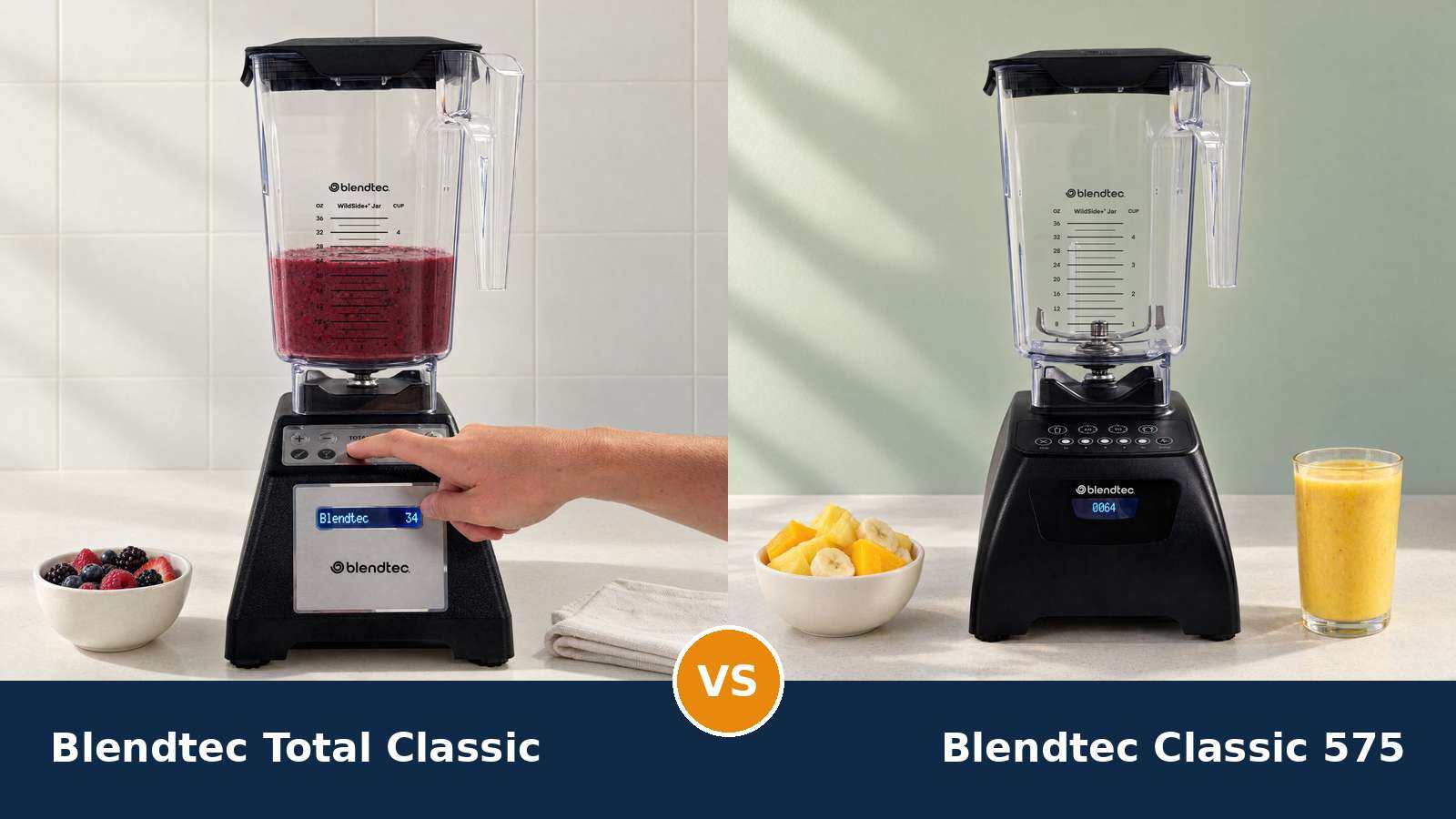
The search that brought you here contains its own first trap. “Total Classic” sounds like a special edition — a trim level, a bundle, maybe a third machine.
It is none of those. Total Blender Classic is simply the full shelf name of the original Blendtec Total, model TB-621-20, unchanged since 2006. The left-hand blender in this comparison answers to two names. The right-hand one, the Classic 575, answers to a number.
Set the names aside and the contest narrows fast. Both bases hide the same 1,560 W motor. Both spin the same blunt blade inside the same family of Tritan jars. Both occupy the same 7 × 15 × 8 in of counter and carry the same warranty on Blendtec's current US schedule.
What is left to choose is a control panel and a buying route: six cycles labelled with foods and ten speeds, against four cycles, five speeds and the only Clean button on either panel. This guide takes the naming question first, then the panel, then the paperwork.
Key Takeaways
- “Total Classic” is a name, not a model. The Total Blender and the Total Blender Classic are one machine, code TB-621-20.
- Under the panels, it is a tie. Same motor, same blade, same jars, same dimensions, same weight on both bases.
- The Total Classic wins on range. Six food-labelled cycles plus ten speeds give it the broader panel by a clear margin.
- The Classic 575 wins on routine. Fewer decisions, a lifetime cycle counter, and a dedicated Clean cycle nothing else here offers.
- Buy on today's paperwork. Both warranties read 2 years on the current US schedule, and neither standard Amazon listing shows a featured offer — seller and jar decide value.
Quick Verdict
Buy the Blendtec Total Classic if your blender cooks. It is the wider instrument.
Hot Soup, Batters, Whole Juice, Ice Cream and Ice Crush each get a tuned, labelled cycle, with ten manual speeds behind them. No button on the 575's panel reproduces that spread.
Buy the Blendtec Classic 575 if your blender mostly makes breakfast. It covers a smoothie-first week with four cycles and five speeds, then cleans itself with a button the Total Classic never received.
Same power, same jar, same blend in the glass. The 575 simply asks less of you on an ordinary morning.
The Scorecard
Every score below is worked out from the manufacturer specifications compared in this guide — wattage, cycle counts, speed counts, jar volumes and published dimensions. Treat them as a reading aid, never as bench-test results.
| Category | Total Classic | Classic 575 | ||
|---|---|---|---|---|
| Power (from specs) | 9 / 10 | 9 / 10 | ||
| Capacity | 8.5 / 10 | 8.5 / 10 | ||
| Programs & manual control | 9 / 10 | 7 / 10 | ||
| Ease of use | 8 / 10 | 9 / 10 | ||
| Cleaning | 8 / 10 | 9 / 10 | ||
| Footprint & storage | 8 / 10 | 8 / 10 | ||
| Value | 8.5 / 10 | 8 / 10 | ||
| Overall | 8.4 / 10 | 8.0 / 10 | ||
Two rows do all the work. Programs and control pull the Total Classic ahead; ease and cleaning pull the 575 back. Everything with a motor attached to it scores level, because the motors are the same part.
At a Glance: Who Each Blender Fits
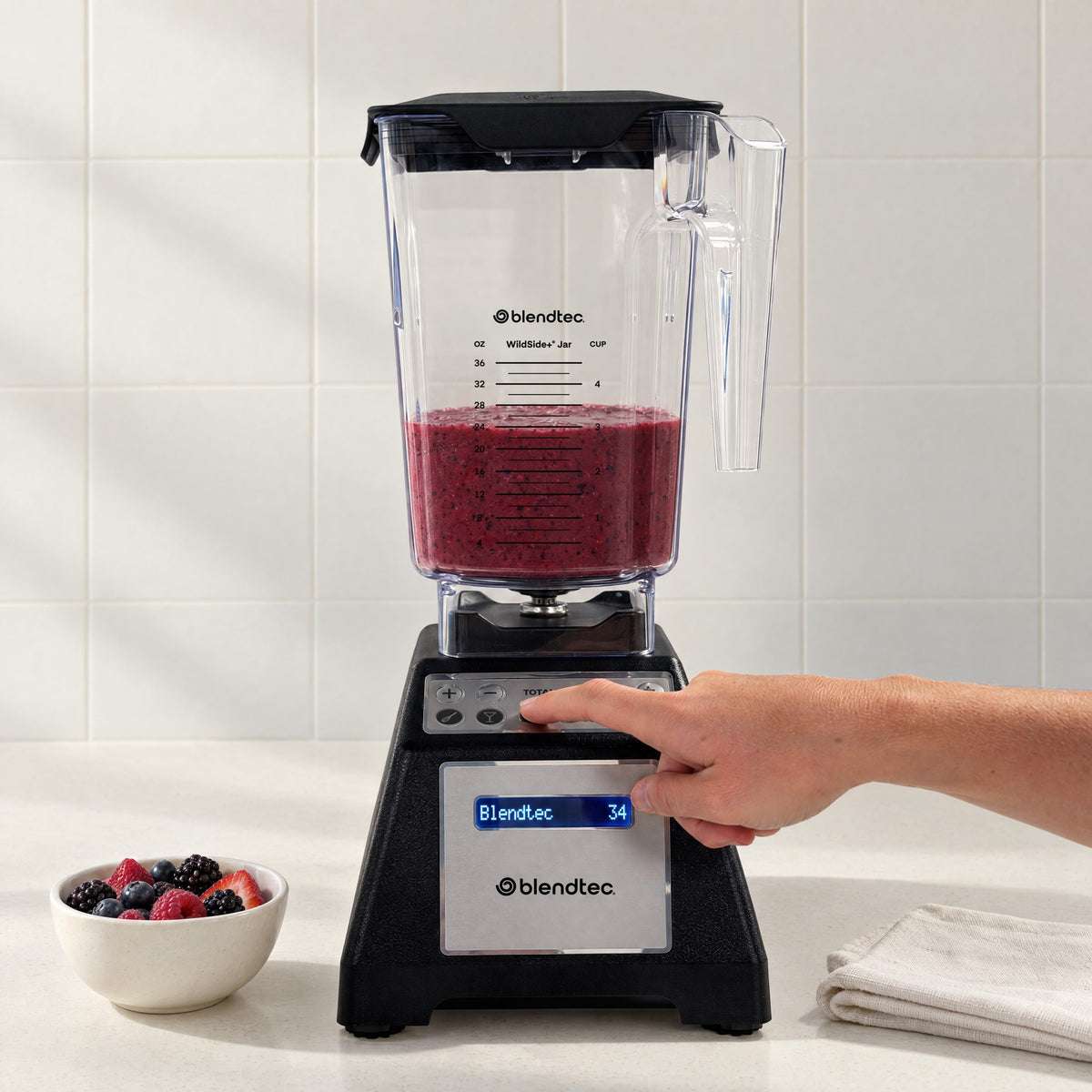
Blendtec Total Classic
- Six cycles: Smoothie, Batters, Hot Soup, Whole Juice, Ice Cream, Ice Crush
- 10 incremental speeds plus Pulse
- 1,560 W motor behind a sealed push-button panel
- Backlit LCD counts down the time remaining
- The 2006 original — still listed and sold by Blendtec
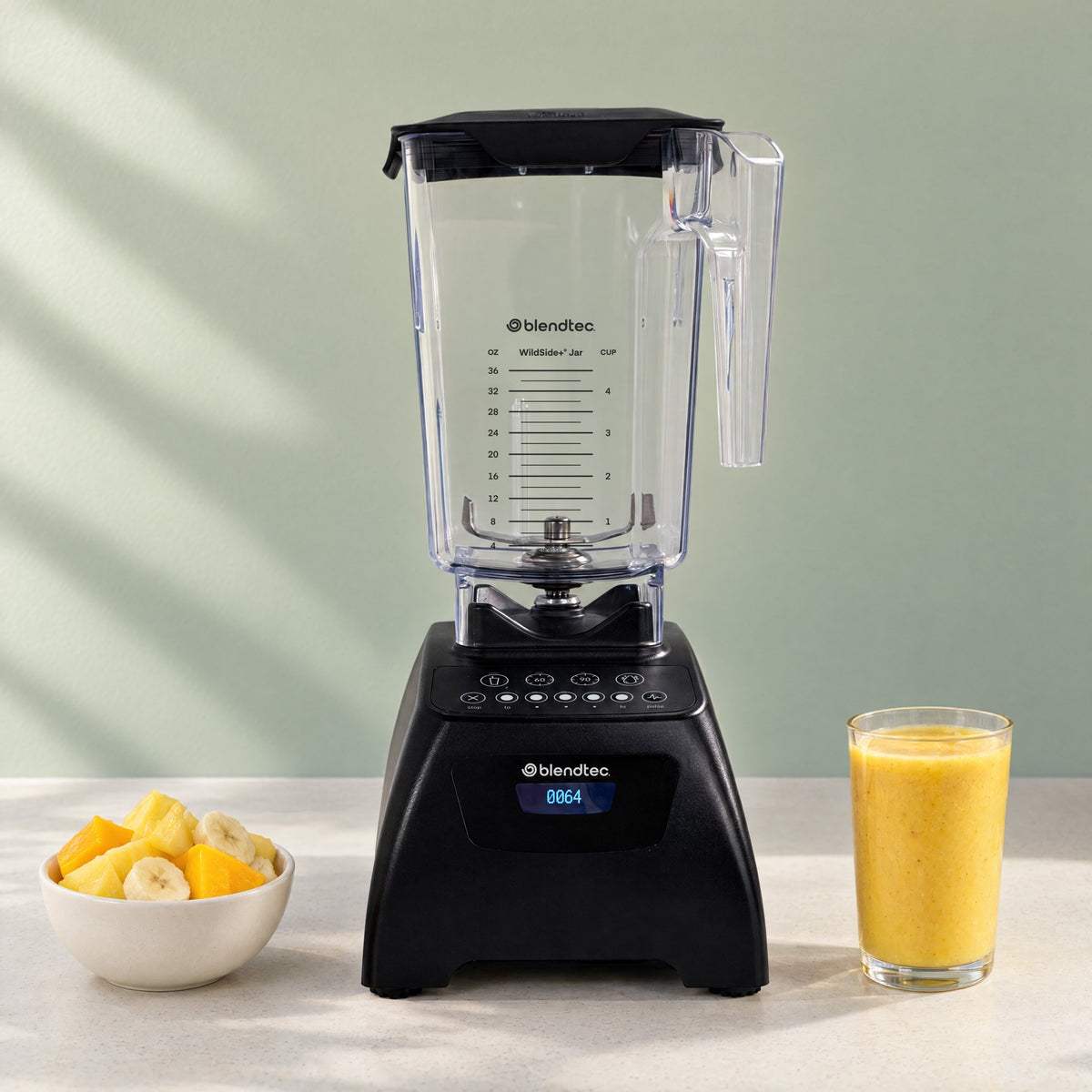
Blendtec Classic 575
- Four cycles: Smoothie, Clean, 60-second, 90-second
- 5 incremental speeds plus Pulse
- The same 1,560 W motor and jar family
- Display adds a lifetime count of blends run
- The leaner panel — Blendtec's everyday Classic
Choose the Blendtec Total Classic if…
Your blender's job description runs past drinks. Soup most weeks. Batter when you bake. Frozen desserts, crushed ice, whole juice from whole fruit.
You adjust texture as you go and would rather have a speed for every shade between coarse and silk than a shorter panel.
You like owning the design a company has kept in production for twenty years, with every jar and lid still orderable.
Choose the Blendtec Classic 575 if…
Weekday smoothies are the headline act and the rest of the repertoire is occasional. Four buttons describe that kitchen honestly.
Whether a blender gets used in your house depends on cleanup. The Clean cycle is one press, and it belongs to this machine alone.
You are stepping up to high-power blending for the first time and want the shallowest learning curve on the Classic shelf.
As an Amazon Associate I earn from qualifying purchases at no extra cost to you.
Specifications: The Specs That Actually Matter
Each figure in the table is drawn from Blendtec's own product pages, its Classic 575 specification sheet and its current US warranty schedule, checked against the manufacturer data attached to the two linked listings.
One warning before the jar row: a jar is packaging, not identity. Each base has been boxed with both of Blendtec's large jars over the years, so the jar named in any listing describes that listing only.
| Specification | Blendtec Total Classic | Blendtec Classic 575 |
|---|---|---|
| Motor | 1,560 W, 120 V, 13 A | 1,560 W, 120 V, 13 A |
| Peak horsepower (as published) | 3.0 peak HP* | 3.0 peak HP* |
| Speed settings | 10 incremental speeds + Pulse | 5 incremental speeds + Pulse |
| Preprogrammed cycles | 6 — Smoothie, Batters, Hot Soup, Whole Juice, Ice Cream, Ice Crush | 4 — Smoothie, Clean, 60-second, 90-second |
| Display | Backlit LCD timer (time remaining) | Backlit LCD timer (time remaining) + lifetime cycle count |
| Controls | Fully sealed push-button touchpad | Push-button touchpad |
| Jar in the linked listing | FourSide jar — 75 oz total volume, markings to 32 oz | WildSide+ jar — 90 oz total volume, markings to 36 oz |
| Container material | Eastman Tritan copolyester, BPA-free | Eastman Tritan copolyester, BPA-free |
| Blade | Blunt wingtip blade, cold-forged hardened stainless steel, fixed in jar | Blunt wingtip blade, cold-forged hardened stainless steel, fixed in jar |
| Dimensions | 7 in W × 15 in H × 8 in D | 7 in W × 15 in H × 8 in D |
| Weight | 7.28 lb | 7.28 lb |
| Dishwasher-safe parts | Jar and lid; self-cleaning means running a manual soap-and-water cycle | Jar and lid, plus a dedicated Clean cycle |
| Warranty (current US schedule) | 2 years parts / 2 years labor, residential use† | 2 years parts / 2 years labor, residential use† |
| Use rating | Residential only — commercial use voids the warranty | Residential only — commercial use voids the warranty |
| Where it is sold today | Blendtec sells it new direct with the WildSide+ jar; the linked Amazon listing is the original FourSide package, carried by marketplace sellers with no featured offer, and a separate Renewed listing exists | Blendtec sells it new direct with the WildSide+ jar; the linked Amazon WildSide+ listing currently shows no featured offer, and bundle listings carry the availability |
*What the horsepower number means: Blendtec's own documentation defines its horsepower figures as motor peak input power as measured in laboratory testing — not the operational HP at the blade. Both machines publish 3.0 peak HP from the same 1,560 W, so the figure separates nothing in this pairing.
†The warranty has two eras: manuals, boxes and reviews from earlier years put an 8-year warranty on both models, and that figure still circulates widely. Blendtec's current US product pages and warranty schedule say 2 years parts and labor for each. Shop against the current schedule, not the older print.
Jar note: FourSide and WildSide+ jars mount on either base, and Blendtec has shipped each model with either jar depending on the package. The packages pinned in the table belong to the linked listings — confirm the jar inside any other offer before paying for it.
The Differences That Actually Matter
1. First, the name — one blender wearing two badges
Clear this up before anything else, because it confuses real buyers. When Blendtec organised its range under the Classic banner, the original Total Blender picked up a second word and became the Total Blender Classic.
Nothing mechanical changed in the renaming. The model code stayed TB-621-20. The panel kept its six cycles. The motor kept its rating.
So a listing headed “Total Blender” and a listing headed “Total Blender Classic” are offering the same base at whatever price each seller chose. Compare them on jar, seller and condition — never pay a premium for the longer name.
The 575 plays no such games. “Classic 575” is the whole name, and its code is C575A2301A-A1AP1D. This article uses “Total Classic” for the left-hand machine throughout, because that is the name on Blendtec's current shelf.
2. Cycles labelled with food vs cycles labelled with minutes
The panels express two different theories of blending. The Total Classic's six cycles are recipes with names: each ramps speed up and down through a profile Blendtec tuned for that dish — Batters stays gentle, Ice Crush works in bursts, Whole Juice runs long at the top.
The 575's four cycles are mostly durations. Beyond Smoothie and Clean, its buttons promise 60 seconds or 90 seconds and then stop. The profile is fixed; your judgement supplies the recipe.
Neither theory produces a better smoothie. They differ in who holds the knowledge. A named cycle teaches a household: anyone can press Hot Soup. A timed cycle assumes the cook already knows that soup wants the long button.
That is why the Total Classic scores the programs row so heavily. Breadth of labelled help is a real feature — it just is not a power feature.
3. Ten speeds vs five — you are buying stops, not speed
Read the speed counts carefully, because they flatter the Total Classic. The 575's five speeds are documented as landing on speeds 1, 3, 5, 7 and 9 of the same range the Total divides into ten.
The slowest speed matches. The fastest speed matches. The 575 simply skips the even-numbered stops on the way up.
Those skipped stops matter in one narrow band of cooking: blending by feel. Chonky salsa held just short of sauce. Nut butter nudged past thick without sliding into runny. A dressing you stop by eye.
If your blending is press-a-cycle-and-walk-away, you will never spend those extra stops. If your hand lives on the panel, the Total Classic's finer ladder is the difference between the texture you wanted and the one either side of it.
4. The Clean cycle — a small button with a daily vote
Ask owners what decides a blender's fate and few say power. They say cleanup. On cleanup, the 575 holds the only outright win in this comparison.
It is the sole machine here with a dedicated Clean cycle. Warm water, a drop of dish soap, one press, and the jar washes itself; the jar and lid are also cleared for the dishwasher when you want a deeper pass.
The Total Classic does the same chemistry by hand — the identical water-and-soap routine, driven manually at a speed you pick and stop yourself. It works fine. It also asks for your attention every single time.
Thirty seconds of attention, twice a day, across years of ownership adds up to the difference between an appliance that lives on the counter and one that migrates to a cupboard. The 575's designers understood that arithmetic.
5. The displays — a countdown against a countdown with a memory
Both panels carry a backlit LCD that reports the time left in the current cycle. Useful, and equal.
The 575's display adds one more figure: a running total of every blend the machine has ever completed. It sounds like a gimmick until a support call, a warranty conversation or a second-hand sale, when it becomes the machine's odometer — objective evidence of how hard a life the base has lived.
The Total Classic keeps no such record. Its history lives in your order emails instead.
Small difference, honest weight: it changes nothing about tonight's soup, and it slightly improves every transaction after tonight.
6. Motor, blade, jar, footprint — the tie under both panels
Now the section neither marketing department would write. Remove the control panels and the two products converge into one.
Each base draws 13 A through a 1,560 W motor and publishes the same 3.0 peak HP — a number Blendtec's own footnote ties to laboratory input power, not to force at the blade. Each jar is Eastman Tritan copolyester, BPA-free, wrapped around the same blunt wingtip blade in cold-forged hardened stainless steel, permanently fixed in the jar.
Each machine measures 7 × 15 × 8 in and weighs 7.28 lb. Under the same cabinets, beside the same kettle, they are interchangeable silhouettes.
Draw the correct conclusion: the Total Classic does not blend harder, and the 575 is not a softened economy version. Fit the same jar, load the same ingredients, and the glass cannot tell them apart. Every real difference in this guide lives in the panel, the package or the paperwork.
7. Paperwork and channels — how each machine reaches you in 2026
Both blenders remain on Blendtec's own shelves today, sold new with the WildSide+ jar attached. That direct route is the tidy one: current warranty handling, known jar, no intermediaries.
Amazon requires more care on both sides of this comparison. The Total Classic's linked listing is its original 2006 FourSide package — identity exact against model TB-621-20 and its UPC — yet recent crawls show marketplace sellers carrying it with no featured offer, and a separate Renewed listing trades the same base under its own ASIN.
The 575's standard WildSide+ listing mirrors the pattern: identity exact, no featured offer at present, live availability flowing through bundle listings instead. Bundles can be genuinely good value on this platform, where a second jar earns its shelf space — but only once the bundle's base code matches C575A2301A-A1AP1D.
Layer the warranty history over all of this. Sellers quoting an 8-year warranty are quoting the old era; Blendtec's current US schedule covers both machines for 2 years parts and labor, bought from Blendtec or an authorised dealer, for home use. Price what is actually being promised.
On the Counter: Fit, Noise, Heat and Care
Fit. Fifteen inches of height and eight of depth, whichever badge you pick. Run a tape from counter to cabinet before ordering; most kitchens clear both machines, and the WildSide+ lid still wants a little headroom to lift free.
Noise. A 1,560 W motor at full chat is loud, and no enclosure softens either of these. Dawn blending will be heard through the house on both panels — if quiet is the requirement, shop the enclosed shelf instead of choosing between these two.
Heat. Hot soup here is friction heat: blade speed alone raises the blend to serving temperature. It is why the Total Classic can name a cycle Hot Soup and why the 575's long timed run warms the jar the same way. No heating element hides in either base.
Care. Jars and lids go in the dishwasher, top rack preferred. Sealed push-button panels wipe down with no seams for spills to colonise. And the blunt blade earns its keep weekly — you can scrub either jar by hand without respecting a knife edge.
Use-Case Fit Guide
Pick from the work, not the badge. This table compresses the whole comparison into one screen.
| The job | Total Classic | Classic 575 | Our call |
|---|---|---|---|
| Family smoothies on weekday mornings | Excellent — a Smoothie cycle of its own | Excellent — a Smoothie cycle of its own | Dead tie — same motor, same jar family |
| Soup built from raw vegetables | Excellent — Hot Soup is a named cycle | Good — the 90-second cycle carries it | Total Classic |
| Batters for pancakes and baking | Excellent — Batters is a named cycle | Workable — manual speeds or a timed run | Total Classic |
| Whole juice from fruit and greens | Excellent — Whole Juice is a named cycle | Good — long timed cycle, no named profile | Total Classic |
| Ice cream and frozen desserts | Excellent — Ice Cream is a named cycle | Good — the 90-second cycle covers it | Total Classic |
| Ice crushed for drinks | Excellent — Ice Crush is a named cycle | Good — Pulse plus the top speeds | Total Classic |
| Dips and salsas finished by eye | Excellent — ten stops to land a texture | Good — five wider stops | Total Classic, by a nose |
| Washing up after the blend | Manual soap-and-water routine | Excellent — a Clean cycle of its own | Classic 575 |
| A first serious blender | Good — six cycles to grow into | Excellent — four cycles, five speeds | Classic 575 |
| A tight counter under low cabinets | 15 in tall, 8 in deep | 15 in tall, 8 in deep | Dead tie — identical dimensions |
The shape of the result tells the story. Wherever the blender acts as a cooking instrument, the Total Classic collects the wins. Wherever it acts as a daily appliance — used fast, cleaned faster — the 575 collects them. Most kitchens need both personalities; decide which one shows up on a wet Tuesday in February.
The 30-Second Decision
| If this sounds like you… | Buy this |
|---|---|
| “Smoothies run my mornings, and washing up should take one press.” | Classic 575 (the Clean cycle) |
| “My blender cooks — soups, batters, desserts, whole juice.” | Total Classic (six named cycles) |
| “I finish textures by feel and hate landing between speeds.” | Total Classic (10 speeds) |
| “Give me the fewest buttons that still do the job properly.” | Classic 575 |
| “One of them is listed with the WildSide+ jar at the better price.” | That one — jar first, badge second |
| “A long factory warranty is my first requirement.” | Neither — read When to Skip Both |
Ready to check today’s price?
Both blenders are sold on Amazon and direct from Blendtec. Sellers and bundles move, so verify the live figure — and the jar inside the box — on the blender that fits your kitchen.
View on Amazon — Total ClassicView on Amazon — Classic 575What You Gain. What You Give Up.
Blendtec Total Classic
You gain: the widest control panel on the Classic shelf. Six cycles tuned and labelled for real dishes, ten speeds for finishing by feel, and a design whose jars, lids and spares have stayed orderable for two decades.
You give up: the one-press clean, and the calm of a short panel. Its original Amazon listing is marketplace ground now, so the seller deserves the same scrutiny as the specification.
Blendtec Classic 575
You gain: the quickest route from ingredients to a washed jar. Four cycles that map onto an ordinary week, a Clean button in daily service, and a cycle counter recording the machine's whole working life.
You give up: labelled help for batters, whole juice, frozen desserts and ice, plus the in-between speeds. Breadth is traded for calm — deliberately, and for many kitchens correctly.
Pros and Cons
Total Classic — Pros
- Six food-labelled cycles — the most on the Classic shelf
- 10 speeds plus Pulse for blending by feel
- Identical 1,560 W motor and jar family to the 575
- Sealed touchpad shrugs off spills
- In production since 2006 — deep parts and jar support
Cons
- No dedicated Clean cycle
- Linked Amazon package carries the smaller FourSide jar
- Standard listing shows no featured offer; marketplace sellers hold it
- Today's warranty is 2 years, whatever older pages claim
Classic 575 — Pros
- Dedicated Clean cycle — unmatched in this pairing
- Shortest panel in the range: 4 cycles, 5 speeds
- Same motor, blade, jars, size and weight as the Total Classic
- Display keeps a lifetime blend count
- Linked listing is the larger WildSide+ package
Cons
- No named cycles for batters, juice, desserts or ice
- Five wide speed steps blunt fine texture work
- Standard Amazon listing currently shows no featured offer
- Today's warranty is 2 years, whatever older pages claim
Check the Name, the Jar and the Model Code
Check the name — it is this comparison's whole lesson. “Total Blender” and “Total Blender Classic” head listings for the identical base, TB-621-20. Treat any price gap between the two wordings as a gap between sellers, not between products.
Check the jar. Each base has been boxed with the FourSide jar (75 oz total volume, markings to 32 oz) and the WildSide+ jar (90 oz total, markings to 36 oz). The linked Total Classic package is the FourSide; the linked 575 package is the WildSide+. Order from Blendtec today and either base arrives wearing the WildSide+.
Because the jars interchange between bases, a jar mismatch is an annoyance rather than a lock-in. It is still real money sitting in the box, so weigh the listing accordingly.
Check the seller. Neither standard Amazon listing presents a featured offer at the moment. The Total Classic moves through marketplace sellers, with a separate Renewed listing beside it; the 575 moves through bundles. Vet the seller, the stated condition and the returns window before the headline price makes the decision for you.
Match the model code. TB-621-20 identifies the Total Classic; C575A2301A-A1AP1D identifies the Classic 575. A listing that cannot produce a matching code is not evidence about either blender.
Keep the paperwork. Blendtec's cover reaches purchases from Blendtec or an authorised dealer, for residential use. On a marketplace order, your receipt is the foundation any claim stands on — file it with the manual.
The Longevity Test
Price these machines over five years, because five years is the purchase actually on offer.
The shared platform is the longevity argument. One jar family serves both bases, accessory jars join the same ecosystem, and jars bought on their own carry a 3-year warranty on the current schedule. A cracked jar in year four is a jar purchase, not a blender purchase.
The Total Classic's twenty years in production also cut in its favour. A design that old, still listed by its maker, leaves a deep trail of manuals, lids, drive spares and answered questions. Obsolescence is not a realistic failure mode for either machine here.
The 575's cycle counter adds a quieter benefit: an honest odometer. It supports a warranty conversation today and a fair asking price if the machine is ever sold on.
And be clear about what an upgrade is not. Swapping one of these for the other buys a different panel, nothing more. The real step up is Blendtec's higher shelf — enclosures, longer headline warranties, quieter running — not the neighbouring Classic.
When to Skip Both
Some kitchens are simply outside what either Classic was built for.
Skip both for any commercial counter — café, juice bar, prep kitchen. Blendtec rates the pair for residential use and states plainly that commercial use voids the warranty; a dedicated commercial range exists for that work.
Skip both if the warranty term is your headline filter. On today's US schedule these are 2-year machines; if a longer factory term matters most, shop the lines sold with one and read their schedules with the same suspicion applied here.
Skip both if early-morning noise starts arguments in your house. Neither base wears a sound enclosure, and 1,560 W announces itself. Enclosed models are the honest answer to that problem.
Skip both, finally, if you want a dial and mechanical certainty. These are touchpad appliances and make no apology for it; the manual-control shelf is a different aisle.
Warranty and Long-Term Support
One schedule covers both machines today: 2 years parts, 2 years labor, residential use, on purchases from Blendtec or an authorised dealer. Jars bought separately carry 3 years.
Both models remain listed and sold by their maker, which keeps manuals, jars, lids and accessories in current production rather than in an archive. For designs of this age, that continuing listing is the strongest support signal available.
Practical habits for owners of either: register the purchase, keep the receipt somewhere findable, and — on the 575 — let the cycle counter speak for the machine's history if support ever asks.
Final Verdict
The Blendtec Total Classic is the broader blender, and it takes this comparison.
The win is not about power, because there is no power gap to win. It is about the panel: six cycles tuned to named foods and ten speeds, set against four cycles and five steps. In a kitchen where the blender cooks, that breadth earns its place weekly.
Buy the Total Classic for soups, batters, whole juice, frozen desserts and blending judged by eye.
View on Amazon — Total Classic
Buy the Classic 575 if smoothies anchor your mornings and cleanup decides what gets used twice.
It surrenders nothing in the glass — identical motor, identical blade, identical jars — and its Clean cycle is the feature either owner would press most often. Scored 8.0 against 8.4 as a cooking instrument, it may well be the better appliance; this guide's gap is narrower than the numbers make it look.
Watch Out: Similar Names, Different Blenders
The Classic shelf rewards slow reading. Four warnings cover the traps that catch buyers of this exact pairing.
First: “Total Blender” and “Total Blender Classic” — the two halves of this article's title keyword — are one product. Blendtec's current name simply carries the extra word; the code TB-621-20 never changed. Never pay more for the longer name.
Second: one digit does real damage on this shelf. The Classic 570 is a smaller-panel machine — fewer cycles, fewer speeds — sitting a rung below the 575 it is so easily confused with.
Third: “FourSide” and “WildSide+” are jar names, not model names. Both jars have been boxed with both bases in this comparison, so a listing leading with a jar name is describing packaging. Find the base's model code before comparing prices.
Fourth: Blendtec's Designer and Professional models are separate shelves with different panels, jars and warranty terms. Nothing in this guide transfers to them, however similar a thumbnail looks.
Work down the product page in order: model code first, jar second, seller third, price last.
Frequently Asked Questions
Is the Total Classic a different blender from the Total Blender?
No. Total Blender Classic is the current full name of the original Total Blender, model TB-621-20. The base, its six cycles and its ten speeds are unchanged — only the shelf name gained a word when the Classic range was organised.
Does the Total Classic blend more powerfully than the Classic 575?
No. Both run the same 1,560 W motor and publish the same 3.0 peak HP, a figure Blendtec's documentation defines as laboratory peak input power rather than power at the blade. With the same jar fitted, results in the glass are the same.
Can the Classic 575 handle soup, batter and ice cream with no named cycles for them?
Yes. The 90-second cycle and its manual speeds do the work; what the Total Classic adds is pre-tuned speed profiles labelled for those dishes. On the 575 you choose a duration, on the Total Classic you choose a dish — the outcomes converge.
Does the Total Classic have a self-cleaning cycle?
Not as a dedicated button. Its cleaning routine is the standard manual one — warm water, a drop of soap, a short run at a speed you control — and its jar and lid are dishwasher safe. The Classic 575 is the only machine here with a one-press Clean cycle.
Which jar should I look for, FourSide or WildSide+?
Both jars fit both bases. The WildSide+ is larger (90 oz total volume, markings to 36 oz) and suits family-sized batches; the FourSide (75 oz, markings to 32 oz) suits smaller households. Check what a listing includes: the linked Total Classic package is FourSide, the linked 575 package is WildSide+.
Why do so many pages claim an 8-year warranty for these blenders?
Because that was the warranty of their earlier era, and the manuals, boxes and reviews recording it are still everywhere online. Blendtec's current US pages and warranty schedule put each machine at 2 years for parts and labor alike. Buy on the current schedule, and treat an 8-year promise on a used or marketplace unit as a warning sign.
Can I run either blender in a café or juice bar?
Not with the warranty alive. Each model is rated for the home, and Blendtec warns that commercial use voids the cover on either. Its commercial range is the line built and warranted for that work.
Sources & Verification
Blendtec Total Blender Classic official product page, blendtec.com • Blendtec Classic 575 official product page, blendtec.com • Blendtec Classic Series collection page • Blendtec Classic 575 manufacturer specification sheet (7 × 15 × 8 in, 7.28 lb) • Blendtec US warranty schedule (both models 2 years parts and labor; separate jars 3 years) • Blendtec jar documentation (WildSide+ 90 oz, FourSide 75 oz, Eastman Tritan copolyester) • Blendtec peak-horsepower footnote (lab peak input power) • Amazon listing data for the two linked listings, matched on model number and UPC. Specifications verified November 2026.

James Wilson
James has spent more than a decade testing blenders and kitchen appliances and writes Honestly Compared's kitchen and blender guides. His rule for every comparison: the verdict has to survive the spec sheet, not the marketing page.