
KitchenAid K400 vs KitchenAid K150: Which Should You Buy?
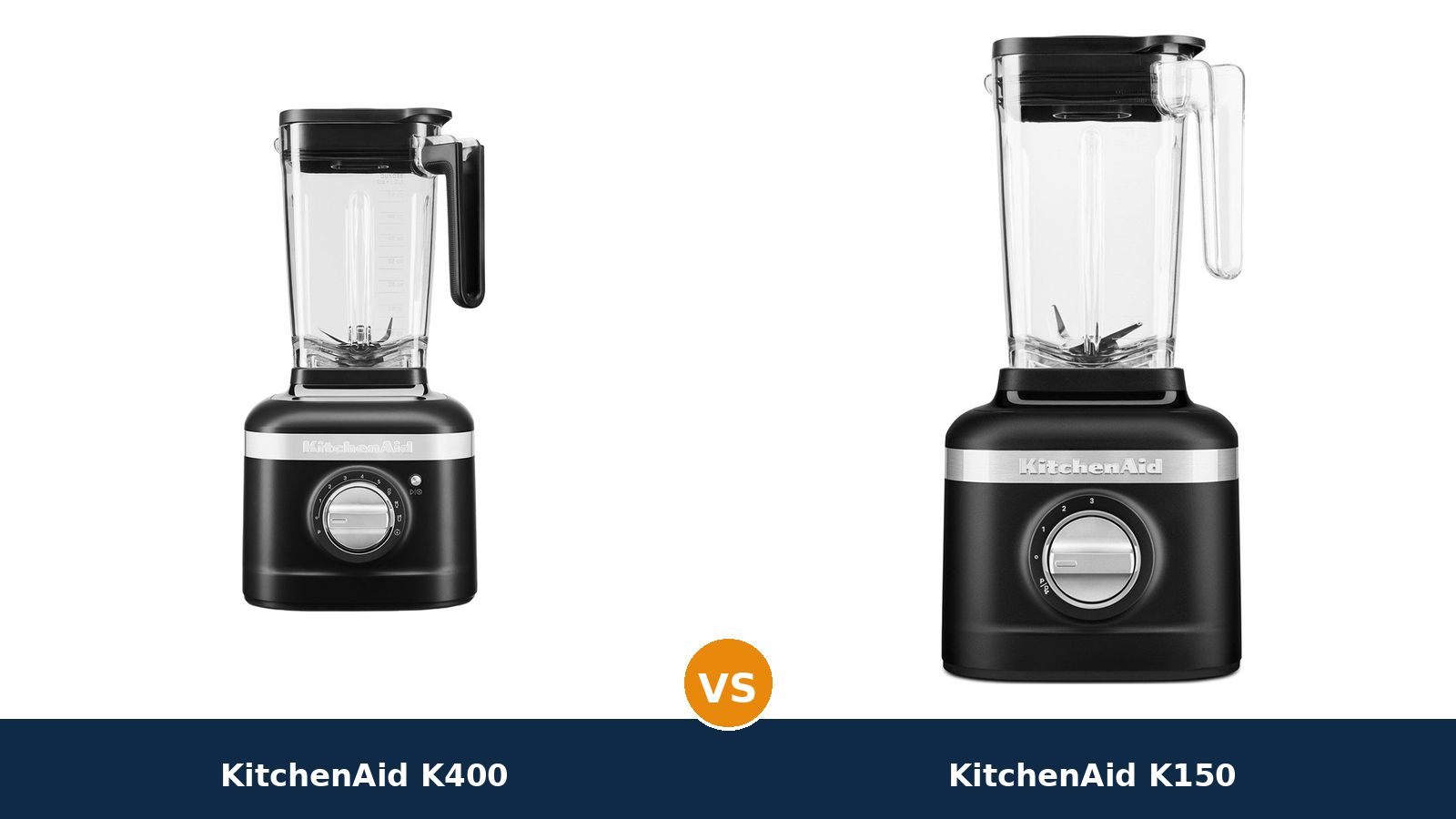
Same brand. Same silhouette. Same ribbed jar, same asymmetric blade, same two motor tricks.
Put the KitchenAid K400 and the KitchenAid K150 side by side and they look like the same blender at two prices. In the ways that decide a purchase, they are not the same blender at all.
The K400 is the step up inside KitchenAid's own line: more power on every honest measure, a bigger jar, two more speeds, three drink presets instead of one, a die-cast metal base — and a warranty five times longer. The K150 is the honest entry point: the same blending system, deliberately trimmed, in a smaller and lighter machine.
The question is the one KitchenAid's own range forces on you: is the step up worth taking, or does the cheaper machine already cover your kitchen? Every specification below comes from KitchenAid's own published data and manuals.
Key Takeaways
- The power gap is real — read it on the honest basis. Both motors are sold on laboratory peak horsepower: 1.5 peak HP for the K400 against 0.9 peak HP for the K150. The listed wattages tell the same story: 1,200 watts against 650. The K400 has close to twice the motor.
- The shared DNA is genuine. Both run KitchenAid's three-part blending system — asymmetric blade at four angles, ribbed jar, Intelli-Speed® motor control — and both have Soft Start®. The K150 is a smaller sibling, not a different species.
- Presets separate them cleanly. The K400 runs Ice Crush, Icy Drinks and Smoothie programs plus a Self-Cleaning cycle. The K150 runs one preset — Ice Crush — plus its cleaning cycle.
- The warranty is the widest gap. Five years on the K400. One year on the K150. From the same company.
- The K150 fights back on size and simplicity. It is shorter, roughly five pounds lighter, and its linked box includes two personal jars the K400's standard box does not.
Quick Verdict
Buy the KitchenAid K400 for most kitchens. It is the better blender in this pairing on almost every line of the spec sheet.
Close to double the listed wattage. A 56 oz jar against 48. Five speeds and three drink presets against three speeds and one. A die-cast base and a 5-year warranty behind it.
If your blender works most days — family smoothies, frozen drinks, sauces, soups — the K400 is where the money belongs. It is not a close call on capability.
Buy the KitchenAid K150 if your blending is simple and your household is small. Morning smoothies for one or two, crushed ice for drinks, the occasional sauce.
For that workload the K150 runs the same blending system with the same self-managing motor, in a shorter, lighter machine — and its bundle adds two personal jars for grab-and-go mornings. Just buy it knowing the warranty is one year, not five.
The Scorecard
Scores below are derived directly from the manufacturer specifications compared in this guide — motor ratings and their basis, jar capacities, speed and program counts, cleaning provisions, dimensions and warranty terms. They are a reading aid, not benchmark results.
| Category | K400 | K150 | ||
|---|---|---|---|---|
| Power (basis from specs) | 8 / 10 | 5 / 10 | ||
| Capacity & batch size | 7 / 10 | 6 / 10 | ||
| Ease of use | 9 / 10 | 8 / 10 | ||
| Cleaning | 8 / 10 | 8 / 10 | ||
| Footprint & storage | 7 / 10 | 8 / 10 | ||
| Value | 8 / 10 | 7 / 10 | ||
| Overall | 8.0 / 10 | 6.9 / 10 | ||
The pattern is a step-up story with one honest exception. The K400 wins power, capacity and ease of use. Cleaning is a dead tie. And the K150 — shorter, lighter, simpler — wins the footprint category outright.
At a Glance: Who Each Blender Fits
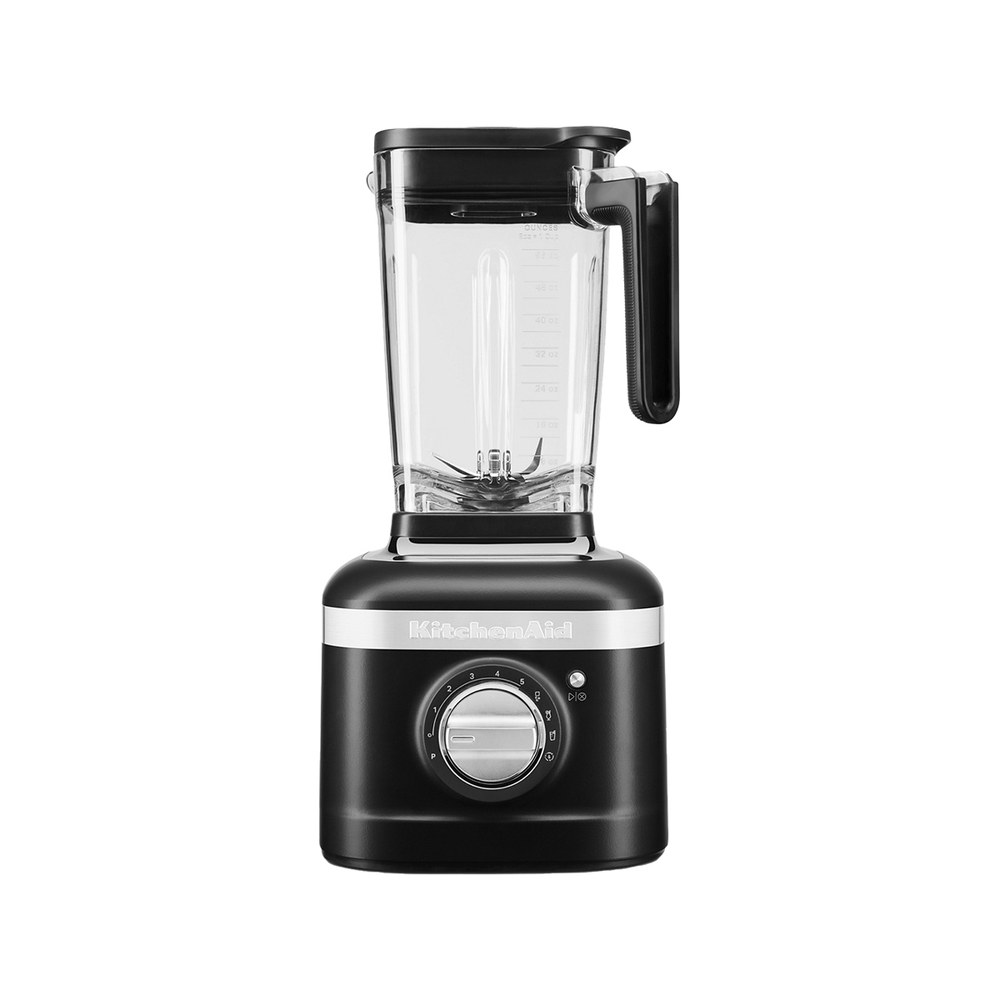
KitchenAid K400
- 1.5 peak HP* motor, listed at 1,200 watts, with Intelli-Speed® and Soft Start®
- 56 oz BPA-free plastic jar
- 5 variable speeds + Pulse, plus Ice Crush, Icy Drinks, Smoothie and Self-Cleaning programs
- Die-cast metal base, steel-reinforced coupler
- 5-year limited warranty
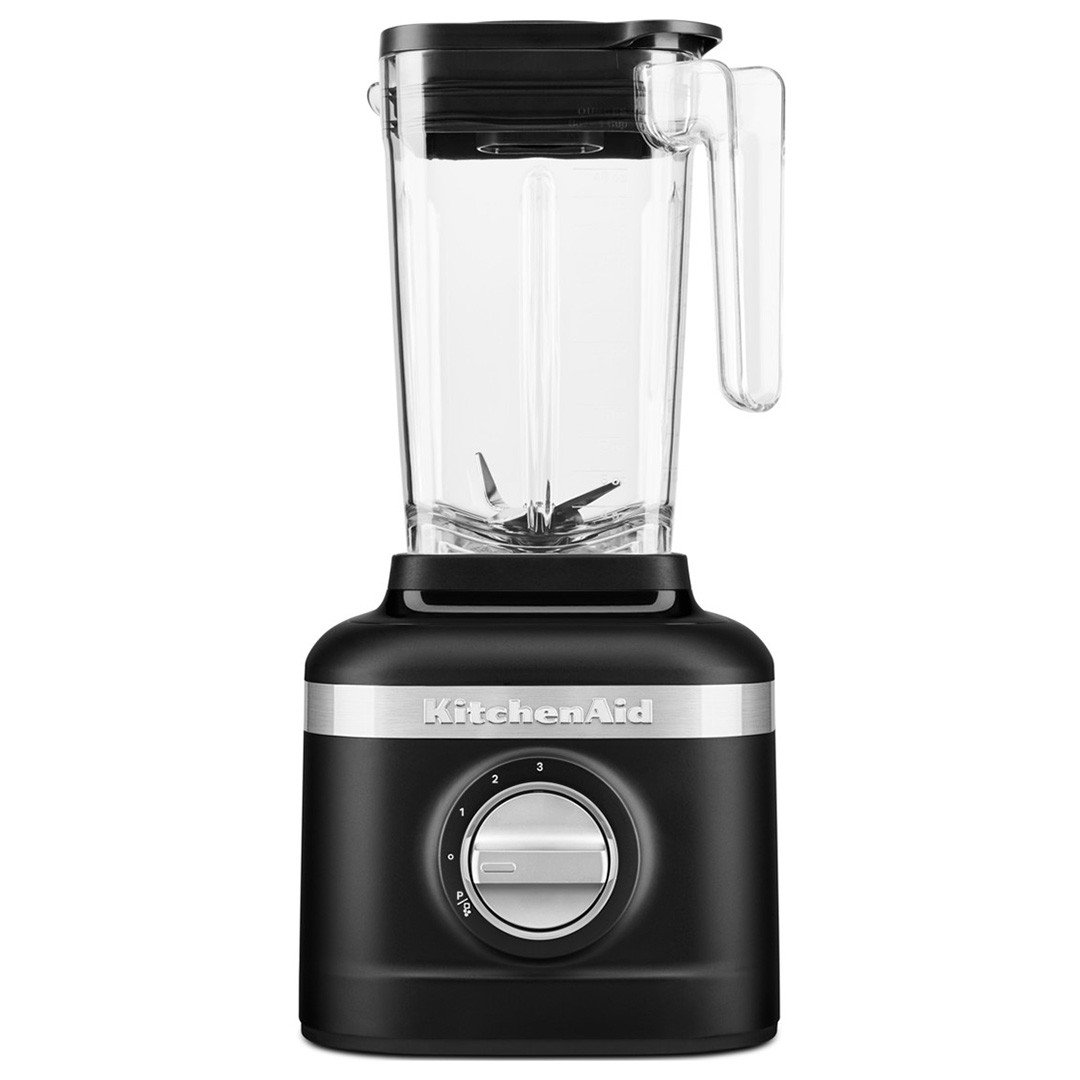
KitchenAid K150
- 0.9 peak HP* motor, 650 watts, with Intelli-Speed® and Soft Start®
- 48 oz BPA-free plastic jar
- 3 variable speeds + Pulse/Ice Crush setting, plus a Self-Cleaning cycle
- Linked bundle adds two 16 oz personal jars
- 1-year limited warranty
Choose the K400 if…
You blend most days, for more than two people. The 56 oz jar and the stronger motor turn family rounds and frozen drinks into single cycles.
You want presets to run the blend. Smoothie and Icy Drinks programs mean the machine, not your thumb, decides when to stop.
You keep appliances for years. A die-cast base and five years of warranty is a different ownership proposition from one year.
Choose the K150 if…
Your blending is a short list: smoothies for one or two, crushed ice, a sauce now and then. The K150 was designed for exactly that list.
Counter height or cupboard space is tight. At 14.8 inches tall and about 7 pounds, it is the easier machine to house and to move.
You blend-and-go in the morning. The linked K150 bundle includes two personal jars; on the K400, the personal jar is a separate purchase.
As an Amazon Associate I earn from qualifying purchases at no extra cost to you.
Specifications: The Specs That Actually Matter
Every figure below is taken from KitchenAid's published specifications, product pages and owner's manuals. The K400 figures are for the standard US model (KSB4027) with its 56 oz jar; the K150 figures are for the KSB1325 blender, in the linked KSB1332 bundle box with two personal jars.
| Specification | KitchenAid K400 | KitchenAid K150 |
|---|---|---|
| Jar capacity | 56 oz (1.6 L) | 48 oz (1.4 L) |
| Jar material | BPA-free plastic, ribbed jar walls | BPA-free plastic, ribbed jar walls |
| Motor rating | 1.5 peak HP*; listed at 1,200 watts | 0.9 peak HP*; 650 watts |
| Blade | Asymmetric stainless steel, four blend angles; fixed in jar | Asymmetric stainless steel, four blend angles; fixed in jar |
| Speed settings | 5 variable speeds + Pulse | 3 variable speeds + Pulse/Ice Crush |
| Preset programs | Ice Crush, Icy Drinks, Smoothie, Self-Cleaning | Ice Crush, Self-Cleaning cycle |
| Motor control | Intelli-Speed® Motor Control + Soft Start® | Intelli-Speed® Motor Control + Soft Start® |
| Base construction | Die-cast metal base, steel-reinforced coupler | Lighter base construction, metal coupler |
| Hot blending | Main jar only; start low, increase gradually | Low speed, lid secured, centre cap locked |
| In the box (linked listing) | 56 oz jar and lid | 48 oz jar and lid, plus two 16 oz personal jars with lids and a blade assembly |
| Dishwasher-safe parts | Jar and lid dishwasher safe, plus Self-Cleaning cycle | Jars and lids dishwasher safe, plus Self-Cleaning cycle |
| Dimensions (H × W × D) | 15.8 × 7.6 × 9.0 in | 14.8 × 7.1 × 8.5 in |
| Weight | 12 lb | ≈7 lb |
| Optional extras | 16 oz personal jar, 6 oz small batch jar, citrus press, tamper version | 16 oz personal jar, 6 oz small batch jar |
| Warranty (US) | 5-year limited | 1-year limited |
*One badge, two sizes — read the basis, not just the number: both motors are marketed on peak horsepower, and KitchenAid's asterisk defines it the same way on both machines: a laboratory measurement of peak horsepower output, not a sustained working rating. The comparison still holds, because the basis is shared — 1.5 peak HP against 0.9 peak HP is an honest like-for-like gap. The wattage figures underneath it agree: retailer and listing data put the K400 at 1,200 watts, while KitchenAid rates the K150 at 650 watts. Whichever basis you choose, the K400's motor is close to twice the K150's. One warning: the K150's “150” is a model name, not a wattage — ignore any listing that claims otherwise.
Configuration note: both blenders are sold in several boxes, detailed in the buying guide below. The K400's standard US box is the KSB4027 (56 oz jar and lid); the KSB4028 adds a tamper and the KSB4031 adds a personal jar. The K150's base model is the KSB1325 (48 oz jar and lid); our link is the KSB1332 bundle, which adds two personal jars. The blender itself — base, motor, main jar — is identical across each model's boxes. Overseas, the K400 also ships as the Artisan K400 with a 48 oz glass jar.
The Differences That Change What You Buy
1. Power: The Same Badge Basis, a Genuinely Bigger Motor
KitchenAid sells both of these motors the same way: a peak-horsepower badge with an asterisk. Peak horsepower, by the brand's own footnote, is a laboratory measurement of the motor at its peak — not the power it sustains at the blade.
Inside this pairing that caveat cuts the other way: because both badges use the same basis, the gap between them is honest. 1.5 peak HP against 0.9 peak HP is a real difference, measured the same way.
The wattage figures agree. The K400 is listed at 1,200 watts; the K150 is rated at 650. On either basis, the K400 brings close to twice the motor to the jar.
What that buys is headroom. Thick mixtures, full jars and frozen loads are where a smaller motor works hardest and slows first. The K400 has reserve for all three; the K150 is sized for ordinary loads.
Intelli-Speed narrows the practical gap, and the K150 has it too: both motors hold the chosen speed as the load shifts. It does not give the K150 the K400's power. It does mean its power is well managed.
Verdict on power: the clearest win in this comparison, and it belongs to the K400. If your blends are thick, frozen or full-jar, this section alone can settle the purchase.
2. Controls and Presets: Five Speeds and Three Recipes Against Three Speeds and One
Both dials look alike. What they offer is not alike.
The K400's dial runs five variable speeds plus Pulse, and around it sit three preset recipe programs: Ice Crush, Icy Drinks and Smoothie. A fourth position runs the Self-Cleaning cycle.
Presets are not decoration. A smoothie program ramps and pulses in a pattern tuned for produce and ice, then stops itself. An Icy Drinks program attacks a heavier ice load differently. Pressing a button and walking away is a genuinely different morning from standing over a dial.
The K150's dial runs three variable speeds. Its single preset is Ice Crush — KitchenAid built this machine around ice, and the dial's Pulse position doubles as the ice-crush setting. It also runs a self-cleaning cycle.
Three speeds are enough for the K150's intended work: a low gear to start, a high gear to finish, and a pulse for control. Where the K400's extra range earns its keep is at the edges — holding a salsa chunky, easing a thick mixture into motion, letting presets handle weekend frozen drinks.
Both machines share Soft Start, which folds ingredients into the blade before full speed arrives. On the feature buyers feel most, day to day, these two are equals.
3. Capacity: 56 Ounces Against 48 Is About Rounds, Not Servings
Eight ounces separate these jars. That is one smoothie — and whether it matters depends entirely on how many people your blender feeds.
The K400's 56 oz jar is the classic full-size pitcher. Four generous smoothies, a full round of frozen drinks, a family batch of soup base: one blend, done.
The K150's 48 oz jar covers one to three servings comfortably. For a couple's morning routine it is not a compromise at all — it is the right size, and smaller loads sit closer to the blade and form their vortex sooner.
The K150's answer to single servings is in its box. The linked bundle includes two 16 oz personal jars: blend in the jar, swap the blade for a lid, and take it with you. The K400 offers the same personal jar — as a separate expansion pack.
So the capacity question is really two questions. Batch blending for a household: K400. Personal blending for one: the K150 bundle is, oddly, the better-equipped box. On jar material and design — BPA-free plastic, ribbed walls, square profile — this is a tie.
4. The Blending System: Shared DNA, Honestly Shared
Here is the section where the K150's case is strongest. KitchenAid builds both machines around the same three-part blending system.
Part one: an asymmetric stainless steel blade that blends at four distinct angles, pulling contents down into the cutting zone. Part two: the ribbed jar, whose walls fold the mixture back toward the blade and sustain the vortex. Part three: the motor, governed by Intelli-Speed.
That system is why the K150 punches respectably for a 650-watt machine, and why its ice crushing works as advertised. Ice crushing is a geometry problem as much as a power problem, and the geometry is shared.
What the K400 adds is not a better system. It is the same system driven harder, in a bigger jar, on a heavier base. Call the blade and jar design a tie, because it is one — the K400's superiority is in the motor behind the identical blade.
5. Build and Footprint: Die-Cast Weight Against Cupboard Manners
Lift both machines and the step up announces itself. The K400 weighs 12 pounds. The K150 weighs about 7.
The K400's weight is construction, not bloat. Its base is die-cast metal, and the coupler that carries the motor's work to the blade is steel-reinforced. A heavy metal base plants the machine during hard blends, damps vibration, and shrugs off a decade of knocks.
The K150's lighter build follows from its brief: a lighter base construction with a metal coupler — adequate for its loads, and a large part of why the machine is easy to live with.
The K400 is also the bigger machine in every direction: taller at 15.8 inches against 14.8, deeper at 9.0 inches front to back against 8.5. That inch of height decides real purchases — under low wall cabinets, the K150 slides where the K400 argues.
So build quality goes to the K400, and housing goes to the K150. Both verdicts are honest; which one matters is a property of your kitchen, not of the blenders.
6. Cleaning: A Genuine Tie
Some comparisons manufacture a winner here. This one does not, because the provision is the same.
Both machines run a self-cleaning cycle: water, a drop of soap, one turn of the dial, and the daily wash is handled. Both put their jars and lids in the dishwasher — the K150's personal jars and lids included.
Both blades are fixed in the jar rather than removable: no separate assembly to wash or lose — and careful washing around a permanent sharp blade for the life of either machine. If cleaning is your deciding factor, decide on something else. These two ask exactly the same of your sink.
7. Warranty: Five Years Against One Settles the Ownership Question
This is the widest gap in the comparison, wider than the power gap. The K400 carries KitchenAid's 5-year limited warranty in the United States. The K150 carries 1 year.
KitchenAid's K400 coverage is its hassle-free replacement style: if the blender fails within the period, KitchenAid arranges a replacement and the return of the original. Five years of that, behind a die-cast base, is a coherent ownership proposition.
The K150's single year is the same cover KitchenAid gives its entry machines — which is what the K150 is. Part of what the K400's price buys is four extra years of the manufacturer carrying the risk.
A warranty is not a lifespan prediction, and a well-kept K150 will likely outlive its year. But if you buy appliances rarely and expect them to stay, the coverage gap is the strongest single argument for stepping up.
Pairing Guide: What You Blend Decides
| Use case | K400 | K150 | Our call |
|---|---|---|---|
| Daily smoothies, 1–2 people | Excellent; jar larger than the job | Right-sized, personal jars in the box | K150 — the simpler daily driver |
| Family smoothie batches | One 56 oz blend covers the table | Two rounds at 48 oz | K400 |
| Frozen & icy drinks | Dedicated Icy Drinks program plus Ice Crush | Ice Crush preset is its party trick | K400 for rounds; K150 for a couple of drinks |
| Crushed ice for cocktails | Ice Crush preset, power in reserve | Built around ice crushing | Tie — pick on batch size |
| Hot soups & sauces | Main jar, low start, stronger motor for big batches | Low speed only, lid and cap locked | K400 for volume; either for a small batch |
| Chunky salsa & dips | Five speeds to hold a coarse texture | Low speeds plus Pulse | K400, narrowly |
| Blend-and-go mornings | Personal jar sold separately | Two personal jars included in the bundle | K150 |
| Buying for a decade | Die-cast base, 5-year warranty | Light build, 1-year warranty | K400 |
| Small kitchen, low cabinets | 15.8 in tall, 12 lb, deepest here | 14.8 in tall, ≈7 lb | K150 |
The 30-Second Decision
| If this sounds like you… | Buy |
|---|---|
| Family of three or more; batches are the norm | The K400 |
| You want presets for smoothies and icy drinks | The K400 |
| You keep appliances for ten years | The K400 |
| Thick, frozen or full-jar blends are routine | The K400 |
| Smoothies for one or two, and little else | The K150 |
| You blend in a personal jar and take it to go | The K150 |
| Low cabinets, small counter, cupboard storage | The K150 |
Ready to buy?
Check the current price — both listings below are the configurations this guide compared.
K400 on Amazon K150 on AmazonThe Real Trade-Offs
What you gain with the K400
Close to double the motor on both honest measures — 1.5 peak HP and 1,200 listed watts against 0.9 peak HP and 650 watts.
Eight more ounces of jar, two more speeds, and Smoothie and Icy Drinks presets the K150 does not have.
A die-cast metal base — and four extra years of warranty behind the whole machine.
What you give up
About five pounds of lightness and an inch of height. The K400 is the bigger appliance to house and to move.
The personal jars in the box. On the K400 they are an expansion pack, bought separately.
And the K150's simplicity: three speeds is a dial nobody has to learn.
Pros & Cons
K400 — pros
- 1.5 peak HP motor, listed at 1,200 watts — close to double the K150
- Five speeds plus Smoothie, Icy Drinks and Ice Crush presets
- Die-cast metal base with steel-reinforced coupler
- 5-year limited warranty
- 56 oz jar handles family batches in one blend
- Intelli-Speed and Soft Start manage the blend
K400 — cons
- Heavy at 12 lb, and the tallest, deepest machine here
- Personal jar is a separate purchase
- Power is sold on a peak-horsepower basis, like the K150's
- Fixed blade — careful washing for life
K150 — pros
- Same three-part blending system: asymmetric blade, ribbed jar, Intelli-Speed
- Soft Start included — the step-up's manners at the entry price
- Shorter and lighter: 14.8 in, about 7 lb
- Linked bundle includes two 16 oz personal jars
- Ice Crush preset and self-cleaning cycle
- Dishwasher-safe jars and lids
K150 — cons
- 650 watts — thick, frozen, full-jar loads work it hard
- Only a 1-year warranty
- Three speeds, one preset — no Smoothie or Icy Drinks programs
- 48 oz jar means second rounds for families
- Lighter base construction than the die-cast K400
Buying Guide: Read This Before You Pick a Box
Decode the badges first
Both packages lead with peak horsepower, and both asterisks say the same thing: a laboratory measurement of peak motor output, not a sustained working figure. Compare like with like — 1.5 against 0.9 on the badge, 1,200 listed watts against 650 rated watts underneath it — and the conclusion is the same on both bases.
One trap is specific to the smaller machine: the K150's name is not its wattage. It is a 650-watt blender. Any listing or review claiming 150 watts has misread the model name.
Which K400 box?
The standard US model is the KSB4027: 56 oz BPA-free plastic jar and lid — the box our link covers, in Black Matte. Two siblings are worth knowing: the KSB4028 adds a tamper, and the KSB4031 adds a 16 oz personal jar. Accessories — personal jar, small batch jar, citrus press — are sold separately and fit across the K400 family.
Cross-border warning: the European and UK Artisan K400 ships with a 48 oz glass jar and a regional plug. This guide's links and figures are the US models.
Which K150 box?
The base model is the KSB1325: 48 oz jar and lid. Our link is the KSB1332 bundle in Black Matte, which adds two 16 oz personal jars, their lids and a blade assembly to the same blender. If you blend-and-go, the bundle is the box to buy; if you never will, the jar-only box is the same machine for less.
The K150's expansion packs — the 16 oz personal jar and the 6 oz small batch jar — are shared with the K400 family. Buy accessories by model compatibility, not by the name on your base.
The colour code
KitchenAid model numbers carry their colour in the final letters: BM is Black Matte, PA Passion Red, CU Contour Silver, WH White. Read the full model number, not just the headline name — a different suffix may mean a different finish, or a different box of contents.
Upgrade Path & Longevity
This comparison is itself an upgrade path, running one way. The two share a design language, an accessory family and a blending system — a K150 owner stepping up finds a familiar machine with more of everything.
Within either model, the path runs through jars: the personal jar turns the K400 into a weekday smoothie station; the small batch jar handles dressings neither big jar manages gracefully. Replacement jars and lids for both are catalogue items.
Longevity is where the stories diverge. A blender's life is usually decided by its motor, coupler and jar — the K400 defends all three with die-cast construction, a steel-reinforced coupler and five years of warranty. The K150 asks the standard entry-level bargain: sound design, ordinary cover.
When to Skip Both
Skip both if your workload is genuinely heavy-duty. Daily nut butters, frozen desserts from solid fruit, dough-like mixtures — that work belongs to the high-performance class. Forcing either KitchenAid to live there shortens its life.
Skip both if counter space is the whole problem — a compact personal blender does single servings in a fraction of the footprint. Though if the personal-jar idea appeals, price the K150 bundle first.
And skip the K150 specifically if a long warranty is non-negotiable. That single requirement ends this comparison at the K400 — or takes you out of this price class altogether.
Support, Warranty & Ownership
The warranty gap deserves a plain restatement. In the United States, the K400 is covered by KitchenAid's 5-year limited warranty, in the brand's hassle-free replacement style. The K150 is covered for 1 year. Same company, same parts network, five times the cover.
Day-to-day support is a tie. KitchenAid publishes full owner's manuals for both models, and sells replacement jars, lids and accessories for both. Two practical notes from those manuals: on the K400, hot liquids belong in the main jar only, started low and increased gradually; on the K150, blend hot liquids on the lowest speed with the lid secured and the centre cap locked in place.
Final Verdict
This is the step-up question, and KitchenAid has structured its range so the answer depends on one thing: how hard your blender works.
The K400 is the better machine, and it is not close on the spec sheet. Close to twice the motor on an honestly shared basis. A bigger jar. More speeds, more presets. A metal base. Five years of warranty against one. On capability per blend, it wins this comparison the way it scored against the rest of the range: 8.0, the mark of the complete mid-range blender.
The K150 is not a failed K400. It is the same blending system, honestly trimmed for a shorter job list, keeping Intelli-Speed and Soft Start while adding personal jars to its bundle. For one or two people blending simple things, its limits may never appear. Its 6.9 is the same score it earned against stronger company — it reflects the warranty and the wattage, not the design.
Our pick for most buyers: the KitchenAid K400 — buy the step up once, and keep it. Our pick for small households with simple blending: the K150 — the same system, the smaller footprint, and no money spent on headroom you will not use.
K400 on Amazon K150 on AmazonSimilar Names, Different Blenders: Do Not Order the Wrong One
K400, KSB4027, KSB4028, KSB4031. All three are the same K400 blender. The 4027 is the standard box; the 4028 adds a tamper; the 4031 adds a personal jar. A price gap between them is a gap in box contents, not in the machine.
K150, KSB1325, KSB1332. The same K150 blender in two boxes: the 1325 is jar and lid; the 1332 bundle — our link — adds two personal jars and a blade assembly. Match the box to whether you blend-and-go.
K400 vs Artisan K400. Overseas, the K400 is sold as the Artisan K400 with a 48 oz glass jar and a regional plug. Same base, different jar and voltage.
K150 vs K400 dials. The fastest visual check: the K150's dial is marked 1, 2, 3 with a P/Ice position; the K400's runs 1 to 5 with preset icons around it. If a listing photo shows three speeds, it is a K150 whatever the headline says.
Frequently Asked Questions
Is the K400 worth the step up from the K150?
For most households, yes. You get close to double the listed wattage (1,200 against 650), a 56 oz jar against 48, five speeds and three drink presets against three speeds and one, a die-cast metal base, and a 5-year warranty against 1 year. The K150 makes sense when the workload is small and simple — that is what it was trimmed for.
How much more powerful is the K400, really?
On the basis KitchenAid itself uses for both — peak horsepower, a laboratory peak measurement — it is 1.5 peak HP against 0.9 peak HP. On listed and rated wattage it is 1,200 watts against 650. Both bases agree: close to twice the motor, with the caveat that peak figures describe a moment, not sustained power at the blade.
Do both blenders have Intelli-Speed and Soft Start?
Yes — both. Intelli-Speed senses the contents and holds the selected speed as the load changes; Soft Start brings the motor up gently so ingredients fold into the blade instead of splashing. These shared features are the main reason the K150 feels more capable than its wattage suggests.
Which blender is better for crushing ice?
Both were designed for it, around the same asymmetric blade and ribbed jar, and both carry an Ice Crush setting. The K150's dial builds its Pulse position around ice crushing. The K400 adds a separate Icy Drinks preset for frozen drinks and brings more power in reserve. For a couple of drinks, call it a tie; for party rounds, the K400.
Can I blend hot soup in either blender?
Yes, with each machine's rules. In the K400, use the main jar only, start low and increase gradually. In the K150, blend on the lowest speed with the lid secured and the centre cap locked. Neither manual treats hot blending as a casual fill-to-the-top job — respect the stated procedure on both.
Are the jars and parts dishwasher safe?
Yes on both. The K400's jar and lid are dishwasher safe; so are the K150's jars and lids, including the bundle's personal jars. Both machines also run a self-cleaning cycle for the everyday wash, which most owners end up using most of the time.
Why does the K400 weigh so much more?
Its base is die-cast metal with a steel-reinforced coupler, where the K150 uses a lighter base construction. The result is 12 pounds against about 7. The weight buys stability, vibration damping and durability; the lightness buys easy moving, cupboard storage and an easier fit under low cabinets.
Which one will last longer?
On paper, the K400: metal construction and a 5-year warranty against the K150's 1 year. In practice, both share the same parts ecosystem with replaceable jars and lids, and real lifespan follows workload. The K400 is the safer decade-long bet; the K150 is the honest budget bet.
Sources & Verification
Specifications were taken from KitchenAid's official product pages, specification sheets and owner's manuals for the K400 (KSB4027 family; specification sheet SDO19001 and the KSB40 owner's manual / quick-start guide W11333854) and the K150 (KSB1325 / KSB1332 family; K150 specification data and the owner's manual W11435381B), read November 2026, and cross-checked against the established records from this site's earlier KitchenAid comparisons. Amazon ASINs were cross-checked against independent ASIN and UPC records — B07WHFBKLR is the K400 in Black Matte (KSB4027BM, UPC 883049525266); B084WDF1DY is the K150 bundle with two personal jars in Black Matte (KSB1332, UPC 883049531939). Where a headline figure and a working figure disagree — peak horsepower against listed wattage — this guide prints both and judges on the shared basis, which both motors use.

James tests and compares everyday tech and home gear for Honestly Compared, with a simple rule: no claim without a source. Every comparison on the site is built from manufacturer specifications, manuals and independent data — checked line by line before publication.