
KitchenAid Pure Power Blender vs KitchenAid K150: Which Should You Buy?
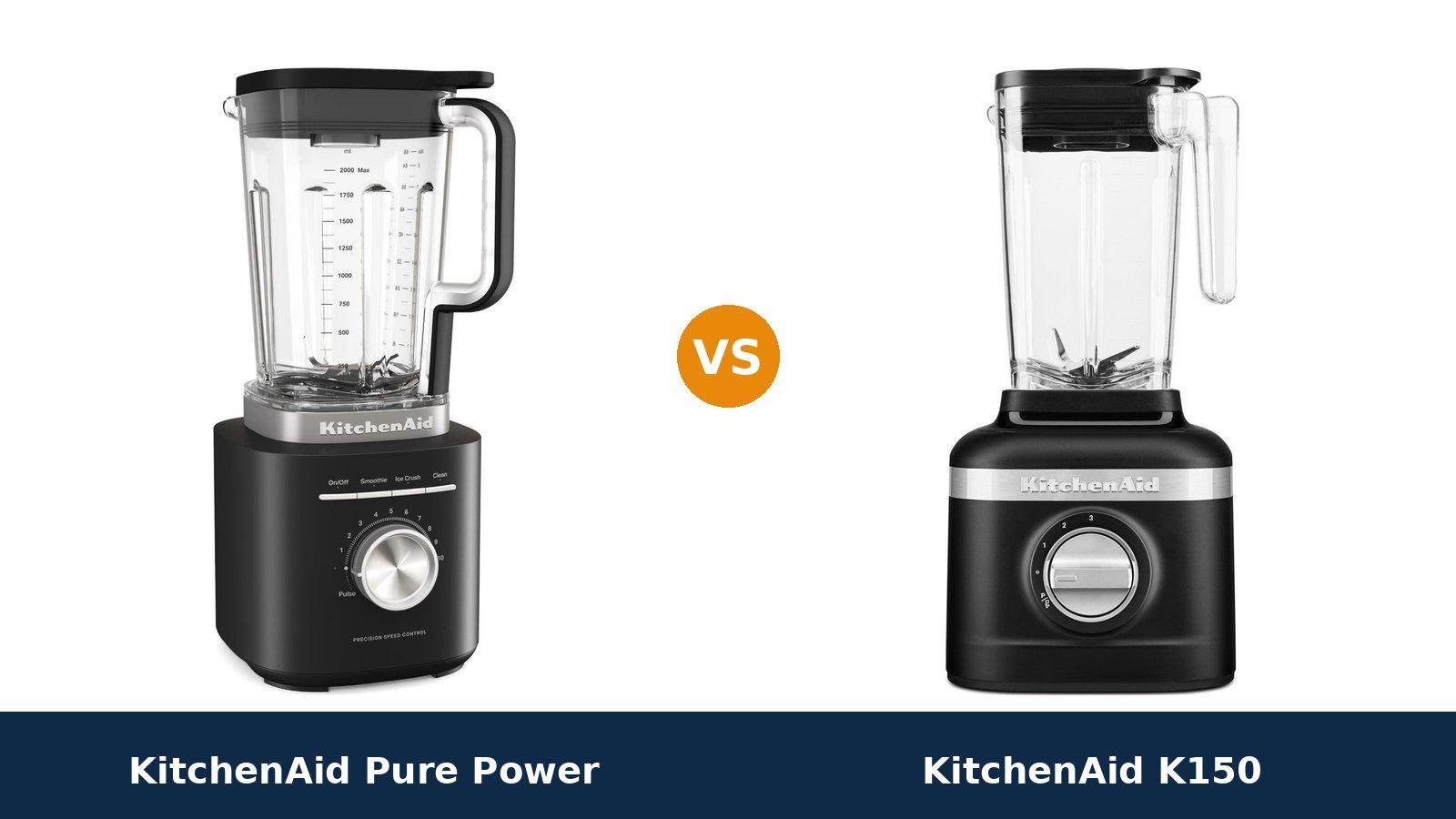
Same brand. Same asymmetric blade idea. Same promise about crushing ice.
On a shelf, the KitchenAid Pure Power and the KitchenAid K150 look like two sizes of the same blender. They are not. One is KitchenAid's current full-size machine, built around a precision speed knob and a motor rated at 1,200 watts. The other is the simplest blender KitchenAid sells: three speeds, a smaller jar, and a 650-watt motor.
The wattage gap is the headline, but it is not the whole story. The Pure Power adds preset programs, a vented lid for hot soup, and a self-cleaning cycle. The K150 counters with two tricks of its own — a motor that senses what is in the jar, and a gentler start that keeps ingredients in the jar instead of on the lid.
This guide settles it properly. Every specification below comes from KitchenAid's own published data and manuals. Every claim can be checked. And the verdict at the end is the same one we would give a friend spending their own money.
Key Takeaways
- The Pure Power is the stronger, more capable blender. Roughly double the rated power, a 68 oz jar against 48 oz, and ten speeds against three.
- Read the wattage claim carefully. “1,700 watt peak power” is a laboratory peak-input figure; KitchenAid's own footnote gives the UL rating as 1,200 watts. That is still nearly twice the K150's 650 watts.
- The K150 is the simpler machine, and that is its charm. Three speeds, an ice-crush setting, Intelli-Speed motor control and a Soft Start — nothing to learn.
- Hot soup separates them. The Pure Power has a heat-release vented lid made for blending straight from the pan. The K150 blends hot liquids only under tighter rules.
- Both carry the same 1-year limited warranty in the US, and both put their jars in the dishwasher. The gap is capability, not coverage.
Quick Verdict
Buy the KitchenAid Pure Power for most kitchens. It is the more complete blender by a wide margin.
Its 1,200-watt UL-rated motor works in a 68 oz jar. Its knob glides through ten speeds instead of clicking through three. It runs a Smoothie cycle, an Ice Crush cycle and a Clean cycle at the press of a button.
And when soup comes straight off the stove, its vented lid lets the steam out instead of pressurising the jar. For family batches, frozen drinks and hot blends, this is the KitchenAid to own.
Buy the KitchenAid K150 if your blending is simple and your kitchen is small. Morning smoothies for one or two people. The occasional tray of ice for drinks. A sauce now and then.
It stands under 15 inches tall, weighs about 7 pounds, and asks nothing of you beyond turning a dial. If that is your whole blending life, the Pure Power's extra power and programs are money spent on capability you will never open.
The Scorecard
Scores below are derived directly from the manufacturer specifications compared in this guide — motor ratings, jar capacities, speed counts, program lists and published dimensions. They are a reading aid, not benchmark results.
| Category | Pure Power | K150 | ||
|---|---|---|---|---|
| Power | 9 / 10 | 5 / 10 | ||
| Capacity & batch size | 9 / 10 | 6 / 10 | ||
| Speed control & presets | 9 / 10 | 5 / 10 | ||
| Ease of use | 8 / 10 | 9 / 10 | ||
| Cleaning | 9 / 10 | 7 / 10 | ||
| Footprint & storage | 6 / 10 | 8 / 10 | ||
| Value | 8 / 10 | 8 / 10 | ||
| Overall | 8.3 / 10 | 6.9 / 10 | ||
The pattern is one-directional. The Pure Power wins every capability category. The K150 wins on simplicity and size — the two things its buyers actually shop for.
At a Glance: Who Each Blender Fits
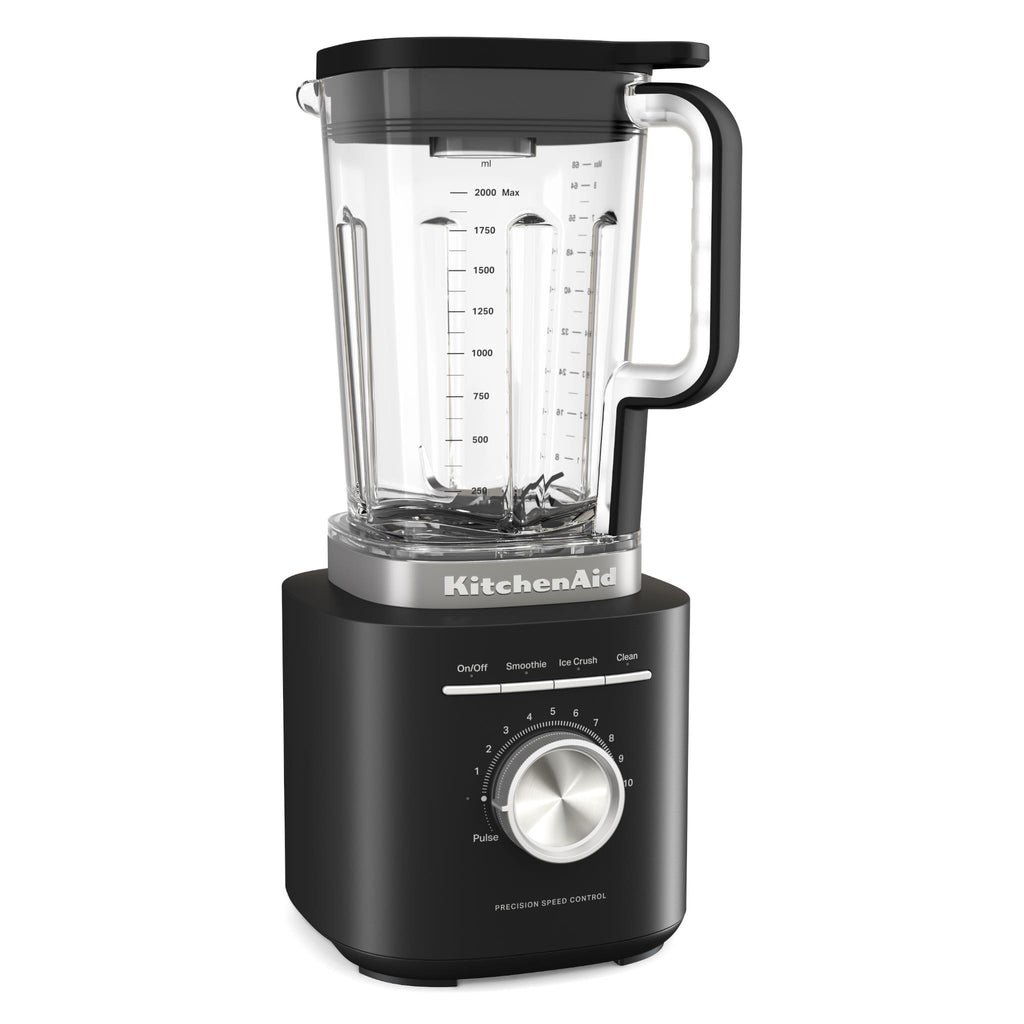
KitchenAid Pure Power Blender
- 1,200 W UL-rated motor (1,700 W peak input*)
- 68 oz BPA-free plastic jar
- 10 glide speeds + Pulse, plus Smoothie, Ice Crush and Clean presets
- Heat-release vented lid for hot blends
- 360° asymmetric stainless steel blades
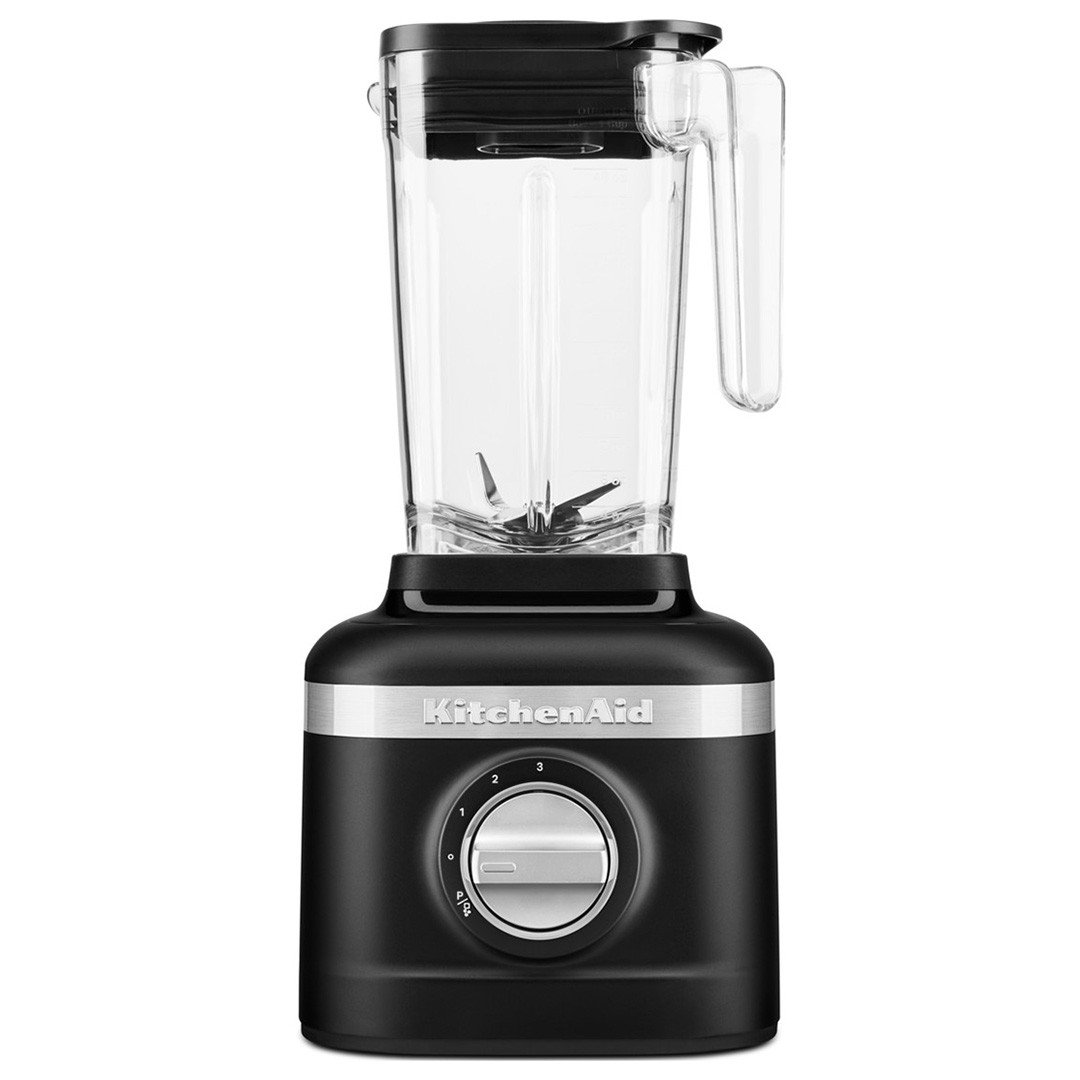
KitchenAid K150
- 650 W motor with Intelli-Speed® control and Soft Start®
- 48 oz BPA-free plastic jar
- 3 speeds + combined Pulse/Ice Crush setting
- Asymmetric stainless blade, blends at four angles
- Linked listing adds two 16 oz personal jars
Choose the Pure Power if…
You blend for a family. Smoothies for four, a pitcher of margaritas, a pot of soup — batches the K150's 48 oz jar turns into two rounds of work.
You blend hot liquids often. The vented lid exists precisely for soup straight from the pan.
You want texture control. Ten speeds you can glide between, mid-blend, is a different tool from three fixed speeds.
Choose the K150 if…
Your blending is a weekday smoothie for one or two, and ice for drinks at the weekend.
Your cabinets are low or your counter space is tight. At 14.8 inches tall, the K150 slides under upper cabinets that the Pure Power cannot.
Or you simply want the KitchenAid that asks the least of you. One dial. Three speeds. Done.
As an Amazon Associate I earn from qualifying purchases at no extra cost to you.
Specifications: The Specs That Actually Matter
Every figure below is taken from KitchenAid's published specifications, product pages and owner's manuals, cross-checked against the manufacturer's product data.
The Pure Power figures are for the standard 68 oz plastic-jar model (KSB2072). The K150 figures are for the blender itself (KSB1325); the Amazon listing we link is the Black Matte bundle that adds two personal jars (KSB1332).
| Specification | KitchenAid Pure Power | KitchenAid K150 |
|---|---|---|
| Jar capacity | 68 oz (2.0 L) | 48 oz (1.4 L) |
| Jar material | BPA-free plastic, ribbed jar walls | BPA-free plastic, ribbed jar walls |
| Motor rating | 1,200 W (UL rated); 1,700 W peak input* | 650 W |
| Blade | 360° asymmetric stainless steel; removable blade assembly | Asymmetric stainless steel, four blend angles; fixed in jar |
| Speed settings | 10 variable speeds on a glide knob + Pulse | 3 speeds + Pulse/Ice Crush |
| Preset programs | Smoothie, Ice Crush, Clean | Ice Crush (shares the Pulse setting) |
| Motor control | Precision speed control knob | Intelli-Speed® Motor Control + Soft Start® |
| Hot blending | Heat-release vented lid; hot fills up to 40 oz | Hot liquids on speed 1, lid secured; no heat vent |
| In the box (linked listing) | 68 oz jar and lid | 48 oz jar and lid, plus two 16 oz personal jars |
| Dishwasher-safe parts | Jar, lid and filler cap (top rack), plus a Clean cycle | Jars and lids (top rack recommended) |
| Dimensions (H × W × D) | ≈16.75 × 8 × 7.25 in | 14.8 × 7.1 × 8.5 in |
| Weight | ≈7.6 lb | 7 lb |
| Optional extras | 62 oz glass jar version; personal-jar versions | 16 oz personal jar, 6 oz small batch jar, citrus press (sold separately) |
| Warranty (US) | 1-year limited | 1-year limited |
*The peak-power footnote: KitchenAid's own asterisk states that 1,700 watts is a “laboratory measurement of peak input wattage, not the operational power at the blade,” and that the blender is UL rated at 1,200 watts.
Use 1,200 watts when you compare. It changes nothing about the outcome — 1,200 watts is still close to double the K150's 650 — but it is the honest number.
Configuration note: both blenders are sold in several boxes. The Pure Power also comes with a 62 oz glass jar (KSB2070), with both jars (KSB2076), or with personal blending jars (KSB2078/KSB2079). The base, motor and controls are the same machine in every box.
The K150's jar-only box is the KSB1325. The KSB1332 bundle adds two 16 oz personal jars with their own blade assemblies. Same blender, more plastic in the box.
The Differences That Change What You Buy
1. Power: 1,200 Honest Watts Against 650
The Pure Power's motor is rated at 1,200 watts under UL testing. The K150's motor is 650 watts. That is the single biggest gap in this comparison, and it is not close.
Wattage on its own does not blend anything. What it buys is headroom: the ability to keep the blades turning at speed when the jar is full, the contents are frozen, or the mixture turns thick.
A 650-watt blender works hardest exactly when you ask the most of it — a full jar of frozen fruit, a hummus that starts as whole chickpeas, a nut butter that passes through a stage like wet cement. Headroom is what carries a blend through those moments without the motor bogging down and the vortex collapsing.
KitchenAid markets the Pure Power with a “1,700 watt peak power” badge. The asterisk under that badge matters: peak input wattage measured in a lab is not power delivered at the blade.
We use the 1,200-watt UL rating throughout this guide, because it is the figure KitchenAid itself certifies. Even read conservatively, the Pure Power has roughly 85% more rated power than the K150.
For a smoothie of banana, yogurt and a handful of frozen berries, you will not feel the difference — both machines finish that job. The gap shows up at the edges of a blender's life: big frozen batches, thick mixtures, and back-to-back use. If your blending lives at those edges, this difference alone decides the purchase.
2. Capacity: 68 Ounces Is a Different Routine
The Pure Power's jar holds 68 ounces. The K150's holds 48. That is 20 ounces — two and a half cups — of difference, and it changes the shape of a morning.
A family smoothie round is typically four glasses. In the Pure Power, that is one blend. In the K150, it is a blend and a partial second blend, or a jar filled uncomfortably close to the top.
Party drinks make the point sharper. A pitcher of frozen margaritas for six people is one cycle in the big jar — and a relay race in the small one.
Capacity cuts the other way for small blends. A single smoothie in a 68 oz jar can sit low on the blades and blend less eagerly, which is why both machines sell personal jars for solo servings — and why the K150's linked bundle, with two 16 oz personal jars included, is a genuinely useful box.
Judge this one by your headcount. Households of one or two will rarely feel the 48 oz ceiling. Households of four will hit it weekly.
3. Controls: A Glide Knob and Presets Against Three Honest Speeds
The Pure Power's dial does not click through settings. It glides. KitchenAid calls it Precision Speed Control: ten variable speeds, and you can sweep between them while the blender runs.
That sweep is more useful than it sounds. Start slow so the jar's contents fold down into the blades instead of flying up the walls. Then ramp up as the vortex forms. It is how you coax a thick mixture into moving without stopping to stir.
Below the preset buttons sit three programs: Smoothie, Ice Crush and Clean. Press one and the machine runs a timed cycle, pulsing and ramping on its own, then stops. It is the difference between supervising a blend and starting one.
The K150's dial offers speeds 1, 2 and 3, plus a combined Pulse/Ice Crush position. Two details define it. First, the Pulse/Ice Crush position is momentary: you hold the dial there and it springs back to Off when you let go, so crushing is something you actively meter out.
Second, KitchenAid's speed guide ties specific jobs to specific speeds — liquids and ice drinks on 3, chunky textures like salsa on 1, hot foods on 1. Three speeds are enough when the guide has already done the thinking.
Neither approach is a gimmick. The Pure Power gives you range and automation. The K150 gives you a dial a guest can operate without instructions. Most households will use the presets; some will never want them.
4. Ice: Both Were Built for It, One Has More in Reserve
Ice crushing is in the K150's full name — it is the job KitchenAid built the model around.
The mechanism is the blade design both blenders share in spirit: an asymmetric stainless steel blade that, in the K150, blends at four distinct angles to pull ice down into the cutting zone from different directions. KitchenAid's stated target is a half tray of ice crushed in under ten seconds when the Ice Crush setting runs at its optimal speed.
The Pure Power answers with a 360-degree asymmetric blade and a dedicated Ice Crush preset that pulses the motor through the work for you — backed by nearly twice the rated power for when the tray is full rather than half.
Notice what neither machine does: neither is a commercial bar blender, and neither should be fed a jar packed solid with ice and nothing else. Add liquid, work in trays, and both will turn out snow for drinks.
The honest summary: for a round of cocktails, both deliver. For frozen drinks as a weekly habit — big batches, whole trays, back-to-back pitchers — the Pure Power's power reserve and hands-free cycle make the job shorter and easier on the motor.
5. Hot Blending: The Lid Is the Story
Blend something hot and physics gets involved. Steam expands. A sealed jar pressurises. The lid becomes the weakest point in the system.
The Pure Power was designed for this. Its lid carries a heat-release vent — the centre piece removes so steam escapes while the blend runs — and KitchenAid rates the jar for hot fills up to about 40 ounces. Soup goes from the pan to the jar to the bowl, silky, without a cooling wait or a transfer to a second appliance.
The K150's manual allows hot liquids, but under stricter terms: speed 1 only, lid firmly secured, the centre cap locked in place, and a warning not to place hands over the lid openings while hot contents are inside. Its comparison data lists no heat-release vent, because there isn't one.
Both machines can blend soup. Only one was built to make it a carefree habit.
If soup, hot sauces or warm purées are a weekly event in your kitchen, this difference is worth as much as the wattage gap. If your blender has never met anything warmer than coffee, it is worth nothing at all.
6. Cleaning: A Clean Cycle Against a Fixed Blade
Blenders fail households at the sink, not on the counter. The one that is annoying to clean is the one that gets used less.
The Pure Power attacks this three ways. Its Clean preset runs a timed wash cycle with water and a drop of soap in the jar. Its blade assembly is removable, so the jar's floor — where smoothie residue hides — can be properly reached. And the jar, lid and filler cap are rated for the top rack of a dishwasher.
The K150's jars and lids are dishwasher safe too, with the top rack recommended. Its manual's cleaning method is the classic one: warm water, a drop of soap, run on speed 3, rinse.
Its blade, though, is fixed in the jar. That is one less part to lose and nothing to reassemble — but it means washing around a sharp, permanent blade, carefully, for the life of the machine.
Neither blender is a burden. The Pure Power is simply the one that treats cleaning as a feature. The K150 treats it as a chore it has made reasonably quick.
7. Size, Weight and the Ecosystem Around Each Base
The K150 is the smaller appliance by a margin that matters under cabinets: 14.8 inches tall against roughly 16.75 for the Pure Power. Standard upper cabinets leave about 18 inches of counter clearance; both fit, but the Pure Power leaves little room to lift a jar off, while the K150 slides in and out without thought.
It is also the lighter machine — about 7 pounds against about 7.6 — though at this size, both move easily. Where the K150 really wins is presence: it reads as a compact blender, and on a small counter it earns its footprint.
The two also grow in different directions. The Pure Power's family includes a 62 oz glass jar version for cooks who prefer glass, and versions bundled with personal jars for gym-bag smoothies. Its jar ecosystem is about scale and material.
The K150's accessories are about portioning: a 16 oz personal jar, a 6 oz small batch jar for dressings and baby food, even a citrus press. Its ecosystem assumes a smaller household doing smaller jobs precisely.
One hard line: jars and accessories do not interchange between the two. Buy personal jars for the model you own; the other model's will not fit.
Pairing Guide: What You Blend Decides
| Use case | Pure Power | K150 | Our call |
|---|---|---|---|
| Daily smoothies, 1–2 people | Strong, and fast on frozen fruit | Entirely sufficient; personal jars included in the bundle | K150 — save the money |
| Family smoothie batches | One 68 oz blend covers the table | Two rounds, or an overfilled jar | Pure Power |
| Crushing ice for drinks | Dedicated cycle, nearly double the power | Built for it; a half tray in seconds per KitchenAid | Tie for a tray; Pure Power for a party |
| Hot soups & sauces | Vented heat-release lid, 40 oz hot fills | Speed 1 only, sealed lid, more care | Pure Power |
| Chunky salsa & dips | Glide to the lowest speeds, pulse precisely | Speed 1 plus manual pulsing does the job | Pure Power, narrowly |
| Thick blends — hummus, nut butters | The power headroom thick mixtures demand | Will work in small batches, with stops to stir | Pure Power |
| Small kitchen, low cabinets | ≈16.75 in tall — measure first | 14.8 in tall, 7 lb, compact footprint | K150 |
The 30-Second Decision
| If this sounds like you… | Buy |
|---|---|
| Family of three or more; batches are the norm | The Pure Power |
| Soup and hot sauces are weekly cooking | The Pure Power |
| Frozen drinks are a habit, not an occasion | The Pure Power |
| You want presets and a self-cleaning cycle | The Pure Power |
| Smoothies for one or two, nothing exotic | The K150 |
| Counter space and cabinet height are tight | The K150 |
| You want the simplest dial in the range | The K150 |
Ready to buy?
Check the current price on the model that fits your kitchen — both listings below are the configurations this guide compared.
Pure Power on Amazon K150 on AmazonThe Real Trade-Offs
What you gain with the Pure Power
Close to double the rated power, in a jar 20 ounces bigger.
Ten glide speeds, three presets and a self-cleaning cycle.
A vented lid that makes hot blending a routine instead of a procedure.
What you give up
About two inches of height and the simplicity of a three-speed dial.
The K150's two softening tricks: the motor that senses its load, and the start that ramps up gently.
And you pay for the step up KitchenAid's range — check the linked listings for current pricing.
Pros & Cons
Pure Power — pros
- 1,200 W rated power handles thick and frozen loads
- 68 oz jar ends the second-batch routine
- Presets for smoothies, ice and cleaning
- Vented heat-release lid for hot soup
- Removable blade assembly; dishwasher-safe jar
Pure Power — cons
- Tall — check your cabinet clearance
- The “1,700 W” badge needs its own footnote to be honest
- Only a 1-year warranty, same as the budget model
K150 — pros
- Dead simple: one dial, three speeds
- Intelli-Speed and Soft Start protect blends and jars
- Compact and light; fits small kitchens
- Ice crushing is its headline talent
- The bundle adds two personal jars
K150 — cons
- 650 W runs out of headroom in thick, full loads
- 48 oz jar means second batches for families
- Fixed blade; no clean cycle; hot blending under strict rules
Buying Guide: Read This Before You Pick a Box
The peak-power asterisk
The Pure Power's packaging leads with “1,700 Watt Peak Power.” Underneath, in KitchenAid's own words, that figure is a laboratory measurement of peak input wattage — not the power working at the blade — and the blender is UL rated at 1,200 watts.
This is the standard trick of blender marketing, and KitchenAid is at least honest enough to footnote it. The K150 plays no such game: 650 watts, stated plainly. Compare 1,200 to 650 and you have the true gap.
Which Pure Power box?
The base model number is KSB2072: the 68 oz plastic jar version this guide covers, sold in colours including Black Matte, Charcoal Grey, Porcelain and Empire Red. Amazon's listing covers the Black Matte.
Prefer glass? The same base ships with a 62 oz glass jar as the KSB2070. Want both jars, the KSB2076. Want personal jars included, look for the versions bundled with them (KSB2078/KSB2079). The motor, knob and presets never change — only the jars in the box.
Prices in this family can be surprisingly close together, or not. If the glass-jar or dual-jar box is near the plastic-jar price on the day you shop, it is the better buy. Check the listing before assuming the base box is the cheapest way in.
Which K150 box?
The K150's jar-only model is the KSB1325. The bundle — model KSB1332 — adds two 16 oz personal blending jars with their own blades and lids, and it is the bundle that mainstream retail, including the Amazon listing we link, actually stocks.
If you are a one-or-two-smoothie household, the personal jars are arguably worth more than the main jar. Blend, swap the blade for a lid, and the smoothie travels. Price the jar-only version if you find it, but do not be surprised if the bundle is the same money or close.
The colour code
KitchenAid model numbers carry their colour in the final letters: BM is Black Matte, ER Empire Red, DG Charcoal Grey, PL Porcelain. Two listings with different model numbers may be the identical blender in a different finish — or, on the Pure Power, a different jar package. Read the full model number, not just the headline name.
Shopping from overseas listings, note the European versions wear a “5” prefix (5KSB1325, 5KSB2072) and different plugs and voltage. This guide's buying links are the US models.
Upgrade Path & Longevity
Neither blender is a dead end, because both sit inside a large parts and accessory ecosystem. Replacement jars, lids and personal jars for both models are catalogue items, not special orders.
Choose the K150 and your upgrade path runs through its accessories first: the personal jars, the small batch jar, the citrus press. Each widens what the little machine does without replacing it.
Outgrow it anyway — the household grows, the soup habit forms — and the Pure Power is the natural next step inside the same brand, same blade philosophy, familiar controls. Nothing you learned goes to waste.
Choose the Pure Power and you start near the top of KitchenAid's standard line. The steps above it are the brand's high-performance machines, a different price world, bought for nut butters by the batch and commercial-style workloads. Few home cooks ever need to climb that far.
The longevity caveat applies to both: a 1-year US warranty is short for an appliance bought to last a decade. Both models sell in volume, which keeps parts and jars plentiful — often worth more, practically, than the paper warranty.
When to Skip Both
Skip both if your blender is really a food processor in disguise. Daily nut butters, frozen desserts from solid fruit, dough-like mixtures — that workload belongs to the 2-horsepower high-performance class. Neither KitchenAid here is built for it, and forcing the issue shortens motors.
Skip both if you only ever blend single servings. A personal bullet blender is cheaper, smaller and washes in seconds. The K150 bundle's personal jars cover this need halfway; a dedicated bullet covers it fully.
And skip both if cast-metal construction and a long warranty are the point of the purchase. These are plastic-jar, 1-year-warranty appliances — good ones, honestly specified. Buyers shopping for a ten-year heirloom should look further up the market.
Support, Warranty & Ownership
Both blenders carry KitchenAid's 1-year limited warranty in the United States, covering defects in materials and workmanship. On paper, the premium machine buys you no extra coverage — a genuine tie in this comparison.
Ownership support is where a big brand earns its keep. KitchenAid publishes full owner's manuals and speed guides for both models, sells replacement jars and blade assemblies, and runs a US support line. The K150's manual is a single document covering the whole KSB13 family; the Pure Power's support pages include a proper speed guide with per-setting food guidance.
Two practical notes from those manuals. On the K150, the Pulse/Ice Crush position must be held — if the dial will not stay there, that is the design, not a fault. On the Pure Power, run the Clean preset after sticky blends before the jar ever meets the dishwasher.
Final Verdict
This is KitchenAid's own ladder, and the rungs are clearly spaced. The Pure Power is the blender for households that blend a lot: bigger loads, hotter loads, thicker loads, more often.
Every specification that decides real kitchen work goes its way. Power: 1,200 honest watts against 650. Capacity: 68 ounces against 48. Control: a ten-speed glide with three presets against three speeds and a spring-loaded ice setting. Safety on hot food: a vented lid against a sealed one.
The K150's wins are real but narrower: it is smaller, lighter, simpler, and cleverer at the start of a blend than its plain dial suggests. For a small household whose blending begins and ends with smoothies and the odd tray of ice, those wins are the whole argument — and the cheaper machine is the right machine.
Our pick for most buyers: the KitchenAid Pure Power. It is the one you will not outgrow. Our pick for small, simple blending lives: the K150, preferably in its personal-jar bundle.
Pure Power on Amazon K150 on AmazonSimilar Names, Different Blenders: Do Not Order the Wrong One
Pure Power, K200. Outside the US, the Pure Power is also sold as the K200 (model 5KSB2072 in Europe). Same blender, regional name and plug.
Pure Power configurations. KSB2072 is the 68 oz plastic jar. KSB2070 swaps in a 62 oz glass jar; KSB2076 includes both jars; KSB2078 and KSB2079 add personal jars. The base never changes.
K150, KSB1325, KSB1332. The K150's name is a model line, not a wattage — it is a 650-watt blender, whatever the “150” suggests. KSB1325 is the jar-only box; KSB1332 adds two personal jars.
K150 vs K400. The K400 shares the K150's silhouette but adds speeds, presets and a stronger motor. If a listing shows a dial with program icons around it, you are looking at a K400, not a K150 — check the model number before ordering.
Frequently Asked Questions
Is the Pure Power really more than twice as powerful as the K150?
Not on an honest reading. The “1,700 W” figure is peak input power measured in a lab; KitchenAid's own footnote gives the UL rating as 1,200 W. Against the K150's 650 W, that is roughly 85% more rated power — a large, real gap, just not the one on the box.
Which is better for smoothies?
The K150 was designed around them and handles one or two servings without effort, especially with its personal jars. For family-sized batches or heavily frozen ingredients, the Pure Power's capacity and power reserve make it the better smoothie machine.
Can both blenders crush ice?
Yes — ice is core business for both. The K150 has a dedicated Ice Crush setting that KitchenAid says crushes a half tray in under ten seconds. The Pure Power adds a one-press Ice Crush preset and far more power in reserve for full trays and frozen drinks.
Can I blend hot soup in the K150?
Yes, within its rules: hot liquids only on speed 1, with the lid secured and the centre cap locked. The Pure Power is the safer routine choice for soup — its lid is vented to release heat, and KitchenAid rates it for hot fills up to about 40 ounces.
Are the jars dishwasher safe?
Both are. K150 jars and lids go in the dishwasher, top rack recommended. The Pure Power's jar, lid and filler cap are top-rack dishwasher safe, and its Clean preset handles the daily wash without the dishwasher at all.
Does the K150 come with personal jars?
It depends on the box. The jar-only KSB1325 does not include them. The KSB1332 bundle — the mainstream retail configuration, and the Amazon listing linked in this guide — includes two 16 oz personal jars. Personal jars are also sold separately.
Which one will last longer?
Both carry the same 1-year US warranty and sit in the same parts ecosystem, so there is no paper advantage either way. Longevity in practice follows workload: a K150 asked to live at its limits will age faster than a Pure Power cruising through the same jobs.
Do accessories fit both blenders?
No. The two use different jar systems, and their personal jars, lids and accessories are model-specific. Always match the accessory to the model number on your blender's base.
Sources & Verification
Specifications and claims in this guide were taken from KitchenAid's official product pages and owner's manuals for the Pure Power (KSB2072 family, including the manufacturer's published comparison table) and the K150 (KSB1325/KSB1332; owner's manual W11435381B and KitchenAid's product-help speed guide), read November 2026. Amazon ASINs were cross-checked against independent ASIN and UPC records (camelcamelcamel product records; manuals.plus ASIN documentation) — B09R4NTXVR is the Pure Power in Black Matte (KSB2072BM, UPC 883049917702); B084WDF1DY is the K150 with two personal jars in Black Matte (KSB1332, UPC 883049531939). Where a headline figure and a certified figure disagree — peak versus UL-rated wattage — this guide prints both and judges on the certified one.

James tests and compares everyday tech and home gear for Honestly Compared, with a simple rule: no claim without a source. Every comparison on the site is built from manufacturer specifications, manuals and independent data — checked line by line before publication.