
Ninja Blast vs Ninja Blast Max: Which Should You Buy?
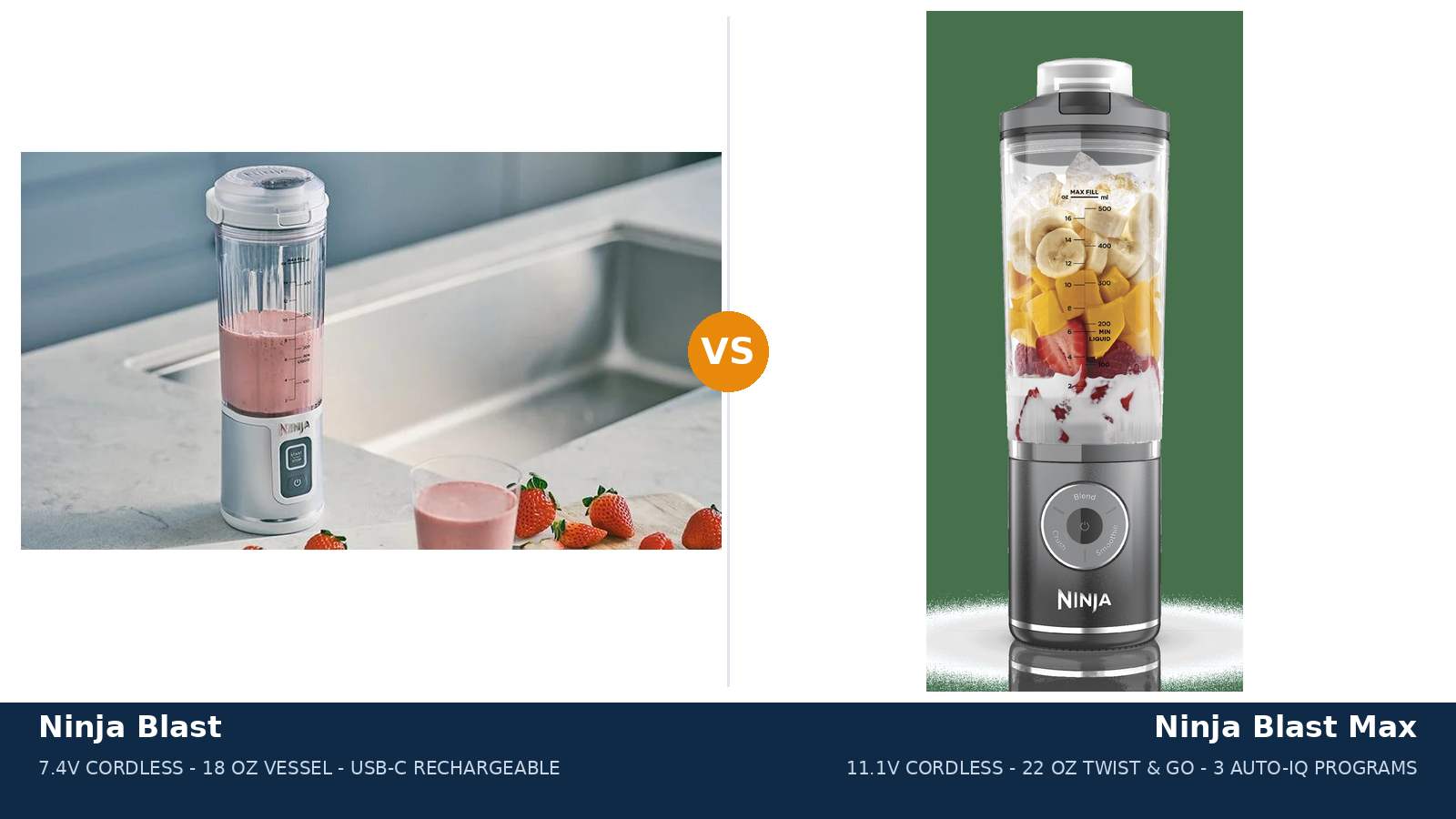
Same brand. Same silhouette. Same promise of a smoothie anywhere.
On a shelf, the two look like a blender and its slightly taller twin. “Max” reads like a trim level — a bigger cup, perhaps, on the same machine.
It is not a trim level. The Max is a different machine: a higher-voltage base, a vessel that twists off and walks away on its own, and three automatic programs where the original offers one timed cycle.
One clarification, because listings blur it constantly. The original here is the Ninja Blast, BC151 series — the 18 oz cordless launched in 2023. The Max is the BC251 series. Every figure below belongs to one of those two model codes.
Every specification comes from SharkNinja’s own pages and owner’s guides. Where SharkNinja does not publish a number — one conspicuous gap on each side — we say so instead of borrowing one from a retailer.
Key Takeaways
- The Blast Max is the stronger blender by a clear margin. An 11.1V base against 7.4V, a 22 oz vessel against 18 oz, and three Auto-iQ programs against a single 30-second cycle.
- The original Blast is the lighter, simpler carry. At 1.73 lb it weighs about two-thirds of the Max, and it recharges over USB-C in about two hours.
- The Max’s vessel detaches. Twist it off the base and the part you carry is, by SharkNinja’s own figure, about 50% lighter — the base stays behind.
- Battery claims favour the Max; charging favours the Blast. Up to 25 blends per charge against 15, but a roughly three-hour refill on a dedicated cable against two hours on USB-C.
- Neither machine publishes a wattage. Any watt figure a retailer attaches to either blender is not a SharkNinja specification.
Quick Verdict
Buy the Ninja Blast Max for most people. It is the more capable portable in nearly every row that involves blending.
Its 11.1V base drives a built-in CrushBlade through ice and frozen fruit with a dedicated Crush program. Its 22 oz Twist & Go vessel holds a genuinely large single serving. And when the blend is done, the vessel twists off — you carry the drink, not the motor.
Buy the original Ninja Blast if size, weight and simplicity outrank power. It is smaller in every dimension, lighter by seven-tenths of a pound, and refills from the same USB-C cable as your phone.
For a protein shake after training, its single 30-second cycle is not a compromise at all. It is the whole job, in one press.
The Scorecard
Scores below are derived directly from the manufacturer specifications compared in this guide — battery voltages, vessel capacities and fill lines, published cycle and program counts, charge times, dimensions, weights and warranty terms. They are a reading aid, not benchmark results.
| Category | Ninja Blast | Ninja Blast Max | ||
|---|---|---|---|---|
| Power & blending | 6 / 10 | 8 / 10 | ||
| Capacity | 6 / 10 | 8 / 10 | ||
| Battery & charging | 7 / 10 | 8 / 10 | ||
| Programs & control | 5 / 10 | 9 / 10 | ||
| Portability | 8 / 10 | 7 / 10 | ||
| Ease of use & cleaning | 8 / 10 | 8 / 10 | ||
| Versatility | 6 / 10 | 8 / 10 | ||
| Overall | 6.6 / 10 | 8.0 / 10 | ||
A note on the Blast’s overall, because this machine now carries three marks on this site: 6.9 against NutriBullet’s corded 900W Pro, where a perfect portability mark flattered it, and 6.7 against the cordless NutriBullet Portable.
Here, judged inside its own family against a sibling that out-volts, out-holds and out-programs it, the same hardware lands at 6.6. Its portability mark rises — it is now the lighter machine in the room — but the blending rows fall further behind. The machine did not change; the yardstick did.
The pattern: the Max wins every blending row; the Blast wins carrying, and ties on cleaning up.
At a Glance: Who Each Blender Fits
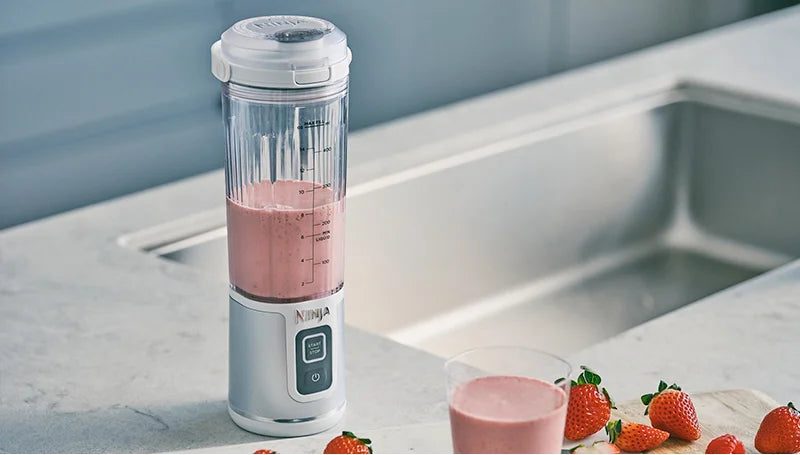
Ninja Blast
- 18 oz ribbed vessel (fill line sits near 16 oz)
- 7.4V base, USB-C rechargeable, about 2 hours to full
- Up to 15 blends per charge, 30 seconds each
- BlastBlade: six stainless-steel blades, 14,069 RPM
- 1.73 lb and 10.71 in tall — the smaller carry
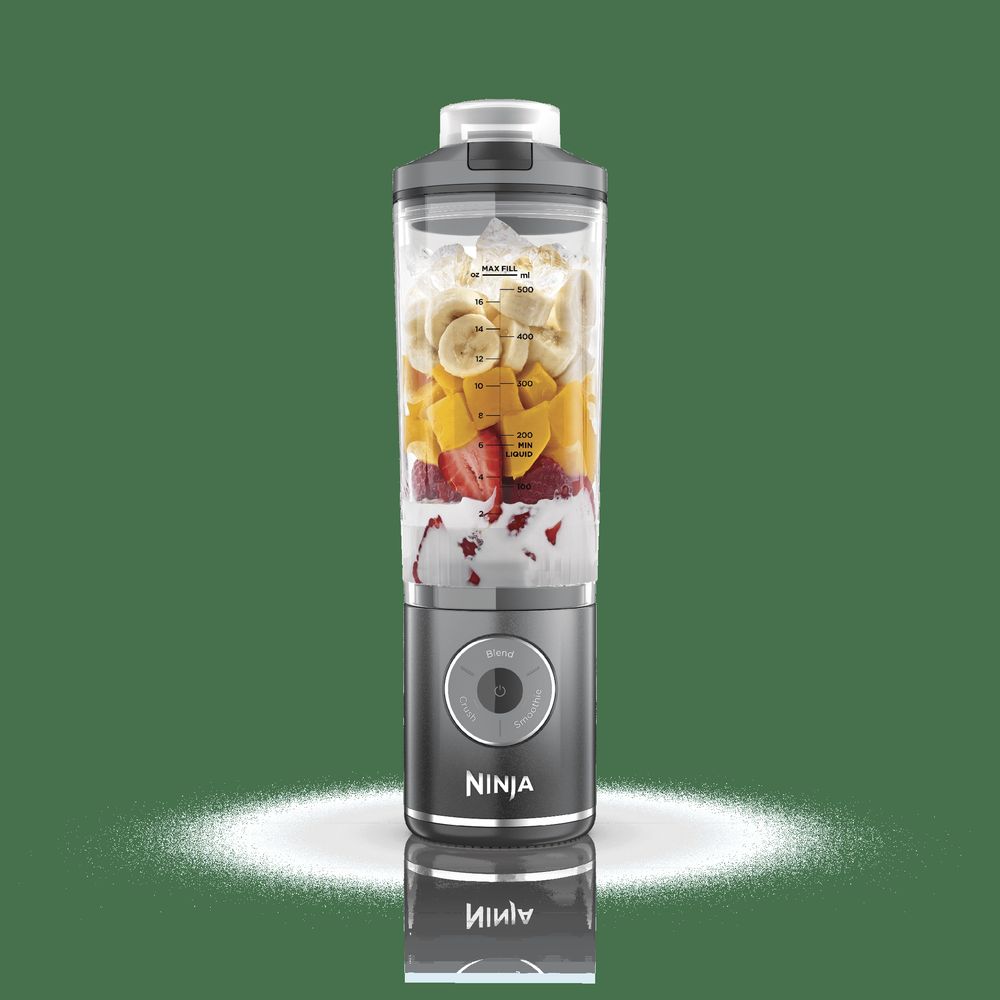
Ninja Blast Max
- 22 oz Twist & Go vessel — twists off the base
- 11.1V base with PowerBlast Technology
- Three Auto-iQ programs: Smoothie, Crush, Blend
- Up to 25 blends per charge; battery life indicator
- Built-in stainless CrushBlade inside the vessel
Choose the Ninja Blast if…
Your blender lives in a gym bag and grams are a personality trait. This is the lightest, shortest machine here, and it is not close.
Your drinks are shakes and soft-fruit smoothies. One 30-second cycle is the entire workflow; a second press handles the rest.
You charge everything from one USB-C cable. The Blast refills from the same lead as your phone, in about two hours.
Choose the Ninja Blast Max if…
Frozen fruit and ice are your default ingredients. The Max pairs a higher-voltage base with a program built for exactly that load.
You blend, then leave. The Twist & Go vessel detaches, so the heavy base stays behind while the drink travels.
You want the machine to decide. Three named programs with automatic pulsing beat judging a single timed cycle by ear.
As an Amazon Associate I earn from qualifying purchases at no extra cost to you.
Specifications: The Specs That Actually Matter
Every figure below is taken from SharkNinja’s published specifications, owner’s guides and official store data, cross-checked against manufacturer product data.
Where SharkNinja does not publish a figure for the US model, the table says so. That absence is itself a finding, and it is scored as one.
| Specification | Ninja Blast | Ninja Blast Max |
|---|---|---|
| Model | BC151 (Black: BC151BK) | BC251 (Cool Grey: BC251GY) |
| Type | Cordless portable, USB-C rechargeable | Cordless portable, rechargeable via supplied cable |
| Power basis | 7.4V lithium-ion battery | 11.1V rechargeable motor base |
| Published wattage (US) | Not published by SharkNinja | Not published by SharkNinja |
| Blade speed | 14,069 RPM (SharkNinja store data) | Not published |
| Blade | BlastBlade — six stainless-steel blades, in the base cap | CrushBlade — stainless steel, built into the vessel |
| Vessel capacity | 18 oz vessel, BPA-free plastic; MAX FILL line sits near 16 oz | 22 oz Twist & Go vessel, BPA-free plastic; MAX FILL line at 500 ml (about 17 oz) |
| Vessel detaches from base | No — the assembly travels as one unit | Yes — Twist & Go; vessel is about 50% lighter carried alone |
| Programs | One 30-second automatic cycle + press-and-hold | Three Auto-iQ programs (Smoothie, Crush, Blend) + manual press-and-hold |
| Controls | Power + Start/Stop buttons, one speed | Dedicated power button + program dial, battery life indicator |
| Blends per full charge | Up to 15 blends | Up to 25 blends (SharkNinja published figure) |
| Full charge time | About 2 hours | Up to about 3 hours |
| Charging | USB-C, cable included | Supplied dedicated cable and 13.3V supply unit |
| Blending while charging | Not permitted (owner’s guide) | Not specified in the US guide |
| Lid | Easy-open sip lid with carrying handle | Easy-open sip lid with carrying handle |
| Dishwasher parts | Vessel and lid | Vessel and lid, top rack |
| Motor base care | Wipe clean; never submerge, not dishwasher safe | Wipe clean; never submerge, not dishwasher safe |
| Hot liquids | Never — owner’s guide | Never — owner’s guide |
| Dimensions | 3.54 × 3.54 × 10.71 in | 4.57 × 3.58 × 12.2 in |
| Weight | 1.73 lb | 2.43 lb |
| In the box | Motor base, 18 oz vessel, sip lid, USB-C cable | Motor base, 22 oz Twist & Go vessel, sip lid, charging cable, recipe guide |
| Warranty (US) | 1-year limited | 1-year limited |
Fill-line note: on both machines the headline ounces are vessel sizes, not serving sizes. The Blast’s MAX FILL line sits below its 18 oz brim — SharkNinja’s UK arm quantifies it at 470 ml, roughly 16 oz.
The Max’s printed scale, visible in SharkNinja’s product photography, tops out at a MAX FILL line of 500 ml, about 17 oz, inside its 22 oz vessel. Its real advantage is therefore headroom — what keeps thick blends circulating instead of stalling.
Voltage note: the Max’s retail spec block prints “13.3 volts” — that is its charging supply’s output (13.3V, 0.75A, per the owner’s guide). The battery itself is 11.1V. Compare 11.1V against the Blast’s 7.4V, not 13.3 against 7.4.
Regional note: the UK sells the Blast Max as model BC251UK — a 570 ml vessel, a 490 ml max fill, a 2-year guarantee on registration. Same machine, regional dress; do not spec its numbers against the US model’s.
The Differences That Actually Matter
1. One family, two generations — “Max” is a model, not a trim
Start here, because most buying mistakes in this pairing happen before a single specification is read.
The Blast (BC151) launched in 2023 as SharkNinja’s first cordless: one vessel, one base, one timed cycle. The Blast Max (BC251) arrived the following year as a ground-up bigger sibling — new base, new vessel system, new controls.
Almost nothing carries over. The Blast’s blade lives in its base cap; its ribbed vessel stays attached to the motor. The Max’s blade is built into its vessel, which locks onto a different base entirely.
So owners of the original are not choosing an accessory; they are choosing whether a second, different machine earns its place. Fresh buyers are not picking a size — they are picking a generation.
2. Power — a voltage step up, and a paper trail that swaps sides
The Max’s base runs an 11.1-volt battery against the Blast’s 7.4 volts. Voltage is not power, but inside one brand’s cordless line it is the honest separator SharkNinja leans on: the Max is sold on “PowerBlast Technology” and ice-crushing compared against a corded Ninja blender.
Its stainless CrushBlade is built into the vessel. A dedicated Crush program exists for no other reason than ice and frozen fruit.
Now the twist. In our NutriBullet comparison, the Blast won the documentation argument: SharkNinja publishes its 14,069 RPM blade speed and six-blade count. For the Max, SharkNinja publishes no RPM at all.
So the paper trail reverses: the weaker machine has the harder number, and the stronger one asks you to trust the platform instead. The Max still wins this row — but a buyer who shops by published blade speed should know which spec sheet prints one. One shared honesty point: neither machine publishes a wattage, and retailer copy attaching hundreds of watts to either base is inventing a figure.
3. Capacity — 22 oz against 18 oz, and the fill lines narrow it
The headline gap is four ounces. The honest gap is smaller, and it still matters.
The Blast blends in an 18 oz vessel up to a fill line near 16 oz. The Max blends in a 22 oz vessel up to a printed MAX FILL of 500 ml — about 17 oz, read straight off the scale in SharkNinja’s own product photos.
So the Max serves roughly an ounce more per blend. What it actually buys is headroom: air space above the fill line, in which frozen chunks circulate and reach the blade instead of bridging above it. The Max needs the mid-cycle shake less often. For soft ingredients, both vessels are adequate and the gap never shows.
4. Programs and control — one cycle against a small computer
The Blast’s control scheme is a 30-second timed cycle and a Start/Stop button. Press, wait, drink. A press-and-hold gives you a manual pulse. That is the entire interface, and for a shake it is genuinely sufficient.
The Max replaces it with three Auto-iQ programs — Smoothie, Crush and Blend — each running its own pattern of pulsing and pausing, then stopping on its own. A dedicated power button means a bag’s contents cannot start it, and a press-and-hold manual mode survives for those who want it.
Programs on a portable are easy to dismiss as garnish. On ice they are not. The pulsing pattern walks frozen fruit down into the blade between bursts; a single constant cycle mostly polishes the layer nearest the steel.
Add the battery life indicator — a real-time readout the Blast does not have — and the Max is the machine that tells you what it is doing. The Blast asks you to remember when you last charged it.
5. The vessel — the Max’s blade moved house
This is the structural difference, and the one owners feel daily.
On the Blast, blade, base and vessel travel as one 1.73 lb assembly. You blend, you carry the whole machine, you drink. Simple, and heavier than it needs to be at the drinking stage.
On the Max, the CrushBlade is built into the vessel. Blend, twist, and the vessel detaches with its sip lid. SharkNinja puts the carried weight saving at about 50%: the motor, battery and dial stay behind.
That makes the Max two products in sequence: a prep blender at blend time, a genuinely light bottle at carry time. It also moves the cleaning target — the blade sits in the vessel you wash. The cost is commitment: the vessel locks only to the Max’s own base.
6. Battery and charging — more blends, slower refill, a different cable
SharkNinja rates the Max for up to 25 blends per full charge; the Blast’s figure is up to 15. Even allowing for the optimism baked into every “up to” in this category, the Max’s larger battery plainly runs longer.
The refill reverses the result. The Blast tops up over USB-C in about two hours, from any cable you already own. The Max needs up to about three hours, on its own supplied cable and 13.3V supply unit.
So the ownership patterns differ. The Blast suits opportunistic charging: car, desk, power bank. The Max suits a routine: blend all week, charge on schedule, watch the indicator. One rule from the Blast’s guide deserves repeating — it cannot blend while charging. The Max’s US guide does not address the point, so plan as if a flat Max is a paused one.
7. Size, weight and cleaning — the Blast’s honest consolation
Assembled, the Max is the bigger object in every dimension: 12.2 in tall against 10.71, and 2.43 lb against 1.73. In a gym bag or a carry-on, that difference is felt — it is the original Blast’s best argument for existing.
Cleaning splits the difference. The Blast’s vessel and lid are dishwasher safe; the Max’s are top-rack only. Both rinse-clean the same way — water, a drop of soap, one blend cycle — and on the Max that cycle also washes around its built-in blade.
Both motor bases are wipe-only, forever; neither may be submerged or dishwashed. On the Blast the blade sits in that base assembly, so its wipe-down is the delicate one; on the Max the blade went with the vessel into the sink, and the base is a simpler wipe.
Shared prohibitions close the section: no hot liquids, no carbonated drinks, no dry blending without liquid, on either machine. The category’s ceiling did not move — only the size of the room beneath it.
Use-Case Fit Guide
The fastest way to choose between these two is to start from where the blender will actually live. This table is the whole comparison in one view.
| Your routine | Ninja Blast | Ninja Blast Max | Our call |
|---|---|---|---|
| Gym bag, protein shake after training | Excellent — lightest here, one cycle per shake | Excellent — bigger shake, vessel detaches for the drive home | Tie — pick on carry weight |
| Frozen fruit smoothies, daily | Good — 30-second cycle, ribbed vortex vessel | Excellent — Crush program, 11.1V base, more headroom | Ninja Blast Max |
| Crushed-ice drinks, camping and tailgates | Fair — ice belongs in drinks with liquid, in one cycle | Excellent — a program built for ice, up to 25 blends per charge | Ninja Blast Max |
| Office desk, blended at lunch | Good — USB-C refill in about 2 hours | Good — indicator prevents surprise flat batteries; refill takes about 3 hours | Tie — pick on charging habit |
| Car commute, cupholder required | Excellent — 3.54 in wide, the compact original | Good — 3.58 in at the base, but 12.2 in tall | Ninja Blast |
| Travel and carry-on | Excellent — smallest and lightest here | Good — taller and heavier; the detached vessel packs well | Ninja Blast |
| One blender, biggest single servings | Fair — plan around a 16 oz fill line | Good — 22 oz vessel, fill line near 17 oz | Ninja Blast Max |
| Home use, outlet always nearby | Workable — but a corded blender is better | Workable — but a corded blender is better | Neither — see Skip Both |
The frozen rows are where the Max’s voltage, programs and headroom stop being decoration — and start being the difference between a smoothie and a cup of chunks.
Ready to check today’s price?
Both machines sell through Amazon. Prices move, so check the live figure on the blender that fits your routine.
View on Amazon — Ninja BlastView on Amazon — Ninja Blast MaxThe 30-Second Decision
| If this sounds like you… | Buy this |
|---|---|
| “I want the strongest cordless Ninja makes.” | Ninja Blast Max |
| “It lives in my gym bag and weight is everything.” | Ninja Blast (1.73 lb) |
| “I blend, twist off the cup, and leave the base behind.” | Ninja Blast Max |
| “Everything I own charges over USB-C.” | Ninja Blast |
| “Ice and frozen fruit are the whole point.” | Ninja Blast Max (Crush program) |
| “I mostly blend at home, near an outlet.” | Neither — a corded personal blender serves you better |
What You Gain. What You Give Up.
Ninja Blast
You gain: the lightest, smallest machine here, a USB-C recharge in about two hours, and the only published blade-speed figure in the comparison — six stainless blades at a stated 14,069 RPM.
You give up: power headroom, programs and capacity. A 7.4V base, one timed cycle, an 18 oz vessel with a fill line near 16 oz, and a battery that asks to be topped up roughly twice as often.
Ninja Blast Max
You gain: the 11.1V base and its Crush program, the 22 oz vessel, up to 25 blends per charge with a battery indicator, and a vessel that detaches so the drink travels at about half the assembled weight.
You give up: the simple life. Seven-tenths of a pound, an inch and a half of height, USB-C charging, and any published blade-speed figure — plus a vessel that fits only its own base.
Pros and Cons
Ninja Blast — Pros
- Lightest (1.73 lb) and shortest (10.71 in) here
- USB-C charging, full in about 2 hours
- Published blade data: six stainless blades, 14,069 RPM
- 30-second cycle — one press per standard drink
- Vessel and lid dishwasher safe
Cons
- 18 oz vessel, with a fill line near 16 oz
- Up to 15 blends per charge; no battery indicator
- Cannot blend while charging
- One program; frozen loads may need a second cycle and a shake
Ninja Blast Max — Pros
- 11.1V base with a dedicated Crush program
- 22 oz Twist & Go vessel — detaches for carrying
- Up to 25 blends per charge, with battery indicator
- Three Auto-iQ programs plus manual mode
- Dedicated power button — no accidental blends in a bag
Cons
- Heaviest (2.43 lb) and tallest (12.2 in) here
- About 3 hours to recharge, on its own dedicated cable
- No published blade speed or wattage
- Vessel and parts fit the BC251 base only
Check the Model Code, the Colour and the Region
Check the model code. The original is BC151; the Max is BC251. Every claim in this guide hangs off those codes, and the code — not the word “Max” in a listing title — is what should appear in the product details of the machine in your basket.
Be wary of round-ups and marketplace titles quoting the Max at 20 oz or 24 oz. SharkNinja’s US figure is 22 oz. A listing that cannot get the vessel size right has not earned your trust on anything else.
Check the colour’s own listing. Each Blast Max colour is its own Amazon listing, with prices and stock flickering independently. These links are pinned to the Cool Grey BC251GY. The Blast links are pinned to Black, BC151BK; its photo here shows a light finish from SharkNinja’s own store photography — the machine is identical, only the finish differs.
Check the region. The UK’s Blast Max (BC251UK) wears a 570 ml vessel, a 490 ml max fill and a registration-based 2-year guarantee. Same machine, but its numbers are not the US model’s, and a UK listing is not a US deal. Likewise, the Blast’s “16 oz” listings are its fill line, not a smaller model.
Check the bundle and the listing type. Both machines circulate in two-packs, priced as two blenders; a bare listing should contain the base, one vessel, the sip lid and the cable. A Renewed version of the original Blast also circulates alongside its new-unit listing — a different offer with a different guarantee, so know which is in your basket.
The Longevity Test
Judge a cordless blender by its battery, because the battery is the product.
Everything else on both machines is simple and durable: a plastic vessel, a lid, a blade. The lithium cell is the one component with a countdown, and on neither machine is it user-replaceable — the Max’s regional guide says so outright, and the Blast’s cell is sealed inside its base.
That reframes the battery rows. The Max’s up-to-25 blends is not just convenience; a larger cell, recharged less often, is likelier to be healthy in year three. Its indicator helps — batteries rarely run to empty age more gently, and the Max tells you where empty is.
The Blast’s counter-argument is charging humility: a machine that refills in two hours from any USB-C cable gets topped up casually, and casual top-ups are the other half of battery longevity.
SharkNinja sells replacement vessels and lids for both lines, so a cracked cup is an errand, not a write-off — remembering that Max parts fit only Max bases. Treat either machine as a two-to-three-year companion under daily use, and buy the one whose charging habits match your own.
When to Skip Both
Honesty cuts both ways. There are buyers neither of these blenders serves well.
Skip both if you blend mostly at home. A corded personal blender delivers several times the power for similar money, with no battery to manage.
Skip the Max if your bag is already at capacity. Twelve inches tall and nearly two and a half pounds is a real object; the original Blast, or nothing, may be the honest answer.
Skip both for hot soups, nut butters in quantity, or anything resembling food processing — and for blending for more than one person at a time.
For the traveller, commuter and gym-bag user, though, one of the two is right. The only question is whether your routine spends its margins on power or on grams.
Warranty and Support
On US terms, the warranty row is a tie: a 1-year limited warranty on both machines.
SharkNinja sells replacement vessels, lids and charging cables for both lines through its own store, which is where support in this category actually lives. The parts are not interchangeable between the BC151 and BC251 lines — order against your model code, not the product name.
UK buyers get a 2-year guarantee on registration — regional practice, not a different product, and it does not travel with an imported unit. The failure that ends these products’ lives — a tired battery — sits outside the parts catalogue on both. The warranty covers defects, not decline.
Final Verdict
The Ninja Blast Max is the portable we would pack.
It wins on the specifications that decide what a cordless blender can do: an 11.1-volt base against 7.4, a Crush program against a single timed cycle, a 22 oz vessel against 18, and up to 25 blends against 15 before the cable comes out.
Then it wins the carrying argument it was supposed to lose. The Twist & Go vessel means the heavy half of the machine only travels when you are blending. The rest of the day, the Max is the lighter thing in your hand.
Buy the Blast Max for frozen fruit and ice, for large single servings, for week-long battery stretches, and for anyone upgrading from the original who found its ceiling.
View on Amazon — Ninja Blast Max
Buy the original Blast if your drinks are shakes and soft fruit, your bag is small, and your life already runs on USB-C. It remains the lightest honest blender in this family, and its spec sheet — alone here — prints a blade speed.
Its defeat is generational, not shameful: the Max is what the Blast grew into. Owners who prize grams over programs will not regret the original.
Watch Out: Similar Names, Different Machines
Ninja’s cordless naming is tidier than most, but the traps are real. Four warnings belong in every version of this guide.
First: the Blast Max is not a trim of the Blast. Different series (BC251 against BC151), different base, different vessel system, no shared parts. A listing describing the Max as “the Blast, but bigger” undersells a redesign.
Second: the UK Blast Max (BC251UK) is a regional variant, not a third model: a 570 ml vessel, a 490 ml max fill, a 2-year guarantee on registration. Its specifications circulate in round-ups as if they were the US machine’s. They are not.
Third: “16 oz” Blast listings are this same BC151 — 16 oz is its fill line, not a smaller sibling. Symmetrically, treat any Max listing headlined 20 oz or 24 oz as mislabelled until the model code BC251 and the 22 oz vessel check out.
Fourth: both machines are sold in two-packs, and the Max’s colours are separate listings with separate prices. Match the model code first, then the unit count, then the colour, then the price — in that order.
Frequently Asked Questions
What is the difference between the Ninja Blast and the Ninja Blast Max?
Almost everything except the badge. The Max (BC251) runs an 11.1V base against the original’s 7.4V, blends in a 22 oz vessel against 18 oz, offers three Auto-iQ programs against a single 30-second cycle, and its vessel twists off for carrying. The original (BC151) is smaller, lighter, and charges over USB-C.
Is the Blast Max just a bigger Blast?
No. It is a redesign: the blade moved from the base cap into the vessel, the controls became a program dial with a battery indicator, and charging moved from USB-C to a dedicated 13.3V supply. Vessels, bases and parts do not swap between the two lines.
How many blends does each make per charge?
SharkNinja rates the Max for up to 25 blends per full charge, and the original Blast for up to 15. Both are “up to” figures assuming cooperative ingredients; frozen loads land lower on both. The Max also takes longer to refill — up to about three hours against about two.
Which crushes ice and frozen fruit better?
The Blast Max, on published evidence. It pairs the 11.1V base with a dedicated Crush Auto-iQ program and a stainless CrushBlade, and SharkNinja positions its ice-crushing against a corded blender. The original handles ice inside drinks with enough liquid, in 30-second cycles — capable, but a class below.
Can I carry the Blast Max’s vessel on its own?
Yes — that is the Twist & Go design. Twist the vessel off the motor base after blending and it becomes a sealed bottle with its own sip lid and handle. SharkNinja puts the carried saving at about 50% of the assembled weight — the motor and battery stay behind.
Are the vessels and lids dishwasher safe?
Yes, with one difference in the small print. The Max’s vessel and lid are top-rack dishwasher safe; SharkNinja lists the original’s vessel and lid as dishwasher safe without the top-rack qualifier. On both machines the motor base must never be submerged or dishwashed — wipe it clean.
I already own the original Blast. Is the Max worth the upgrade?
If you hit the original’s ceiling — frozen loads needing a second cycle, servings capped at the fill line, a battery that dies mid-week — yes: the Max answers each of those. If your Blast makes a daily protein shake without complaint, the upgrade buys capacity and programs you may never use. Keep your money until the battery fades.
Sources & Verification
Ninja Blast Max official product page, sharkninja.com (BC251GY: 11.1V motor base, three Auto-iQ programs, 22 oz Twist & Go vessel with built-in CrushBlade, battery indicator, dimensions, 2.43 lb, BPA-free, 1-year warranty) • Blast Max BC251 owner’s guide data (13.3V 0.75A charging supply, full charge up to about 3 hours, MAX FILL rules, cleaning and care, vessel about 50% lighter detached) • SharkNinja UK Blast Max page (up to 25 blends per charge, 570 ml regional vessel, 490 ml max fill, 2-year guarantee on registration) • Ninja Blast BC151 owner’s guide and SharkNinja store data (7.4V USB-C base, 18 oz vessel, 30-second cycle, about-2-hour charge, no blending while charging, 14,069 RPM, six-blade BlastBlade, up to 15 blends, 1-year limited US warranty). Amazon listing data used for ASIN verification only, never for specifications. Specifications verified November 2026.

James Wilson
James has been testing small kitchen appliances for over a decade and writes Honestly Compared’s blender and appliance guides. His rule for every comparison: the verdict has to survive the spec sheet, not the marketing page.