
Ninja Nutri-Blender Plus vs Pro: BN301 vs BN401 Compared
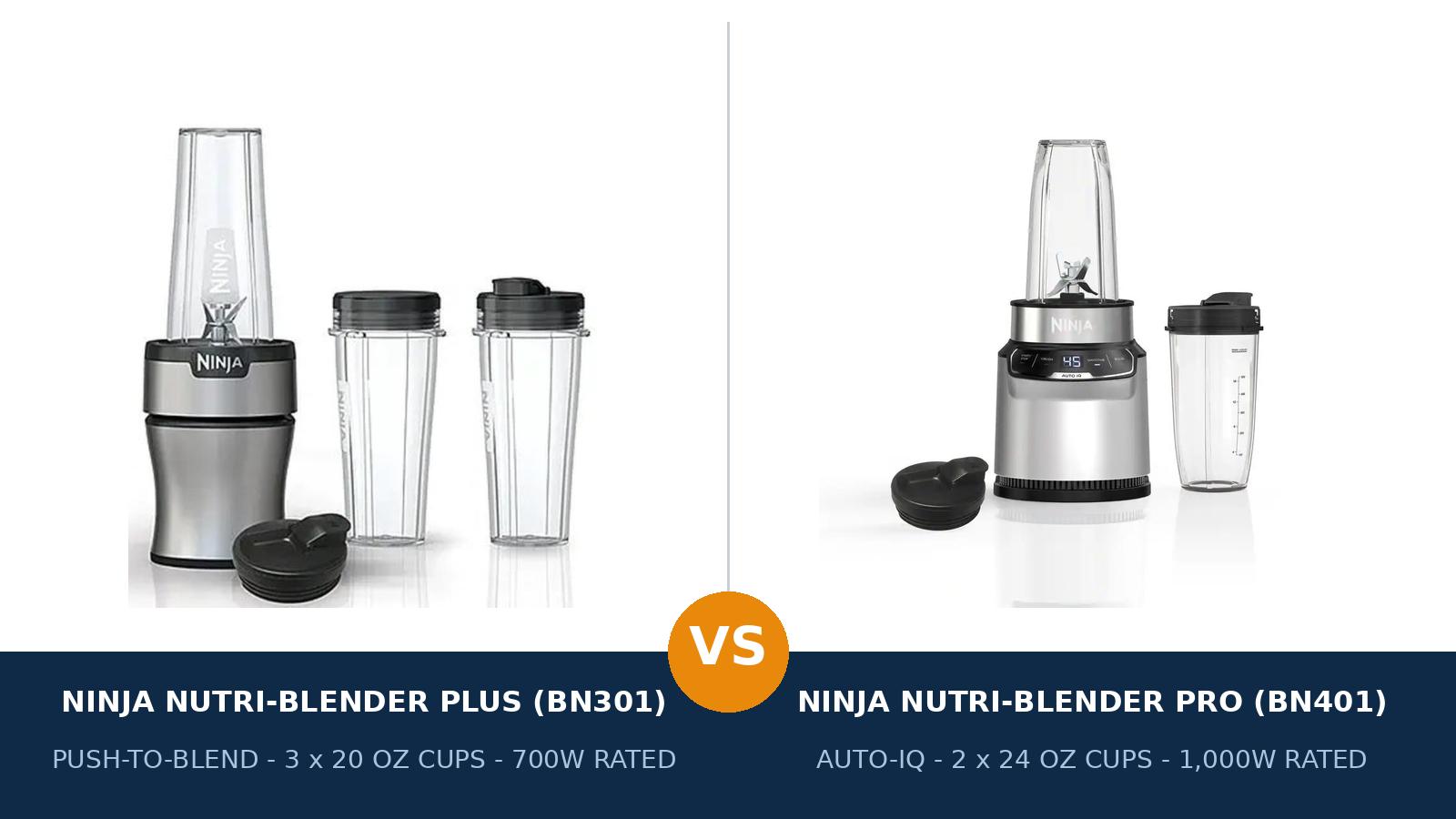
Two silver Ninja personal blenders, one family, and a naming ladder that causes real confusion. The Nutri-Blender Plus and the Nutri-Blender Pro with Auto-iQ sit a single step apart in SharkNinja's BN300/BN400 range, share the same Pro Extractor Blades concept, and both blend in the cup you drink from. Almost everything else — power, cup size, controls, footprint — is different.
First, the identification, stated plainly. In this family, "Nutri-Blender Plus" is the BN301: a 700-watt rated, push-to-blend machine sold with three 20 oz cups. "Nutri-Blender Pro" is the BN401: a 1,000-watt rated machine with two Auto-iQ programs and two 24 oz cups. Neither name refers to the base BN300, and neither refers to the BN300WM, a separate 600-watt Walmart variant that borrows the family look. This comparison is BN301 against BN401, spec sheet against spec sheet.
Two more names deserve a line so they do not ambush you while shopping. The BN300C is the Canadian-market variant of the Plus, and the BN302Q is a QVC-channel variant of the same Plus configuration — either may surface in search results wearing the Nutri-Blender Plus name. They share the BN301's series and guide, but their listings, bundles and support channels differ by market, so the buttons on this page link the US BN301 listing specifically. If you are shopping outside the US, match the full model number on the rating plate, not just the name on the box.
The short answer: the Pro is the stronger, more capable blender and wins this comparison. The Plus is the simpler, smaller, better-equipped-for-prep machine, and it wins several categories outright. Which one belongs on your counter depends on whether you value automation and cup capacity over simplicity and a three-cup set.
Key Takeaways
- Power, rated honestly: the BN401's owner's guide rates its motor at 1,000 watts; the BN301's guide rates 700 watts. Ignore the "1,100 peak watts" and "900 peak watts" on the boxes — those are peak figures, and this comparison uses the guide ratings for both.
- Cups: the Plus includes three 20 oz cups plus a storage lid; the Pro includes two larger 24 oz cups. More cups versus bigger cups.
- Controls: the Plus has no buttons at all — press the cup down to blend, short presses to pulse. The Pro adds Smoothie and Crush Auto-iQ programs, a countdown display, a 60-second manual mode and a Pulse button.
- Size: the Plus is the smaller, lighter machine (4.7 in square footprint, 5.34 lb) against the Pro (6.34 × 6.93 in, 6.28 lb).
- Shared ground: same Pro Extractor Blades approach, BPA-free dishwasher-safe cups, lids and blade assemblies, no hot liquids in either guide, and a 1-year limited warranty on both.
Quick Verdict
Winner: Ninja Nutri-Blender Pro (BN401), 8.0 vs 7.0. It is ahead on the fundamentals that decide daily results: a 1,000-watt rated motor against 700 watts, 24 oz cups against 20 oz, and Auto-iQ programs that run a timed cycle while you do something else. The Plus (BN301) is the better buy for a specific buyer — someone who wants the smallest footprint, the simplest possible controls and a third cup for staging drinks ahead. If that description fits you, the Plus is not a consolation prize; it wins those categories cleanly.
Scorecard
Scores are derived from the two owner's guides and SharkNinja's published product data — rated power, cup capacity and set contents, program counts, dimensions and care instructions. They are assessments of the published specifications, not measurements from our own bench tests, and they are relative to this pairing.
| Category | Ninja Nutri-Blender Plus (BN301) | Ninja Nutri-Blender Pro (BN401) |
|---|---|---|
| Motor power (guide-rated) | 6.0 | 8.0 |
| Cups & set contents | 7.0 | 8.0 |
| Programs & automation | 3.0 | 9.0 |
| Manual control | 8.0 | 7.0 |
| Ease of use | 8.0 | 8.0 |
| Cleaning | 9.0 | 9.0 |
| Footprint & storage | 8.0 | 7.0 |
| Overall | 7.0 | 8.0 |
A note on these marks: scores on this site are relative to the pairing on the page. The BN401 has appeared here before against a cross-brand rival with a locking continuous mode, where its press-dependent manual control cost it more; scored inside its own family, against a rival with no programs at all, its overall mark rises to 8.0. The BN301's 7.0 is scored fresh from its owner's guide for this comparison: a genuinely simple machine whose low program score reflects a deliberate design choice, not a defect.
At a Glance
Ninja Nutri-Blender Plus (BN301)
The simple one — push-to-blend, three cups
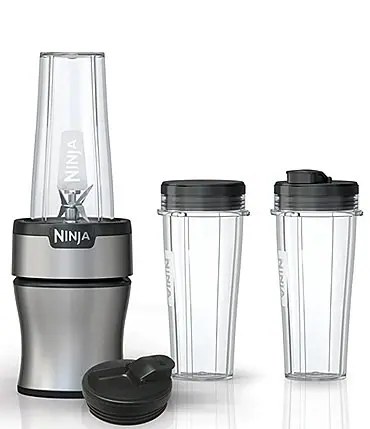
- 700W rated motor (sold as "900 peak watts")
- Three 20 oz To-Go Cups in the box
- Two spout lids plus a storage lid for prep ahead
- No buttons: press down to blend, tap to pulse
- Smallest base here: 4.7 × 4.7 × 13.8 in, 5.34 lb
Ninja Nutri-Blender Pro with Auto-iQ (BN401)
The capable one — Auto-iQ programs, bigger cups
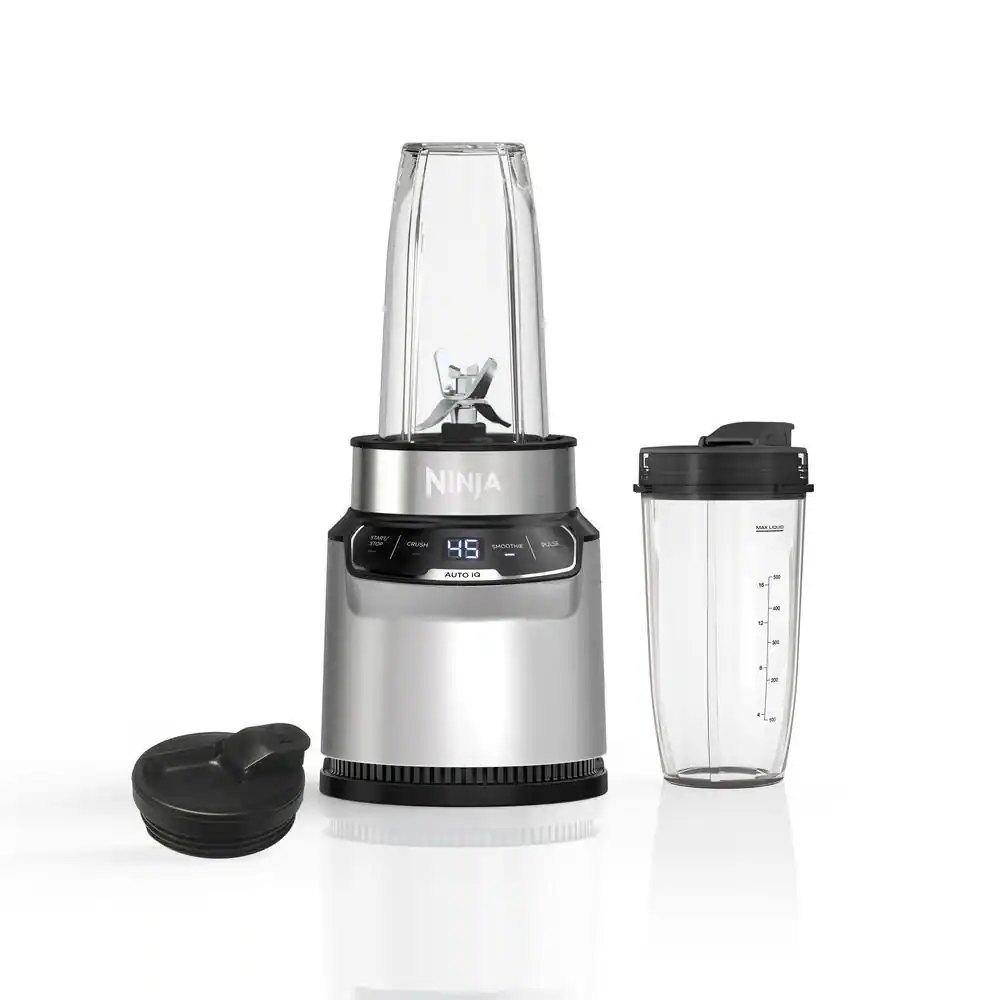
- 1,000W rated motor (sold as "1,100 peak watts")
- Two Auto-iQ programs: Smoothie and Crush
- Two 24 oz Single-Serve Cups with spout lids
- Countdown display; manual mode runs up to 60 seconds
- 20-recipe inspiration guide included
Choose the Plus (BN301) if you want the smallest base, zero controls to learn, and a third cup so a drink can wait in the fridge under its storage lid.
Choose the Pro (BN401) if you blend daily, want the bigger 24 oz cup and the stronger motor, and like a program that starts, counts down and stops on its own.
As an Amazon Associate I earn from qualifying purchases at no extra cost to you.
Full Specification Comparison
| Specification | Ninja Nutri-Blender Plus (BN301) | Ninja Nutri-Blender Pro (BN401) |
|---|---|---|
| Model number | BN301 | BN401 |
| Rated motor power (owner's guide) | 700 watts | 1,000 watts |
| Marketed peak watts | 900 peak watts | 1,100 peak watts |
| Cups included | 3 × 20 oz To-Go Cups | 2 × 24 oz Single-Serve Cups |
| Capacity per cup | 20 oz (591 ml) | 24 oz |
| Lids included | 2 spout lids + 1 storage lid | 2 spout lids |
| Blade assembly | Pro Extractor Blades Assembly | Pro Extractor Blades Assembly |
| Programs | None — push-to-blend only | 2 Auto-iQ: Smoothie, Crush |
| Manual control | Press-and-hold; release to stop; short presses pulse | Start/Stop up to 60 seconds; Pulse while pressed |
| Countdown display | No | Yes |
| Dimensions (W × D × H) | 4.7 × 4.7 × 13.8 in | 6.34 × 6.93 × 14.29 in |
| Weight | 5.34 lb | 6.28 lb |
| Cord length | Not published in the owner's guide | 31.5 in (2.6 ft) |
| Dishwasher-safe parts | Cups, lids, blade assembly (BPA-free) | Cups, lids, blade assembly (BPA-free) |
| Hot liquids | Not permitted | Not permitted |
| Thermal overload reset | About 15 minutes | About 15 minutes |
| Recipe guide | Not listed in the box contents | 20-recipe inspiration guide |
| Colour | Silver | Cloud Silver |
| Warranty | 1-year limited | 1-year limited |
Two rows deserve emphasis. The rated-power row uses each owner's guide's own technical specification — 700 watts for the BN300-series guide that covers the Plus, 1,000 watts for the BN400-series guide that covers the Pro. The marketed row shows the peak-watt figures both boxes lead with. Comparing guide to guide, the Pro's motor is rated roughly 43% higher; comparing box to box would flatter both machines and distort the gap.
The cups row is the one shoppers misread. The Plus wins the count — three cups, plus the family's only storage lid — while the Pro wins the size, 24 oz against 20 oz. Total included capacity is nearly identical (60 oz against 48 oz of cups), so the real question is whether you drink one large smoothie or stage several smaller ones.
The Differences That Actually Matter
1. Rated power: 1,000 watts against 700, whatever the boxes say
Both machines are sold on peak watts — "900 peak watts" for the Plus, "1,100 peak watts" for the Pro. Peak wattage is a momentary ceiling, not the figure the motor is rated to sustain, and the owner's guides tell the plainer story: the BN300-series guide specifies 700 watts, the BN400-series guide 1,000 watts. We score and compare on the guide figures, as we do across this site.
The practical effect is headroom. Both machines run the same style of Pro Extractor Blades and both guides promise ice crushing and whole-fruit breakdown. The Pro simply has more rated power pushing the same blade concept through denser loads — thick frozen-fruit mixes, nut-heavy blends, full cups of ice. The Plus handles the standard personal-blender repertoire, but its guide's own safeguards (one-minute blending intervals, a thermal reset if the unit overheats) describe a motor with less margin.
2. Programs: Auto-iQ against no programs at all
This is the widest gap in the comparison. The Pro's Smoothie and Crush programs run pre-set pulse-and-blend patterns and stop on their own, timed on a countdown display. Press Smoothie, and the machine manages the cycle while you put the fruit away.
The Plus has no programs, no buttons and no display. You press the cup down and the blades run; you release and they stop. For a plain morning smoothie the result is the same drink. The difference is attention: the Plus asks you to stand there and judge doneness by eye, the Pro does not. Buyers who blend while getting ready will feel that difference every single day.
3. Cups: three 20 oz against two 24 oz
The Plus is the meal-prep machine. Three cups mean one in the dishwasher, one in hand, one waiting — and the included storage lid, which the Pro's box lacks, lets a finished drink go straight into the fridge in its blending cup. Households blending for two people at staggered times get real value from that third cup.
The Pro's cups are bigger. Twenty-four ounces is a full large smoothie with headroom for greens and ice; twenty ounces can force a choice between a smaller drink and blending in two rounds. If your drink is a big one, the Pro's cup is the right size and the Plus's extra cups do not compensate.
4. Manual control: the Plus's one genuine win over the panel
Automation is not the whole control story. The Plus's press-down interface is the most direct control either machine offers: short presses give short pulses, exactly when you want them, with no mode to select first. For pulse-textured results — a chunky salsa-style mix, a partially crushed ice bed — that immediacy is genuinely useful.
The Pro answers with a Pulse function of its own (hold the button and it runs) plus a manual Start/Stop mode that runs up to 60 seconds hands-free. It can do everything the Plus can; it just asks for a button press first. We score manual control to the Plus for directness, while noting the Pro's manual mode is the only way here to blend continuously without holding anything down.
5. Footprint: the smaller base is meaningfully smaller
The Plus's base is 4.7 inches square and the machine stands 13.8 inches tall; the Pro needs 6.34 × 6.93 inches and stands 14.29 inches. In a dorm room, a small rental kitchen or a crowded counter, that difference decides where the machine can live — and the Plus, at 5.34 lb against 6.28 lb, is also the easier of the two to move into a cupboard between uses.
Height deserves a specific mention. At 13.8 inches tall, the Plus can sit assembled under most wall cabinets; the Pro, a half-inch taller and noticeably wider, is more likely to live pulled forward on the counter. Neither figure is a problem in an open kitchen; both matter in a small one.
6. Ownership: a tie, deliberately
Cleaning and warranty do not separate these machines. Both guides make the cups, lids and blade assembly dishwasher safe and BPA-free; both prohibit hot liquids; both carry a thermal reset of about 15 minutes after an overload; both are covered by a 1-year limited warranty. SharkNinja sells replacement cups, lids and blade assemblies for both series, and in both cases the part must match the model family — BN300-series cups for the Plus, BN400-series cups for the Pro.
One small ownership plus for the Pro: its box includes a 20-recipe inspiration guide, where no recipe guide is listed in the Plus's box contents. One small plus for the Plus: fewer electronics. A machine with no display and no program board has fewer things to fail outside that shared 1-year warranty.
Which Jobs Suit Which Blender?
| Job | Better fit | Why |
|---|---|---|
| One large daily smoothie | Pro (BN401) | 24 oz cup takes the whole recipe in one round; Smoothie program runs it unattended. |
| Meal-prep and make-ahead drinks | Plus (BN301) | Three cups plus the storage lid: blend, cap, refrigerate, repeat. |
| Frozen drinks and heavy ice crushing | Pro (BN401) | Crush Auto-iQ program and a 1,000W rated motor against 700W. |
| Small kitchens, dorms, tight counters | Plus (BN301) | 4.7 in square footprint, 13.8 in tall, 5.34 lb — the easier machine to house. |
| Blending while you get ready | Pro (BN401) | Programs and the 60-second manual mode run hands-free with a countdown. |
| Chunky, pulse-controlled textures | Plus (BN301) | Press-and-release pulsing is immediate; no mode selection between you and the blades. |
| Two people's morning routine | Depends | Plus for two smaller drinks staged in separate cups; Pro for two large drinks blended back to back. |
The 30-Second Decision
| If this sounds like you… | Buy |
|---|---|
| You want to press a button and walk away | Pro (BN401) |
| Your smoothie is a big one, 24 oz territory | Pro (BN401) |
| You prep drinks ahead and store them in the cup | Plus (BN301) |
| Counter space is the scarcest thing in your kitchen | Plus (BN301) |
| You want the fewest possible controls to learn | Plus (BN301) |
| You blend frozen fruit and ice most days | Pro (BN401) |
| You are still torn | Pro (BN401) — it wins the power, capacity-per-cup and automation categories that decide daily results |
Ready to choose?
Both listings below are each model's own Amazon page — check the current offer and delivery options there. The Pro is our pick for most buyers; the Plus is the right call for small counters and prep-ahead routines.
Trade-Offs Worth Knowing
The Plus's simplicity cuts both ways. No programs means no timer, no countdown and no hands-free run. Every blend is attended, and consistency between drinks depends on your judgement of when to let go. Buyers upgrading from a basic blender will not miss what they never had; buyers who have used Auto-iQ will.
The Pro's cups are fewer. Two cups is enough for a daily drink and a spare, but there is no storage lid in the box and no third cup for staging. Prep-ahead households will end up buying extra cups — BN400-series ones, specifically — and should count that cost.
Neither machine touches hot liquids. Both guides prohibit them outright, so soup-making is off the table for the pair. Neither is a batch blender, either: 24 oz is the largest single blend in this comparison, and family-sized batches mean repeated rounds on both.
Peak-watt marketing flatters both. The boxes' 900 and 1,100 figures make the gap look like 200 watts; the rated gap is 300. Neither number is false, but the guide figures are the ones that describe the motors you are actually buying.
Pros and Cons
Ninja Nutri-Blender Plus (BN301) — Pros
- Three 20 oz cups and a storage lid in the box
- Nothing to learn: press down, blend, release
- Smallest, lightest base in the family
- Direct press-pulse control for chunky textures
- All blending parts dishwasher safe and BPA-free
Ninja Nutri-Blender Plus (BN301) — Cons
- No programs, no timer, no hands-free blending
- 700W rated motor has the least headroom here
- 20 oz cups can force a second round on big recipes
- No recipe guide listed in the box contents
Ninja Nutri-Blender Pro (BN401) — Pros
- 1,000W rated motor — the strongest in this pairing
- Smoothie and Crush Auto-iQ programs with countdown
- Two 24 oz cups fit a full large smoothie
- Manual mode runs up to 60 seconds hands-free
- 20-recipe inspiration guide included
Ninja Nutri-Blender Pro (BN401) — Cons
- Only two cups, and no storage lid in the box
- Larger, heavier base needs more counter room
- More electronics to go wrong beyond the 1-year warranty
- Manual pulse needs a button hold rather than a cup press
Buying Guide: Reading a Personal-Blender Spec Sheet
Start with the rated watts, not the peak watts. Personal blenders are marketed on peak figures because they are larger. The owner's guide's technical specification carries the rated figure, and it is the honest basis for comparison — in this family, 700 against 1,000 watts tells you more than 900 against 1,100.
Count the cups, then size them. A three-cup set and a two-cup set serve different routines. Multiply out the total included capacity if you prep ahead; check the single-cup size against your actual recipe if you blend once and drink. Lids matter too: a storage lid turns a blending cup into a fridge container, which a spout lid alone does not.
Decide how much automation you will really use. Programs earn their keep when they replace attention you would rather spend elsewhere — getting dressed, making coffee, packing a bag. If you happily stand at the counter for 40 seconds, a press-to-blend machine gives up nothing in the glass.
Measure your counter before you fall for a footprint. Personal blenders are bought for small kitchens and then stored in them. Height under wall cabinets and the depth of the base decide whether a machine lives out or gets buried in a cupboard — and a buried blender is a blender you stop using.
Check the parts ecosystem by model number. Cups, lids and blade assemblies in this family are series-specific. Whichever machine you choose, replacement parts are sold against the BN300 or BN400 series numbers, so confirm the series on any spare cup before buying it.
The Upgrade Path
If the Pro wins your shortlist but you want more, the step up inside Ninja's personal range is capacity and power together: larger Auto-iQ personal machines add bigger cups and stronger motors while keeping the blend-in-the-cup format. If, instead, you find even the Pro's 24 oz limiting, you have outgrown the format — a full-size blender with a 64 oz-plus pitcher is the honest next step, not a bigger personal blender.
If the Plus wins but you worry about power, note that the next model up in its own series does not exist: the BN301 is the top of the push-to-blend line, and more power in this family means crossing to the BN400 series and its button panel. That is a genuine fork in the range, not a ladder.
When to Skip Both
Skip both if you blend for a household in batches — neither machine makes more than 24 oz at once. Skip both if hot blending matters: both guides prohibit hot liquids, so soup-makers need a machine built and rated for it. Skip both if you want a cordless or travel blender; both are corded countertop machines. And skip both if you need a warranty longer than a year as standard — both stop at one year, so factor in retailer protection plans if that is a priority.
Support and Replacement Parts
Both machines are supported through SharkNinja's standard channels, with owner's guides, troubleshooting and parts sold against the series numbers. The shared ownership picture: cups, lids and blade assemblies are wear parts on any personal blender — blade assemblies dull and cup tabs wear — and both series have those parts available, which is what makes a 1-year warranty less of a concern than it would be on an orphaned model.
Two guide instructions apply to both and are worth following. Let the motor cool for about 15 minutes after a thermal cut-out rather than forcing a restart, and keep liquid at or below the cup's MAX line — overfilling is the commonest cause of leaks and strained motors in this format, on either machine.
Final Verdict
The Ninja Nutri-Blender Pro (BN401) wins, 8.0 to 7.0. It pairs the family's stronger rated motor with the bigger cup and the only automation in the comparison, and those three advantages land on the blends most people make most often. Its losses — footprint, cup count, sheer simplicity — are real but situational.
The Plus (BN301) remains the right answer for a defined buyer: the smallest counter, the simplest routine, the prep-ahead habit. If two of those three describe you, buy the Plus with confidence. For everyone else, the Pro is the better Ninja.
Frequently Asked Questions
Is the Nutri-Blender Plus the same machine as the BN300?
No. The Plus is the BN301, the three-cup configuration of the BN300 series: same 700-watt rated platform and owner's guide, sold with three 20 oz cups, two spout lids and a storage lid. The base BN300 is the two-cup version of the same series. A separate model, the BN300WM, is a 600-watt Walmart variant — a different, weaker machine that should not be confused with either.
Why do the boxes say 900 and 1,100 watts when you quote 700 and 1,000?
The box figures are peak watts — a momentary ceiling. Each owner's guide's technical specification gives the rated figure: 700 watts for the BN301's series, 1,000 watts for the BN401's. We compare guide to guide, so the comparison uses the rated numbers for both machines and shows the peak numbers alongside for completeness.
Can either blender handle hot liquids or soup?
No. Both owner's guides prohibit hot liquids and warn against blending heated ingredients. Let cooked ingredients cool before blending in either machine, and choose a blender rated for hot blending if soup is a regular job.
Are the cups interchangeable between the Plus and the Pro?
The two machines belong to different series — BN300 and BN400 — with different cup sizes (20 oz against 24 oz) and their own blade assemblies. SharkNinja sells cups, lids and blade assemblies against the series number, so buy spares matched to your model's series rather than assuming cross-compatibility.
Which is better for frozen fruit and ice?
The Pro. Its Crush program is a dedicated Auto-iQ cycle for frozen loads, and its guide-rated 1,000 watts give it roughly 43% more rated power than the Plus's 700 watts pushing the same style of extractor blades. The Plus crushes ice too — its guide says so — but with less headroom on dense, fully frozen loads.
Are the parts dishwasher safe?
Yes, on both. Each guide lists the cups, lids and blade assembly as dishwasher safe, and the cups and lids are BPA-free. The motor bases, as with any blender, are wiped clean and never immersed.
What warranty do the two machines carry?
The same: a 1-year limited warranty on both the BN301 and the BN401. Replacement cups, lids and blade assemblies are sold separately for both series, which covers the parts most likely to wear out after the warranty year.
Sources & Verification
Specifications are taken from SharkNinja's own documents: the BN300 Series Owner's Guide (rated power 700W, 20 oz cup capacity, parts and care instructions) covering the BN301, and the BN400 Series Owner's Guide (rated power 1,000W, Auto-iQ programs, manual and pulse operation) covering the BN401, plus SharkNinja's BN401 product data for box contents, dimensions, weight and cord length. BN301 dimensions and weight are the manufacturer's product data as published by its retailers. Where listing copy conflicts with an owner's guide — both models' wattage is marketed as a peak figure, and one listing field credits the BN301 with "3 speeds" it does not have — the guide governs, and the discrepancy is noted on this page. The Amazon buttons link each model's own listing: availability on the Plus's listing has fluctuated over time, so check the listing itself for the current offer.

James Wilson
James researches small appliances and home gear by starting with the manual, not the marketing. Honestly Compared exists to put two spec sheets side by side and reach a verdict you can act on — peak watts and all.