
Ninja Nutri-Blender Pro vs NutriBullet Ultra: Which Should You Buy?
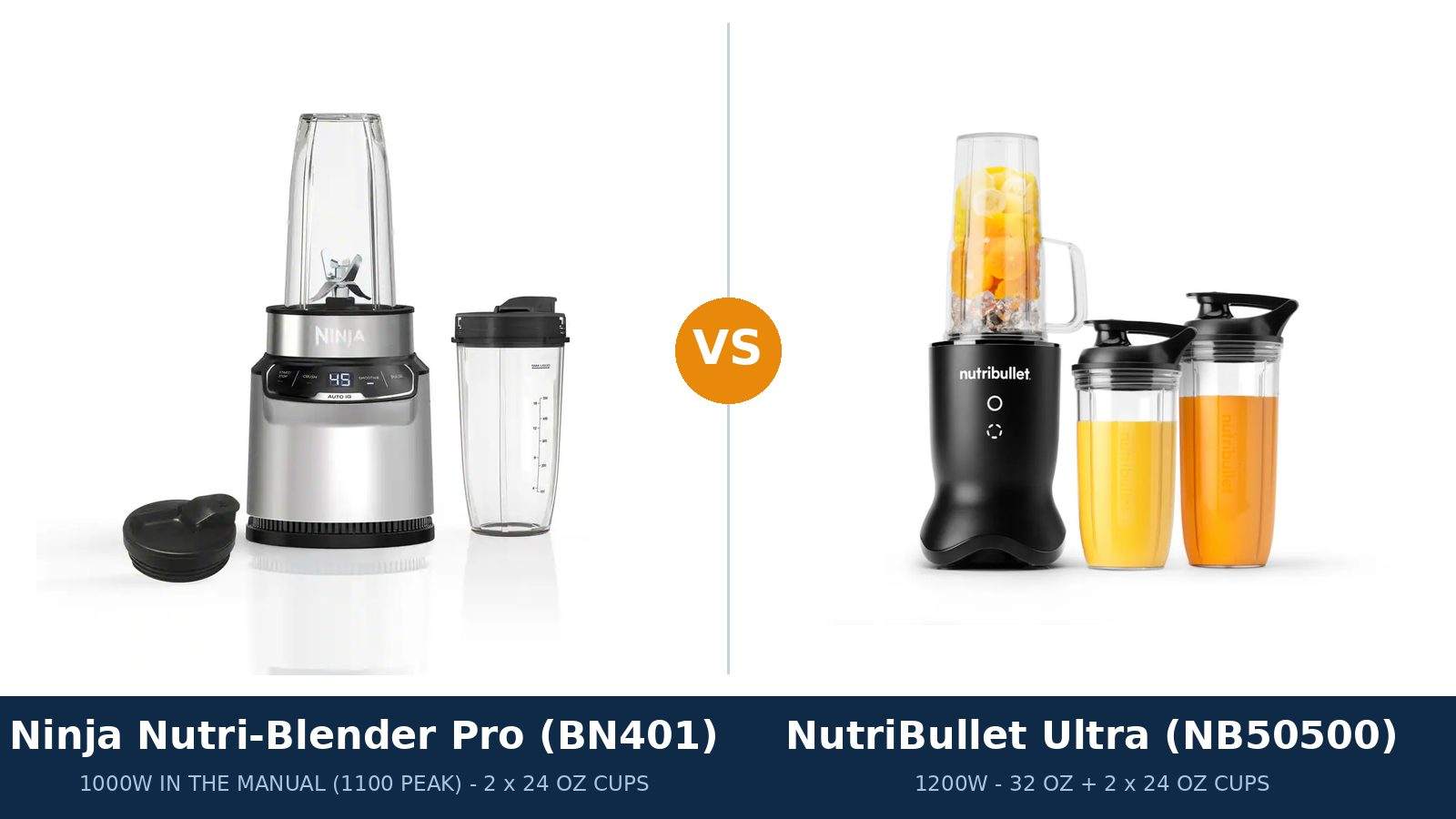
Two personal blenders. Two very different ideas about what “premium” means.
The Ninja Nutri-Blender Pro — model BN401 — puts its money into intelligence: Auto-iQ programs that pulse, blend and pause on a timer, a countdown display, and buttons labelled by job. The NutriBullet Ultra — model NB50500 — puts its money into hardware: the strongest motor NutriBullet has ever fitted to a single-serve machine, a titanium-coated blade, and cups made from recycled-content Tritan Renew.
The wattage numbers will try to confuse you first. Ninja advertises 1100 peak watts; NutriBullet advertises a flat 1200 watts. Read the manuals instead of the boxes and the gap changes shape — Ninja’s own owner’s guide specifies a 1000-watt motor, while NutriBullet’s user guide publishes 1200 watts with no “peak” qualifier at all.
This guide works from both manufacturers’ own documents throughout. Every specification below can be checked against them. And the verdict at the end is the same one we would give a friend spending their own money.
Key Takeaways
- The Ultra has the stronger motor on paper. Its user guide specifies 1200 watts; the BN401’s owner’s guide specifies 1000 watts under an 1100-peak-watt headline.
- The Ninja has the smarter controls. Two Auto-iQ programs plus Start/Stop and Pulse, against the Ultra’s two touch modes: an auto cycle and a pulse.
- The Ultra’s cup set is in another league. Three cups — 32 oz, 24 oz and a handled 24 oz — against two identical 24 oz cups.
- Cleaning splits on the blade. Every Ninja part, blade included, is dishwasher safe. The Ultra’s titanium blade is hand-wash only, by its manual’s instruction.
- The Ultra’s blade carries a 5-year limited warranty. Both machines otherwise carry a 1-year limited warranty.
Quick Verdict
Buy the NutriBullet Ultra for most single-serve blending. It is the more complete hardware package.
Its motor is the stronger one by the only honest measure — the figures in the two user guides. Its blade is titanium-coated and warranted for five years. Its three Tritan Renew cups cover everything from a 32 oz breakfast smoothie to a handled commuter cup.
Buy the Ninja Nutri-Blender Pro if programs and easy cleaning matter more than raw specification. Its Crush program is purpose-built for frozen drinks, its Pulse button gives real texture control for salsa, and when you are done, the blade assembly goes in the dishwasher with everything else.
Neither machine is a pitcher blender, and neither will blend hot liquids. Within the personal-blender brief, though, the Ultra’s hardware wins more of the rounds that cannot be changed later.
The Scorecard
Scores below are derived directly from the manufacturer specifications compared in this guide — motor figures as published in each brand’s own user guide, cup capacities, program counts, dishwasher rulings and warranty terms. They are a reading aid, not benchmark results.
| Category | Ninja BN401 | NutriBullet Ultra | ||
|---|---|---|---|---|
| Power (per the user guides) | 7 / 10 | 9 / 10 | ||
| Capacity & cup set | 6 / 10 | 9 / 10 | ||
| Programs & control | 9 / 10 | 7 / 10 | ||
| Ease of use | 8 / 10 | 8 / 10 | ||
| Cleaning | 9 / 10 | 7 / 10 | ||
| Footprint & storage | 7 / 10 | 8 / 10 | ||
| Blade & warranty cover | 6 / 10 | 9 / 10 | ||
| Overall | 7.4 / 10 | 8.1 / 10 | ||
The pattern is consistent. The Ultra wins the hardware rounds — motor, blade, cups. The Ninja wins the living-with-it rounds — programs and cleanup. Which set matters more decides this comparison, and for most buyers the hardware set is the one you cannot upgrade later.
At a Glance: Who Each Blender Fits
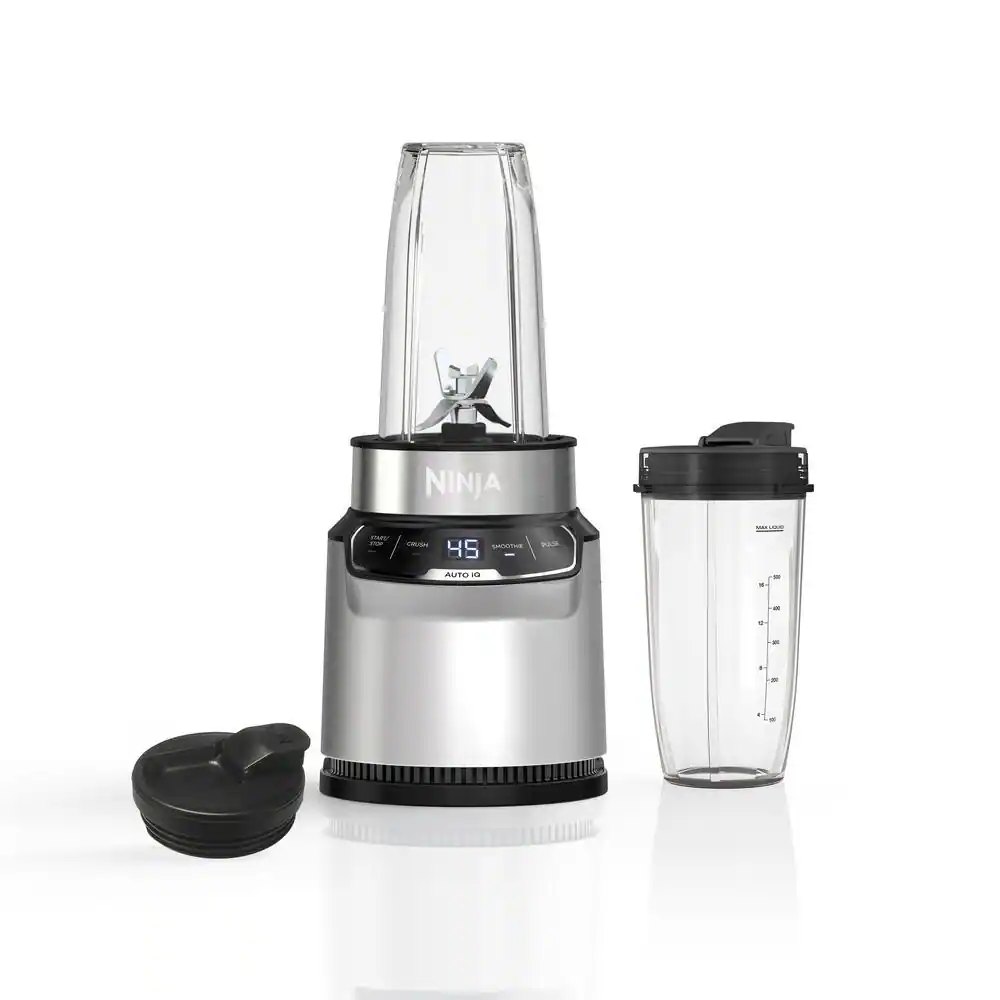
Ninja Nutri-Blender Pro (BN401)
- 1000W motor per the owner’s guide; sold as 1100 peak watts
- Auto-iQ programs for Smoothie and Crush, plus Start/Stop and Pulse
- Two 24 oz cups with spout lids
- Every removable part dishwasher safe, blade included
- Countdown display on the control panel
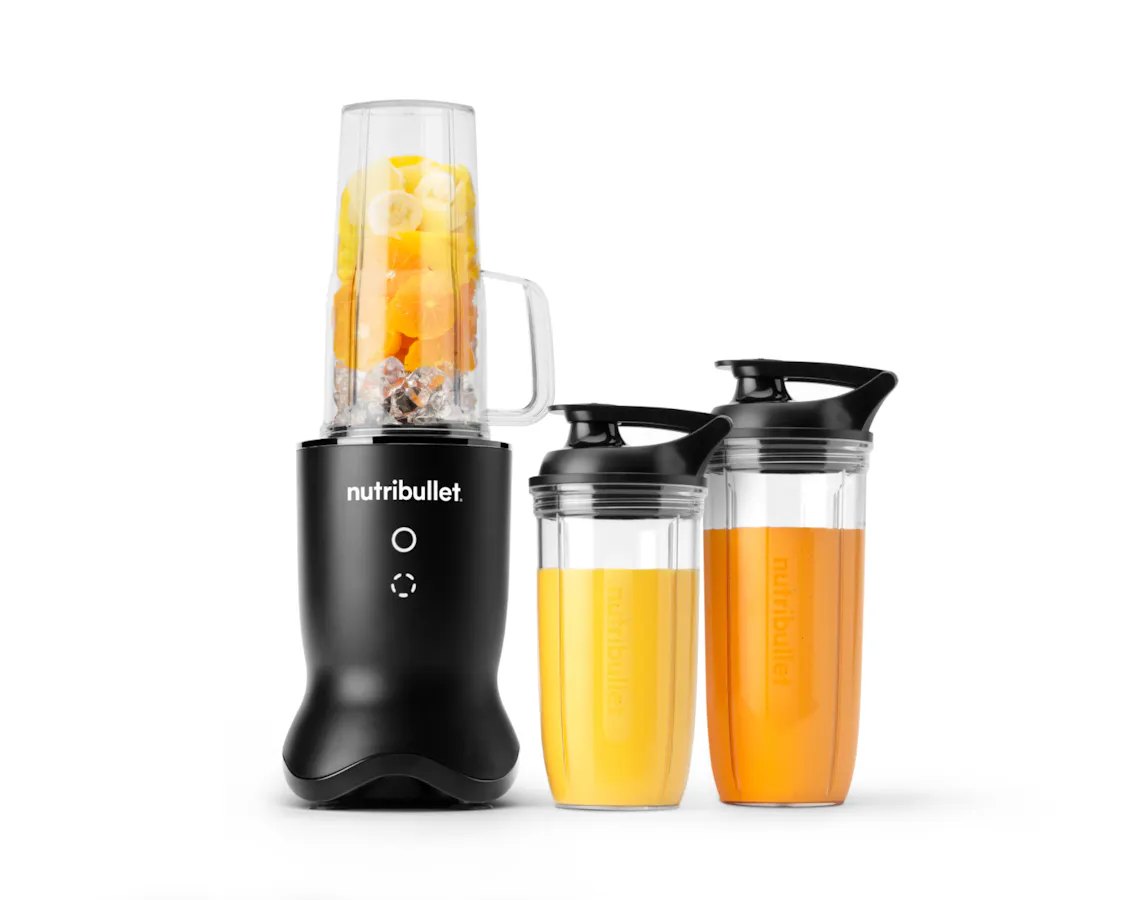
NutriBullet Ultra (NB50500)
- 1200W motor — the figure in NutriBullet’s user guide, no peak qualifier
- Titanium-coated Rapid Extractor Blade, 5-year blade warranty
- Three Tritan Renew cups: 32 oz, 24 oz, 24 oz handled
- Illuminated touch interface: one auto cycle plus pulse
- Engineered to run at a lower sound frequency — NutriBullet’s quietest single-serve
Choose the Ninja Nutri-Blender Pro if…
You make frozen drinks constantly. The Crush program exists for exactly that job, and it runs itself.
You make salsa, dips and anything where texture is the point. A hold-to-pulse button beats a touch circle for stopping at chunky.
You refuse to hand-wash anything. On the Ninja, the blade assembly goes in the dishwasher with the cups and lids.
Choose the NutriBullet Ultra if…
Your smoothies are green, seedy and frozen. NutriBullet designed this motor and blade around kale, nuts and seeds, and publishes the strongest wattage figure in its guide.
You blend for a household. Three cups in three sizes — including a 32 oz — mean nobody waits for a washed cup.
You blend early in a quiet house. The Ultra was engineered to produce lower-frequency sound than any previous NutriBullet single-serve.
As an Amazon Associate I earn from qualifying purchases at no extra cost to you.
Specifications: The Specs That Actually Matter
Every figure below comes from the manufacturers’ own product pages, owner’s guides and published product data. Where a brand’s marketing and its manual disagree, the manual’s figure is the one in the table — and the disagreement gets its own note underneath.
| Specification | Ninja Nutri-Blender Pro (BN401) | NutriBullet Ultra (NB50500) |
|---|---|---|
| Model | BN401, Cloud Silver | NB50500 |
| Motor power | 1000 W per the owner’s guide technical specification; marketed as 1100 peak watts | 1200 W per the user guide specification; no peak qualifier published |
| Voltage | 120 V, 60 Hz | 120 V (US model) |
| Cups in the box | 2 × 24 oz single-serve cups, 2 spout lids | 32 oz cup, 24 oz cup, 24 oz handled cup, 2 to-go lids |
| Cup material | BPA-free plastic | Tritan Renew — 50% certified recycled content, BPA-free, shatter-resistant |
| Blade | Pro Extractor Blades Assembly, stainless steel | Rapid Extractor Blade, titanium-coated stainless steel |
| Programs & controls | 2 Auto-iQ programs (Smoothie, Crush) + Start/Stop + Pulse; button panel with countdown display | Illuminated touch interface: automated smoothie cycle + pulse |
| Speeds | Single speed; programs vary the pulse/pause pattern | Single speed; two touch modes |
| Continuous run limit | Up to 60 seconds on Start/Stop | Do not exceed 1 minute; auto cycle is the brand’s ~30-second blend |
| Dishwasher-safe parts | Cups, lids and blade assembly (top rack) | Cups and to-go lids (top rack); blade hand-wash only |
| Footprint / dimensions | 6.34 × 6.93 in base; 14.29 in tall assembled | 5 × 4.75 in base; 14 in tall assembled (base alone 7.9 in) |
| Weight | 6.28 lb | 10.14 lb for the full set, per nutribullet.com |
| Cord length | 31.5 in | 29.5 in |
| Warranty | 1-year limited | 1-year limited; blade covered by a 5-year limited warranty |
| Hot liquids | Not permitted (owner’s guide) | Not permitted (user guide) |
Wattage note: Ninja sells the BN401 on peak watts. Its current product page headlines an 1100-peak-watt motor; the BN400 Series Owner’s Guide technical specification reads 1000 watts, and the Amazon listing spent its first years described as 1000-peak-watt before the copy moved to 1100.
NutriBullet publishes one figure for the Ultra — 1200 watts — in its user guide specifications, with no peak/rated split. We compare guide figure to guide figure throughout this article: 1200 against 1000.
Weight note: NutriBullet’s published 10.14 lb covers the Ultra’s full three-cup set as listed in its specifications. The Ninja’s 6.28 lb is SharkNinja’s figure for the two-cup BN401 set. Neither number is the bare motor base.
The Differences That Actually Matter
1. The wattage headline — peak watts vs one published figure
Start here, because the boxes are designed to mislead you. “1100-peak-watt” and “1200 watts” look like a 100-watt gap. They are not measured the same way.
Peak watts describe a motor’s momentary maximum, not its working specification. SharkNinja’s own owner’s guide for the BN400 series lists the technical specification plainly: 120 volts, 1000 watts.
NutriBullet’s user guide lists its specification just as plainly: motor power, 1200 watts. No peak figure is published separately, because none is needed for the marketing.
So the honest comparison is 1200 against 1000 — a 20% advantage to the Ultra, from the documents each brand gives its owners. That is the basis the scorecard uses, and it is why Difference 1 matters more than any other in this guide.
One more wrinkle for the careful buyer: the BN401’s Amazon listing was titled 1000-peak-watt for years and now reads 1100-peak-watt. Same model number, same ASIN. The manual’s 1000 watts is the figure that has never changed.
2. Capacity — two matching cups vs a three-cup ladder
The Ninja gives you two identical 24 oz cups. The Ultra gives you a 32 oz cup, a 24 oz cup and a 24 oz handled cup.
The single-blend gap is the headline: 32 oz against 24 oz. A breakfast smoothie with greens, frozen fruit, protein and liquid fits the Ultra’s big cup without riding the MAX line. In the Ninja, that recipe is a two-batch job or a smaller drink.
The set gap matters just as much over a week. Three cups means a clean cup is usually waiting. Two cups means the second smoothie of the morning waits on the first cup being rinsed.
The handled cup is the quiet star. It is the one that goes to the car, the gym bag and the desk — a small ergonomic decision the Ninja’s spout-lid cups do not answer.
Credit where due: the Ninja’s cups carry measurement markings and its spout lids are proven commuter hardware. But on capacity and cup count, this round is not close.
3. Control philosophy — labelled programs vs glowing circles
Here the Ninja wins, and wins clearly. Its panel offers four controls: Smoothie and Crush Auto-iQ programs, Start/Stop, and Pulse.
The Auto-iQ programs are timed patterns of pulsing, blending and pausing, tuned per job. Crush exists specifically to turn ice and frozen fruit into frozen drinks. A countdown display tells you where the cycle stands.
The Ultra’s interface is two illuminated circles that appear when the cup locks on: the full circle runs the automated smoothie cycle, the broken circle pulses. It is elegant, minimal and genuinely pleasant to use.
It is also only two decisions deep. There is no crush-specific pattern, no continuous run button, no timer readout. NutriBullet’s answer is that its auto cycle — positioned as a 30-second blend — makes programs unnecessary.
Underneath, both machines are single-speed. The Ninja spends its intelligence on pattern variety; the Ultra spends its on power and simplicity. If you blend exactly one thing every day, the Ultra’s two circles are enough. If your blender moonlights as a salsa and frozen-drink machine, the Ninja’s panel earns its keep.
4. The blade — titanium coating and a five-year promise
Both blades are stainless-steel extractor assemblies that screw onto the cup. The Ultra’s Rapid Extractor Blade adds a titanium coating.
NutriBullet’s stated reasoning is durability: the coating increases longevity and reduces blending time. The claim that matters, though, is not the coating — it is the warranty standing behind it. The Ultra’s blade carries a 5-year limited warranty of its own.
The Ninja’s Pro Extractor Blades Assembly is a well-proven design shared across the BN400 series. It carries no separate blade warranty; the whole machine sits under one 1-year limited warranty.
Extractor blades are the wear item on every personal blender. Gaskets age, edges dull, and the assembly is what you eventually replace. A manufacturer willing to warrant that part for five years is making a measurable statement about its expected lifespan.
Call this round for the Ultra — on the warranty paperwork as much as the metallurgy.
5. Cleaning — the blade is where the dishwasher story splits
Both brands agree on cups and lids: top rack of the dishwasher. They part company on the sharp part.
Ninja’s instruction manual is unambiguous: containers, lids and the blade assembly are dishwasher safe, with the blade assembly placed on the top rack. Everything you touched goes in the machine.
NutriBullet’s Ultra manual is equally unambiguous the other way: hand-wash the Rapid Extractor Blade with warm, soapy water and a brush, and do not place it in the dishwasher.
That is a daily-life difference, not a footnote. The blade assembly is the fiddliest part to clean on any extractor blender — the part with the gasket, the threads and the sharp edges.
If your household rule is that everything goes in the dishwasher, the Ninja is the only one of these two that honours it. The Ultra asks for sixty seconds at the sink, every time.
6. Noise and silhouette — designed to sound lower
Neither manufacturer publishes a decibel figure, so we will not invent one. What NutriBullet does publish is an engineering intent: the Ultra is designed to produce sound at a lower frequency than its previous models, and it is positioned as the brand’s quietest single-serve blender.
Lower-frequency sound is the kind that carries less harshly through a kitchen at 6 a.m. If your household sleeps while you blend, the Ultra was designed with you in mind; the Ninja makes no equivalent claim anywhere in its documents.
On the counter, the shapes differ too. The Ultra’s base footprint is 5 by 4.75 inches — genuinely narrow — and its silhouette is a smooth, sculpted pod with no visible buttons until the interface lights up.
The Ninja’s base is wider at 6.34 by 6.93 inches and wears its panel openly, display and all. It looks like an appliance; the Ultra looks like an object. Neither is better in the abstract — but the narrower footprint is a measurable Ultra win in a small kitchen.
7. Endurance rules — the 60-second ceiling both manuals impose
Personal blenders are sprinters. Both manuals say so, in almost the same words.
The Ninja’s Start/Stop runs continuously for up to 60 seconds. NutriBullet’s Ultra manual instructs you not to blend continuously for more than one minute, and its auto cycle is built around roughly half that.
Both machines protect themselves the same way: a thermal cut-out that disables the motor if it overheats, and a cool-down of about 15 minutes before it will run again. Both manuals describe the reset.
The practical consequence is identical blending discipline. Frozen loads go in with liquid. Thick mixtures get pulsed, rested and pulsed again. Back-to-back batches for a crowd will eventually trip either machine’s patience.
Call endurance a tie — and let it temper both brands’ marketing equally. Neither of these is a batch-production machine, and neither manual pretends otherwise.
Use-Case Fit Guide
The fastest way to choose between these blenders is to start from what actually goes in the cup. This table is the whole comparison in one view.
| Your use case | Ninja BN401 | NutriBullet Ultra | Our call |
|---|---|---|---|
| Daily green smoothies | Good — Smoothie program runs itself | Excellent — 1200W, 32 oz cup, kale/nuts/seeds are its stated brief | NutriBullet Ultra |
| Frozen drinks & ice crushing | Excellent — a dedicated Crush Auto-iQ program | Excellent — the strongest motor of the two, titanium blade | Tie — program vs power |
| Nut butters | Workable — pulse in bursts, add liquid, scrape down | Better — nuts are a designed-for ingredient; still a scrape-and-pulse job | NutriBullet Ultra, with patience |
| Salsa & chunky textures | Excellent — hold-to-pulse control stops exactly at chunky | Good — pulse mode exists, but control is two touch circles | Ninja BN401 |
| Two-person household | Good — two cups, one each | Excellent — three cups, including a handled commuter cup | NutriBullet Ultra |
| Travel & commuting | Good — blend in the cup, swap on a spout lid | Excellent — the handled 24 oz cup is built for the car and gym bag | NutriBullet Ultra |
| Small kitchen, tight counter | Good — compact, but the wider base of the two | Excellent — 5 × 4.75 in footprint, cord 29.5 in | NutriBullet Ultra |
| Dishwasher-only cleanup | Excellent — blade assembly included, top rack | Compromised — the blade is hand-wash only | Ninja BN401 |
Read the frozen-drinks row carefully. It is the honest centre of this comparison: the Ninja answers ice with software, the Ultra answers it with hardware, and both answers work.
The 30-Second Decision
| If this sounds like you… | Buy this |
|---|---|
| “I want the strongest personal blender motor I can buy.” | NutriBullet Ultra (1200W in its user guide) |
| “I make frozen drinks every weekend.” | Ninja BN401 (dedicated Crush program) |
| “Everything I own goes in the dishwasher. Everything.” | Ninja BN401 (blade included) |
| “Two of us blend every morning before work.” | NutriBullet Ultra (three cups) |
| “I blend at dawn and the house is asleep.” | NutriBullet Ultra (lower-frequency sound design) |
| “Salsa texture matters to me.” | Ninja BN401 (hold-to-pulse) |
| “I keep appliances for years and hate replacing wear parts.” | NutriBullet Ultra (5-year blade warranty) |
Ready to check today’s price?
Both blenders sell through Amazon. Prices move, so check the live figure on the blender that fits your kitchen.
View on Amazon — Ninja BN401View on Amazon — NutriBullet UltraWhat You Gain. What You Give Up.
Ninja Nutri-Blender Pro (BN401)
You gain: the control panel. Two job-specific Auto-iQ programs, a continuous-run button, a true hold-to-pulse, and a countdown display that tells you where a cycle stands. Plus the easiest cleanup in the class — every removable part, blade included, is dishwasher safe.
You give up: specification headroom. A 1000-watt motor by its own manual, two same-size 24 oz cups, a plain stainless blade with no separate warranty, and the wider base of the two.
NutriBullet Ultra (NB50500)
You gain: the hardware. A 1200-watt motor by its user guide’s own figure, a titanium-coated blade warranted for five years, three Tritan Renew cups including a 32 oz and a handled commuter cup, the narrower footprint, and the quieter sound design.
You give up: program variety and dishwasher freedom. Two touch modes are all the control you get — no Crush program, no continuous button — and the blade must be hand-washed after every blend.
Pros and Cons
Ninja BN401 — Pros
- Two Auto-iQ programs tuned by job, plus Start/Stop and Pulse
- Blade assembly is dishwasher safe — full no-hand-washing cleanup
- Countdown display; physical buttons work with wet hands
- Crush program is purpose-built for frozen drinks
- Longer cord (31.5 in) and lighter set (6.28 lb)
Cons
- 1000W in the manual under an 1100-peak-watt headline
- Two identical 24 oz cups — no big cup, no handled cup
- No separate blade warranty; 1 year covers everything
- Wider base footprint of the two
NutriBullet Ultra — Pros
- 1200W published in the user guide — strongest here, no peak-watt framing
- Titanium-coated blade with a 5-year limited warranty
- Three Tritan Renew cups: 32 oz, 24 oz, 24 oz handled
- Narrow 5 × 4.75 in footprint; illuminated touch interface
- Engineered for lower-frequency, quieter operation
Cons
- Blade is hand-wash only, every time
- Only two control modes — no Crush program or continuous run
- Heavier set as published (10.14 lb for the three-cup set)
- Touch interface needs the cup locked on before it lights up
Check the Model Number and the Box Contents, Not Just the Name
Check the Ninja variant. “Nutri-Blender Pro” is the BN401, and the giveaway is the control panel: Auto-iQ buttons, a countdown display, and a Cloud Silver finish.
The BN300 and BN301 wear the plainer “Nutri-Blender” name. They are press-and-hold machines with no Auto-iQ programs at all. A listing that shows no display is not this blender, whatever the headline says.
SharkNinja also sells a BN401 bundle configuration (its own store lists a BN401B1 bundle) with expanded box contents and different package dimensions. The standard BN401 retail set is the two-cup configuration in this guide — count the cups in the listing before you pay.
Expect the wattage copy to wobble. The BN401’s listing has been titled both 1000-peak-watt and 1100-peak-watt over its life, under the same model number. Neither figure is the manual’s. Buy the model number, not the wattage headline.
Check the Ultra’s colour code. The NB50500 ships in several finishes with different SKUs: Satin Black (NB50500AK on NutriBullet’s own store), Gunmetal Gray on Amazon, and a white variant (NB50500AW) whose manual circulates separately. The machine is identical; the code is the colour.
There is also an expanded Ultra Deluxe set (NB70500) with a larger cup collection. If a listing shows more than three cups, you are looking at the Deluxe bundle, not a different blender.
Count the cups on both. The Ultra set is three cups and two to-go lids. The BN401 set is two cups and two spout lids. Marketplace listings blur configurations constantly — the includes list is the truth.
The Upgrade Path Test
Judge a personal blender by its second year, not its first smoothie.
Year one, both machines delight. The Ninja’s programs make you feel clever; the Ultra’s power makes you feel equipped. Both blend-in-cup, both travel, both rinse clean in under a minute of effort.
Year two is about wear and wants. The wear item is the blade assembly, and here the Ultra’s five-year blade warranty starts to look like the most valuable line in either spec sheet.
The wants are capacity and quiet. If your household grows into the blender, the Ultra’s 32 oz cup and third cup absorb it. If your Ninja starts feeling small, the honest next step is out of the personal format entirely — into a full-size system with a pitcher.
Both brands sell that step up, and neither machine’s cups will follow you there in any guaranteed way. Buy the personal blender that fits your life now, and treat the pitcher machine as a separate purchase when the day comes.
When to Skip Both
Honesty cuts both ways. There are kitchens neither of these blenders serves.
Skip both if you blend for a family at once. A 32 oz single cup is the ceiling here; pitcher blenders exist for the four-smoothie breakfast run.
Skip both if hot soup is the plan. Both manuals prohibit hot liquids outright — pressure build-up in a sealed cup is the reason, and it is a good one. Vented pitcher blenders are the tool for soup.
Skip both if dry milling is your main job. Grain, spice and coffee grinding belongs to machines whose manuals are written for it; both of these are wet-blend designs that ask for liquid in the cup.
And skip both if you want variable speeds. Each of these is a single-speed motor wearing different controls. A dial-controlled blender is a different product class.
Warranty and Long-Term Support
Both machines carry a 1-year limited warranty on the unit. That is where the similarity ends.
The Ultra’s Rapid Extractor Blade carries its own 5-year limited warranty — NutriBullet publishes the terms on its warranty page, and it is the longest wear-part cover in this comparison by four years.
Both brands sell replacement cups, lids and blade assemblies through their own stores, and both run product registration: Ninja through its registration site, NutriBullet through its warranty page.
Both machines also share the same failure manners: a thermal cut-out that rests the motor for roughly 15 minutes after an overload. It is protection, not a defect — both manuals describe it, and both treat a tripped unit as a cooled-down-and-carry-on event.
Long-term, the Ultra’s paperwork is simply better. A five-year promise on the part that wears out first is the kind of support detail that decides second-year satisfaction.
Final Verdict
The NutriBullet Ultra is the personal blender we would buy.
It wins this comparison on the documents, not the slogans. Its user guide publishes the stronger motor figure — 1200 watts, unqualified. Its blade is titanium-coated and warranted for five years. Its cup set is bigger, better and made from recycled-content Tritan Renew.
Add the narrower footprint and the quieter sound design, and the Ultra is the more complete answer to the personal-blender brief — the machine whose advantages are built into parts you will never upgrade.
Buy the Ultra for green smoothies, seedy blends, multi-cup households, early-morning blending and long ownership.
View on Amazon — NutriBullet Ultra
Buy the Ninja Nutri-Blender Pro if your blending life runs on frozen drinks and salsa, and your cleaning life runs on the dishwasher. Its Auto-iQ panel is genuinely the better control system, and its Crush program has no equivalent on the Ultra.
It is the smarter machine. The Ultra is the stronger one — and in a category where the motor and blade do the work, stronger wins.
Watch Out: Similar Names, Different Blenders
Personal-blender naming is a trap for the hurried buyer. Four warnings belong in every version of this guide.
First: the Ninja Nutri-Blender (BN300) and Nutri-Blender Plus (BN301) are not the Pro. They are press-and-hold blenders — the BN300’s guide rates it at 700 watts under a 900-peak-watt headline — with no Auto-iQ. Only the BN401 carries the Pro name and the program panel.
Second: NutriBullet’s 1200 watts appears twice in the range. The Ultra is a personal blender; the Full-Size Blender Combo is a pitcher machine that also advertises 1200 watts. Same number, unrelated format.
Third: the Ultra has special editions. The McLaren collaboration version sold in some regions is a 220–240V machine with its own specification — do not import its figures, or the machine, into a US kitchen.
Fourth: older NutriBullet Pro models are not the Ultra. The Pro line tops out at 1000 watts in its own right, uses different cups, and was built around a different blade. “NutriBullet” on the base is not a specification.
Slow down on the product page. Match the model number — BN401 or NB50500 — then the cup count, then the price. In that order.
Frequently Asked Questions
Is the Ninja BN401 really 1100 watts?
It is marketed that way — as 1100 peak watts. The BN400 Series Owner’s Guide technical specification lists the motor at 1000 watts, and the Amazon listing itself was described as 1000-peak-watt for its first years. For comparison purposes, the guide’s 1000 watts is the figure to use.
Which blender is more powerful, honestly?
The NutriBullet Ultra, by the only like-for-like measure available: the figures in each brand’s own user guide. NutriBullet publishes 1200 watts for the Ultra with no peak qualifier; SharkNinja’s guide specifies 1000 watts for the BN401. Neither brand publishes torque or RPM figures for these models, so wattage from the manuals is where an honest comparison has to stop.
Can either blender make nut butter?
Neither is a dedicated nut-butter machine, and both manuals steer you toward liquid in the cup. The Ultra has the better brief: NutriBullet names nuts among the ingredients its motor and blade are designed to handle. On both machines, expect a pulse-scrape-pulse process rather than a one-touch result.
Which blender holds more?
The Ultra. Its largest cup is 32 oz against the Ninja’s 24 oz, and its box holds three cups to the Ninja’s two. For a single big smoothie or a two-person morning, the Ultra’s cup set is the clear winner.
Can I put the blades in the dishwasher?
The Ninja’s, yes — its manual clears the blade assembly for the top rack, along with the cups and lids. The Ultra’s, no — NutriBullet’s manual instructs you to hand-wash the titanium-coated blade and keep it out of the dishwasher. The Ultra’s cups and lids are top-rack safe.
Which is quieter?
The Ultra, by design intent. NutriBullet engineered it to produce lower-frequency sound and positions it as its quietest single-serve blender. Neither manufacturer publishes a decibel rating, so no honest numerical comparison exists — but only one of the two brands makes quietness part of the product’s brief.
Can I blend hot liquids in either?
No. Both manuals prohibit hot liquids. A sealed personal-blender cup builds pressure with heat, and both brands are explicit about it. For soup, use a vented pitcher blender.
Do the cups fit other models from the same brand?
Do not count on it. Personal-blender cups and blade assemblies are model-family specific, and both brands revise their cup systems between generations — NutriBullet’s current lines, for example, do not share cups with its older Pro machines. Check the model’s own parts page before buying spare cups for either blender.
Sources & Verification
SharkNinja BN400 Series Owner’s Guide (technical specifications: 120V, 1000W; Auto-iQ program definitions; dishwasher rulings) • SharkNinja BN401 product page and product data (1100-peak-watt marketing figure, cord 31.5 in, 2 manual + 2 automatic programs, 1-year warranty) • Ninja BN401 instruction manual via manuals.plus (parts, cleaning, dimensions 6.34 × 6.93 × 14.29 in, 6.28 lb) • NutriBullet Ultra product page, nutribullet.com (SKU NB50500AK: includes list, dimensions, weight, cord, 5-year blade warranty, 1-year warranty) • NutriBullet Ultra user guide NB50500 (1200W specification, glow interface operation, hand-wash blade ruling, one-minute limit) • Amazon.com listing data for BN401 (ASIN B08QXJ31WR, UPC 622356569446) and NB50500 (ASIN B0CBWD3PN7, UPC 810097972803). Specifications verified November 2026.

James Wilson
James has been testing and writing about kitchen appliances and PC hardware for over a decade. His rule for every Honestly Compared guide: the verdict has to survive the spec sheet — and the owner’s manual — not the marketing page.