NutriBullet Portable Blender vs Ninja Blast: Which Should You Buy?
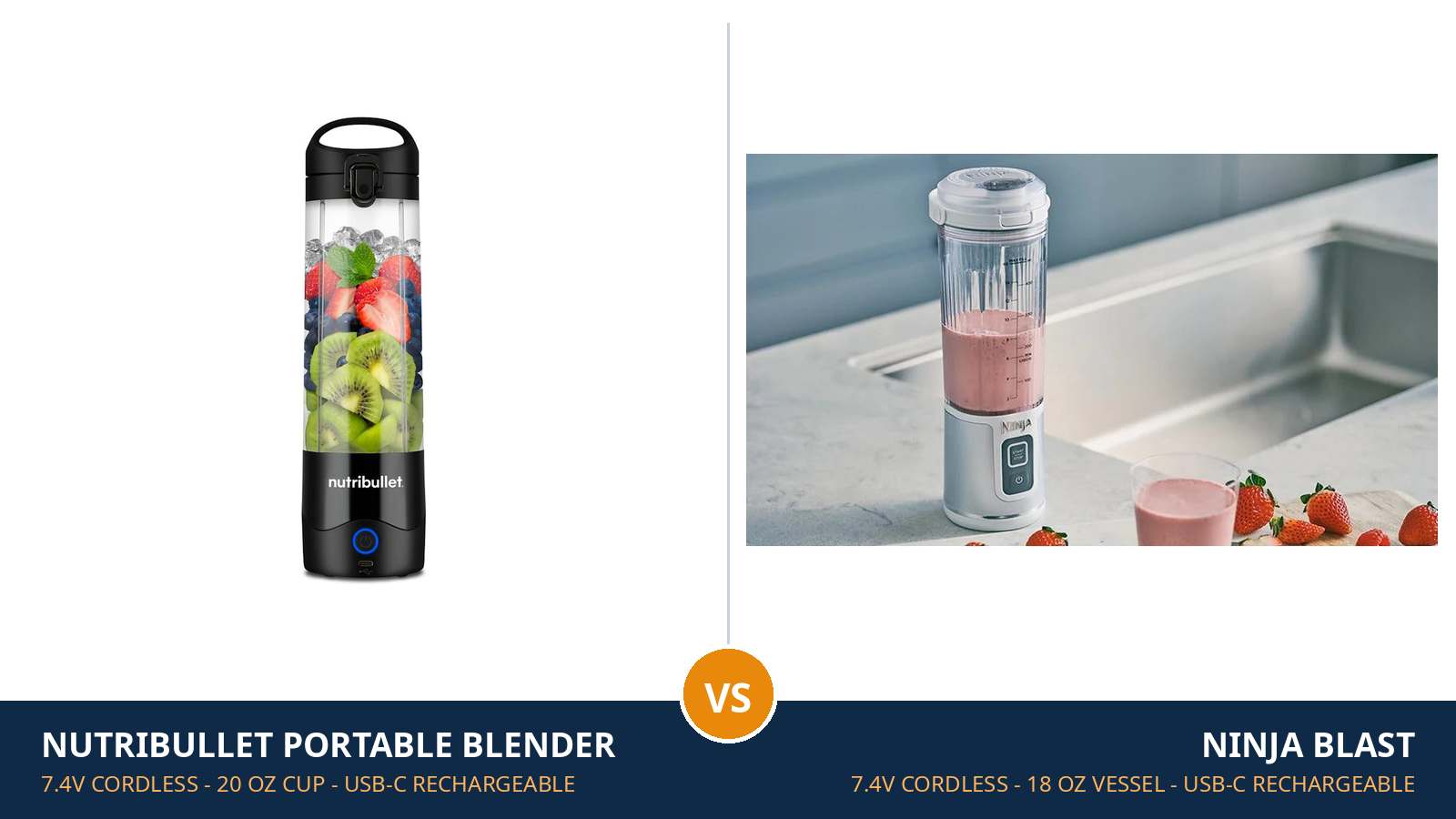
Two cordless blenders. Same 7.4-volt pitch. Same USB-C cable. Nearly the same promise: fifteen blends, then plug it back in.
On paper, the NutriBullet Portable Blender and the Ninja Blast look interchangeable — the two default answers when someone searches “portable blender,” sold as if the choice were a coin toss.
It is not. The differences are small but specific: how much the cup holds, how long a recharge takes, how long each blend cycle runs, and how much of the power story either brand will put in writing.
One warning before anything else. NutriBullet sells three cordless blenders, and only one of them is the machine in this comparison: the model its own store names, plainly, the nutribullet Portable Blender, model NBPB50100.
The smaller 13 oz NutriBullet GO and the insulated stainless-steel Flip are different machines with different specifications. They are walled off by name later in this guide, because listings blur them constantly.
Every figure below comes from the two brands’ own pages, manuals and published store data. Where a brand refuses to publish a number, we say so instead of borrowing one from a retailer.
Key Takeaways
- The NutriBullet Portable Blender is the better all-round portable. A bigger 20 oz cup, a recharge in up to 90 minutes, and the smaller, lighter body.
- The Ninja Blast has the better-documented power story. SharkNinja publishes a 14,069 RPM blade speed and a six-blade stainless assembly; NutriBullet publishes neither a speed nor a wattage for its machine.
- Battery claims are a dead heat; charging is not. Both promise about fifteen blends per charge. The NutriBullet refills in roughly half the time.
- Neither brand publishes a wattage for the US models. Any watt figure a retailer attaches to either machine is not a manufacturer specification.
- Check the model number, not the name. “Portable Blender” is a specific NutriBullet model (NBPB50100) — the GO, the Flip and the Flex are different products.
Quick Verdict
Buy the NutriBullet Portable Blender for most people. It holds more, charges faster, and takes up less room in a bag.
Its 20 oz cup is the largest vessel in this comparison. Its battery goes from empty to full in up to 90 minutes, half the Ninja’s roughly two hours. And at 1.63 lb and 3.3 inches wide, it is the one designed to drop into a car cupholder.
Buy the Ninja Blast if you blend frozen fruit daily and want the stronger paper trail. Its 30-second cycle does in one press what the NutriBullet usually needs two 20-second cycles to finish.
SharkNinja also publishes the harder spec sheet: a ribbed vortex vessel, a six-blade stainless BlastBlade, a stated 14,069 RPM. If documented hardware matters more than charge time, the Blast is the honest pick.
The Scorecard
Scores below are derived directly from the manufacturer specifications compared in this guide — vessel capacities, published battery and charging figures, cycle lengths, dimensions, weights and warranty terms. They are a reading aid, not benchmark results.
| Category | NutriBullet Portable | Ninja Blast | ||
|---|---|---|---|---|
| Power & blending | 5 / 10 | 6 / 10 | ||
| Capacity | 7 / 10 | 6 / 10 | ||
| Battery & charging | 8 / 10 | 7 / 10 | ||
| Portability | 8 / 10 | 7 / 10 | ||
| Ease of use & cleaning | 7 / 10 | 8 / 10 | ||
| Versatility | 6 / 10 | 6 / 10 | ||
| Overall | 6.8 / 10 | 6.7 / 10 | ||
A note on the Blast’s overall. Against NutriBullet’s corded 900W Pro, this same machine scored 6.9 in our earlier comparison, carried by a perfect portability mark against a blender with a power cord.
Judged here against a direct cordless rival — one that matches its battery claims and beats its capacity and charge time — the same hardware lands at 6.7. The machine did not change; the yardstick did, and scores on this site follow the pairing.
The pattern is consistent: the NutriBullet wins the ownership rows (capacity, charging, size); the Blast wins the blending rows (documented power, one-press cycles). Which set matters more decides the purchase.
At a Glance: Who Each Blender Fits
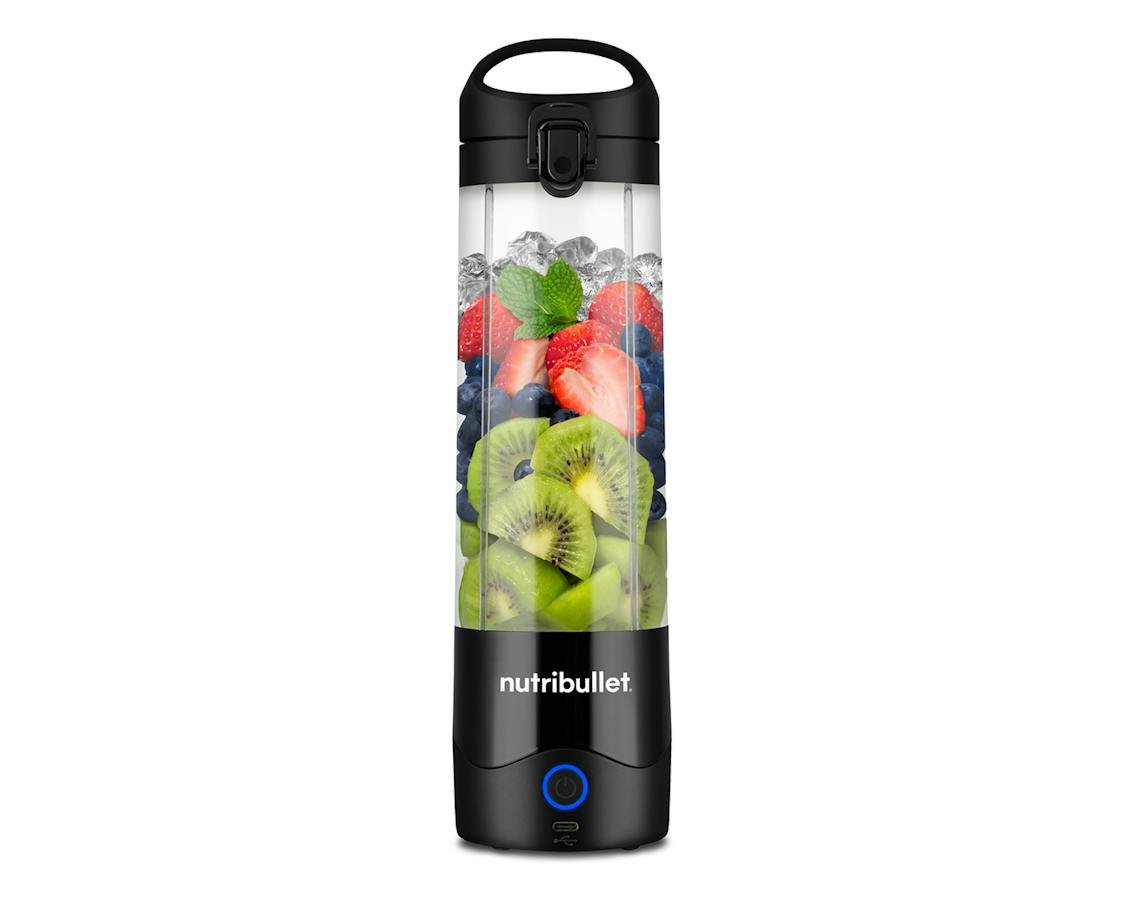
NutriBullet Portable Blender
- 20 oz cup — the bigger vessel in this comparison
- 15+ blend cycles per charge, 20 seconds each
- Full recharge in up to 90 minutes via USB-C
- 1.63 lb, 3.3 in wide — built for car cupholders
- Flip-top Sip and Carry Lid with handle
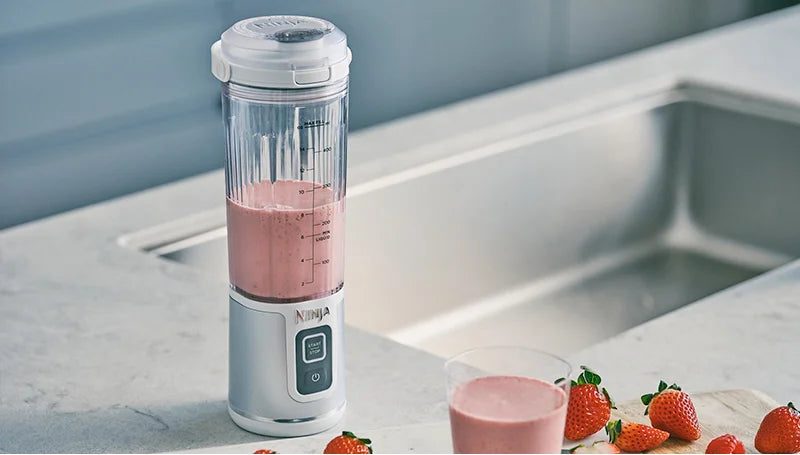
Ninja Blast
- 18 oz ribbed vessel (fill line sits near 16 oz)
- Up to 15 blends per charge, 30 seconds each
- BlastBlade: six stainless-steel blades, 14,069 RPM
- Full recharge in about 2 hours via USB-C
- Easy-open sip lid with carrying handle
Choose the NutriBullet Portable Blender if…
You make one smoothie or shake a day. The 20 oz cup is the only vessel here that holds a full-size serving without a fill-line argument.
You charge opportunistically — car, desk, power bank. A battery that refills in up to 90 minutes forgives a forgotten overnight charge.
Your commute involves a cupholder. At 3.3 inches wide, this is the machine NutriBullet explicitly sized for one.
Choose the Ninja Blast if…
Frozen fruit is your default, not your exception. The 30-second cycle and ribbed vortex vessel keep thick mixtures moving without a second press.
You want the hardware in writing. SharkNinja publishes blade count, blade material and blade speed. NutriBullet, for this model, publishes none of the three.
You prefer one press per drink. One Blast cycle is half again as long as a NutriBullet cycle, and the guide treats a single cycle as the standard drink.
As an Amazon Associate I earn from qualifying purchases at no extra cost to you.
Specifications: The Specs That Actually Matter
Every figure below is taken from the manufacturers’ published specifications, manuals and official store data, cross-checked against manufacturer product data.
Where a brand does not publish a figure for the US model, the table says so. That absence is itself a finding, and it is scored as one.
| Specification | NutriBullet Portable Blender | Ninja Blast |
|---|---|---|
| Model | NBPB50100 (Black: NBPB50100K) | BC151 (Black: BC151BK) |
| Type | Cordless portable, USB-C rechargeable | Cordless portable, USB-C rechargeable |
| Power basis | 7.4V rechargeable motor base | 7.4V lithium-ion battery |
| Published wattage (US) | Not published by NutriBullet | Not published by SharkNinja |
| Blade speed | Not published | 14,069 RPM (SharkNinja store data) |
| Blade | Stainless-steel extractor blade, integrated in the motor base | BlastBlade — six stainless-steel blades |
| Vessel capacity | 20 oz cup, BPA-free plastic | 18 oz vessel, BPA-free plastic; MAX FILL line sits near 16 oz |
| Blend cycle | 20 seconds, automatic | 30 seconds, automatic |
| Blends per full charge | 15+ cycles | Up to 15 blends |
| Full charge time | Up to 90 minutes | About 2 hours |
| Charging | USB-C, cable included | USB-C, cable included |
| Blending while charging | Not specified by NutriBullet | Not permitted (owner’s guide) |
| Controls | Single push button, one speed | Power + Start/Stop buttons, one speed |
| Lid | Flip-top Sip and Carry Lid, handled, push-button release | Easy-open sip lid with carrying handle |
| Dishwasher parts | Cup and lid, top rack only | Vessel and lid |
| Motor base care | Wipe clean; never submerge | Wipe clean; never submerge, not dishwasher safe |
| Hot liquids | Never — manufacturer warning | Never — owner’s guide |
| Dimensions | 3.3 × 3.74 × 10.16 in | 3.54 × 3.54 × 10.71 in |
| Weight | 1.63 lb | 1.73 lb |
| In the box | Motor base, 20 oz cup, Sip and Carry Lid, USB-C cable | Motor base, 18 oz vessel, sip lid, USB-C cable |
| Warranty (US) | 1 year | 1-year limited |
Height note: NutriBullet’s own pages disagree about its machine: the specification block prints 10.16 in tall; the FAQ section prints 10.61 in.
We use the specification-block figure. Either way it is the shorter blender here — but a brand’s own pages should not need a referee.
Capacity note: the Blast’s 18 oz is a vessel size, not a serving size. Its MAX FILL line sits below the brim — SharkNinja’s UK arm quantifies it at 470 ml, roughly 16 oz — which is why some listings title the same BC151 a “16 oz” blender.
Regional note: NutriBullet sells a 475 ml version of the Portable Blender under different model numbers outside the US, and retailer copy for it quotes figures — including a wattage — that NutriBullet does not publish for the US model. None of it is used here.
The Differences That Actually Matter
1. The name problem — three NutriBullet portables, one comparison
Start here, because most buying mistakes in this category happen before any specification is read.
NutriBullet’s cordless range has three members. The GO (NB50300) is the small one: a 13 oz cup and a 70W motor. The Flip is the premium one: a 20 oz insulated stainless-steel cup and an 11.1V base. The Portable Blender (NBPB50100) is the one between them — and the one that carries the bare name.
That naming is not a technicality. A buyer searching “nutribullet portable blender” is shown all three machines, plus the newer 22 oz Flex, in one blur of near-identical product photos.
This comparison covers the NBPB50100 only: 7.4 volts, 20 oz plastic cup, 15+ cycles per charge. If a listing says 13 oz, 70 watts, stainless or insulated, it is a different blender — use the Similar Names section before you buy.
The Ninja side has its own blur, covered there too: several Blast listings advertise “16 oz” for the identical BC151, because that is its fill line rather than its vessel size.
2. Power — the Blast puts its numbers in writing; the NutriBullet does not
Neither manufacturer publishes a wattage for the US version of its machine. Both run 7.4-volt battery bases. That is where the published similarity ends.
SharkNinja states a blade speed for the Blast: 14,069 RPM in its own store specification data. It names the blade — BlastBlade — and specifies six stainless-steel blades.
NutriBullet states none of this for the Portable Blender. No RPM. No blade count. The manual filing confirms a stainless-steel extractor blade integrated into the motor base, and that is the end of the published record.
Cycle length widens the gap. The Blast runs a 30-second automatic cycle. The NutriBullet runs 20 seconds, and its own FAQ concedes a drink typically takes one to two cycles — up to 40 seconds of blending, in two presses, with the lid vented between cycles to release pressure.
Does an RPM figure guarantee a smoother smoothie? No. But a buyer comparing paper has exactly one power story to read here, and it is not NutriBullet’s.
3. Capacity — 20 oz against an 18 oz vessel with a 16 oz ceiling
The NutriBullet’s 20 oz cup is the biggest vessel here, and capacity is the specification portable-blender buyers feel first.
Two ounces sounds trivial. In a category where a standard smoothie runs 12 to 16 oz, it is the difference between headroom and the fill line.
The Blast’s vessel is 18 oz to the brim, but blending stops at the MAX FILL line — quantified by SharkNinja’s UK arm at 470 ml, about 16 oz. Fill past it and the guide’s warning is leaks and poor circulation, not extra smoothie.
For protein shakes and small blends, both are adequate and the gap never shows. For a full fruit smoothie with ice, the NutriBullet’s extra room is a real, daily advantage. One tie: both vessels double as the drinking cup, under sip lids.
4. Battery — the same fifteen blends, half the recharge
Read the two battery claims side by side and they nearly rhyme. NutriBullet: 15+ cycles per full charge. SharkNinja: up to 15 blends per full charge.
Convert cycles to drinks and the NutriBullet’s number softens. At its own stated one to two cycles per drink, a full charge delivers roughly eight to fifteen finished drinks. The Blast’s 30-second cycle is the drink, so its fifteen is closer to fifteen.
Call blends-per-charge a draw, with an asterisk on the NutriBullet side. Recharge time is not a draw at all.
The NutriBullet reaches full in up to 90 minutes. The Blast takes about two hours. For a product whose entire purpose is being ready away from home, the faster refill is the more useful battery specification — and it is not close.
One more asymmetry: SharkNinja’s guide prohibits blending while the Blast charges. NutriBullet’s published material does not address it. Plan around the Ninja rule; do not assume the NutriBullet allows what it never mentions.
5. Size and weight — small margins, one cupholder winner
Both machines are genuinely portable. The argument here is over fractions.
The NutriBullet is lighter (1.63 lb against 1.73), shorter (10.16 in against 10.71, on its specification block), and narrower (3.3 in against 3.54 in at the Blast’s widest).
That last figure has a job to do. NutriBullet designs and markets the 3.3 in width around standard car cupholders; SharkNinja makes no equivalent claim, and its extra quarter inch is exactly the margin that decides fit in a snug console.
In a gym bag or backpack, neither machine is the bulkiest thing you carry, and both lids have handles. Call the bag test a tie; in the car, the NutriBullet wins on a published dimension and a stated design intent.
6. Lids, sipping and cleaning — two philosophies of the same lid
Both blenders blend in the vessel you drink from. Both seal that vessel with a handled sip lid. The implementations differ in the details.
NutriBullet’s Sip and Carry Lid flips open at the push of a button to expose the spout, and the brand calls the seal leak-proof. The Blast’s easy-open sip lid is the simpler mechanism — fewer moving parts, a carry handle, and a ribbed vessel.
Cleaning is a genuine tie. Both brands describe the same ritual: water, a drop of dish soap, one blend cycle, rinse.
In the dishwasher, a small print difference appears. The NutriBullet’s cup and lid are top-rack only. SharkNinja lists the Blast’s vessel and lid as dishwasher safe without the top-rack qualifier.
And a shared rule with no exceptions: neither motor base goes in the dishwasher or under water. Wipe it down. The blade lives in that base on both machines, so the wipe-down deserves care, not speed.
7. The shared ceiling — what neither portable will do
Honesty about this category matters more than the verdict. Both machines are convenience devices with hard limits, and both manuals state them.
Neither blends hot or warm liquids. NutriBullet warns that steam pressure in a sealed cup is a safety risk; SharkNinja’s guide bans hot liquids and carbonated drinks outright. Soup is a countertop blender’s job.
Neither is a heavy-duty machine. NutriBullet’s own guidance frames portables as built for convenience, not power, and permits ice only inside a drink with enough liquid — never as a standalone ice-crushing task.
Dry grinding, nut butters in quantity, dough, family-size batches: none of it is on either menu. A 7.4-volt battery base does not become a food processor by optimism.
If your blending is mostly at home and mostly frozen, the correct conclusion may be to skip both and buy a corded personal blender. The Skip Both section says exactly when.
Use-Case Fit Guide
The fastest way to choose between these two is to start from where the blender will actually live. This table is the whole comparison in one view.
| Your routine | NutriBullet Portable | Ninja Blast | Our call |
|---|---|---|---|
| Gym bag, protein shake after training | Excellent — lightest here, handled lid | Excellent — one 30-second cycle per shake | Tie — pick on price |
| Car commute, cupholder required | Excellent — 3.3 in wide, sized for cupholders | Good — 3.54 in at its widest | NutriBullet Portable Blender |
| Office desk, blended at lunch | Excellent — 90-minute recharge fits a workday | Good — needs about 2 hours to refill | NutriBullet Portable Blender |
| Frozen fruit smoothies, daily | Good — usually two 20-second cycles | Excellent — 30-second cycle, ribbed vortex vessel | Ninja Blast |
| Travel and carry-on | Excellent — smallest and lightest here | Excellent — proven travel format | NutriBullet, by a small margin |
| Full-size single servings | Good — 20 oz cup | Fair — plan around a 16 oz fill line | NutriBullet Portable Blender |
| Home use, outlet always nearby | Workable — but a corded blender is better | Workable — but a corded blender is better | Neither — see Skip Both |
Read the frozen-fruit row carefully. It is the one routine where the Blast’s longer cycle and published blade data outweigh everything the NutriBullet wins elsewhere.
Ready to check today’s price?
Both machines sell through Amazon. Prices move, so check the live figure on the blender that fits your routine.
View on Amazon — NutriBullet Portable BlenderView on Amazon — Ninja BlastThe 30-Second Decision
| If this sounds like you… | Buy this |
|---|---|
| “I want the biggest cup and the fastest recharge.” | NutriBullet Portable Blender |
| “It has to fit my car’s cupholder.” | NutriBullet Portable Blender |
| “I blend frozen fruit every day and want one press per drink.” | Ninja Blast |
| “I read spec sheets. Show me the blade speed.” | Ninja Blast (14,069 RPM, published) |
| “It lives in my gym bag and weight is everything.” | NutriBullet Portable Blender (1.63 lb) |
| “I mostly blend at home, near an outlet.” | Neither — a corded personal blender serves you better |
What You Gain. What You Give Up.
NutriBullet Portable Blender
You gain: the 20 oz cup, the up-to-90-minute recharge, the lightest and narrowest body in this comparison, and a flip-top lid that opens at the push of a button.
You give up: the documented power story. No published blade speed, no blade count, 20-second cycles that usually run twice per drink, and a cup and lid restricted to the dishwasher’s top rack.
Ninja Blast
You give up: capacity and convenience margins. An 18 oz vessel with a fill line near 16 oz, a recharge that takes about two hours, and the slightly larger, heavier body of the two.
You gain: the 30-second cycle, the ribbed vortex vessel, and the only fully published blade specification in this comparison — six stainless-steel blades at a stated 14,069 RPM.
Pros and Cons
NutriBullet Portable — Pros
- 20 oz cup — the largest vessel here
- Full recharge in up to 90 minutes
- Lightest (1.63 lb) and narrowest (3.3 in)
- Sized and marketed for car cupholders
- Push-button flip-top sip lid with handle
Cons
- No published wattage or blade speed
- 20-second cycles; most drinks take two
- Cup and lid are top-rack dishwasher only
- Easy to confuse with the GO and Flip when buying
Ninja Blast — Pros
- 30-second cycle — one press per standard drink
- Published blade data: six stainless blades, 14,069 RPM
- Ribbed vessel keeps thick blends circulating
- Vessel and lid dishwasher safe, no top-rack caveat
- Wide colour range and a two-pack option
Cons
- 18 oz vessel, with a fill line near 16 oz
- About 2 hours to recharge
- Cannot blend while charging
- Slightly larger and heavier of the two
Check the Model Number, the Colour and the Listing Type
Check the model number. “NutriBullet Portable Blender” is model NBPB50100. It is not the GO (NB50300, 13 oz, 70W) and not the Flip (20 oz insulated stainless steel, 11.1V), and the newer Flex is a fourth machine again.
The model number is printed on the base and in every honest listing’s product details. If it does not say NBPB50100, this guide’s specifications do not apply to the machine in your basket.
Check the colour’s own listing. Each NutriBullet colour — Black, Navy Blue, Bright Pink — is its own Amazon listing with its own identifier. The same is true of the Blast’s colour range. Prices and stock flicker independently per colour, so check yours, not the range’s headline.
The links in this guide are pinned to the Black versions of both machines: NBPB50100K and BC151BK. The Blast photo on this page shows a light finish from SharkNinja’s own store photography; the linked listing is the Black colourway of the same BC151. Vessel, base, blade and controls are identical — only the finish differs.
Check the listing type. A Renewed version of the Blast circulates alongside the new-unit listing. Renewed can be a sensible buy, but it is a different offer with a different guarantee — know which one is in your basket before comparing prices.
Check the box contents. Both machines ship with four pieces: motor base, vessel, sip lid, USB-C cable. Neither includes a wall charging block — NutriBullet specifies a UL-approved block of your own — so a listing advertising extras is a bundle, and should be priced as one.
The Longevity Test
Judge a cordless blender by its battery, because the battery is the product.
Everything else on both machines is simple and durable: a plastic vessel, a lid, a blade in a sealed base. The lithium cell is the one component with a countdown on it, and neither brand sells it as a user-replaceable part.
Charging habits are therefore the whole longevity game. The NutriBullet’s 90-minute recharge is not just convenience — top-ups that fit a routine beat a two-hour refill, and a battery rarely left flat ages better.
Both brands sell replacement cups, vessels and lids through their own stores, so a cracked vessel is an errand, not a write-off. NutriBullet also lists an extended warranty add-on on its site.
Treat either machine as a two-to-three-year travel companion with daily use, not a decade appliance. At that horizon, the faster-charging machine is the one more likely to still be earning its bag space.
When to Skip Both
Honesty cuts both ways. There are buyers neither of these blenders serves well.
Skip both if you blend mostly at home. A corded personal blender — NutriBullet’s own Pro or Ultra, or any mains-powered rival — delivers several times the power for the same money, with no battery to manage.
Skip both if you want your drink still cold at noon. That is the NutriBullet Flip’s entire reason to exist: the same portable format wrapped around an insulated stainless-steel cup.
Skip both if you need the smallest possible machine and mostly make protein shakes. The 13 oz NutriBullet GO is smaller and lighter than either blender here, and shakes are all it has ever claimed to do.
Skip both for hot soups, nut butters in quantity, or anything resembling food processing. And skip both if your household blends for more than one person at a time — a full-size blender ends that argument in one jug.
For the traveller, commuter and gym-bag user, though, one of the two is right. The question is which set of small margins matches your routine.
Warranty and Support
On US terms, the warranty row is a tie: one year on both machines.
NutriBullet lists the Portable Blender with a free 1-year warranty and sells replacement cups, lids and an extended warranty add-on through its own store. Its published guidance also covers travel directly — the empty blender generally rides in a carry-on, with the instruction to check your airline, since lithium-battery rules are the carrier’s call.
SharkNinja covers the Blast with a 1-year limited warranty in the US and sells replacement vessels, lids and bases through its own parts channel. UK buyers get a 2-year guarantee on registration — regional consumer law, not a different machine.
Support in this category is mostly parts availability, and both brands pass. The failure that ends these products’ lives — a tired battery — sits inside the sealed base on both, outside any parts catalogue. Buy accordingly.
Final Verdict
The NutriBullet Portable Blender is the portable we would pack.
It wins this comparison on the specifications that govern a portable blender’s daily life: how much it holds, how fast it refills, and how little room it takes up while doing both.
The 20 oz cup swallows a full serving. The up-to-90-minute recharge rescues a forgotten overnight plug-in. The 3.3-inch body fits the cupholder the Blast’s spec sheet never mentions.
Buy the NutriBullet Portable Blender for commuting, office and gym routines, for full-size single servings, and whenever charging time is the resource you actually run out of.
View on Amazon — NutriBullet Portable Blender
Buy the Ninja Blast if frozen fruit is your daily default and you want it handled in one 30-second press — or if you simply refuse to buy a motor whose maker will not state its blade speed.
Its defeat here is by accumulation, not by flaw: an ounce or two of capacity, half an hour of charging, a tenth of a pound. Owners who prize the blending rows will not regret it.
Watch Out: Similar Names, Different Machines
Portable-blender naming is a trap for the hurried buyer. Four warnings belong in every version of this guide.
First: the nutribullet Portable Blender (NBPB50100) is not the nutribullet GO (NB50300). The GO is the older, smaller machine — 13 oz cups and a 70W motor publishing up to 20 cycles per charge. Fine product, different specifications, lower capacity.
Second: it is not the nutribullet Flip. The Flip keeps the 20 oz size but wraps it in an insulated stainless-steel cup on an 11.1V base, at a higher price and roughly double the weight. If a listing says “insulated” or “stainless,” it is the Flip, and this guide’s numbers do not apply.
Third: it is not the newer nutribullet Flex (NBPB50200), a 22 oz model that arrived later, nor the Magic Bullet Portable sold under NutriBullet’s sister brand. Similar silhouette, different model numbers, different spec sheets.
Fourth: on the Ninja side, a “16 oz Blast” listing is this same BC151 — 16 oz is its fill line, not a smaller model. The larger Blast Max line, and the Blast two-pack (two BC151 units in one box), are separate offers not to be priced against the single machine by mistake.
Slow down on the product page. Match the model number first, then the colour, then the price — in that order.
Frequently Asked Questions
Which machine is actually the “nutribullet Portable Blender”?
One specific model: the NBPB50100, the cordless blender NutriBullet’s own store sells under exactly that name — 7.4V base, 20 oz cup, 15+ cycles per charge. The GO (13 oz, 70W), the Flip (insulated stainless steel, 11.1V) and the Flex (22 oz) are separate models that search results and listings blur into the same name.
Which blends frozen fruit and ice better?
On published evidence, the Ninja Blast. It runs a 30-second cycle through a ribbed vortex vessel with a six-blade stainless assembly at a stated 14,069 RPM. The NutriBullet permits ice inside drinks with enough liquid, but publishes no blade speed and usually needs two 20-second cycles for the same drink. Neither machine should be used as a standalone ice crusher.
How many drinks does each make per charge?
Both brands claim about fifteen cycles. Converted to drinks, the Blast’s 30-second cycle is roughly one drink per cycle, so its figure is close to fifteen drinks. NutriBullet states one to two 20-second cycles per drink, so its 15+ cycles realistically deliver about eight to fifteen drinks depending on thickness.
Which charges faster?
The NutriBullet, clearly. It reaches a full charge in up to 90 minutes over USB-C. The Blast needs about two hours for the same refill. Both include the USB-C cable; neither includes a wall block, and the Blast cannot blend while it charges.
Can either blender handle hot liquids?
No. Both manufacturers prohibit it. NutriBullet warns that hot or warm liquids build steam pressure inside the sealed cup; SharkNinja’s guide bans hot liquids — and carbonated drinks — outright. For soups and hot sauces, use a countertop blender designed for them.
Are the cups and lids dishwasher safe?
Yes, with one difference in the small print. The NutriBullet’s cup and lid are top-rack dishwasher safe only; SharkNinja lists the Blast’s vessel and lid as dishwasher safe without the top-rack restriction. On both machines the motor base — which houses the blade — must never be submerged or dishwashed; wipe it clean.
Which one fits a car cupholder?
The NutriBullet, by design. At 3.3 inches wide it is the narrower machine, and NutriBullet explicitly markets it as cupholder-sized. The Blast measures 3.54 inches at its widest; it will fit many consoles, but SharkNinja publishes no cupholder claim for it. Test-fit either before a long trip.
Can I take a portable blender on a plane?
Generally, yes — in a carry-on, empty. That is NutriBullet’s own published guidance for its Portable Blender, with the correct caveat that airlines set their own lithium-battery rules and TSA decisions vary. Check your carrier before you fly, and never pack either blender in checked luggage without confirming it is allowed.
Sources & Verification
nutribullet® Portable Blender official product page and FAQs, nutribullet.com (SKU NBPB50100KIN: 7.4V USB-C motor base, 20 oz cup, 15+ cycles, 20-second cycles, up-to-90-minute charge, dimensions, weight, dishwasher and hot-liquid guidance, 1-year warranty) • NutriBullet Portable Blender NBPB50100K instruction manual (manuals.plus filing under the linked Amazon listing: box contents, stainless-steel blade, cleaning, warranty) • SharkNinja BC151 owner’s guide data (7.4V USB-C base, 18 oz vessel, 30-second cycle, about-2-hour charge, no blending while charging, no hot liquids or carbonated drinks, care rules, 1-year limited US warranty) • SharkNinja official store specification data (14,069 RPM, six-blade BlastBlade, up to 15 blends per charge) • SharkNinja UK BC151 page (470 ml max-fill quantification, regional terms). Amazon listing data used for ASIN verification only, never for specifications. Specifications verified November 2026.

James Wilson
James has been testing small kitchen appliances for over a decade and writes Honestly Compared’s blender and appliance guides. His rule for every comparison: the verdict has to survive the spec sheet, not the marketing page.