
NutriBullet Pro 900 vs NutriBullet Pro 1000: Which Should You Buy?
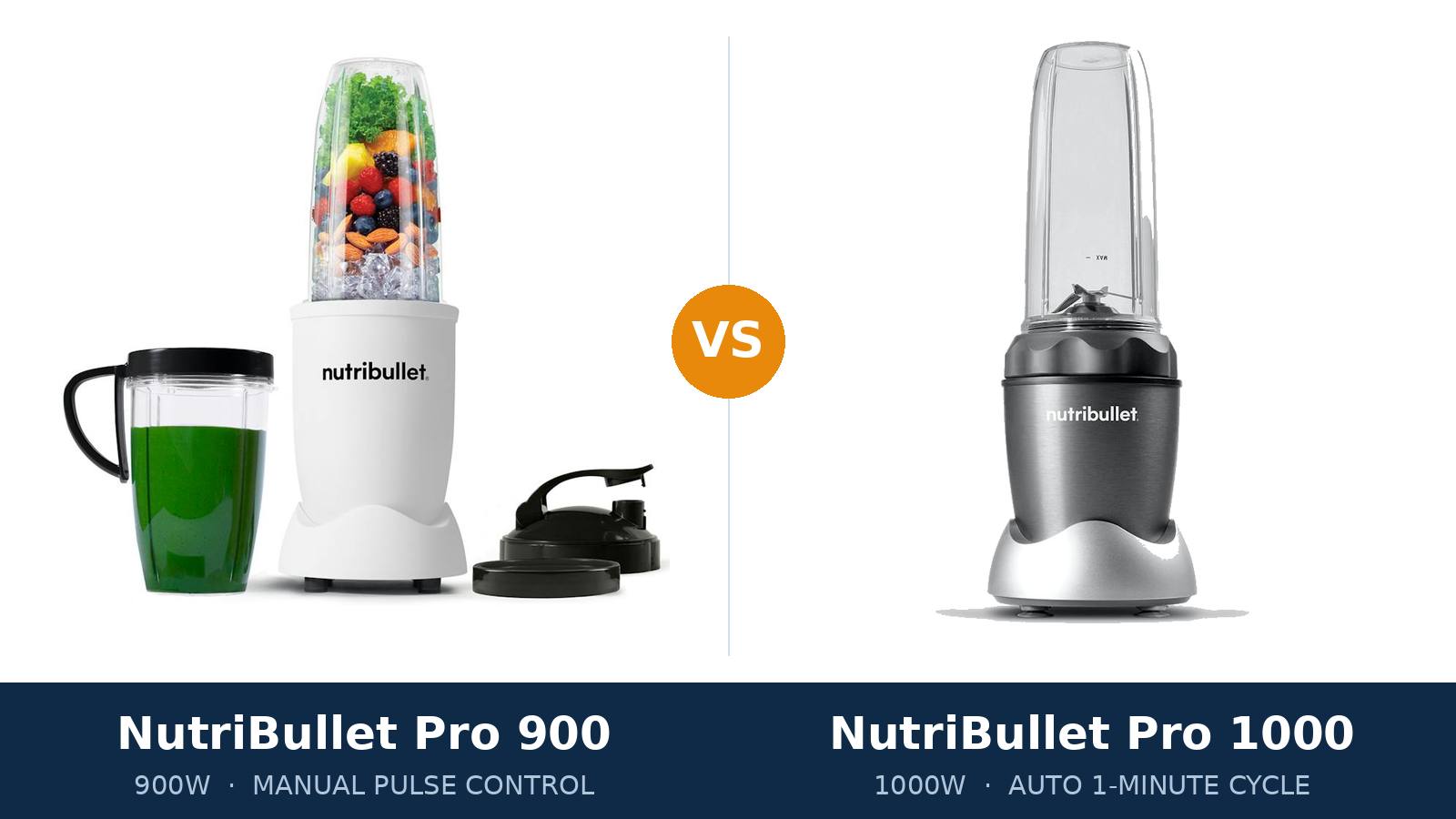
Same brand. Same silhouette. One hundred watts apart.
On paper, the NutriBullet Pro 900 and the NutriBullet Pro 1000 look like the easiest comparison in the personal blender world: pick the bigger number. That reading is wrong, and it is wrong in an interesting way.
These two machines do not just differ in power. They differ in philosophy. The Pro 900 is fully manual — you press, it blends, you decide when it stops, and you can pulse. The Pro 1000 hands that control to an automatic cycle that runs for one minute and switches itself off, and in exchange it takes the pulse away entirely.
There is a second twist. NutriBullet discontinued the Pro 900 in autumn 2026. So this is no longer just a spec fight. It is also a decision between a classic that is leaving the range and the model that stays.
Every specification below comes from NutriBullet's own published data and manuals. Where the paper record contradicts itself — and on box contents and dimensions, it does — this guide says so rather than tidying it away.
Key Takeaways
- The Pro 1000 has the stronger motor. 1000 watts against 900, and NutriBullet positions it as the personal blender in its range that is best at crushing ice and blending frozen fruit.
- The Pro 900 keeps a feature the 1000 dropped. Manual pulse control. You run it, you stop it, you pulse it. The Pro 1000 cannot pulse at all.
- The Pro 1000 is hands-free. Twist the cup to lock it and an automatic extraction cycle runs for one minute, then stops on its own.
- Cups are effectively a tie. Both machines work around 32 oz and 24 oz cups — but Pro 900 bundle contents vary, so check the exact box.
- The Pro 900 has been discontinued. NutriBullet ended it in autumn 2026. It remains on sale while retail stock lasts, and replacement cups and blades are still sold — but the Pro 1000 is the current model.
Quick Verdict
Buy the NutriBullet Pro 1000 for most kitchens. It is the more complete daily smoothie machine.
It brings the stronger motor, the blade NutriBullet redesigned for an easier twist, and a hands-free one-minute cycle you can walk away from. It is also the model still in the range, with its full retail life ahead of it.
Buy the NutriBullet Pro 900 if control is your thing. It is the only one of the two that pulses.
For salsas, chunky dips and thick mixtures you work in bursts, that manual control is a real feature, not nostalgia. And if you already own Pro 900 cups and blades, a matching base keeps them useful — while stock lasts.
The Scorecard
Scores below are derived directly from the manufacturer specifications compared in this guide — motor wattage, control type, cup sets and NutriBullet's own published positioning. They are a reading aid, not benchmark results.
| Category | Pro 900 | Pro 1000 | ||
|---|---|---|---|---|
| Power | 8 / 10 | 9 / 10 | ||
| Ice & frozen fruit | 7 / 10 | 9 / 10 | ||
| Control & pulse | 9 / 10 | 6 / 10 | ||
| Capacity & cups | 8 / 10 | 8 / 10 | ||
| Ease of use | 8 / 10 | 9 / 10 | ||
| Cleaning | 8 / 10 | 9 / 10 | ||
| Footprint & storage | 8 / 10 | 8 / 10 | ||
| Overall | 8.0 / 10 | 8.3 / 10 | ||
The pattern is clean. The Pro 1000 wins on power, on frozen ingredients and on convenience. The Pro 900 wins on the one thing the newer machine gave up: your hand on the controls.
At a Glance: Who Each Blender Fits
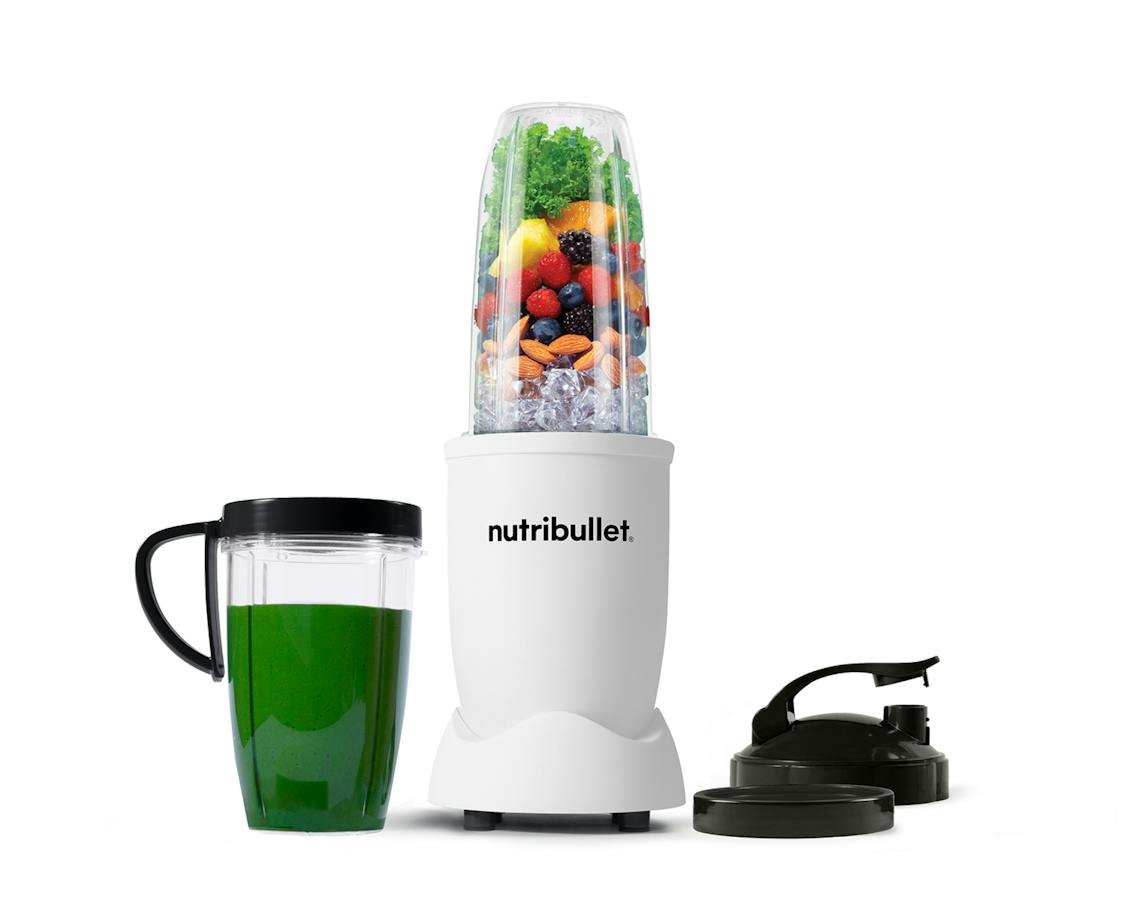
NutriBullet Pro 900
- 900W motor base, single speed, fully manual
- Push-and-twist control with a true manual pulse
- Classic stainless steel extractor blade, cyclonic action
- Sold in many bundle configurations and colours
- Discontinued by NutriBullet in autumn 2026; parts still sold
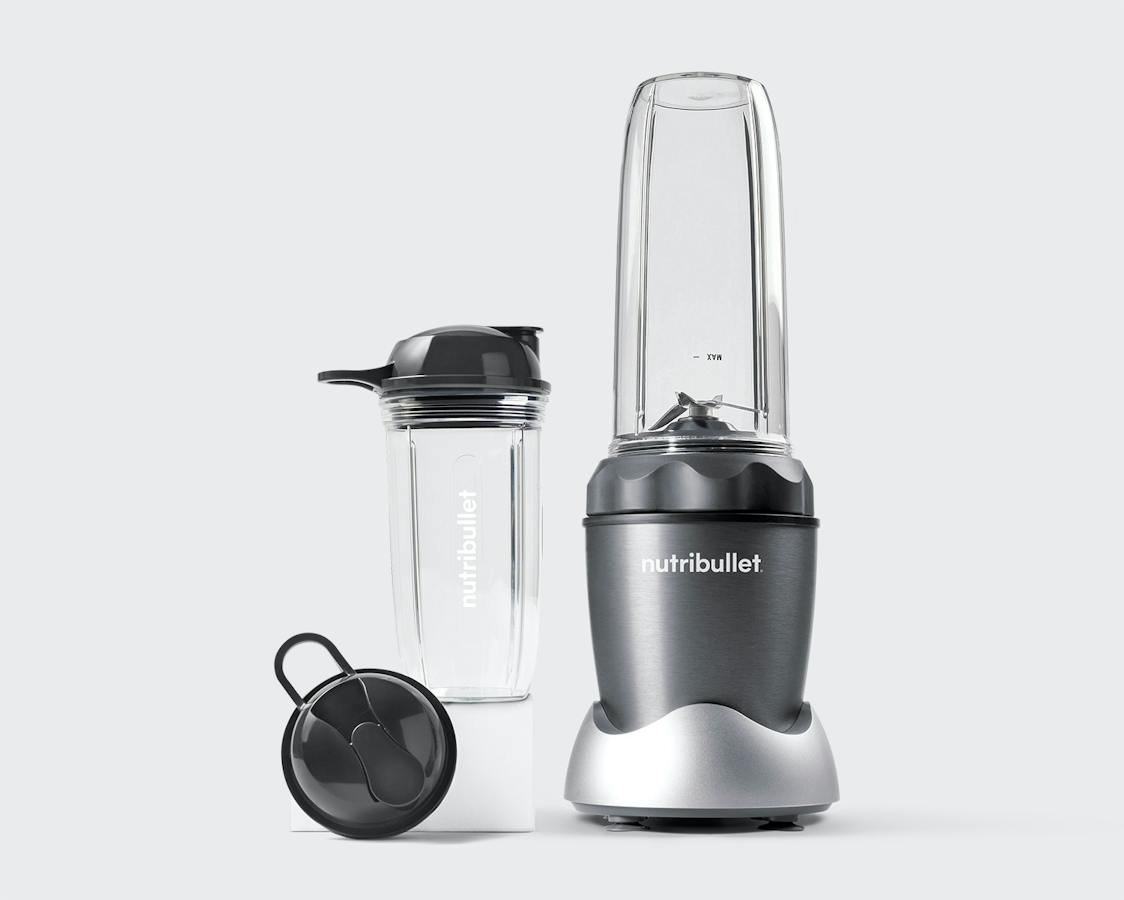
NutriBullet Pro 1000
- 1000W motor base, single speed, automatic cycle
- Hands-free one-minute extraction cycle, auto shut-off
- Easy-Twist extractor blade, redesigned for grip
- One fixed 7-piece set: 32 oz cup, 24 oz cup, two to-go lids, recipe book
- NutriBullet's own pick of its range for ice and frozen fruit
Choose the Pro 900 if…
You pulse. Salsa with some body left in it. A dip you stop before it turns to soup. Thick mixtures worked in short bursts.
You already own Pro 900 cups, blades or lids. A matching base keeps the whole drawer useful.
Or you simply prefer the classic design and its long list of colours — and you are comfortable buying a model the manufacturer has retired while new stock remains.
Choose the Pro 1000 if…
Your smoothie is frozen fruit and ice, most mornings. This is the job NutriBullet built and positions this machine for.
You want to twist, lock and walk away. The automatic cycle stops itself; there is nothing to supervise.
Or you want the current model, with a fixed, predictable box contents and the longest support runway ahead of it.
As an Amazon Associate I earn from qualifying purchases at no extra cost to you.
Specifications: The Specs That Actually Matter
Every figure below is taken from NutriBullet's published specifications, its product manuals, and the manufacturer's product data carried by retailers.
Two of those sources argue with each other — the Pro 900's bundle contents and the Pro 1000's published dimensions. Both get a note under the table.
| Specification | NutriBullet Pro 900 | NutriBullet Pro 1000 |
|---|---|---|
| Model | NB9 series (NB9-0901 / NB9-1301 retail SKUs) | NB50100C |
| Motor power | 900 W | 1000 W |
| Peak horsepower | Not published by NutriBullet | Not published by NutriBullet |
| Blade | Stainless steel extractor blade, screw-on | Easy-Twist extractor blade, stainless steel, grip ring |
| Speeds | 1 | 1 |
| Pulse | Yes — press and release | No |
| Programs / cycle | None — fully manual, runs until you stop it | Automatic 1-minute extraction cycle, stops itself |
| Maximum capacity | 32 oz | 32 oz |
| Cups in the box | Varies by bundle — 32 oz and 24 oz cups circulate (see note) | 32 oz cup + 24 oz cup, 2 to-go lids, recipe book |
| Cup material | BPA-free plastic | Tritan (retailer product data) |
| Dimensions (manufacturer) | 12.01 × 7.72 × 15.94 in | 12.44 × 10.02 × 6.54 in, packaged (see note) |
| Weight (manufacturer) | 4.7 lb | 6.9 lb packaged (see note) |
| Cord length | 29.5 in | 39.3 in |
| Dishwasher-safe parts | Cups and lids, top rack only; blade and base excluded | Cups and lids, top rack only; blade and base excluded |
| Warranty | 1-year limited | 1-year limited |
| Status | Discontinued autumn 2026; retail stock remains | Current model |
Bundle note: the Pro 900 has been sold for years in shifting configurations. NutriBullet's own current configuration lists two 32 oz cups with two to-go lids, two cup rings and two handled lip rings; its help pages describe one 32 oz and one 24 oz cup; the long-running 13-piece retail set is described both ways in its own listing copy.
The machine never changes. The box does. Check the exact contents on the listing you buy from — it decides whether a second cup size is in your kitchen or on your shopping list.
Dimension and weight note: NutriBullet's published dimensions and weight for the Pro 1000 describe the packaged unit. Assembled with its 32 oz cup it stands about 14.9 inches tall, and retailer product data puts the unit itself at about 4.7 lb — near-identical to the Pro 900 in the hand, whatever the boxes say.
The Differences That Actually Matter
1. The hundred watts — a real gap, honestly sized
The Pro 1000's motor is rated 100 watts higher. That is an 11 percent step, not a doubling, and the article will not pretend otherwise.
What it buys is headroom. Dense, frozen loads ask the most of a personal blender's motor, and headroom is what keeps a thick frozen blend moving instead of stalling against the cup wall.
For fresh fruit, greens, seeds and protein shakes, both motors are comfortably sufficient on NutriBullet's own descriptions. The Pro 900 was the range's power model for years; nobody's kale smoothie is waiting on the extra hundred watts.
Verdict on power: a genuine Pro 1000 win, sized honestly. It matters most exactly where the next difference lives.
2. Ice and frozen fruit — NutriBullet has already voted
Most comparisons guess at this category. This one does not have to, because the manufacturer states its own hierarchy in plain language.
Of the Pro 1000, NutriBullet says it is “the personal blender that's best at crushing ice and blending frozen fruit” in its range. Of the Pro 900, its help pages say it “can crush ice,” while noting that higher-powered models in the lineup are better suited to consistently handling ice and frozen fruit.
Both statements can be true, and together they are the whole story. The 900 handles ice. The 1000 is the designated tool for it.
One shared discipline applies to both: NutriBullet's guidance for the Pro 1000 caps ice at a quarter of the cup's total volume. Treat that as the house rule for either machine and both will live longer.
3. Control — the difference that actually decides this comparison
Here is the fork in the road, and it is not about power at all.
The Pro 900 is manual. Push the cup down and twist, and it blends until you untwist it. Press and release in short bursts, and you have a pulse — the technique behind chunkier salsas, evenly worked nut mixtures and dips that stop where you want them.
NutriBullet states the contrast itself: the Pro 900 “can only turn on and off based on manual manipulation.” That is not a limitation. For texture work, it is the feature.
The Pro 1000 removes your hand entirely. Lock the cup and its extraction cycle runs for one minute, then stops on its own. For a smoothie, that is strictly more convenient. For anything where the endpoint is a judgement call, the machine has taken the judgement away — and there is no pulse to take it back with.
Neither answer is wrong. They are answers to different questions, and your cooking decides which question you are asking.
4. The blade — a redesign you feel in your wrist
Both machines extract the same way: a stainless steel extractor blade, a sealed cup, and cyclonic action pulling ingredients down into the blades.
The difference is the interface. The Pro 900's blade is the classic flat assembly you screw onto the cup and — the familiar ritual — sometimes wrestle off again with wet hands after a cold blend.
The Pro 1000's Easy-Twist blade was ergonomically redesigned, with a grip that twists on and locks into place more positively. It is a small change that shows up twice a day, every day: once sealing the cup, once opening it.
One warning covers both: NutriBullet designs each model's blade and cups for that model and cautions against mixing parts across models. The Pro 1000's redesigned cups and blade are their own system. Your Pro 900 spares drawer does not transfer.
5. Cups and bundles — a tie with an asterisk
On capacity, there is nothing to separate these machines. Both top out at a 32 oz cup. Both are built around the same two sizes, 32 oz and 24 oz. Both drink from the cup you blended in, under a to-go lid.
The asterisk is the Pro 900's box. Across its long life it has been sold in 9-piece, 10-piece, 13-piece and other configurations, in a long list of colours, with cup and ring counts that change by bundle and by era — as the note under the spec table documents.
The Pro 1000 is one fixed 7-piece set, in a restrained colour range: motor base, Easy-Twist blade, 32 oz cup, 24 oz cup, two to-go lids, recipe book. What you see is the whole story, every time.
Call capacity a tie. Call buying certainty a Pro 1000 win.
6. Size, weight and the countertop
Neither machine will trouble a kitchen. Both bases sit on roughly the same small footprint, and both store their cups upside-down on top.
With the tall cup fitted, the Pro 900 stands 15.94 inches by NutriBullet's own figures; the Pro 1000 stands about an inch shorter. Under low wall cabinets, that inch can be the difference between sliding the machine home and parking it sideways.
In the hand they are the same weight class, the packaged figures under the spec table notwithstanding — each unit itself weighs about 4.7 lb.
The one clear physical win is the cord. The Pro 1000's runs 39.3 inches against the Pro 900's 29.5. On a deep counter with a distant socket, ten extra inches is the difference between using the machine where you want it and where the wall allows it.
7. The discontinuation question — what “retired” actually means
NutriBullet discontinued the 900-watt Pro in autumn 2026 and points buyers to its Turbo model as the replacement. The Pro 900's official page now wears that notice plainly.
What does that mean for a buyer today? Three things, precisely. First, the machine remains on sale at Amazon and other retailers while stock lasts — discontinued is a factory decision, not a recall. Second, NutriBullet confirms replacement cups, blades and accessories for the Pro 900 remain available through its own accessories range. Third, the one-year limited warranty still applies from purchase.
What it does mean is a horizon. Production has ended. When retail stock is gone, it is gone, and the long colour list will thin out first.
The Pro 1000, launched in 2019 and still a current listing with the manufacturer, has no such clock on it. For a buyer who keeps appliances for a decade, that runway is worth real weight in the decision.
Use-Case Fit Guide
The fastest way to choose between these blenders is to start from what actually goes in the cup. This table is the whole comparison in one view.
| Your routine | Pro 900 | Pro 1000 | Our call |
|---|---|---|---|
| Daily green smoothies | Excellent | Excellent | Tie — buy on the other rows |
| Frozen fruit and ice, most days | Capable | Excellent — the designated ice model | Pro 1000 |
| Salsas and chunky dips | Excellent — pulse control | Weak — no pulse, fixed cycle | Pro 900 |
| Nut butters and thick mixtures | Good — work in manual bursts | Good — full-minute cycle per load | Pro 900, narrowly, on technique |
| Grab-and-go single servings | Excellent | Excellent — hands-free cycle | Pro 1000, on convenience |
| Two servings back to back | Good — check your bundle's cup count | Good — both cup sizes in the box | Tie, if the 900's box has both cups |
| Family-size batches | Wrong tool — 32 oz ceiling | Wrong tool — 32 oz ceiling | Neither; see When to Skip Both |
Read the frozen-fruit and salsa rows together. They are the same household dividing line: the more your blending is frozen and automatic, the stronger the Pro 1000's case; the more it is textured and hands-on, the stronger the Pro 900's.
The 30-Second Decision
| If this sounds like you… | Buy this |
|---|---|
| “Frozen fruit and ice go in almost every morning.” | NutriBullet Pro 1000 |
| “I make salsa and dips, and texture matters.” | NutriBullet Pro 900 (the pulse) |
| “I want to start it and get dressed while it blends.” | NutriBullet Pro 1000 (automatic cycle) |
| “I already own Pro 900 cups and a spare blade.” | NutriBullet Pro 900, while stock lasts |
| “I keep appliances for ten years and want the current model.” | NutriBullet Pro 1000 |
| “Whichever one — I just blend soft fruit and protein powder.” | Legitimate — both are overqualified; buy the better deal |
Ready to check today’s price?
Both blenders sell through Amazon. Prices move, so check the live figure on the machine that fits your routine.
View on Amazon — Pro 900View on Amazon — Pro 1000What You Gain. What You Give Up.
NutriBullet Pro 900
You gain: the only pulse in this comparison, and full manual say over when blending starts and stops. A design with years of cheap, plentiful replacement cups and blades. A wide choice of colours and bundles while they last.
You give up: a hundred watts of headroom for frozen loads, the hands-free cycle, and the easier blade. And you take on the discontinuation horizon: factory production has ended, so the listing in front of you is the stock there is.
NutriBullet Pro 1000
You gain: the stronger motor and the manufacturer's own designation as its best personal blender for ice and frozen fruit. A twist-lock automatic cycle that stops itself. A blade redesigned to grip and seal without a fight, and a longer cord.
You give up: the pulse, entirely — texture is the cycle's decision now, not yours. Your Pro 900 cups and blades, which do not carry over. And the wider colour and bundle choice the older model accumulated.
Pros and Cons
Pro 900 — Pros
- True manual pulse for texture control
- Runs exactly as long as you want — no fixed cycle
- Huge installed base of cups, blades and spares
- Many colours and bundle configurations
- Same 32 oz ceiling and 1-year warranty as the 1000
Cons
- Discontinued in autumn 2026 — finite new stock
- Weaker motor, and not the brand's ice specialist
- Classic blade can be stubborn to untwist
- Bundle contents vary — easy to buy the wrong box
- Shorter cord (29.5 in)
Pro 1000 — Pros
- 1000W — the stronger motor
- NutriBullet's designated model for ice and frozen fruit
- Hands-free 1-minute cycle with auto shut-off
- Easy-Twist blade seals and releases more easily
- Fixed, predictable 7-piece box; longer 39.3 in cord
Cons
- No pulse function at all
- Fixed cycle length — stop early or accept its timing
- Pro 900 cups and blades do not fit
- Narrow colour range
- Published dimensions describe the box, not the unit
Check the Bundle and the Badge, Not Just the Blender
Check the Pro 900's box contents. “NutriBullet Pro 900” names one machine and many boxes.
Piece counts run from nine upward. Some sets carry one of each cup size; the manufacturer's current configuration carries two 32 oz cups; ring and lid counts move with the bundle. The mainstream Amazon listing is the 13-piece set in Champagne — other colours are separate listings with their own contents.
Read the includes list on the exact listing, in full, before ordering. It is the only version of the truth that ships to your house.
Check the condition. Both models circulate as refurbished units through outlet channels, the Pro 1000 included. A refurbished machine typically carries a short seller warranty — 90 days is common — against the one-year limited warranty of a new one. Fine as a saving, as long as you are making that trade with your eyes open.
Check your existing parts. NutriBullet designs blades and cups per model and warns against mixing them. The Pro 1000's cups and Easy-Twist blade are a redesigned system; Pro 900 parts stay with Pro 900 machines.
If a drawer of Pro 900 cups is part of your kitchen economy, that is a genuine argument for the older base — and a genuine deadline, since production has ended.
Check the name on the base. The Pro 1000 is model NB50100C. The Pro 900 is the NB9 series. If a listing cannot tell you which of those it is selling, it is not a listing to buy a blender from.
The Upgrade Path Test
Judge a personal blender by its second year, not its first week.
Year one, both machines make a daily smoothie without drama. The differences that matter — pulse against auto cycle, ice headroom — show up only if your routine asks for them.
Year two is about wear parts and wants. Blades dull; cups multiply; NutriBullet sells replacements for both models, and confirms Pro 900 accessories remain available despite the discontinuation. Neither owner is stranded.
The real upgrade pressure is not wear. It is scope. The day you want a pitcher of soup for four, or a batch that feeds a family, both of these machines answer the same way: 32 ounces is the ceiling, and no accessory raises it.
Buy either Pro knowing it is a personal blender for life, not a stepping stone. The household that outgrows single servings outgrows both at once.
When to Skip Both
Honesty cuts both ways. There are buyers neither of these machines serves well.
Skip both if you blend for a family. A 32 oz sealed cup is a personal serving, and NutriBullet's full-size and combo models exist precisely for pitcher work.
Skip both if you blend hot liquids. Neither machine may be used with hot ingredients — the cups are sealed, and NutriBullet's caution on this point is absolute. Hot blending needs a vented pitcher blender.
Skip both if you want the pulse and more power. NutriBullet's own range answers that combination further up the line, not in this pairing.
And skip the Pro 900 specifically if buying a discontinued model bothers you at any price. That is a legitimate preference, and the Pro 1000 exists to serve it.
Warranty and Long-Term Support
On paper, support is a tie. Both machines carry NutriBullet's one-year limited warranty, parts and labour, from the manufacturer.
Both sit inside the same support structure: NutriBullet's own help pages, replacement cups, blades and lids sold per model, and manuals that remain published online.
The difference is trajectory. The Pro 1000 is a current model with an open-ended retail life. The Pro 900's production has ended, though NutriBullet explicitly confirms its accessories remain on sale — the consumables an owner actually needs are the last thing a manufacturer withdraws.
One habit serves both owners: keep the model number. NB9 for the Pro 900, NB50100C for the Pro 1000. Every part, manual and warranty conversation starts there, and the two ranges of parts are not interchangeable.
Final Verdict
The NutriBullet Pro 1000 is the blender we would buy today.
It wins this comparison the way appliances should win: on the work most owners actually do. Frozen fruit and ice are the daily test of a personal blender, and here the Pro 1000 holds both the stronger motor and the manufacturer's own designation as the best tool in its range for exactly that job.
Add the hands-free cycle, the blade that twists without a wrestling match, the longer cord and the security of a current model, and the case is complete. Its 8.3 against the Pro 900's 8.0 is a narrow margin, honestly earned.
Buy the Pro 1000 for frozen smoothies, walk-away convenience, and a machine with its full retail life ahead of it.
Buy the Pro 900 if the pulse is the feature your cooking actually uses. If texture is a decision you make, not a cycle you accept. Or if your kitchen already runs on its cups and blades.
It remains a genuinely capable machine — the classic of its category — and its discontinuation is a reason to decide promptly, not a reason to dismiss it.
Watch Out: Similar Names, Different Blenders
NutriBullet's range is a naming maze, and three traps sit close to this comparison.
First: the Pro 900's replacement in NutriBullet's range is the Turbo — also a 1000-watt machine, with its own auto cycle, blade and cups. It is not the Pro 1000 in this comparison, and its parts fit neither machine here.
Second: “Pro+” is a different, 1200-watt model with a pulse function, and the Ultra is a different 1200-watt model again. “Pro” on the box is the beginning of the model name, not the end of it.
Third: in the UK, the Pro 900 is sold as the “900 Series.” Same machine, regional name — and a reminder to check the voltage and plug before ordering across regions.
Match the model code — NB9 or NB50100C — before you match the price.
Frequently Asked Questions
Is the NutriBullet Pro 1000 better than the Pro 900?
For most buyers, yes — narrowly. It has the stronger motor (1000W against 900W), NutriBullet's own designation as its best personal blender for ice and frozen fruit, a hands-free automatic cycle, and the security of being a current model. The Pro 900 fights back with the one feature the 1000 dropped: manual pulse control.
Can both blenders crush ice?
Yes, with a hierarchy. NutriBullet says the Pro 900 can crush ice but points consistent ice and frozen-fruit users toward its higher-powered models; it describes the Pro 1000 as the personal blender in its range that is best at exactly that job. Its own guidance caps ice at about a quarter of the cup's volume.
Does the NutriBullet Pro 1000 have a pulse function?
No. The Pro 1000 runs a single automatic extraction cycle of one minute when the cup is locked in, and stops on its own; you can end the cycle early by unlocking the cup, but there is no pulse. The Pro 900 pulses manually — press and release in bursts — and runs only while you control it.
Are the cups and blades interchangeable between the Pro 900 and Pro 1000?
Treat them as not interchangeable. NutriBullet designs each model's blade and cups specifically for that model and cautions against using the wrong parts; the Pro 1000's cups and Easy-Twist blade were ergonomically redesigned as their own system. Buy spares by model number: NB9 series for the Pro 900, NB50100C for the Pro 1000.
Is the NutriBullet Pro 900 discontinued?
Yes. NutriBullet discontinued the 900-watt Pro in autumn 2026 and positions its Turbo model as the replacement. The Pro 900 remains on sale at Amazon and other retailers while existing stock lasts, its one-year limited warranty still applies from purchase, and NutriBullet confirms replacement cups, blades and accessories remain available.
Which one makes better nut butter?
On technique, the Pro 900. Thick mixtures reward short bursts and pauses — exactly what its manual pulse gives you, and what the Pro 1000's fixed one-minute cycle cannot imitate. Both are single-serve machines working in small loads, and NutriBullet lists nut butters among the uses for the design generally; neither turns a personal blender into a food processor.
Can I make hot soup in either blender?
No. Both machines blend in sealed cups, and NutriBullet's instruction is unambiguous: never blend hot or carbonated ingredients in them. Hot blending requires a vented full-size pitcher blender, which is a different product class from either Pro.
What warranty does each blender carry?
The same: a one-year limited warranty from NutriBullet, covering parts and labour. That applies to new machines; refurbished units sold through outlet channels typically carry a much shorter seller warranty — 90 days is common — so check the condition and its terms on the listing.
Sources & Verification
NutriBullet Pro official product page and FAQ, nutribullet.com (NB9-0901; discontinuation notice, specifications, includes list) • NutriBullet Pro 1000 official product page and FAQ, nutribullet.com (NB50100C; specifications, includes list) • NutriBullet Pro 1000 user and recipe guide (extraction cycle, ice guidance) • NutriBullet retail product data for NB9-1301 and NB50100C (Amazon listings, model and capacity data). Specifications verified November 2026.

James Wilson
James has been building and benchmarking PCs for over a decade and writes Honestly Compared's motherboard and component guides. His rule for every comparison: the verdict has to survive the spec sheet, not the marketing page.