
NutriBullet Pro 900 vs Ninja Auto-iQ: Which Should You Buy?
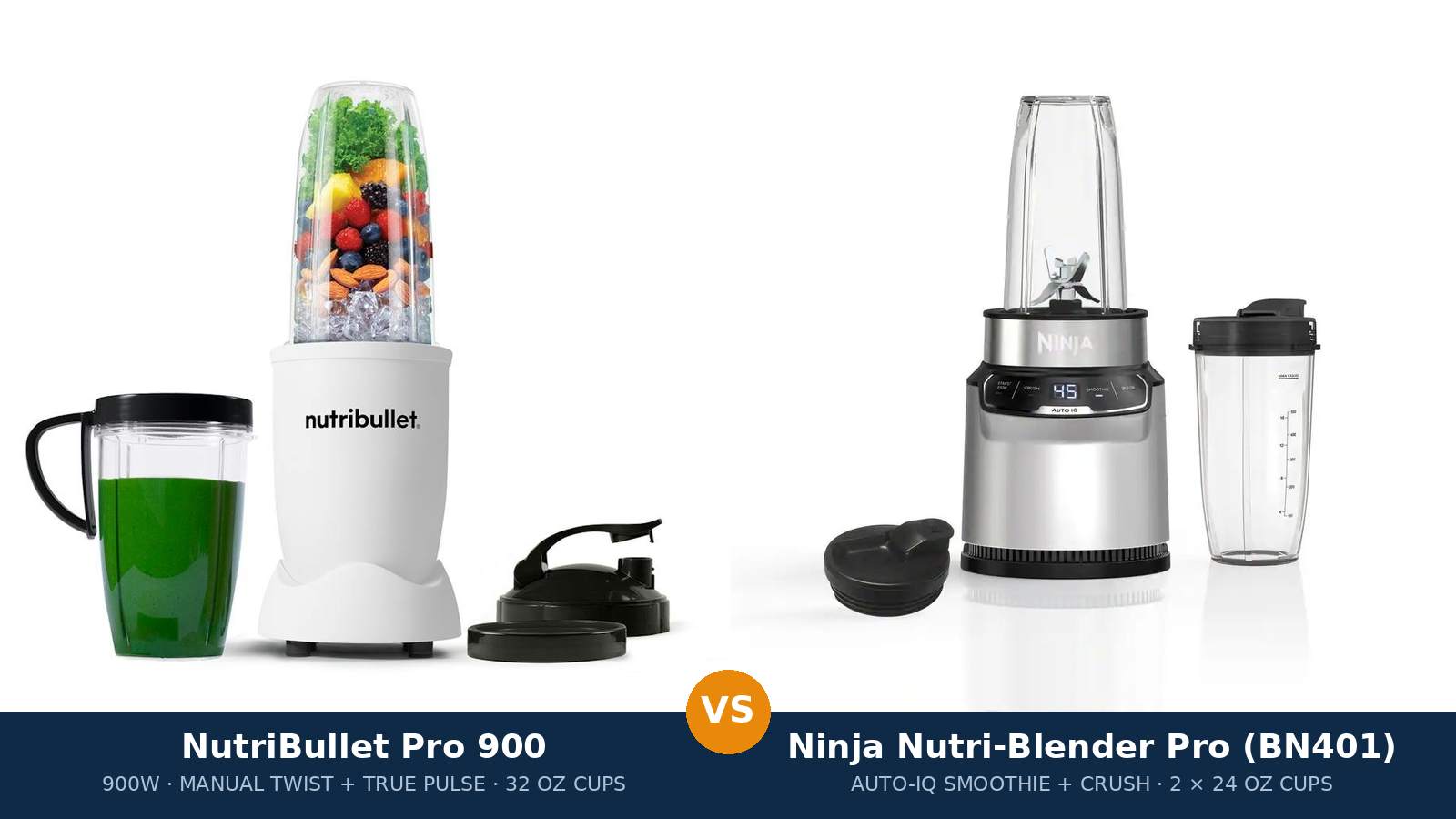
One side of this matchup is a specific machine. The other side is a feature.
“Ninja Auto-iQ” is not a model name. Auto-iQ is SharkNinja’s name for its timed blending programs, and over the years those programs have lived on several different blenders.
That matters more than it sounds. Search this pairing and you will find decade-old articles comparing the Pro 900 against a Ninja you can no longer buy new.
So before any verdict, this guide does the honest first job: it works out which Auto-iQ machine a buyer actually gets today, names it, and only then compares.
First, the Determination: Which Ninja Is “the Auto-iQ”?
Historically, the name pointed at the Nutri Ninja BL480D. That was the original “Nutri Ninja with Auto-iQ” — a 1000-watt personal blender with Blend and Ultra Blend programs, an 18 oz and a 24 oz cup, and a countdown timer.
Today, that machine is a legacy product. SharkNinja no longer sells it new through its own store. The listings that remain are refurbished units, used machines and old retail stock.
The current carrier of the name is the Ninja Nutri-Blender Pro with Auto-iQ, model BN401. It is the personal blender SharkNinja sells today under the Auto-iQ banner: two preset programs, two 24 oz cups, sold new with a full warranty.
That is the machine compared here. Same job, same class, same program idea — updated hardware.
If you own a BL480D and came looking for its modern equivalent, this is also the right page. Difference 1 below sets the old and new Auto-iQ side by side so you can see exactly what changed.
Key Takeaways
- “Ninja Auto-iQ” today means the BN401. The BL480D that originally carried the name survives only as refurbished and used stock.
- The Pro 900 wins this comparison, 8.0 to 7.4. Bigger cups, a lighter base and a true manual pulse outweigh the Ninja’s automation for most solo blenders.
- The BN401 is the hands-off pick. Its Auto-iQ Smoothie and Crush programs run a timed cycle and stop on their own.
- Read the watts carefully. The Ninja’s box headline says 1100 peak watts; its own owner’s guide specifies 1000. The Pro 900 publishes one figure: 900.
- Both carry quirks into the purchase. The Pro 900 was discontinued in autumn 2026 while its listing still trades; the BN401 is a current model. Both points are priced into the verdict.
Quick Verdict
Buy the NutriBullet Pro 900 if you blend for one and like being in charge. There are no programs at all. You push, you twist, you stop when the texture looks right.
Its 32 oz cup is the biggest vessel in this pairing. Its base is the lighter one by a wide margin. And its press-and-release pulse is the more precise tool for chunky jobs like salsa.
Buy the Ninja Nutri-Blender Pro (BN401) if you want the machine to do the thinking. Press Smoothie or Crush and the Auto-iQ cycle pulses, blends, pauses and stops by itself.
Every removable part, blade included, can go in the dishwasher. And as the current model, it is the straightforward new purchase with full parts support behind it.
On the full scorecard the Pro 900 edges it, 8.0 to 7.4. The gap is real but narrow, and it reverses the moment automation matters more to you than cup size and hand control.
The Scorecard
Scores below are derived directly from the manufacturer specifications compared in this guide — motor figures as each brand publishes them, control types, cup sets, dishwasher rulings, dimensions and warranty terms. They are a reading aid, not benchmark results.
The overall marks are the ones these machines carry from their other head-to-heads on this site: the Pro 900 at 8.0, the BN401 at 7.4. Category marks are set for this pairing. The power row scores the published basis: the 1100-peak headline is what a buyer sees first, so the two machines finish level there.
| Category | NutriBullet Pro 900 | Ninja Auto-iQ (BN401) | ||
|---|---|---|---|---|
| Power, as published | 8 / 10 | 8 / 10 | ||
| Programs & automation | 3 / 10 | 9 / 10 | ||
| Manual control & pulse | 9 / 10 | 7 / 10 | ||
| Capacity & cup set | 8 / 10 | 6 / 10 | ||
| Ease of use | 8 / 10 | 8 / 10 | ||
| Cleaning | 8 / 10 | 9 / 10 | ||
| Footprint & storage | 8 / 10 | 7 / 10 | ||
| Value | 8 / 10 | 7 / 10 | ||
| Overall | 8.0 / 10 | 7.4 / 10 | ||
Read the shape of that table, not just the totals. The Ninja wins exactly where automation and cleaning live. The NutriBullet wins on capacity, hand control and carrying weight. The overall gap comes from how often a solo smoothie drinker uses each set.
At a Glance: Who Each Blender Fits
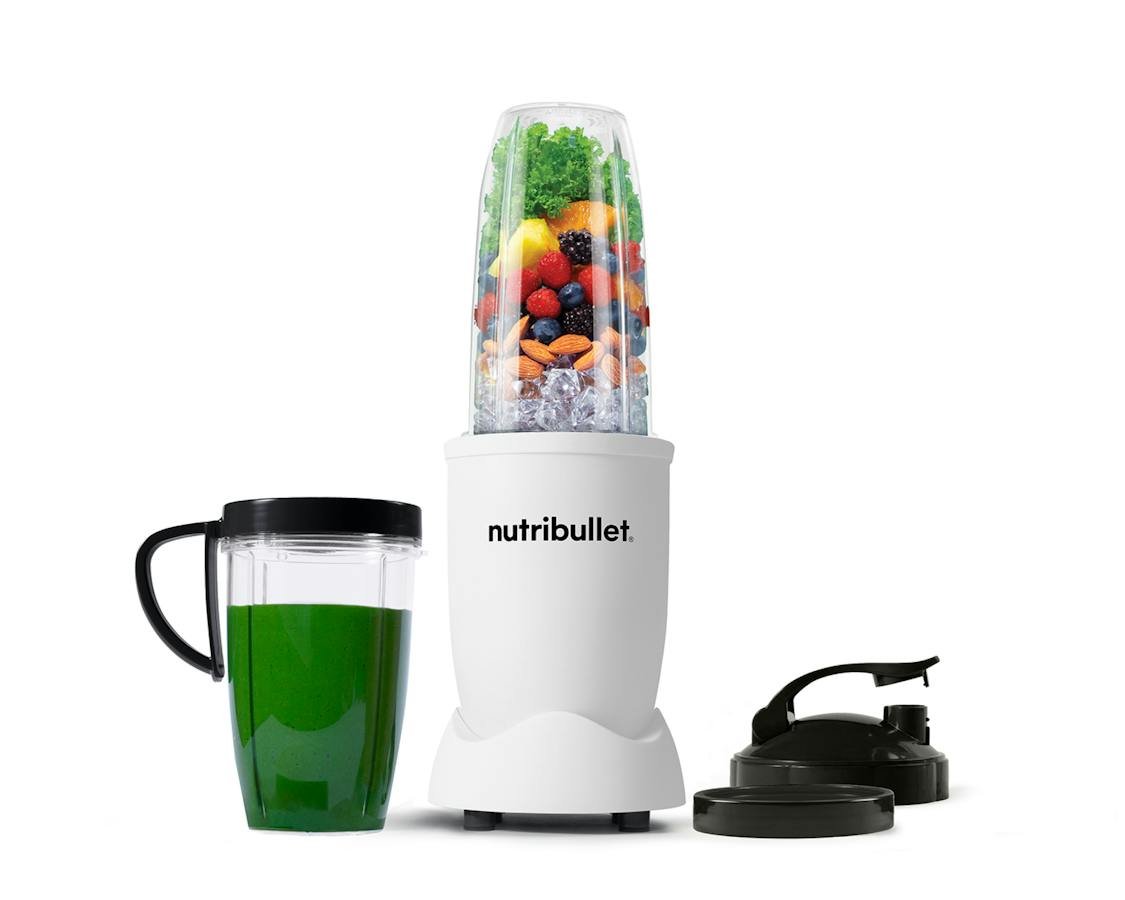
NutriBullet Pro 900
- 900W motor, single published rating, no peak-watt headline
- Fully manual: push to blend, twist to lock on, press-and-release pulse
- 32 oz largest cup — the biggest single serving here
- Lightest base in the pairing at 4.7 lb
- 1-year limited warranty; model discontinued autumn 2026, listing still trading
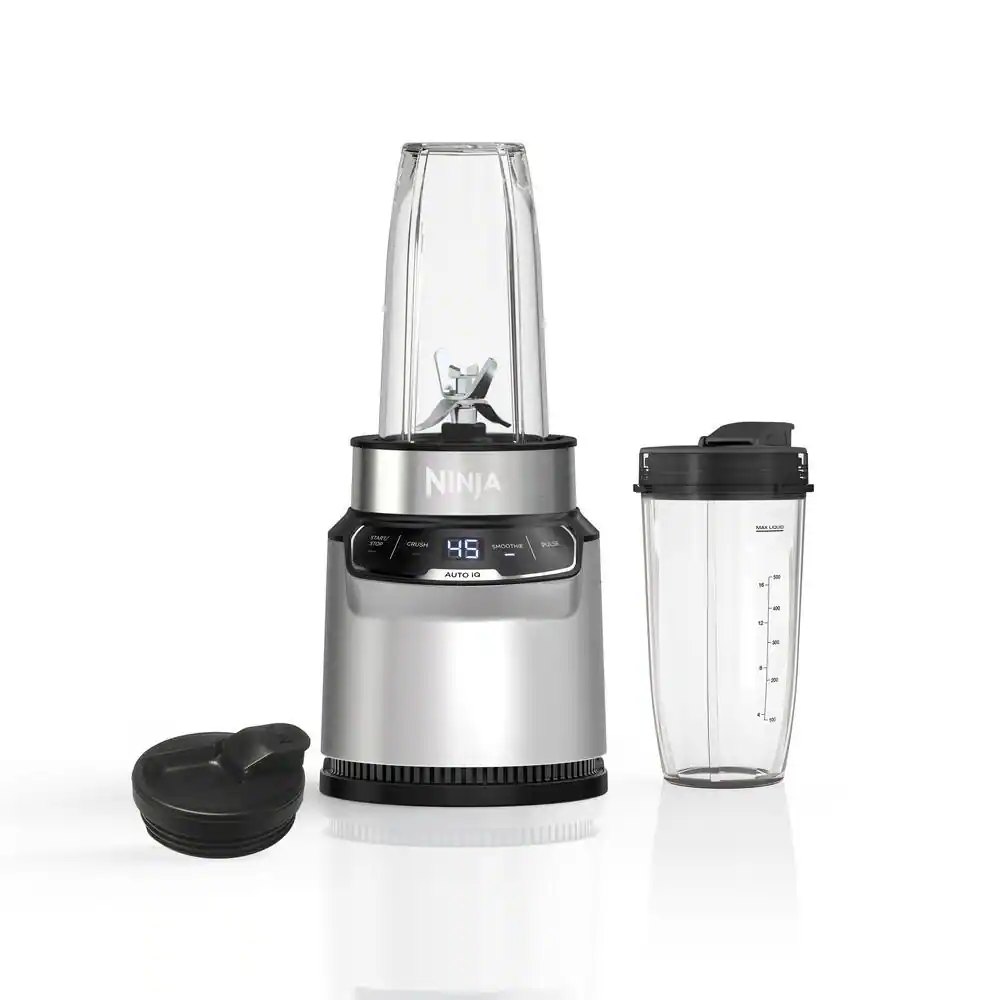
Ninja Auto-iQ — Nutri-Blender Pro (BN401)
- 1000W per the owner’s guide; marketed as 1100 peak watts
- Auto-iQ Smoothie and Crush programs with countdown display
- Two matched 24 oz cups with spout lids in the box
- Cups, lids and blade assembly all dishwasher safe
- Current model, 1-year limited warranty
Choose the NutriBullet Pro 900 if…
Your smoothie is a meal, not a snack. The 32 oz cup swallows a full recipe in one load, where the Ninja makes you split it or shrink it.
You judge texture by eye and by taste, mid-blend. A machine with no programs never argues with you about when a drink is done.
You pulse often. Salsa, crumb toppings, a rough chop — the press-and-release cup is a finer instrument than a held button.
Or the blender travels. Between kitchen and office, dorm or caravan, 4.7 lb against 6.28 lb is a difference your arm will notice.
Choose the Ninja Auto-iQ (BN401) if…
Your mornings are not negotiable. Load the cup, press Smoothie, and get dressed while the machine runs its cycle and stops itself.
Frozen drinks are the house special. Crush is a dedicated Auto-iQ program, not a technique you have to learn.
You hate hand-rinsing blades. On the Ninja, the blade assembly goes in the dishwasher with everything else.
Or you simply want the current model. New stock, live support, replacement cups on sale — the BN401 is the low-drama purchase.
As an Amazon Associate I earn from qualifying purchases at no extra cost to you.
Specifications: The Specs That Actually Matter
Every figure below comes from the manufacturers’ own product pages, published data and owner’s guides. Where the brands describe the same thing differently, the table prints both versions rather than tidying them away.
| Specification | NutriBullet Pro 900 | Ninja Auto-iQ (BN401) |
|---|---|---|
| Model | NB9 series (13-piece retail set, NB9-1301) | BN401, Cloud Silver |
| Motor power | 900 W — the only figure NutriBullet publishes | 1000 W in the owner’s guide; sold as 1100 peak watts |
| Programs | None — fully manual | Auto-iQ Smoothie and Crush, countdown display |
| Pulse | Yes — press and release the cup, true pulse | Yes — hold the Pulse button; runs while pressed |
| Manual running | Runs while the cup is held down; twist to lock on | Start/Stop manual mode, up to 60 seconds |
| Speed settings | 1 | 1 motor speed, program-timed |
| Blade | Stainless steel extractor blade, screw-on | Pro Extractor Blades Assembly, stainless steel |
| Largest cup | 32 oz | 24 oz |
| Cups in the box | 13-piece set — cup mix varies by listing (see note) | (2) 24 oz cups, (2) spout lids, 20-recipe guide |
| Cup material | BPA-free plastic | BPA-free plastic |
| Dimensions | 12.01 × 7.72 × 15.94 in (manufacturer, set as configured) | 6.34 × 6.93 × 14.29 in |
| Weight | 4.7 lb (manufacturer) | 6.28 lb |
| Cord length | 29.5 in | 31.5 in |
| Dishwasher-safe parts | Cups and lids, top rack; blade hand-rinse only | Cups, lids and blade assembly — all dishwasher safe |
| Warranty | 1-year limited | 1-year limited |
| Status | Discontinued autumn 2026; retail listing still trading | Current model |
The wattage note, once, plainly: SharkNinja’s product page headlines an “1100-peak-watt motor” for the BN401. The BN400 Series Owner’s Guide prints its technical specification as 1000 watts, and the Amazon listing spent its first years described as 1000-peak-watt under this same ASIN. This guide compares guide figure to guide figure — 1000 against 900 — and treats the 1100 as what it is: a peak headline.
Bundle note: the Pro 900’s 13-piece listing contradicts itself about its own cups. One passage lists two 24 oz mugs; another describes two 32 oz colossal cups; NutriBullet’s current configuration lists 32 oz cups with to-go lids and handled rings. The NB9 machine underneath is identical either way. Count the cups on the exact listing before you pay.
Dimensions note: NutriBullet’s published dimensions describe the configured set with its tall cup fitted, so they read wider than the Ninja’s single-unit figures. The weights need no such caution: 4.7 lb against 6.28 lb is a straight comparison, and the NutriBullet is lighter by a third.
Photo note: the Pro 900 shown here wears the Matte White finish. The linked listing is the Champagne finish of the same NB9 model — identical but for colour.
The Differences That Actually Matter
1. Auto-iQ, then and now — what the name used to buy you
Start here, because this pairing’s confusion lives here. The original Nutri Ninja BL480D built the Auto-iQ name on two programs called Blend and Ultra Blend.
Its manual rated it at a clean 1000 watts, and it shipped with an 18 oz and a 24 oz cup. The BN401 carries the same idea forward with different labels: Smoothie and Crush, tuned for drinks and for ice.
The wattage story grew a wrinkle in the handover — where the BL480D published one figure, the BN401 publishes two. What did not change is the point: a timed pattern of pulses, runs and pauses that finishes without supervision.
So if an older article told you the Pro 900’s rival had a program called Ultra Blend, it was describing the BL480D honestly — for its era. The programs, the cups and the buyable machine have all moved on.
2. Control — your hands against the program
The Pro 900 has the simplest control scheme in blending. There are no buttons because there is nothing to select.
Push the cup down and it blends. Twist it and it locks on, hands-free, until you twist back. Tap it down in short presses and you are pulsing.
The BN401 answers with a panel. Start/Stop runs manually for up to 60 seconds. Pulse runs while you hold the button. And the two Auto-iQ programs take the whole job away.
Neither approach is a gimmick. They suit different temperaments, and different mornings.
The manual machine rewards attention: you watch the vortex and stop at the moment the texture turns — you are the program. The programmed machine rewards routine: the same smoothie gets the same cycle daily, finished while you do something else.
Where the Pro 900 pulls ahead is pulse work. A press-and-release cup gives short, judged bursts with instant stops — the motion you want for salsa or a coarse crumb. The Ninja’s held button pulses too, but your hand is on a switch, not on the vessel, and the feel is one step removed.
Where the BN401 pulls ahead is everything timed. Walk-away blending simply does not exist on the NutriBullet. If your hands are busy every morning, that is not a detail. It is the decision.
3. The wattage headline — 900, 1000 and 1100
Three numbers circle this comparison, and only two of them are like-for-like.
NutriBullet publishes a single rating for the Pro 900: 900 watts. No peak figure, no second number in the small print. What you read is what the spec sheet says.
SharkNinja publishes the BN401 twice. The owner’s guide — the document that governs the warranty — specifies 1000 watts. The product page and the box headline 1100 peak watts.
Peak and rated figures measure different moments in a motor’s life. A peak number describes a ceiling touched briefly; the guide figure is the honest basis for comparison.
Compared properly, the Ninja leads by 100 watts on paper. That is a real but modest edge, worth having with frozen loads — not the 200-watt gap the shelf edge implies.
Let this row teach the wider lesson. When one brand prints its guide figure and the other prints its peak, the louder number is not necessarily the stronger motor. Always ask which basis a wattage is quoted on before you let it sway you.
4. Cups and capacity — one big vessel against a matched pair
The Pro 900’s 32 oz cup is the largest single serving in this pairing. A full meal-replacement smoothie — greens, frozen fruit, protein, liquid — fits in one load.
The BN401 ships two identical 24 oz cups. No single serving matches the NutriBullet’s biggest, but two cups mean two drinks back to back, one in the dishwasher while one is on the base. For couples with the same morning deadline, that rhythm matters.
The Pro 900’s box is the bigger set on paper — thirteen pieces — but its exact cup mix depends on the listing, as the bundle note explains. The Ninja’s contents are fixed and knowable before you order.
Both blend in the cup you drink from, in BPA-free plastic, with spout lids for travel. Neither cup fits the other brand’s base. Call it plainly: the NutriBullet wins the single serving, the Ninja wins the two-person morning.
5. Blades and loading — the quiet discipline both demand
Both machines use the same extraction idea: a compact stainless blade assembly that screws onto the cup, inverts onto the base, and pulls ingredients down through the blades. NutriBullet calls its part the extractor blade; SharkNinja calls its equivalent the Pro Extractor Blades Assembly.
Both guides teach the same discipline: the max-fill line is a hard limit, and overfilling is the fastest route to a poor blend and a stressed seal. Both machines are cold-only tools — neither guide permits hot liquids.
The Ninja’s guide adds one ownership detail: a thermal reset of around fifteen minutes if an overworked motor cuts out. Protection, not fragility — but it rewards respecting the fill line.
Score this section a genuine tie. Comparable hardware, comparable rules, and neither system forgives an overfilled cup.
6. Cleaning — the blade is where it splits
Personal blenders live or die on wash-up. A machine that is annoying to clean becomes a machine that stays in the cupboard.
On the Pro 900, cups and lids are top-rack dishwasher safe, but the extractor blade is hand-rinse only. On the BN401, everything removable is dishwasher safe — blade assembly included.
Hand-rinsing a blade takes under a minute, so this is a convenience gap, not a hygiene gap. Still, convenience compounds: twice a day, every day, the machine asking for one less chore keeps getting used. Cleaning is the BN401’s clearest everyday win.
7. Size, weight and status — the practical footnotes
On dimensions, read the note under the spec table first: the NutriBullet’s figures describe its configured set, the Ninja’s one unit. The honest comparisons are height and weight.
The BN401 stands 14.29 in tall as published — low enough for most under-cabinet counters. Weight is unambiguous: at 4.7 lb the NutriBullet is two-thirds the Ninja’s 6.28 lb, felt twice a day if the blender lives in a cupboard. Cord length slightly favours the Ninja, 31.5 in against 29.5.
Then there is status. The Pro 900 was discontinued in autumn 2026, its 1000W Turbo successor’s parts do not fit it, yet its listing remains live and trading, and a decade of NB9 parts in circulation keeps spares findable.
The BN401 carries none of that baggage — it is the model SharkNinja sells now. For buyers who keep appliances for many years, that difference already sits inside the verdict, on the Ninja’s side of the Pro 900’s win.
Use-Case Fit Guide
Start from the drink, not the brand. This table maps the jobs these machines actually get hired for.
| Your use case | NutriBullet Pro 900 | Ninja Auto-iQ (BN401) | Our call |
|---|---|---|---|
| One large meal-replacement smoothie daily | Excellent — 32 oz in one load | Good — 24 oz ceiling per cup | NutriBullet Pro 900 |
| Two drinks, same rushed morning | Workable — wash between drinks | Excellent — two matched cups | Ninja BN401 |
| Frozen drinks and crushed ice | Good — manual, watched closely | Excellent — dedicated Crush program | Ninja BN401 |
| Salsa, crumbs and coarse textures | Excellent — true press-and-release pulse | Good — held-button pulse | NutriBullet Pro 900 |
| Press-and-go routine while you get ready | Poor — needs your hands or a twist-lock watch | Excellent — Auto-iQ stops itself | Ninja BN401 |
| Small kitchen, blender stored in a cupboard | Excellent — 4.7 lb, lifts easily | Good — heavier at 6.28 lb | NutriBullet Pro 900 |
| Buying a gift for a first-time blender owner | Good — simple, but fully manual | Excellent — programs forgive beginners | Ninja BN401 |
| Hot soups and sauces | Not suitable — cold blending only | Not suitable — no hot liquids per guide | Neither — buy a countertop blender |
The pattern repeats the scorecard. Tasks defined by size and hand control go to the NutriBullet. Tasks defined by routine and automation go to the Ninja. There is no row where either machine is embarrassed.
The 30-Second Decision
| If this sounds like you… | Buy this |
|---|---|
| “My smoothie is my breakfast, and it is a big one.” | NutriBullet Pro 900 (32 oz cup) |
| “I want to press one button and walk away.” | Ninja BN401 (Auto-iQ) |
| “I pulse salsa and toppings more than I blend drinks.” | NutriBullet Pro 900 (true pulse) |
| “Two of us leave at the same time every morning.” | Ninja BN401 (two 24 oz cups) |
| “Everything must go in the dishwasher, blade included.” | Ninja BN401 |
| “The blender lives in a cupboard and comes out daily.” | NutriBullet Pro 900 (4.7 lb) |
| “I only buy current models with live parts support.” | Ninja BN401 |
Ready to check today’s price?
Both machines sell through Amazon. Prices move, so check the live figure on the blender that fits your routine.
View on Amazon — NutriBullet Pro 900View on Amazon — Ninja BN401What You Gain. What You Give Up.
NutriBullet Pro 900
You gain: the biggest single cup here at 32 oz. A true pulse under your own hand. The lightest base in the pairing. And a single honest wattage figure with no peak-watt arithmetic to decode.
You give up: all automation — no program will ever run or stop a blend for you. The blade stays out of the dishwasher. And you take on a discontinued model whose successor’s parts do not fit it.
Ninja Auto-iQ (BN401)
You gain: two timed Auto-iQ programs that finish on their own. A matched pair of travel cups. A blade assembly that goes in the dishwasher. And the security of a current model with live parts support.
You give up: the big single serving — 24 oz is the ceiling. Some precision on pulse work. A third more carrying weight. And a wattage story you have to read twice to compare fairly.
Pros and Cons
NutriBullet Pro 900 — Pros
- 32 oz cup — the largest single serving here
- True press-and-release pulse for controlled textures
- Lightest base at 4.7 lb
- One published wattage figure, no peak headline
- No menus, no modes — nothing to learn
Cons
- No programs; blending always needs you
- Extractor blade is hand-rinse only
- Discontinued autumn 2026; successor’s parts do not fit
- Box contents vary by listing — check the cups
Ninja BN401 — Pros
- Auto-iQ Smoothie and Crush programs with countdown
- Two matched 24 oz cups with spout lids
- Every removable part is dishwasher safe
- Current model with live parts support
- Dedicated Crush program for ice and frozen drinks
Cons
- 24 oz maximum per serving
- Heavier base at 6.28 lb
- 1100-peak headline overstates the 1000W guide figure
- Pulse is a held button, less tactile than a cup press
Check the Model Behind the Name, Not Just the Name
Check which Auto-iQ you are actually buying. “Auto-iQ” alone names a feature spanning a decade of machines.
The current personal model is the BN401, and that is what the button on this page leads to. Listings for the older BL480D still circulate, mostly refurbished or used — a legitimate bargain for some buyers, but a different purchase with a different warranty position.
A bundle variant, the BN401B1, also exists with its own package figures. If a listing’s weight or dimensions differ from the spec table here, that variant is usually why. The base machine and programs are the same.
Check the NutriBullet’s box, not just its badge. Every NB9 Pro 900 is the same machine, but the 13-piece set’s cup mix is described inconsistently across listings. If the 32 oz cup is your reason for buying — for most Pro 900 buyers it should be — confirm it is in the box on the exact listing. The photo here shows Matte White; the linked listing is Champagne.
Check your parts assumptions. NutriBullet cups do not fit Ninja bases, or vice versa — and the Pro’s own successor uses different parts again. Whichever side you choose, you are buying into that brand’s cup-and-blade ecosystem for as long as you own the machine.
The Upgrade Path Test
Personal blenders rarely get upgraded. They get outgrown, or they get worn out. Judge these two on both exits.
Outgrowing looks like smoothies for one becoming smoothies for two, or drinks becoming batch cooking. The Ninja’s second cup delays the first exit; neither machine answers the second — a full-size pitcher blender is the honest next step for both owners.
Wearing out is where the paths separate. The BN401 has a live channel of replacement cups, lids and blade assemblies behind it. The Pro 900 runs on existing stock and a large installed base: spares are findable today, but the supply thins with time and the Turbo successor does not replenish it.
Neither machine is a decade-long heirloom. If your planning horizon is long, though, the current model’s parts pipeline is a genuine, if unglamorous, advantage.
When to Skip Both
Some kitchens should buy neither of these, and an honest guide says so.
Skip both if you blend for a household in one batch. A 72 oz countertop blender — including Ninja’s own pitcher models with Auto-iQ — does that job properly, and no pair of personal cups imitates it.
Skip both if hot blending matters. Neither guide allows hot liquids; soup belongs to a vented pitcher machine.
Skip the Pro 900 if discontinued status itself worries you, whatever the parts reality. Skip the BN401 if you know you will never use a preset — you would be paying for the panel and skipping its point.
And skip both if your real target is the old BL480D specifically. It exists only in the refurbished and used market now, and it should be bought there knowingly, at a used price, not hunted for as new stock.
Warranty and Long-Term Support
On paper, support is a tie: both machines carry a 1-year limited warranty.
Underneath, the positions differ. SharkNinja supports the BN401 as a current product, with manuals, troubleshooting and parts in its live system. NutriBullet’s support for the Pro continues, but its own discontinuation notice — naming the Turbo as successor — tells you where the range’s future effort goes.
The warranty year is equal either way. The years after it favour the current model — one more reason the Pro 900’s win here is about the blending itself, not about ownership being simpler.
Final Verdict
The NutriBullet Pro 900 wins this comparison — for the buyer this pairing is actually about.
Strip away the naming fog and the contest is simple. One machine gives you a bigger cup, a lighter base and total hand control. The other gives you programs.
For a solo smoothie drinker, the cup and the control get used every day; the programs get used on hurried mornings, which for most people is not every morning. That is how the scorecard lands at 8.0 to 7.4 — a verdict about frequency, not cleverness. The BN401 is plainly the cleverer machine.
Buy the Pro 900 if your drink is large, your textures are judged by eye, and a hand-rinsed blade is a fair price for both. Go in knowing it is a discontinued model whose listing still trades, and confirm the 32 oz cup is in your box.
View on Amazon — NutriBullet Pro 900
Buy the Ninja BN401 if your mornings run on routine. If two cups need filling, if the dishwasher should take everything, if a current model with live parts support simply lets you stop thinking about the purchase.
Plenty of buyers should. The Auto-iQ programs are genuinely useful, the Crush preset earns its place, and not one of the Pro 900’s advantages survives contact with a household that blends on autopilot.
Watch Out: Similar Names, Different Blenders
No corner of the small-appliance world punishes a hurried buyer like personal blenders. Four warnings belong in this guide.
First: “Ninja Auto-iQ” is a feature, not a model. It has appeared on the old BL480D, on the current BN401, and on large pitcher systems that share nothing with either but the badge. Always resolve the name to a model number before comparing anything.
Second: the BL480D and the BN401 are not the same machine in a new colour. Different programs (Blend and Ultra Blend against Smoothie and Crush), different cup sets, different bases — and parts compatibility should never be assumed between generations.
Third: NutriBullet’s own range invites mix-ups. The Pro 900 (NB9 series) is not the newer 1000W Turbo that replaced it, and the Turbo’s cups and blades do not fit the Pro. A listing that says “Pro” deserves a model check just as much as a Ninja does.
Fourth: a BN401B1 bundle variant circulates with different package weights and dimensions. It is the same base machine in a different box. Match the model number first, then the bundle, then the price — in that order.
Frequently Asked Questions
Which Ninja blender is “the Ninja Auto-iQ”?
Today, the Ninja Nutri-Blender Pro with Auto-iQ, model BN401. Auto-iQ is the name of SharkNinja’s timed program system, not a model. The BN401 is the personal blender SharkNinja currently sells under that name, with Smoothie and Crush programs and two 24 oz cups.
Is the Ninja BL480D the same as the BN401?
No. The BL480D was the original Nutri Ninja with Auto-iQ, sold with Blend and Ultra Blend programs and 18 oz and 24 oz cups. It is now a legacy product found mainly as refurbished or used stock. The BN401 is its modern successor in the same role, with different programs, cups and hardware.
Is the NutriBullet Pro 900 discontinued?
Yes. NutriBullet discontinued the Pro in autumn 2026 and names the 1000W Turbo as its successor; the Turbo’s parts do not fit the Pro. The Pro 900’s Amazon listing nevertheless remains live and trading, which is why this guide compares it — with the status stated openly throughout.
Which is more powerful, the Pro 900 or the Ninja BN401?
On the figures that compare fairly, the Ninja leads narrowly. Its owner’s guide specifies 1000 watts against the Pro 900’s single published 900-watt rating. The BN401’s “1100 peak watts” headline is a peak figure and should not be compared directly against a rated one.
Can I put the blades in the dishwasher?
On the Ninja, yes — its guide clears the cups, lids and blade assembly for the dishwasher. On the NutriBullet, the cups and lids are top-rack dishwasher safe, but the extractor blade is hand-rinse only.
Do NutriBullet and Ninja cups fit each other’s bases?
No. Each brand’s cups and blade assemblies fit only its own bases. Choosing either machine means buying into that brand’s cup ecosystem for spares and extras. Even within NutriBullet’s range, the Pro’s Turbo successor uses incompatible parts.
Can either blender handle hot liquids or soup?
Neither. Both manufacturers’ guides rule out blending hot liquids — these are cold-drink machines. For soups, look at a vented countertop pitcher blender instead.
What warranty does each blender carry?
Both carry a 1-year limited warranty from the manufacturer. The practical difference is not the warranty year but the years after: the BN401 is a current model with a live parts channel, while the Pro 900 relies on existing stock and its large installed base.
Sources & Verification
NutriBullet Pro product page and FAQ, nutribullet.com (900W rating, NB9 series, dimensions, warranty, discontinuation notice) • NutriBullet Pro user guide (manual control and pulse, care instructions) • SharkNinja BN401 product page, sharkninja.com (Auto-iQ programs, 1100-peak-watt headline, model data) • SharkNinja BN400 Series Owner’s Guide (1000W technical specification, dishwasher rulings, thermal reset) • Nutri Ninja BL480D owner’s guide (original Auto-iQ model, Blend/Ultra Blend programs, 18 oz and 24 oz cups) • Amazon listing data used for ASIN verification only, never for specifications. Specifications verified November 2026.

James Wilson
James has been testing and writing about kitchen and home equipment for over a decade and writes Honestly Compared’s blender guides. His rule for every comparison: the verdict has to survive the spec sheet, not the marketing page.