
NutriBullet Pro 900 vs NutriBullet Rx: Which Should You Buy?
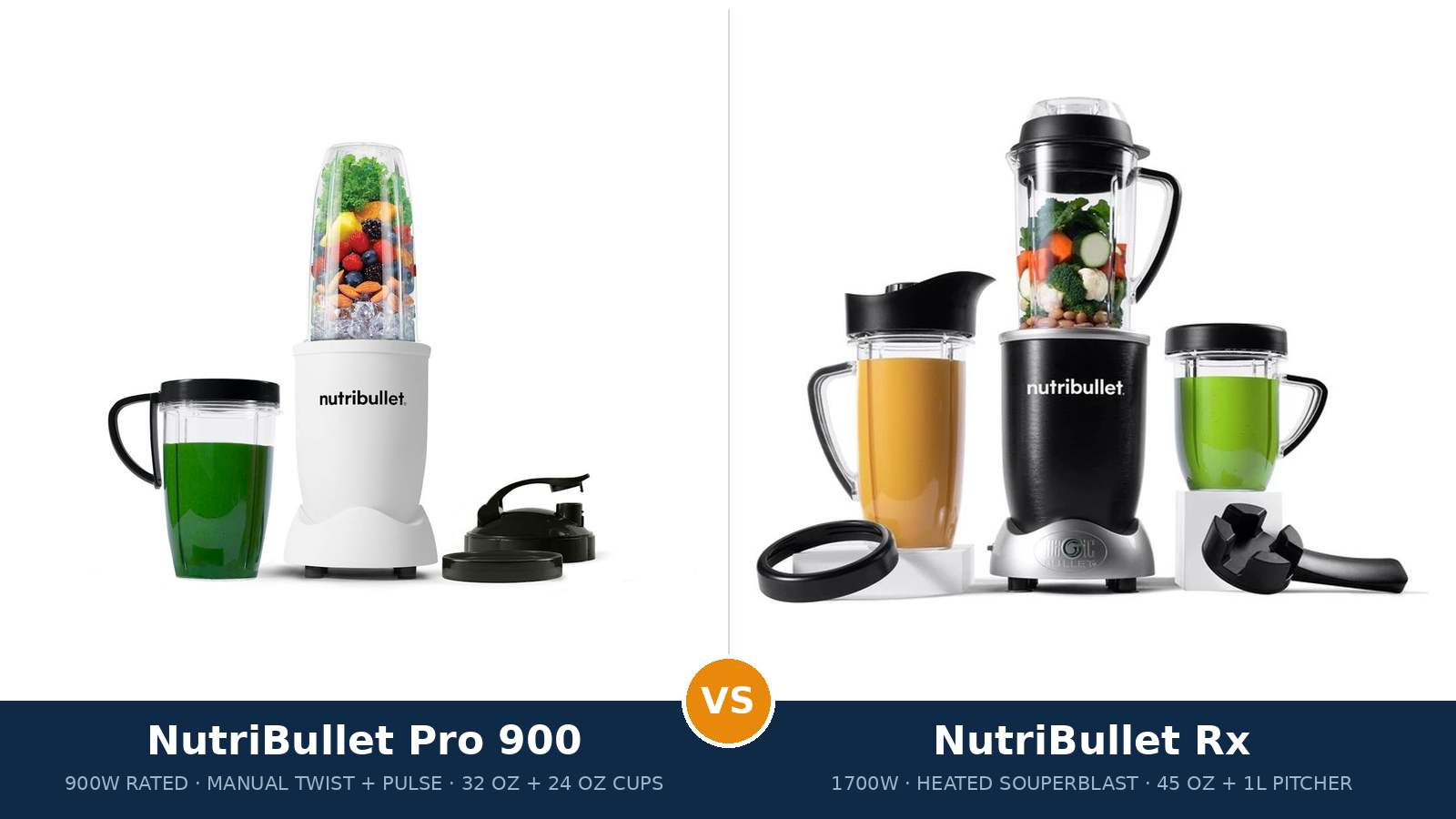
Same brand. Same bullet silhouette. Two completely different ideas about what a blender is for.
The Pro 900 is the classic NutriBullet ritual: fill a cup, twist it onto the base, blend for under a minute, drink from the cup you blended in. No programs. No panel. No pitcher.
The Rx is the flagship that broke that mould. It keeps the cups, but adds a pitcher, nearly double the wattage, automatic cycles — and a soup mode that heats as it blends.
So the question is not which one is stronger. It is whether your kitchen runs on cups and a twist, or on pitchers and heat. This guide settles it from the two manuals.
One thing both machines share: neither sits in NutriBullet's current range any more. What that means for buying in 2026 gets its own section below.
Key Takeaways
- The Rx is the more capable machine. 1700W, a 1-litre pitcher, bigger cups and two automatic cycles against the Pro 900's 900W manual twist.
- Only the Rx makes soup. Its SouperBlast cycle heats contents to about 150°F by blade friction. The Pro 900's guide forbids hot liquids outright.
- The Pro 900 fights back on control. Its press-and-release pulse is a true manual pulse; the Rx has no manual pulse at all — its cycles run themselves.
- Both blades stay out of the dishwasher. Cups are top-rack safe on both; each manual keeps the extractor blade at the sink.
- Both are legacy buys now. The Pro 900 was discontinued in autumn 2026 and the Rx left the range earlier — every offer is remaining or marketplace stock, so the set has to be checked, not assumed.
Quick Verdict
Buy the NutriBullet Rx if you find a complete, genuine set. On specifications it is the bigger machine in almost every direction.
It doubles the Pro 900's published wattage. It blends in a pitcher as well as in cups. And it does the one trick no other NutriBullet of its era could do: it makes hot soup from cool ingredients in a single cycle.
Buy the NutriBullet Pro 900 for the daily smoothie ritual. Twist, blend, drink from the same cup, rinse, done.
It is smaller, simpler and easier to live with every morning — and the brand still sells its parts, even though the machine itself has been retired.
The Scorecard
Scores below are derived directly from the manufacturer specifications compared in this guide — published wattages, vessel sizes, cycle lists and the manuals' care rules. They are a reading aid, not benchmark results.
| Category | NutriBullet Pro 900 | NutriBullet Rx | ||
|---|---|---|---|---|
| Power (published rating) | 7 / 10 | 10 / 10 | ||
| Capacity & vessels | 7 / 10 | 9 / 10 | ||
| Programs & controls | 6 / 10 | 9 / 10 | ||
| Ease of use | 8 / 10 | 9 / 10 | ||
| Cleaning | 7 / 10 | 7 / 10 | ||
| Footprint & storage | 9 / 10 | 6 / 10 | ||
| Value | 8 / 10 | 7 / 10 | ||
| Overall | 8.0 / 10 | 8.3 / 10 | ||
Read the table and the shape of the choice is clear. The Rx wins wherever size and automation count. The Pro 900 wins where a blender earns its keep: the counter, the cupboard and the morning routine.
A note on the Pro 900's marks: they are the scores this NB9 machine carries under its shorter name — “Pro” and “Pro 900” are one blender, not two (see Similar Names).
At a Glance: Who Each Blender Fits
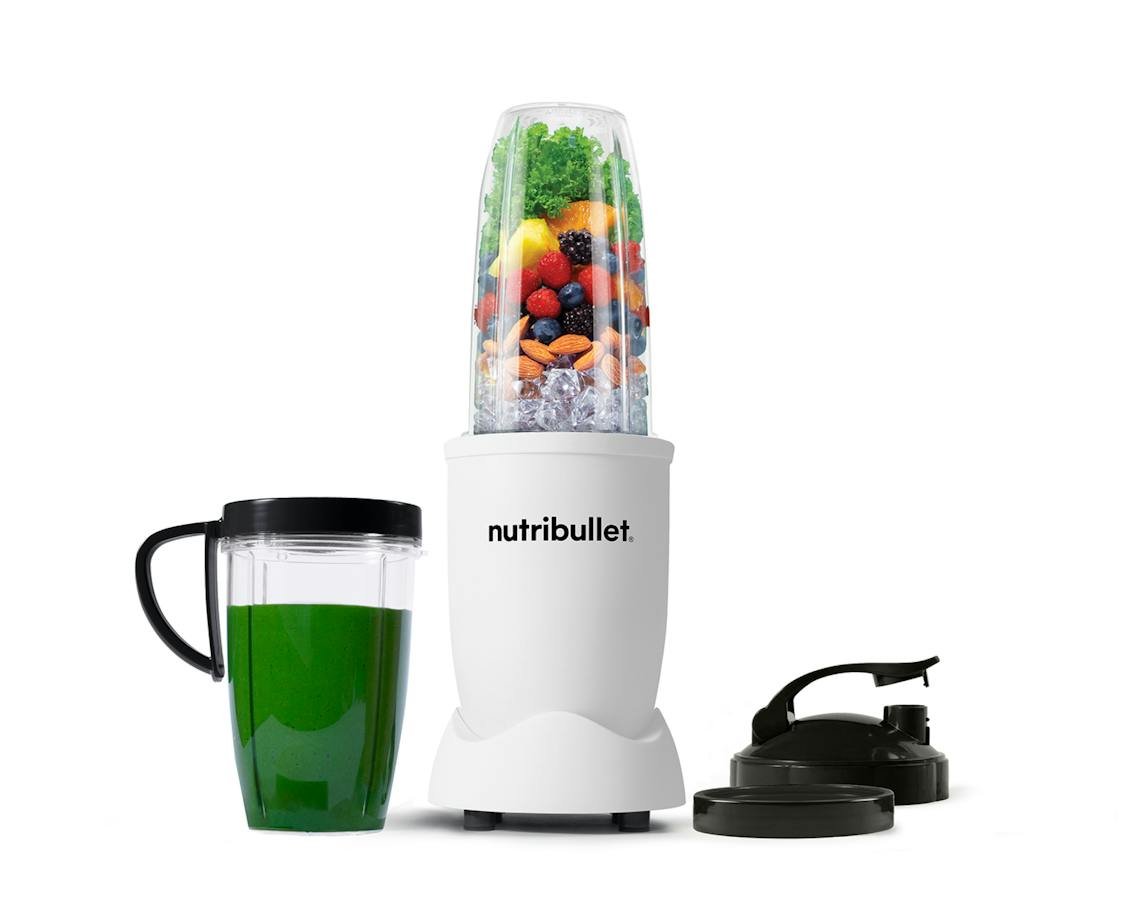
NutriBullet Pro 900
- 900W motor — the brand's single published rating
- Fully manual push-and-twist control, with a true pulse
- Blends in the cup you drink from: 32 oz + 24 oz in the linked set
- Compact base, 4.7 lb, made for daily smoothie duty
- Discontinued autumn 2026 — listing live, parts still sold
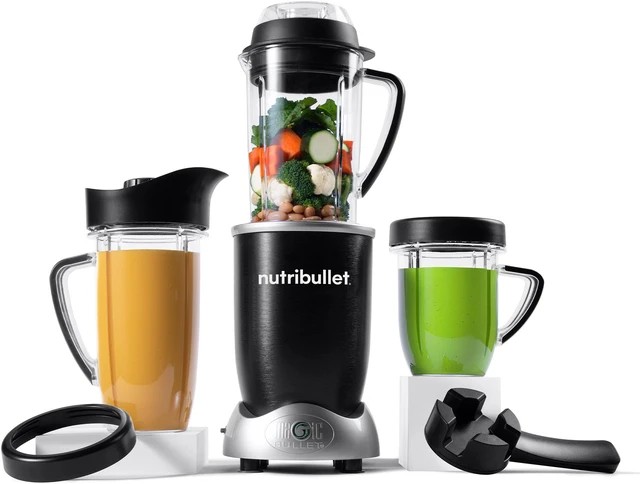
NutriBullet Rx
- 1700W motor with SMART automatic cycles
- SouperBlast mode heats soup to about 150°F as it blends
- 1-litre pitcher plus 45 oz and 30 oz cups in the box
- Blade is a consumable — the manual schedules replacement every 6 months
- Out of the brand's current range — remaining and marketplace stock only
Choose the NutriBullet Pro 900 if…
Your blender's job is a smoothie, once or twice a day, for one or two people. You want to drink from the vessel you blended in and wash almost nothing.
You blend by hand and by eye — a shake of the cup, a pulse, a look, another pulse. The Pro 900's manual control is built for exactly that.
Counter and cupboard space are tight. This is the smaller machine by a wide margin.
Choose the NutriBullet Rx if…
You want one machine that does smoothies and dinner. Hot soup from raw vegetables, in the pitcher, without a hob, is the Rx's alone in this pairing.
You blend for a household, not a person. The 45 oz cup and the pitcher end the two-fill workaround.
And you are willing to buy carefully — checking a legacy set piece by piece, as the buying guide below sets out.
As an Amazon Associate I earn from qualifying purchases at no extra cost to you.
Specifications: The Specs That Actually Matter
Every figure below comes from the two machines' own user guides and NutriBullet's published product data. Where a figure is bundle-dependent or a source disagrees with itself, the table says so.
| Specification | NutriBullet Pro 900 | NutriBullet Rx |
|---|---|---|
| Model | NB9-0901 (13-piece retail set NB9-1301) | N17-1001 |
| Motor rating | 900W — single published rating | 1700W — single published rating |
| Rating basis | NutriBullet publishes one wattage figure; no separate peak number | One wattage figure; brand copy also quotes “2.3 horsepower”, a marketing line we set aside |
| Vessels in the box | 32 oz cup + 24 oz cup (linked set), to-go lids, cup and lip rings | 1-litre SouperBlast pitcher, 45 oz oversized cup, 30 oz short cup, resealable lid, lip ring |
| Largest single batch | 32 oz | 45 oz cup; 1 litre in the pitcher |
| Controls | Fully manual: push and twist to run, single speed | G-button with SMART automatic cycles |
| Pulse | True pulse — press and release in short bursts | None — the cycles run their own profiles |
| Programs | None | Smoothie (1-minute automatic) and SouperBlast (about 7 minutes, heated) |
| Hot liquids | Never — the guide forbids blending hot liquids | Heats cool ingredients to about 150°F / 70°C, pitcher only |
| Blade | Extractor blade; no scheduled replacement in the guide | Extractor blade; manual recommends replacement every 6 months |
| Vessel material | BPA-free plastic | BPA-free plastic |
| Dimensions | 12.01 × 7.72 × 15.94 in (configured set, manufacturer) | 6.3 × 7.05 × 18.5 in with pitcher fitted (manufacturer data) |
| Weight | 4.7 lb (manufacturer figure; some listing data says 5.5 lb) | No consistent manufacturer figure is published |
| Cord length | 29.5 in | About 1 m (manufacturer datasheet); the US guide does not publish one |
| Dishwasher-safe parts | Cups and lids, top rack; extractor blade hand-rinse only | Cups, top rack on a normal cycle; extractor blade hand wash only, never the dishwasher |
| Warranty | 1-year limited | 1-year limited |
| Sold today as | Discontinued autumn 2026; the Amazon listing remains live with remaining stock | Out of the brand's current range; remaining and marketplace stock only |
Configuration note: the Pro 900's cup mix depends on the bundle. The linked set pairs a 32 oz cup with a 24 oz cup; the brand's own store configuration listed two 32 oz cups, and its FAQ describes a 32 oz plus 24 oz pairing. Count the box in front of you, not the one in a review.
Photo note: the Pro 900 photograph shows the Matte White finish. The linked listing is the Champagne finish of the same NB9 machine. The difference is the colour of the base and nothing else.
Status note: the Rx's listing data still carries “Is Discontinued By Manufacturer: No”, while the brand no longer lists or sells the machine in its current range. Treat every Rx offer as remaining or marketplace stock, whatever the data field says.
The Differences That Actually Matter
1. Power — 900 honest watts against 1700
Start with the numbers as the manufacturers publish them. The Pro 900 carries a single 900W rating. The Rx carries a single 1700W rating.
Neither brand splits its figure into rated and peak for these machines, so the comparison is unusually clean: guide against guide, the Rx publishes close to double the Pro 900's wattage.
One distraction to clear away. Rx-era brand copy also quotes “2.3 horsepower”. That is a marketing conversion, not a second rating. We judge both machines on watts, the figure each manual stands behind.
What does the gap buy? Headroom. The Rx's motor works further inside its comfort zone on frozen fruit, ice and thick mixtures, and it sustains the long soup cycle the Pro 900 cannot run at all.
What it does not buy is a better ordinary smoothie. A 900W bullet empties a cup of fruit and greens completely. The Rx's extra power shows at the extremes, not at breakfast.
2. Heat — the difference with no answer on the other side
This is the widest gap in the comparison, and it is not close.
The Pro 900's guide is blunt: never blend hot liquids. Heat and pressure inside a sealed cup are a safety problem, so the machine is a cold-drinks appliance, full stop.
The Rx was designed around the opposite idea. Its SouperBlast cycle runs for about seven minutes in the vented 1-litre pitcher, and blade friction brings cool ingredients up to roughly 150°F — serving-hot soup from raw vegetables.
The rules are strict. Start with cool or room-temperature ingredients only. Use the pitcher and its vented two-piece lid — the cups are not vented and are never for soup. Never reheat a finished soup, and never run the cycle twice back to back without the rest the duty rules demand.
If soup is even a monthly event in your kitchen, this section decides the comparison on its own. If it is not, the Rx's headline feature is one you will never press.
3. Control — a twist and a pulse against two automatic cycles
The Pro 900 has no electronics worth the name. Push the cup down, twist, and it runs; release, and it stops.
That simplicity hides a genuine skill feature: the pulse. Press and release in short bursts and you get a true manual pulse — the tool for chunkier textures, for knocking ingredients down off the cup walls, for stopping exactly where your eye says stop.
The Rx replaces your hands with its G-button. One press starts Smoothie mode: a one-minute, two-stage automatic cycle that ramps, pauses and stops on its own, the button glowing green.
Press and hold for two seconds and the button turns orange for SouperBlast, the three-stage heated cycle.
What the Rx does not have is a pulse. There is no way to blip the motor for half a second. Texture control means trusting the cycles, or running a short cycle and checking.
Neither approach is wrong. The Pro 900 suits cooks who blend by feel. The Rx suits anyone who would rather press once and walk away.
4. Vessels — drink from the cup, or pour from the pitcher
The Pro 900 is a cup system and nothing else. Blend in the 32 oz or 24 oz cup, swap the blade for a lid, and the vessel is your glass. Washing up is one cup and a rinsed blade.
Its ceiling is the cup itself. A household smoothie round means blending twice, and anything destined for a bowl or a pan has to be poured out of a drinking cup.
The Rx keeps the cup idea — a 30 oz short cup and a 45 oz oversized cup — and adds what the Pro 900 never had: a true 1-litre pitcher with a handle and a vented lid.
The pitcher is not an accessory. It is the soup vessel, the nut-butter vessel (the manual works nut butters in it, in 30-second increments), and the batch vessel for anything shared.
Households blend in pitchers. Individuals blend in cups. Pick the machine that matches the headcount.
5. The duty rules — one machine minds its manners, the other minds its temperature
High power in a small base generates heat, and the Rx's manual manages it like an engineer wrote it.
Standard cycles: no more than three consecutive one-minute runs, with 15-second rests between them. Cool the machine two to three minutes after the third. After four or five cycles, it rests for ten.
Soup is stricter: a maximum of two consecutive SouperBlast cycles with a minute between them, then thirty to sixty minutes of cooling. Trip the thermal safety breaker and the manual asks for a full hour before the machine runs again.
The Pro 900's discipline is simpler: blends run under sixty seconds, liquid goes in first, and the motor is not held on and on. There is no published regime of rests and cooling windows to memorise.
None of this makes the Rx fragile. It makes it a machine with an operating envelope. If your blending style is back-to-back batches for a crowd, read those rules twice — they are the price of 1700W in a bullet-sized base.
6. Cleaning — a tie at the sink, a difference in the drawer
Both machines clean the same way at the cup level. Cups go in the top rack of the dishwasher. The Rx's manual adds a sensible refinement: a normal cycle, not the sanitize setting.
Both machines also agree on the blade, which is the part that matters. The Pro 900's extractor blade is hand-rinse only under the brand's current guidance. The Rx's manual is stronger still: the blade never goes in the dishwasher, because the heat damages its gasket seals.
Neither base is submersible. Wipe, never dunk, on both.
The real cleaning difference is not washing — it is wear. The Rx's manual recommends replacing the extractor blade every six months, and the machine ships with a blade remover tool and brush for that maintenance life.
The Pro 900 asks for no scheduled blade swaps. Over five years, that is ten Rx blades against none — a running cost worth counting before the headline wattage seduces you.
7. Buying in 2026 — two legacy machines, two different risks
Neither blender can be bought the way it was bought in its prime, and the risks are not the same.
The Pro 900 was discontinued in autumn 2026 and succeeded by the 1000W Turbo, whose parts do not fit the Pro. But its Amazon listing is still live and trading, and the brand continues to sell Pro cups, lids and blades. The machine is retired; the ecosystem around it is not.
The Rx left the range earlier and quieter. The brand no longer lists it, so every offer on its listing is remaining or marketplace stock, and the consumable it depends on — that six-month blade — comes from the same aftermarket.
That is why our verdict carries a condition. An Rx with its base, blade, pitcher, both cups, the resealable lid, the lip ring and the blade tool is the better blender here. An Rx missing its pitcher or wearing a tired blade is a smoothie cup with a famous name.
The Pro 900 asks for less faith. A new-old-stock set, a quick count of the cups against the listing, and you know what you own.
Use-Case Fit Guide
Start from the job, not the badge. This table is the whole comparison in one view.
| The job | NutriBullet Pro 900 | NutriBullet Rx | Our call |
|---|---|---|---|
| Weekday smoothie for one, drunk straight from the cup | Excellent — blend, swap lid, go | Good — the 30 oz cup does it, with more machine around it | Pro 900 |
| Smoothies for a household of three or four | Workable — two fills of the big cup | Excellent — 45 oz cup or the pitcher | NutriBullet Rx |
| Hot soup from raw ingredients | Not possible — hot liquids are forbidden | Excellent — SouperBlast heats to about 150°F | NutriBullet Rx |
| Salsa, dips and textures you stop by eye | Excellent — true press-and-release pulse | Workable — no manual pulse; cycles only | Pro 900 |
| Frozen fruit and ice, daily | Good — 900W handles it inside a minute | Excellent — 1700W with an automatic two-stage cycle | NutriBullet Rx |
| Nut butter at home | Workable — small cups, short blends | Excellent — the manual's pitcher method, 30-second increments | NutriBullet Rx |
| A small counter and a shallow cupboard | Excellent — 4.7 lb, compact base | Good — 18.5 in tall with the pitcher fitted | Pro 900 |
| Minimal washing up | Excellent — the blending cup is the drinking cup | Good — cups rinse easily; the pitcher is one more vessel | Pro 900 |
Count the rows and the pattern holds: the Rx takes the cooking jobs, the Pro 900 takes the routine ones.
Ready to check today’s price?
Both machines sell through Amazon as remaining stock. Check the live figure — and the completeness of the set — on the one that fits your kitchen.
View on Amazon — NutriBullet Pro 900View on Amazon — NutriBullet RxThe 30-Second Decision
| If this sounds like you… | Buy this |
|---|---|
| “A smoothie every morning, in the cup, out the door.” | NutriBullet Pro 900 |
| “I want soup from the blender, not just smoothies.” | NutriBullet Rx — if the set is complete |
| “I blend for the whole household at once.” | NutriBullet Rx (45 oz cup, 1-litre pitcher) |
| “I pulse, check, pulse again. Texture is my call.” | NutriBullet Pro 900 (true manual pulse) |
| “Small kitchen, small cupboard, no clutter.” | NutriBullet Pro 900 |
| “I found an Rx, but the pitcher or blade is missing.” | Walk away — buy the Pro 900 instead |
What You Gain. What You Give Up.
NutriBullet Pro 900
You gain: the simplest smoothie ritual NutriBullet ever sold. A compact base, two cups, a true pulse, and parts the brand still stocks today.
You give up: power headroom, batch size and heat. No pitcher, no programs, no soup — ever. And the machine itself is discontinued, so you are buying remaining stock.
NutriBullet Rx
You gain: the flagship spec of its era. 1700W, automatic cycles, a pitcher, a 45 oz cup, and the only heated soup mode in the bullet-blender world of its time.
You give up: manual control — there is no pulse. You accept duty-cycle rules, a blade that is a six-month consumable, and a purchase that depends entirely on the completeness of a second-hand-era set.
Pros and Cons
NutriBullet Pro 900 — Pros
- True press-and-release manual pulse
- Blend and drink in the same cup — almost no washing up
- Compact and light: 4.7 lb, small counter footprint
- Brand still sells its cups, lids and blades
- Simple mechanism, nothing electronic to fail
Cons
- 900W is the ceiling — thick loads work it hard
- No pitcher, no programs, no hot liquids
- 32 oz maximum batch
- Discontinued in autumn 2026
NutriBullet Rx — Pros
- 1700W — close to double the Pro 900's published rating
- SouperBlast heated soup cycle, unique in its class
- Pitcher plus 45 oz and 30 oz cups
- Automatic two-stage smoothie cycle
- Blade remover tool and brush included for maintenance
Cons
- No manual pulse — cycles or nothing
- Strict duty-cycle and cooling rules
- Blade replacement recommended every 6 months
- Out of the brand's range; marketplace stock only, completeness varies
Buying a Legacy NutriBullet: Check the Set, Not the Badge
For the Rx, completeness is the whole game. The full system is: the powered base, the extractor blade, the 1-litre SouperBlast pitcher with its vented two-piece lid, the 45 oz oversized cup, the 30 oz short cup, the pitcher lid, the stay-fresh resealable lid, the comfort lip ring, the blade remover tool and the cleaning brush.
Missing pitcher? The soup mode — the reason to buy this machine — is gone. Missing blade tool? The six-month blade swap becomes a wrestling match. Price any incomplete set as a smoothie machine, not as an Rx.
Check the blade first on any long-stored Rx. The manual treats it as a consumable with a six-month life. A dull or corroded blade on a machine bought for its power is the worst of both worlds. Budget for a fresh, genuine blade.
For the Pro 900, count the cups. Bundles differ: the linked set is a 32 oz plus a 24 oz cup; other configurations list two 32 oz cups. Neither is wrong — but you should receive the one you paid for, with its to-go lids and rings.
Mind the finish on the Pro 900 listing. The linked listing is Champagne. The photograph on this page is Matte White. Same NB9 machine, same pieces — do not let a colourway panic you, and do not pay a premium for one either.
Do not cross the parts streams. NutriBullet publishes no compatibility between these two systems, and the Pro line's own successor, the 1000W Turbo, does not accept Pro 900 parts. Buy every cup, lid and blade by exact model number: NB9 for the Pro 900, N17-1001 for the Rx.
The Five-Year Test
Judge both machines by year five, because that is where legacy products separate.
The Pro 900's fifth year looks like its first. The mechanism is a motor and a switch; there is nothing to go obsolete. Its cups and blades remain orderable from the brand's parts channels, and its failure modes are cheap ones.
Its limit is equally stable: it will never make soup, never blend a family batch in one go. You are buying a ceiling you already know.
The Rx's fifth year depends on what you stocked in year one. Ten blade cycles pass in five years at the manual's replacement rhythm. The pitcher, cups and seals have no current brand channel behind them.
Owners who bought a spare blade and a spare pitcher when they were plentiful own a flagship. Owners who did not own a countdown.
The upgrade from either machine is not the other one. It is the current range — bigger, supported, and missing exactly the quirks that make these two interesting while they last.
When to Skip Both
Honesty cuts both ways. There are buyers neither of these legacy machines serves.
Skip both if you want a warranty that starts today with a full term ahead of it. Each machine carries a 1-year limited warranty on paper, but both are end-of-range products bought through remaining stock. If long factory support is the priority, buy current.
Skip both if you need a full-size countertop blender. A 64 or 72 oz pitcher machine is a different appliance class, and no cup system stretches that far.
Skip the Pro 900 if hot soup matters at all, and skip the Rx if you cannot verify the set in front of you. An unverifiable Rx is a gamble, not a bargain.
And skip both if the six-month blade rhythm or the duty-cycle rules sound like chores. They are not fine print; on the Rx, they are the ownership experience.
Warranty and Long-Term Support
On paper, the warranty row is a tie: a 1-year limited warranty stands behind each machine.
In practice, support follows the parts shelf. The Pro 900's cups, lids, rings and blades remain in the brand's parts ecosystem today, because the NB9 platform sold in enormous numbers and its pieces stayed listed after the machine retired.
The Rx was always the rarer machine. Its support line exists, but its blade — a scheduled consumable — is sourced from the same remaining-stock channels as the machine itself.
One habit serves owners of either: keep the model number with the manual. NB9-0901 for the Pro 900, N17-1001 for the Rx. Every parts conversation starts there, and on legacy products it is the difference between the right blade and a paperweight.
Final Verdict
The NutriBullet Rx is the better blender — conditionally.
On the manuals' own numbers it is not a subtle win. Nearly double the published wattage. A pitcher alongside the cups. An automatic smoothie cycle. And a heated soup mode the Pro 900 cannot answer at all, because its guide forbids the very thing the Rx was built to do.
The condition is the set. Base, blade, pitcher, both cups, the tools — all present, all genuine. Verified like that, the Rx earns its 8.3.
Buy the Rx for household batches, frozen loads and soup, and buy it with your eyes open.
View on Amazon — NutriBullet Rx
Buy the Pro 900 for the morning ritual it perfected: twist, blend, drink, rinse.
It is the easier machine to own in 2026 — smaller, simpler, still supported at the parts counter — and for one or two smoothies a day, its 8.0 is the honest score of a machine doing its whole job.
View on Amazon — NutriBullet Pro 900
Watch Out: Similar Names, Different Blenders
NutriBullet's naming is a trap for the hurried buyer, and this pairing sits in the middle of it.
First: the NutriBullet Pro and the NutriBullet Pro 900 are the same machine. Both names belong to the NB9 platform; “900” is its wattage, not a second model. Comparisons written against “the Pro” — including the Rx comparison elsewhere in this series — are about the blender on this page.
Second: the Rx is not the Pro+ or the Ultra. The Pro+ is a later 1200W cup machine; the Ultra is a newer platform again. The Rx's pitcher and heated cycle belong to the N17-1001 alone.
Third: the Pro 900's successor is the 1000W Turbo, and successor does not mean compatible. Turbo parts do not fit the Pro, and Pro parts do not fit the Turbo. A listing that blurs the two is a listing to close.
Fourth: a full-size NutriBullet Blender or Blender Combo is a different appliance — a pitcher machine with a different base. Nothing in this guide's cup-and-blade advice transfers to it.
Slow down on the product page. Match the model code — NB9 or N17-1001 — then count the set, then look at the price. In that order.
Frequently Asked Questions
Is the NutriBullet Pro 900 the same as the NutriBullet Pro?
Yes. “Pro” and “Pro 900” are two names for the same NB9 machine — the 900 is its published wattage, not a separate model. Specs, cups and blades are identical under either name, which is why this comparison keeps the scores the Pro carries elsewhere.
Can the Pro 900 make soup?
No. Its guide forbids blending hot liquids, and it has no heating function. It makes smoothies, shakes and sauces. If soup matters, the Rx's SouperBlast cycle is the only route in this pairing.
Does the Rx really cook the soup, or just blend it hot?
It heats as it blends. The SouperBlast cycle runs about seven minutes in the vented pitcher and blade friction brings cool ingredients to roughly 150°F, per the manual. You start with cool ingredients — it is not a reheater, and the manual forbids running it on already-hot contents.
Which is more powerful, the Pro 900 or the Rx?
The Rx, on the published figures: 1700W against 900W, both single ratings from the manuals. Ignore the “2.3 horsepower” line in Rx-era marketing — it is a conversion of the same 1700W, not extra power.
Can I put the extractor blades in the dishwasher?
Neither blade belongs there. The Pro 900's blade is hand-rinse only under the brand's current guidance, and the Rx's manual says never — dishwasher heat damages its gasket seals. Cups from both machines are top-rack safe.
Are cups and blades interchangeable between the Pro 900 and the Rx?
NutriBullet publishes no cross-compatibility between the NB9 and N17-1001 systems, and the bases, vessels and blades were designed as separate sets. Buy every part by its exact model number. The same warning applies to the Pro 900's successor, the Turbo, whose parts do not fit the Pro.
Both models are discontinued. Is buying one a mistake?
Not automatically. The Pro 900's listing is live and its parts remain on sale, so it is a low-risk legacy buy. The Rx is a conditional one: complete and genuine, it is the better machine here; incomplete, it loses the features that justify it. The buying guide above lists what “complete” means.
How long can I run each machine at a time?
The Pro 900's guide works in blends of under sixty seconds, with liquid added first. The Rx runs a one-minute automatic smoothie cycle and a roughly seven-minute soup cycle, under the manual's duty rules: limited consecutive cycles, set rest periods, and a long cool-down after repeated soup cycles.
Sources & Verification
NutriBullet Pro user guide and product page with FAQ, nutribullet.com (NB9-0901: 900W rating, dimensions, weight, cord, warranty, discontinuation and Turbo succession) • NutriBullet Rx User Guide, model N17-1001 (manufacturer PDF; SMART cycles, SouperBlast temperature and rules, duty limits, cleaning, blade replacement, 1-year warranty) • Manufacturer listing data for N17-1001 (dimensions with pitcher) • Amazon listing data for both machines, used for ASIN verification only, never for specifications. Specifications verified November 2026.

James Wilson
James has been testing kitchen gear and small appliances for over a decade and writes Honestly Compared's blender and kitchen guides. His rule for every comparison: the verdict has to survive the spec sheet, not the marketing page.