
NutriBullet Pro 900 vs NutriBullet Pro+ 1200: Which Should You Buy?
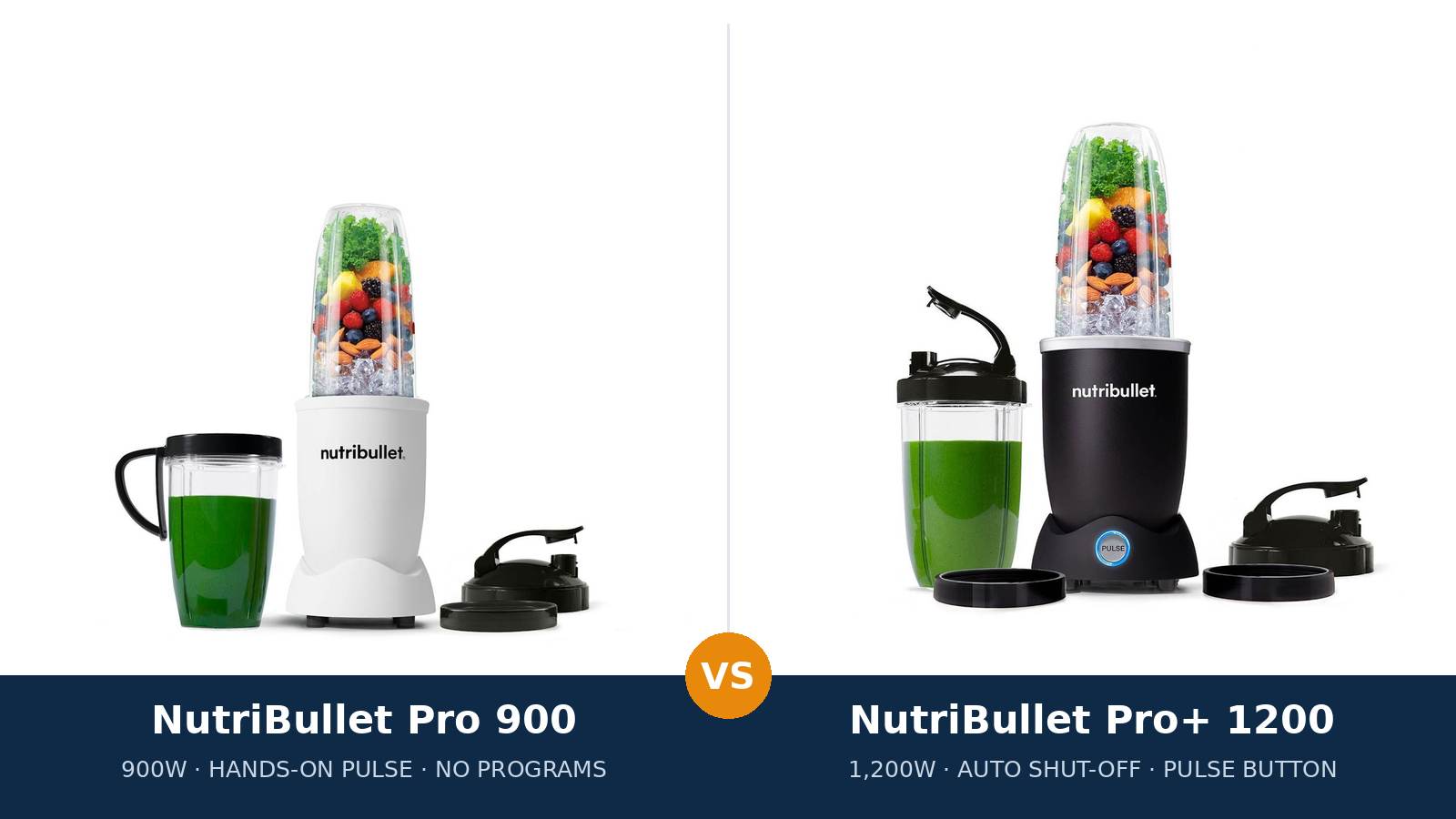
You typed both names out in full. That already puts you ahead of most shoppers comparing these two.
What the full names do not tell you is how much these machines share. Same classic bullet silhouette. Same extractor-blade idea. Same 32 oz ceiling on the biggest cup. The same one-year warranty standing behind each of them.
So the honest question is narrow: what do the Pro+’s extra 300 watts, one illuminated button and one automatic stop actually buy you — and what does the Pro 900 still do better with none of those things?
There is also a generational twist hiding under the badges. The numbered machine is the one NutriBullet has retired; the Plus-named machine is current production. This guide works through all of it from the manufacturer’s own pages and manuals.
Key Takeaways
- The Pro+ is the stronger, newer machine. 1,200W against 900W, an automatic shut-off the Pro 900 lacks, and a production line that is still running.
- The Pro 900 keeps the best pulse in the pairing. Its press-and-release technique is fully in your hands; the Pro+ moves the same job onto a button.
- Cups, blade and warranty are level. Both top out at a 32 oz cup, both spin a stainless extractor blade, and both carry a one-year limited warranty.
- The Pro 900 was discontinued in autumn 2026. Listings still trade, but its named successor is a different machine whose parts do not swap with it.
- “Pro Plus”, “Pro+” and “the 1200” are one blender — model N12-1001MK. The other 1,200W NutriBullet, the Ultra, is a separate platform entirely.
Quick Verdict
Buy the NutriBullet Pro+ 1200 for most kitchens. It wins this comparison narrowly, and it wins on things you will feel weekly.
The extra headroom helps with frozen-heavy loads. The base stops on its own when the extraction cycle is done. And it is the machine NutriBullet still builds, which matters for parts and support over the years ahead.
Buy the NutriBullet Pro 900 if your hands make the decisions. Its pulse is a technique, not a feature buried in a cycle — press, release, look, repeat.
It remains the better tool for chunky, stop-and-check blending, and its simpler base has nothing electronic to age. Just buy it knowing production has ended, and that remaining stock is what the listings are selling.
Either way, you are choosing between two honest versions of the same idea. The sections below separate the real gaps — power, automation, production status — from the long list of things that were never different at all.
The Scorecard
Scores below come straight from the manufacturer specifications compared in this guide — published motor ratings, controls, cup sizes and warranty terms. Treat them as a reading aid, not as benchmark results.
| Category | NutriBullet Pro 900 | NutriBullet Pro+ 1200 | ||
|---|---|---|---|---|
| Power (from specs) | 8 / 10 | 9 / 10 | ||
| Programs & automation | 3 / 10 | 7 / 10 | ||
| Manual control & pulse | 9 / 10 | 8 / 10 | ||
| Capacity & cup set | 8 / 10 | 8 / 10 | ||
| Ease of use | 8 / 10 | 8 / 10 | ||
| Cleaning | 8 / 10 | 7 / 10 | ||
| Value | 8 / 10 | 8 / 10 | ||
| Overall | 8.0 / 10 | 8.1 / 10 | ||
One line of context before you read too much into a single decimal. Against the NutriBullet Ultra, this same Pro+ scores lower — the Ultra’s titanium blade and longer blade cover open a gap the Pro+ cannot close.
That gap does not exist here. The Pro 900’s blade and warranty are the Pro+’s blade and warranty, so the rows that decide this card are power and automation instead — and the Pro+ takes both.
At a Glance: Who Each Blender Fits
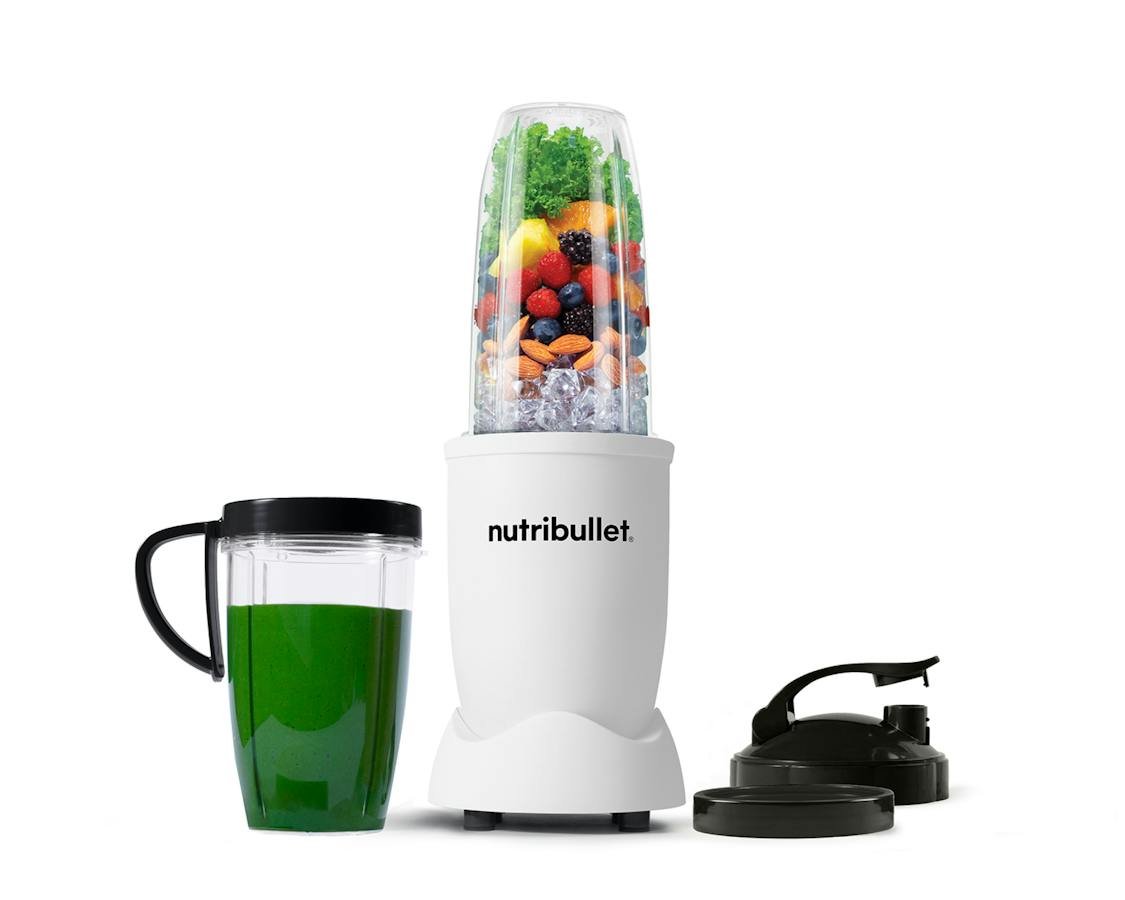
NutriBullet Pro 900
- 900W motor, single speed, nothing to program
- True hands-on pulse: press to run, release to stop
- Two 32 oz cups in the standard configuration
- Stainless extractor blade, rinsed by hand
- Discontinued in autumn 2026 — listings are remaining stock
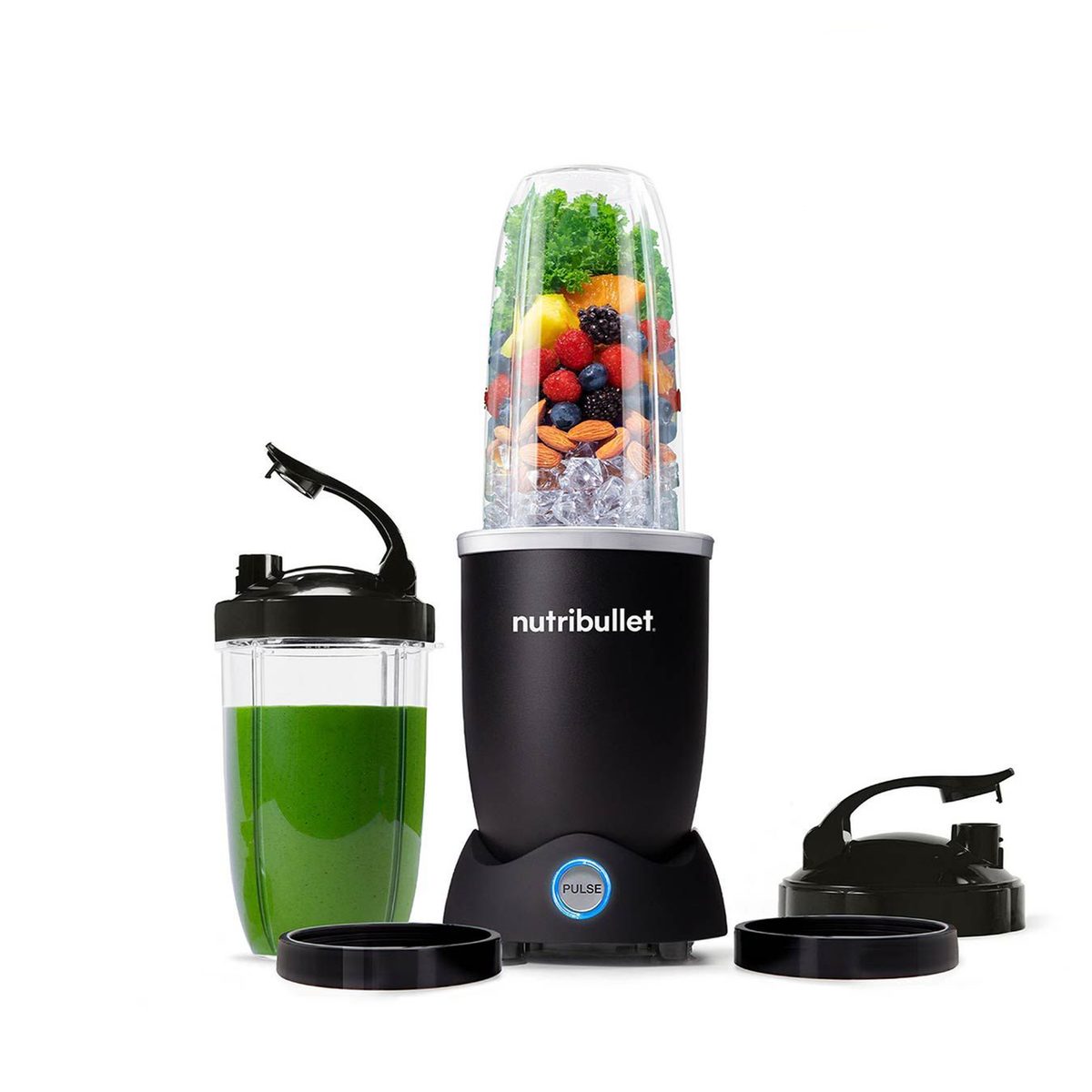
NutriBullet Pro+ 1200
- 1,200W motor — the top rung of the classic ladder
- Illuminated PULSE button at the foot of the base
- Automatic shut-off when the extraction cycle completes
- 32 oz and 24 oz Tritan cups in the box
- Current production, model N12-1001MK
Choose the Pro 900 if…
You blend by eye and by feel. Salsa that should stay coarse. Dips you stop mid-chunk.
You would rather own the simplest version of a proven design — a motor, a cup, and your own judgement about when to stop.
Or you already live in the classic NutriBullet ecosystem and want the strongest version of the original formula while stock lasts.
Choose the Pro+ 1200 if…
Your mornings run on routine. Fill, twist, walk away, come back to a finished drink and a base that has already stopped itself.
You load cups with frozen fruit and ice and want the extra headroom behind the blade. Or you simply prefer buying the model the manufacturer still builds.
As an Amazon Associate I earn from qualifying purchases at no extra cost to you.
Specifications: The Specs That Actually Matter
Every figure below is taken from NutriBullet’s own product pages, manuals and manufacturer product data. Where the two brands of paperwork measure different things, the table says so rather than pretending otherwise.
| Specification | NutriBullet Pro 900 | NutriBullet Pro+ 1200 |
|---|---|---|
| Model | NB9 series; 13-piece retail set NB9-1301 | N12-1001MK |
| Motor rating | 900W | 1,200W |
| Rating basis | Single figure published by NutriBullet; no rated/peak split | Single figure published by NutriBullet; no rated/peak split |
| Speeds | Single speed | Single speed |
| Pulse | Hands-on: press and hold the cup to run, release to stop | Illuminated PULSE button; press to pulse, release to stop |
| Programs & automation | None — you start and stop every blend | Hands-free auto shut-off at the end of the extraction cycle (about 60 seconds) |
| Blade | Stainless steel extractor blade | Stainless steel extractor blade |
| Largest cup | 32 oz | 32 oz |
| Cups in the standard set | 2 × 32 oz, with to-go lids, cup rings and handled lip rings | 32 oz + 24 oz, with 2 to-go lids and 2 lip rings |
| Cup material | BPA-free plastic (polymer not named on the US product page) | Tritan, BPA-free |
| Dishwasher-safe parts | Cups and lids, top rack; extractor blade hand-rinse only | Cups and lids; extractor blade hand-wash (see Difference 6) |
| Dimensions | 12.01 × 7.72 × 15.94 in — the configured retail set | 5.26 × 4.8 × 14.4 in — the base unit |
| Weight | 4.7 lb (manufacturer figure) | 6.2 lb (boxed-set figure) |
| Warranty | 1-year limited | 1-year limited |
Dimensions and weight — read the basis, not just the numbers. The Pro 900’s published measurements describe the full configured set; the Pro+’s describe the bare base. Placed side by side they flatter the Pro+ unfairly, so this guide draws no size verdict from them. Both are compact personal blenders in the same footprint class.
Box contents vary. The Pro 900 listing’s own data is not fully consistent about its smaller pieces, and the Pro+ set gains extras in some retail channels. The buying guide below turns both into a count-the-box check.
Photo note: the Pro 900 pictured here is the Matte White finish. The linked listing is the Champagne finish of the same NB9 model — the machine is identical, only the colour differs.
The Differences That Actually Matter
1. Two nameplates on one classic platform
Start with the naming, because it causes more confusion than any specification. “Pro Plus” is how the name is spoken; “Pro+” is how it is printed; “1200” is its wattage. All three point at one machine: model N12-1001MK.
The Pro 900 wears its wattage as its name instead. Underneath the different naming habits sits the same design language — a tapered base, a cup that locks and twists, an extractor blade that spins the contents into a vortex.
One warning belongs here. NutriBullet sells a second 1,200W personal blender, the Ultra, built on a newer cup platform with a different blade. Wattage twins, mechanical strangers. If a listing’s photos show a base with a glowing touch panel rather than a single round button, you are looking at the Ultra, not the Pro+.
2. The 300-watt gap — real, and honestly stated
Credit both machines with clean paperwork. NutriBullet publishes a single motor figure for each — 900W here, 1,200W there — with no peak-versus-rated shell game for the reader to decode.
So the gap is what it appears to be: a third more rated power in the Pro+. In a personal blender that headroom shows up as composure under load. Dense frozen blends ask the most of a small motor, and the stronger base holds its speed with less strain.
What the gap does not do is change the category. Both are single-speed extraction machines working the same cup sizes. The Pro+ is the more powerful version of the idea, not a different idea — and for soft-fruit smoothies and protein shakes, the Pro 900 was never short of power in the first place.
That single-speed point deserves underlining. The extra watts do not arrive as extra settings, because neither machine has settings to add them to. One speed, full commitment, on both bases. What you are buying with the Pro+ is composure at that one speed when the load fights back — nothing more mystical than that, and nothing less useful.
3. Pulse, defined two different ways
This is the Pro 900’s home turf. It has no pulse button because it does not need one: press the cup down and the motor runs, lift your hand and it stops. Short presses make a pulse; you decide each one, watching the contents the whole time.
The Pro+ moves that job onto an illuminated PULSE button at the foot of the base. Per its manual you work it the same way — press to pulse, release to stop. The hand moves from cup to button; the control stays manual.
Ignore the store copy that calls the Pro+’s pulse “pre-programmed”. The manual describes a button you hold and release, and the manual is the document that governs. Scored honestly, the Pro 900 still edges this row: pressing the cup itself is the most direct pulse either design offers.
4. The shut-off — the one true automation gap
Here the Pro+ does something the Pro 900 simply cannot. Twist its cup on and it runs a hands-free extraction, then switches itself off when the cycle completes — roughly a minute, per the manual.
The Pro 900 has no equivalent. It runs while you hold it in the run position, and stopping is your responsibility every single time. Attentive owners call that control; busy owners call it one more thing to stand over at 6 a.m.
Neither answer is wrong. They are different relationships with the same ritual — supervised blending against delegated blending. It is the clearest everyday difference in this comparison, and it is why the automation row of the scorecard is not close.
The shut-off cuts both ways in one small respect. A machine that ends its own cycle also decides when blending is finished, and the cook who likes to intervene — another ten seconds, one more burst — gives that up. On the Pro+, the pulse button is where that instinct has to live. On the Pro 900, the whole machine works that way.
5. Cups and capacity — a tie with paperwork attached
Both machines peak at a 32 oz cup. Both pour their results into the same style of lids and rings. On capacity, there is nothing to buy here.
The differences live in the box. The Pro 900’s standard configuration pairs two 32 oz cups with to-go lids, cup rings and handled lip rings — yet its own listing data muddles some of the smaller pieces, so the exact count in a given box is worth confirming on delivery.
The Pro+ splits its pair: a 32 oz and a 24 oz, two to-go lids, two lip rings, and a recipe book. Some retail channels sweeten that set further. Neither bundle is better in principle — but check the one in front of you against the manual’s list before assuming.
6. Same blade, same wash — one documentation wrinkle
The hardware ties again. Both machines spin a stainless steel extractor blade, and for both the correct care is the same: cups and lids can go in the dishwasher, the blade gets washed by hand.
The wrinkle is that the Pro+’s paperwork argues with itself. A summarised cleaning text suggests the blade is top-rack safe; the full manual text leaves the blade out of the dishwasher list. Follow the full manual — hand-wash the blade — as the brand’s wider guidance advises for the whole range.
That contradiction is the only reason the Pro+ drops a mark on cleaning. The Pro 900’s instructions say one thing, once, and it is the same thing: rinse the blade by hand and move on.
7. One is retired, one is current — and the warranty cannot tell them apart
The strangest line in this comparison belongs to the calendar. NutriBullet discontinued the Pro in autumn 2026. The Pro 900 you can still buy is remaining stock moving through live listings — genuine machines, finite supply.
Its maker has already named the successor: a 1,000W model sold as the Turbo. Note the catch for owners — the Turbo’s parts are not compatible with the Pro 900’s, so a loyal NB9 kitchen is its own ecosystem now.
The Pro+, on sale since January 2023, is still a current model sold through ordinary retail channels. Yet step back and the paperwork equalises: both machines carry exactly a one-year limited warranty. Buying the newer design buys you production status and parts horizon — not a longer promise.
Which Blender Fits Which Job?
Start from the job and the right badge usually picks itself. This table compresses the whole comparison into one view.
| The job | NutriBullet Pro 900 | NutriBullet Pro+ 1200 | Our call |
|---|---|---|---|
| Weekday green smoothies | Excellent — quick, simple, proven | Excellent — set it running and dress | Tie — pick on control style |
| Frozen fruit and ice-heavy cups | Good — works, with less headroom | Excellent — the extra 300W earns its keep | Pro+ 1200 |
| Salsa, dips and chunky textures | Excellent — pulse by hand, watch it change | Good — button pulse, still manual | Pro 900 |
| Hands-busy morning routines | Workable — it stops when you stop it | Excellent — auto shut-off ends the cycle | Pro+ 1200 |
| Protein shakes and soft blends | Excellent | Excellent | Tie — either is overqualified |
| A first bullet blender | Good — fewest features to learn | Excellent — forgiving, current, supported | Pro+ 1200 |
| An owner restocking an NB9 kitchen | Excellent — same platform you already run | Workable — a different model line | Pro 900, while stock lasts |
Notice the pattern. The Pro+ collects the routine jobs — the blends you make half-asleep, five days a week. The Pro 900 collects the judgement jobs, where the person matters more than the program.
Notice, too, the jobs missing from the table. Neither machine is the answer for hot soup, for litre-scale batches, or for a household queue at breakfast. Those absences are shared, and the When to Skip Both section deals with them honestly rather than scoring a winner neither deserves.
The 30-Second Decision
| If this sounds like you… | Buy this |
|---|---|
| “I want to press a button mentally, not hold a cup physically.” | Pro+ 1200 (auto shut-off) |
| “I stop and check textures. Chunky is a destination, not an accident.” | Pro 900 (hands-on pulse) |
| “My cups are frozen solid most mornings.” | Pro+ 1200 (1,200W headroom) |
| “I distrust features. Give me the simplest strong version.” | Pro 900 |
| “I am buying for the next five years of spare parts.” | Pro+ 1200 (current production) |
| “Honestly, either would do.” | Then take the Pro+ — it is the one still being made |
See today’s listings side by side
Both machines sell through Amazon. Sellers and stock move — the Pro 900’s especially — so check the live listing for the one that fits your routine.
View on Amazon — NutriBullet Pro 900View on Amazon — NutriBullet Pro+ 1200Trade-Offs at a Glance
NutriBullet Pro 900
You gain: the most direct control either design offers. A pulse that lives in your hand, a single speed that never second-guesses you, and the strongest, simplest expression of the original bullet formula.
You give up: automation of any kind, a third of the Pro+’s power, and a production future. Every Pro 900 sold now comes out of remaining stock, and its spare-parts horizon shortens each year.
NutriBullet Pro+ 1200
You gain: 1,200W of headroom, a base that ends its own cycle, named Tritan cups, and the security of a model line still in production with ordinary retail support behind it.
You give up: the last degree of hands-on feel — the button is good, the cup-press is better — and a little paperwork clarity, since its own cleaning guidance contradicts itself about the blade.
Pros & Cons
Pro 900 — Pros
- Pulse control that is entirely in your hands
- Simple, proven, nothing electronic to fail
- Two full-size 32 oz cups in the standard set
- Cleaning instructions with no contradictions
- The strongest form of the classic NB9 design
Cons
- Discontinued — stock is finite
- No auto shut-off or programs of any kind
- Least power in this comparison
- Named successor’s parts do not fit it
Pro+ 1200 — Pros
- 1,200W — top of the classic wattage ladder
- Auto shut-off ends the extraction cycle for you
- Dedicated illuminated pulse button
- Tritan cups, named in the manufacturer data
- Current production model
Cons
- Pulse loses the cup-press feel of the Pro 900
- Manual summaries disagree on blade dishwashing
- Set contents shift between retail channels
- Warranty is the same single year as the Pro 900
Before You Buy: A Short Checklist
Match the model code, not the nickname. “Pro 900” should resolve to the NB9 series. “Pro Plus” should resolve to N12-1001MK — the MK suffix marks the current kit.
An earlier Pro+ kit from 2018 circulates under a near-identical name. If a listing cannot show you the MK model code, it is not evidence about the machine in this comparison.
Count the box when it lands. The Pro 900’s standard configuration is two 32 oz cups with to-go lids, cup rings and handled lip rings — but its listing data has described the small pieces inconsistently, so verify against the manual’s list rather than the product page.
The Pro+’s manual list is the 32 oz and 24 oz cups, two to-go lids, two lip rings and the recipe book. Some retailers add extras; treat anything beyond the manual list as a bonus, not a baseline.
Mind the finish. The Pro 900’s linked listing is the Champagne finish, while the photographs here show Matte White. Same NB9 machine, different colour — buy the one whose listing names the finish you want.
The Pro+ side needs no such translation: the linked listing is the Matte Black kit, and the machine in these photographs is that finish. If a Pro+ listing shows a different colour at an unusual price, treat it as a prompt to re-check the model code before anything else.
Price the Pro 900 as remaining stock. Because production ended in autumn 2026, seller quality matters more than usual. Favour listings with clear returns, and register the purchase promptly — the one-year warranty runs regardless, but paperwork is your friend on a discontinued line.
Where Each Machine Leads
Think of these two as neighbouring rungs, not stepping stones to each other. Moving from a Pro 900 to a Pro+ buys power and one automatic stop; it does not change what a personal blender is.
The Pro 900’s official line ends with it. NutriBullet points its owners at the 1,000W Turbo as the successor, and that machine’s parts do not interchange with the NB9 cups and blades on your shelf. An upgrade there means starting the accessory drawer again.
The Pro+ sits one rung below the Ultra, where the platform itself changes — new cups, a titanium-coated blade, a different interface. That is the genuine step up from either machine here.
And when the job outgrows 32 oz cups entirely, neither badge helps. Family batches and big frozen drinks belong to full-size pitcher blenders, a different shelf of the same shop.
When to Skip Both
Skip both if the blade is your deciding feature. The Ultra’s titanium-coated blade and longer blade cover outclass anything on this page, and pretending otherwise would not survive a spec sheet.
Skip both if you blend for a household in one pass. A 32 oz cup is a personal serving with ambitions; pitcher machines exist because families noticed.
Skip both if hot liquids are the plan. Bullet blenders of this class are built for cold extraction, and soup weather deserves a machine designed for heat.
Finally, skip the Pro 900 specifically if discontinued lines worry you, and skip the Pro+ specifically if a physical button for every function matters more than automation. Each machine has a buyer it will quietly annoy — the sections above name them.
Warranty, Support & Parts
The warranty row is a dead heat: one year, limited, on both machines. No amount of Plus branding stretches the Pro+’s term, and the Pro 900’s age does not shorten its stated cover.
Support horizons differ more than terms. The Pro+ is in production, so its cups, blades and lids sit in the ordinary retail pipeline. The Pro 900’s parts remain its own ecosystem — worth a thought about a spare blade if you plan to run one for years.
One discipline serves owners of either: keep the model code with your paperwork. NB9 and N12 parts are ordered by code, not by nickname, and the codes are what support desks and parts listings speak.
Final Verdict
The NutriBullet Pro+ 1200 takes this comparison, 8.1 to 8.0 — narrowly, and for practical reasons.
It is more powerful on the only basis either brand publishes. It finishes its own extraction cycle while you do something else. And it is the machine still rolling off the line, which is the kind of advantage that compounds quietly over years of cups and blades.
Buy the Pro+ 1200 for daily smoothies, frozen-heavy blends, and any kitchen that values a routine which runs itself.
View on Amazon — NutriBullet Pro+ 1200
Buy the Pro 900 if control is the feature you actually use. Its pulse lives in your hand, its design has a decade of proof behind it, and on chunky, watched, adjusted blending it remains the better instrument.
Buy it clear-eyed, though: production has ended, so the listing in front of you is some of the last of its kind.
View on Amazon — NutriBullet Pro 900
Watch Out: Similar Names, Different Blenders
This corner of the catalogue is a naming maze. Four warnings belong in every version of this guide.
First: Pro Plus, Pro+ and “the 1200” are the same blender — model N12-1001MK. A listing using any of the three names, with that code, is this machine.
Second: the Ultra is also rated at 1,200W and is not this machine. Different cup platform, different blade, touch-panel front. Wattage is a specification, not a surname.
Third: the 1,200W Blender Combo is a full-size pitcher blender that happens to share the motor figure. It answers a different question — batch size — and belongs in a different comparison.
Fourth: the Pro 900’s successor, the Turbo, is a separate 1,000W machine whose cups and blades do not fit the Pro 900. A “replacement” listing that quietly substitutes it is not selling you this comparison’s Pro 900.
Slow down on the product page. Match the model code, then the cup set, then the price — in that order.
Frequently Asked Questions
Are “Pro Plus”, “Pro+” and “the 1200” really the same blender?
Yes. All three labels point to model N12-1001MK: Pro+ is the printed badge, Pro Plus is the spoken form, and 1200 is its motor rating. Check for the MK model code on any listing and the names stop mattering.
Is the Pro+ just a renamed Pro 900?
No. They share the classic bullet platform and design language, but the Pro+ is a distinct model line (N12 against NB9) with a stronger 1,200W motor, a pulse button the Pro 900 does not have, and an automatic shut-off. The Pro 900 is the older machine — and, since autumn 2026, a discontinued one.
How does the Pro 900 pulse without a pulse button?
By hand. Pressing the cup down runs the motor and releasing stops it, so a sequence of short presses works as a pulse. Its manual documents the technique, and many owners prefer it — your hand sets the rhythm and your eyes watch the texture between bursts.
What does the Pro+’s auto shut-off actually do?
Twist the cup on and the Pro+ runs its extraction hands-free, then switches itself off when the cycle is complete — about 60 seconds, per the manual. It is the one piece of genuine automation in this pairing; the Pro 900 has no equivalent and runs only under your hand.
Can the Pro+ extractor blade go in the dishwasher?
Treat it as hand-wash only. A summarised cleaning text in the Pro+’s paperwork suggests top-rack washing, but the full manual text excludes the blade, and the brand’s wider guidance is to rinse extractor blades by hand. The cups and lids are dishwasher safe on both machines.
The Pro 900 has been discontinued. Should that stop me?
It can be. The machine itself is unchanged and its one-year warranty still stands behind new stock; what has ended is production. Sensible means buying from a seller with clear returns, confirming the box contents on arrival, and knowing its parts form a closed ecosystem now that the successor model uses different ones.
Why does the Pro+ score higher here than it does against the Ultra?
Because the opposition changed. Against the Ultra, the Pro+ loses a blade-and-warranty row outright — titanium blade, longer blade cover — and that drags its overall down. Against the Pro 900 those rows are ties, so the Pro+’s genuine edges, power and automation, carry the card instead. Scores here are always relative to the pairing on the page.
Sources & Verification
NutriBullet Pro product page, FAQ and user guide, nutribullet.com (900W rating, NB9 series, dimensions, weight, warranty, care guidance, discontinuation and successor notice) • NutriBullet Pro+ instruction manual, model N12-1001MK (1,200W rating, auto shut-off, pulse operation, parts list, care instructions) • Manufacturer product data for the Pro+ via Williams Sonoma and Best Buy (Tritan cups, warranty) • Amazon listing data for both models, used to verify listings only, never specifications. Specifications verified November 2026.

James Wilson
James has spent over a decade putting small kitchen appliances through their paces, from two-slice toasters to high-performance blenders, and writes Honestly Compared’s blender and kitchen guides. His rule for every comparison: the verdict has to survive the spec sheet, not the marketing page.