
NutriBullet Ultra vs NutriBullet Pro 900: Which Should You Buy?
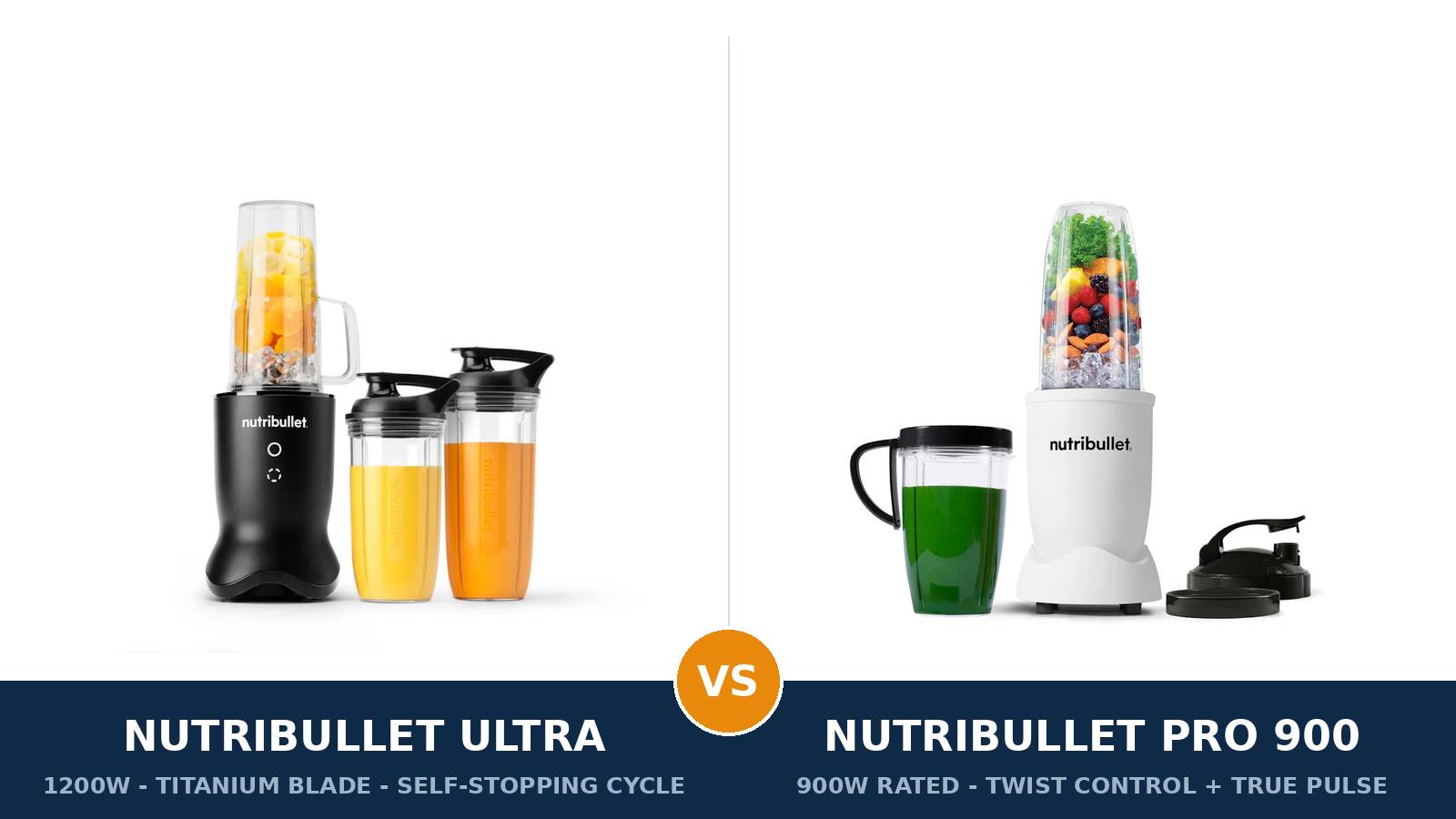
Two bullet blenders from the same brand, built a decade apart, aimed at the same kitchen counter.
The Ultra is where the line stands today: a 1,200-watt motor, a titanium-coated blade, and a backlit touch ring that runs a timed smoothie cycle and switches off by itself. The Pro 900 is the machine that made the format famous — 900 watts, a twist-to-run cup, and a complete absence of buttons.
Before anything else, the name needs pinning down, because NutriBullet reuses its words shamelessly. In this guide, “900” means the Pro 900 from the NB9 family — the 900-watt flagship of the classic range. The 600-watt original NutriBullet is a separate, smaller machine, and the Pro+ is a different 1,200-watt model entirely. Neither is compared here.
One more fact shapes everything below. NutriBullet retired the Pro in autumn 2026, yet the listing linked from this page is still selling through remaining stock. You are therefore choosing between a discontinued manual classic and the automated model that effectively succeeded it — while both remain on sale.
All specifications come from NutriBullet's official pages and user guides; where the brand's sources disagree, its current figure wins.
Key Takeaways
- The Ultra wins on hardware. A 1,200W rating against 900W, measured on the same single-figure basis, and a blade carrying five years of warranty cover.
- The Pro 900 wins on control. A true pulse worked by hand beats a pulse mode buried in a touch interface whenever texture is the point.
- More cups come with the Ultra. Three Tritan Renew vessels, one of them handled, against the two-cup set the Pro usually ships with.
- Neither machine asks much of the dishwasher. Cups and lids are top-rack safe on both; both blades are washed by hand.
- Discontinued is not the same as unavailable. Pro stock and Pro spare parts are still sold — but the range's successor, the Turbo, shares no parts with it.
Quick Verdict
Buy the NutriBullet Ultra if you want the default answer. For most buyers, it is the more capable and longer-lived machine.
It offers half as much power again on paper, a blade warranted five times longer, an extra cup in a better plastic, and a cycle that finishes without supervision. As the current model, its parts pipeline is the one still being fed.
Buy the NutriBullet Pro 900 if you blend by feel. Twist, watch, release: the whole interaction takes a second to learn and gives you timing no preset can match.
It also suits anyone invested in NB9 cups and spares, or who finds the remaining stock discounted hard. Just go in clear-eyed about the model's status.
The Scorecard
Scores below are derived directly from the manufacturer specifications compared in this guide — wattage as published in each user guide, cup counts and capacities, control systems, dishwasher rulings, dimensions and warranty terms. They are a reading aid, not benchmark results.
| Category | NutriBullet Ultra | NutriBullet Pro 900 | ||
|---|---|---|---|---|
| Power & motor | 9 / 10 | 8 / 10 | ||
| Capacity & cups | 9 / 10 | 8 / 10 | ||
| Control & pulse | 7 / 10 | 9 / 10 | ||
| Cleaning | 7 / 10 | 7 / 10 | ||
| Footprint & storage | 8 / 10 | 7 / 10 | ||
| Blade & warranty | 9 / 10 | 6 / 10 | ||
| Value | 7 / 10 | 8 / 10 | ||
| Overall | 8.1 / 10 | 8.0 / 10 | ||
How the numbers were set is worth a sentence. Each machine keeps the overall mark it has already earned elsewhere in this series — 8.1 for the Ultra, 8.0 for the Pro 900 — because no specification has changed since those readings were taken.
The category scores, by contrast, are read against the machine across the page. Control and pulse gets its own row here — rather than being folded into ease of use — because it is the sharpest split between the pair, and scored honestly it belongs to the older machine.
At a Glance: Who Each Blender Fits
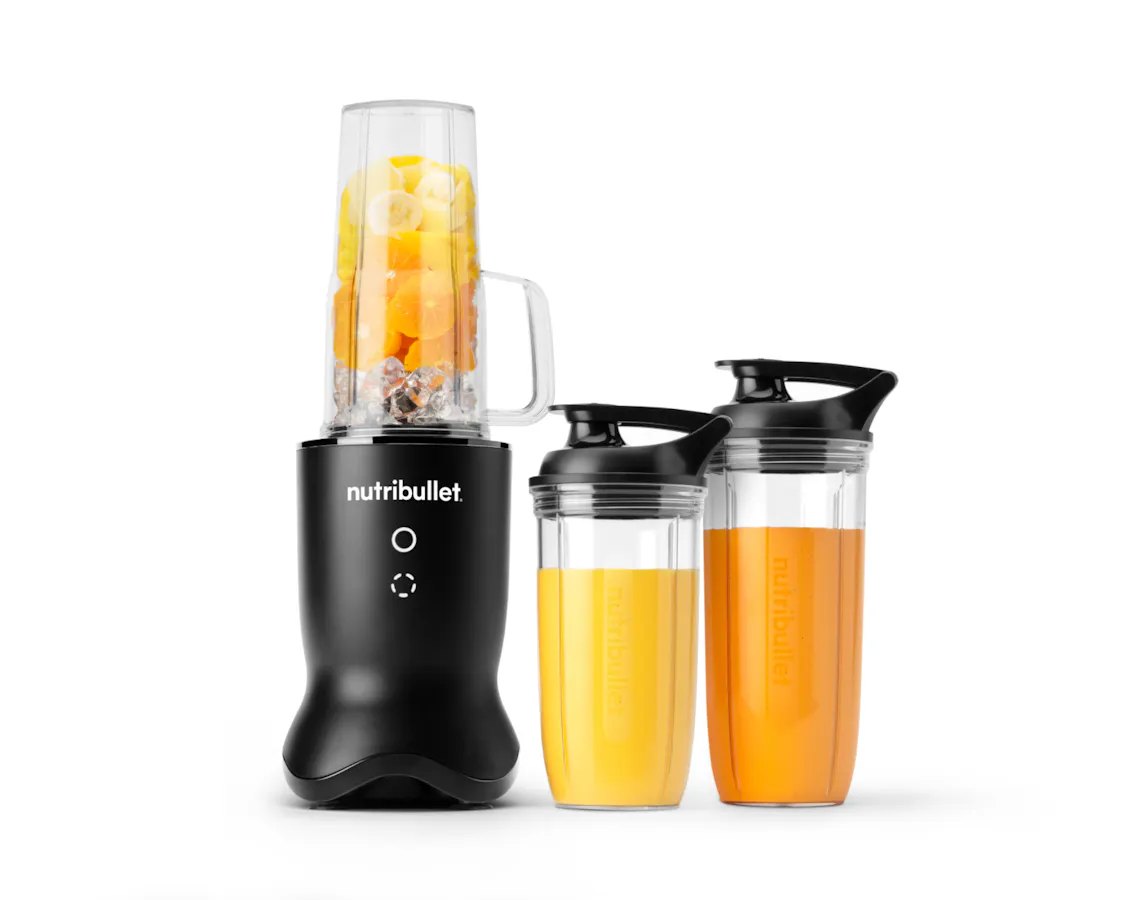
NutriBullet Ultra (NB50500)
- 1,200W motor — one published figure in the user guide, no peak rating
- Rapid Extractor Blade in titanium-coated stainless steel
- Blade warranty: 5 years, separate from the unit warranty
- Three Tritan Renew cups: 32 oz, 24 oz, 24 oz handled
- Backlit glow interface with a self-stopping smoothie cycle
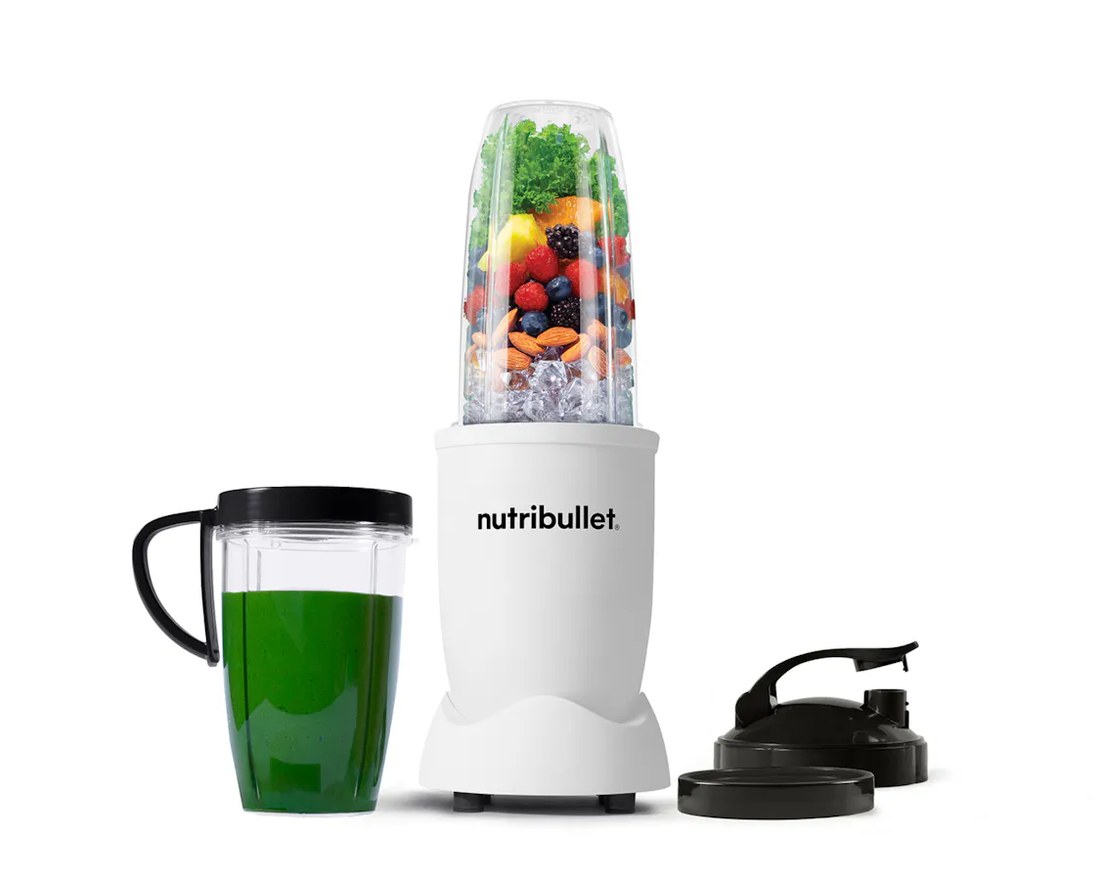
NutriBullet Pro 900 (NB9-0901)
- 900W motor — one published rated figure, no peak rating
- Push-and-twist running with a genuine manual pulse
- Linked set holds a 32 oz and a 24 oz cup; sets vary by listing
- Plain stainless extractor blade; rinse it by hand
- Retired in autumn 2026 — stock still live, 1-year warranty
Choose the NutriBullet Ultra if…
Mornings at your house are a routine, not a ritual. Load the cup, touch the lit circle, and get on with something else while the cycle runs to its own stop.
Ice and frozen fruit go in most days. The extra 300 watts of rating is exactly the headroom a densely packed cup asks for.
Two people drink from the same machine, or a handled cup for the commute sounds useful. This box carries three cups; the Pro’s usually carries two.
Or you simply intend to keep the thing for years. Current model, current parts, and a blade covered for five of those years.
Choose the NutriBullet Pro 900 if…
Texture is something you judge mid-blend. Salsa, thick bowls and nut butter all reward bursts timed by eye, and the Pro’s press-and-release action is built around exactly that habit.
Your cupboards already hold NB9 gear. Cups, lids and blades from the classic line belong on this base; the brand publishes no bridge between them and the Ultra’s accessories.
Or the discount is doing the persuading. Remaining stock priced as the outgoing model it is can be a rational purchase — provided the discontinuation holds no surprises for you.
As an Amazon Associate I earn from qualifying purchases at no extra cost to you.
Specifications: The Specs That Actually Matter
Figures in the table are taken from NutriBullet’s product pages and manuals for the NB50500 Ultra and the NB9 Pro range.
| Specification | NutriBullet Ultra (NB50500) | NutriBullet Pro 900 (NB9-0901) |
|---|---|---|
| Motor power | 1,200W (single published rating) | 900W (rated — single published figure) |
| Blade | Rapid Extractor Blade, titanium-coated stainless steel | Extractor blade, stainless steel, screw-on |
| Cups in the box | 32 oz + 24 oz + 24 oz handled (3 cups), 2 to-go lids | 32 oz + 24 oz (2 cups), flip-top to-go lid — set contents vary by listing |
| Cup material | Tritan Renew, 50% certified recycled content, BPA-free | BPA-free plastic |
| Controls | Illuminated glow interface: automated smoothie cycle + pulse | Twist-lock on/off, manual pulse — no buttons, no timer |
| Auto shut-off | Yes — the automated cycle stops itself | No — you end the blend |
| Speed settings + pulse | Single speed; pulse mode on the glow interface | Single speed; true press-and-release pulse |
| Dimensions | 5 × 4.75 in footprint; 14 in tall assembled (base alone 7.9 in) | 12.01 × 7.72 × 15.94 in (manufacturer’s published figures) |
| Weight | 10.14 lb (manufacturer’s figure, full three-cup set) | 4.7 lb |
| Cord length | 29.5 in | 29.5 in |
| Dishwasher-safe parts | Cups and lids, top rack — blade hand-wash only | Cups and lids, top rack — blade hand-rinse per brand guidance |
| Warranty | 1 year on the unit; 5 years on the blade | 1 year limited, whole machine |
| Hot liquids | Not permitted | Not permitted |
Which “900” is on this page? Model NB9-0901, the Pro 900, retailed in sets like the 13-piece NB9-1301 that the buttons here lead to. The 600W machine that started the brand shares the surname and nothing else, while the Pro+ is a separate 1,200W design. Keep the three apart when you shop.
A note on the measurements: the two columns are not measuring the same thing. For the Ultra, 5 × 4.75 in describes the base itself, and the guide’s 7.9 in is that base standing alone. The Pro’s published dimensions cover the assembled set instead. The Ultra base is the slimmer object, but treat the Pro’s figures as set dimensions, not a rival footprint.
Weight needs the same care: 10.14 lb is what NutriBullet publishes for the Ultra’s complete three-cup kit, while 4.7 lb is a machine-only figure for the Pro. If counter space is your concern, footprints are the honest comparison.
About the photographs: our Ultra image wears Satin Black, while the linked listing sells the Gunmetal Gray version of the NB50500. The Pro image is Matte White; its listing is the Champagne version of the same NB9 machine. Finish aside, the products are identical.
The Differences That Actually Matter
1. Power — a third more, on an honest basis
Wattage claims in this category usually need unpicking. Here, refreshingly, neither number hides anything.
The Ultra’s guide states its motor power as a single 1,200W figure. The Pro’s documentation does the same at 900W. No peak ratings, no asterisks — so the gap can be taken at face value: the newer machine is rated a third higher.
Where a bullet blender feels that difference is under load. Frozen chunks and a full cup drag on a motor; the stronger unit keeps its pace through the resistance instead of labouring against the blade assembly.
Perspective still applies. A one-minute continuous limit sits in both manuals, both machines are single-speed, and hot liquids are banned from both cups. The Ultra does the same job with more in reserve — it does not take on a bigger job.
Power, then: a clean win for the Ultra, with nothing to disclaim on either side.
2. Control and pulse — the older machine’s genuine victory
Reverse the lens and the result reverses with it. On hands-on control, the Pro 900 is not merely competitive; it is better.
Its entire interface is mechanical. Seat the cup, push down, twist — it blends. Twist back and it stops. A pulse is your own hand pressing and letting go, as short or as long as the mixture in front of you demands.
Anyone who makes food with texture will recognise the value. A chunky salsa needs restraint measured in fractions of a second. A thick bowl needs three bursts, a shake, then one more. The Pro imposes nothing between your judgement and the blade.
The Ultra organises things differently. One illuminated circle launches an automated cycle that ends itself; a second, dashed circle offers a pulse mode for manual work.
That pulse is real, but it is a setting on a touch ring — chosen, not felt — and the machine’s philosophy plainly favours handing timing over to the cycle. Wonderful for consistency, poorer for improvisation. The scorecard gives the Pro this category at 9 against 7, and the reasoning is the whole section.
3. The blade — coating matters, the warranty matters more
On any bullet blender, the blade unit is the consumable. It lives in liquid and grit, its seal flexes under load, and it is typically the first part to dull or weep.
The Pro’s extractor blade is uncoated stainless steel of a conventional design. Cover runs with the machine: one year. After that, a fresh blade is an ordinary purchase, and NutriBullet does still sell them.
The Ultra’s Rapid Extractor Blade adds a titanium coating over stainless steel. Treat the coating as a durability claim — then look at the document that backs it: a 5-year limited warranty written for the blade alone, on top of the unit’s single year.
Five years of cover on a wear component is a statement of expected lifespan, not a marketing garnish. Of every line in either manual, it may be the most informative one in this comparison.
Fitting is shared ground: both blades thread onto their cups by hand. So is care — the Ultra’s guide insists on hand-washing its blade, and NutriBullet’s current advice for the Pro is a rinse by hand, whatever an older manual summary may say.
4. Cups — three modern vessels against a variable classic set
Start with what matches: both machines centre on a 32 oz cup with a 24 oz alongside it. A solo smoothie drinker is served by either box.
The Ultra then pulls ahead on count and content. Its box adds a third cup — a handled 24 oz — plus a pair of to-go lids. The handled vessel turns out to be the one owners reach for, because it goes from base to cupholder with no pouring in between.
Its plastic is the better story too: Tritan Renew, BPA-free and shatter-resistant, with half of its content certified recycled. Against that, the Pro’s cups are described by the brand only as BPA-free, the polymer left unnamed on its US page.
The Pro’s packaging needs active caution. Depending on which listing you read — the brand’s own configuration, older retail sets, the FAQ — the cup mix changes. The set linked here pairs 32 oz with 24 oz, but verify the includes list on the page in front of you before paying.
Finally, plan each machine as its own ecosystem: no published statement says NB9 cups or blades work with the Ultra, and the blade designs differ. Assume nothing transfers.
5. Cleaning — level, and limited in the same place
We looked for a cleaning winner in the manuals. There isn’t one.
Ultra owners put cups and lids on the top rack and keep the blade out — the guide could not be plainer. Pro owners get the same split: vessels and lids are top-rack parts, and current brand guidance has the blade rinsed at the sink.
So the daily experience converges. The component you would most like to hand to the dishwasher is, on both machines, the one standing at the tap with you. Equal constraint, equal score: 7 and 7.
Settle this purchase on power, handling, blade life and cups instead — the ground where the two genuinely diverge.
6. Size, weight and noise — slim base, heavy box
Judged as a countertop object, the Ultra is the tidier design. Its base covers a 5 × 4.75 in patch, the body is sculpted rather than cylindrical, and the face carries only the wordmark and the two lit controls.
With the handled cup mounted it reaches 14 in tall; unmounted, the base alone is 7.9 in. The Pro replies with the familiar upright bullet silhouette a decade of kitchens has already made room for.
The published weights flatter the Pro unfairly: its 4.7 lb describes the machine, the Ultra’s 10.14 lb an entire three-cup kit.
Noise is an Ultra claim we can report but not quantify. The brand says it was engineered toward lower-frequency sound, its quietest single-serve model — with no decibel figure published for either blender, that stays a positioning statement. The cords, at least, tie exactly: 29.5 in each.
7. Discontinuation — what the Pro’s status does and does not change
Autumn 2026 is when NutriBullet ended the Pro, posting the notice on the model’s own page and pointing buyers toward the 1,000W Turbo as its place in the range.
Start with what remains true. The listing behind this page’s buttons is live, trading stock, and the blender inside the box is the same NB9 sold for years. Spares have not vanished either — the brand continues to sell Pro parts.
Now the part that matters. A retired model’s support is a tail, not a pipeline, and this succession carries a specific sting: Turbo cups and blades, though they belong to the designated replacement, do not fit the Pro at all.
So buy the older machine the way you would buy any end-of-line product: because this exact design is what you want, at a price that acknowledges its status, with a spare blade added while they are easy to get. The Ultra asks for none of that calculation.
Use-Case Fit Guide
Match the machine to the routine and this pairing mostly resolves itself. The table below compresses the whole argument.
| Your routine | NutriBullet Ultra | NutriBullet Pro 900 | Our call |
|---|---|---|---|
| A smoothie every morning, made on autopilot | Excellent — set the cycle going and walk off | Good — quick, but you attend it | NutriBullet Ultra |
| Frozen fruit and ice as the daily default | Excellent — the rating leaves headroom | Good — works, with manual bursts helping | NutriBullet Ultra |
| Two drinkers, or servings back to back | Excellent — three cups ready in the box | Good — two cups, and sets vary | NutriBullet Ultra |
| Salsas, bowls and nut butters judged by eye | Fair — a pulse mode on a cycle-first machine | Excellent — the pulse is in your hand | NutriBullet Pro 900 |
| A drawer already full of NB9 spares | Poor — no published compatibility path | Excellent — everything you own still fits | NutriBullet Pro 900 |
| Tight counter, machine never put away | Excellent — a 5 × 4.75 in base | Good — the classic bullet footprint | NutriBullet Ultra |
| One purchase to cover the next several years | Excellent — in production, blade covered to year five | Workable — sound machine, finite runway | NutriBullet Ultra |
The pattern across the rows is consistent: the Ultra serves the routine you repeat, the Pro serves the technique you practise.
The 30-Second Decision
| If this sounds like you… | Buy this |
|---|---|
| “One touch, then I get ready while it blends.” | NutriBullet Ultra |
| “I stop the blend when it looks right, not when a timer does.” | NutriBullet Pro 900 |
| “Ice goes in daily and I am tired of motors straining.” | NutriBullet Ultra |
| “Warranty length is part of how I judge value.” | NutriBullet Ultra (blade covered for 5 years) |
| “Half my cupboard is already NB9 cups and lids.” | NutriBullet Pro 900 |
| “It is discounted like an outgoing model, because it is one.” | Fair reasoning — buy the Pro with its status in mind |
Ready to check today’s price?
Both machines are sold via Amazon, and figures shift — fastest of all on the retired Pro, where the stock is finite. Check the current number on whichever blender fits your routine.
View on Amazon — NutriBullet UltraView on Amazon — NutriBullet Pro 900What You Gain. What You Give Up.
NutriBullet Ultra
You gain: a motor with a third more rating behind it, a coated blade underwritten for five years, an extra cup in recycled-content plastic, a cycle that needs no supervision, and the security of buying the model the brand currently builds.
You give up: any real say over timing mid-blend. The cycle calls the finish, the pulse is a touchscreen setting, and your accumulated NB9 accessories become orphans the day this arrives.
NutriBullet Pro 900
You gain: total manual authority — on, off and pulse all happen at the speed of your own hand — plus a design proven over years of sale and an installed base of cups and spares that fits straight onto the base.
You give up: the stronger motor, the coated blade and its long cover, the third cup and the self-stopping cycle. You also accept an end-of-line model whose official successor cannot donate it a single part.
Pros and Cons
NutriBullet Ultra — Pros
- 1,200W published rating, a clear third above the Pro
- Titanium-coated blade with a separate 5-year warranty
- Three Tritan Renew cups, the handled one included
- Automated cycle ends itself — nothing to supervise
- Slim 5 × 4.75 in base; still a current model
Cons
- Timing belongs to the cycle, not to you
- Published set weight is heavy next to the Pro’s figure
- Blade remains hand-wash only, as on the Pro
- The 5-year cover is blade-only; the unit gets one year
- Existing NB9 accessories have no documented home here
NutriBullet Pro 900 — Pros
- A pulse you work by hand — unmatched for texture
- Learning curve of roughly one blend
- Honest 900W rating on a design proven for years
- Enormous installed base of compatible cups and parts
- Featherweight machine figure of 4.7 lb
Cons
- Retired in autumn 2026; what is sold now is remaining stock
- The Turbo that replaces it shares no parts with it
- Uncoated blade covered for a single year
- Set contents shift between listings — verify before buying
- Nothing stops the blend but you
Verify the Model Code and Count the Cups
Start with the model code. Names wander across this range; codes do not. The Ultra is NB50500. The 900 in this guide is NB9-0901, distributed in sets such as the 13-piece NB9-1301. A listing that displays neither code is selling something else, whatever its headline claims.
Then audit the Pro’s box. The brand’s current configuration, the long-running retail sets and its own FAQ each describe the cup contents differently, which is how buyers end up surprised. The set behind our link holds a 32 oz and a 24 oz cup — confirm the includes list on the page you actually order from.
Know about the finishes. Photography here shows an Ultra in Satin Black and a Pro in Matte White. The listings sell Gunmetal Gray and Champagne respectively, each on the identical underlying machine. If a particular finish matters to you, choose the listing that names it.
Price the Pro as an end-of-line purchase. Live stock is not a defect, but it should be reflected in what you pay. Committing to one? Adding a spare blade to the same order, while supply is uncomplicated, is the cheapest insurance available.
Already Own the Pro? Read the Step Up This Way
Many people landing here are not first-time buyers. Their Pro is ageing and the Ultra is the natural successor, so the honest question is what the step actually buys.
The improvements are concrete: easier work with frozen loads, a cycle that frees your attention, a handled cup in the box, and a blade warranted for five years instead of one. If a dulling blade ails your current machine — the common failure — the upgrade addresses your precise problem.
The reset is equally concrete. None of your cups come along: no published compatibility exists between the NB9 accessory line and the Ultra’s. Cost the Ultra as a clean start.
Expect one habit to need relearning. Pulse control on the Ultra is a mode you engage, not a reflex you perform; devoted twist-and-burst blenders should handle one before retiring a working Pro.
And a Pro that still runs well owes you nothing. Treat the Ultra as the replacement you choose when wear forces the question — the routine stays familiar while every component underneath it improves.
When to Skip Both
Plenty of kitchens are simply asking a different question, and neither bullet is the answer to it.
Feeding a household in a single batch is one such question. Capacity tops out at a 32 oz personal cup here; family-scale blending is what full-size pitcher machines exist for.
Hot soup is another. The manuals for both models prohibit hot liquids without exception, so look toward heated-blend designs or a countertop blender built for the job.
Programmes, variable speed and jug versatility in a single appliance form a third. Each of these is deliberately a one-speed personal tool; that narrowness is both the appeal and the ceiling.
If your blending life is the daily cup for one or two, though, the shortlist really is these two — the remaining decision is which era of the idea you prefer.
Warranty and Long-Term Support
The cover documents formalise the age gap. A Pro buyer receives one limited warranty year spanning the entire machine, blade included, and nothing beyond it.
An Ultra buyer receives the same single year on the unit — plus a dedicated 5-year limited warranty standing behind the extractor blade. Given which component wears first, it is the more valuable of the two promises on this page.
Longevity of support follows the same slope. Ultra parts flow from a live production line; Pro parts remain on sale, backed by a long aftermarket tail from the model’s vast ownership — but a tail is a declining thing.
One practical habit: keep the receipt and the model code together. NB50500 or NB9-0901 is the first thing support will request — and, for the Pro, the surest way a spare you order is not a Turbo part in disguise.
Final Verdict
For the majority of buyers, the NutriBullet Ultra takes this — by a short head, and on the paperwork as much as the hardware.
No single feature decides it. The Ultra wins by reinforcing every point where bullet blenders age: more rated power for hard loads, a coated blade backed for five years, a third cup in a sturdier material, and automation that removes the one chore the format still had.
That is why the marks land at 8.1 to 8.0 rather than anything wider. The two machines are close kin, and one is simply the more finished expression of the idea.
Choose the Ultra for weekday smoothies, habitual frozen ingredients, blending for two, and any purchase meant to still be earning its counter space in five years.
View on Amazon — NutriBullet Ultra
Choose the Pro 900 when your hands do the programming — when pulse-by-feel is the technique, when the cupboard already speaks NB9, or when outgoing stock is priced to match. Go in informed, tally the box contents, and consider a spare blade in the same basket.
View on Amazon — NutriBullet Pro 900
Watch Out: Similar Names, Different Blenders
Few ranges punish a hurried buyer like this one, so four distinctions are worth stating outright.
The 900 is not the original. The founding NutriBullet is a 600W machine from an earlier era, and the word “Pro” has been applied loosely across the NB9 years. Anchor on NB9-0901 and you cannot go far wrong.
The Pro+ and Pro 1000 are separate models. One is a different 1,200W design; the other (NB50100C) runs its own automatic cycle. A listing blurring any of these names together is describing its product badly.
The Turbo succeeds the Pro without fitting it. Replacement in the catalogue does not mean compatibility on the counter. Turbo spares on a Pro base, or Pro spares on a Turbo, will not work.
The Ultra shares a surname, not a platform. Base, controls, blade and cups are all its own engineering under model NB50500. Treat the family resemblance as branding.
Working order on any product page: model code first, contents second, colour last.
Frequently Asked Questions
Is the NutriBullet Ultra better than the Pro 900?
For most people, yes, though the margin is slim. It brings a higher published rating (1,200W to 900W on the same single-figure basis), a coated blade warranted for five years, three cups to the Pro’s usual two, and a cycle that ends itself. In reply, the Pro offers a true hand-worked pulse and a cupboard’s worth of compatible accessories.
What does the “900” in Pro 900 actually mean?
It marks the 900-watt flagship of the classic Pro range — model NB9-0901, sold in sets like the 13-piece NB9-1301. It should not be confused with the 600W original NutriBullet or the 1,200W Pro+. The model code on the listing is the reliable identifier.
Is the NutriBullet Pro 900 discontinued?
It is. NutriBullet retired the model in autumn 2026 and named the 1,000W Turbo as its successor in the range. The listing linked here is remaining stock that is still trading, and Pro spare parts remain available — with the caveat that Turbo parts do not fit the Pro.
Do Pro 900 cups and blades fit the Ultra?
There is no published compatibility to rely on. NutriBullet does not state that NB9 cups or blades work with the Ultra, and the blade assemblies are different designs. Budget on each blender keeping to its own accessories.
Which blender has more power?
The Ultra, by a third on paper. Its guide publishes one 1,200W figure and the Pro’s documentation publishes one 900W figure, with no peak rating on either side to muddy the reading.
Does the Pro 900 have a pulse function?
It does — the most literal kind. Pressing and releasing the cup works the pulse entirely by hand, so burst length is yours to judge. The Ultra counters with a pulse mode on its glow ring: capable, but a selected setting rather than a physical action, which is why control and pulse scores for the older machine here.
Can either blender handle hot liquids or soup?
Neither. Hot liquids are prohibited in both manuals, full stop. Regular soup-making points you to a heated-blend model or a countertop blender rated for the task.
What warranty does each blender carry?
The Pro’s cover is a single limited year across the whole machine. The Ultra matches that year on the unit and then adds a separate 5-year limited warranty for its titanium-coated blade — the component likeliest to wear out first.
Sources & Verification
NutriBullet Ultra official product page, nutribullet.com (NB50500: 1,200W, glow interface, includes list, dimensions, weight, Tritan Renew cups, blade warranty) • NutriBullet Ultra user guide NB50500AW (1,200W motor power, automated cycle and pulse circles, blade hand-wash only, 5-year blade warranty) • NutriBullet Pro official product page and FAQ, nutribullet.com (NB9-0901: 900W, dimensions, weight, cord, warranty, dishwasher guidance, autumn 2026 discontinuation and Turbo succession) • NutriBullet Pro user guide, NB9 series (twist-lock operation, true pulse, one-minute guidance, no hot liquids) • Amazon listing data for ASINs B0CBWD3PN7 and B0163K1Z3G, used for ASIN verification only. Specifications verified November 2026.

James Wilson
James has been building and benchmarking PCs for over a decade and writes Honestly Compared’s motherboard and component guides. His rule for every comparison: the verdict has to survive the spec sheet, not the marketing page.