
Vitamix 5200 vs Vitamix 6300: Which Should You Buy?
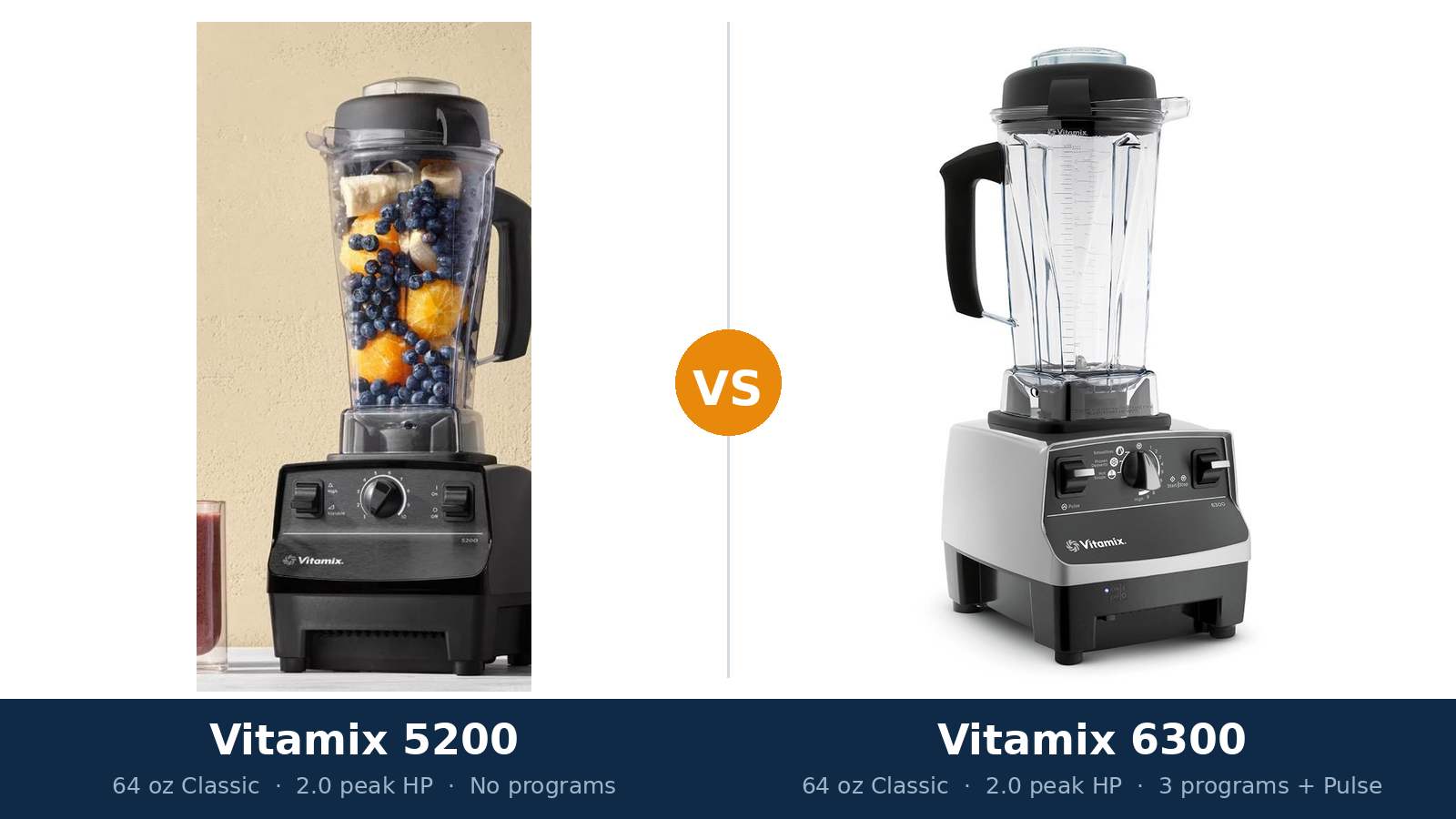
Same motor. Same tall jar. Same blades. Same seven-year promise.
The Vitamix 5200 and the Vitamix 6300 are both C-Series machines built on the one Classic platform. Each runs a ≈2 peak horsepower motor drawing 11.5 amps, and each ships with the same tall 64-ounce container.
So the hardware is not the decision. The control panel is. The 6300 adds three automatic programs and a Pulse switch to the Classic layout. The 5200 keeps the original formula: a speed dial, a High switch, and nothing you do not turn yourself.
The second difference is the calendar. The 5200 is still sold new by Vitamix today. The 6300 is discontinued, so buying one now means marketplace or reconditioned stock — and this guide treats that honestly, in the open, wherever it matters.
Every figure below comes from the two machines’ own owner’s manuals and Vitamix’s published product data. No borrowed numbers, no invented ones.
Key Takeaways
- The hardware is a tie. Same ≈2 peak HP motor, same 11.5 A draw, same tall 64 oz jar, same laser-cut stainless blades.
- The 6300’s panel is the upgrade. Smoothies, Frozen Desserts and Hot Soups programs that ramp up and stop on their own — plus a true Pulse switch the 5200 never had.
- The 5200 fights back with its High switch. One flip gives full speed and maximum motor cooling, with no dial sweep in between.
- Cleaning rules are identical. Both manuals bar the dishwasher for the container; both machines self-clean with the same soap-and-water cycle.
- Buying today splits them. The 5200 is sold new with a fresh warranty clock. The 6300 is discontinued — check the seller and the serial before you pay.
Quick Verdict
Buy the Vitamix 6300 if you can find genuine, checkable stock. It is the more complete machine.
Under the panel it is a 5200 — same motor, same jar, same blades. On the panel it adds the two things 5200 owners have always asked for: programs that run a smoothie or a soup cycle hands-free, and a Pulse switch for texture work.
Buy the Vitamix 5200 if you want to buy new. It is a current model, sold by Vitamix itself, and its seven-year warranty starts the day you buy it.
No conditions, no used-market lottery. For most buyers in 2026, that certainty is worth more than three programs.
The Scorecard
Scores below are derived directly from the manufacturer specifications compared in this guide — motor ratings, control sets, container data and published warranty terms. They are a reading aid, not benchmark results.
| Category | Vitamix 5200 | Vitamix 6300 | ||
|---|---|---|---|---|
| Power & motor | 8 / 10 | 8 / 10 | ||
| Programs & controls | 4 / 10 | 9 / 10 | ||
| Capacity & batch range | 9 / 10 | 9 / 10 | ||
| Cleaning | 7 / 10 | 7 / 10 | ||
| Footprint & storage | 7 / 10 | 7 / 10 | ||
| Warranty terms (as published) | 9 / 10 | 9 / 10 | ||
| Buying today: channel & support | 9 / 10 | 5 / 10 | ||
| Overall | 8.0 / 10 | 8.1 / 10 | ||
Read the pattern, not just the totals. The 6300 wins exactly one row outright — the control panel — and it is the row you touch every day.
The 5200’s 8.0 is the mark it carries across our C-Series guides. The 6300 edges ahead of it on identical hardware because of the programs and the pulse, and its discontinued channel is scored where it belongs: in the buying row, not hidden.
At a Glance: Who Each Blender Fits
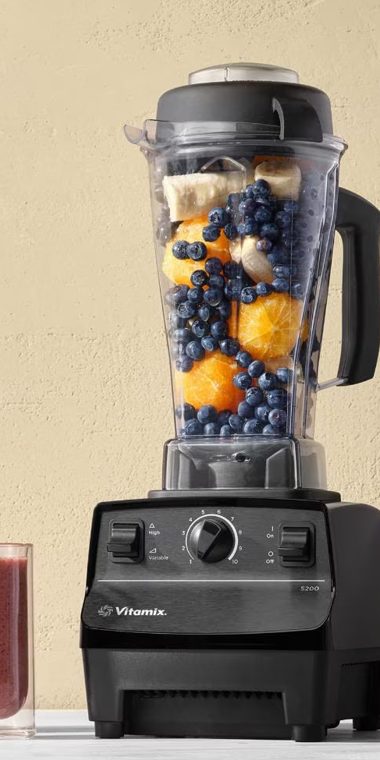
Vitamix 5200
- ≈2 peak HP motor, 11.5 A — the original C-Series drive
- Tall 64 oz Classic container, BPA-free Tritan
- Variable dial 1–10 plus a dedicated High switch
- No programs and no Pulse — fully manual control
- Sold new by Vitamix today; Amazon listing usually runs through marketplace sellers
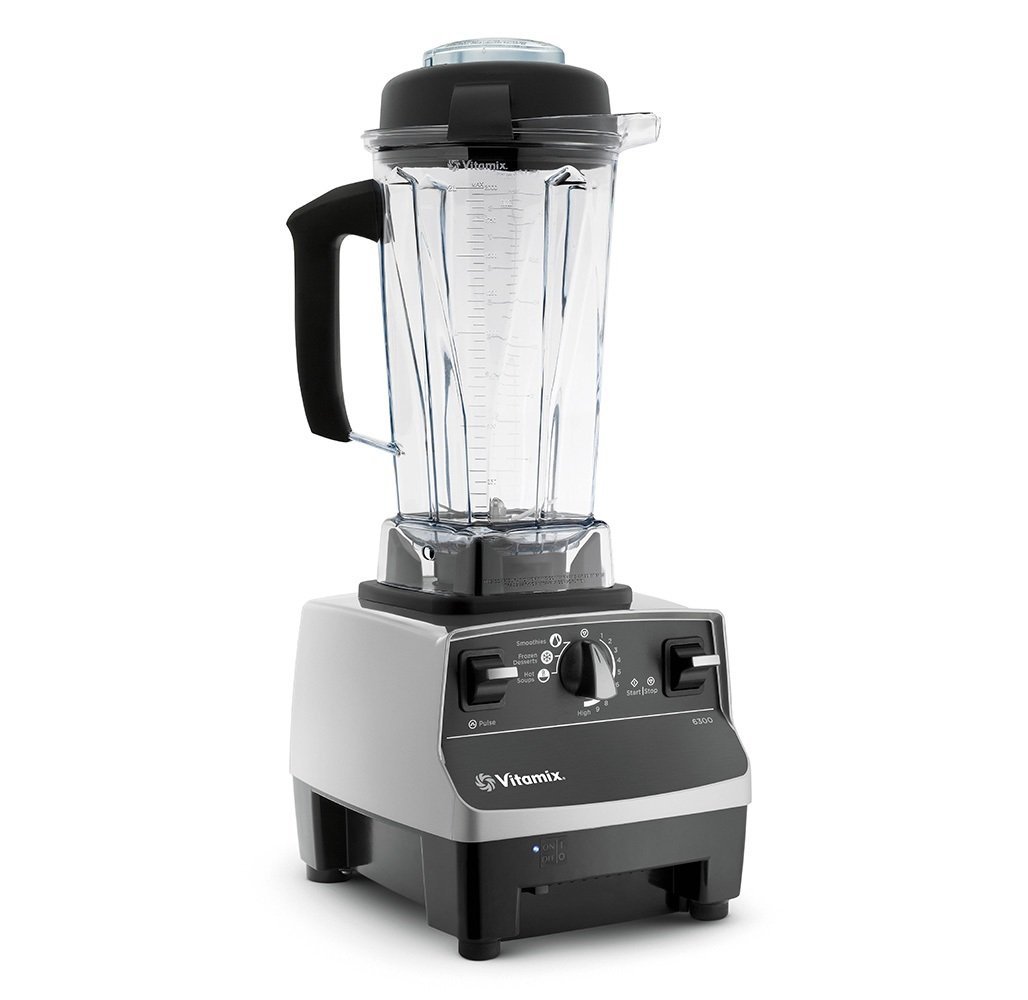
Vitamix 6300
- Same ≈2 peak HP motor and tall 64 oz jar as the 5200
- Three programs: Smoothies, Frozen Desserts, Hot Soups
- Pulse switch — at dial speed, or 50% of High inside a program
- Start/Stop and Pulse switches flank the dual-purpose dial
- Discontinued — Amazon stock is marketplace and reconditioned units
Choose the Vitamix 5200 if…
You want to buy new, from a maker who still sells the model, with the warranty clock starting today.
You blend manually anyway. Sauces, nut butters and doughs are dial-and-tamper work, and programs would sit unused.
You value the High switch. Instant full speed — and the maximum motor cooling that comes with it — is the 5200’s quiet advantage on long, thick blends.
Choose the Vitamix 6300 if…
Your routine is smoothies, soups and frozen desserts on repeat. Those are literally the three programs on the dial.
You chop as much as you blend. Salsa, dips and coarse textures are pulse work, and the 5200 simply has no pulse to offer.
And you are willing to buy carefully: a discontinued model, from a seller you can check, at a price that reflects its status.
As an Amazon Associate I earn from qualifying purchases at no extra cost to you.
Specifications: The Specs That Actually Matter
Every figure below is taken from the two owner’s manuals and Vitamix’s published product data. Where the manuals stay silent — wattage, for one — the table says so instead of borrowing a number from a review site.
| Specification | Vitamix 5200 | Vitamix 6300 |
|---|---|---|
| Series / platform | C-Series (Classic) | C-Series (Classic) |
| Model number | 001372 | VM0102B |
| Container | Tall 64 oz (2 L) Classic, 2-part lid, Classic tamper | Tall 64 oz (2 L) Classic, 2-part lid, Classic tamper |
| Container material | BPA-free Eastman Tritan copolyester | BPA-free Eastman Tritan copolyester |
| Motor | ≈2 peak output HP | ≈2 peak output HP |
| Electrical | 120 V, 11.5 A | 120 V, 50/60 Hz, 11.5 A |
| Speed settings | Variable dial 1–10, plus High via the High/Variable switch | Variable dial 1–10, High at the top of the dial |
| Pulse | None — no Pulse switch fitted | Yes — Pulse switch (dial speed in Variable; 50% of High in a program) |
| Programs / presets | None | 3 — Smoothies, Frozen Desserts, Hot Soups (ramp to High, stop automatically) |
| Controls | High/Variable switch, Variable Speed Dial, On/Off switch | Start/Stop switch, Pulse switch, Variable Speed/Programming Dial, On/Off switch |
| Blades | Laser-cut, hardened stainless steel wet blade (3 in) | Laser-cut, hardened stainless steel wet blade (3 in) |
| Dishwasher-safe parts | None — container, lid and tamper are hand-wash (owner’s manual) | None — container, lid, lid plug and tamper are hand-wash (owner’s manual) |
| Dimensions | 20.5 H × 7.25 W × 8.75 D in | 20.3 H × 8.8 W × 9.0 D in (owner’s manual) |
| Cord | 6 ft | Long cord, stores under the base (manual publishes no length) |
| Warranty | 7 years — Vitamix’s current page heads it “7-Year Limited” (see note) | 7-Year Full Machine Warranty (owner’s manual, incl. normal wear and tear) |
| Sold today as | New — sold direct by Vitamix; Amazon listing usually marketplace sellers | Discontinued — marketplace, used and reconditioned stock only |
Warranty wording note: the two seven-year terms are not described in identical words. The 6300’s manual prints a “7-Year Full Machine Warranty” that expressly covers normal wear and tear.
Vitamix’s current 5200 page heads its cover “7-Year Limited Warranty”, while the model’s manual and listing record describes the same full pattern — parts, labour and two-way shipping. We score both on the seven-year term and flag the adjective rather than lean on it.
Channel note: Vitamix sells the 5200 new today; its Amazon price slot commonly shows marketplace sellers rather than a featured offer. The 6300 left the range years ago — every unit behind its button is remaining, marketplace or reconditioned stock, and the buying guide below explains how to check one.
Wattage note: neither manual publishes a wattage. The shared electrical rating is 120 V at 11.5 A. Higher wattage figures quoted for either machine elsewhere are arithmetic or error, not Vitamix specifications.
The Differences That Actually Matter
1. Programs — the whole ballgame
Turn the 6300’s dial to the left of its centre stop and you are choosing a program, not a speed: Smoothies, Frozen Desserts or Hot Soups.
Each program starts low, ramps to High on its own schedule, and stops by itself at the end. Load the jar, press Start, and walk away.
The Hot Soups program is the clearest example. It runs the long, full-speed cycle that heats soup by blade friction — the same job the 5200 does, with the ramping and the timing handled for you.
The 5200 makes the identical soup. You are the program: start on 1, sweep the dial to 10, flip to High, and watch the clock yourself.
Neither method blends better. One of them lets you unload the dishwasher while it works.
2. Pulse vs the High switch — the texture divide
The 6300 has a real Pulse switch, and it is smarter than most. In Variable mode it pulses at whatever speed the dial shows.
Inside a program, it pulses at 50% of High. That is the tool for salsa, chopped herbs, crumb toppings — work where three one-second bursts beat ten seconds of blending.
The 5200’s second switch is not a pulse. It selects between Variable and High — and High matters, because it also runs the motor’s cooling fan at maximum.
But for texture, the 5200 owner has the dial and nothing else. There is no pulse function to reach for. On chopped and chunky work, this is the 6300’s cleanest win after the programs themselves.
3. Motor, jar and blades — a genuine tie
Strip the panels away and these are the same appliance. Both manuals rate the motor at ≈2 peak output horsepower on an 11.5-amp draw.
Both ship the same tall 64-ounce Classic container in BPA-free Tritan, with the same 3-inch laser-cut, hardened stainless wet blade and the same long Classic tamper.
That means the same strengths: family-size batches, friction-hot soup, nut butters worked with the tamper. And the same weakness — a tall jar needs a minimum volume to circulate, so small servings are neither machine’s game.
It also means the same accessory shelf. Classic-platform containers — the 48 oz and 32 oz jars, the Dry Grains container, the Personal Cup Adapter — fit both bases. SELF-DETECT containers from the Ascent line fit neither.
We will not manufacture a performance gap where the spec sheets show none. Blending quality is a draw.
4. Living with the two panels
The 6300 spreads four controls across the base: a lit On/Off switch below the panel, then Start/Stop and Pulse switches flanking one dual-purpose dial.
The dial itself is the learning curve. Left is programs, right is speeds 1 to High, and the stop symbol sits at the top, in the middle.
One behaviour worth knowing, straight from the manual: interrupt a program with the Start/Stop switch and it does not resume — press start again and the program begins from the top.
The 5200 is three controls in a row — High/Variable, dial, On/Off — and nothing to learn beyond them. Neither machine has a timer or a display.
If other people use your blender — partners, parents, teenagers — the 6300’s programs make their results more repeatable. If it is only ever you, the 5200’s simplicity costs nothing.
5. Size and storage — both are countertop tenants
Neither blender tucks under a standard wall cabinet with its jar on. The 5200 stands 20.5 inches tall; the 6300’s manual figures read 20.3 inches.
That fifth of an inch buys nothing in a real kitchen. Both machines live on the counter, or store with the jar off the base.
The 6300’s base is the wider of the two on paper — 8.8 inches against 7.25 — though in practice the two occupy the same class of counter corner.
Cord handling differs in detail: the 5200’s cord is a published 6 feet, while the 6300’s manual simply notes a long cord that stores underneath the base. Neither will decide this comparison.
6. Cleaning — identical rules, identical routine
Both manuals give the same cleaning method: half-fill the container with warm water, add a few drops of washing-up liquid, run up to High for 30 to 60 seconds, rinse and drain.
And both manuals give the same warning, in so many words: do not put the container, lid or tamper in the dishwasher.
The 5200’s feature list calls this cycle “Self-Cleaning”. It is the same soap cycle, not a program — and the 6300, for all its programs, does not have a cleaning program either.
Call cleaning a draw, because it is one. Buy the dishwasher-safe jar conversation out of this pairing entirely; it belongs to other models.
7. Warranty words, and the 2026 channel split
On paper the warranty row ties: seven years each, from the same era of Vitamix cover.
The 6300’s manual is the more generous document — a Full Machine Warranty that names normal wear and tear as covered, with Vitamix paying standard shipping both ways on a claim.
But a warranty is only as useful as the machine’s paperwork and history. A new 5200’s seven years start on the day you buy it, from a model Vitamix still sells and supports as current.
A 6300’s stock is discontinued. Vitamix’s own Certified Reconditioned route for this platform carried a five-year full warranty; a marketplace unit’s position depends on its seller and its past.
That is why the scorecard separates the two rows: the terms tie, the buying does not. The next section turns that into checks you can actually run.
Use-Case Fit Guide
Start from what you actually make. This table is the whole comparison in one view.
| Your routine | Vitamix 5200 | Vitamix 6300 | Our call |
|---|---|---|---|
| Morning smoothies for the family | Excellent — manual dial work | Excellent — Smoothies program, walk away | 6300 |
| Hot soup from raw ingredients | Excellent — you run the ramp to High | Excellent — Hot Soups program runs it for you | Tie; 6300 for hands-free |
| Frozen desserts and ice cream | Excellent — tamper work at High | Excellent — Frozen Desserts program | Tie; 6300 for repeatability |
| Salsa, chopping, coarse textures | Workable — dial only, no pulse | Excellent — true Pulse switch | 6300 |
| Nut butters and thick doughs | Excellent — tamper plus the High switch’s cooling | Excellent — tamper; pulse helps start thick mixes | Tie |
| Small single servings | Poor — tall jar needs volume | Poor — same tall jar | Neither — add a 48 oz container |
| Buying new, warranty from today | Excellent — current model, sold by Vitamix | Not available new | 5200 |
Notice the shape of it. The 6300 wins the daily-use rows; the 5200 wins the ownership row. Which table matters more to you is the real decision.
The 30-Second Decision
| If this sounds like you… | Buy this |
|---|---|
| “I want to press a program and walk away.” | Vitamix 6300 |
| “I want to buy new, with the warranty starting today.” | Vitamix 5200 |
| “I chop salsa and dips and want a real pulse.” | Vitamix 6300 |
| “I found a clean 6300 for less than a new 5200.” | Vitamix 6300 — if the seller and serial check out |
| “I blend manually anyway and never use presets.” | Vitamix 5200 |
| “It has to live under my cabinets.” | Neither — both stand over 20 in with the jar on |
Ready to check today’s price?
The 5200 sells new; on Amazon its listing usually runs through marketplace sellers. The 6300 is discontinued — its listing is remaining and reconditioned stock, so read the seller details carefully on either.
View on Amazon — Vitamix 5200View on Amazon — Vitamix 6300What You Gain. What You Give Up.
Vitamix 5200
You gain: a current model you can buy new today, with seven years of warranty starting at your purchase. The High switch’s instant full speed and maximum cooling. The simplest control panel Vitamix ever put on this platform.
You give up: programs — every cycle is run by hand. And a Pulse switch: texture work is dial work, with nothing in between.
Vitamix 6300
You gain: three automatic programs matched to the three things this platform makes most, and a proper Pulse switch with a program-mode setting of its own. The most complete control panel ever fitted to the tall-jar Classics.
You give up: the ability to buy it new. Every 6300 is discontinued stock now, so the warranty position and the machine’s history depend on the seller in front of you.
Pros and Cons
Vitamix 5200 — Pros
- Sold new by Vitamix today; warranty clock starts at purchase
- High switch gives instant full speed and maximum motor cooling
- Same motor, jar and blades as the 6300
- Three controls — nothing to learn, little to go wrong
Cons
- No programs of any kind
- No Pulse switch for texture work
- Tall jar — over 20 in on the base, weak at small batches
- Amazon price slot often shows marketplace sellers, not a featured offer
Vitamix 6300 — Pros
- Smoothies, Frozen Desserts and Hot Soups programs, fully automatic
- True Pulse switch — at dial speed, or 50% of High in a program
- Same proven ≈2 peak HP hardware as the 5200
- Manual prints a 7-Year Full Warranty including normal wear and tear
Cons
- Discontinued — no new stock from Vitamix
- Warranty position depends on the seller and the unit’s history
- Interrupted programs restart from the beginning
- Same tall-jar limits as the 5200
Buying a Discontinued Model Without Getting Burned
Check the model number. A true 6300 is model VM0102B, printed on the back of the motor base. The 5200 is model 001372.
Sellers use “6300” loosely. The model plate does not.
Check the panel. A 6300’s dial carries the three program names to the left of its stop position, with a Pulse switch on the panel.
If the panel shows a plain dial and a High/Variable switch, you are looking at a 5200 — whatever the listing title says.
Check what “reconditioned” means. Vitamix’s own Certified Reconditioned version of this platform was sold as the “Standard Programs”, with a five-year full warranty from Vitamix.
A third-party refurb is a different promise — or no promise. Ask who reconditioned it, and what warranty they themselves honour.
Check the box contents. Either machine should arrive with the tall 64 oz container, its 2-part lid, and the long Classic tamper made for that jar.
Lids and tampers are not interchangeable between container sizes. A short tamper in the box is a mismatch worth querying before you blend, not after.
For the 5200, check the channel. Vitamix sells it new direct; use that as your reference point when an Amazon marketplace offer looks odd.
Buy the 6300 when the unit, the seller and the paperwork all check out. Buy the 5200 when you would rather not run checks at all.
The Upgrade Path Test
Judge these machines by their fifth year, not their first week. On this platform, the upgrade path is containers, not bases.
Both bases accept the Classic container family: the 48 oz and 32 oz jars for smaller batches, the Dry Grains container for flour and coffee, and the Personal Cup Adapter for single servings.
A 48 oz container fixes the tall jar’s one real weakness — small batches — for far less than a new blender. It fits whichever of these two you buy.
The wall is equally clear on both: SELF-DETECT containers from the Ascent series fit neither base. If that ecosystem is where you are heading, neither machine is a stepping stone.
Parts support favours the platform, not the model. Lids, tampers and containers for the Classic line remain standard catalogue items, and both machines sit on Vitamix’s normal service footing.
When to Skip Both
Honesty cuts both ways. There are kitchens neither of these tall Classics serves well.
Skip both if the blender must store under wall cabinets with its jar on. Look at the low-profile 64 oz models instead — in this family, that means the 6500 and its G-Series relatives.
Skip both if a dishwasher-safe container is a hard requirement. The Explorian E310 and E320 manuals allow it; these two manuals do not.
Skip both if you want a timer, a display or app-era controls. That is the Ascent series’ ground, and neither Classic pretends to it.
And skip both if most of your blending is a single smoothie for one. A personal blender — or either base with the cup adapter — fits that life better than a tall 64 oz jar.
Support and Long-Term Ownership
Both machines sit on Vitamix’s standard support pages: manuals, warranty registration, and customer service for the Classic platform.
The 6300’s manual adds a detail worth knowing: its warranty is for household use, and it follows the owner — if the machine changes hands inside the term, Vitamix asks you to update the owner record rather than voiding the cover.
Both motors carry automatic overload protection. Trip it, and the fix is patience: let the machine cool before the next cycle, as the manuals direct.
Expect ownership to be uneventful in the way this platform is known for. The differences that matter are all at the buying stage, which is why this guide spends so much of its length there.
Final Verdict
The Vitamix 6300 is the better machine on the counter — narrowly.
The score is 8.1 to 8.0, and the margin is exactly one control panel. Same motor, same jar, same blades, same cleaning rules, same warranty term.
The 6300 adds the two features that change daily use: programs that run the three classic jobs hands-free, and a Pulse switch that makes texture work deliberate instead of approximate.
Buy the 6300 if the unit in front of you checks out — model VM0102B, the program dial on the panel, a seller who can speak for its history.
Buy the 5200 if you want the same blending with none of the detective work. It is the one we would send a friend to buy new, today, without a second thought.
It gives up the programs and the pulse. It gives back certainty: a current model, a fresh warranty, and a maker still standing behind the listing.
Watch Out: Similar Names, Different Blenders
C-Series names are a trap for the hurried buyer. Three warnings belong in this guide.
First: the 6300 is not the Professional Series 500. Both are programmed Classics with three presets, sold under different names through different channels. Match the model number — VM0102B — before you pay 6300 money.
Second: “Standard Programs” is not a separate model. It is the name Vitamix sold this platform under in its Certified Reconditioned store, with the five-year reconditioned warranty rather than the seven-year new-machine term.
Third: the 6500 is the sibling to look at if height is your problem — a low-profile 64 oz container and a higher ≈2.2 peak HP rating. It is not a 6300 with a shorter jar by another name; it is a different model with its own manual and parts.
Slow down on the product page. Match the model number, then the panel, then the price — in that order.
Frequently Asked Questions
What is the difference between the Vitamix 5200 and 6300?
Controls and availability. Both are C-Series machines with a ≈2 peak HP motor, an 11.5 A draw and the same tall 64 oz container. The 6300 adds three automatic programs (Smoothies, Frozen Desserts, Hot Soups) and a Pulse switch; the 5200 is fully manual, with a High/Variable switch instead. The 5200 is still sold new; the 6300 is discontinued.
Does the Vitamix 5200 have programs or a pulse?
No. The 5200’s control set is a Variable Speed Dial (1–10), a High/Variable switch and an On/Off switch. There are no preset programs and no Pulse switch — every cycle is run by hand, which is precisely the gap the 6300 was built to fill.
Can the 6300 make hot soup like the 5200?
Yes — by the same method. Both machines heat soup through blade friction at sustained high speed. The 6300’s Hot Soups program automates the ramp and the timing; on the 5200 you run the same profile manually, starting at Variable 1 and finishing on High.
Is the Vitamix 6300 discontinued?
Yes. Vitamix no longer sells the 6300 as a new model, so the units behind its Amazon button are remaining, marketplace and reconditioned stock. That is why this guide scores its buying channel separately from its hardware — and why the buying guide’s model, panel and seller checks matter.
Are the containers interchangeable between the 5200 and 6300?
Yes. Both bases belong to the Classic platform and ship with the same tall 64 oz container. The wider Classic container family — 48 oz, 32 oz, Dry Grains and the Personal Cup Adapter — fits both. SELF-DETECT containers made for the Ascent series fit neither.
Can either container go in the dishwasher?
No. Both owner’s manuals instruct you not to put the container, lid or tamper in the dishwasher. Both machines clean with the same routine instead: warm water, a few drops of washing-up liquid, 30 to 60 seconds up to High, then rinse and drain.
Which blender is better for small batches?
Neither, as shipped. The tall 64 oz jar both machines carry needs a minimum volume to circulate, so single servings are their shared weakness. The fix is the same for both: add the 48 oz Classic container, which fits either base, or use the Personal Cup Adapter.
What warranty does the Vitamix 6300 have?
When sold new, the 6300 carried a 7-Year Full Machine Warranty covering defects and normal wear and tear, per its owner’s manual. Certified Reconditioned units sold by Vitamix carried a five-year full warranty. A marketplace unit’s position depends on its seller and history — ask before you buy, and register the machine with Vitamix once it is yours.
Sources & Verification
Vitamix 6300 Owner’s Manual (Vita-Mix Corporation, Rev A 10/14): control panel, program settings, care and cleaning, 7-Year Full Machine Warranty, specifications (≈2 peak output HP; 120 V, 50/60 Hz, 11.5 A; 20.3 × 8.8 × 9.0 in) • Vitamix 5200 Owner’s Manual data (model 001372) and vitamix.com 5200 Getting Started page (model sold new and in stock; warranty headed “7-Year Limited Warranty”) • Vitamix product data for the Classic 64 oz container (BPA-free Eastman Tritan copolyester) • Amazon.com listing data for the Vitamix 5200 (B008H4SLV6) and Vitamix 6300 (B008FJEQYE). Specifications verified November 2026.

James Wilson
James has been building and benchmarking PCs for over a decade and writes Honestly Compared's motherboard and component guides. His rule for every comparison: the verdict has to survive the spec sheet, not the marketing page.