
Vitamix 5300 vs E320: Which Should You Buy?
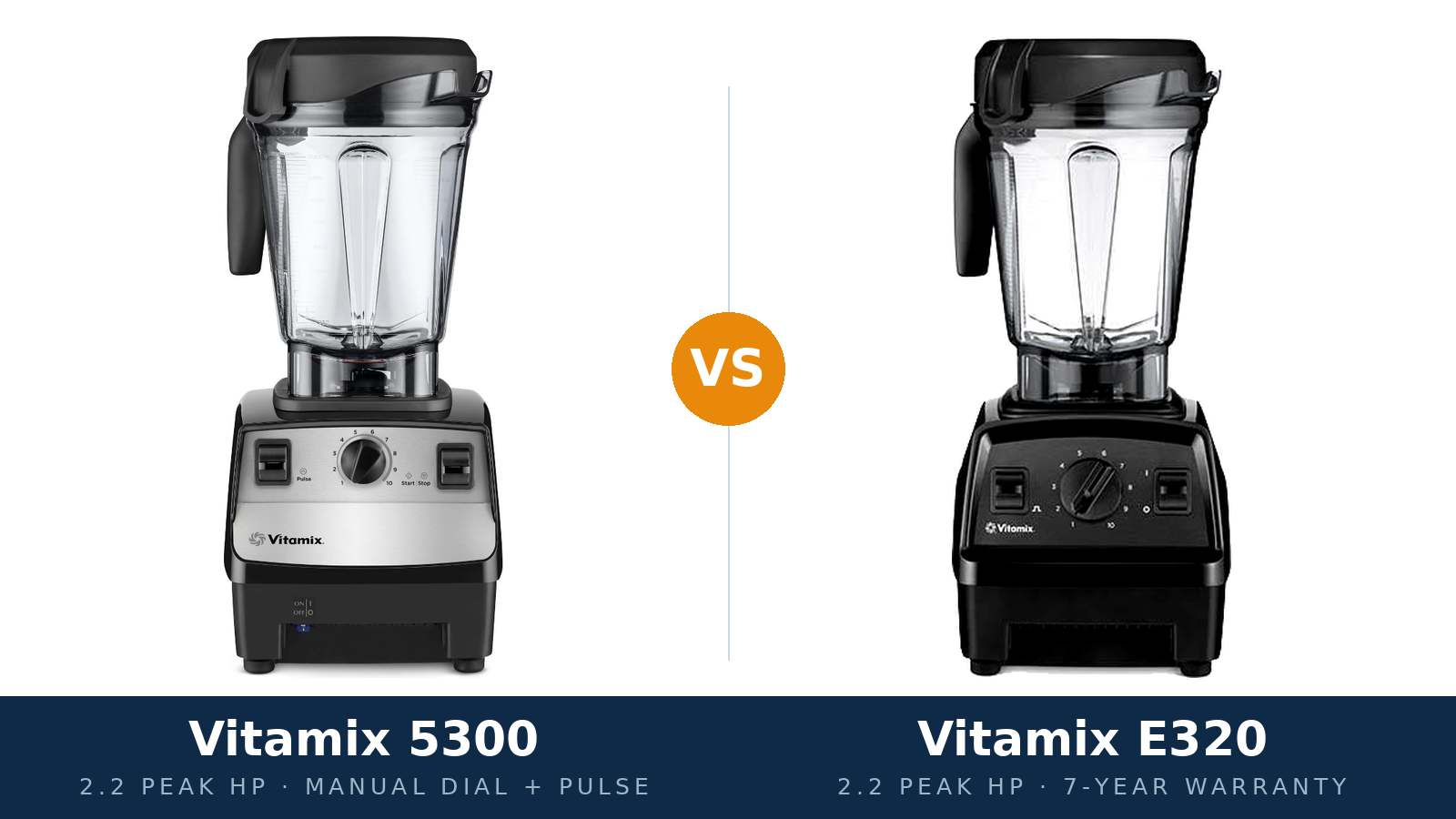
Two blenders. Same 64-ounce low-profile jar. Same 4-inch stainless blades. The same ≈2.2 peak horsepower motor class.
On a spec sheet, the Vitamix 5300 and the Vitamix E320 look like the same machine wearing two different badges. In a sense, they nearly are.
The E320 is the Explorian model that replaced the 5300 in Vitamix’s line-up. The 5300 was a C-Series machine built around the low-profile jar. The E320 is its successor, built on the newer Explorian base.
So this comparison has a twist most head-to-heads do not. The hardware is close to a draw. What separates these two in 2026 is everything around the hardware: how each one is cleaned, how each one is warranted, and how each one can actually be bought.
One determination up front, because it changes how you shop: you cannot buy a new 5300. It survives only as a Certified Reconditioned machine. The E320 is still sold new. That fact shapes the whole verdict below.
Key Takeaways
- Power, jar and blades are a near tie. Both are rated at ≈2.2 peak HP, drive the same 4-inch blades and ship with the same 64-oz low-profile container.
- Neither blender has programs. The new E320’s own manual shows a dial, a Pulse switch and an On/Off switch — nothing automatic. “E320 with programs” listings describe a reconditioned variant, not the new machine.
- The E320’s container can go in the dishwasher. Its manual allows a dishwasher cycle. The 5300’s manual explicitly forbids it.
- You cannot buy a new 5300. It exists now only through Vitamix’s Certified Reconditioned program, with a 5-year warranty instead of 7.
- The E320 is the current machine. Sold new by Vitamix, Costco and Amazon, with the full 7-year warranty — it is the 5300’s replacement, and it wins this comparison on ownership, not on blending.
Quick Verdict
Buy the Vitamix E320 for almost everyone. It matches the 5300 on the parts that touch your food, then beats it on everything about owning it.
Its container is dishwasher-safe by the manual. It is sold new with the full 7-year full warranty. And Vitamix still supports it as a current model, because it is one.
Buy the Vitamix 5300 as a Certified Reconditioned machine if the price is right. You give up the dishwasher-safe jar and two years of warranty. You keep the motor class, the jar and the blending results.
Through Vitamix’s own reconditioned program it remains an honest route into this performance class. Just go in knowing that “new 5300” listings are not what they claim — the only 5300s left are reconditioned ones.
The Scorecard
Scores below are derived directly from the manufacturer specifications compared in this guide — motor ratings, published dimensions, manual-stated care rules and warranty terms. They are a reading aid, not benchmark results.
| Category | Vitamix 5300 | Vitamix E320 | ||
|---|---|---|---|---|
| Power | 8.6 / 10 | 8.7 / 10 | ||
| Capacity & batch flexibility | 8.5 / 10 | 8.5 / 10 | ||
| Ease of use | 7.4 / 10 | 7.4 / 10 | ||
| Cleaning | 7.8 / 10 | 8.4 / 10 | ||
| Footprint & storage | 8.6 / 10 | 8.5 / 10 | ||
| Warranty & support (as sold today) | 7.5 / 10 | 9.0 / 10 | ||
| Value | 7.0 / 10 | 8.2 / 10 | ||
| Overall | 7.9 / 10 | 8.4 / 10 | ||
The pattern is consistent. Everything above the base — jar, blades, motor class — is shared. The E320 wins on the terms you buy it on and the care rules you live with.
At a Glance: Who Each Blender Fits
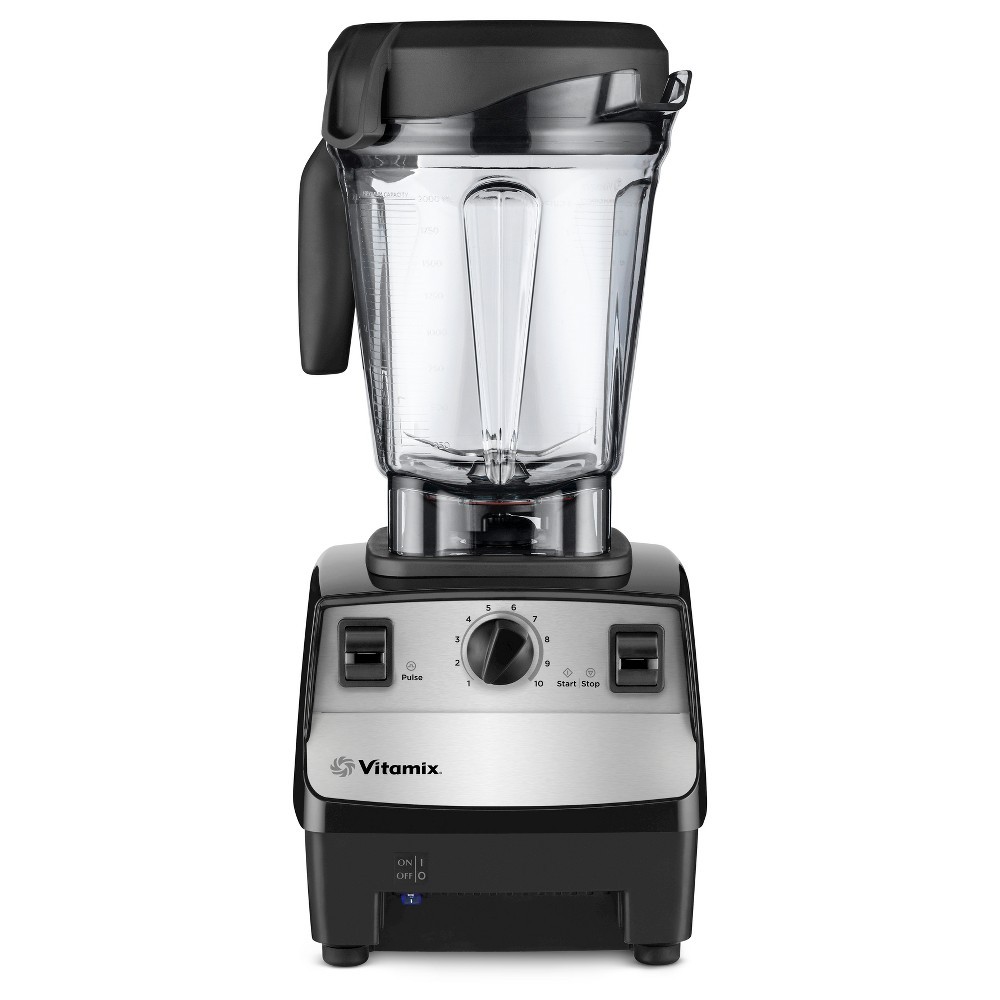
Vitamix 5300
- ≈2.2 peak HP motor, 11.5 A electrical rating
- 64-oz low-profile container, 4-inch stainless blades
- Manual only: 10 variable speeds + Pulse, no programs
- C-Series base, silver fascia, separate On/Off switch
- Sold new originally with a 7-year full warranty — now reconditioned only, 5-year warranty
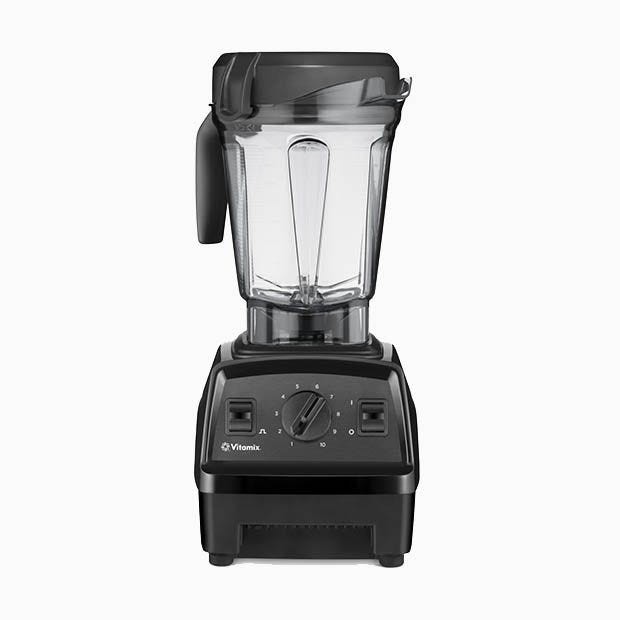
Vitamix E320
- ≈2.2 peak HP motor, 12 A electrical rating
- 64-oz low-profile container, 4-inch stainless blades
- Manual only: 10 variable speeds + Pulse, no programs
- Explorian base, black fascia, two-switch panel
- Sold new today with a 7-year full warranty
Choose the Vitamix 5300 if…
You are buying through Vitamix’s Certified Reconditioned program and the saving against a new E320 is real.
You blend manually anyway and have never once wished for a program button. The 5300’s dial-and-pulse layout is the same discipline the E320 demands.
You already hand-wash your blender jar as a matter of habit. Then the 5300’s one hard rule — no dishwasher for the container — costs you nothing.
Choose the Vitamix E320 if…
You want to buy new, with the full 7-year warranty starting the day the box arrives. That option simply does not exist on the 5300 side of this page.
You want to put the jar in the dishwasher and be done. The E320’s manual allows it. The 5300’s forbids it.
Or you want the machine Vitamix currently sells and supports as its entry-level full-size blender. The E320 is the 5300’s replacement. Buying the replacement is rarely the wrong call.
As an Amazon Associate I earn from qualifying purchases at no extra cost to you.
Specifications: The Specs That Actually Matter
Every figure below is taken from Vitamix’s own manuals and published product data, cross-checked against the manufacturer’s product data carried by retailers.
Two honest gaps apply to both machines: Vitamix rates this class by peak horsepower and amperage, and does not publish a clean US wattage figure for either model. Retail wattage numbers you may see elsewhere are conversions or imports from other markets.
| Specification | Vitamix 5300 | Vitamix E320 |
|---|---|---|
| Series / platform | Classic (C-Series), model VM0102D | Explorian Series, model VM0201 |
| Container | 64-oz low-profile, BPA-free Eastman Tritan | 64-oz low-profile, BPA-free Eastman Tritan |
| Motor | ≈2.2 peak output HP | ≈2.2 peak HP |
| Electrical | 120 V, 50/60 Hz, 11.5 A (no wattage published) | 120 V, 50/60 Hz, 12 A (no wattage published) |
| Blades | 4-inch laser-cut stainless steel, hammermill and cutting | 4-inch laser-cut stainless steel |
| Speed settings | Variable dial 1–10 | Variable dial 1–10 |
| Pulse | Yes — Pulse switch, pulses at the dial’s set speed | Yes — Pulse switch, pulses at the dial’s set speed |
| Programs / presets | None | None (new machine — see Difference 2) |
| Dimensions (H × W × D) | 17.25 × 8.8 × 9 in (manual) | 17 × 8 × 11 in (manual, with container) |
| Weight | ≈11.95 lb | ≈10.5 lb |
| Dishwasher-safe parts | None of the blending parts — manual prohibits container, lid, lid plug and tamper in the dishwasher | Container, lid, lid plug and tamper — manual allows a dishwasher cycle |
| Warranty | 7-year full when sold new; 5-year full as Certified Reconditioned — the only way it is sold now | 7-year full, sold new |
| In the box | Motor base, 64-oz low-profile container, low-profile tamper, Getting Started guide | Motor base, 64-oz low-profile container, tamper, cookbook, owner’s manual |
| Sold new today? | No — discontinued; Certified Reconditioned only | Yes — Vitamix direct, Costco and Amazon |
Motor note: Vitamix’s own documents disagree about the 5300. The original owner’s manual rates it at ≈2.2 peak output HP. The Certified Reconditioned manual for the same machine (VM0102D) prints ≈2.1.
There is no mechanical difference behind the two numbers. We use the original manual’s ≈2.2 figure, which also matches how the E320 is rated.
Height note: the E320’s US owner’s manual gives 17 inches with the container on the base. Vitamix’s later reconditioned and international manuals for the same model print 18.0 inches. We use the US manual figure; either way, both machines fit under standard 18-inch cabinet clearance only just — measure your counter before ordering either.
The Differences That Actually Matter
1. Power — an honest near-tie
Start with the number that sells blenders. Both machines sit in Vitamix’s ≈2.2 peak horsepower class.
Both drive the same 4-inch laser-cut stainless blades through the same wide 64-ounce jar. In the glass, there is nothing to choose between them.
The one published electrical gap is small: the E320’s manual rates it at 12 amps, the 5300’s at 11.5 amps. That is headroom on paper, not a different blending experience.
Neither manual publishes a US wattage. If a listing shows you a precise watt figure for either machine, it is a conversion or a number borrowed from another market’s model. Treat it as decoration.
And remember the 5300’s documentation quirk: its reconditioned manual prints ≈2.1 peak HP for the identical machine. The motor never changed. Only the paperwork did.
Call power a tie with a rounding-edge to the E320. Nobody has ever tasted the difference between 11.5 and 12 amps.
2. Programs — neither blender has any, whatever the listings say
This is the section where the E320’s marketing fog needs clearing, because it decides real purchases.
Open the new E320’s owner’s manual to the control panel page. It lists three controls: an On/Off switch, a Variable Speed Dial from 1 to 10, and a Pulse switch.
That is the whole panel. No Smoothies program. No Hot Soups program. No Frozen Desserts program. Nothing that starts, times itself and stops.
The 5300 is exactly the same. Dial, Pulse, switches. Two generations of the same manual philosophy.
So where does “E320 with programs” come from? From the reconditioned channel. Vitamix has sold a Certified Reconditioned variant described as having three programs, and shopping results blur it together with the new machine.
The Explorian that genuinely has three programs as a new model is the E520 — a different blender, covered in our E310 vs E520 comparison. If walk-away programs are what you want, that is the machine to look at, not this E320.
Score this difference a tie, and treat any listing that promises programs on a new E320 as a listing that has not read the manual.
3. Controls and base design — two panels, one discipline
The 5300 wears the C-Series silver fascia. Pulse switch on the left. Start/Stop switch on the right. The dial in the middle.
Its power switch sits separately, low on the base. Three switches and a dial, each doing exactly one thing.
The E320 wears the Explorian’s black panel. Two switches flank the dial — On/Off and Pulse — and the dial itself does the starting and stopping.
It is a slightly simpler panel with the same underlying discipline. You ramp the speed up yourself. You judge the texture yourself. You stop it yourself.
Pulse behaviour matches too. On both machines, the Pulse switch spins the blades at whatever speed the dial is showing. Set the dial low for chunky salsa work. Set it high for a finishing burst.
Neither base has the sound dampening Vitamix built into its G-Series machines. Both are loud in the honest way powerful blenders are loud. If a quiet base matters, you are shopping in the wrong comparison — see When to Skip Both.
4. Cleaning — the manual gives the E320 a real win
Both blenders self-clean the same way. Warm water, a drop of dish soap, run at high speed for 30 to 60 seconds, rinse.
For daily smoothie duty, that routine is genuinely enough on either machine. The difference appears on the days it is not.
The E320’s manual states that the container is designed to be cleaned in a dishwasher — a dishwasher cycle is presented as a complete cleaning method, and the lid, lid plug and tamper are dishwasher-safe too.
The 5300’s manual says the opposite, in plain terms. Do not put the container, lid, lid plug or tamper in the dishwasher.
Same jar shape. Same material family. Opposite rules — because the warranties behind them differ, and the manufacturer writes the rule it is willing to stand behind.
Follow the manual for the machine you own, not the one for its sibling. And if dishwasher cleaning is part of your routine, this difference alone can settle the comparison.
5. Size, shape and weight — same shelf, different footprint
Both machines were designed around the same problem: a 64-ounce jar that still fits under kitchen cabinets.
The 5300’s manual gives 17.25 inches tall, 8.8 wide and 9 deep. It is the wider, shallower machine.
The E320’s US manual gives 17 inches tall with the container seated, 8 wide and 11 deep. Narrower, but it reaches further back on the counter.
Note the paperwork conflict on the E320’s height: Vitamix’s later reconditioned and international manuals print 18.0 inches. We use the US owner’s manual’s 17 — but if your cabinet gap is exactly 18 inches, measure the actual machine before you commit.
Weight separates them more clearly. The E320 is about 10.5 pounds. The 5300 is about 11.95.
A pound and a half sounds trivial. It is the difference between sliding the blender out from under a cabinet one-handed and making it a two-handed job. For smaller households and smaller cooks, the E320 is simply the easier machine to live around.
6. Containers and accessories — one shared ecosystem
Here is the good news for upgraders: these two blenders speak the same container language.
Both are legacy-platform machines. Vitamix’s own manuals confirm that Legacy containers — the C-Series and G-Series jars — work on the Explorian base, and the 5300’s low-profile jar is the same design generation.
Both also work with the Personal Cup Adapter and its 20-ounce cups. The E320’s manual covers the cups directly. That is how a wide-jar machine does single servings.
And both draw the same hard line: Self-Detect containers do not work on either base. Those belong to the Ascent and Venturist lines.
Where the bundles differ is what arrives in the box. The standard E320 package is base, jar, tamper and cookbook. The E320 Super Pack — the bundle Vitamix sells direct and Costco is known for — adds the Personal Cup Adapter and two 20-ounce cups.
The 5300’s original box never included the adapter. If single-serve blending matters to you, price the adapter into any 5300 deal before you call it cheap.
7. Availability and warranty — the difference that decides it in 2026
Everything above this section is close. This section is not.
The 5300 is discontinued. Vitamix’s own product page for it is retired, and the model’s only Amazon listing is a Renewed one — for the Certified Reconditioned machine, carrying the reconditioned 5-year warranty.
That listing has also been showing no featured offers. A dead Renewed listing is the entire Amazon presence of the 5300 in 2026.
None of this makes the 5300 a bad buy. Vitamix’s reconditioned program is a genuine inspection-and-warranty operation, and a reconditioned 5300 from Vitamix direct is a legitimate machine with a legitimate 5-year full warranty.
But compare what the same money buys on the other side. The E320 is a current model. Vitamix sells it new today — including the Super Pack bundle — and it carries the full 7-year full warranty from new.
Seven years against five. New against reconditioned. A live model against a retired one. The blending is a tie. The ownership is not.
That is why the E320 wins this comparison — and why the 5300’s only winning move is price, through the reconditioned channel, with your eyes open.
Use-Case Fit Guide
The fastest way to choose between these blenders is to start from what you actually blend. This table is the whole comparison in one view.
| Your use case | Vitamix 5300 | Vitamix E320 | Our call |
|---|---|---|---|
| Family smoothies & big batches | Excellent — full 64-oz jar | Excellent — same jar | Dead tie; buy on channel and warranty |
| Hot soups | Excellent — friction heat on high | Excellent — same technique | Tie — start low, ramp up, per both manuals |
| Nut butters & thick mixes | Excellent — tamper included | Excellent — tamper included | Tie — one-minute circulation limit applies to both |
| Small single batches | Workable — wide jar needs roughly 2 cups minimum | Workable — same wide jar | Tie — add a 48-oz or 32-oz legacy container |
| Single-serve cups to go | Adapter sold separately | Included in the Super Pack bundle | E320 Super Pack |
| Dishwasher-first clean-up | Container must be hand-washed | Container is dishwasher-safe | E320, clearly |
| Buying brand-new, full warranty | Not possible — reconditioned only | Yes — 7-year full warranty | E320, by default |
| Lowest-cost route into the class | Certified Reconditioned direct from Vitamix | Costs more, bought new | 5300 — if the saving is real |
Read the pattern, not just the rows. Every blending task is a tie. Every ownership task points at the E320 — except the last one, which is the 5300’s whole reason to still exist.
Ready to check today’s price?
The E320 sells new through Amazon. The 5300’s Amazon listing is its Renewed one — check what is actually being offered before you compare figures.
View on Amazon — Vitamix 5300View on Amazon — Vitamix E320The 30-Second Decision
| If this sounds like you… | Buy this |
|---|---|
| “I want to buy new, with the full 7-year warranty.” | Vitamix E320 |
| “I found a reconditioned 5300 at a sharp price and I blend manually anyway.” | Vitamix 5300 (Certified Reconditioned) |
| “I hate hand-washing blender jars.” | Vitamix E320 |
| “I want programs that run themselves and stop.” | Neither — look at the E520 or a G-Series machine |
| “I already own legacy Vitamix containers.” | Either — both bases run them |
| “I want single-serve cups in the box.” | Vitamix E320 Super Pack bundle |
What You Gain. What You Give Up.
Vitamix 5300
You gain: the cheapest honest route into the 2.2 HP, 64-ounce low-profile class — through Vitamix’s own reconditioned program, with a 5-year full warranty and the same jar and blades as the current machine.
You give up: buying new, two years of warranty, and the dishwasher. The container is hand-wash only by its manual, and the model behind your machine is retired.
Vitamix E320
You gain: the same blending hardware as a current model — sold new, warranted for a full seven years, with a dishwasher-safe container and a lighter base that is easier to move around the counter.
You give up: the reconditioned bargain. A new E320 costs more than a reconditioned 5300, and for that premium you get ownership terms, not better smoothies.
Pros and Cons
Vitamix 5300 — Pros
- Same ≈2.2 peak HP class, jar and 4-inch blades as the E320
- Cheapest route in, via Certified Reconditioned
- Full manual control with a proper Pulse switch
- Shallower footprint — 9 in deep against 11
- Reconditioned units carry a real 5-year full warranty
Cons
- Cannot be bought new — discontinued
- Container, lid and tamper are not dishwasher-safe
- Heavier base, ≈11.95 lb
- No programs — same as the E320
- Amazon presence is a Renewed listing with no featured offers
Vitamix E320 — Pros
- Sold new today, with a 7-year full warranty
- Container and parts are dishwasher-safe per the manual
- Same ≈2.2 peak HP class and 64-oz low-profile jar
- Lighter, ≈10.5 lb, and a simpler two-switch panel
- Super Pack bundle adds cups and adapter
Cons
- No programs — “with programs” listings are the reconditioned variant
- Costs more than a reconditioned 5300
- Deeper footprint — 11 in front to back
- Wide jar is clumsy for small batches
- No sound dampening — same as the 5300
Buy the Channel as Carefully as the Machine
Check which 5300 you are looking at. Every 5300 on sale in 2026 is a reconditioned machine, whatever the listing headline implies.
Vitamix’s Certified Reconditioned 5300 carries a 5-year full warranty. Amazon’s Renewed channel is the same idea through a different door — and at the time of writing, its listing shows no featured offers at all.
The cleanest 5300 purchase is the reconditioned one sold by Vitamix itself. If a marketplace listing promises a “new” 5300, ask where it has been sitting for a decade.
Check which E320 bundle you are looking at. The name covers at least two boxes.
The standard package is the base, the 64-ounce low-profile container, a tamper and a cookbook. The Super Pack adds the Personal Cup Adapter and two 20-ounce cups — the bundle Vitamix sells direct and warehouse clubs are known for.
Neither box contains programs. If a listing for a new E320 advertises Smoothies, Hot Soups or Frozen Desserts programs, you are looking at a reconditioned variant or a listing that has confused the E320 with the E520.
Check the colour and the warranty start. Both machines were sold in black and red. On the E320 side, a new machine’s 7-year warranty starts at purchase. On the 5300 side, confirm in writing whether the warranty is Vitamix’s 5-year reconditioned term before you pay.
The Longevity Test
Judge these blenders by their fifth year, not their first week.
In year one, they are indistinguishable in the glass. Same jar, same blades, same class of motor turning them. Nobody’s smoothie exposes a winner.
Year three is where the ownership gap opens. The E320 owner is midway through a 7-year warranty on a machine Vitamix still sells. The reconditioned 5300 owner is midway through a 5-year term on a retired model.
Accessories age well on both. Legacy containers and the Personal Cup Adapter fit both bases, so money spent on jars is not stranded on either side.
The one upgrade neither machine allows is the smart one. Self-Detect containers will never work on these bases. If the Ascent ecosystem is in your future, it starts with a different blender entirely.
Longevity verdict: the E320 is built to be owned longer, on paper and in practice. The 5300 is built to be bought cheaper. Both are honest propositions — for different buyers.
When to Skip Both
Honesty cuts both ways. There are buyers neither of these blenders serves well.
Skip both if you want programs that run themselves. That buyer wants the E520 in this price class, or a Professional Series 750 above it. Both of those stop on their own. These two never will.
Skip both if small daily batches are your main use. A wide 64-ounce jar is the wrong tool for a single smoothie — both machines ask for roughly two cups before the blades bite properly. A 48-ounce model or a personal blender serves that life better.
Skip both if a quiet kitchen matters. Neither base has sound dampening. Vitamix reserved that for its G-Series and Ascent machines.
And skip both if you are drawn to app control, timers and self-detecting containers. That is the Ascent line’s entire reason to exist.
For everyone else — manual blenders who want the big jar and the big motor — one of these two is the right answer. The only question is whether you buy it new or reconditioned.
Warranty and Long-Term Support
Warranty terms, stated exactly as the manufacturers publish them:
The E320, bought new, carries a 7-year full warranty. The 5300 carried the same 7-year full warranty when it was sold new — but the machines you can actually buy in 2026 are Certified Reconditioned, and those carry a 5-year full warranty.
Reconditioned E320s exist too, with shorter terms again — the Renewed Premium version carries 3 years. Always match the warranty to the channel, not the model name.
Support depth follows the same split. The E320 is a current model: parts, containers and service all sit in Vitamix’s active catalogue.
The 5300’s containers and tampers remain easy to source because the low-profile jar is shared across generations. Base service for a retired model is the thinner ice — another reason the reconditioned warranty matters.
One habit protects either purchase: register the machine with Vitamix when it arrives, and keep the receipt with the warranty term printed on it. Five, seven or three years — the paper is what you will be holding.
Final Verdict
The Vitamix E320 is the blender we would buy.
It wins this comparison the way successors are supposed to win. Not by blending better — the jar, blades and motor class it inherited see to that — but by being the better machine to own.
It is sold new, with the full 7-year warranty. Its container goes in the dishwasher. Its base is a pound and a half lighter. It is the model Vitamix currently makes, sells and supports.
Buy the E320 if you are purchasing a blender to keep. For families, for daily use, for anyone who values the warranty and the dishwasher over the discount.
Buy the 5300 only as what it now is: a Certified Reconditioned machine, priced like one.
Bought that way — ideally from Vitamix’s own reconditioned program, with the 5-year warranty confirmed — it delivers the same blending for less money. That is a rational purchase. Just do not let any listing sell it to you as a new blender, because no such thing exists.
Watch Out: Similar Names, Different Blenders
Vitamix model names are a trap for the hurried buyer. Four warnings belong in every version of this guide.
First: the E320 is not the E310. The E310 is its Explorian sibling with a smaller 48-ounce container, a 2.0 HP rating and a 5-year warranty. Same family, different machine.
Second: the Explorian with three programs is the E520, not the E320. “E320 with programs” describes a reconditioned variant sold through Vitamix’s reconditioned channel — the new E320’s manual lists no programs at all.
Third: the 5300 is not the 5200 and not the 7500. The 5200 is the tall-jar Classic. The 7500 is a G-Series machine with a quieter base. The 5300 is the C-Series hybrid that paired the classic base with the low-profile jar.
Fourth: a “5300C” is the same 5300 — the suffix marked the warehouse-club channel the model was originally built for. It is not an upgrade.
Slow down on the product page. Match the full model name, then the channel — new or reconditioned — then the warranty term. In that order.
Frequently Asked Questions
Is the Vitamix E320 just a renamed 5300?
No — it is the 5300’s successor, not its alias. The E320 sits on the newer Explorian base with a simpler two-switch panel, a 12-amp rating against 11.5, and a container its manual allows in the dishwasher. The jar, 4-inch blades and ≈2.2 peak HP motor class are shared, which is why the two are so often confused.
Does the Vitamix E320 have programs?
The new E320 does not. Its owner’s manual lists an On/Off switch, a 1–10 variable speed dial and a Pulse switch — no preset programs. A Certified Reconditioned variant described as having three programs has been sold through Vitamix’s reconditioned channel, and the new Explorian that genuinely has three programs is the E520.
Can I still buy a new Vitamix 5300?
No. The 5300 is discontinued, Vitamix’s product page for it is retired, and its only Amazon listing is a Renewed one for the Certified Reconditioned machine — which has also been showing no featured offers. New-old-stock claims for a model retired years ago should be treated with suspicion.
Which is more powerful, the 5300 or the E320?
On paper they are the same class: both are rated at ≈2.2 peak HP and drive identical 4-inch blades. The E320’s manual shows a slightly higher electrical rating (12 A against 11.5 A). Neither manual publishes a US wattage. In actual blending, treat them as equals.
Is the E320’s container really dishwasher-safe?
Yes, according to its owner’s manual, which presents a dishwasher cycle as a complete cleaning method for the container and lists the lid, lid plug and tamper as dishwasher-safe. The 5300’s manual states the opposite for its container and parts. Follow the manual written for your machine.
Will my older Vitamix containers fit these blenders?
Legacy containers — the C-Series and G-Series jars — work on both bases, and both accept the Personal Cup Adapter with 20-ounce cups. Self-Detect containers from the Ascent and Venturist lines do not work on either machine.
What warranty do I actually get with each?
A new E320 carries a 7-year full warranty. A 5300 bought today is a Certified Reconditioned machine with a 5-year full warranty; the 7-year term only applied when it was sold new. Reconditioned E320s carry shorter terms again — 3 years on the Renewed Premium version.
Why do the 5300’s manuals disagree about horsepower?
The original owner’s manual rates the 5300 at ≈2.2 peak output HP; the Certified Reconditioned manual for the same machine (VM0102D) prints ≈2.1. It is a documentation inconsistency, not a hardware change — the motor is the same in both documents.
Sources & Verification
Vitamix 5300 Owner’s Manual, original edition (document 111861_A) • Vitamix Certified Reconditioned 5300 Owner’s Manual VM0102D (vitamix.com) • Vitamix E320 Owner’s Manual, Explorian Series VM0201 / US Explorian manual (vitamix.com) • Vitamix E320 + Personal Cup Adapter product page (vitamix.com, live at time of writing) • Vitamix manufacturer product data via authorised retailers for dimensions, weight and box contents • Amazon.com listing data for the E320 (ASIN B08JXHQ3YF, UPC-verified) and the 5300’s Renewed listing. Specifications verified November 2026.

James Wilson
James has been building and benchmarking PCs for over a decade and writes Honestly Compared's motherboard and component guides. His rule for every comparison: the verdict has to survive the spec sheet, not the marketing page.