
Vitamix VX1 vs Vitamix 5200: Which Should You Buy?
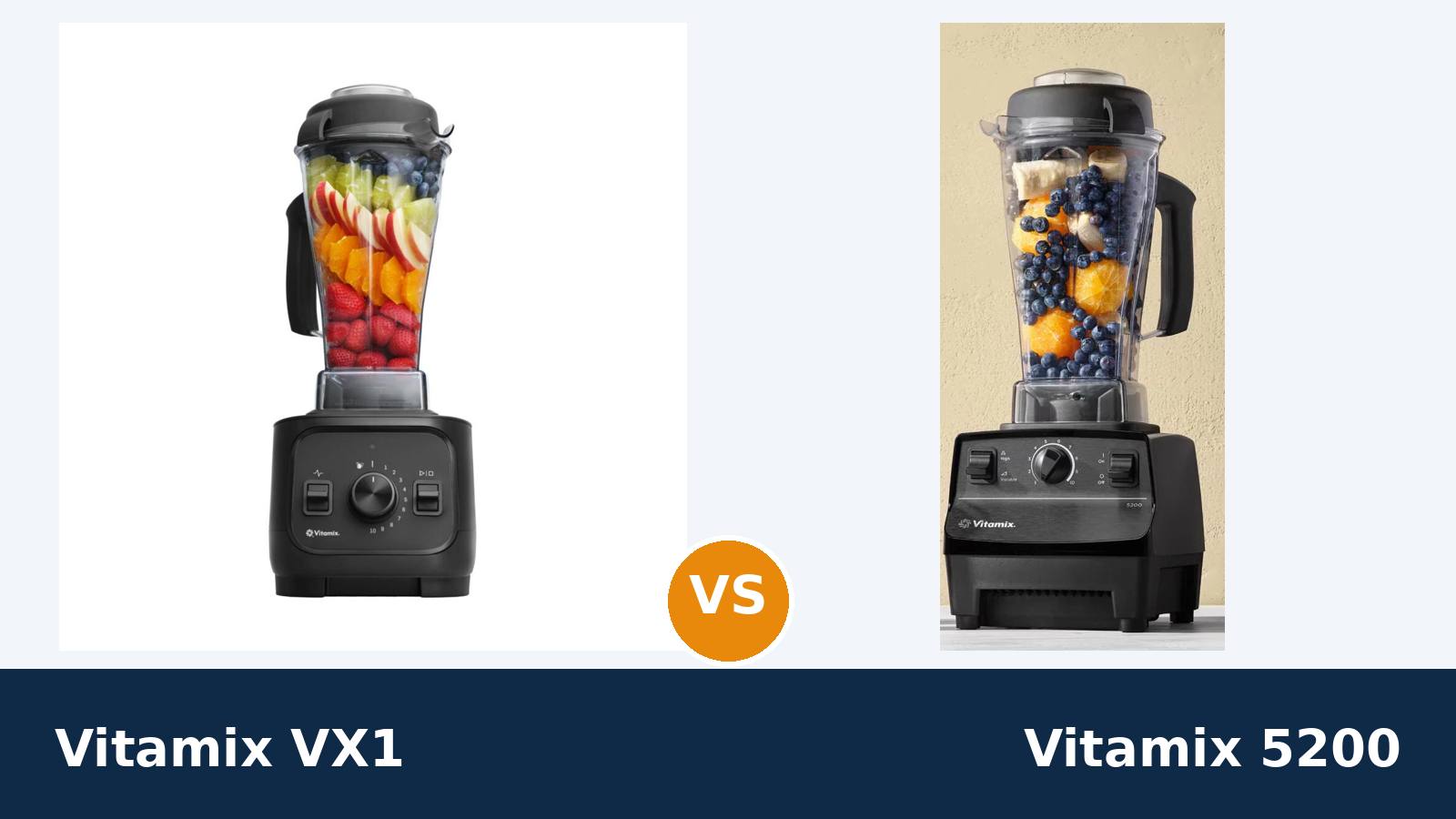
One of these blenders has been on sale for nearly two decades. The other one barely existed a year ago.
The Vitamix 5200 is the classic: the machine that built the brand's reputation, still sold new today. The Vitamix VX1 is the newcomer nobody had heard of until 2026 — an entry-level full-size model that quietly took over the bottom of the Vitamix range.
Here is what makes this comparison genuinely confusing. Both machines ship with the exact same 64-ounce Classic container. Both run laser-cut stainless-steel blades. Both are built around a simple variable-speed dial, with no touchscreen and no app.
So what, exactly, does the newer machine change? And is the original still worth buying? Every specification below comes from Vitamix's own manuals and product pages. The verdict at the end is the one we would give a friend spending their own money.
Key Takeaways
- The VX1 is real, and it is current. Vitamix launched it in early 2026 as its entry-level full-size blender — it has its own owner's manual, its own model number (075804), and a place in the official range.
- The container is a dead tie. Both machines use the same Classic 64-ounce container (part VM0135) — Vitamix's own copy for the VX1 says so outright.
- The VX1 adds the two controls the 5200 never had: a dedicated Pulse switch and an automatic Self-Cleaning program, plus a blend timer and status light.
- The 5200 fights back on ownership: a 7-year warranty against the VX1's 5 years, and a 6-foot cord against 3.5 feet.
- On published figures the VX1 is the stronger motor: 2.2 HP and 1,440 W against the 5200's roughly 2 peak HP and 1,380 W — though the two ratings are not measured the same way.
Quick Verdict
Buy the Vitamix VX1 if you are buying your first Vitamix. It is the current entry model, it carries the stronger published motor figures, and it fixes the 5200's two most dated omissions: no pulse, and no automatic cleaning cycle.
It is also nearly an inch shorter with the container fitted, which matters in real kitchens. For most new buyers, this is the default choice.
Buy the Vitamix 5200 if warranty length is your top priority. Its 7-year cover beats the VX1's 5 years, its cord is almost twice as long, and its narrower base leaves more counter free.
It remains a fully current product — Vitamix sells it new on its own site today. Just know you are giving up pulse and the cleaning program to get it.
The Scorecard
Scores below are derived directly from the manufacturer specifications compared in this guide — published motor ratings, control layouts, dimensions and warranty terms. They are a reading aid, not benchmark results.
| Category | Vitamix VX1 | Vitamix 5200 | ||
|---|---|---|---|---|
| Power (published figures) | 9 / 10 | 8 / 10 | ||
| Capacity & container | 9 / 10 | 9 / 10 | ||
| Controls & ease of use | 9 / 10 | 7 / 10 | ||
| Cleaning | 8 / 10 | 7 / 10 | ||
| Footprint & storage | 7 / 10 | 8 / 10 | ||
| Warranty & support | 7 / 10 | 9 / 10 | ||
| Overall | 8.2 / 10 | 8.0 / 10 | ||
The pattern is generational. The VX1 wins on controls and published power. The 5200 wins on the ownership details — warranty and cord. The blending hardware in the middle, the part that touches your food, is shared.
At a Glance: Who Each Blender Fits
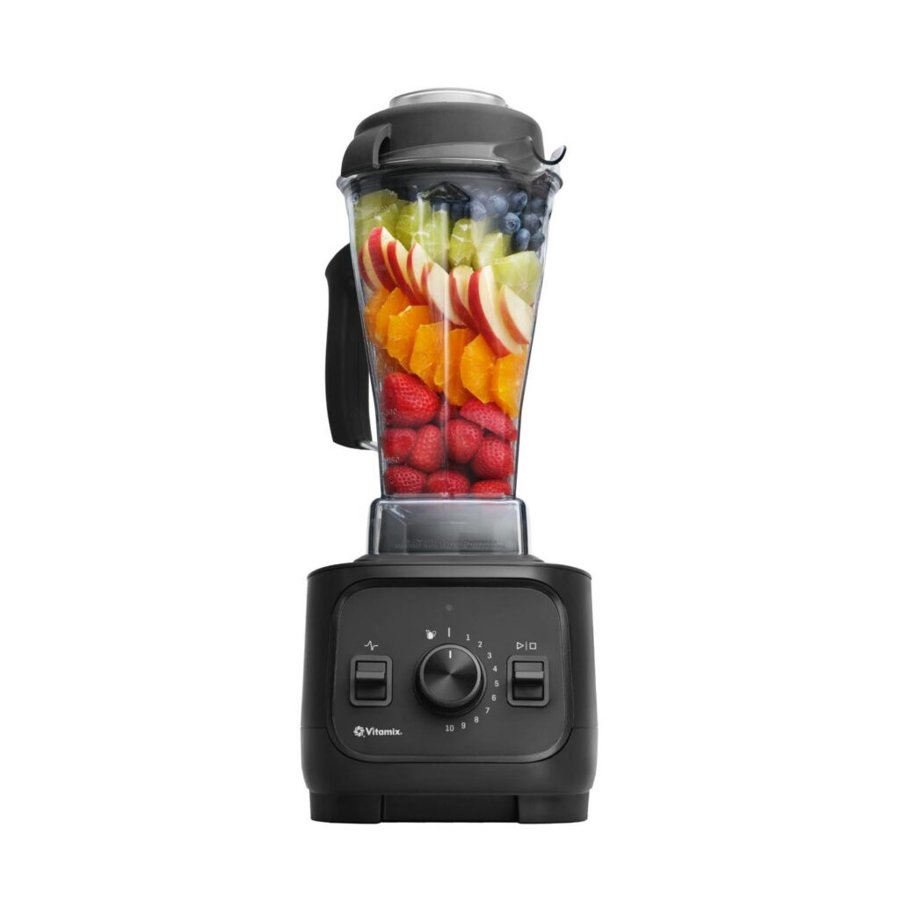
Vitamix VX1
- 2.2 HP motor, 1,440 W (12 A) per the owner's manual
- Dedicated Pulse switch and Self-Cleaning program
- Same Classic 64 oz container as the 5200
- Blend timer display and status light
- 5-year limited warranty; 19.6 in tall assembled
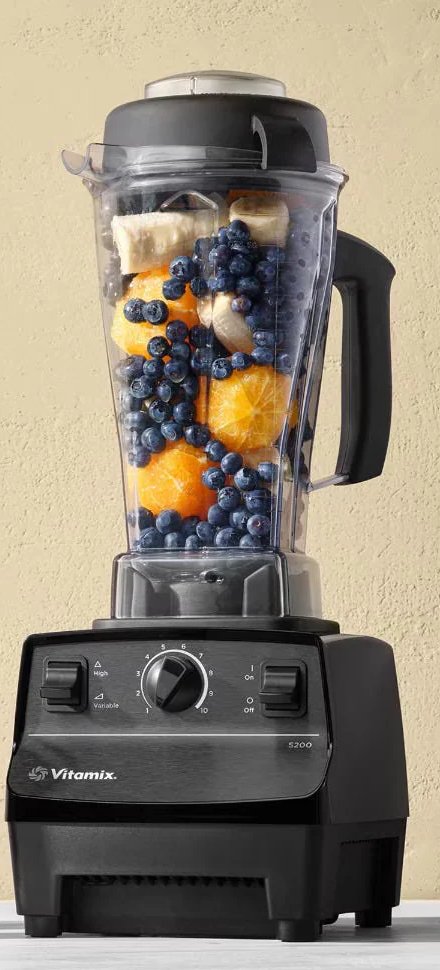
Vitamix 5200
- Approx. 2 peak HP motor, 1,380 W (11.5 A)
- Variable dial plus High switch — no pulse
- Classic 64 oz container, friction-heat hot soups
- 6 ft cord and the narrower footprint
- 7-year warranty; still sold new by Vitamix
Choose the Vitamix VX1 if…
This is your first high-performance blender and you want the current model, not the back catalogue.
You make salsas, dips or doughs where texture control matters. The Pulse switch exists for exactly that work.
Your cabinets are low. At 19.6 inches assembled, the VX1 is the shorter of the two — measure first, but it starts ahead.
Choose the Vitamix 5200 if…
You plan to keep this machine for a decade and want the longest warranty on the page: seven years.
Your outlet is not next to the counter spot. A 6-foot cord reaches places a 3.5-foot cord simply cannot.
Or you found one at a strong discount, new or Certified Reconditioned. At the right price, its missing pulse stops mattering.
As an Amazon Associate I earn from qualifying purchases at no extra cost to you.
Specifications: The Specs That Actually Matter
Every figure below is taken from Vitamix's published specifications and owner's manuals, cross-checked against the manufacturer's product data.
Where a figure comes from the manual rather than marketing copy, the manual wins. Two wording conflicts are material enough to get their own notes under the table.
| Specification | Vitamix VX1 | Vitamix 5200 |
|---|---|---|
| Container capacity | 64 oz (2.0 L) Classic container | 64 oz (2.0 L) Classic container |
| Motor (as published) | 2.2 HP; 1,440 W, 12 A (manual rating) | Approx. 2 peak HP; 1,380 W, 11.5 A |
| Blade design | Laser-cut, hardened stainless steel | Laser-cut, hardened stainless steel |
| Speed control | Variable Speed Dial 1–10, plus Standby position | Variable Speed Dial 1–10, plus High switch |
| Pulse | Yes — dedicated Pulse switch, at the speed set on the dial | None |
| Programs | Self-Cleaning program (automatic stop) | None — self-cleaning is a manual method |
| Timer & indicators | Blend timer display; status indicator light | None |
| Container material | BPA-free Eastman Tritan copolyester | BPA-free Eastman Tritan copolyester |
| Dimensions (assembled) | 7.75 in W × 9.5 in D × 19.6 in H | 7.25 in W × 8.75 in D × 20.5 in H |
| Cord length | 3.5 ft | 6 ft |
| Dishwasher-safe parts | Tamper and centering pad only — container is not dishwasher safe | None published — manual says do not put container, lid or lid plug in the dishwasher |
| Warranty (new units) | 5-year limited warranty | 7-year warranty |
| In the box | Motor base, Classic 64 oz container, Classic tamper | Motor base, Classic 64 oz container, Classic tamper |
| Container compatibility | Legacy Classic containers and attachments; SELF-DETECT cups and bowls do not work | Legacy Classic (C-Series) containers and attachments; no SELF-DETECT |
Warranty wording note: the 5200's manual header and Vitamix's product page call its cover a “7-year limited warranty”, while Vitamix's own retail copy elsewhere describes a “7-year full warranty” covering parts, labour and return shipping both ways. Either way, the term is seven years — two more than the VX1's five.
Reconditioned note: both names also exist in Vitamix's Certified Reconditioned channel, with shorter cover. The VX1 manual hosted on vitamix.com is the reconditioned edition, and it states a 3-year warranty — that figure applies to reconditioned VX1 units, not new ones. Check which channel a listing belongs to before comparing prices.
The Differences That Actually Matter
1. Power on paper — 2.2 HP against roughly 2 peak HP
Start with the numbers Vitamix itself publishes. The VX1 is rated at 2.2 HP on Vitamix's product page, and its manual specifies 120 V, 12 A, 1,440 W.
The 5200's manual describes a motor of approximately 2 peak output horsepower. Its electrical rating is 11.5 A, which is where the widely listed 1,380 W figure comes from.
On paper, then, the newcomer is the stronger machine. Read that claim carefully, though.
“Peak” horsepower and rated horsepower are not the same measurement, and these two figures were published almost twenty years apart. Neither number tells you, on its own, how a smoothie will turn out.
What settles real blends is the system: motor, blade geometry and container shape working together. The container and blade design are shared here, so the honest reading is narrow — the VX1 holds a modest edge in published motor figures, not a proven edge in the glass.
2. Pulse — the control the 5200 never had
This is the clearest functional gap in the comparison. The word “pulse” does not appear anywhere in the 5200's owner's manual.
Its panel is three controls: an On/Off switch, the variable dial, and a High/Variable switch. To chop coarsely on a 5200, you flick the machine on and off at a low speed by hand and judge the result by eye.
The VX1 adds a dedicated Pulse switch on the left of its panel. It pulses at whatever speed the dial is set to, so a burst at speed 3 and a burst at speed 10 are both available without touching the dial.
For smoothies and soups, you will rarely miss pulse. For salsa, breadcrumbs, chopped nuts and dough, it is the difference between a controlled texture and a purée you did not ask for.
If your cooking leans chunky, this single switch is a legitimate reason to choose the VX1 on its own.
3. The Self-Cleaning program, the timer and the status light
Both machines clean the same fundamental way: warm water, a drop of dish soap, run the machine, rinse. Neither container goes in the dishwasher — both manuals say so, in the VX1's case twice.
The difference is who runs the cycle. On the 5200, you do: Vitamix's product page describes the method — run on High for 30 to 60 seconds, no disassembly.
On the VX1, you turn the dial counter-clockwise to the Self-Cleaning position and the machine runs the cycle and stops by itself. A small thing, repeated daily, for years.
The VX1 also shows a running blend timer and carries a status light that dims in Standby and flashes if the motor overheats. The 5200 gives you none of that feedback.
Its thermal protection still exists — both machines shut down to protect the motor — but on the 5200 you learn about it when the machine stops, not before.
4. The container and blades — an honest, complete tie
Now the part of the machine that actually touches your food. It is identical.
Vitamix's own description of the VX1 states that its 64-ounce Classic container is “the same container featured on the iconic Vitamix 5200”. The VX1 manual identifies it by part number: VM0135.
Same tall, narrow Tritan copolyester container. Same two-part lid. Same classic tamper, roughly 12.5 inches long. Same laser-cut, hardened stainless-steel blade assembly, built to pulverise rather than tear.
This is why both machines make hot soup the same way — blade friction heating the ingredients — and why both handle the same batch range, from a single smoothie to a family-size batch, better than low-profile containers handle small loads.
Do not let anyone sell you either machine on its container. You are getting the same one.
5. Height, footprint and the cord — a split decision
On dimensions, each machine wins a different measurement. The VX1 stands 19.6 inches tall with the container on the base; the 5200 stands 20.5 inches.
That 0.9-inch gap decides whether the assembled machine slides under some wall cabinets. Measure your own gap before ordering either — both are tall appliances.
On the counter, the result flips. The 5200's footprint, 7.25 by 8.75 inches, is smaller than the VX1's 7.75 by 9.5 inches. The classic base leaves more counter free.
Then there is the cord, and here it is not close: 6 feet on the 5200, 3.5 feet on the VX1.
If your only sensible outlet sits across a corner or behind other appliances, the 5200 reaches and the VX1 may not. Extension leads and high-draw motors are poor company. Treat cord length as a genuine buying factor, not a footnote.
6. Warranty and product status — seven years against five, classic against current
The 5200's strongest card is its warranty: seven years on a new unit, against five years for a new VX1. On machines people routinely keep for a decade or more, two extra covered years are real value.
Status matters too, so let us be precise about both. The 5200 is not discontinued: Vitamix's own store lists the 5200 Getting Started package as in stock and sold new today, alongside a Certified Reconditioned channel for the same classic platform.
The VX1, meanwhile, is the present, not a rumour. It launched in early 2026 at the bottom of the range, in the slot the old Explorian models used to hold — the role reviewers describe it inheriting.
Practically, that means parts, containers and support for both machines run through the same, very deep Vitamix ecosystem. Neither purchase strands you.
But if identical prices ever stare at you from the shelf, the 5200's extra two warranty years are the tiebreaker that favours the older machine.
Use-Case Fit: What Each Blender Is Built For
Because the container and blades are shared, most jobs score level. The rows where they separate are the rows decided by controls, not by blending hardware.
| Use case | Vitamix VX1 | Vitamix 5200 | Our call |
|---|---|---|---|
| Green smoothies | Excellent | Excellent | Tie — same container, same blades |
| Hot soups | Excellent | Excellent | Tie — friction heat on both |
| Nut butters | Excellent | Excellent | Tie — tamper work on both; follow the VX1 manual's one-minute rule after circulation starts |
| Frozen desserts | Excellent | Good | VX1 — pulse helps hold a thick, scoopable texture |
| Salsas & chopping | Excellent | Workable | VX1 — the 5200 has no pulse at all |
| Family batches | Excellent | Excellent | Tie — identical 64 oz capacity |
| Small single servings | Good | Good | Tie — the tall container handles small loads better than low-profile designs |
Read the table honestly and it tells one story: buy on controls, warranty and fit. The food itself will come out the same.
The 30-Second Decision
| If this sounds like you… | Buy this |
|---|---|
| “It's my first Vitamix. I want the current model.” | Vitamix VX1 |
| “I make salsa and chop often — texture control matters.” | Vitamix VX1 (Pulse) |
| “I want the longest warranty I can get.” | Vitamix 5200 (7 years) |
| “My outlet is nowhere near where the blender will live.” | Vitamix 5200 (6 ft cord) |
| “My cabinets are low and every inch counts.” | Measure first — then likely the VX1 (19.6 in) |
| “I found the 5200 discounted, new or reconditioned.” | Vitamix 5200 — the gap is small at the right price |
Ready to check today’s price?
Both blenders sell through Amazon. Prices move, so check the live figure on the machine that fits your kitchen.
View on Amazon — Vitamix VX1View on Amazon — Vitamix 5200What You Gain. What You Give Up.
Vitamix VX1
You gain: the current entry model with the stronger published motor figures. A dedicated Pulse switch. A self-cleaning program that runs itself. A blend timer and status light. And the shorter assembled height of the two.
You give up: two years of warranty against the 5200. Nearly half the cord length. And a slightly larger counter footprint than the classic base.
Vitamix 5200
You gain: a 7-year warranty, the longest on this page. A 6-foot cord that reaches real-world outlets. The smaller footprint. And a design with nearly two decades of ownership history behind it.
You give up: pulse — entirely. The automatic cleaning program and timer. A little published motor output on paper. And 0.9 inches of height your cabinets may not have.
Pros and Cons
Vitamix VX1 — Pros
- Dedicated Pulse switch — the 5200 has none
- Self-Cleaning program with automatic stop
- Higher published motor figures: 2.2 HP, 1,440 W
- Shorter assembled height (19.6 in)
- Blend timer and overheating status light
- The current model — the range's entry point
Cons
- 5-year warranty, two years short of the 5200
- Short 3.5 ft cord limits placement
- Larger counter footprint than the 5200
- Container is not dishwasher safe (manual is explicit)
Vitamix 5200 — Pros
- 7-year warranty on new units
- 6 ft cord — nearly double the VX1's reach
- Smallest footprint of the two
- Still sold new by Vitamix; huge accessory ecosystem
- Proven design with a very long track record
Cons
- No pulse function at all
- No programs, timer or status display
- Tallest of the two at 20.5 in
- Lower published motor figures on paper
- Container, lid and lid plug are not dishwasher safe
Check the Channel and the Model Number, Not Just the Name
Check which VX1 you are buying. The new retail model in Black is model 075804, UPC 703113758041, with a 5-year limited warranty.
A Certified Reconditioned VX1 also exists — Vitamix's own manual for it carries model code VM0252 — and reconditioned units carry a shorter 3-year warranty. A suspiciously cheap “VX1” is often the reconditioned machine. That can be a smart buy, but buy it knowingly.
Canadian shoppers will meet a separate Canadian SKU (075861) on Amazon.ca. It is the same blender for a different market; US buyers should stick to the US listing so the warranty paperwork matches their address.
Check which 5200 you are buying. The Black model is 001372, UPC 703113013720. The White version is a separate listing and a separate model number (001371) — colour is the only difference, so never pay a “different model” premium for it.
The current 5200 package on Vitamix's own site is the Getting Started package: motor base, Classic 64-ounce container and Classic tamper. Much older boxes also included a getting-started guide and DVD. If a listing advertises a DVD, you are looking at old stock or a used unit.
Marketplace offers on the 5200 are mostly third-party sellers rather than Vitamix itself. Check the seller, the condition, and whether the unit is new — the 7-year warranty applies to new machines bought through authorised channels, and a reconditioned 5200 is a different purchase with shorter cover.
Check the container rule that applies to both. Neither base works with SELF-DETECT cups and bowls, and neither takes the 12-cup Food Processor Attachment.
Both run the legacy container family — the 64-ounce Classic, low-profile 64-ounce, 48-ounce, Dry Grains, Aer Disc and stainless-steel containers, and the Personal Cup Adapter. If a seller bundles a SELF-DETECT cup kit with either machine, that bundle is wrong.
The Upgrade Path Test
Judge these machines by year three, not day one. On day one, both will make the same smoothie in the same container, and nobody could tell them apart in a blind test.
The accessory path is shared. Because both bases accept the legacy container family, a Dry Grains container for flour, a 48-ounce container for mid-size jobs, or the stainless-steel container upgrades either machine identically.
The ceiling is shared too. Neither base will ever run SELF-DETECT programs, wireless containers or the food processor attachment. If those are in your future, the upgrade is a whole new base from the Ascent range — for owners of both machines equally.
Where they differ is how the years feel. The VX1's pulse and cleaning program are small daily conveniences that compound. The 5200's extra two warranty years are invisible until the one day they are the only thing that matters.
Neither answer is wrong. It depends on whether you value daily ease or long cover more — and you now know exactly which machine holds which card.
When to Skip Both
Honesty cuts both ways. There are buyers neither of these machines serves well.
Skip both if you want blending programs that run themselves, wireless container recognition, or personal cups that work straight on the base. That is the Ascent series' job, at Ascent prices.
Skip both if the assembled machine must live under standard wall cabinets and your measured gap is under 19.6 inches. Look at a model supplied with a low-profile container instead.
Skip both if you mainly blend single small servings. A 64-ounce container, however good, is a large tool for one small smoothie — personal blenders exist for that job.
And skip both if you need commercial duty cycles. These are household machines; Vitamix's commercial line is a separate catalogue.
For everyone else — which is most people shopping for a first serious blender — one of these two is the right answer. The only question is which trade-offs you prefer.
Warranty and Long-Term Support
Both machines are household products from the same manufacturer, supported through Vitamix's US service network, with owner's manuals published free on vitamix.com.
The terms differ in length only: five years, limited, for a new VX1; seven years for a new 5200. Vitamix's retail copy describes the 5200's cover as including parts, labour and return shipping both ways.
Two habits protect either purchase. Buy through Vitamix or an authorised seller, since published warranty terms are written around those channels. And keep your proof of purchase — it is what turns a warranty claim from an argument into a formality.
Both machines carry thermal protection that stops the motor before overheating causes damage. If it trips, the manuals' advice is the same: switch off, let the machine cool — up to 45 minutes — and ramp straight to high speed next time so the cooling fan does its work.
Containers, lids and tampers for the Classic platform remain standard catalogue items. On either machine, the wearing parts are the easiest parts to replace.
Final Verdict
The Vitamix VX1 is the blender we would buy today.
It wins this comparison on the things a new buyer will actually touch every day: a pulse switch the 5200 simply does not have, a cleaning program that runs itself, a timer that shows the blend, and the stronger set of published motor figures behind the same container and blades.
It is also the current model, at the friendlier end of the range, and nearly an inch shorter on the counter. The 5200's advantages are real but narrower.
Buy the VX1 for a first Vitamix, for texture work like salsa, and for lower cabinets.
Buy the 5200 if the 7-year warranty decides it for you, if your outlet demands the 6-foot cord, or if you find one — new or Certified Reconditioned — at a price that makes its missing pulse irrelevant.
It built the brand's reputation honestly, and it is still on sale for a reason. Just buy it knowing the controls are a generation behind.
Frequently Asked Questions
Is the Vitamix VX1 a real model?
Yes. The VX1 is a genuine, current Vitamix model that launched in early 2026 as the entry-level full-size blender. Vitamix publishes an owner's manual for it, authorised dealers stock it (model 075804 in Black), and it holds the place in the range previously occupied by the Explorian models. It is not a rebrand of the 5200 — it is a newer base that shares the 5200's container.
What is the main difference between the VX1 and the 5200?
Controls and warranty. The VX1 adds a dedicated Pulse switch, an automatic Self-Cleaning program, a blend timer and a status light, and carries higher published motor figures (2.2 HP, 1,440 W against roughly 2 peak HP, 1,380 W). The 5200 answers with a 7-year warranty against five years, a 6 ft cord against 3.5 ft, and a smaller footprint. The container and blades are the same on both.
Do the VX1 and 5200 use the same container?
Yes. Both ship with the Classic 64-ounce container — Vitamix part VM0135, in BPA-free Eastman Tritan copolyester — and the same classic tamper. Vitamix's own VX1 copy states the container is the same one featured on the 5200. Both bases also accept the wider legacy container family, and neither works with SELF-DETECT cups or bowls.
Does the Vitamix 5200 have a pulse function?
No. The 5200's panel has an On/Off switch, a variable-speed dial and a High/Variable switch, and its owner's manual never mentions pulse. For chunky textures, 5200 owners pulse manually by switching the machine on and off at low speed. The VX1 has a dedicated Pulse switch that pulses at the speed set on the dial.
Which blender is more powerful, the VX1 or the 5200?
On published figures, the VX1: Vitamix rates it at 2.2 HP, and its manual specifies 1,440 W at 12 A. The 5200's manual describes approximately 2 peak output horsepower, with an 11.5 A rating behind the commonly listed 1,380 W. The figures were not published to the same measure, and both machines drive the same container and blade design — so treat the VX1's edge as a paper advantage, not a guarantee of a smoother blend.
Are the containers dishwasher safe?
No. The VX1's manual states twice that its container is not dishwasher safe, and the 5200's manual says not to put the container, lid or lid plug in the dishwasher. Both machines are designed to self-clean with warm water and a drop of dish soap instead. On the VX1 only, the tamper and the centering pad are dishwasher safe.
Is the Vitamix 5200 discontinued?
No. Vitamix sells the 5200 new on its own website today, in the Getting Started package (motor base, Classic 64-ounce container, Classic tamper), and a Certified Reconditioned version of the classic platform is sold alongside it. It is a legacy design, but a current product. The line the VX1 replaced at the bottom of the range was the Explorian series, not the 5200.
Which should I buy, the VX1 or the 5200?
For most new buyers, the VX1: it is the current model, it adds pulse and a self-cleaning program, and it is shorter on the counter. Choose the 5200 if its 7-year warranty, 6 ft cord or smaller footprint matter more to you — or if you find one discounted. You cannot make a bad purchase here; you are choosing between two generations of the same idea.
Sources & Verification
Vitamix VX1 Owner's Manual (vitamix.com — Certified Reconditioned edition, model VM0252: ratings, dimensions, container compatibility, cleaning and pulse/self-cleaning operation) • Vitamix VX1 product data via authorised dealers (Pleasant Hill Grain; Blending For Good — 2.2 HP, 5-year limited warranty, model 075804, UPC 703113758041) • Vitamix 5200 Owner's Manual (103670: approx. 2 peak HP, 11.5 A, no pulse, dimensions, dishwasher guidance) • Vitamix.com 5200 Standard – Getting Started product page (in stock new; 7-year limited warranty; box contents) • Amazon.com listing data for ASIN verification (VX1 B0G6FR8V9Y; 5200 B008H4SLV6, model 001372, UPC 703113013720). Specifications verified November 2026.

James Wilson
James has been testing kitchen appliances and small electrics for over a decade and writes Honestly Compared's blender and appliance guides. His rule for every comparison: the verdict has to survive the spec sheet, not the marketing page.