
1Zpresso J-Ultra vs X-Ultra: Which Should You Buy?
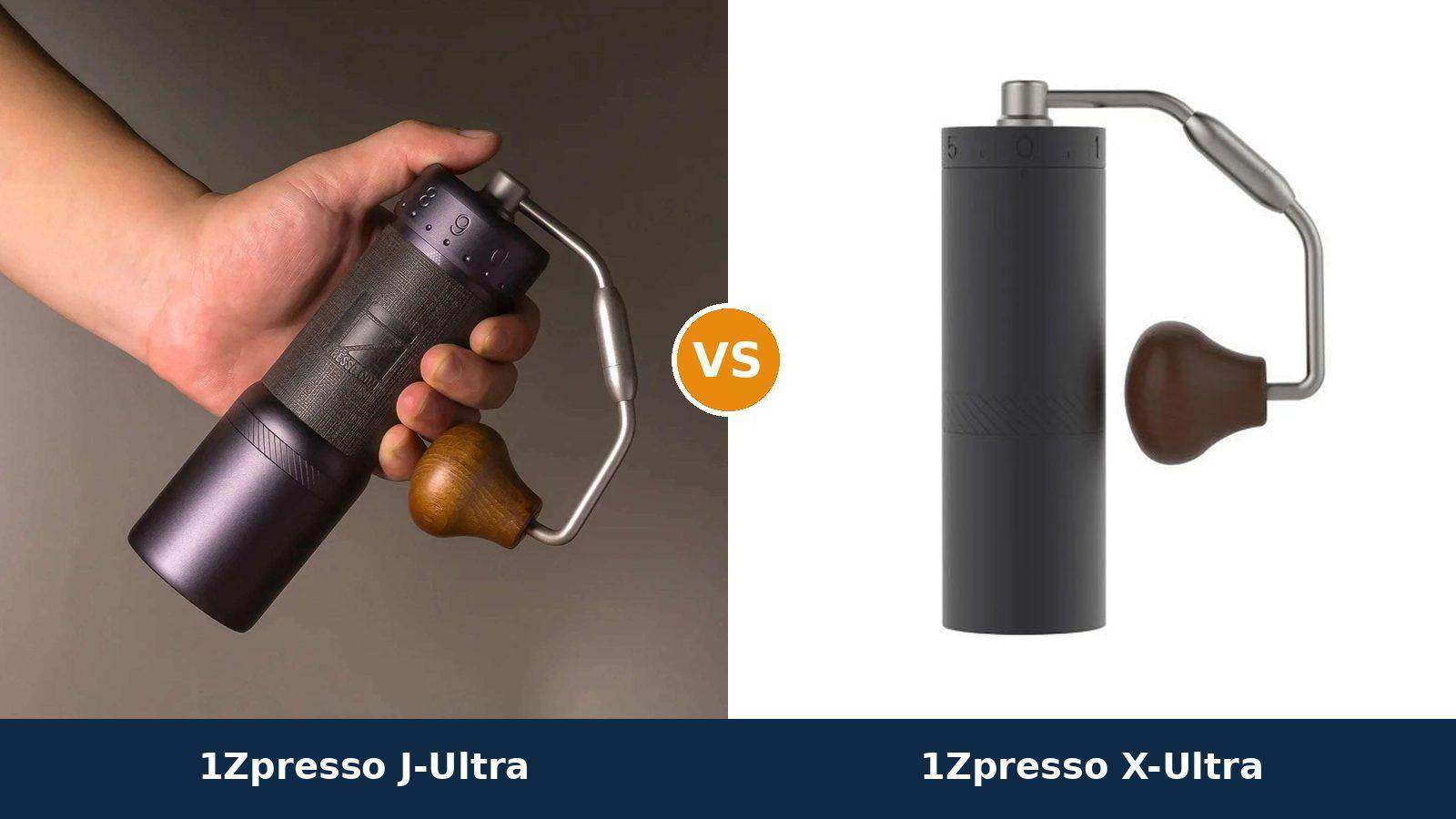
Two grinders, one suffix. The shared “Ultra” badge invites an obvious assumption — that these are siblings, two trims of the same idea. They are not.
The J-Ultra is the top of 1Zpresso's J line: the espresso flagship that replaced the old J-Max, built around a titanium-coated 48 mm burr and the finest adjustment mechanism the maker publishes anywhere in its range.
The X-Ultra is the flagship of a different family, the X line, and it was designed to a different brief: a full-range hand grinder — espresso to pour-over — in the slimmest, lightest body 1Zpresso sells at this level.
So this is not a trim-level choice. It is a question about your life with the grinder: does it live beside an espresso machine, or does it live in a bag? Answer that, and the spec sheet settles the rest.
Every figure below is drawn from 1Zpresso's own product pages, model comparison chart and instruction manuals — and the verdict is written the way we would advise a friend.
Key Takeaways
- Espresso belongs to the J-Ultra. 8 microns per click on an external ring, 100 clicks per rotation, 500 settings — the highest-resolution adjustment 1Zpresso makes.
- The X-Ultra's steps are half again as coarse, and that is fine. 12.5 microns per click is still espresso-grade resolution in a 590 g body.
- Different burrs, different briefs. A coated, espresso-designed 48 mm conical against an uncoated 40 mm conical shaped for all-round work.
- Travel belongs to the X-Ultra. 80 g lighter, 5 mm slimmer, an anti-slip band in the box — the grinder built to be carried.
- Capacity belongs to the J-Ultra. A magnetic 35–40 g cup against a magnetic 25–30 g cup; both release the same way, one simply holds a bigger brew.
Quick Verdict
Buy the 1Zpresso J-Ultra if espresso is the point. It is the sharpest manual dialing instrument in the maker's catalogue, and nothing in this comparison dilutes that.
The case in one breath: coated 48 mm burr, 8-micron clicks, the deepest settings range in the family, the biggest catch cup either grinder offers, and a setting chart that runs from Turkish to French press.
Buy the 1Zpresso X-Ultra if the grinder has to travel and still do everything. It gives up resolution it rarely needs and keeps everything else.
The X-Ultra concedes the espresso crown honestly — coarser clicks, a smaller burr, a smaller cup — and wins everywhere a bag, a drawer or a campsite is involved: 590 g, a 52 mm body, and the anti-slip band the J-Ultra does without.
The Scorecard
Scores below are derived directly from the manufacturer specifications compared in this guide — burr diameter, coating and geometry, clicks per rotation and microns per click, stated capacity, weight, body diameter and included kit. They are a reading aid, not benchmark results.
| Category | 1Zpresso J-Ultra | 1Zpresso X-Ultra | ||
|---|---|---|---|---|
| Burr set | 9 / 10 | 8 / 10 | ||
| Adjustment system & precision | 10 / 10 | 9.5 / 10 | ||
| Espresso dialing | 9.5 / 10 | 8.5 / 10 | ||
| Filter brewing fit | 8 / 10 | 8.5 / 10 | ||
| Capacity & dosing | 9 / 10 | 7.5 / 10 | ||
| Portability & travel | 8.5 / 10 | 9 / 10 | ||
| Cleaning & maintenance | 8.5 / 10 | 8.5 / 10 | ||
| Overall | 8.9 / 10 | 8.5 / 10 | ||
Read the shape, not just the totals: the J-Ultra's wins cluster where espresso lives, the X-Ultra's where movement lives. Neither is the other one done worse; each is its own brief executed well.
At a Glance: Who Each Grinder Fits
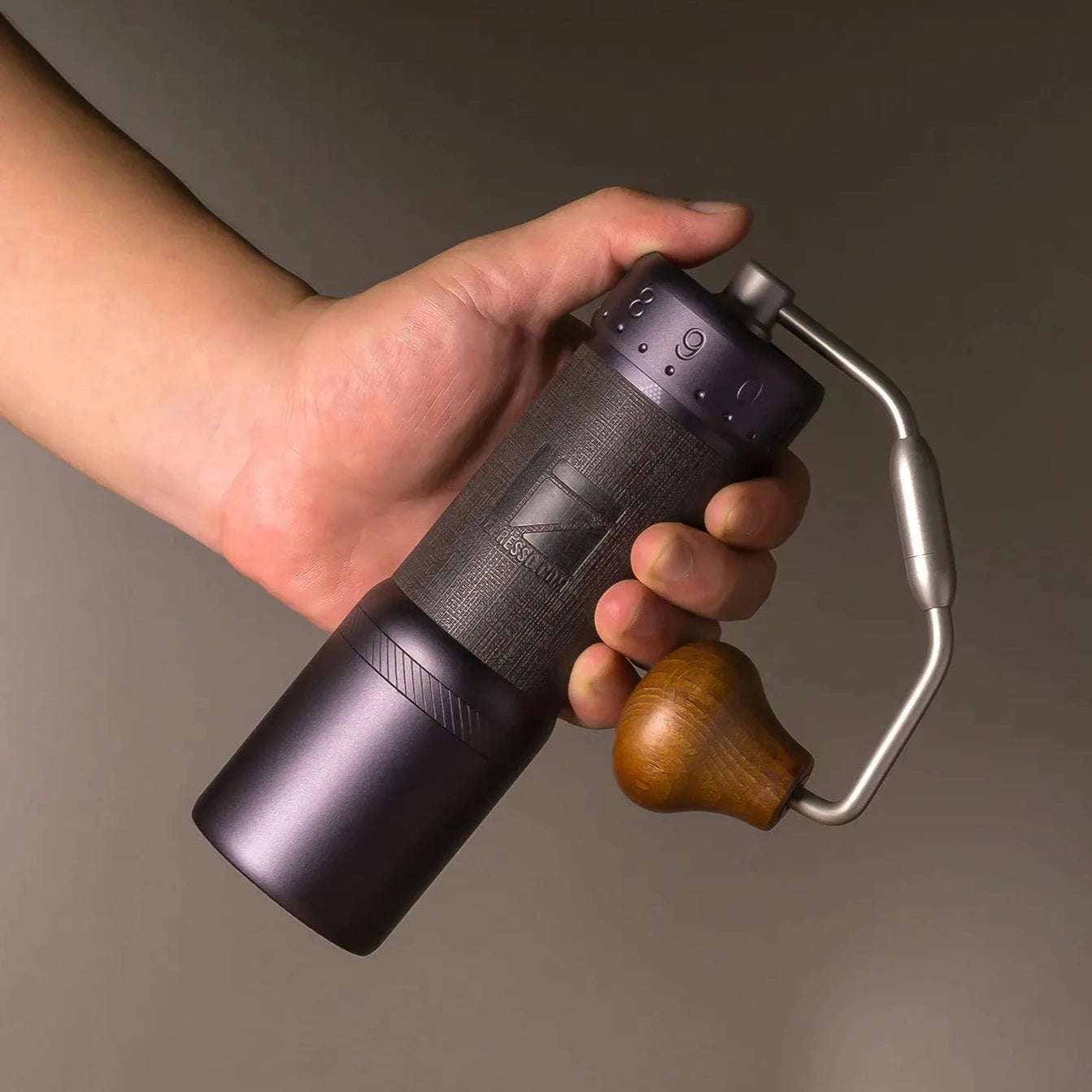
1Zpresso J-Ultra
- 48 mm conical burr, titanium-coated, espresso design
- External numerical ring: 100 clicks per rotation, 8 microns per click
- Magnetic catch cup, 35–40 g capacity
- 670 g; foldable crank handle; carry case included
- Positioned by 1Zpresso as its espresso flagship
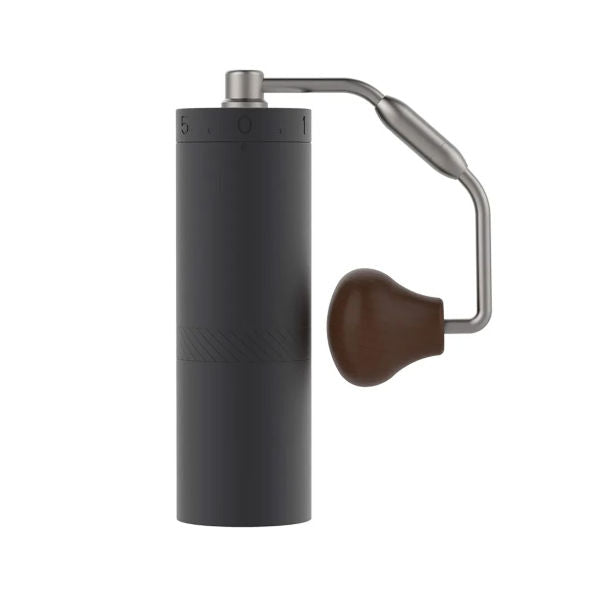
1Zpresso X-Ultra
- 40 mm conical burr, stainless steel, heptagonal geometry
- External numerical ring: 60 clicks per rotation, 12.5 microns per click
- Magnetic catch cup, 25–30 g capacity
- 590 g; 52 mm body; case, brush, blower and anti-slip band included
- Positioned by 1Zpresso as an all-round grinder: pour-over and espresso
Choose the 1Zpresso J-Ultra if…
Espresso is the main event. You dial shots in, you notice when a shot runs two seconds fast, and you want clicks fine enough to answer that.
The grinder lives at home. Weight and width stop mattering on a counter, and what remains is the J-Ultra's home ground: resolution, burr, capacity.
You grind bigger doses. Doubles back to back, a 35 g filter batch — the bigger cup takes the load in one pass.
Choose the 1Zpresso X-Ultra if…
The grinder travels — office, cabin, campsite — and still has to cover espresso when it gets there. Nothing else in the range packs this much range into 590 g.
Your brewing is genuinely mixed and filter-led. The X-Ultra is the maker's all-round brief, and its filter fit is the stronger of the two on positioning.
As an Amazon Associate I earn from qualifying purchases at no extra cost to you.
Specifications: The Specs That Actually Matter
Every figure below is taken from 1Zpresso's official product data — its model comparison chart, product pages and instruction manuals — with manufacturer data carried by authorised retailers.
Disagreements between sources are flagged in the notes beneath the table.
| Specification | 1Zpresso J-Ultra | 1Zpresso X-Ultra |
|---|---|---|
| Burrs | 48 mm conical, titanium-coated stainless steel, heptagonal geometry (manufacturer-stated), designed for espresso | 40 mm conical, stainless steel, heptagonal geometry (manufacturer-stated) |
| Adjustment system | External numerical ring with rotation indicator | External numerical ring |
| Clicks per rotation | 100 | 60 |
| Step size | 8 microns per click — the finest in the maker's range | 12.5 microns per click |
| Total settings | 500 (5 rotations) | ~240 (60 across 4 rotations; see note below) |
| Motor | None — hand crank/manual | None — hand crank/manual |
| Catch cup | Magnetic quick-release, twist to open (24 magnets per the manual) | Magnetic, quick-release |
| Capacity | 35–40 g | 25–30 g |
| Weight | 670 g | 590 g |
| Dimensions | Distributor specification 14 × 18 × 5.6 cm; body Ø approx. 56 mm | 173 mm body, 185 mm with handle; body Ø 52 mm |
| Materials | Aluminium alloy, stainless steel, wood, polycarbonate, silicone (distributor specification) | Aluminium alloy, stainless steel, wooden handle knob |
| Handle | Foldable crank handle | Foldable crank handle |
| Finishes | Iron Gray | Midnight Black, Space Gray, Pacific Blue |
| In the box | Grinder, carry case, cleaning brush, air blower | Grinder, carrying case, cleaning brush, air blower, anti-slip band |
| Cleaning & calibration | Tool-free disassembly; burr factory-calibrated and fixed | Tool-free disassembly; designed to return to zero more easily after reassembly |
| Maker positioning | Espresso flagship; maker's setting chart spans Turkish to French press | All-round: pour-over and espresso |
| Estimated burr life | ~100–200 kg of beans (maker's estimate) | ~100–200 kg of beans (maker's estimate) |
| Warranty | 1-year limited warranty | 1-year limited warranty |
Two Ultras, two families — read this before you buy anything. The J-Ultra heads the J line and replaced the discontinued J-Max: same flagship chair, changed specification — 100 clicks per rotation at 8 microns against 90 at 8.8, 670 g against 775 g, a foldable handle. It is a successor, not a rebadge, and old J-Max stock is not this grinder. The X-Ultra heads the separate X line, the maker's travel-format family. Neither is the plain J — the internal-dial entry model — and a listing that mixes these names up is a listing to walk away from.
The glance test separates them instantly: the wider, heavier grinder in a single Iron Gray finish is the J-Ultra; the slim 52 mm body in three finishes is the X-Ultra. If it looks pocketable, it is the X.
Total settings note: totals are the softest numbers in hand-grinder specifications. The J-Ultra's 500 follows directly from its published 100 clicks across 5 rotations. For the X-Ultra, the maker's manual illustrates up to 200 clicks while compiled model charts compute ~240 from 60 clicks across 4 rotations. The figures that govern dialing — clicks per rotation and microns per click — agree everywhere, and those are what this verdict rests on.
Weight note: both figures in the table are grinder weights from the maker's model data. Retail listings show higher item weights — the J-Ultra's listing data runs to about 1.54 lb, roughly 698 g — because they weigh the packaged kit, case included.
Dimensions note: the two are published in different formats — a three-axis distributor specification for the J-Ultra, body and with-handle heights for the X-Ultra — so each is printed as published rather than forced into a tidier pair. The comparison that matters, body diameter, is consistent: roughly 56 mm against 52 mm.
The Differences That Actually Matter
1. Burrs — 48 mm of coated steel against 40 mm of plain
Start where the coffee starts. The J-Ultra's burr is 48 mm across, titanium-coated, and described by its maker as designed for espresso, with a heptagonal cutting geometry in the published data.
The X-Ultra's burr is 40 mm, uncoated stainless steel, and its published data claims the same heptagonal geometry. Geometry, on paper, is the shared line in this section. Diameter and brief are not.
Eight millimetres of diameter is cutting surface on every revolution, and the J-Ultra pairs that surface with a coating specified for the dense, fine, high-resistance work at the espresso end of the dial. The X-Ultra's smaller burr is a packaging decision as much as a grinding one: it is what allows a 52 mm body to exist.
What neither specification licenses is invented grind data — 1Zpresso publishes no particle measurements or grind times for either model, so we invent none. On published specifications alone, the espresso flagship's burr is the stronger tool; the travel flagship's is smaller by deliberate design.
2. Step size — 8 microns against 12.5
Both grinders adjust the modern way: a numbered ring on the outside of the body, readable at a glance, changeable with the catch cup in place. The mechanism ties. The arithmetic does not.
One J-Ultra click moves the burr 8 microns. One X-Ultra click moves it 12.5 — half again as far. Across a full rotation the counts are 100 clicks against 60; across the whole range, 500 settings against roughly 240.
Where does that difference actually bite? Not at filter settings, where the target zone is broad and either step size lands inside it. It bites at espresso, where the distance between a shot that chokes and a gushing one is measured in single microns. At 12.5 microns per click, the X-Ultra strides through that window respectably; at 8, the J-Ultra tiptoes — and tiptoeing is what dialing-in rewards.
Frame it honestly: the X-Ultra's resolution would be the headline feature on almost any other hand grinder. It loses this section only because the other grinder on the page owns the finest adjustment its maker has ever published.
3. The travel equation — 590 g and 52 mm against 670 g and 56
Now weigh them, which is the X-Ultra's home fixture. 590 g against 670 g. A 52 mm body against one roughly 56 mm across. The same foldable crank handle on both, the same included carry case, and one small extra in the X-Ultra's box: an anti-slip band, there because a slim travel body gets held over sinks, tailgates and campsite tables.
Eighty grams is nothing at a kitchen counter. In a carry-on pocket or a bikepacking setup it is part of a budget spent gram by gram, and the slimmer body slides beside a travel brewer instead of needing to be planned around.
This is also why the scorecard's portability row is close rather than a rout: the J-Ultra is only 80 g heavier, folds the same way, and ships with the same case. The X-Ultra wins the row clearly — by design, not by accident.
4. Capacity — the same magnetic trick, a bigger cup
One mechanism, two sizes. Both catch cups attach magnetically and pull free without unscrewing anything — the J-Ultra's manual specifies 24 magnets and a twist release — and both are quick to dose from and quick to empty.
The J-Ultra's cup holds 35–40 g. The X-Ultra's holds 25–30 g. Ten grams is the whole of this section, and whether it matters depends entirely on your doses.
For a single dose or a one-cup brew, 25–30 g is headroom nobody touches. For back-to-back doubles, a two-cup batch, or grinding for two at a campsite, the smaller cup splits loads the bigger one swallows whole — and splitting a load mid-brew is exactly the friction a flagship is supposed to remove.
Verdict on the section: a tie on mechanism, a clear J-Ultra win on volume. If your doses are single serves, score it a tie in your head and move on.
5. Brew-method fit — read the maker's own filing
1Zpresso files these grinders under different headings, and the filing is the most honest sentence in either product description.
The J-Ultra is presented as the maker's espresso flagship — yet its published setting chart is a full-range document: Turkish at 80 clicks, espresso at 132, AeroPress and moka at 210, pour-over at 300, French press at 450. An espresso instrument that covers the whole map as a side effect of its resolution.
The X-Ultra is presented as the all-rounder — pour-over and espresso in the maker's own positioning — and its chart covers the same methods with coarser steps to do it with.
That is why the scorecard splits as it does. Judged as espresso grinders, the J-Ultra's filing, coating and resolution align into one answer. Judged as filter-first grinders, the X-Ultra's brief and value carry the row. Judged as one grinder for everything, the question collapses back into sections 2 and 3: how fine do your clicks need to be, and how light does your bag need to be?
6. Cleaning — a scored tie, and why it is one
House rules first, because both grinders live under the same ones: tool-free disassembly, burrs factory-calibrated and fixed to the shaft, and no water anywhere near the burrs — brush and blower only, because water rusts steel.
The X-Ultra holds one genuine card here: its design is stated to return to zero more easily after reassembly, which shortens the fiddliest part of a deep clean. The J-Ultra counters with the readable ring — a setting you can see survives disassembly as a number, not a memory — and both boxes include the brush and blower the routine requires.
Neither card outweighs the other, and both burrs carry the same maker-estimated life of roughly 100–200 kg. The scorecard calls the row what it is: 8.5 against 8.5, an honest tie.
Brew-Method Fit Guide
The fastest way to choose between these grinders is to start from what you actually drink, and where you drink it — the whole comparison compresses into this one table.
| What you brew | 1Zpresso J-Ultra | 1Zpresso X-Ultra | Our call |
|---|---|---|---|
| Espresso at home, daily | Excellent — 8-micron clicks, coated espresso burr | Very good — 12.5-micron clicks reach and hold espresso | J-Ultra, decisively |
| Pour-over first: V60, Kalita, Chemex | Very good — maker chart puts pour-over at 300 clicks | Excellent — the maker's all-round brief, filter-led value | X-Ultra, on brief and value |
| Espresso and filter, one grinder, at home | Excellent — built for method-switching at espresso resolution | Very good — covers both, coarser steps at the espresso end | J-Ultra |
| Espresso and filter, one grinder, on the road | Good — capable everywhere, 670 g in the bag | Excellent — 590 g, 52 mm body, anti-slip band in the box | X-Ultra |
| Turkish and extra-fine grinding | Excellent — maker's chart starts at Turkish, 80 clicks | Good — range reaches fine, steps are coarser | J-Ultra |
| Two-cup batches, 35 g and up | Excellent — 35–40 g in one load | Tight — 25–30 g cup, split the biggest loads | J-Ultra |
| AeroPress and moka, travel kit | Good — full range, heavier body | Excellent — the travel-format flagship, case included | X-Ultra |
Notice the pattern: the J-Ultra's rows are about what is in the cup, the X-Ultra's rows are about where the cup is. Pick the column that sounds like your life.
The 30-Second Decision
| If this sounds like you… | Buy this |
|---|---|
| “Espresso is the hobby. I want the finest clicks money buys in a hand grinder.” | 1Zpresso J-Ultra |
| “One grinder has to do everything, and it has to fit in my travel kit.” | 1Zpresso X-Ultra |
| “I grind for two — doubles, batches, a second cup for someone else.” | 1Zpresso J-Ultra |
| “Mostly pour-over, espresso when I visit a machine — and I move around a lot.” | 1Zpresso X-Ultra |
| “The grinder stays home, next to the machine, forever.” | 1Zpresso J-Ultra |
Ready to check today’s price?
Both grinders are current models sold by 1Zpresso itself on Amazon — the J-Ultra in Iron Gray, the X-Ultra listing linked here in Midnight Black.
View on Amazon — J-UltraView on Amazon — X-UltraWhat You Gain. What You Give Up.
1Zpresso J-Ultra
You gain: the finest adjustment mechanism in the maker's range — external, numbered, 8 microns per click, 500 settings deep. A coated 48 mm burr designed for espresso, the biggest catch cup of the two at 35–40 g, and a maker's chart that runs from Turkish to French press without leaving the dial.
You give up: the travel crown. At 670 g with the wider body, it is the heavier thing in the bag, and its single Iron Gray finish is the whole colour choice. Filter-led brewers also carry espresso hardware they will rarely engage — the resolution is only worth owning if the fine end of the dial is somewhere you live.
1Zpresso X-Ultra
You gain: a full-range flagship that weighs 590 g and measures 52 mm across — espresso-capable resolution, an external ring, a magnetic cup, and a box that adds the anti-slip band to the shared case, brush and blower kit. Three finishes to choose from, and the maker's all-round brief behind it.
You give up: the last word in espresso resolution — 12.5-micron clicks against 8 — plus burr diameter, and the headroom of the bigger cup. Back-to-back doubles and 35 g batches mean split loads. And its published total-settings figure is the softest number on either spec sheet, even if the clicks that matter are consistent.
Pros and Cons
1Zpresso J-Ultra — Pros
- External numbered ring: 100 clicks per rotation, 8 microns per click
- 500 total settings — the deepest range in the family
- Titanium-coated 48 mm burr designed for espresso
- Magnetic quick-release cup, 35–40 g — the biggest here
- Maker's setting chart covers Turkish to French press
- Case, brush and blower included
Cons
- Heavier and wider of the two at 670 g
- Single finish — Iron Gray is the whole choice
- Espresso hardware is wasted on filter-only brewing
- Old J-Max stock nearby invites listing mix-ups
- Flagship position at the top of its line
1Zpresso X-Ultra — Pros
- Lightest flagship here: 590 g, slim 52 mm body
- External numbered ring: 60 clicks per rotation, 12.5 microns per click
- Genuine all-round range — espresso to pour-over in one grinder
- Case, brush, blower and anti-slip band in the box
- Designed to return to zero more easily after cleaning
- Three finishes: Midnight Black, Space Gray, Pacific Blue
Cons
- Clicks are half again as coarse as the J-Ultra's at espresso
- Smallest cup of the two at 25–30 g — big loads split
- Smaller 40 mm burr, uncoated
- Published total-settings figure varies between sources
- Espresso specialists will outgrow its resolution first
Two Ultras, Two Families: Check Which Grinder the Listing Is Selling
Check the model number, not the headline. Both grinders wear the word “Ultra”, and listings lean on it. The J-Ultra's Amazon listing carries the item model number “J-Ultra Iron Gray”. The X-Ultra listing linked in this guide is “X-Ultra-Midnight Black”. A model field that says J-Max, J, or anything else means a different grinder is in the basket.
Check the finish against the family. The J-Ultra exists in exactly one finish: Iron Gray. Any listing offering the J-Ultra in colours is mislabelled. The X-Ultra is the one with finishes — Midnight Black, Space Gray and Pacific Blue are separate listings, and the manual on file belongs to the Space Gray variant, so confirm the finish in the model field before you pay.
Check the body in the photos. The X-Ultra is the slim, straight 52 mm body with the ring at the very top. The J-Ultra is visibly broader, with a textured grip section under its ring. Both rings are numbered — the families are separated by silhouette and weight, not by the presence of a dial.
Beware the J-Max sitting next door. The J-Ultra replaced it, and old stock still circulates at tempting positions in search results. The J-Max is a different specification — 90 clicks per rotation at 8.8 microns, 775 g — and belongs at an older-model price. Buy one knowingly or not at all.
Check the box contents. A complete J-Ultra kit is the grinder, carry case, cleaning brush and air blower. A complete X-Ultra kit adds the anti-slip band to the same list. A listing missing pieces is an incomplete kit at a complete-kit price.
Check the seller. 1Zpresso sells both grinders itself on Amazon, and authorised retailers stock them elsewhere. Warranty claims run through the maker, so buy through a channel that keeps that route open.
The Upgrade Path Test
Judge these grinders by year three, because that is where their difference stops being a spec sheet and becomes a biography.
The X-Ultra owner's first years are easy to picture: the grinder goes everywhere and never feels like the wrong purchase. Its ceiling arrives in one specific future — the year its owner gets serious about espresso. Not casual espresso, which it handles indefinitely; serious espresso, where mornings are spent chasing half-second changes, is where 12.5-micron clicks start to feel like a stride length.
The J-Ultra owner's ceiling points the other way. Resolution never expires — there is no finer 1Zpresso adjustment to upgrade toward. What expires is patience for hand grinding itself: the household pulling drinks for four every morning outgrows both grinders at once, and the next step is electric.
So the buy-once logic runs along your likely future. If it contains serious espresso, the J-Ultra is bought once and the X-Ultra is bought twice. If it contains mostly movement and mixed brewing, the X-Ultra is bought once and never resented. Both burrs carry the same maker-estimated life, roughly 100–200 kg — neither wears out before its brief does.
When to Skip Both
Neither flagship is the answer for everyone, and pretending otherwise would undo the point of this guide.
Skip both for electric convenience. Hand grinding is a ritual at one dose and a queue at four, and no click resolution on earth changes that arithmetic.
Skip both if you routinely grind more than 40 g at once. Even the bigger cup here tops out at a two-cup brew; household batch brewing belongs to a larger class of grinder entirely.
Skip both if your brewing is filter-only and stays home. The plain J — the maker's pour-over-positioned entry model with the same 48 mm burr diameter as the J-Ultra — covers that brief at the value end of the range, and a smaller dedicated travel grinder covers the road for less than either flagship.
And skip the dream of both in one body. The finest adjustment in the range and the lightest body in the range are different grinders because physics and packaging pull opposite ways. Choose the axis your life actually uses.
Warranty and Long-Term Support
The closest thing in this comparison to a dead heat: the same maker's one-year limited warranty covers both grinders, and the same manuals library backs both.
Both carry burrs fixed and factory-calibrated to the shaft, which removes the most common hand-grinder support issue — user-introduced misalignment — from the table entirely. Burr life is a wash as well: the maker estimates roughly 100–200 kg for each.
Support quality therefore comes down to channel, as it usually does with this maker. An official or authorised purchase makes a warranty claim a formality; a grey-market one leaves you relying on a stranger's goodwill.
Both boxes include the brush and blower the care routine needs — and the routine's one hard rule is that water never touches the burrs.
Final Verdict
The 1Zpresso J-Ultra is the grinder we would buy of these two — because a comparison of flagships should be settled by which flagship is better at the hard thing, and the hard thing is espresso.
It wins on resolution (8 microns per click, 500 settings), on the burr (48 mm, coated, designed for the job), and on capacity (a 35–40 g magnetic cup). Its maker's chart covers every method the X-Ultra covers — the fine end of the map simply gets a finer instrument.
The X-Ultra's case is the strongest situational case in this niche: the same flagship tier of hardware, rebalanced for movement. 590 g, 52 mm, an anti-slip band in the box, and resolution that would headline almost any other grinder's spec sheet. For a grinder that travels weekly, it is not the consolation pick — it is the correct one.
What separates them is not quality. It is address: one grinder lives beside a machine, the other lives in a bag. Buy for the address.
Buy the J-Ultra if espresso is in your present or your plausible future, if you dial shots and notice microns, or if your doses run large. One listing, one finish — Iron Gray.
Buy the X-Ultra if the grinder travels, if your brewing is mixed and filter-led, or if 80 g and 4 mm are real numbers in your packing. The listing linked here is the Midnight Black finish.
Just buy it with your eyes open about the suffix. “Ultra” is a tier, not a family — check the model number before you pay.
Frequently Asked Questions
Which is better for espresso, the J-Ultra or the X-Ultra?
The J-Ultra. Espresso dialing lives in a window a few microns wide, and the J-Ultra steps through it 8 microns at a time with a coated 48 mm burr behind the clicks. The X-Ultra's 12.5-micron steps are genuinely espresso-capable — the difference is between capable and definitive.
Are the J-Ultra and X-Ultra the same family?
No. The J-Ultra heads the J line as its espresso flagship, successor to the J-Max. The X-Ultra heads the separate X line, the maker's travel-format family. The shared “Ultra” is a tier badge, not a shared design — beyond the suffix and the brand, the burrs, bodies and briefs all differ.
Which grinder is better for travel?
The X-Ultra: 590 g against 670 g, a 52 mm body against roughly 56 mm, the same foldable handle and carry case, and an anti-slip band in the box that the J-Ultra does without. It was designed for the bag; the J-Ultra merely tolerates it well.
Can the X-Ultra actually grind for espresso?
Yes — its maker positions it as an all-round grinder spanning pour-over and espresso, and 12.5 microns per click is real espresso resolution. What it cannot do is match the J-Ultra's 8-micron steps across the narrowest part of the dialing window, which is a specialist's complaint, not a casual brewer's.
Which holds more coffee?
The J-Ultra: a magnetic catch cup rated at 35–40 g, against the X-Ultra's magnetic 25–30 g. Both cups attach and release the same way. The gap only matters if your doses or batches run past 30 g.
Does either grinder have a motor?
No. Both are hand grinders — hand crank and manual effort only, with foldable crank handles. There is no battery, no cable and no RPM figure to compare; the “motor” is you, which is rather the point of the format.
Is the J-Ultra just a renamed J-Max?
No — it replaced the J-Max with a changed specification: 100 clicks per rotation against 90, 8 microns per click against 8.8, 670 g against 775 g, and a foldable handle. Successive generations of the same flagship chair, not a rebadge — old J-Max stock should be priced as the older model.
Which should a pour-over brewer buy?
The X-Ultra, on brief and value: filter fit is its home row, and its maker files it as the all-rounder. The J-Ultra grinds pour-over perfectly well — its own chart sets it at 300 clicks — but a filter-only brewer is paying for espresso resolution they will never engage. Choose the J-Ultra instead only if espresso is realistically on your horizon.
Sources & Verification
1Zpresso official product pages and model comparison chart — both grinders' burr diameters and materials, adjustment systems, clicks per rotation, microns per click, capacities, weights and finishes • 1Zpresso J-Ultra instruction manual — magnetic cup (24 magnets), setting chart (Turkish 80, espresso 132, pour-over 300, French press 450 clicks) • 1Zpresso X-Ultra instruction manual — adjustment illustration, dimensions, reassembly-to-zero design • Rogue Wave Coffee (authorised distributor) J-Ultra product data — dimensions, materials, package contents • Cape Coffee Beans X-Ultra product data — included components and finish range • Amazon listing data for both models, used for ASIN verification only. Specifications verified November 2026.

James Wilson
James has been testing coffee gear and small kitchen appliances for over a decade and writes Honestly Compared's coffee and grinder guides. His rule for every comparison: the verdict has to survive the spec sheet, not the marketing page.