
1Zpresso J vs J-Ultra: Which Should You Buy?
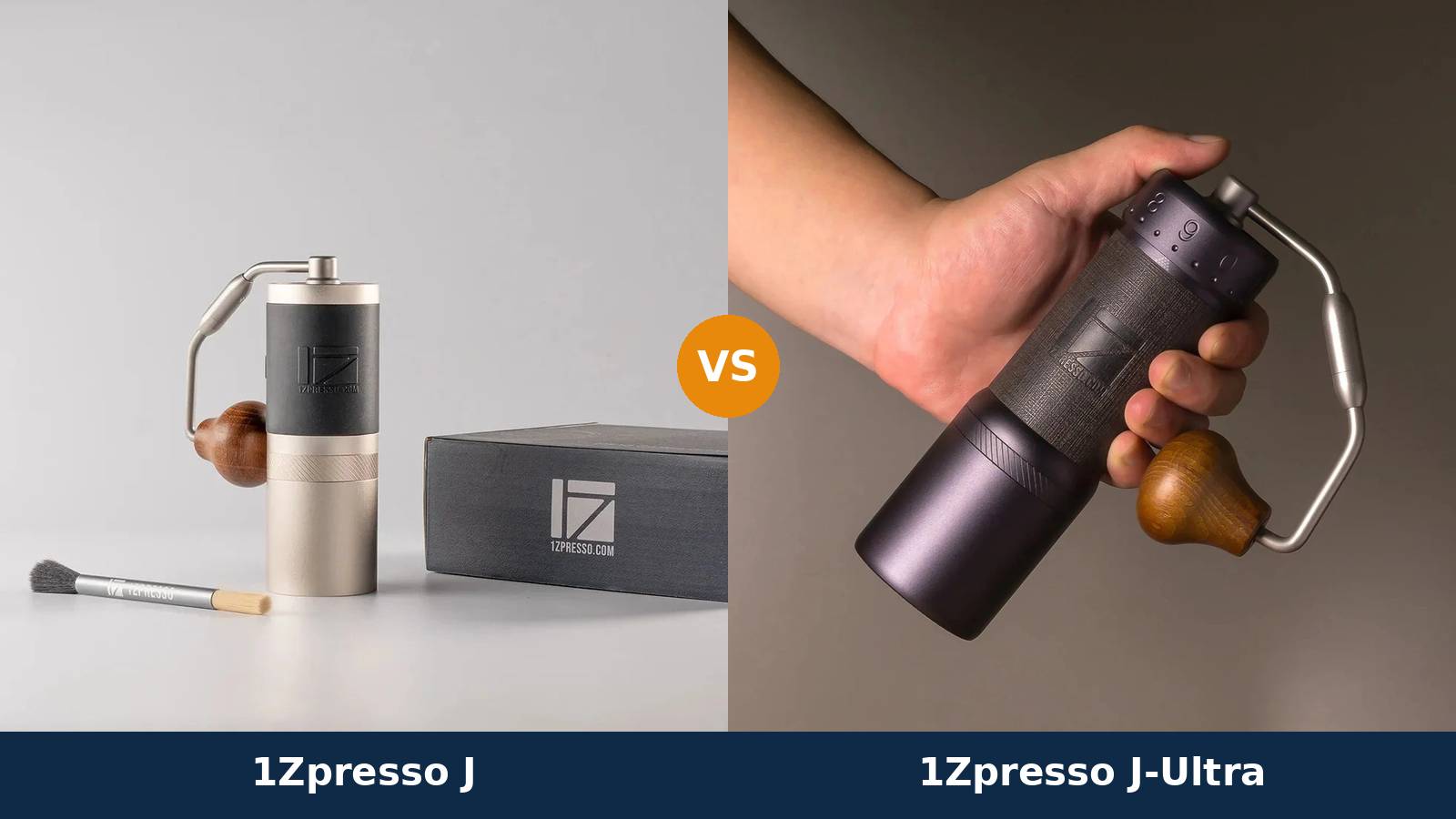
One word. That is the entire distance between these two grinders on a listing page — and it hides the largest specification gap inside 1Zpresso's whole J family.
Pin the names down first, because everything else depends on it. The bare “J” in this comparison is the current 1Zpresso J: the entry model in the maker's present range, successor to the discontinued JX, with an internal adjustment dial, a threaded catch cup and 25-micron clicks.
The J-Ultra is a different machine in every way that matters: the maker's espresso flagship for the J line, successor to the old J-Max, with a titanium-coated 48 mm burr, an external adjustment ring, clicks of just 8 microns, and a magnetic catch cup. Beyond the burr diameter and the badge, it shares no hardware with the plain J.
So the real matchup: the filter-first value grinder against the espresso specialist, same maker, opposite ends of the same letter. If you brew espresso, this is barely a contest. If you never do, it is closer than the spec sheet suggests.
Every specification below comes from 1Zpresso's own published data — its product pages, model comparison chart and instruction manuals. The verdict is the one we would give a friend spending their own money.
Key Takeaways
- The J-Ultra owns espresso. Its external ring moves the burr 8 microns per click — the finest adjustment 1Zpresso publishes — across 100 clicks per rotation and 500 settings in total.
- The J's clicks are three times coarser. 25 microns per click, 120 settings, on an internal dial you reach by unscrewing the catch cup.
- Same burr diameter, different burr. Both are 48 mm conical; the J-Ultra's is titanium-coated and designed for espresso, the J's is plain stainless steel.
- The J-Ultra carries more and weighs less. A magnetic 35–40 g cup against a threaded 30–35 g cup, at 670 g against 705 g, case, brush and blower in the box.
- The J is the filter-first value pick. It is the model 1Zpresso positions for pour-over, and for filter-only brewing the J-Ultra's extra resolution is hardware you never use.
Quick Verdict
Buy the 1Zpresso J-Ultra if espresso is in your life — or might be. It is the most capable hand grinder in the J family, and it is not close.
The specification is a rout: an external numbered ring at 8 microns per click, 500 total settings, a coated espresso burr, a magnetic quick-release cup that holds 35–40 g, and a travel kit in the box.
Buy the 1Zpresso J if you brew filter and only filter. A genuinely good grinder — just a narrower one.
The J counters with the same 48 mm burr diameter, a pour-over brief straight from the maker's own chart, and the maker's stated anti-static design. Its compromises — the hidden dial, the coarse clicks, the threaded cup — all live exactly where espresso dialing happens — nowhere a filter brewer will feel them.
The Scorecard
Scores below are derived directly from the manufacturer specifications compared in this guide — burr diameter, coating and geometry, adjustment location, clicks per rotation and microns per click, stated capacity, weight and included kit. They are a reading aid, not benchmark results.
| Category | 1Zpresso J | 1Zpresso J-Ultra | ||
|---|---|---|---|---|
| Burr set | 8.5 / 10 | 9 / 10 | ||
| Adjustment system & precision | 6.5 / 10 | 10 / 10 | ||
| Espresso dialing | 6.5 / 10 | 9.5 / 10 | ||
| Filter brewing fit | 9 / 10 | 8 / 10 | ||
| Capacity & dosing | 8.5 / 10 | 9 / 10 | ||
| Portability & travel | 7.5 / 10 | 8.5 / 10 | ||
| Cleaning & maintenance | 8 / 10 | 8.5 / 10 | ||
| Overall | 7.8 / 10 | 8.9 / 10 | ||
The shape of this result is unusual: the J ties on burr size and wins the filter row outright, then loses on the adjustment mechanism, on espresso, on the cup, and on the kit, all at once. Gaps this wide in one direction are rare inside a single family.
At a Glance: Who Each Grinder Fits
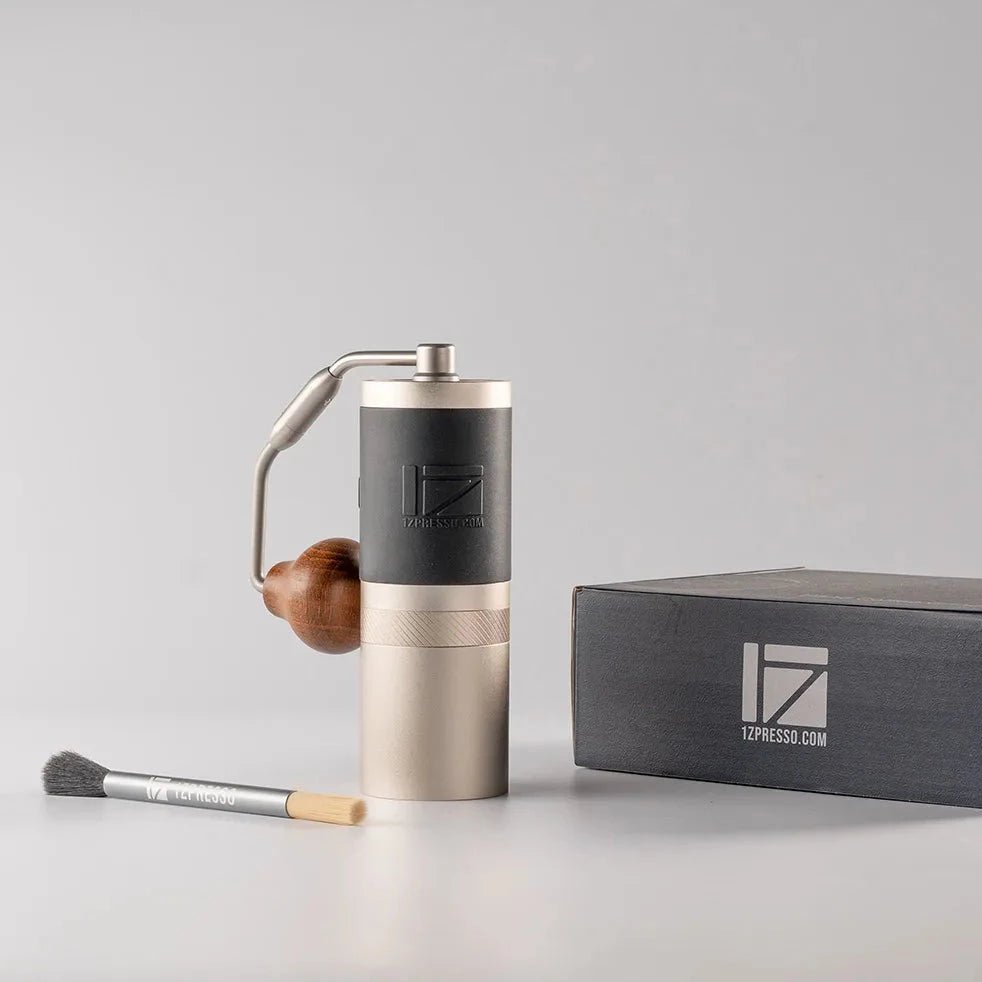
1Zpresso J
- 48 mm conical burr, stainless steel, uncoated
- Internal numerical adjustment: 30 clicks per rotation, 25 microns per click
- Threaded catch cup, 30–35 g capacity
- 705 g; 57 mm body diameter; foldable crank handle
- Positioned by 1Zpresso primarily for pour-over
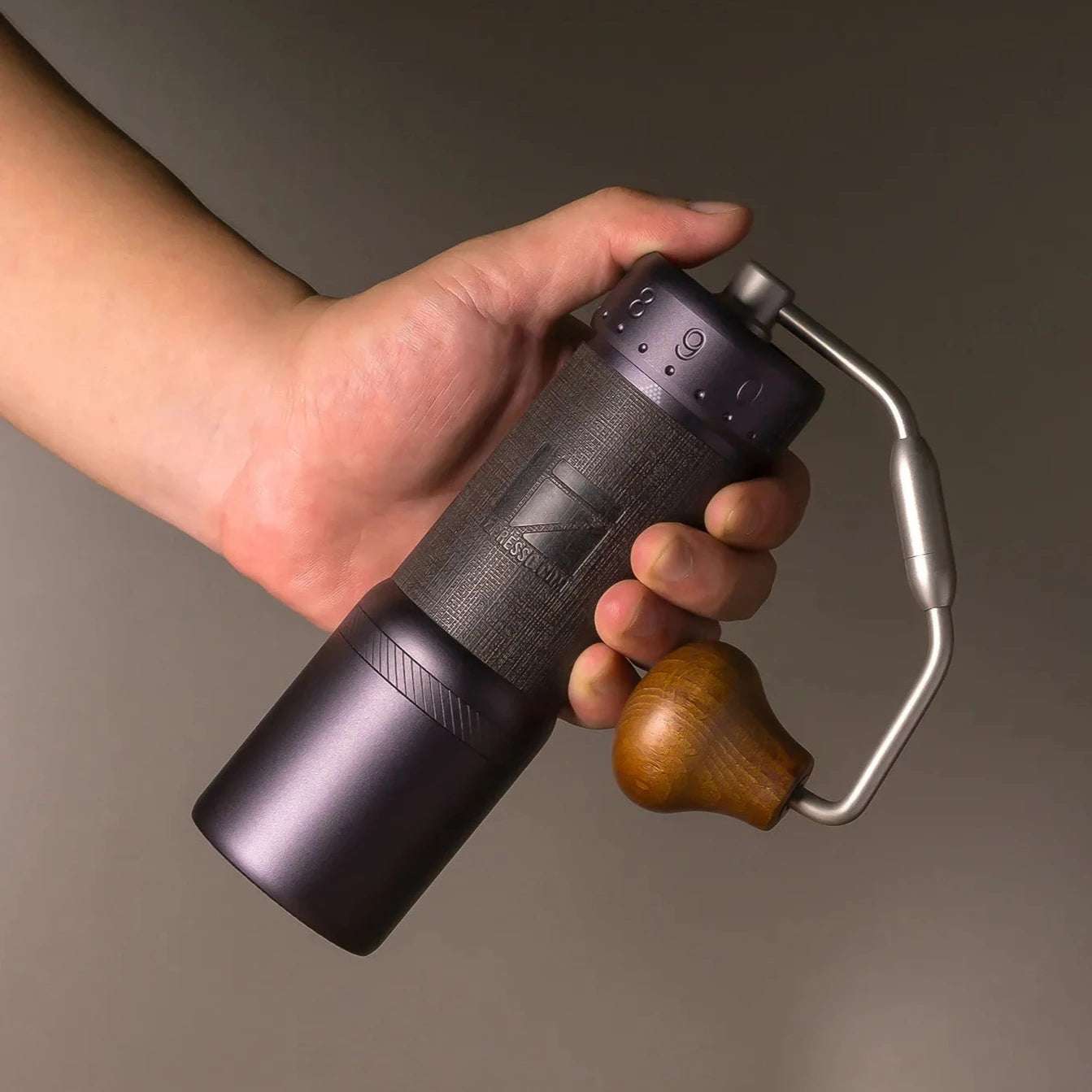
1Zpresso J-Ultra
- 48 mm conical burr, titanium-coated, espresso design
- External numerical ring: 100 clicks per rotation, 8 microns per click
- Magnetic catch cup, 35–40 g capacity
- 670 g; foldable crank handle; carry case included
- Positioned by 1Zpresso as its espresso flagship
Choose the 1Zpresso J if…
Filter coffee is the whole hobby. V60, Kalita, Chemex, French press — the J is the grinder 1Zpresso itself aims at those methods, with a full-size 48 mm burr doing the work.
Your grinder lives on a counter and your budget has limits. The J sits at the value end of the maker's range, and none of its compromises touch a filter brew.
You know espresso is not coming. No machine on the counter, none on the wish list — the J-Ultra's resolution would be a feature you paid for and never used.
Choose the 1Zpresso J-Ultra if…
You pull espresso shots, or plan to. Eight-micron clicks on an external ring are the difference between dialing a shot in and chasing it.
You brew across the whole range — Turkish to French press — and change settings daily. The ring reads at a glance, counts 500 settings deep, and never asks you to remove the cup.
As an Amazon Associate I earn from qualifying purchases at no extra cost to you.
Specifications: The Specs That Actually Matter
Every figure below is taken from 1Zpresso's official product data — its J-series comparison chart, product pages and instruction manuals — with manufacturer data carried on its own Amazon listing and by authorised retailers.
Where sources disagree, we say so in the notes under the table.
| Specification | 1Zpresso J | 1Zpresso J-Ultra |
|---|---|---|
| Burrs | 48 mm conical, stainless steel | 48 mm conical, titanium-coated stainless steel, heptagonal geometry (manufacturer-stated), designed for espresso |
| Adjustment system | Internal numerical dial, beneath the catch cup | External numerical ring with rotation indicator — no need to remove the catch cup |
| Clicks per rotation | 30 | 100 |
| Step size | 25 microns per click | 8 microns per click — the finest in the maker's range |
| Total settings | 120 (4 rotations) | 500 (5 rotations) |
| Catch cup | Threaded (screw-on) | Magnetic quick-release, twist to open (24 magnets per the manual) |
| Capacity | 30–35 g | 35–40 g |
| Weight | 705 g | 670 g |
| Dimensions | 170 mm tall with handle; body Ø 57 mm | Distributor specification 14 × 18 × 5.6 cm; body Ø approx. 56 mm |
| Materials | 304 stainless steel, aluminium alloy, wooden handle knob | Aluminium alloy, stainless steel, wood, polycarbonate, silicone (distributor specification) |
| Handle | Foldable crank handle | Foldable crank handle |
| Finishes | Silver | Iron Gray |
| In the box | Grinder with crank handle | Grinder, carry case, cleaning brush, air blower |
| Static handling | Maker states the current J's design minimises static electricity | No anti-static claim published by the maker |
| Maker positioning | Primarily pour-over; can reach espresso fineness | Espresso flagship; maker's setting chart spans Turkish to French press |
| Estimated burr life | ~100–200 kg of beans (maker's estimate) | ~100–200 kg of beans (maker's estimate) |
| Warranty | 1-year limited warranty | 1-year limited warranty |
Which J is which? Read this before you buy anything. The JX and JX-Pro are discontinued earlier generations. The J-Max was the espresso flagship of its day — 90 clicks per rotation at 8.8 microns, 775 g — and the J-Ultra is the model that replaced it: 100 clicks at 8 microns, 670 g, foldable handle. The plain J in this comparison is none of those: it is the current entry model, internal dial, threaded cup, 25 microns per click.
The glance test works. If the adjustment ring is on the outside of the body, it is not the plain J. If the cup pulls free on magnets, it is not the plain J. And a “J” listing that quotes 8 microns per click is quoting J-Ultra specifications, whichever name sits in the title.
Catch cup note: 1Zpresso's brand chart uses “magnetic catch cup” as a generic label across the range, but its compiled model data lists the J's cup as threaded, and reviewers of the current J confirm it. The J-Ultra's cup is genuinely magnetic — its manual specifies 24 magnets and a twist release.
Weight note: the figures in the table are grinder weights from the maker's model data — 705 g and 670 g. Retail listings show higher item weights (the J-Ultra's listing data runs to about 1.54 lb, roughly 698 g); those are packaged weights, kit included.
Dimensions note: the two figures are published in different formats — a height for the J, a three-axis distributor specification for the J-Ultra — so we print each as published rather than inventing a tidier pair. The bodies are within a millimetre of each other in diameter.
The Differences That Actually Matter
1. Adjustment — the dial you unscrew to reach, against the ring on the body
Start with the physical act of changing a setting, because you will do it thousands of times.
On the J, the numerical dial lives underneath the catch cup: unscrew the cup, turn the dial to your number, screw the cup back on. It is the classic 1Zpresso arrangement, and it works — but the cup comes off for every coffee change, every method change, every experiment.
On the J-Ultra, the dial is a numbered ring on the outside of the body, with a rotation indicator. Read the setting at a glance, turn the ring, grind. The cup never moves, and returning to a recorded setting takes seconds.
This is not cosmetic. A setting that costs nothing to change gets changed — fine-tuned per bean, per method. A setting that costs a disassembly gets left alone, and the grinder quietly becomes a one-setting machine.
2. Step size — 25 microns against 8
Now the numbers behind the dials. Each J click moves the burr 25 microns. Each J-Ultra click moves it 8 — less than a third as far, and the finest step 1Zpresso publishes on any grinder it makes.
At filter settings, both are comfortable: the pour-over zone is broad, a 25-micron step still lands inside it, and the J's steps are sized for exactly that job.
Espresso is where the arithmetic turns. The window between a choked shot and a gushing one is a handful of microns. A 25-micron click can jump clean over it, leaving the shot you wanted sitting between two clicks. The J-Ultra's 8-micron steps walk through that window one pace at a time — the maker's own chart places espresso at 132 clicks, with room either side.
Total range tells the same story: 500 settings across five rotations against 120 across four. The J-Ultra is not a finer grinder by a little, but by design category.
3. Burrs — the same 48 mm, a different brief
The one headline number these grinders share is burr diameter: 48 mm, conical, on both. If you stopped reading there, you would call the burr row a tie. It is not quite.
The J's burr is stainless steel, uncoated — the same diameter class used across the J line, with no flavour or geometry brief in the maker's data.
The J-Ultra's burr is titanium-coated, fixed to the shaft, and described by the maker as crafted for espresso, with a heptagonal cutting geometry in its published data. The coating serves the hard, dense work of espresso-range grinding; the geometry is the maker's stated design choice, recorded as such.
What we will not do is convert either specification into invented grind data — the maker publishes no particle measurements or grind times. On published specifications, the trade is plain steel against a coated, espresso-designed burr at identical diameter: a real difference, and the smallest one in this comparison.
4. Catch cup — threaded and smaller, magnetic and bigger
The cup decides two things at once: how much you can grind, and how the daily routine feels.
The J's cup holds 30–35 g and screws on and off. Threaded cups are secure — the current J gets finer threads, per the maker, to stop it loosening mid-grind — but every dose and every adjustment starts with unscrewing.
The J-Ultra's cup holds 35–40 g and attaches magnetically — 24 magnets, per the manual, twist to release. It pulls free for dosing, clicks back for grinding, and never needs to move for a setting change, because the ring is outside.
Capacity first: 35–40 g covers a two-cup filter brew or a run of espresso doses without splitting the load. Workflow second: magnets are simply the better mechanism, and here they arrive attached to the bigger cup. The J wins neither half of this section.
5. Brew-method fit — read the maker's own categories
1Zpresso files these two grinders under different headings on its own J-series page, and the filing is honest.
The J sits in the pour-over section, presented for filter brewing, with espresso a fineness its range can reach. Its design agrees: big burr, filter-zone steps, a dial you set once and leave.
The J-Ultra sits in the espresso section — the maker's ultimate manual grinder for espresso — yet its published setting chart runs the full range: Turkish at 80 clicks, espresso at 132, AeroPress and moka at 210, pour-over at 300, French press at 450. A full-range tool whose precision is espresso-grade.
That is why the scorecard splits as it does: judged purely as filter grinders, the J's brief and value carry the row; judged as espresso grinders, or as one grinder for every method, the J-Ultra was designed for the job and the J was not.
6. Size, weight and travel
Closer than the price gap suggests, and still a J-Ultra win: 35 g lighter (670 g against 705 g), a body within a millimetre of the J's diameter, the same foldable handle design.
The travel difference is the box: the J-Ultra ships with a carry case, brush and air blower — a kit that goes in a bag as it arrives. The J ships as a grinder with its handle, and travels wrapped in whatever you improvise.
On a home counter, little of this matters — both are compact, all-metal, a mug's worth of space. In luggage or a work drawer, the grinder that arrives with its own case wins by default.
7. Cleaning and living with them
Both grinders follow the brand's house rules: tool-free disassembly, burrs factory-calibrated and fixed to the shaft, and a strict no-water rule — brush and blower only, because water rusts burrs.
The differences are at the margins, and one belongs to the J: 1Zpresso states the current J's design minimises static — the daily nuisance of grounds clinging to cup and counter. No equivalent claim is published for the J-Ultra, so we credit the point where it is published and stay silent where it is not.
The J-Ultra's margin is the ring's memory: a setting you can read without touching the mechanism survives a cleaning intact, while the J's dial asks you to count rotations back from zero after a deep clean. Both burrs carry the same maker-estimated life, roughly 100–200 kg.
Brew-Method Fit Guide
The fastest way to choose between these grinders is to start from what you actually drink. This table is the whole comparison in one view.
| What you brew | 1Zpresso J | 1Zpresso J-Ultra | Our call |
|---|---|---|---|
| Espresso at home, daily | Workable — reaches the fineness, 25-micron steps | Excellent — 8-micron clicks on an external ring | J-Ultra, decisively |
| Pour-over first: V60, Kalita, Chemex | Excellent — the maker's pour-over pick, 48 mm burr | Very good — full range, maker chart puts pour-over at 300 clicks | J, on brief and value |
| Espresso weekdays, filter weekends | Workable — every switch means cup off, dial, cup on | Excellent — built for method-switching | J-Ultra |
| Turkish and extra-fine grinding | Limited — range reaches fine, steps are coarse | Excellent — maker's chart starts at Turkish, 80 clicks | J-Ultra |
| Two-cup batches, 35 g and up | Tight — 30–35 g cup, split the biggest loads | Excellent — 35–40 g in one load | J-Ultra |
| Travel, camping, office drawer | Good — foldable handle, but no case included | Excellent — lighter, case and cleaning kit in the box | J-Ultra |
Read the espresso row honestly. It is the row this comparison turns on: if it describes your kitchen, the rest of the table is a formality.
The 30-Second Decision
| If this sounds like you… | Buy this |
|---|---|
| “I brew espresso and I am tired of shots I cannot quite dial in.” | 1Zpresso J-Ultra |
| “Pour-over is my whole routine and espresso is not coming.” | 1Zpresso J |
| “I switch methods and coffees constantly.” | 1Zpresso J-Ultra |
| “I want a serious grinder at the value end of the range.” | 1Zpresso J |
| “The grinder travels with me, case and all.” | 1Zpresso J-Ultra |
Ready to check today’s price?
Both grinders are current models sold by 1Zpresso itself on Amazon — the J in Silver, the J-Ultra in Iron Gray, one listing each.
View on Amazon — 1Zpresso JView on Amazon — J-UltraWhat You Gain. What You Give Up.
1Zpresso J
You gain: a full-size 48 mm burr and the maker's pour-over brief at the value end of its range. Simple, proven hardware: an internal numerical dial with 120 settings, tool-free cleaning, a stated anti-static design, and an aluminium and stainless build with a wooden knob.
You give up: nearly everything the flagship adds — the external ring, the 8-micron steps, the coated burr, the magnetic cup, the bigger capacity, the travel kit. And espresso headroom: the J reaches espresso fineness but was not designed around dialing it, so espresso on a J is an exercise in patience.
1Zpresso J-Ultra
You gain: the finest adjustment mechanism 1Zpresso makes — external, numbered, 8 microns per click, 500 settings. A coated espresso burr at the same 48 mm, a magnetic 35–40 g cup, the lighter body of the two, and a box that includes the case, brush and blower.
You give up: money, mostly — this is the flagship end of the range, and filter-only brewers pay for espresso hardware they will never engage. The maker's anti-static claim published for the J is not published for this model. Its precision is also wasted if your brewing never leaves the coarse half of the dial.
Pros and Cons
1Zpresso J — Pros
- 48 mm stainless conical burr — full flagship diameter
- 1Zpresso's own pour-over pick in its range
- Maker states the design minimises static
- Internal numerical dial: 120 settings, easy to record
- Tool-free disassembly; foldable handle
- Entry-model pricing within the maker's range
Cons
- Adjustment hides under a threaded catch cup
- 25-micron clicks are coarse for espresso dialing
- Smaller cup of the two, and it screws on
- Heavier of the two at 705 g; no case included
- Name collides with JX, J-Max and J-Ultra listings
1Zpresso J-Ultra — Pros
- External numbered ring: 100 clicks/rotation, 8 microns per click
- 500 total settings — the deepest range in the family
- Titanium-coated 48 mm burr designed for espresso
- Magnetic quick-release cup, 35–40 g
- Lightest of the two at 670 g; case, brush and blower included
- Maker's setting chart covers Turkish to French press
Cons
- Flagship pricing within the maker's range
- Espresso hardware is wasted on filter-only brewing
- No anti-static claim published by the maker
- Single finish — Iron Gray is the whole choice
- Old J-Max stock nearby invites listing mix-ups
One Word Apart: Check Which Grinder the Listing Is Selling
Check the adjustment ring's location in the photos. This is the single most important check in this guide. The plain J's dial is internal — the photos show a clean body with a silicone grip sleeve and no numbered ring. The J-Ultra's ring is unmistakable: a numbered band around the top of the body. If a listing titled “J” shows the ring, it is selling J-Ultra hardware, or the photos are wrong; either way, stop and verify.
Check the model number, not the headline. The J-Ultra's Amazon listing carries the item model number “J-Ultra Iron Gray”, and Iron Gray is its only finish — there are no colour variants to mismatch. The J's listing is the silver model with internal adjustment. A model field that says anything else — J-Max, JX-Pro — means a different grinder is in the basket.
Beware the J-Max sitting next door. The J-Ultra replaced the J-Max, and old stock still circulates. The J-Max is a legitimate grinder, but a different specification: 90 clicks per rotation at 8.8 microns, 775 g, a fixed handle in its original form. Buy one knowingly, at an older-model price — never as a J-Ultra substitute at J-Ultra money.
Check the box contents on the J-Ultra. A complete kit is the grinder, carry case, cleaning brush and air blower. A listing missing the case is an incomplete kit at a complete-kit price. For the J, confirm the crank handle is attached in the photos.
Check the seller. Both grinders are sold by 1Zpresso itself on Amazon and by authorised retailers elsewhere. The one-year warranty conversation is with the maker — buy through a channel that can honour it.
Write your settings down. Both dials are numbered and repeatable, which only helps if you record what worked. The J-Ultra even ships with the maker's reference points — espresso around 132 clicks is the starting line, not the answer.
The Upgrade Path Test
Judge a hand grinder by its third year, not its first week.
Year one on the J, a filter brewer is delighted: fresh grounds, no motor, no counter space surrendered, and a burr the size of the flagships'. Nothing about filter brewing exposes the J's compromises, because they all live in the espresso range.
Year two is when the paths fork. If an espresso machine arrives — and it arrives for a lot of filter brewers — the J's owner meets the 25-micron click and the cup-off dialing routine on day one, and the upgrade conversation starts immediately. The J ends up the travel grinder in a two-grinder life it was not bought for.
The J-Ultra's owner skips that fork entirely. The same grinder that handled pour-over at 300 clicks handles the new machine at 132, and its ceiling is not espresso at all — it is volume.
The buy-once logic: if there is any realistic chance of espresso in your future, the J-Ultra is the cheaper purchase across three years, because it is bought once. If there is genuinely none, the J's savings are real and its ceiling never shows.
When to Skip Both
Honesty cuts both ways. There are buyers neither of these grinders serves.
Skip both if you want electric convenience. Hand grinding an 18 g espresso dose is a ritual; hand grinding for four guests is a queue. No click resolution fixes that arithmetic, and an electric grinder solves it outright.
Skip both if you routinely grind more than 40 g at once: both cups top out at a two-cup brew. Household batch brewing belongs to a bigger hopper class entirely.
Skip the J-Ultra, specifically, if your brewing is French press, cold brew and the occasional AeroPress. You would be buying the finest espresso adjustment in the maker's range to live permanently in the coarse half of the dial. The J — or the maker's smaller travel grinders — covers that brief for less.
And skip the J, specifically, if an espresso machine is already on your counter. Its own maker files it under pour-over. Believe the filing.
Warranty and Long-Term Support
The closest thing in this comparison to a tie. Both grinders carry 1Zpresso's one-year limited warranty, from the same maker, backed by the same manuals library.
Both carry burrs fixed and factory-calibrated to the shaft, which removes the most common hand-grinder support issue — user-introduced misalignment — from the table. The maker's estimated burr life, roughly 100–200 kg, is identical for both.
Support quality therefore comes down to channel. Buy from 1Zpresso's own storefront or an authorised retailer and a warranty claim is a formality. Buy grey-market and you are relying on the seller's goodwill.
One habit serves both: never wash the burrs with water — brush and blower only. The J-Ultra's box includes both tools; the J asks you to supply your own brush.
Final Verdict
The 1Zpresso J-Ultra is the grinder we would buy of these two — and for espresso drinkers, it is not a close call.
It wins on the mechanism (an external ring at 8 microns per click, 500 settings deep), on the burr (the same 48 mm, coated and designed for espresso), on the cup (magnetic, and the bigger of the two), and on the box it arrives in.
The J's case is narrower but real: the maker's pour-over pick, same burr diameter, a stated anti-static design, a value position in the range. For a brewer who will never pull a shot, the J-Ultra's advantages are features admired rather than used.
But grinders outlive habits, and habits drift toward espresso more often than away from it. Weighed across the whole spec sheet, the J-Ultra is the one that never needs replacing.
Buy the J-Ultra if espresso is in your present or your plausible future, if you switch methods often, or if the grinder travels. One listing, one finish — Iron Gray.
Buy the J if filter coffee is your whole world and you want the most burr for the money at the value end of the range.
Just buy it with your eyes open about the name. The J is a good grinder wearing an almost identical name to a great one — check the ring before you pay.
Frequently Asked Questions
Is the 1Zpresso J the same grinder as the J-Ultra?
No — they share a letter and a burr diameter, and almost nothing else. The J is the current entry model: internal adjustment under a threaded cup, 25 microns per click, uncoated 48 mm burr, pour-over positioning. The J-Ultra is the espresso flagship: external ring, 8 microns per click, titanium-coated burr, magnetic 35–40 g cup. If a “J” listing shows an external ring, it is the J-Ultra.
Is the J-Ultra just a renamed J-Max?
No — the J-Ultra replaced the J-Max, but the specification changed with the name: 100 clicks per rotation against 90, 8 microns per click against 8.8, 670 g against 775 g, a foldable handle. Successive generations of the espresso flagship, not a rebadge — and old J-Max stock should be priced as the older model.
Which is better for espresso, the J or the J-Ultra?
The J-Ultra, decisively. Espresso dialing lives in a window a few microns wide; the J-Ultra steps through it 8 microns at a time on an external ring, while the J steps 25 microns at a time on a dial hidden under its cup.
Which is better for pour-over?
The J, on brief and value: it is the model 1Zpresso positions for pour-over, with the same 48 mm burr diameter. The J-Ultra grinds pour-over perfectly well — the maker's chart puts it at 300 clicks — but a filter-only brewer pays for espresso-grade adjustment they never use.
Can the 1Zpresso J grind for espresso?
Its range reaches espresso fineness — 1Zpresso's own data says it can. The compromise is resolution and routine: at 25 microns per click, one click can jump past the window where a shot runs correctly, and every adjustment means unscrewing the catch cup. Possible, yes. Enjoyable, no.
Both have 48 mm burrs — what actually differs?
Almost everything around the burr. The J-Ultra's burr is titanium-coated and designed for espresso, with a heptagonal geometry the maker states; the J's is plain stainless steel. Then the adjustment (external 8-micron ring against internal 25-micron dial), the cup (magnetic 35–40 g against threaded 30–35 g), and the kit in the box. Diameter is where the similarity ends.
Which grinder is better for travel?
The J-Ultra: 35 g lighter, a handle that folds like the J's, and a carry case, brush and air blower in the box — a travel kit as standard. The J travels adequately as a bare grinder, but arrives without a case.
How long do the burrs last on these grinders?
1Zpresso estimates roughly 100–200 kg of coffee for the burrs on both models. At a home pace of a few hundred grams a week, that is many years of use — burr wear is not a deciding factor between them, and neither asks you to realign anything: the burrs are factory-calibrated and fixed to the shaft.
Sources & Verification
1Zpresso official J-series page and model comparison chart — J and J-Ultra adjustment systems, microns per click, capacities, weights, catch cup types • 1Zpresso J-Ultra instruction manual — external dial and rotations, magnetic cup (24 magnets), setting guidance, specifications • 1Zpresso official model chooser and range navigation — current-model status of the J, separated from the J-Ultra, J-Max, JX-Pro S and JE-Plus • Rogue Wave Coffee (authorised distributor) J-Ultra and J product data — dimensions, materials, package contents, warranty terms • Amazon listing data for both models, used for ASIN verification only. Specifications verified November 2026.

James Wilson
James has been testing coffee gear and small kitchen appliances for over a decade and writes Honestly Compared's coffee and grinder guides. His rule for every comparison: the verdict has to survive the spec sheet, not the marketing page.