
1Zpresso J vs X-Ultra: Which Should You Buy?
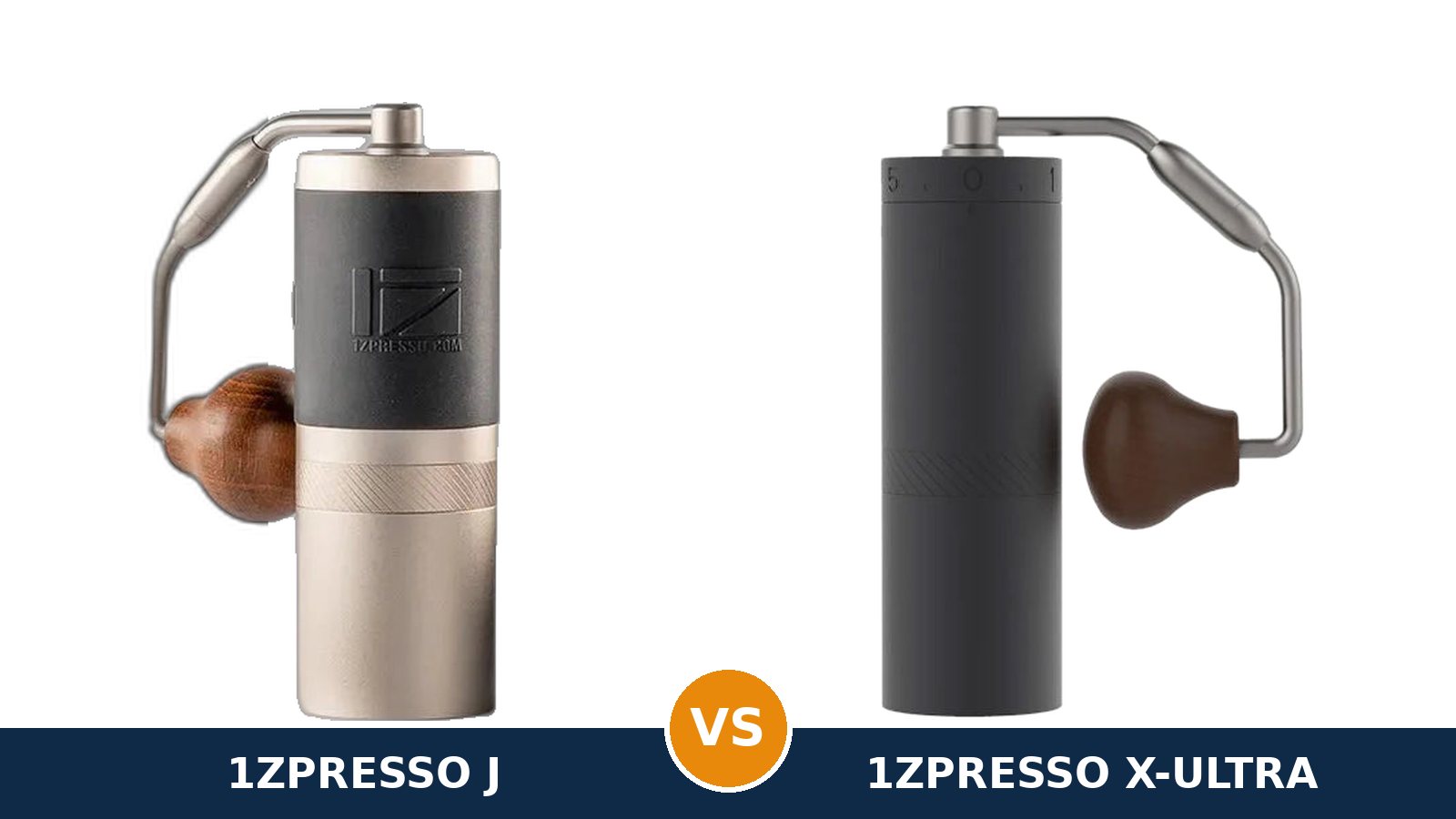
Same brand. Same Taiwan engineering team. Two hand grinders that look like close relatives — and one of the most confusing name collisions in coffee.
Before anything else, the naming trap. 1Zpresso's J line has run through the JX, JX-Pro, J-Max and J-Ultra, and listings still mix them freely. The bare “J” here is the current 1Zpresso J: the entry model in the maker's present range, direct successor to the discontinued JX, still listed in its official model chooser today.
It is not the J-Ultra. The J-Ultra is a separate, pricier espresso specialist with a coated 48 mm burr, an external ring and 8-micron clicks. None of its specifications appear on the J side of this page. If a listing tries to sell you a “J” with an external adjustment ring, it is selling you a different grinder.
So pinned down, the matchup is this: the J is 1Zpresso's larger-burr, filter-first value grinder. The X-Ultra is its slimmer all-rounder, built around an external adjustment ring with clicks half the size. Everything below follows from those two design briefs.
Every specification in this guide comes from 1Zpresso's own published data — its product pages, model comparison charts and manuals. The verdict is the one we would give a friend spending their own money.
Key Takeaways
- The X-Ultra wins on adjustment. Its external numbered ring moves the burr 12.5 microns per click, 60 clicks per rotation — twice the J's resolution, changed without removing the catch cup.
- The J wins on burr size and capacity. A 48 mm conical burr against 40 mm, and a 30–35 g catch cup against 25–30 g.
- The J is the maker's pour-over pick. 1Zpresso positions the J primarily for filter brewing; the X-Ultra is positioned for pour-over and espresso alike.
- Neither is the espresso specialist. That job belongs to the J-Ultra. Of these two, the X-Ultra's finer clicks make it the more workable espresso grinder.
- The X-Ultra is the traveller. 590 g against 705 g, a slimmer 52 mm body, a magnetic catch cup and a carrying case in the box.
Quick Verdict
Buy the 1Zpresso X-Ultra if you want one hand grinder for everything. It is the more complete machine on the spec sheet.
Its external adjustment ring is the headline: 60 numbered clicks per rotation at 12.5 microns each, changed from outside while the catch cup stays on. Add a magnetic quick-release cup, a 52 mm body that suits smaller hands, 590 g of weight, and a box with a carrying case, brush and air blower. This is the grinder for mixed brewing and travel.
Buy the 1Zpresso J if you brew filter first. It is the model 1Zpresso itself points pour-over drinkers at.
The J counters with the bigger burr — 48 mm against 40 mm — and the bigger cup, 30–35 g against 25–30 g. Its adjustment is internal, beneath the cup, in coarser 25-micron steps. For filter brewing that trade is barely a compromise; for espresso it is the whole story, and it is why the J finishes second overall.
The Scorecard
Scores below are derived directly from the manufacturer specifications compared in this guide — burr diameter and geometry, adjustment location, clicks per rotation and microns per click, stated capacity, weight and body diameter. They are a reading aid, not benchmark results.
| Category | 1Zpresso J | 1Zpresso X-Ultra | ||
|---|---|---|---|---|
| Burr set | 8.5 / 10 | 8 / 10 | ||
| Adjustment system & precision | 6.5 / 10 | 9.5 / 10 | ||
| Espresso dialing | 6.5 / 10 | 8.5 / 10 | ||
| Filter brewing fit | 9 / 10 | 8.5 / 10 | ||
| Capacity & dosing | 8.5 / 10 | 7.5 / 10 | ||
| Portability & travel | 7.5 / 10 | 9 / 10 | ||
| Cleaning & maintenance | 8 / 10 | 8.5 / 10 | ||
| Overall | 7.8 / 10 | 8.5 / 10 | ||
The pattern is consistent. The J wins where filter brewers live: burr diameter, capacity, the maker's own pour-over positioning. The X-Ultra wins on the mechanism you touch every time you change coffees — the adjustment system — and on everything to do with carrying the grinder.
At a Glance: Who Each Grinder Fits
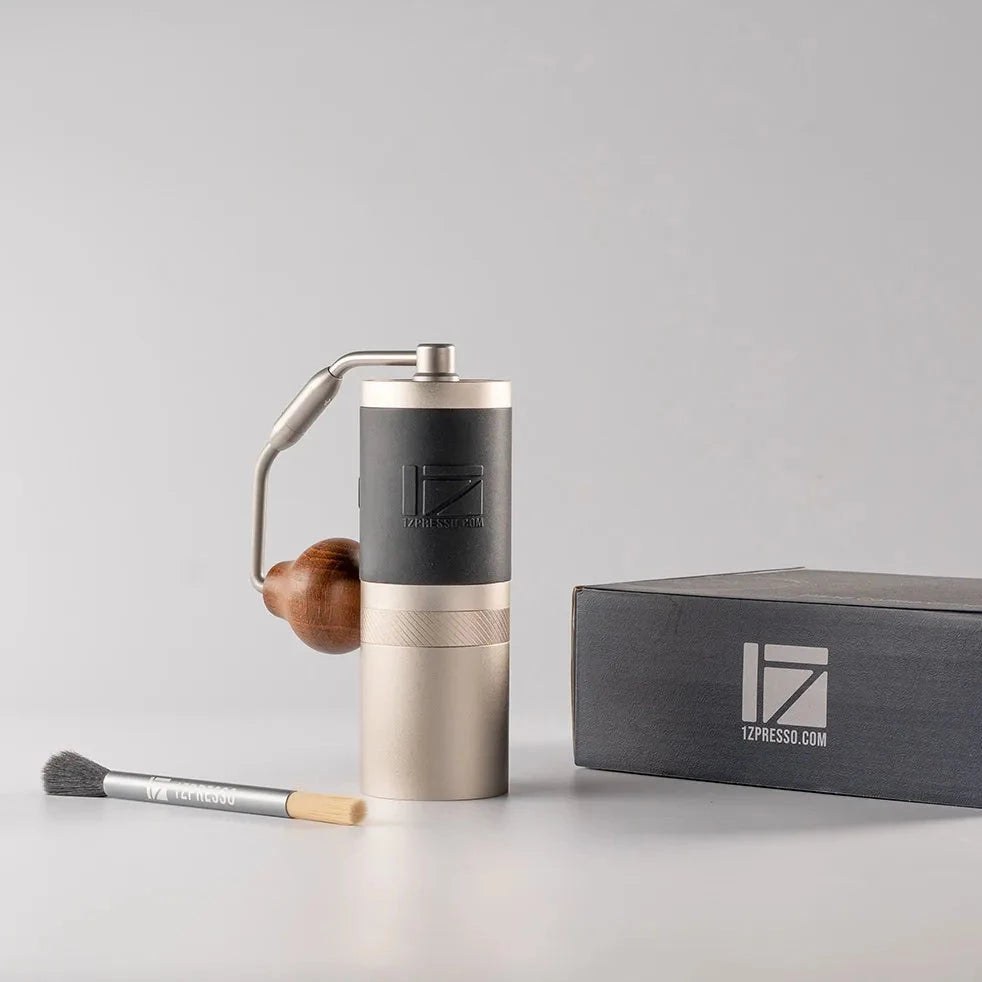
1Zpresso J
- 48 mm conical burr, stainless steel
- Internal numerical adjustment: 30 clicks per rotation, 25 microns per click
- Threaded catch cup, 30–35 g capacity
- 705 g; 57 mm body diameter; foldable crank handle
- Positioned by 1Zpresso primarily for pour-over
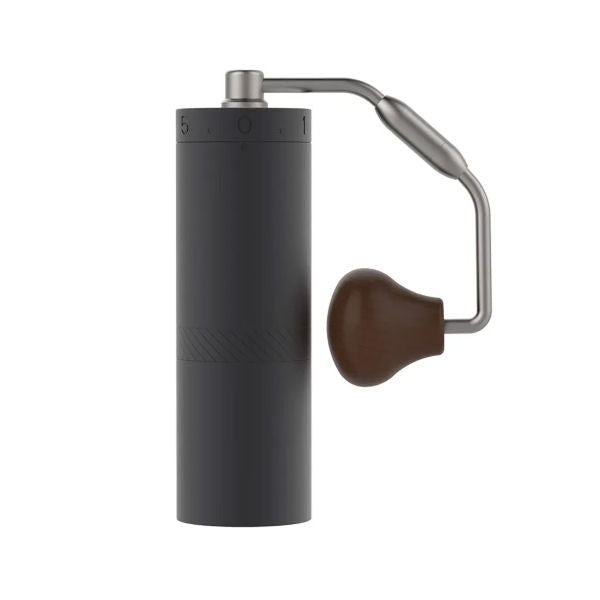
1Zpresso X-Ultra
- 40 mm conical burr, stainless steel, heptagonal geometry
- External numerical ring: 60 clicks per rotation, 12.5 microns per click
- Magnetic catch cup, 25–30 g capacity
- 590 g; 52 mm body diameter; carrying case included
- Positioned by 1Zpresso for pour-over and espresso
Choose the 1Zpresso J if…
Pour-over is the main event. V60, Kalita, Chemex, AeroPress — the J is the grinder 1Zpresso itself steers filter brewers toward, with the larger burr and the larger cup for two-cup brews.
You grind at home, at a counter, and rarely pack the grinder in a bag. The J's extra 115 g and wider body stop mattering the moment travel leaves the picture.
You want the most burr and the most capacity in this pairing, at the lower rung of the maker's price ladder.
Choose the 1Zpresso X-Ultra if…
You switch methods — and coffees — constantly. An external ring you can read and turn without unscrewing anything is worth more than burr diameter when your setting changes twice a day.
Espresso is part of your week, or you travel with your grinder. The 12.5-micron clicks give the X-Ultra twice the J's dialing resolution, and it is slimmer, lighter, with a case in the box.
As an Amazon Associate I earn from qualifying purchases at no extra cost to you.
Specifications: The Specs That Actually Matter
Every figure below is taken from 1Zpresso's official product data — its comparison charts, product pages and manuals — with manufacturer data carried on its own Amazon listings and by authorised retailers.
Where sources disagree, we say so in the notes under the table rather than quietly picking a number.
| Specification | 1Zpresso J | 1Zpresso X-Ultra |
|---|---|---|
| Burrs | 48 mm conical, stainless steel | 40 mm conical, stainless steel, heptagonal geometry (manufacturer-stated) |
| Adjustment system | Internal numerical dial, beneath the catch cup | External numerical ring — no need to remove the catch cup |
| Clicks per rotation | 30 | 60 |
| Step size | 25 microns per click | 12.5 microns per click |
| Total settings | 120 (4 rotations) | ~240 (60 across 4 rotations; see note below) |
| Catch cup | Threaded (screw-on) | Magnetic, quick-release |
| Capacity | 30–35 g | 25–30 g |
| Weight | 705 g | 590 g |
| Dimensions | 170 mm tall with handle; body Ø 57 mm | 173 mm body, 185 mm with handle; body Ø 52 mm |
| Materials | 304 stainless steel, aluminium alloy, wooden handle knob | Aluminium alloy, stainless steel, wooden handle knob |
| Handle | Foldable crank handle | Foldable crank handle |
| Finishes | Silver | Midnight Black, Space Gray, Pacific Blue |
| In the box | Grinder with crank handle | Grinder, carrying case, cleaning brush, air blower, anti-slip band |
| Cleaning & calibration | Tool-free disassembly; burr factory-calibrated and fixed | Tool-free disassembly; designed to return to zero more easily after reassembly |
| Maker positioning | Primarily pour-over; can reach espresso fineness | All-round: pour-over and espresso |
| Estimated burr life | ~100–200 kg of beans (maker's estimate) | ~100–200 kg of beans (maker's estimate) |
| Warranty | 1-year limited warranty | 1-year limited warranty |
Which J is this? Read this before you buy anything. The J name has carried several grinders. The JX and JX-Pro are discontinued earlier generations. The J-Max was the espresso flagship of its day and has been replaced in the range by the J-Ultra — a different machine in every way that matters: coated 48 mm burr, external ring, 100 clicks per rotation at 8 microns per click, magnetic 35–40 g cup, flagship price.
The grinder in this comparison is the plain J: the current entry model, internal adjustment, 25 microns per click, threaded cup. 1Zpresso's own comparison chart lists it exactly that way, and its official model chooser still carries it. The tell at a glance: if the dial is on the outside, it is not this J.
Catch cup note: 1Zpresso's brand chart uses “magnetic catch cup” as a generic label across the range, but its compiled model data lists the J's cup as threaded, and reviewers of the current J confirm it. We spec the J as threaded — plan around unscrewing the cup, not pulling it free.
Total settings note: totals are the softest numbers in hand-grinder specs. The J's 120 follows from its published 30 clicks across 4 rotations. For the X-Ultra, the maker's manual illustrates up to 200 clicks while model charts compute ~240. The figures that govern dialing — clicks per rotation and microns per click — are consistent everywhere, and those are the ones this verdict rests on.
Weight note: the J's 705 g is grinder weight in the maker's model data; the roughly 1.8 lb on its retail listing is packaged weight.
The Differences That Actually Matter
1. Adjustment — internal dial against external ring
This is the defining difference between the two grinders, and it is not close.
The J adjusts the way classic 1Zpresso grinders do: unscrew the catch cup, reach the numerical dial underneath, click to your setting, screw the cup back on. It works. It is also a small ceremony every single time you change coffees or methods.
The X-Ultra moves the dial to a numbered ring on the outside of the body. Settings change with the cup in place, the number reads at a glance, and returning to a favourite setting is a twist, not a procedure.
Neither system is more accurate in itself — accuracy lives in the click size, which is the next section. But the external ring removes friction from the adjustment you make most often, and over a year that is the difference between a setting you fine-tune and one you leave alone.
2. Step size — 25 microns against 12.5
Each click of the J's dial moves the burr 25 microns. Each click of the X-Ultra's ring moves it 12.5 — exactly half.
At filter settings, both are fine. Pour-over forgives a wide step because the target zone is broad; one click either way on the J still lands inside it.
Espresso does not forgive. The window between a choked shot and a fast one is a handful of microns, and a 25-micron click can jump clean over it. The J can grind fine enough for espresso — 1Zpresso says so, and its range reaches the fineness — but dialing in means working with half the resolution, and small corrections become compromises.
The honest framing: the X-Ultra is espresso-capable with genuinely useful resolution. The family's espresso specialist is the J-Ultra at 8 microns per click — if espresso is your whole hobby, see “When to Skip Both”. Between these two, the X-Ultra dials espresso and the J tolerates it.
3. Burrs — 48 mm of diameter against a shaped 40 mm
The J's burr is the bigger one: 48 mm of stainless steel conical burr, the same diameter class as the maker's espresso models. A larger burr presents more cutting surface per revolution, which is the spec-sheet basis for the J's filter-first brief.
The X-Ultra runs a 40 mm burr, and 1Zpresso is specific about its geometry: heptagonal, a seven-sided cutting profile the maker associates with clarity in the cup. Note the asymmetry — 1Zpresso publishes the X-Ultra's burr geometry and no equivalent claim for the J's burr, so we do not invent one.
What we will not do is convert either claim into invented grind data — no particle measurements, no grind times; the maker publishes neither. On published specifications, the trade is diameter against stated geometry. Filter-first buyers take the diameter; buyers who trust the maker's clarity brief take the smaller burr.
4. Brew-method fit — the maker's own positioning
Manufacturers tell you what a grinder is for, if you read their charts instead of their adjectives.
In 1Zpresso's own comparison data, the J's row reads “pour-over”. Its design agrees: a big burr, a big cup, and adjustment steps sized for the filter range.
The X-Ultra's row reads pour-over and espresso. Its design agrees too: the external ring and 12.5-micron clicks exist because method-switchers change settings constantly, and the finer step exists because one of those methods is espresso.
This is why the scorecard splits the way it does. Judged as filter grinders, the J edges it. Judged as one-grinder-for-everything, the X-Ultra was designed for the job and the J was not.
5. Catch cup and capacity — threaded and larger, magnetic and smaller
Two trades in one component. The J's cup holds more — 30–35 g against 25–30 g — the difference between grinding a two-cup V60 in one load and splitting it. But it screws on and off, every dose, every day.
The X-Ultra's cup is magnetic: pull it free, knock the grounds out, click it back. Anyone who has fumbled a threaded cup with wet hands at 7 a.m. understands why the maker made it a headline feature of the Ultra generation.
Capacity only matters if you regularly grind more than 30 g at once. Workflow matters every dose. Batch filter brewers take the J; everyone else takes the magnets.
6. Size, weight and travel
The X-Ultra is the smaller object by every measure that matters in a bag or a small hand: 590 g against 705 g, a 52 mm body against 57 mm, and a slimmer profile that the maker's own data pitches at smaller grips.
Both handles fold. Both are all-metal. But only one ships with a carrying case, and it is not the J — the X-Ultra's box includes the case, a cleaning brush, an air blower and an anti-slip band. A travel kit, included, against a grinder you would wrap in a towel.
On a home counter the gap shrinks to preference. In a carry-on or a desk drawer at work, it is decisive.
7. Cleaning and living with them
A practical tie, with one footnote each way. Both grinders disassemble without tools — a brand-wide 1Zpresso design rule — and both carry burrs factory-calibrated and fixed to the shaft, so there is no alignment ritual after a clean.
The X-Ultra's footnote: 1Zpresso's own copy notes it is easier to return to its zero point after reassembly — a wandering zero quietly invalidates every setting you have written down. The J's footnote: its dial lives under a cup that is already in your hand at every dose, so checking a setting adds seconds, not a disassembly. Daily ownership is closer than the adjustment scores suggest.
Brew-Method Fit Guide
The fastest way to choose between these grinders is to start from what you actually drink. This table is the whole comparison in one view.
| What you brew | 1Zpresso J | 1Zpresso X-Ultra | Our call |
|---|---|---|---|
| Pour-over first: V60, Kalita, Chemex | Excellent — the maker's pour-over pick, 48 mm burr | Very good — rated for filter, smaller burr | J, on burr size and capacity |
| Espresso at home, daily | Workable — reaches the fineness, 25-micron steps | Good — 12.5-micron clicks on an external ring | X-Ultra, on dialing resolution |
| Espresso weekdays, filter weekends | Workable — setting changes mean cup off, dial, cup on | Excellent — built for method-switching | X-Ultra |
| AeroPress and moka pot | Excellent — mid-range settings are its home | Excellent | Tie — buy on the other rows |
| Two-cup batches, 30 g and up | Excellent — 30–35 g in one load | Tight — 25–30 g cup, split big batches | J |
| Travel, camping, office drawer | Good — foldable handle, but no case included | Excellent — 590 g, slim body, case in the box | X-Ultra |
| Smaller hands, long grinding sessions | Good — 57 mm body to grip | Excellent — 52 mm body, lighter crank load | X-Ultra |
Read the espresso row honestly. If espresso is an occasional guest in your brewing, either grinder hosts it. If it is a daily resident, the X-Ultra's clicks are the minimum resolution worth having.
The 30-Second Decision
| If this sounds like you… | Buy this |
|---|---|
| “I brew pour-over almost every day and espresso rarely.” | 1Zpresso J |
| “I change grind settings constantly and hate unscrewing the cup.” | 1Zpresso X-Ultra |
| “Espresso is half my brewing and I need clicks that can dial it.” | 1Zpresso X-Ultra |
| “I grind 30 g or more at a time for two people.” | 1Zpresso J |
| “The grinder comes travelling with me.” | 1Zpresso X-Ultra |
| “I want the most burr for the money and I grind at home.” | 1Zpresso J |
Ready to check today’s price?
Both grinders are current models sold by 1Zpresso itself on Amazon. The X-Ultra comes in three colours, and each colour is its own listing.
View on Amazon — 1Zpresso JView on Amazon — X-UltraWhat You Gain. What You Give Up.
1Zpresso J
You gain: the bigger burr (48 mm) and the bigger cup (30–35 g) in this pairing, in the grinder 1Zpresso itself positions for pour-over. Solid, simple hardware: internal numerical adjustment, tool-free cleaning, an aluminium and stainless build with a wooden knob.
You give up: adjustment convenience and resolution — a dial hidden under a threaded cup, moving in 25-micron steps. The magnetic cup. The travel kit: no case in the box, 115 g more weight, a wider body. And espresso headroom: the J reaches espresso fineness but was not designed around dialing it.
1Zpresso X-Ultra
You gain: the best adjustment system in this comparison — external, numbered, 60 clicks per rotation at 12.5 microns. A magnetic cup, a slimmer and lighter body, three finishes, and a box that includes the case, brush and blower. Genuine two-method range, espresso included.
You give up: burr diameter — 40 mm against 48 mm — and cup capacity, 25–30 g against 30–35 g. The J's simplicity premium: the X-Ultra costs more of your budget to buy a smaller burr, and what you are paying for is the mechanism around it.
Pros and Cons
1Zpresso J — Pros
- 48 mm stainless conical burr — the larger burr here
- 30–35 g capacity handles two-cup brews in one load
- 1Zpresso's own pour-over pick in this price class
- Internal numerical dial: 120 settings, easy to record
- Tool-free disassembly; foldable handle
- Entry model pricing within the maker's range
Cons
- Adjustment hides under a threaded catch cup
- 25-micron clicks are coarse for espresso dialing
- No magnetic catch cup
- Heaviest and widest of the two at 705 g / 57 mm
- No carrying case included
- Name collides with JX, J-Max and J-Ultra listings
1Zpresso X-Ultra — Pros
- External numbered ring: 60 clicks/rotation, 12.5 microns per click
- Magnetic quick-release catch cup
- Light and slim: 590 g, 52 mm body
- Carrying case, brush and air blower included
- Rated by the maker for espresso and filter alike
- Three finishes; easier re-zeroing after cleaning
Cons
- 40 mm burr — smaller than the J's
- 25–30 g cup splits bigger filter batches
- Costs more than the J for a smaller burr set
- Espresso-capable, but not the espresso specialist (that is the J-Ultra)
- Total-settings figures vary between the maker's own documents
Check the Name on the Listing, Not Just the Letter
Check which “J” the listing is actually selling. This is the single most important check in this guide. The current J has an internal dial and a threaded cup. If the photos show an external ring, a magnetic cup or a coated burr, the listing is a J-Ultra wearing a shorter name — a fine grinder, but a different one at a different price.
The reverse trap exists too. Older JX and JX-Pro stock still circulates through marketplaces. They are close relatives of the J, but they are discontinued models; buy one knowingly, at a used-model price, not as the current J.
Check the X-Ultra's finish before you order. It comes in Midnight Black, Space Gray and Pacific Blue, and each finish is a separate listing with its own identifier. The listing this guide links is Midnight Black; for another colour, switch listings.
Check what is in the box. A complete X-Ultra kit includes the grinder, carrying case, cleaning brush, air blower and anti-slip band. A listing missing the case is an incomplete kit at a complete-kit price. For the J, confirm the crank handle is included and attached in the photos — it is the one part that occasionally goes missing from marketplace returns.
Check the seller. Both grinders are sold by 1Zpresso itself on Amazon and by authorised retailers elsewhere. The one-year warranty conversation is with the maker — buy through a channel that can honour it.
Write your settings down. Both dials are numbered and repeatable, which only helps if you record what worked. The J counts rotations from zero; the X-Ultra reads its ring directly.
The Upgrade Path Test
Judge a hand grinder by its third year, not its first week.
Year one, both grinders delight. Fresh grounds on demand, no motor noise, no counter space surrendered. The differences are seconds of workflow, and both feel like the correct purchase.
Year two, your habits harden. If they harden around filter, the J's burr and capacity are what you live with, and they age well — the maker's estimated burr life of roughly 100–200 kg is years of home use on either grinder.
If they harden around variety — or around espresso — the X-Ultra's ring is what you live with. Settings stop being a chore, and the grinder keeps up as your methods multiply. That is the year the adjustment system repays its price.
Know the ceiling of both. If espresso becomes the whole hobby, neither grinder is the endgame: the J-Ultra exists for exactly that reader. Buying the X-Ultra now and a J-Ultra later is a legitimate path — the X-Ultra remains the travel and filter grinder afterwards. And neither grinder grows a motor: if your future is grinding for a household every morning, that future is electric.
When to Skip Both
Honesty cuts both ways. There are buyers neither of these grinders serves.
Skip both if espresso is your main drink. The maker's espresso specialist is the J-Ultra — external ring, 8 microns per click, coated 48 mm burr, magnetic cup. It costs more than either grinder here, and for a daily espresso drinker it is the correct spend. Buying the X-Ultra as a “close enough” espresso grinder is how people end up owning two grinders in a year.
Skip both if you want an electric grinder's convenience. Hand grinding 18 g is a pleasant ritual; hand grinding for four guests is a chore with an audience. No burr specification fixes that arithmetic.
Skip both if you routinely grind more than 35 g at once. Both cups top out around a two-cup brew. Batch brewers for a household need a bigger hopper class entirely.
And skip the J specifically if your brewing is already half espresso. Its coarse steps will not stop you making espresso — they will stop you enjoying dialing it in, which is most of the hobby.
Warranty and Long-Term Support
This section is the closest thing in the comparison to a tie. Both grinders carry 1Zpresso's one-year limited warranty, from the same maker, with the same manuals library behind them.
Burrs on both are fixed and factory-calibrated to the shaft, which removes the most common hand-grinder support issue — user-introduced misalignment — from the table. The maker's estimated burr life, roughly 100–200 kg, is identical for both.
Support quality therefore comes down to channel. Buy from 1Zpresso's own storefront or an authorised retailer and warranty claims are a formality. Buy grey-market and you are relying on the seller's goodwill.
One habit serves both: never wash the burrs with water — brush and blower only, which is why the X-Ultra's box includes both. The J asks for the same dry-cleaning routine.
Final Verdict
The 1Zpresso X-Ultra is the hand grinder we would buy of these two.
It wins this comparison on the mechanism that defines daily life with a hand grinder. An external, numbered ring at 12.5 microns per click, a magnetic cup, a lighter and slimmer body, and a travel kit in the box add up to the more capable all-rounder — one that covers espresso credibly and filter well, and goes in a bag without a second thought.
The J beats it — clearly — on burr diameter, capacity and the maker's own pour-over positioning. If filter coffee is your whole world and the grinder never leaves your counter, the verdict flips, and we say so without hedging.
But weighed across the whole spec sheet, the X-Ultra's adjustment system is worth more than the J's extra 8 mm of burr.
Buy the X-Ultra if you brew across methods, travel with your kit, or want the finer click for espresso. Pick your finish deliberately — the link below is the Midnight Black listing.
Buy the J if you are a filter-first brewer who grinds at home: the biggest burr and cup in this pairing, from the value end of the range, in the model the maker itself aims at pour-over.
Just buy it with your eyes open about the name. The J is a good grinder. It is simply not the J-Ultra, and it was never priced or specced to be.
Frequently Asked Questions
Is the 1Zpresso J the same grinder as the J-Ultra?
No. They are different models that share a letter. The J is the current entry model: internal adjustment, 25 microns per click, threaded catch cup, uncoated 48 mm burr, pour-over positioning. The J-Ultra is the espresso flagship: external ring, 8 microns per click across 100 clicks per rotation, titanium-coated 48 mm burr and a magnetic 35–40 g cup. If a “J” listing shows an external ring, it is the J-Ultra.
Is the 1Zpresso J the same as the old JX?
It is the JX's successor rather than the same product. The JX was discontinued, and the J continues its role — big-burr, filter-first, internal adjustment — as the current entry J model listed in 1Zpresso's official chooser and comparison charts today. Used JX units still circulate; a legitimate budget buy, but not the current model.
Which is better for espresso, the J or the X-Ultra?
The X-Ultra, of these two. Its clicks move the burr 12.5 microns against the J's 25, and its ring adjusts from outside without removing the cup — both advantages land exactly where espresso dialing is unforgiving. Note the ceiling: the maker's actual espresso specialist is the J-Ultra at 8 microns per click. Neither grinder here is that machine.
Which is better for pour-over?
The J, narrowly. It is the model 1Zpresso positions for pour-over, with the larger 48 mm burr and a 30–35 g cup that covers two-cup brews in one load. The X-Ultra is also rated for filter and adds finer clicks for small corrections; filter-only buyers should take the J's burr and capacity, method-switchers the X-Ultra's ring.
Can the 1Zpresso J grind for espresso?
Yes, in the sense that its range reaches espresso fineness — 1Zpresso's own data says it can. The compromise is resolution: at 25 microns per click, one click can jump past the narrow window where a shot runs correctly, so dialing in takes more patience and more wasted shots than on a finer-stepped grinder.
Which grinder is better for travel?
The X-Ultra. It is 115 g lighter (590 g against 705 g), slimmer (52 mm against 57 mm body), folds its handle like the J, and ships with a carrying case, cleaning brush and air blower. The J travels adequately — it is still an all-metal hand grinder — but it arrives without a case and takes up more room doing it.
How long do the burrs last on these grinders?
1Zpresso estimates roughly 100–200 kg of coffee for both models' stainless burrs. At a home pace of a few hundred grams a week, that is many years of use — burr wear is not the deciding factor between them, and neither grinder asks you to realign anything: the burrs are factory-calibrated and fixed.
Does the catch cup difference actually matter?
More than the spec sheet suggests. The J's threaded cup holds more (30–35 g) but screws on and off for every dose and every setting change, because its dial lives underneath it. The X-Ultra's magnetic cup holds less (25–30 g) but pulls free instantly and never moves for an adjustment — the ring is outside. Dose small and often: magnets. Dose big and rarely: threads.
Sources & Verification
1Zpresso official model comparison chart and product copy (via the maker's Amazon listings for both models) — burr sizes, adjustment systems, clicks and microns per click, capacities, positioning • 1Zpresso J and X-Ultra instruction manuals — adjustment ranges, dimensions, burr life estimate • 1Zpresso official model chooser and 2026 range navigation — current-model status of the J, separated from the J-Ultra, J-Max, JX-Pro S and JE-Plus • Rogue Wave Coffee (authorised Canadian distributor) — J model data, warranty terms • Honest Coffee Guide 33-model comparison chart, compiled from manufacturer data — J totals (120 settings, 705 g, threaded cup) and X-Ultra totals, cross-checking the maker's figures • Amazon listing data for both models, used for ASIN verification only. Specifications verified November 2026.

James Wilson
James has been testing coffee gear and small kitchen appliances for over a decade and writes Honestly Compared's coffee and grinder guides. His rule for every comparison: the verdict has to survive the spec sheet, not the marketing page.