
1Zpresso Q vs Q Air: Which Should You Buy?
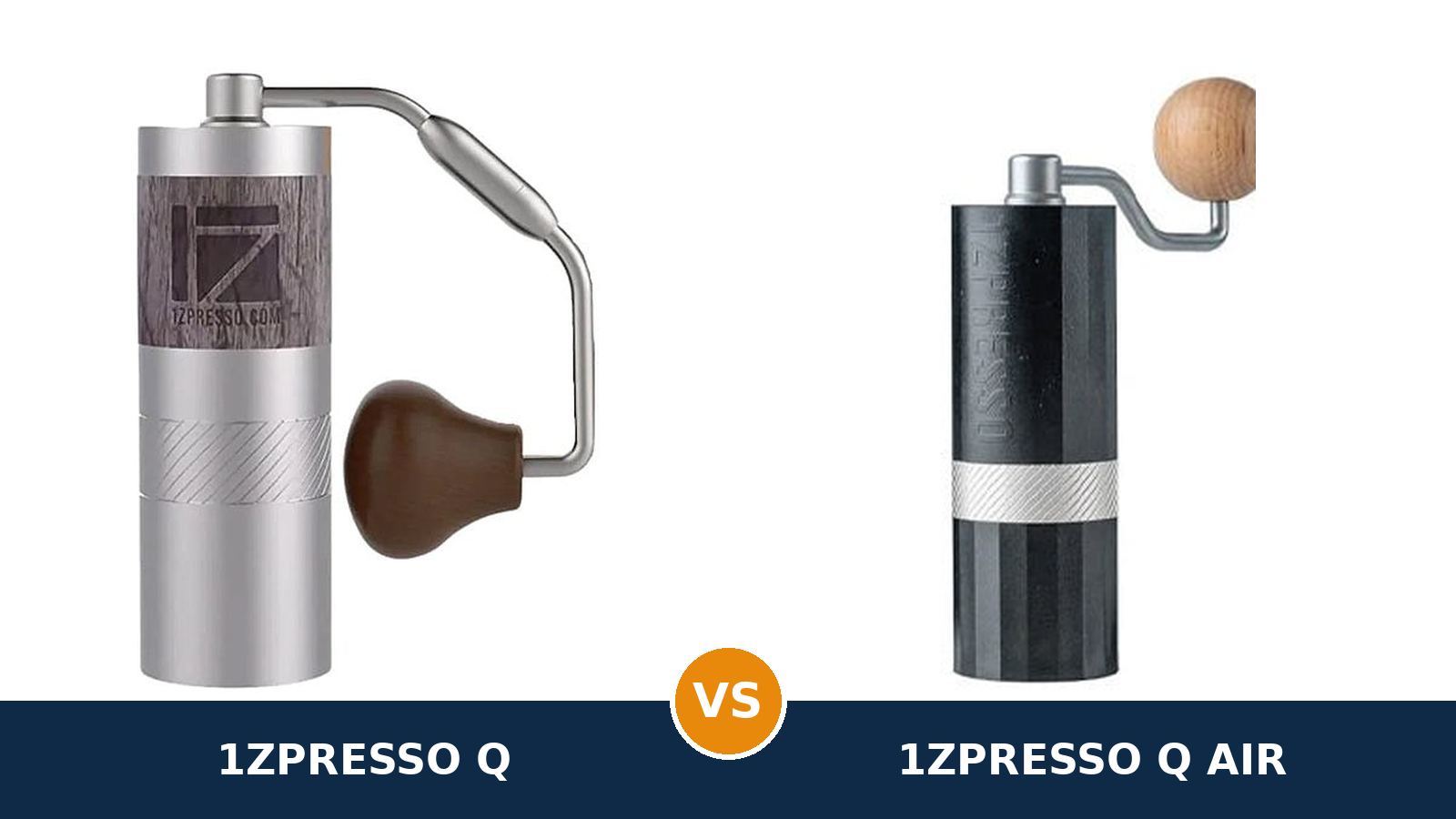
Put these two grinders on a bench, take the bodies away, and a parts inspector would struggle to separate what is left.
Underneath the shells sits the same hardware: a 38 mm heptagonal conical burr in stainless steel, a dual-bearing shaft, and an internal dial that clicks 30 times per rotation. Even the dose is shared, at 15 to 20 grams per fill.
So this comparison is not really about grinding. It is about the tube the hardware lives in. 1Zpresso sells that tube in aluminium, as the Q, and in polycarbonate, as the Q Air — and the material you pick decides the weight, the price and how the grinder feels after a year of mornings.
One clarification before the table, because the Q family tree is genuinely confusing. The grinder in the left column is the current 1Zpresso Q, the 480 g metal model on the maker’s Q Series page today. Older stock wearing the Q2 name, and a near-twin called the Q2 S, are covered in the variant note below so nobody orders the wrong one.
Everything quoted here traces back to 1Zpresso’s own material — the official Q Series page and comparison table, the instruction manuals, and the manufacturer’s listing data. Where the maker’s numbers are the only numbers, we say so.
Key Takeaways
- The grinding parts are identical. Same 38 mm heptagonal stainless burr, same dual-bearing shaft, same 10-number internal dial moving 0.025 mm per click across 30 clicks a turn.
- The Q is the ownership pick. Aluminium body, aluminium catch cup, a crank that folds away, and a silicone leather grip — the version built to be kept.
- The Q Air is the weight pick. At 365 g it undercuts the Q by 115 g, roughly a quarter of its own mass, and it is the cheaper way to get this exact burr set.
- Check which Q you are actually buying. Today’s Q Series is the Q2 S, the Q and the Q Air. The discontinued original Q2 also came with a pentagonal burr — that one is not in this comparison.
- Filter brewers only, by design. 1Zpresso builds the whole Q line around pour-over. Anyone chasing espresso should look at the external-dial models higher up the range.
Quick Verdict
Buy the 1Zpresso Q if this is a long-term purchase. Nothing about the coffee improves — the burr set is shared — but everything about owning it does.
The body and the cup that hangs under it are aluminium. The handle folds flat against the body for packing. The grip is a fitted silicone leather sleeve rather than a band. Grounds behave better against metal, and metal takes years of knocks without complaint.
Buy the 1Zpresso Q Air if the scale or the wallet is voting. It is the lightest grinder 1Zpresso sells, and the saving was taken entirely from the shell.
The cup it produces is the Q’s cup. What changes is the ownership experience: a plastic body and cup, a handle that stays where it works, and static that the manufacturer itself warns you about. Plenty of travellers will call that a fair trade. It is simply a trade you should make knowingly.
The Scorecard
These scores are worked out from the manufacturer specifications set out in this guide — burr size and material, click resolution, published weights, capacities and shell materials. Treat them as a structured reading of the spec sheet, not as bench-test results.
| Category | 1Zpresso Q | 1Zpresso Q Air | ||
|---|---|---|---|---|
| Burr set | 8.5 / 10 | 8.5 / 10 | ||
| Adjustment system & precision | 8.0 / 10 | 8.0 / 10 | ||
| Filter brewing fit | 9.0 / 10 | 9.0 / 10 | ||
| Build & materials | 9.0 / 10 | 6.5 / 10 | ||
| Capacity & dosing | 7.5 / 10 | 7.5 / 10 | ||
| Portability & travel | 8.5 / 10 | 9.5 / 10 | ||
| Cleaning & maintenance | 8.5 / 10 | 7.5 / 10 | ||
| Overall | 8.4 / 10 | 8.1 / 10 | ||
Notice where the daylight is. Four rows cannot separate the pair because the machinery behind them is one design. The verdict is earned in the remaining rows — shell, weight and upkeep — which is why this article spends most of its length there.
At a Glance: Who Each Grinder Fits
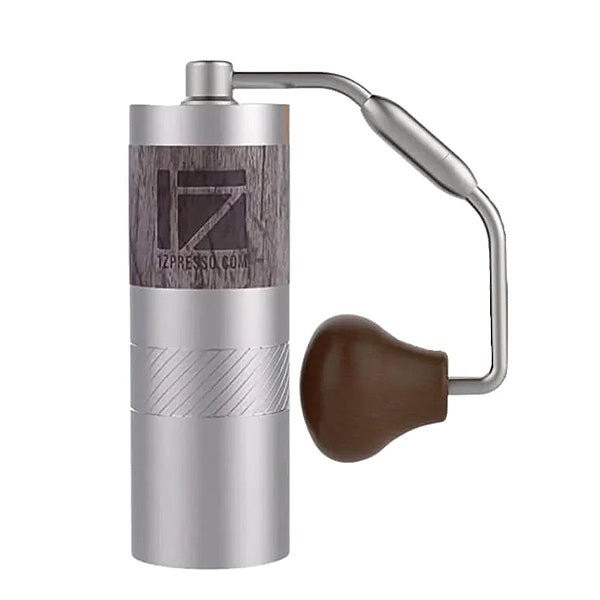
1Zpresso Q
- 38 mm heptagonal stainless steel conical burr
- Internal dial: 10 numbers, 30 clicks per rotation
- Aluminium body with an aluminium catch cup
- Crank handle folds flat, wooden knob
- 480 g in silver, with a silicone leather grip sleeve
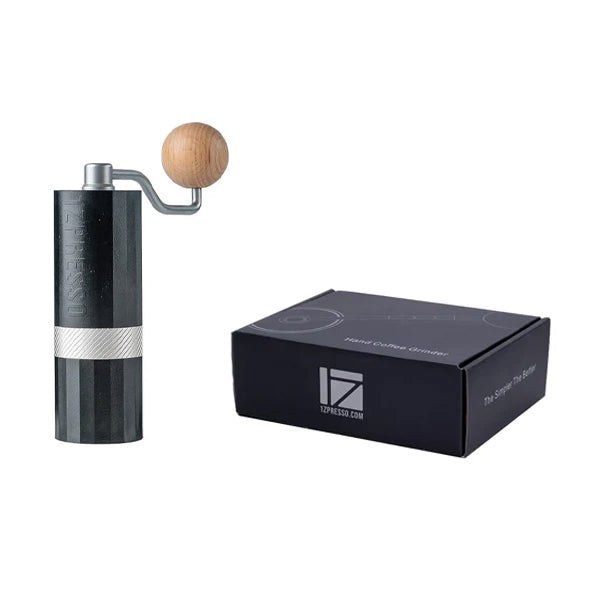
1Zpresso Q Air
- The same 38 mm heptagonal stainless steel burr
- The same internal dial, 30 clicks per rotation
- Polycarbonate body with a plastic catch cup
- Fixed crank handle with a wooden ball knob
- 365 g, sold in Black, Blue, Gray and Purple
Choose the 1Zpresso Q if…
You buy tools once and keep them. An aluminium shell and cup are what a decade of daily grinding asks for.
Your grinder travels in bags that get handled roughly. Metal forgives drops and compression that would stress a plastic thread.
You value a tidy pack. Fold the crank away and the Q becomes a plain cylinder with nothing left sticking out.
Choose the 1Zpresso Q Air if…
You travel light on principle. This is the lightest grinder in the maker’s catalogue, and the burr inside is not a downgrade.
The budget is fixed and you refuse to compromise the grind itself. The Air’s savings never touch the parts that touch the coffee.
You want a colour other than silver. The Air offers four; the Q offers the one.
As an Amazon Associate I earn from qualifying purchases at no extra cost to you.
Specifications: The Specs That Actually Matter
Figures below are drawn from 1Zpresso’s Q Series page and comparison table, the grinders’ manuals, and manufacturer listing data, checked against each other.
Stated plainly, because it changes what you might order: the Q Series as 1Zpresso sells it today has three members — the Q2 S, the Q and the Q Air. The Q in this comparison is the middle one, the current metal grinder. The original Q2 is an earlier, discontinued generation and appears only in the variant note under this table.
| Specification | 1Zpresso Q | 1Zpresso Q Air |
|---|---|---|
| Burr set | 38 mm heptagonal conical, stainless steel | 38 mm heptagonal conical, stainless steel |
| Burr material detail | 420 stainless steel | 420 stainless steel |
| Adjustment system | Internal numbered dial, 10 numbers | Internal numbered dial, 10 numbers |
| Clicks per rotation | 30 | 30 |
| Step size | 0.025 mm per click (maker’s figure) | 0.025 mm per click (maker’s figure) |
| Grind range (maker’s positioning) | Pour-over first; the manual also covers French press, cold brew, moka pot and drip | Pour-over first; the manual covers the same method list |
| Capacity | 15–20 g | 15–20 g |
| Body / receiver material | Aluminium / aluminium | Plastic (polycarbonate) / plastic |
| Handle | Foldable crank, wooden knob | Fixed crank, wooden knob (shorter) |
| Weight | 480 g | 365 g |
| Dimensions | 14.5 × 16 × 4.6 cm | 14.5 × 15 × 4.6 cm |
| Shaft | Dual-bearing, fixed central shaft | Dual-bearing, fixed central shaft |
| Full material list | 420 stainless steel, 304 stainless steel, aluminium alloy, wood | 420 stainless steel, 304 stainless steel, polycarbonate (PC), wood |
| Grip | Anti-slip silicone leather sleeve | Anti-slip rubber band included |
| Colours | Silver | Black, Blue, Gray, Purple |
| Burr service life (maker’s rating) | 100–200 kg of coffee | 100–200 kg of coffee |
| Warranty | 1 year (manufacturer) | 1 year (manufacturer) |
| Motor / power | None — hand crank only, nothing to charge or plug in | None — hand crank only, nothing to charge or plug in |
Variant note — the three metal Qs. Shoppers searching this family meet three metal grinders. The earliest, sold simply as the Q2, came in two burr versions — pentagonal and heptagonal — and has been discontinued. Its replacement generation splits in two on the current Q Series page: the Q2 S at 465 g with the first-generation heptagonal burr, and the Q at 480 g with the newer heptagonal burr the maker describes as easier to turn.
The Q and the Q2 S are close enough in daily use that most owners would not tell them apart blind. What separates them is the burr revision and 15 g. This article compares the current Q, and the buttons point at the manufacturer’s listing for it.
What to avoid is the leftover original Q2 in pentagonal form, still circulating in old stock and used listings. If a seller cannot confirm the word “heptagonal”, that listing is not this grinder.
Weight note: 480 g is the number in the manufacturer’s own Q Series comparison table for the Q. Roundups sometimes quote 465 g for the metal model — that figure belongs to the Q2 S in the same table. The manufacturer’s table governs here.
The Differences That Actually Matter
1. The burr set — deliberately identical
The most useful fact in this comparison is a non-difference. Both grinders cut coffee with the same 38 mm heptagonal conical burr, machined from 420 stainless steel and carried on a dual-bearing shaft.
Heptagonal means seven cutting faces, and this is the current Q Series geometry — the revision 1Zpresso markets as the easier-grinding one. The Air was not given the older burr as a quiet downgrade. It received the same one the Q uses.
Longevity is shared too. The maker rates the set at roughly 100 to 200 kg of coffee, which at a daily 15 to 20 g dose stretches past a decade without trying.
Score it level, and understand what that means: nothing you taste will separate these grinders. Everything after this section is about the object, not the output.
2. Adjustment — one dial, one routine, no winner
Changing the grind works the same way on both. The catch cup unscrews, the numbered dial underneath turns, the cup goes back on.
That dial shows 10 numbers and delivers 30 clicks per full turn. The maker’s click data works out to 0.025 mm of burr travel per click, and the adjustment range spans several turns of the dial.
The honest drawback belongs to both: because the dial hides under the cup, a mid-dose tweak means stopping and opening the grinder. Slim bodies charge that toll; neither model dodges it.
The numbered scale repays some of that inconvenience. Learn the setting for your pour-over and the setting for your press once, write them down, and either grinder repeats them exactly.
Level again — identical mechanism, identical steps, identical workflow.
3. The shell — the one decision that matters
Everything the two grinders do not share is in this section. The Q wraps its steel core in an aluminium body and catches grounds in an aluminium cup. The Q Air wraps the same core in polycarbonate and catches grounds in plastic.
1Zpresso does not hide the strategy. The steel frame and the burr set stay; the tube and the cup are where the Air’s lower price and lower weight are manufactured.
In use, the difference registers as character. The metal grinder feels dense and cold, and stays composed when set down hard. The plastic grinder feels warm and slightly hollow, and asks for a gentler hand around its threads.
Time sides with aluminium as well. It scuffs and keeps working; polycarbonate can crack where stress concentrates, at a thread root or a drop point. Neither grinder is delicate — but only one material shrugs off a decade.
The Air’s defence is legitimate and short: plastic is precisely how it got to 365 g and to its price. The next two sections are fought on its ground.
4. The handle — folding is a packing feature
The Q’s crank folds down. The Air’s crank does not — the manufacturer’s comparison table leaves that cell empty for the Air.
Folded, the Q turns into an uncomplicated cylinder. It slides into a wash bag, a side pocket, or the hollow of an AeroPress plunger — the space this body diameter was designed around — without a lever hunting for something to snag on.
The Air’s arm is a touch shorter, which softens the contrast but cannot remove it. Packed, that fixed crank is the outline you have to plan around.
There is a counterpoint, and it belongs to the Air: a hinge is a joint, and joints are where looseness eventually lives. A fixed handle has nothing to work loose. On a countertop, that simplicity is worth something.
Verdict for the road goes to the folding crank. Verdict for a quiet life at home is closer than the marketing suggests.
5. The 115-gram question
Numbers first: 480 g against 365 g. The difference, 115 g, is about a quarter of the lighter grinder’s total weight — proportionally, a large gap between small objects.
Where it counts depends on how the grinder travels. In a car kit or a cabin bag, 115 g will never be felt. In a pack you carry up a hill, it is a deliberate saving, the kind gram-counters itemise.
Keep the context in view, though. These are the two lightest machines 1Zpresso makes, and the Air is the lightest of all. The Q is only “heavy” in this specific company.
Both share a 46 mm body that nests inside an AeroPress plunger, and both vanish into hand luggage. The Air just vanishes 115 g lighter.
If you weigh your kit before trips, the Air has already won this section for you. If you never weigh anything, spend the difference on the metal and stop thinking about it.
6. Static, retention and the morning routine
Credit to 1Zpresso for candour: the Q Air’s own manual concedes that its material mix makes static something the owner will need to manage.
Plastic holds a charge, so grounds cling — to the cup wall, around the chute, anywhere dust can stick. A tap on the counter becomes part of the ritual, and a spray of water on the beans becomes a habit for many owners.
Metal gives the charge an exit. The Q is not static-proof — no small hand grinder is — but its grounds let go more willingly, and the cup empties cleaner.
The maker publishes no retention figure for either grinder, so none is claimed here. What the specifications do establish is the material in the grounds path, and on that evidence the Q runs the tidier routine.
Dosing itself is identical: beans in from the top, grounds out into a 15 to 20 g cup, nothing stored inside between brews to go stale.
7. Grip, colour and finishing touches
The Q’s grip is a fitted silicone leather sleeve — the wood-patterned band in the photographs. It gives wet or coffee-dusted fingers something to hold during a hard grind.
The Air answers with a simple anti-slip rubber band. Less elegant, equally functional, and trivially replaceable if it ever perishes.
Colour is the Air’s clear win. Black, Blue, Gray or Purple against the Q’s single silver finish — for a gift, or a kit you want to spot quickly in a bag, that choice has real value.
Beyond that, the finishing details converge: wooden knobs on both cranks, dual-bearing shafts in both bodies, and tool-free strip-downs with factory-set burrs across the pair.
Tally the small stuff honestly — grip to the Q, colour to the Air, the remainder shared.
Brew Method Fit Guide
Since the grind range is common to both, treat this as a guide to fit rather than a contest. Where a method leans one way, the lean comes from handling and materials — the range itself never separates them.
| Your brew method | 1Zpresso Q | 1Zpresso Q Air | Our call |
|---|---|---|---|
| Pour-over (V60, Kalita) | Excellent — the brief this grinder was designed around | Excellent — identical burrs and dial | Dead heat — decide on build or weight |
| AeroPress | Excellent — nests in the plunger, crank folds away | Excellent — nests in the plunger, lightest build | Q Air for gram-counters; Q for tight packing |
| French press / cold brew | Excellent — comfortable at the coarse end | Excellent — same coarse end, same range | Tie |
| Moka pot | Good — on the maker’s listed methods | Good — on the maker’s listed methods | Tie |
| Travel & camping | Excellent — metal tolerates rough handling | Excellent — 115 g less to carry | Q Air on weight; Q on toughness |
| Espresso | Outside the design brief — pour-over first | Outside the design brief — pour-over first | Neither — see When to Skip Both |
The short version of that table: choose your brewing method and both grinders qualify. Choose your priorities — durability or grams — and the winner names itself.
The 30-Second Decision
| If this sounds like you… | Buy this |
|---|---|
| “I want one small grinder that is still going in ten years.” | 1Zpresso Q |
| “I count the grams in my pack before every trip.” | 1Zpresso Q Air |
| “The budget is set, but I will not accept a lesser burr.” | 1Zpresso Q Air |
| “My bag is cramped and everything must pack without snagging.” | 1Zpresso Q (folding crank) |
| “It’s a gift and it should feel substantial when they pick it up.” | 1Zpresso Q |
| “It’s a gift and a colour will make it feel personal.” | 1Zpresso Q Air |
Ready to check today’s price?
Both grinders are sold on Amazon by 1Zpresso itself. Prices drift, so confirm the live figure on whichever one fits your kit.
View on Amazon — 1Zpresso QView on Amazon — 1Zpresso Q AirWhat You Gain. What You Give Up.
1Zpresso Q
You gain: a metal ownership experience — aluminium body and cup over the shared steel core, a crank that folds flat, a fitted grip sleeve, and grounds that release cleanly instead of clinging.
You give up: 115 g against the Air every time it travels. The extra money the metal costs. And any say in the colour — silver is the catalogue.
1Zpresso Q Air
You gain: the lightest grinder 1Zpresso makes, the lowest price in this pairing, and the identical burr set doing the identical job. Four colours and a fixed handle with no hinge to wear round out the case.
You give up: metal, and everything that comes with it — the polycarbonate shell brings the static the maker warns about, the crank stays unfolded, and the in-hand solidity is a step down.
Pros and Cons
1Zpresso Q — Pros
- Aluminium body and aluminium catch cup
- Crank folds completely flat for packing
- The current heptagonal burr, shared with the Q Air
- Fitted silicone leather grip sleeve
- Calmer static behaviour from the metal shell
Cons
- 115 g heavier than the Q Air
- Costs more than the Q Air
- Silver is the only finish offered
- Settings change under the cup, like the Air
1Zpresso Q Air — Pros
- 365 g — lightest grinder in the 1Zpresso range
- Identical 38 mm heptagonal burr set to the Q
- Cheapest entry to this burr set in the range
- Four colours: Black, Blue, Gray, Purple
- Fixed handle — no folding joint to develop play
Cons
- Polycarbonate body and plastic catch cup
- Crank does not fold for packing
- Static cling flagged by the manufacturer itself
- Shorter crank means slightly less leverage
Before You Order: the Name, the Burr and the Colour
Start with the name. It is the easiest mistake in this family, so it comes first.
Three metal variants hide behind Q searches: the discontinued original Q2, the Q2 S and the current Q. All three are aluminium, all three fold — the separation is burr generation and a few grams of weight.
The listing linked from this page is the manufacturer’s current Q: model Q, the newer heptagonal burr, 480 g. Shopping elsewhere, verify those three details before you compare prices.
Then verify the burr. The word to hunt for on any Q listing is “heptagonal”.
The original Q2 was also sold with a pentagonal burr, and surviving stock does not always declare which set is fitted. A seller who cannot confirm heptagonal is selling a question mark.
On the Q Air, pick the colour on the listing. Black, Blue, Gray and Purple are separate variants of the one grinder.
The buttons here open the Black. Switch the variant on the page if another colour suits you — nothing inside changes.
Finally, check the grip in the box. The Q’s sleeve is fitted at the factory; the Air ships with its rubber band as a separate item.
Neither grinder includes a hard travel case at this rung of the range. If your kit needs one, price it in rather than discovering its absence at the airport.
The Upgrade Path Test
A travel grinder earns its verdict in year three, not on the first trip.
In year one there is nothing to separate them in the cup. Shared burrs, shared dial, shared dose — the brew cannot tell which shell it passed through.
By year three the stories have diverged. The Q’s aluminium carries its scratches and keeps its threads, and its folding hinge is the single wear point worth an occasional check.
The Air has travelled lighter for those same years. Its cup and threads have absorbed the wear, and its static habits are either routine by now or the reason an upgrade is on the list.
When Q owners do move up, the destination is rarely another Q. It is the part of the range with external adjustment and a larger burr — the formula of models like the X-Ultra — usually because espresso curiosity arrived.
So buy the Q if you want this to be a settled decision for a long stretch. Buy the Air if you would rather keep the saving today and let experience argue the case later.
When to Skip Both
Fairness requires naming the brewers this pair does not serve.
Skip both for espresso. The Q Series is positioned pour-over first, and a 0.025 mm click behind a cup-off dial is a filter tool, not an espresso one. The range’s external-adjustment models — X-Ultra, J-Ultra — exist for that job.
Skip both for group brewing. A 15 to 20 g chamber means a second and third grind for a family pot, every morning, indefinitely.
Skip both if the ritual itself is the problem. Twenty grams by hand is a pleasant half-minute alone and a chore multiplied by people; a small electric grinder is the honest answer there.
For the solo brewer and the travelling one — the audience these were designed for — the answer is one of these two. The only remaining question is which material you want it built from.
Warranty and Long-Term Support
Both grinders sit under the same one-year manufacturer warranty from 1Zpresso. No advantage either way.
The burrs are the long horizon: set and fixed at the factory, and rated by the maker at roughly 100 to 200 kg of coffee. At a dose a day, that rating outlives the warranty by decades on both models.
Cleaning needs no tools on either grinder. Both strip down by hand and go back together without recalibration — a design habit 1Zpresso applies across the range, this pair included.
Support flows through 1Zpresso’s own store and its authorised distributor network, which is also where both grinders are sold. Keep the receipt and quote the exact model — Q or Q Air, rather than a generic “Q2” — and a warranty claim starts on firm ground.
Final Verdict
The 1Zpresso Q is our pick.
It takes this comparison on the only territory the two grinders actually contest. With the burr set, the dial and the dose all shared, the decision reduces to the shell — and the aluminium version with the folding crank is simply the better long-term object.
Its advantages are not spec-sheet decoration. The metal cup that empties cleanly, the grip that holds, the body that forgives a drop — those are felt at every single grind.
Buy the Q for daily use at home, for travel in bags that take knocks, and for any kit with room to spare. It is the finished form of this design.
Buy the Q Air when grams or money are doing the deciding. It is the lightest grinder its maker sells, the cheapest route to this burr set, and it concedes absolutely nothing in the cup.
Just take it with eyes open: the economy lives in the shell, not the burrs, and plastic — not performance — is the currency you pay in.
View on Amazon — 1Zpresso Q Air
Frequently Asked Questions
Is the 1Zpresso Q the same grinder as the old Q2?
It is the current form of that design, and we flag the relationship openly. 1Zpresso’s Q Series page today lists the Q2 S, the Q and the Q Air; the plain Q2 badge belonged to an earlier, discontinued generation. The metal grinder sold under Q searches now is the current Q — 480 g with the newer heptagonal burr — and that is the grinder compared here.
What actually differs between the Q and the Q Air?
The shell and the scale. The Q is aluminium in body and catch cup, weighs 480 g and folds its crank. The Q Air is polycarbonate, weighs 365 g and keeps a fixed crank. Burr set, internal 30-click dial, 15–20 g capacity and dual-bearing shaft are common to both.
Can either of these grind for espresso?
Not by design. 1Zpresso positions the Q Series pour-over first, and the manuals’ recommended methods run to pour-over, French press, cold brew, moka pot and drip. At 0.025 mm per click with an internal dial, these are filter instruments; espresso belongs to the maker’s external-adjustment models such as the X-Ultra and J-Ultra.
How much coffee fits in each grinder?
15–20 g on both — one generous single cup, or a two-cup AeroPress session. Brewing for a group means a second fill, which is the standing limit of the entire Q Series.
Do both grinders fit inside an AeroPress plunger?
Yes. The Q Series body is designed to nest in the plunger, and the pair share the same 46 mm body diameter. The Q’s folding crank gives it the neater packed profile of the two.
Which one should a traveller buy?
It follows the trip. The Q Air removes 115 g, which matters to backpackers and ultralight kits. The Q folds flat and its metal shell tolerates rough bags better. Both are smaller than a drinks can; the choice is weight against toughness.
How long will the burrs last?
The maker rates the set at roughly 100–200 kg of coffee. At 15–20 g a day that is decades of ordinary use. The burrs are factory-calibrated and fixed, and both grinders carry a one-year manufacturer warranty.
What colours does the Q Air come in?
Black, Blue, Gray and Purple, each a variant of the same listing. The Q is silver only. Every Q Air colour contains the identical grinder.
Sources & Verification
1Zpresso Q Series official page and comparison table (1zpresso.coffee) • 1Zpresso Q Air instruction manual (materials, 365 g, 30 clicks per rotation, one-year limited warranty, 100–200 kg burr rating) • 1Zpresso manufacturer listing data for the Q (model Q, EAN-verified) and Q Air (model Q Air Black) • 1Zpresso authorised-distributor product data (dimensions, full material lists, click size). Specifications verified November 2026.

James Wilson
James has been testing coffee gear and small kitchen appliances for over a decade and writes Honestly Compared's coffee and grinder guides. His rule for every comparison: the verdict has to survive the spec sheet, not the marketing page.