
Baratza Encore ESP vs Fellow Opus 2: Which Should You Buy?
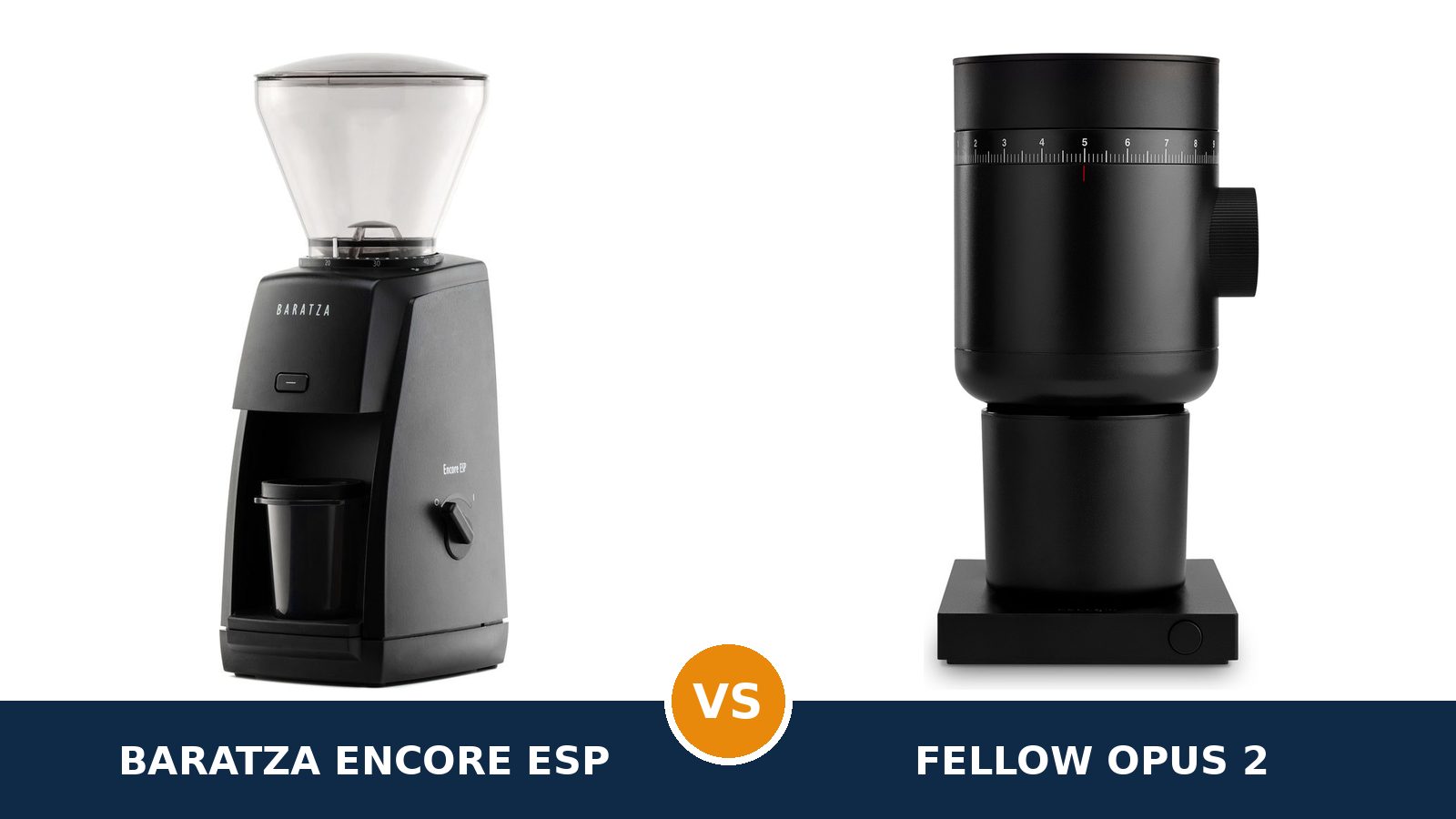
Most comparisons ask which machine is better this month. This one asks which of these two you would rather still own in six years.
The Baratza Encore ESP is the incumbent — the default recommendation in this class since 2023, from a company that publishes every figure it has and sells owners the parts to fix what wears. The Fellow Opus 2 is the 2026 challenger: bigger burrs, a dial with no clicks, double the warranty.
One piece of housekeeping first. “Opus” on a current listing means the Opus 2 — Fellow’s present model, which replaced the original outright. The 2023 original — 40 mm burrs, a stepped dial with an inner micro ring, 140 W — is discontinued and fenced off by name throughout this guide; a spec block quoting 40 mm or 41 settings describes that old machine, whatever the headline says.
Both claim the same brief — one machine for espresso and brewed coffee alike — and answer it from opposite directions: documentation against continuous adjustment and raw motor.
Every number below traces to the makers’ own pages, manuals and product sheets. Where dealer copy contradicts them, the manufacturer’s figure stands.
Key Takeaways
- The Opus 2 takes the verdict by a single point. Continuous adjustment, the stronger motor and double the warranty outweigh the Baratza’s documentation.
- The Encore ESP is the repeatability champion. Forty clicks — twenty reserved for espresso at roughly 20 microns apiece — each unit calibrated before it leaves the factory.
- Baratza documents; Fellow equips. The ESP publishes its burr speed and output rate outright. The Opus 2 counters with an ionizer, an impeller grind path and a portafilter-ready espresso cup.
- Batch drinkers and single-dosers split cleanly. A 300 g hopper feeds the drip routine; a 100 g load bin serves weighed doses and bean swaps.
- The ownership stories point in opposite directions. Fellow covers two years, then service is authorised-only. Baratza covers one year, then sells you the spares and instructions.
Quick Verdict
Buy the Baratza Encore ESP if your kitchen runs on routine. It is the grinder for households that brew on schedule.
Its hopper stays loaded and ready. Its settings are numbers you can write on the coffee tin and return to months later. Its burr set is a named component, and its wear parts sit in a public catalogue.
Buy the Fellow Opus 2 if espresso leads and variety follows. On the published specifications, it is the more capable machine — barely.
A stepless dial finds settings a clicked collar cannot reach. The motor is rated at over four times the wattage, with a quoted nine-second espresso grind. An impeller sweeps grounds under an ionizer; the warranty runs two years.
The Scorecard
The marks below are read straight off the manufacturer specifications in this guide — a summary of the spec sheets, not bench results. Neither maker publishes a decibel rating, so there is no noise row.
| Category | Baratza Encore ESP | Fellow Opus 2 | ||
|---|---|---|---|---|
| Burr set | 8.5 / 10 | 8 / 10 | ||
| Adjustment & espresso resolution | 9 / 10 | 9.5 / 10 | ||
| Dosing & workflow | 6.5 / 10 | 8 / 10 | ||
| Motor & published output | 8 / 10 | 8.5 / 10 | ||
| Brew-method range | 8 / 10 | 8 / 10 | ||
| Build, footprint & capacity | 7.5 / 10 | 7 / 10 | ||
| Warranty, support & repairability | 8.5 / 10 | 8 / 10 | ||
| Overall | 8.0 / 10 | 8.1 / 10 | ||
Read the rows as two philosophies tying on points. The Baratza wins wherever a fact can be written down; the Fellow wherever a hand does the work — dialling in, dosing, clearing the grind path.
At a Glance: Who Each Grinder Fits
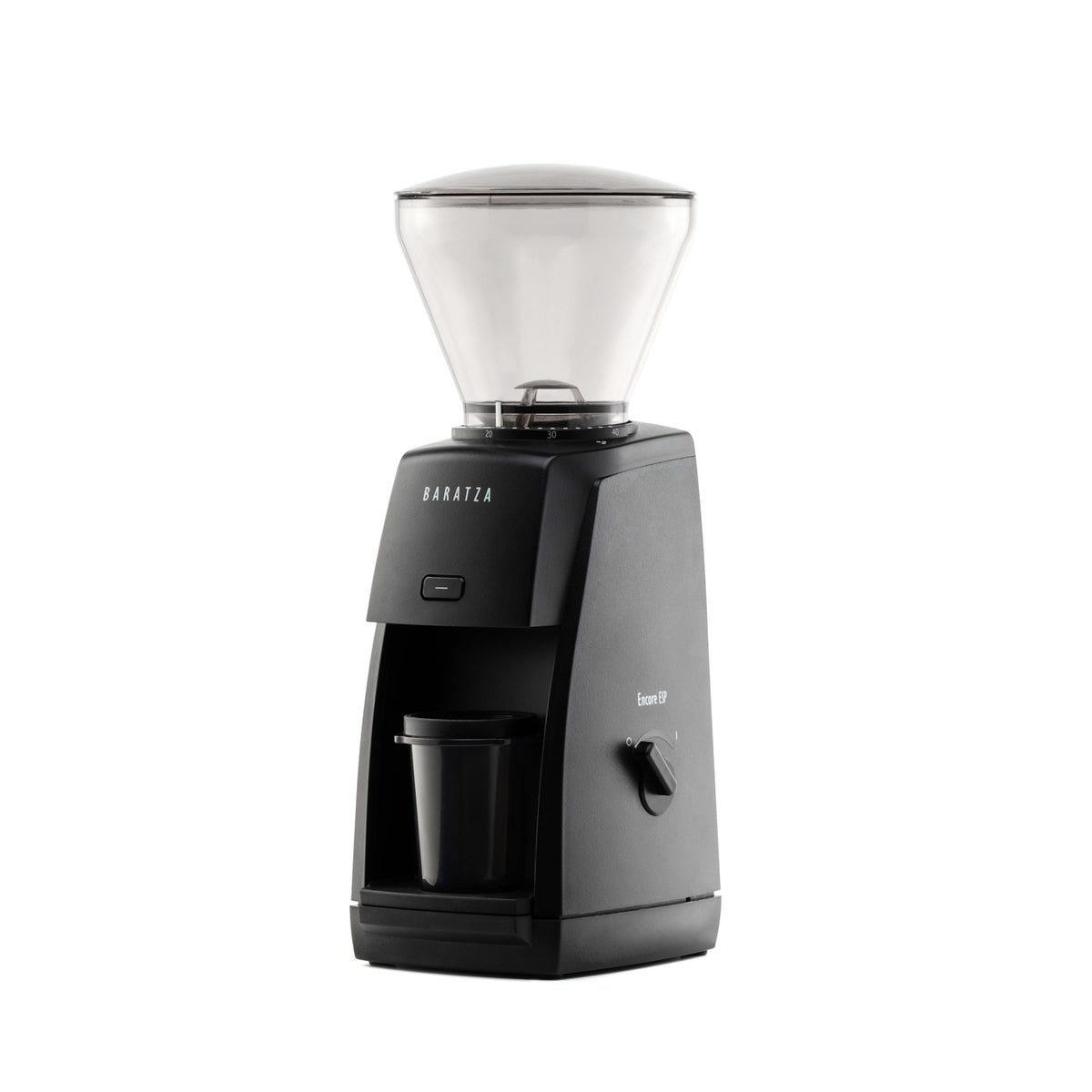
Baratza Encore ESP
- 40 mm M2 conical burrs in hardened alloy steel by Etzinger — the Virtuoso+ set
- 40 clicked settings in two bands: #1–20 espresso micro-range, #21–40 for brewed coffee
- 70 W gear-reduced DC motor; 550 RPM burr speed, 1.3–2.2 g/sec output — all published
- 300 g bean hopper, 120 g grounds bin, anti-static dosing cup in the box
- 1-year US warranty behind a full spares catalogue and owner repair guides
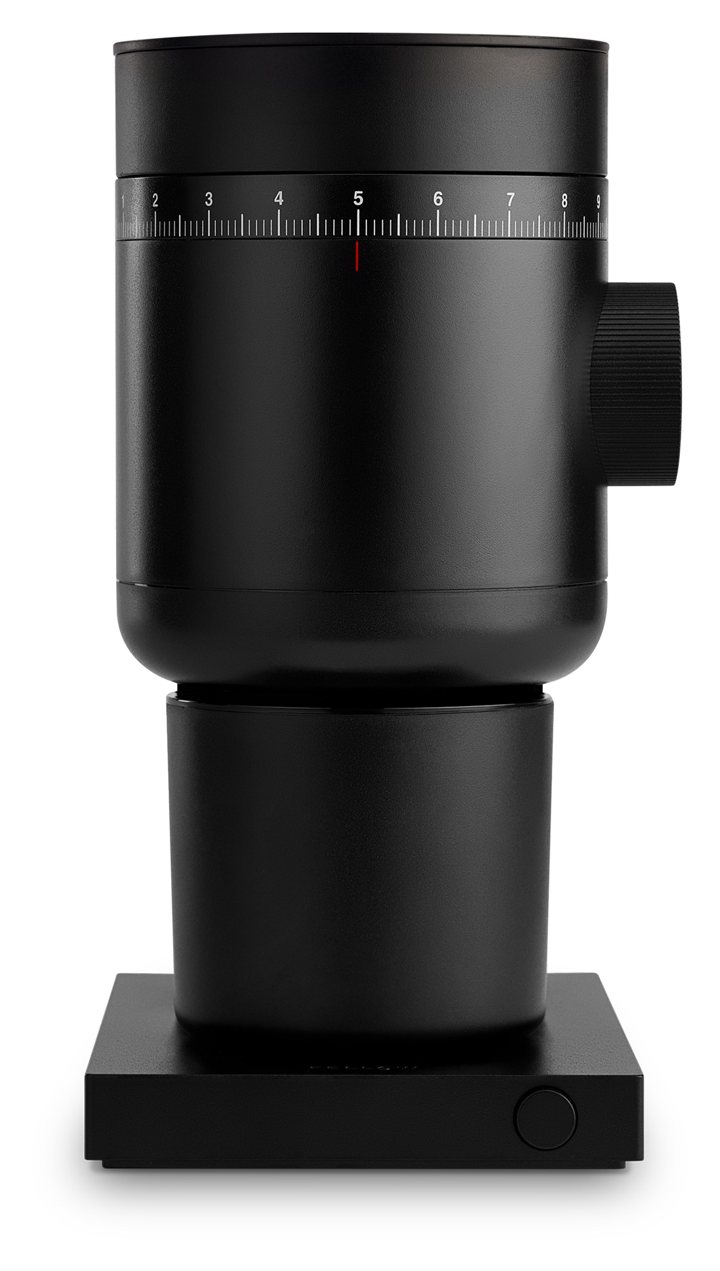
Fellow Opus 2
- 48 mm stainless steel conical burrs spanning espresso to cold brew
- Stepless side dial — continuous travel, 48 numbered marks as references, not stops
- 300 W motor; Fellow quotes roughly nine seconds per espresso dose
- 100 g single-dose load bin with automatic stop, ionizer and impeller-assisted path
- Two magnetic catch cups: 100 g for brewed coffee, plus a 30 g espresso cup for 54/58 mm baskets
Choose the Baratza Encore ESP if…
Your mornings run to a schedule. The hopper holds 300 g, the machine is always loaded, and drip is a knob-turn away.
You keep a notebook by the coffee tin. Forty numbered clicks — twenty of them fine espresso steps — come back exactly.
You intend to own the thing for a decade. When a part wears, Baratza lists it and publishes the fitting guide.
Choose the Fellow Opus 2 if…
You chase the shot by taste. A dial with no detents parks the burrs at precisely the gap your beans demand.
You weigh single doses and swap beans often. The load bin, automatic stop and anti-static hardware were built around that habit.
Space is negotiated in centimetres. At 267 mm tall and 2.27 kg, this is the smaller, lighter machine.
As an Amazon Associate I earn from qualifying purchases at no extra cost to you.
Specifications: The Specs That Actually Matter
Sources for this table: Baratza’s Encore ESP product sheet (v2.2), and Fellow’s Opus 2 product page with its Safety and Maintenance manual.
| Specification | Baratza Encore ESP (ZCG495) | Fellow Opus 2 Conical Burr Grinder |
|---|---|---|
| Model identity | Encore ESP, model ZCG495, 120 V US build — separate from the standard Encore and the Encore ESP Pro | Opus 2, models OP01AANA (standard) and OP02AANA (wooden upgrades); the 2023 original is discontinued |
| Burr set | 40 mm conical M2 burrs, hardened alloy steel, made by Etzinger (Liechtenstein); the Virtuoso+ set | 48 mm conical burrs in stainless steel |
| Adjustment system | Stepped collar, 40 settings: #1–20 micro-steps of about 20 microns for espresso, #21–40 macro steps; every unit factory-calibrated | Stepless side dial — continuous travel, no clicks, 48 marked reference settings on its scale |
| Grind range | Espresso across #1–20, then pour-over, drip, French press and cold brew across #21–40 | Espresso to cold brew; about 200–1200 microns by retailer specification sheets — Fellow itself publishes no micron span |
| Motor | 70 W DC motor with gear reduction | 300 W, 3.0 A in the US build, per Fellow’s manual; no burr speed published |
| Published grind output | 1.3 g/sec at setting #10 to 2.2 g/sec at #30, at a published 550 RPM burr speed | No output rate published; Fellow quotes roughly nine seconds per espresso shot |
| Dosing format | Hopper-fed, from a 300 g bean hopper; an on/off knob and pulse button run the grind, so the dose is set by scale or eye | Single-dose, from a 100 g load bin with the grind guide on its lid; the motor stops itself when the bin empties |
| Catch cups / grounds bin | 120 g grounds bin, plus the bundled anti-static dosing cup for weighed espresso doses | Two magnetic catch cups: 100 g for brewed coffee, 30 g espresso cup shaped for 54/58 mm portafilters |
| Retention & static handling | Anti-static effort concentrated in the dosing cup; no ionizer | An upgraded ionizer works on static at the chute while an internal impeller moves grounds through the path — designed for near-zero retention |
| Duty cycle | Baratza’s product sheet publishes no per-cycle grinding limit | The manual caps grinding at under 45 seconds per cycle, 60+ seconds of rest between cycles, 3 minutes inside any 10 |
| Dimensions (L × W × H) | 13 × 15 × 34 cm (5.1 × 5.9 × 13.4 in) | 206 × 130 × 267 mm (8.1 × 5.1 × 10.5 in) |
| Weight | 3.1 kg | 2.27 kg / 5.0 lb (Fellow’s manual) |
| Materials | ABS plastic body | No premium-material trim on the standard model; OP02AANA builds add a wooden lid and a weighted metal dial |
| Noise engineering | No decibel figure appears in Baratza’s product sheet | Fellow publishes neither a decibel figure nor a named noise feature |
| Warranty | 1-year US warranty; parts diagrams, repair guides and a complete spares range published | 2-year limited warranty, extendable on registration |
The name note: both surnames hide a family. An Encore is not an Encore ESP — different burrs, different adjustment, no espresso micro-range — and the ESP is not the newer Encore ESP Pro (ZCG595), a stepless model with a timer that has its own comparison here. Unqualified “Opus” in today’s retail is the Opus 2; the original (40 mm C6-40 burrs, 41 stepped settings, an inner micro-adjust ring, 140 W) left production in 2026. None of those relatives contributes a figure here.
The power note: Fellow’s manual rates the Opus 2’s US models (OP01AANA/OP02AANA) at 120 V, 300 W and 3.0 A. Some dealer tables paste “140 W, 1.3 A” into the Opus 2 column — figures from Fellow’s earlier grinders. The manual governs here.
The dimensions note: the Opus 2 manual prints its specification block with the dimensions in a scrambled order. Dealer data converges on 206 × 130 × 267 mm, used here. An 8.25 lb “listed weight” on mirrors is the boxed weight; the manual’s 2.27 kg is the grinder.
The grind-range note: Baratza publishes its output rate and burr speed outright. Fellow publishes no micron range and no burr speed for the Opus 2; the roughly 200–1200 micron span above is retailer-sheet data, labelled as such.
The Differences That Actually Matter
1. Adjustment — forty recorded clicks, against a dial that never clicks
Everything else here is a detail. This is the fork.
The Encore ESP divides its range into 40 detents, half spent on espresso. Settings #1 to #20 step the burrs by roughly 20 microns each, and Baratza calibrates every grinder before boxing it — setting 14 on your machine means the same gap as setting 14 on ours. Log it, and return after a month on filter coffee.
The Opus 2’s dial turns in one unbroken sweep. Forty-eight numbers are printed as landmarks, but nothing stops the dial between them. For espresso that continuity is a genuine capability: the gap a bean wants is always available, never rounded to the nearest click.
The trade is exact. Clicks give up resolution to buy memory; the stepless dial gives up memory to buy resolution. Note-keepers should buy the ESP. Taste-diallers should buy the Fellow — and accept that a knocked dial restarts the search.
2. Burr sets — the set with a name and a maker, against the set with eight extra millimetres
Open the spec blocks and the philosophies show immediately.
Baratza names its component: M2 burrs, hardened alloy steel, produced by Etzinger in Liechtenstein — the same set that grinds in the Virtuoso+. A named burr is a purchasable burr: when this set dulls, the identical replacement sits in a catalogue.
Fellow’s burrs are the bigger hardware — 48 mm against 40 mm, stainless steel — and the page stops at size and material. No name, no maker. The diameter advantage shows in the speed Fellow quotes; the documentation advantage is entirely Baratza’s.
Our scoring splits the difference: the ESP takes this row on pedigree and replaceability, and the Opus 2 collects its size dividend in the motor row, where Fellow’s performance claim lives.
3. Workflow — a hopper that waits for you, against a bin that makes you weigh
The ESP is built around a loaded hopper. Three hundred grams of beans sit on the machine; the controls are a knob and a pulse button; the dose is however long you run it. For a household drip routine, nothing there needs improving.
The Opus 2 refuses the hopper entirely. Beans live in a separate canister; each grind starts with a weighed dose in a 100 g load bin, and the machine stops itself when the bin empties. Two magnetic cups cover the output — one for batches, one dosing straight into a 54/58 mm portafilter.
Which workflow wins depends on the calendar, not the clock. Weekday batch brewing favours the hopper; weekend bean-hopping, the bin. The scorecard gives the row to the Opus 2 as the more complete espresso routine — and the fit table below hands the batch row straight back to Baratza.
4. Motors — the small motor with nothing to hide, against 300 W and a single stopwatch claim
The headline numbers flatter the Fellow: 300 W against 70 W. The documentation flatters the Baratza just as much.
Baratza’s 70 W is a gear-reduced DC motor, and the sheet states what it achieves: burrs at 550 RPM, throughput from 1.3 g/sec at a filter setting to 2.2 g/sec at #30. Every figure is in print.
Fellow prints a wattage (in the manual, where the 300 W and 3.0 A ratings sit) and exactly one performance number: about nine seconds per espresso shot — a pointed figure, since the original Opus dawdled at fine settings. No burr speed, no grams-per-second.
The wattage also conceals a Fellow limit: bursts under 45 seconds, a minute’s rest between them, three minutes of grinding in any ten. Baratza publishes no comparable cap. Two breakfast drinks will never meet either ceiling; a brunch queue might meet Fellow’s.
5. Retention and static — engineering that sweeps, against a cup that catches
Single-dosing runs on one promise: the grams you weigh are the grams you drink, with nothing from yesterday seasoning them.
Fellow pursues it with active hardware. An ionizer — upgraded over the original Opus’s unit — discharges static at the chute, and an impeller carries grounds out rather than letting them settle. Fellow describes the result as near-zero retention; on published design it is the more thorough system here.
Baratza’s answer is deliberately modest: anti-static treatment centred on the dosing cup, a conventional path, and no retention figure claimed at all. Nothing about it can break in a way that needs a service centre.
We score the row to the Opus 2 on the published designs. The ESP’s real reply sits in a different column of this page: the parts column, where every component of its simpler path is a line item an owner can order.
6. Size, weight and materials — the tall appliance, against the compact object
The Encore ESP is 34 cm tall and weighs 3.1 kg. The Opus 2 stops at 267 mm and 2.27 kg — nearly a kilo lighter and short enough for cabinets that would refuse the Baratza.
The Baratza’s height is not waste, though: it is the 300 g hopper standing on the grind chamber. The Fellow’s compactness is likewise structural — a 100 g bin needs less machine around it.
Materials are closer than the styling suggests. Both standard machines are plastic-bodied; Fellow’s own table is candid that premium materials belong to the wooden-upgrade variants — a wood lid and weighted metal dial over identical hardware. Buy those for feel, never for grind quality.
7. Names and generations — three traps, two surnames, one rule
End with the trap behind most bad purchases: the shared surname.
“Encore” covers three Baratza machines. The standard Encore lacks the ESP’s burrs and its espresso micro-range. The Encore ESP Pro (ZCG595) sits a tier above, with a timer and a dial that never clicks. The grinder in this guide is the middle one — model code ZCG495 — and the code, not the surname, is what to check.
“Opus” covers two Fellow generations that share a silhouette and little else. The original’s 40 mm burrs, stepped dial with an inner ring and 140 W motor were all replaced in the 2026 redesign. Old listings still circulate; the spec block is the tell.
The rule for both families: buy the model code, not the name. ZCG495 or OP01AANA on the box means the machines in this guide; anything else is a different grinder with a familiar face.
Brew-Method Fit Guide
Start from the cup you actually make; this table settles most of the argument.
| Your brewing | Baratza Encore ESP | Fellow Opus 2 | Our call |
|---|---|---|---|
| Espresso, unpressurised baskets | Excellent — twenty micro-steps built for exactly this | Excellent — continuous dial, portafilter cup included | Opus 2, for continuous fine-tuning |
| Espresso, pressurised baskets | Excellent | Excellent | Dead tie |
| Pour-over | Good — settings repeat to the number | Good — the conical set covers the range | Dead tie; pick on workflow |
| Drip and batch brewing | Excellent — 300 g hopper, loaded and ready | Workable — 100 g loadings under a duty cap | Baratza Encore ESP |
| AeroPress and moka pot | Excellent | Excellent | Dead tie |
| French press and cold brew | Excellent | Excellent | Dead tie |
| A mixed household — espresso and filter | Excellent — one grinder, whole range | Excellent — one grinder, whole range | Opus 2, unless you batch-brew |
| Single-dosing and rotating beans | Good — dosing cup helps a hopper-first design | Excellent — ionizer, impeller, automatic stop | Fellow Opus 2 |
| Owners who repair their own gear | Excellent — exploded diagrams, spares catalogue | Manuals published; no user-serviceable parts | Baratza Encore ESP |
Two rows decide for most readers: the first, if espresso is the point; the fourth, if the morning pot is.
Ready to check today’s price?
Both machines are sold through Amazon, and grinder pricing drifts with stock. Check the current figure on the one matching your routine.
View on Amazon — Baratza Encore ESPView on Amazon — Fellow Opus 2The 30-Second Decision
| If this sounds like you… | Buy this |
|---|---|
| “My settings live in a notebook, and I expect to land on the same one twice.” | Baratza Encore ESP — 40 calibrated clicks |
| “The setting my beans want always seems to hide between two clicks.” | Fellow Opus 2 — stepless dial |
| “A drip pot goes on every single morning.” | Baratza Encore ESP (300 g hopper) |
| “I weigh every dose and change beans all the time.” | Fellow Opus 2 |
| “Low cabinets, a small counter, and the grinder gets moved.” | Fellow Opus 2 (267 mm tall, 2.27 kg) |
| “I fix my own appliances and keep them for years.” | Baratza Encore ESP |
| “Given the choice, I take the longer warranty in writing.” | Fellow Opus 2 (2 years) |
What You Gain. What You Give Up.
Baratza Encore ESP
You gain: a burr set with a name, a maker and a paper trail, shared with a pricier sibling. An espresso micro-range calibrated on your unit. Motor data published down to the gram per second, a hopper sized for batch brewing, and the deepest owner-repair support in the class.
You give up: the spaces between clicks, where the perfect espresso setting sometimes sits. Automatic stop and any timed dosing, any ionizer, half the Fellow’s warranty term, and the counter space a 34 cm machine commands.
Fellow Opus 2
You gain: adjustment with no granularity at all — the dial stops wherever your palate says stop. A 300 W motor with a maker-quoted nine-second espresso grind, the better-engineered answer to retention and static, a portafilter dosing cup, two years of warranty, and the smaller footprint.
You give up: the ability to write a setting down and trust it — a stepless dial asks for landmarks and memory. Hopper-fed convenience, plus a duty cycle written into the manual, and a documented burr pedigree traded for a larger set with no name on it.
Pros and Cons
Baratza Encore ESP — Pros
- M2 burrs by Etzinger — named, documented, Virtuoso+ set
- Twenty dedicated espresso micro-steps, calibrated per unit
- 550 RPM and 1.3–2.2 g/sec printed on the sheet
- 300 g hopper built for the daily batch routine
- Parts diagrams, repair guides, complete spares catalogue
- Quick-release burr for cleaning and replacement
Cons
- Stepped dial — the ideal setting can fall between clicks
- No timer, no automatic stop; every dose is manual
- Static control rests on the dosing cup; no ionizer
- 1-year US warranty — half the term Fellow offers
- Taller and heavier than the Fellow by a clear margin
Fellow Opus 2 — Pros
- Stepless dial — finer espresso resolution than any collar here
- 48 mm conical burrs covering espresso through cold brew
- 300 W motor; Fellow quotes roughly nine seconds per espresso shot
- Ionizer and impeller path built for near-zero retention
- Two magnetic cups, one shaped for 54/58 mm portafilters
- 2-year warranty; shortest, lightest build in this pairing
Cons
- Repeating a setting means finding your mark, not clicks
- Duty-cycle limits in the manual: short bursts, enforced rests
- Single-dose only — no hopper for batch mornings
- Burr set unnamed; burr speed and output rate unpublished
- Standard finish misses the variants’ wood and metal trim
Check the Model Code, the Generation and the Box
Check the Baratza model code first. The machine in this guide is the ZCG495; that code should appear on the box and the base. The standard Encore wears the same silhouette with different burrs and no micro-range; the Encore ESP Pro (ZCG595) is a newer stepless model with a timer. Three grinders, one surname — the code is the identity.
Check the Fellow generation just as hard. The Opus 2 replaced the original Opus in 2026, and old stock still moves through listings. The redesign carries 48 mm burrs and a plain side dial; the original has 40 mm burrs, 41 stepped settings and an inner micro-adjust ring. A spec block reading 40 mm or 41 settings describes the discontinued machine.
Check which Opus 2 variant the price refers to. OP01AANA is the standard build. OP02AANA layers on wooden upgrades — a wood load-bin lid, a weighted metal dial, a built-in dosing compartment on select models. Burrs, motor and adjustment do not change, so the premium buys feel and finish only.
Check the contents against the box. An Encore ESP should arrive with its anti-static dosing cup next to the 120 g grounds bin. An Opus 2 should carry both magnetic catch cups and a cleaning brush. A missing cup means an incomplete box.
Check the voltage before anything else ships. Both brands build regional versions. The ratings here describe the US builds — 120 V for each — and warranties follow the territory. Buy the version built for your sockets.
The Upgrade Path Test
Judge a grinder by the second year, when the habits are set.
The Baratza’s path runs through staying put. Its burr set already lives in a machine a class up, its wear parts are catalogue lines, and its common failures are documented with guides attached. Owners who move on usually move sideways — keeping the ESP for filter work — or never needed to move at all.
The Fellow’s path runs through range. It begins as the household’s only grinder and deepens as technique does: the continuous dial and portafilter cup that seemed like garnish in month one become the daily workflow by month twelve. Its ceiling is the all-rounder’s — the day flat-burr clarity or café volume becomes the goal, the search restarts.
In one line: the ESP is the easier grinder to keep, the Opus 2 the easier to grow into.
When to Skip Both
Neither machine is the answer for every counter.
Skip both if the grinder must dose unattended. Neither offers grind-by-weight; the ESP has no timer, and the Opus 2’s automation ends at its automatic stop.
Skip both for café counters, offices and event service. These are household appliances, and Fellow’s manual writes the cycle limits down in so many words.
Skip the Encore ESP if detents already irritate you — twenty fine steps are generous, and still steps. Skip the Opus 2 for a daily drip pot; loading 100 g at a time under a duty cap fights that routine.
And if brewed-coffee clarity is the entire pursuit, skip both: a dedicated flat-burr filter grinder serves that goal more honestly.
Warranty and Long-Term Support
Fellow covers the Opus 2 for two years under a limited warranty, extendable on registration. Baratza covers the Encore ESP in the US for one year.
After the paperwork expires, the order flips. Fellow publishes the manual and documents routine cleaning, but states that the Opus 2’s base contains no user-serviceable parts — a repair means authorised service. Baratza publishes exploded diagrams, repair guides and a spares catalogue, with a quick-release burr.
Neither approach is a trick. One maker insures the machine for longer; the other equips the owner for longer. The universal caution is territorial: cover follows the country and voltage version, so buy your own market’s build.
Final Verdict
Our pick for most counters is the Fellow Opus 2.
The margin is a single point, earned in the daily acts of grinding rather than the paperwork. Its dial adjusts without granularity, so espresso settings are located rather than approximated. Its motor is the stronger unit by rating and by quoted grind time. Its retention and static systems are the current generation, and its warranty runs twice as long.
Buy the Opus 2 if espresso leads your brewing, if you single-dose and rotate beans, or if your settings live in your hands, not a notebook.
View on Amazon — Fellow Opus 2
Buy the Encore ESP if batch filter anchors the morning, if written-down settings keep your kitchen consistent, or if you plan to maintain the machine yourself.
It concedes the headline specifications and wins nearly every argument about documentation and longevity. In a household that repairs before it replaces, this ranking would reverse.
View on Amazon — Baratza Encore ESP
Frequently Asked Questions
Is the Encore ESP simply the standard Encore with a new badge?
No — the ESP is a different machine wearing a familiar housing. It carries the M2 burr set in hardened alloy steel where the standard Encore uses a different set, and its collar splits into an espresso micro-range (#1–20) and a macro range (#21–40). Its model code is ZCG495; the standard Encore cannot grind for unpressurised baskets the way the ESP can.
I still see the original Opus on sale — is it the same grinder as the Opus 2?
It is not, and the distinction drives this comparison. The original Opus (2023) has 40 mm C6-40 burrs, 41 stepped settings plus an inner micro-adjust ring, and a 140 W motor; Fellow discontinued it when the Opus 2 arrived in 2026. The Opus 2 grinds through 48 mm burrs behind a stepless dial with a 300 W motor.
Which dial actually finds the better espresso setting?
They optimise for different virtues. The Opus 2’s continuous dial can sit at any gap, so a setting is never stranded between detents — Fellow also quotes about nine seconds per shot. The Encore ESP steps in roughly 20-micron increments across twenty espresso settings, calibrated per unit, so Tuesday’s setting is reproducible on Friday. Finer resolution: the Fellow. Exact repetition: the Baratza.
Can the Opus 2 handle a household that brews a pot every morning?
It can grind the coffee, but the routine fights its design. The load bin takes 100 g at a time, and the manual limits grinding to bursts under 45 seconds with rests, and three minutes in any ten. The Encore ESP’s 300 g hopper makes it the natural pot-a-day machine.
How does the Encore ESP Pro differ from the Encore ESP in this guide?
The ESP Pro (ZCG595) is a separate, newer Baratza with stepless adjustment and a timer. The grinder compared here is the Encore ESP (ZCG495): a stepped, dual-range collar, no timer. A third machine, the standard Encore, differs from both in burrs and range.
Which of the two keeps fewer stale grounds in the grind path?
On published design, the Opus 2 — an impeller physically carries grounds through the path and Fellow describes the outcome as near-zero retention, with an ionizer on the static side. The Encore ESP depends on its anti-static dosing cup and claims no retention figure. Neither maker publishes a measured value, so this compares documented systems, not invented numbers.
One year against two — how should I weigh the warranties?
Treat them as two different products. Fellow’s two-year term (extendable on registration) doubles Baratza’s one-year cover, so the Fellow is better insured early. Baratza’s advantage arrives later: parts diagrams, repair guides and a spares catalogue make the ESP a machine an owner can keep alive, where Fellow declares the Opus 2’s base free of user-serviceable parts.
Sources & Verification
Baratza Encore ESP official product sheet v2.2 — M2 burrs by Etzinger, dual-range adjustment, factory calibration, dosing cup, 1.3–2.2 g/sec, 550 RPM, 300 g hopper, 120 g bin, 3.1 kg, 70 W, 1-year warranty • Baratza Encore ESP data via authorised dealers (Whole Latte Love) • Fellow Opus 2 official product page (fellowproducts.com) — 48 mm stainless steel conical burrs, stepless dial, 48 marked settings, ionizer, impeller retention design, two catch cups, Opus 1 comparison, 2-year warranty • Fellow Opus 2 Safety and Maintenance manual (789-00291) — OP01AANA/OP02AANA specifications: 120 V, 300 W, 3.0 A, 2.27 kg, duty-cycle limits, jam guidance, automatic stop, 2-year limited warranty • Amazon listing data for both models, used for ASIN verification only. Specifications verified November 2026.

James Wilson
James has been testing coffee gear and small kitchen appliances for over a decade and writes Honestly Compared's coffee and grinder guides. His rule for every comparison: the verdict has to survive the spec sheet, not the marketing page.