
Baratza Encore vs KINGrinder K6: Which Should You Buy?
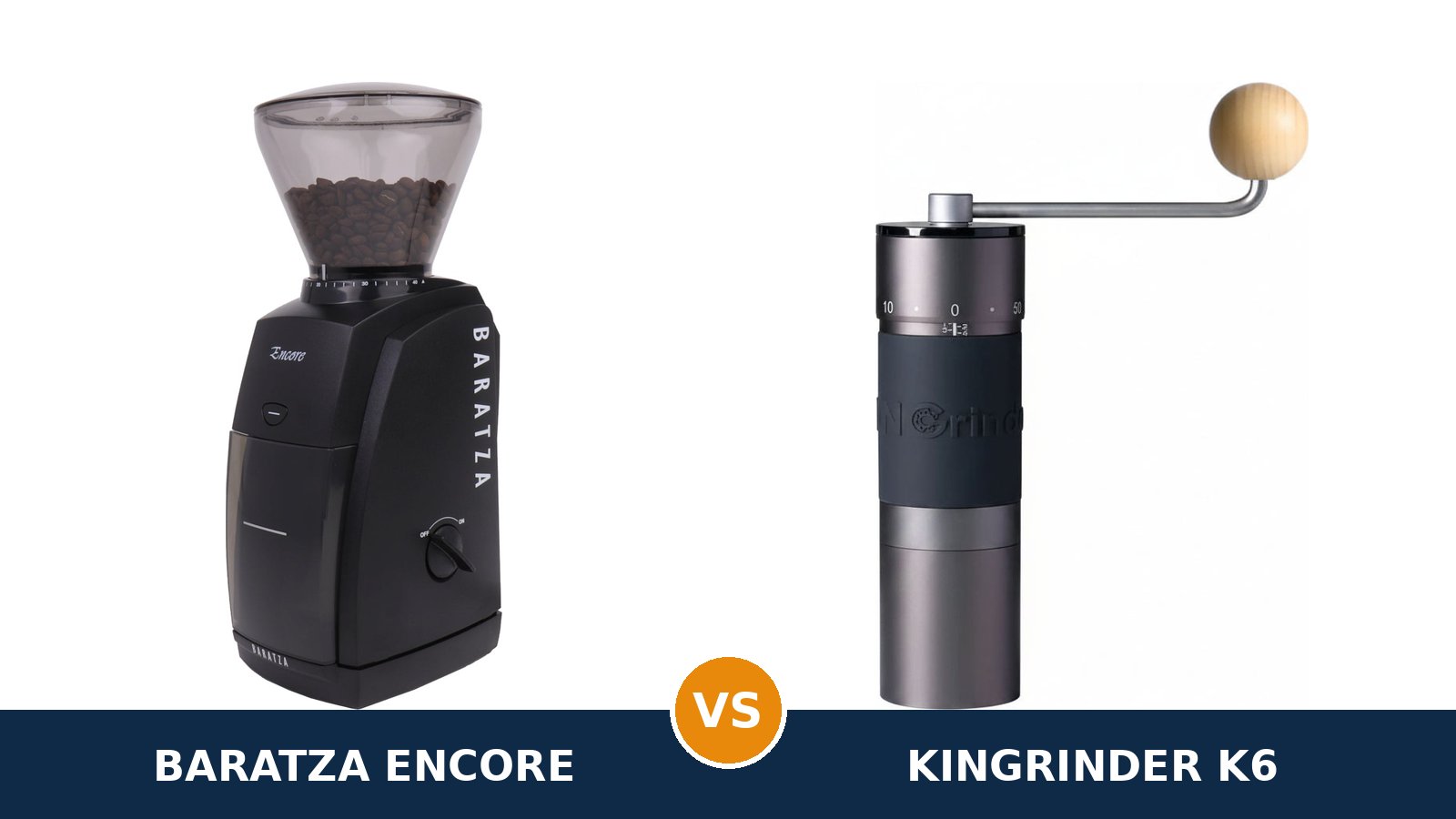
Every first serious grinder purchase eventually becomes this exact fork in the road. Do you buy the plug-in machine that lives on the counter, or the hand grinder that lives in a drawer?
The Baratza Encore is the default answer to the first half of that question. It has been the entry point to real burr grinding for over a decade.
The KINGrinder K6 is the strongest answer to the second half. It packs a 48 mm burr set into a 630 g aluminium tube — a bigger burr than the Encore carries, in something that fits in a jacket pocket.
Names first, because one side attracts impostors. The “Encore” here is the standard Baratza Encore, model ZCG485 — not the Encore ESP (ZCG495) and not the Encore ESP Pro (ZCG595). Those are separate, espresso-focused machines, and they are walled off throughout this guide.
The “K6” is the current KINGrinder K6 with the straight handle, in Iron Grey. A bent-handle version and a silver finish exist; they are not what is compared here.
Every figure below comes from the two manufacturers’ own pages, manuals and product sheets. Where their documents disagree with each other, the manual wins — and the disagreement is flagged.
Key Takeaways
- The Encore wins for most first-time buyers. A 227 g hopper, a published 0.8–1.1 g/sec grind speed and zero arm work beat hand cranking for daily household brewing.
- The K6 has the better burr and the finer dial. 48 mm heptagonal burrs and roughly 240 clicks at 16.6 microns each, against 40 mm burrs and 40 steps.
- Espresso separates them honestly. The K6 was designed to dial espresso; the standard Encore reaches fine grinds but has no micro-adjustment band — that gap is exactly why the Encore ESP exists.
- Effort is the K6’s tax. Every gram is hand-cranked, up to 30–35 g a load. The Encore’s tax is counter space, noise and a plastic bin’s static.
- Support is not close. Baratza sells nearly every Encore part and publishes repair guides. KINGrinder’s warranty carries a parts-shipping caveat in its own terms.
Quick Verdict
Buy the Baratza Encore for most kitchens. It is the grinder a household actually uses every day.
Fill the hopper once and it feeds a week of drip, pour-over and press pots at the twist of a collar. No weighing ritual per cup unless you want one. No arm workout before your first coffee.
Its 40 steps cover the full brew range Baratza publishes — 250 to 1,200 microns. Its parts catalogue means a worn burr or a cracked hopper is a small order, not a new grinder.
Buy the KINGrinder K6 if grind hardware per gram matters more than convenience. For a solo drinker, it is the better instrument.
The burr is bigger, the steps are six times finer, and it grinds espresso-range coffee the standard Encore can only approximate. Then it goes in a drawer — or a backpack. No counter, no cord, no noise.
The Scorecard
Scores below are derived directly from the manufacturer specifications compared in this guide — burr dimensions, adjustment steps, published output and capacities. They are a reading aid, not benchmark results. This pairing mixes an electric and a manual grinder, so the categories judge both on the work a first grinder actually does: grinding well, adjusting precisely, and fitting a daily routine.
| Category | Baratza Encore | KINGrinder K6 | ||
|---|---|---|---|---|
| Burr set | 7.5 / 10 | 9 / 10 | ||
| Adjustment & precision | 7 / 10 | 9 / 10 | ||
| Dosing & workflow | 8.5 / 10 | 7 / 10 | ||
| Speed & effort | 9 / 10 | 5.5 / 10 | ||
| Retention & static control | 6.5 / 10 | 8 / 10 | ||
| Brew-method range | 8 / 10 | 8.5 / 10 | ||
| Build, support & warranty | 9 / 10 | 7 / 10 | ||
| Overall | 7.9 / 10 | 7.7 / 10 | ||
Read the split rows, not just the total. The K6 wins the three categories about the grind itself. The Encore wins the four about living with the grinder. Which group matters is a decision about your mornings, not about machinery.
At a Glance: Who Each Grinder Fits
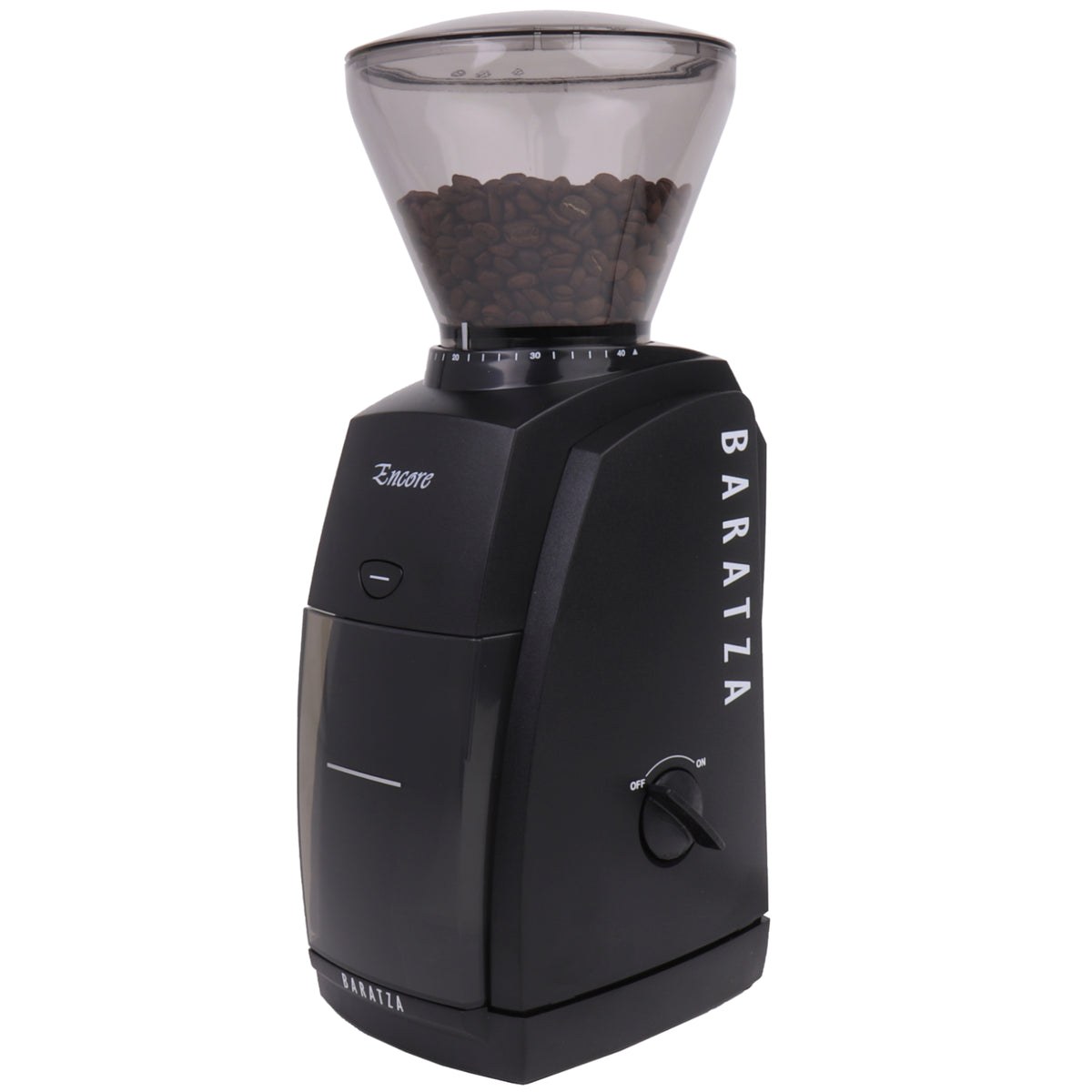
Baratza Encore (ZCG485)
- 40 mm conical burrs made by Etzinger
- 40 grind settings, 250–1,200 micron published range
- 227 g hopper and 142 g grounds bin
- 70 W DC motor, published 0.8–1.1 g/sec output
- Full spare-parts catalogue and repair guides
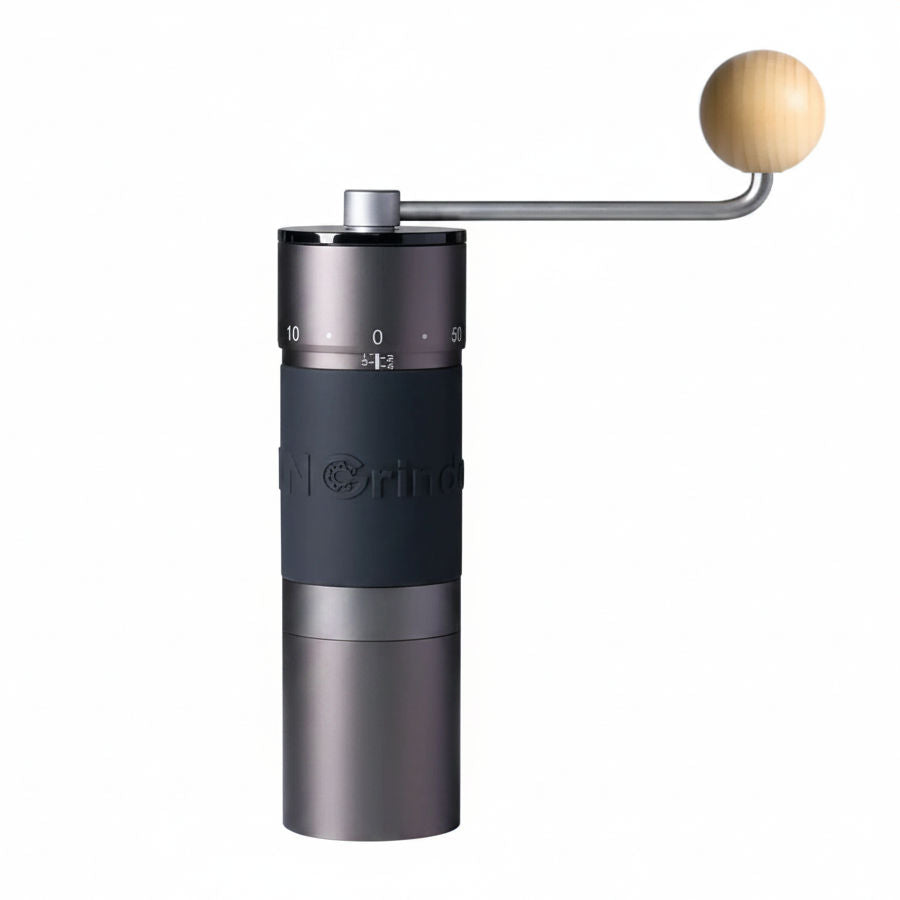
KINGrinder K6 (Straight Handle)
- 48 mm SUS420 stainless heptagonal burrs
- External collar: 60 clicks per rotation, ~240 settings
- 16.6 microns of burr movement per click
- 30–35 g threaded catch cup, 630 g total weight
- Maker-documented drill drive for powered grinding
Choose the Baratza Encore if…
You brew for more than one person. A hopper-fed electric grinder absorbs a household’s coffee habit without turning each pot into a project.
Your methods are drip, pour-over, French press and cold brew. That is the exact centre of the Encore’s published range.
You want a machine you can still be repairing in ten years. Baratza’s parts and guides culture is the best in this class.
Choose the KINGrinder K6 if…
You brew for one, and you brew carefully. Single doses, weighed in, ground fresh — the K6 is built around exactly that ritual.
Espresso is on your roadmap. The fine end of the K6’s dial is a real espresso tool; the Encore’s fine end is not.
Counter space is precious, or coffee travels with you. The K6 needs no outlet and disappears into a drawer.
As an Amazon Associate I earn from qualifying purchases at no extra cost to you.
Specifications: The Specs That Actually Matter
Every figure below is taken from Baratza’s official Encore product sheet and KINGrinder’s own manuals and listing data, cross-checked against each manufacturer’s product pages.
| Specification | Baratza Encore (ZCG485) | KINGrinder K6 |
|---|---|---|
| Burr set | 40 mm conical burrs, made by Etzinger | 48 mm conical heptagonal burrs, SUS420 stainless, HRC57 |
| Adjustment system | 40 stepped settings (twist hopper), user-calibratable | External collar, 60 clicks per rotation, ~240 total settings |
| Step size | Evenly spread across the range; no micro band | 16.6 microns per click (maker’s manual) |
| Published grind range | 250–1,200 microns | Maker setting chart: extra fine ~15–25 clicks to coarse 150+ clicks |
| Motor | 70 W DC, speed-controlled | None — hand crank/manual (drill drive documented by the maker) |
| Burr speed | 450 RPM under control (550 RPM no-load) | — (crank speed) |
| Grind output | 0.8–1.1 g/sec, published on Baratza’s sheet | Not published — depends on the arm turning it |
| Capacity | 227 g hopper; 142 g grounds bin | 30–35 g per load (manual figure), threaded catch cup |
| Dosing format | Hopper-fed: side switch plus front pulse button | Single-dose: weigh, load, grind, unscrew the cup |
| Dimensions | 12 × 35 × 16 cm — a counter appliance | Ø55 × 175 mm body, 160 mm handle |
| Weight | 3.1 kg (7 lb) | 630 g — about a fifth of the Encore |
| Body & build | Plastic housing; tool-free upper burr removal | Anodised aluminium alloy; 10 mm steel shaft on dual bearings |
| Static handling | Plastic grounds bin; no anti-static system published | Grounds fall straight through into a metal threaded cup |
| Noise | Electric motor; Baratza publishes no decibel figure | No motor; KINGrinder publishes no figure because there is nothing to rate |
| Warranty | 1 year (US), backed by a full spare-parts catalogue | 1 year (maker’s terms; parts shipping caveat applies) |
Capacity note: KINGrinder’s own Amazon headline says “25–35g Capacity”, while its manuals and specification table say 30–35 g. The manual figure is used throughout this guide.
Speed note: Baratza publishes two burr speeds for the Encore — 450 RPM held by the speed-control circuit under load, and 550 RPM no-load. Both are Baratza’s numbers; the controlled figure is the one that describes grinding.
Coating note: many listings and reviews describe a “titanium-coated” K6 burr. KINGrinder’s own specification table assigns the titanium coating to its K4 model only. The K6 burr is uncoated stainless steel — which is how it is described here.
The Differences That Actually Matter
1. The burrs — the hand grinder brings the bigger hardware
Start with the uncomfortable fact for the electric side. The K6’s burr is 48 mm across. The Encore’s is 40 mm.
KINGrinder’s set is a seven-sided “heptagonal” conical design in SUS420 stainless steel, hardness-rated at HRC57 in the maker’s specification table. It is the same burr family the brand sells as an espresso-capable set.
The Encore’s 40 mm conical set is made for Baratza by Etzinger of Liechtenstein — a specialist burr maker, and a genuine quality signal. Baratza also sells the set as a spare part, which matters later.
Bigger is not automatically better. But a larger burr presents more cutting edge per revolution, and the K6 pairs it with a shaft running on dual bearings to keep it true.
On burr hardware alone, the hand grinder wins. It is not close, and pretending otherwise would insult both spec sheets.
2. Adjustment — 40 steps against roughly 240
The Encore adjusts by twisting its hopper through 40 stepped settings. Baratza publishes a 250–1,200 micron range across them, and the system can be recalibrated by the user if it drifts.
Those 40 steps are spread evenly across the whole range. That is the design’s strength for brew coffee — and its hard limit for espresso.
Dialling an espresso shot means nudging the grind by tiny amounts and tasting the difference. With the Encore’s step spacing, one click can jump past the sweet spot. Baratza knows this: the fine micro-range is the entire reason the Encore ESP exists as a separate model.
The K6 adjusts from an external collar — no opening the grinder, no losing the thread of where you were. Sixty clicks per rotation, four rotations of usable range, about 240 settings in total.
Each click moves the burr 16.6 microns, per the maker’s manual. KINGrinder’s own chart puts espresso at roughly 30 clicks from zero. That is fine control, in the zone where fine control decides the shot.
If your future includes espresso, this section is the comparison. The K6 was built for it. The standard Encore was built around it.
3. Dosing and workflow — a hopper against a ritual
The Encore is a hopper grinder. Load 227 g of beans, and the week’s coffee is a switch-flip away.
Run it with the side switch for a full bin, or hold the front pulse button and grind straight into a portafilter basket or brewer. There is no timer and no dose memory — you grind by eye and by habit, and for drip and press that is honestly enough.
The K6 is a single-dose instrument. Weigh the beans, tip them in, grind, unscrew the threaded catch cup, pour.
That ritual has real virtues. Nothing sits in a hopper going stale. Switching coffees costs nothing. The dose you weighed is the dose you get.
It also has a hard ceiling: 30–35 g a load, by hand. A 60 g press pot for guests is two loads and two rounds of cranking. A household’s Monday-morning drip is a chore, not a ritual.
Neither workflow is wrong. They serve different kitchens. Be honest about which kitchen is yours.
4. Speed and effort — the motor’s whole argument
Baratza publishes the Encore’s grind speed on its product sheet: 0.8–1.1 g per second. A typical 20 g dose is a matter of seconds, and your only job is to watch it happen.
The 70 W DC motor holds its burrs at a controlled 450 RPM, with a thermal cutout standing guard if you grind long and hard. Back-to-back pots, a houseful of guests — the machine does not care.
The K6 publishes no output figure, because the motor is you. Fine grinds take more turns and more force; coarse grinds spin through quickly. Hard, light-roasted beans at espresso settings are a genuine workout.
KINGrinder does document an escape hatch: the K6’s shaft accepts a standard 6.35 mm (1/4-inch) drill chuck. The maker’s conditions are specific — a drill rated at 15 Nm of torque or more, and the grind set more than 15 clicks from zero.
That turns the K6 into a part-time electric grinder. It also turns a calm ritual into a power-tool exercise. Most owners will crank by hand and accept the deal.
The deal is this: the K6 asks effort every single day. The Encore asks for counter space once. Score accordingly.
5. Retention, static and cleaning — straight-through against a bin
The K6’s grind path is a straight vertical drop into a threaded metal cup. There is nowhere much for coffee to hide, and unscrewing the cup and brushing out the burr chamber is the whole cleaning routine.
Two cautions from the maker’s own manual. Never wash the K6 with water. And a full deep strip of the burr assembly calls for circlip pliers — routine cleaning is tool-free, deep cleaning is not quite.
The Encore’s grounds land in a plastic bin, and plastic bins hold static. Expect some cling and scatter, especially with darker roasts in dry air. Baratza publishes no anti-static system for this model, and we will not invent one.
Inside, the Encore holds on to more coffee than a straight-through hand grinder can. It is the standing trade of the hopper design: yesterday’s grams mingle with today’s unless you purge.
Cleaning day favours the Encore, though. The upper burr lifts out without tools, the chamber brushes clean, and Baratza publishes the guides to walk you through it — including recalibration when you are done.
6. Footprint, noise and travel — an appliance against an object
The Encore is a counter appliance: 12 × 35 × 16 cm, 3.1 kg, with a cord. It will live where you put it, under a cabinet, permanently plugged in.
It also makes an electric grinder’s noise while it works. Baratza publishes no decibel figure for it, so none is quoted here — but no one has ever called a 450 RPM electric grinder silent, and the person asleep in the next room will have an opinion.
The K6 is Ø55 × 175 mm and 630 g. It has no motor, so it has no motor noise; the loudest part of using it is the beans cracking. KINGrinder publishes no noise figure because there is nothing to rate.
It travels. In a drawer, in a bag, in a camper — anywhere coffee goes, the K6 goes, and it asks for no outlet when it gets there.
For a fixed kitchen, none of this matters much. For a small flat, a shared house or a travel kit, it can matter more than every burr figure above.
Brew-Method Pairing Guide
The fastest way to choose between these grinders is to start from what you actually brew. This table is the whole comparison in one view.
| Your coffee | Baratza Encore | KINGrinder K6 | Our call |
|---|---|---|---|
| Daily drip / batch brewer for a household | Excellent — hopper feeds the routine | Workable — load by load, by hand | Baratza Encore |
| Solo pour-over (V60, Kalita) | Excellent | Excellent — the maker’s pour-over-first positioning | Either — decide on effort, not grind |
| Espresso, learning to dial in | Limited — no micro-adjustment band | Excellent — 16.6-micron clicks, maker espresso chart | KINGrinder K6 |
| French press & cold brew | Excellent — coarse end, big batches | Good — coarse clicks, but 30–35 g loads | Encore for batches; K6 for one cup |
| AeroPress & moka pot | Excellent | Excellent | Dead tie — both sit mid-range happily |
| Travel, camping, office drawer | Not portable — 3.1 kg and a cord | Excellent — 630 g, no outlet needed | KINGrinder K6 |
| Early mornings, sleeping household | Motor noise, no published rating | No motor to hear | KINGrinder K6 |
Notice the pattern. The Encore’s wins are about volume and routine. The K6’s wins are about precision, silence and movement. Your row in this table is your answer.
The 30-Second Decision
| If this sounds like you… | Buy this |
|---|---|
| “Two or more coffee drinkers, drip or press, every day.” | Baratza Encore |
| “One careful cup at a time, weighed and dialled.” | KINGrinder K6 |
| “Espresso now, or honestly planned within the year.” | KINGrinder K6 |
| “I want to fix it myself for a decade.” | Baratza Encore |
| “Tiny kitchen, or coffee that travels with me.” | KINGrinder K6 |
| “I refuse to exercise before my first coffee.” | Baratza Encore |
Ready to check today’s price?
Both grinders sell through Amazon. Prices move, so check the live figure on the one that fits your kitchen.
View on Amazon — Baratza EncoreView on Amazon — KINGrinder K6What You Gain. What You Give Up.
Baratza Encore
You gain: a hopper-fed electric workflow that absorbs a household’s habit. Published output figures, a calibration system, and a parts catalogue that turns wear into maintenance instead of replacement.
You give up: the finer burr and the finer dial — both belong to the hand grinder. Espresso micro-adjustment does not exist here. And the machine takes permanent counter space and makes motor noise to earn it.
KINGrinder K6
You gain: a 48 mm heptagonal burr and roughly 240 settings in 630 g of aluminium. Real espresso dialling, a straight-through grind path, silence, and a grinder that travels anywhere.
You give up: every convenience an electric grinder exists to provide. Doses cap at 30–35 g, every gram is arm work, and the support network behind it is a fraction of Baratza’s.
Pros and Cons
Baratza Encore — Pros
- 227 g hopper: grind for a household without loading each time
- Published 0.8–1.1 g/sec output at a controlled 450 RPM
- 40 settings across a published 250–1,200 micron range
- User-calibratable, tool-free burr removal
- Full spare-parts catalogue and manufacturer repair guides
Cons
- No micro-adjustment band — espresso dialling is approximate
- Plastic grounds bin, with the static that comes with it
- No timer or dose memory
- Permanent counter footprint, 3.1 kg, corded
- Motor noise with no published rating to hide behind
KINGrinder K6 — Pros
- 48 mm heptagonal SUS420 burrs — bigger than the Encore’s set
- ~240 settings at 16.6 microns per click, adjusted externally
- Maker charts espresso at ~30 clicks: a genuine espresso tool
- 630 g, Ø55 mm body — travels anywhere, needs no outlet
- Maker-documented drill drive for powered grinding
Cons
- Every dose is hand-cranked effort; hard beans at fine settings are work
- 30–35 g per load — batch brewing means repeat loads
- Deep cleaning needs circlip pliers; never wash with water
- 1-year warranty with a parts-shipping caveat in the maker’s terms
- No published output or retention figures — the arm decides
Check the Model Name Twice Before You Buy Either
On the Encore side, the name is the trap. “Encore” covers three different Baratza grinders.
This comparison is the standard Encore, model ZCG485, in black. The Encore ESP (ZCG495) adds the dual-range micro dial and a dosing cup — a different machine with a different listing. The Encore ESP Pro (ZCG595) is different again.
A listing that just says “Encore” deserves a slow read. Match the model code, ZCG485, before anything else. The white Encore is its own separate listing, and an older duplicate Encore listing also circulates — the live canonical listing is the one the buttons on this page point to.
One more listing wrinkle: some retail comparison tables print a 300 g hopper against the standard Encore. That figure belongs to other Baratza models’ data; Baratza’s own product sheet for the ZCG485 says 227 g. Trust the sheet.
On the K6 side, check the handle and the finish. The grinder compared here is the straight-handle K6 in Iron Grey, sold by KINGrinder itself.
A bent-handle version exists, and the silver finish is a separate listing in its own right. If the listing you land on shows a different handle or finish, you are looking at a sibling — same burr family, but confirm it is the configuration you meant to buy.
Ignore the titanium claim. If a K6 listing or review promises a titanium-coated burr, it is describing the wrong grinder. KINGrinder’s own specification table gives the coating to the K4. The K6’s burr is uncoated SUS420 stainless — a good burr that does not need a borrowed story.
Planning to use the drill drive? Check your drill against the maker’s conditions first: a 6.35 mm (1/4-inch) chuck, torque rated at 15 Nm or more, and never grind finer than 15 clicks from zero under power.
The Upgrade Path Test
Judge a first grinder by its second year, not its first week.
The Encore’s second year is its home turf. Burrs wear? A replacement Etzinger set is a catalogue order. The grind drifts? Recalibrate it yourself, following Baratza’s published guides.
And if espresso arrives in year two, the honest Encore answer is a step sideways: Baratza’s own range answers with the ESP models, while the Encore keeps the brew work it was built for. Many households end up owning both shapes of grinder anyway.
The K6’s second year looks different. There is nothing to upgrade inside it — the burr is the product, and it starts at a level the Encore never reaches.
Its upgrade path is about the kitchen around it. The K6 stays as the travel and espresso grinder long after a hopper machine joins the counter. Owners rarely sell them on; they demote them to the bag.
Either way, neither purchase is a dead end. One becomes the repairable daily driver. The other becomes the permanent specialist.
When to Skip Both
Honesty cuts both ways. Some buyers should walk past this entire pairing.
Skip both if espresso is your main drink and you want it electric. That buyer is served by the Encore ESP or ESP Pro on one side of this page’s wall — machines built with the micro-dial this comparison’s Encore lacks.
Skip both if you grind for a crowd daily. A 227 g hopper and a 35 g catch cup are both small answers to a big household; larger hopper-fed grinders exist for that job.
Skip the K6 if your hands or shoulders object — arthritis and hand cranking are a poor match, and no burr figure changes that. Skip the Encore if your kitchen has no spare counter or no spare outlet; it cannot shrink to fit.
For everyone else — the first-grinder buyer standing at the plug-versus-hand fork — one of these two is the right answer. The only question is which mornings you are buying for.
Warranty and Long-Term Support
Both grinders carry a 1-year warranty. What stands behind the warranty is where they part company.
Baratza’s support is the benchmark in home grinding. Spare burrs, hoppers, bins and switches are catalogue items. Repair and calibration guides are published by the manufacturer, and the Encore’s decade-plus production run means the knowledge base around it is enormous.
KINGrinder’s warranty runs through the maker’s own terms, which carry a caveat worth knowing before you buy: replacement parts can involve shipping costs borne by the owner. The K6’s simple construction — a shaft, two bearings, a burr set — means there is less to go wrong. What does wear, you will likely be sourcing yourself.
Neither maker publishes a decibel rating for these grinders, and neither publishes a burr-life figure for them. Where a manufacturer has not stated a number, this guide does not invent one.
Final Verdict
The Baratza Encore is the first grinder we would hand to most people.
Not because its hardware outclasses the K6 — on burr size and dial precision, it plainly does not. It wins because a grinder’s first job is to be used, daily, without friction.
The hopper holds the week’s beans. The motor does the work at a published, controlled speed. And when something wears in year four, Baratza sells the part and publishes the guide.
Buy the Encore for household drip, pour-over, press and cold brew. For a counter that can host it. And for a decade of repairable service.
View on Amazon — Baratza Encore
Buy the KINGrinder K6 if you brew for one or two, if espresso is real in your plans, or if your grinder needs to live in a drawer, a bag or a quiet house.
It is the better grinding instrument in this pairing — bigger burr, finer steps, straighter path. You just have to be its motor.
View on Amazon — KINGrinder K6
Frequently Asked Questions
Is the Baratza Encore the same grinder as the Encore ESP?
No. The Encore in this comparison is the standard model, ZCG485, with 40 evenly spread settings. The Encore ESP (ZCG495) adds a dual-range dial whose first 20 settings are fine micro-steps for espresso, plus a dosing cup. The ESP Pro is a third, different model. Check the model code on any listing before buying.
Can the standard Encore grind for espresso?
It reaches the fine end of its published 250–1,200 micron range, but its 40 steps are spread evenly, with no micro-adjustment band for the tiny changes espresso dialling demands. Baratza’s own range answers espresso with the ESP models. The K6, by contrast, was designed for it: its maker charts espresso at roughly 30 clicks, with 16.6-micron steps.
Is the K6’s burr really titanium-coated?
No — despite what some listings and reviews claim. KINGrinder’s combined-manual specification table assigns the titanium coating to the K4 only. The K6’s 48 mm heptagonal burr is uncoated SUS420 stainless steel, rated HRC57. The article’s specification table and buying guide both flag the claim so you can spot it in the wild.
How much coffee can each grinder handle at once?
The Encore’s hopper holds 227 g of beans and its bin takes 142 g of grounds, so batch after batch is a switch-flip. The K6’s catch cup holds one dose: 30–35 g per the maker’s manuals (its Amazon headline says 25–35 g). A large press pot on the K6 means a second load and a second round of cranking.
Can I really drive the K6 with a drill?
Yes — it is the maker’s own documented feature, not a hack. The shaft takes a standard 6.35 mm (1/4-inch) chuck. KINGrinder’s conditions: a drill or driver rated at 15 Nm of torque or more, and the grind set more than 15 clicks away from the zero point. Treat it as an occasional shortcut, not the default.
Which grinder is quieter?
The K6, by construction: it has no motor, so there is no motor noise. Neither manufacturer publishes a decibel figure for these models, so this guide quotes none. The Encore is an electric grinder with a speed-controlled DC motor — expect normal appliance noise for the seconds it runs.
Which one lasts longer?
Different answers for different failure modes. The Encore is the repairable one: burrs, hoppers and switches are Baratza catalogue parts, calibration is user-serviceable, and its production run stretches back over a decade. The K6 has far fewer parts to fail — a shaft, dual bearings and a burr set in an aluminium body — but its 1-year warranty carries a parts-shipping caveat in the maker’s terms, and there is no comparable parts catalogue behind it.
I am buying my first grinder and only brew pour-over. Which one?
Both grind pour-over well — KINGrinder positions the K6 pour-over-first, and pour-over is the Encore’s home turf. Decide on the ritual instead. If you want the hopper filled and the cup made in seconds, buy the Encore. If you weigh single doses, enjoy the process, or ever plan espresso or travel with it, buy the K6.
Sources & Verification
Baratza Encore official product sheet (baratza.com) — burrs, settings, range, motor, speeds, capacities, dimensions, warranty • Baratza grinder comparison chart • KINGrinder K6 user manual and combined K2/K4/K6 manual specification table — burr, clicks, capacities, drill guidance, cleaning • KINGrinder manufacturer listing data for the K6 (straight handle) • Cape Coffee Beans (official KINGrinder distributor) K6 product data • Whole Latte Love authorised-dealer Encore data. Specifications verified November 2026.

James Wilson
James has been testing coffee gear and small kitchen appliances for over a decade and writes Honestly Compared's coffee and grinder guides. His rule for every comparison: the verdict has to survive the spec sheet, not the marketing page.