
Baratza Sette 270 vs DF64 Gen 2: Which Should You Buy?
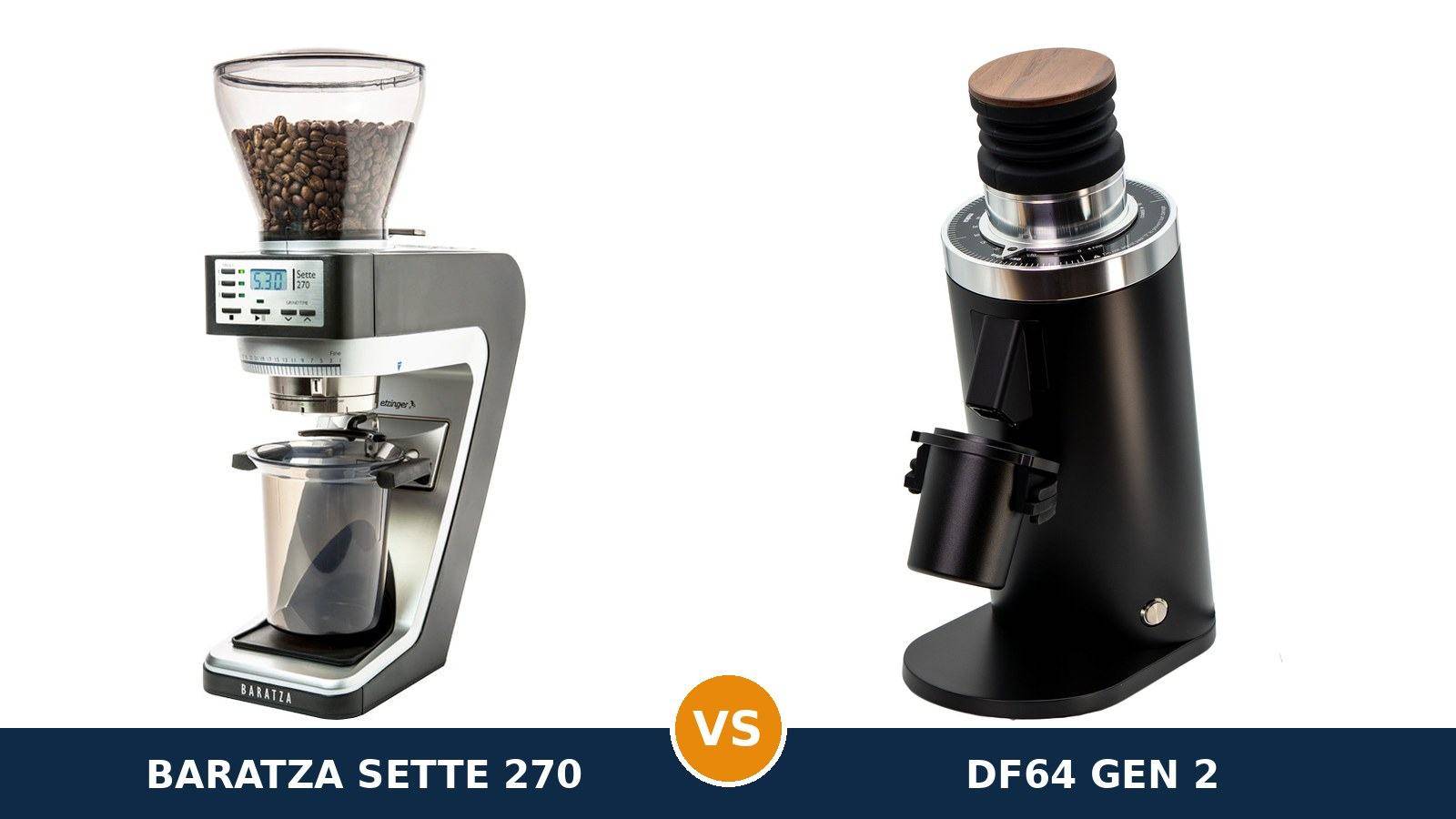
Two espresso grinders. Two opposite answers to the same question: how should a dose of coffee reach your portafilter?
The Baratza Sette 270 says: fill the hopper, program the timer, press a button. The DF64 Gen 2 says: weigh every dose, grind it through 64mm flat burrs, and leave almost nothing behind.
One warning before anything else. “DF64” is not one grinder. The name covers the original DF64, the current Gen 2, a variable-speed DF64V, and hopper-fed DF64P and DF64E variants.
This comparison pins the name down. The DF64 here is the current Gen 2 — sold in the US as the MiiCoffee DF64 II, the Turin DF64 Gen 2, and the DF64 Gen 2 by DF64 Coffee. The other DF64s are walled off by name wherever they could cause confusion.
The Sette side needs the same care. This is the Sette 270: timed dosing, no scale. The weight-dosing Sette 270Wi and the simpler Sette 30 are different models, walled off by name too.
Every specification below comes from the manufacturers’ and distributors’ own published data — Baratza’s manual and spec sheets, MiiCoffee’s and Turin’s DF64 documentation. Where those sources disagree, the disagreement is printed, not buried.
Key Takeaways
- The scorecard finishes level, 8.4–8.4. This choice is decided by workflow — hopper or scale — not by a spec-sheet knockout.
- The DF64 Gen 2 is the single-dose machine. 64mm flat burrs, a published retention claim under 0.1g, a plasma ionizer, and an upgrade path to SSP burrs.
- The Sette 270 is the convenience machine. A 300–400g hopper, three timer presets settable to 0.1 seconds, and hands-free grinding straight into a portafilter.
- The Sette publishes the fastest grind speed here: 2.9–4.0 g/sec in Baratza’s current product data. The DF64 publishes no output figure at all.
- Check which DF64 you are actually buying. Gen 1, Gen 2, DF64V and DF64P/E share a name and almost nothing else; generation, seller and voltage all need verifying.
Quick Verdict
Buy the DF64 Gen 2 if you single-dose. If you weigh your beans, switch coffees often, or chase clarity from light roasts, this is your grinder.
Its 64mm flat burrs sit in the deepest upgrade ecosystem in home grinding. Its distributor publishes a sub-0.1g retention claim and backs it with a bellows and an ionizer. Nothing on the Sette side answers that combination.
Buy the Baratza Sette 270 if you run a household on one coffee. Hopper filled, timer programmed, portafilter in the arms — a dose takes seconds and no scale ever leaves the drawer.
It is also the faster grinder on published figures, and its stepped macro dial makes returning to a setting exact rather than estimated. For a family espresso routine, that matters every morning.
The Scorecard
Scores below are derived directly from the manufacturer and distributor specifications compared in this guide — burr sizes, published output figures, retention claims, adjustment systems and warranty terms. They are a reading aid, not benchmark results.
| Category | Baratza Sette 270 | DF64 Gen 2 | ||
|---|---|---|---|---|
| Burr set | 8 / 10 | 9 / 10 | ||
| Adjustment & repeatability | 9 / 10 | 8.5 / 10 | ||
| Motor & published grind speed | 9 / 10 | 7.5 / 10 | ||
| Retention & static control | 8.5 / 10 | 9.5 / 10 | ||
| Dosing & workflow | 9.5 / 10 | 7.5 / 10 | ||
| Brew-method range | 7.5 / 10 | 8.5 / 10 | ||
| Build & footprint | 7.5 / 10 | 8.5 / 10 | ||
| Overall | 8.4 / 10 | 8.4 / 10 | ||
A dead heat, and an honest one. The Sette wins every category about getting a dose made quickly and repeatably. The DF64 wins every category about what happens to the coffee on its way through the burrs.
So the rest of this guide asks one question: which of those two jobs is your kitchen asking a grinder to do?
At a Glance: Who Each Grinder Fits
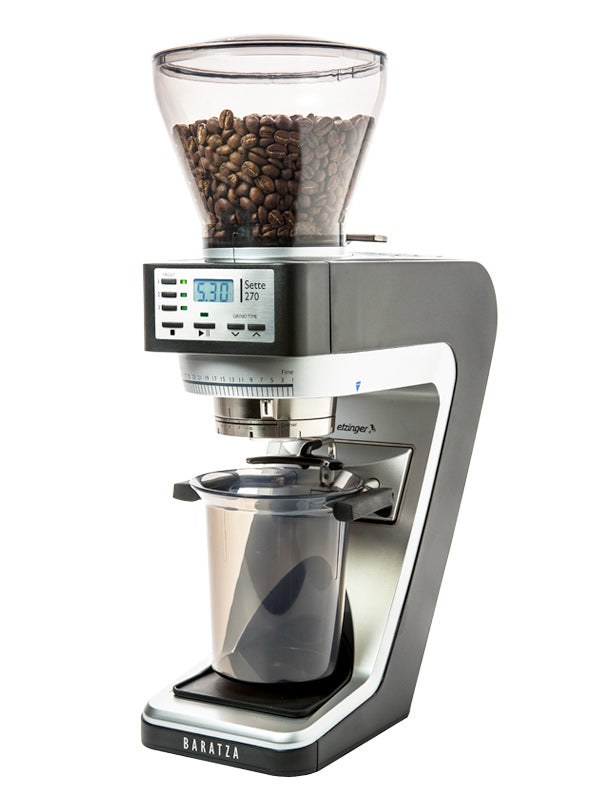
Baratza Sette 270
- 40mm conical steel burrs by Etzinger (S1 set)
- 270 settings: 31 macro steps + stepless micro ring
- Three timer presets, adjustable to 0.1 seconds
- 300–400g hopper with bean shutoff; 160g grounds bin
- Convertible arms: portafilter, bin or brew device
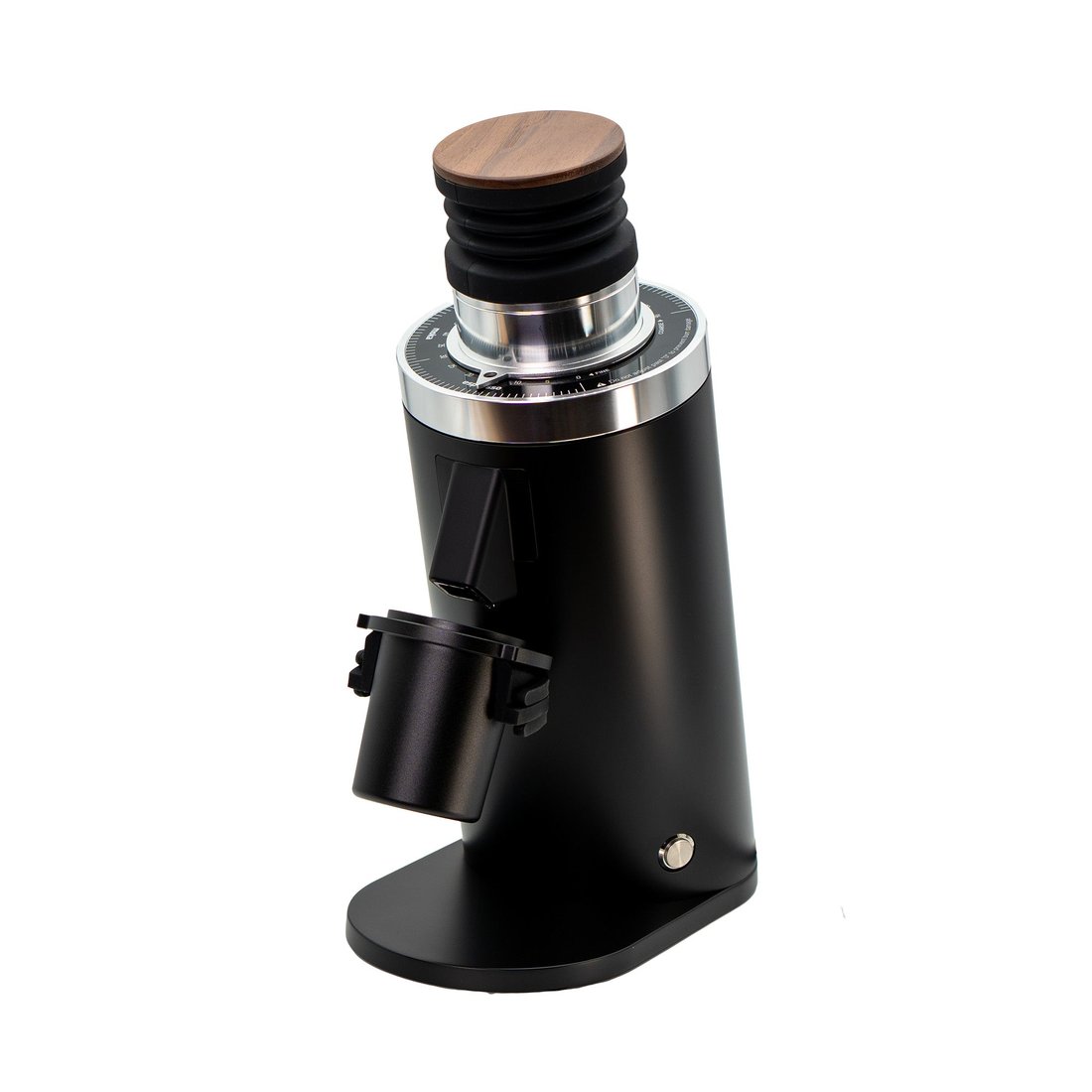
DF64 Gen 2
- 64mm flat stainless steel burrs, SSP-upgradeable
- Stepless chrome dial with metal indicator
- Published retention claim under 0.1g, plasma ionizer
- Single-dose bellows funnel; 58mm aluminium dosing cup
- Aluminium body; 250W motor at a fixed 1,400 RPM
Choose the Baratza Sette 270 if…
One coffee lives in your hopper for a week or more. Dialling in happens once per bag, not once per drink.
Several people make drinks back to back. Timed presets and hands-free portafilter grinding keep a morning queue moving.
You hate scales on the counter. The Sette’s whole design exists so the weighing happened once, when you programmed the timer.
Choose the DF64 Gen 2 if…
You weigh every dose anyway. A hopper full of beans going stale is a cost, not a convenience, in your routine.
You rotate coffees — a washed Ethiopian today, a natural tomorrow — and want yesterday’s grounds out of today’s cup. Sub-0.1g published retention is the headline for a reason.
You want a platform, not just a grinder. The 64mm burr ecosystem means this machine can change character later without being replaced.
As an Amazon Associate I earn from qualifying purchases at no extra cost to you.
Specifications: The Specs That Actually Matter
Every figure below is taken from Baratza’s manual and specification sheets for the Sette 270, and from MiiCoffee’s and Turin’s published data for the DF64 Gen 2. Where the two DF64 distributors differ, the table uses MiiCoffee’s figures — the primary US brand source — and the conflict is flagged under the table.
| Specification | Baratza Sette 270 | DF64 Gen 2 |
|---|---|---|
| Burr set | 40mm conical steel, by Etzinger (S1) | 64mm flat stainless steel, custom-made; SSP and other 64mm sets fit |
| Adjustment system | 270 settings: 31 numbered macro steps + stepless micro ring with 9 indicators | Stepless collar dial, chrome-wrapped, with metal indicator; no detents |
| Grind range, as published | Espresso to medium-coarse manual brew; Baratza excludes very coarse grinding | Espresso through filter and French press, per distributor data |
| Motor | High-torque DC motor, 19:1 planetary gearbox; 290W rating on Baratza’s North America spec sheet | 250W AC motor, fixed 1,400 RPM |
| Published grind speed | 2.9 g/sec at setting 8E to 4.0 g/sec at setting 28E (current Baratza product data) | Not published by either distributor |
| Retention | Straight-through vertical grind path; Baratza describes near-zero retention, no gram figure published | Published claim: under 0.1g, with or without the bellows |
| Static control | Anti-static grounds bin | Plasma generator (ionizer) built into the exit chute |
| Hopper / dosing format | 300–400g hopper with bean shutoff; three timed presets; 160g grounds bin | Single-dose funnel: 30g, or 80g with the bellows fitted; 58mm aluminium dosing cup |
| Grinding into a portafilter | Convertible arms hold the portafilter hands-free; also fits bin and brew devices | Portafilter rest fitted; distributor recommends the dosing cup, especially for non-58mm baskets |
| Body & weight | Plastic housing; 3.2 kg (7 lb) | Aluminium body, powder-coated; 15 lb per MiiCoffee |
| Dimensions (W × D × H) | 13 × 24 × 40 cm | 12.7 × 22.9 × 35.6 cm (5 × 9 × 14 in) |
| Noise features | None published; no decibel figure from Baratza | None published; no decibel figure from either distributor |
| Duty guidance | Designed for a maximum of 1 kg (2 lb) of coffee per day, 10% duty cycle | No daily duty figure published |
| Warranty (US) | 1 year, Baratza | 1 year, via the US distributor (MiiCoffee / Turin) |
Which DF64 is this? The Gen 2 — the ground-up redesign that replaced the original DF64, integrating elements of the DF64V and DF83 lines: a three-position upper burr carrier with a wave spring, a redesigned exit chute with the plasma generator, an anti-popcorn disc, and a chrome-wrapped stepless dial.
In the US it is sold under three labels for the same machine: MiiCoffee DF64 II, Turin DF64 Gen 2, and DF64 Gen 2 from DF64 Coffee. Minor internal builds carry seller version numbers — MiiCoffee’s current build is V2.6, which changed the anti-popcorn disc; the defining hardware has been stable since the Gen 2 redesign.
Not this grinder: the original DF64 (Gen 1), the variable-speed DF64V, and the hopper-fed DF64P and DF64E. All four are different machines sharing the name, and none of their specifications are used in this guide.
Sette family note: the Sette 270 in this comparison doses by time. The Sette 270Wi looks nearly identical but doses by weight through a built-in Acaia scale — a different model with a different manual. The Sette 30 is the simplified sibling, with fewer macro steps and preset-free dosing. Check the model printed on the display surround before you buy; the bodies are easy to confuse at a glance.
Two conflicts, printed honestly: Baratza’s 2016 spec sheet claims grind speeds of 3.5–5.5 g/sec; its current data lists 2.9–4.0 g/sec, and the current figures are used here. The DF64’s funnel capacity is 30g / 80g per MiiCoffee but 50g per Turin’s manual — the same bellows funnel, measured differently.
The Differences That Actually Matter
1. Dosing philosophy — the difference that decides everything else
These grinders disagree about first principles. The Sette 270 assumes your coffee lives in its hopper. You program three timed presets once — adjustable to 0.1 seconds — and from then on, dosing is a button press.
The DF64 Gen 2 assumes your coffee lives in a bag, or in single-dose tubes. Every dose is weighed by you, ground, and blown clear with the bellows. There is no hopper workflow to fall back on: the 30g funnel (80g with the bellows fitted) was never meant to store beans.
Everything else in this comparison is a footnote to this section. Decide how you dose, and you have mostly decided the comparison.
2. Burrs — a finished answer against an open platform
The Sette’s 40mm conical burrs are made by Etzinger in Liechtenstein, and the design is unusual: the outer burr rotates around a fixed cone. Baratza tunes the S1 set for espresso, and the cup signature is the classic conical one — body and sweetness first.
It is also a closed system. The shipped burr set is the burr set it is, with one factory exception: Baratza’s accessory BG (brew grind) burr for manual-brew use. There is no aftermarket.
The DF64’s 64mm flat burrs are the opposite proposition. The stock stainless set is competent and espresso-capable, but the mount is the standard 64mm pattern — the deepest burr aftermarket in home coffee. SSP’s High Uniformity, Multi-Purpose and Cast Lab Sweet sets all fit, as do DLC-coated and Mazzer-pattern options.
That makes the DF64 two grinders in one purchase: the one in the box, and whichever one a burr swap turns it into later. If you know you will experiment, this section outweighs several others. If you know you will not, the Sette’s fixed, well-sorted answer costs you nothing.
3. Adjustment — returning to a setting versus never leaving it
The Sette gives you 270 settings with structure: 31 numbered macro steps for range, and a stepless micro ring with nine indicators for the fine work. The mechanism connects directly to the cone burr, so a change registers immediately and exactly.
The practical prize is repeatability. Note “17, micro E” in your brew log and you can return to that precise grind next week, after the grinder has been somewhere else entirely.
The DF64’s stepless collar is finer in theory — infinitely fine — and its chrome dial carries a metal indicator, so positions are readable. But there are no detents. Returning to a previous setting is an act of eyesight and memory, not of counting clicks.
For a single-dose espresso routine, that hardly matters: you live in one small dial region and nudge. For anyone swinging between brew methods daily, the Sette’s numbered structure is the better tool. The scorecard gives the Sette the edge because repeatable beats infinite when both dial in espresso equally well.
4. Retention and static — a published number against a design claim
The DF64’s distributors publish the boldest retention claim in this class: under 0.1g, even without the bellows. The hardware behind the claim is visible — a short, redesigned chute, a plasma generator (ionizer) in the exit to kill static, an anti-popcorn disc, and a bellows to purge what is left.
The Sette’s answer is architectural. Grounds travel a straight-through vertical path from burrs to bin, dropping under gravity with nowhere to accumulate, and Baratza describes the result as near-zero retention. It is a credible design with a decade-old reputation — but Baratza publishes no gram figure, and there is no active static treatment beyond an anti-static grounds bin.
So the honest scoring is this: both grinders are low-retention machines by design. Only one side puts a number in writing and adds an ionizer. If you switch beans daily, the DF64’s paper trail is the one to trust.
5. Speed — the Sette is fast, and says so
Baratza’s current product data lists the Sette 270 at 2.9 g/sec on an espresso setting and 4.0 g/sec at a manual-brew setting. Those are exceptional figures for a home grinder — an 18g dose in about five to six seconds — from a high-torque DC motor through a 19:1 planetary gearbox, spinning the outer burr at high speed.
A housekeeping note, because honesty is the house rule: Baratza’s original 2016 sheet claimed 3.5–5.5 g/sec. The lower, current figures are used throughout this guide. Even on the conservative numbers, the conclusion survives.
The DF64 side is a blank page. Neither distributor publishes a grams-per-second figure; the published motor data is 250W at a fixed 1,400 RPM. That is not a slow specification, but a comparison scores what is published — and on published output, the Sette wins this section outright.
6. Range — where each dial honestly ends
Baratza is explicit about the Sette’s coarse limit. The 31 macro steps run from espresso to manual brewing, and the manual’s framing stops at medium-coarse: this is not the grinder for very coarse work such as cold brew at its coarsest, and Baratza’s guidance says so.
Within its range it is complete — espresso through Chemex and batch brew. But a household whose second drink is a French press is already at the fence.
The DF64’s distributors rate its stepless range across espresso, pour-over, drip and French press without a coarse-end caveat. Flat burrs at filter settings are also the enthusiast default for clarity, which is why so many DF64s live double lives as espresso-and-filter machines.
If your brewing is espresso-only, call this section a tie. The moment filter coffee — especially coarse filter coffee — enters the picture, the DF64 is the broader instrument.
7. Build, footprint and the daily-grind details
Pick both up and the difference is immediate. The DF64 Gen 2 is an aluminium body with a powder-coated finish, listed at 15 lb — dense, planted, finished like a small appliance machined rather than moulded. At 35.6 cm tall it is also the shorter machine, which matters under low wall cabinets.
The Sette weighs 3.2 kg — less than half as much — in a largely plastic housing. It is the narrower, lighter unit, easier to slide out for cleaning. What it returns for that lightness is the convertible device holder: swing the arms and the same grinder takes a portafilter hands-free, the supplied 160g anti-static bin, or a V60 or AeroPress. Nothing else at this level integrates the brewer into the dosing step like that.
One Sette limit deserves daylight: Baratza designs it for a maximum of 1 kg (2 lb) of coffee per day, on a 10% duty cycle — grind, then rest. Normal home use never approaches that. A small office or a heavy entertaining habit genuinely might, and the DF64 publishes no equivalent ceiling.
Noise, finally, is a section neither brand will help you score. Neither maker publishes a decibel figure or any noise-reduction feature for these models, so none is claimed here. Any source quoting a precise decibel number for either machine is inventing it.
Brew-Method and Routine Fit
Start from what you brew and how you dose. This table is the whole comparison in one view.
| Your routine | Baratza Sette 270 | DF64 Gen 2 | Our call |
|---|---|---|---|
| Espresso, one house coffee, drinks all week | Excellent — hopper and timer presets were built for this | Good — capable, but the single-dose routine is unpaid labour here | Sette 270 |
| Espresso, rotating beans and roasters | Workable — hopper works against you; single-dosing a Sette is off-label | Excellent — sub-0.1g published retention, burrs swap for taste | DF64 Gen 2 |
| Espresso + pour-over (V60, Chemex) | Excellent — numbered macro steps make the swing repeatable; arms hold the brewer | Excellent — flat-burr clarity, if you log dial positions by eye | Tie — pick by dosing style |
| French press and cold brew in the rotation | Weak — Baratza excludes very coarse grinding | Good — distributor-rated across the full range | DF64 Gen 2 |
| Back-to-back drinks for a household | Excellent — 2.9–4.0 g/sec published, hands-free portafilter dosing | Slower by design — weigh, grind, purge, repeat | Sette 270 |
| Planning burr experiments later (SSP and friends) | Not possible — closed burr system, BG accessory burr aside | Excellent — the 64mm aftermarket is the point | DF64 Gen 2 |
Read the first two rows together. They are the same drink — espresso — pointing at opposite grinders. The coffee does not decide this comparison. The routine around it does.
The 30-Second Decision
| If this sounds like you… | Buy this |
|---|---|
| “Fill the hopper Monday, pull shots all week, no scale on my counter.” | Baratza Sette 270 |
| “I weigh every dose and change coffees constantly.” | DF64 Gen 2 |
| “Three people, one machine, mornings are a queue.” | Baratza Sette 270 |
| “I want SSP burrs one day without buying a new grinder.” | DF64 Gen 2 |
| “French press and cold brew are weekly drinks here.” | DF64 Gen 2 |
| “I alternate espresso and V60 and need to find settings again exactly.” | Baratza Sette 270 |
Ready to check today’s price?
Both grinders sell through Amazon. Check the live figure on the one that fits your routine — and on the DF64, confirm the seller is an official distributor store first.
View on Amazon — Baratza Sette 270View on Amazon — DF64 Gen 2What You Gain. What You Give Up.
Baratza Sette 270
You gain: the fastest published grind speed in this class, a hopper-and-timer workflow that removes the scale from your morning, hands-free portafilter grinding, and a numbered adjustment system you can return to exactly.
You give up: the flat-burr platform and its upgrade path, a published retention figure, and the coarse end of the grind range. Baratza’s 1 kg-per-day duty guidance also caps very heavy use.
DF64 Gen 2
You gain: 64mm flat burrs in the deepest upgrade ecosystem in home grinding, a published sub-0.1g retention claim with an ionizer behind it, an aluminium body, and a grind range with no coarse-end caveat.
You give up: automation. Every dose is weighed, ground and purged by hand; there are no presets, no hopper, and no published grind-speed figure. Returning to an old setting is estimation, not counting.
Pros and Cons
Baratza Sette 270 — Pros
- Published 2.9–4.0 g/sec — fastest output figures in its class
- Three timer presets to 0.1 seconds; no scale needed daily
- 270 settings with numbered macro steps — exactly repeatable
- Convertible arms grind into portafilter, bin or brewers
- Straight-through grind path keeps retention low by design
Cons
- Closed burr system — no aftermarket burr path
- Baratza excludes very coarse grinding; press and cold brew suffer
- Plastic housing; no published retention figure
- Designed duty limit of 1 kg of coffee per day
DF64 Gen 2 — Pros
- 64mm flat burrs; SSP and DLC upgrade path
- Published retention claim under 0.1g, plus plasma ionizer
- Stepless range covers espresso to French press
- Aluminium body; shortest of the two under cabinets
- Sold by established US distributors with 1-year warranty
Cons
- Fully manual dosing — weigh every dose, every time
- No published grind-speed figure from either distributor
- Stepless dial has no detents — settings return by eye
- One name, many variants — generation and seller need checking
Check the Generation, the Seller and the Model, Not Just the Name
On the DF64 side, generation is everything. You want the Gen 2: chrome-wrapped dial with a metal indicator, plasma generator in the chute, anti-popcorn disc, metal power button on current builds. A listing that just says “DF64” with a basic dial and no ionizer is describing the Gen 1 — a different, older machine at what may look like a tempting price.
Buy from the official channels. In the US the machine is sold by MiiCoffee (as the DF64 II), by Espresso Outlet under the Turin label, and through DF64 Coffee’s own store. The Amazon listing linked here is DF64 Coffee’s official-seller Gen 2 listing; its featured-offer availability runs intermittently, so if it shows no offer, the distributors’ own stores carry the same grinder. Buy the seller, not just the title.
Check voltage and burr configuration. US stock is 100–120V. Listings also offer DLC-coated burr variants at a premium; the standard stainless set in this comparison is the sensible start, because the SSP path stays open either way.
On the Sette side, check the model, not the silhouette. The 270 (this one) doses by time and shows seconds on its display. The 270Wi doses by weight — different model, different price. The Sette 30 trims the adjustment system down. All three share a body shape, so read the model name, not the photograph.
The Upgrade Path Test
Judge these two by their second year, because they age in opposite directions.
The DF64’s second year can look completely different from its first. A set of SSP burrs — High Uniformity for espresso clarity, Multi-Purpose for a dual-role machine, Cast Lab Sweet for filter sweetness — changes the cup more than most grinder upgrades do, and the swap is a home job. The grinder you bought becomes the grinder you were saving for.
The Sette’s second year looks like its first, and that is its own kind of upgrade path: consistency. Burrs are replaceable wear parts from Baratza, the BG accessory burr widens its brew range, and the daily routine does not degrade. What you cannot do is change its character — there is no burr ecosystem to grow into.
Both machines carry a one-year US warranty. Beyond it, Baratza’s model is parts availability and repair documentation for the machine’s whole life; the DF64’s is distributor support, with burrs a standard 64mm item sourceable anywhere.
So the test is simple. If your hobby is going somewhere — new burrs, new methods, new coffees — the DF64 grows with it. If your routine is settled, the Sette refuses to get in its way.
When to Skip Both
Honesty cuts both ways: some buyers should skip both.
Skip both if you want grind-by-weight dosing. That is the Sette 270Wi — a different Baratza model with a built-in scale — and no amount of timer precision fully substitutes for it.
Skip both if you want variable motor speed for filter experimentation. That is the DF64V’s entire reason to exist — again, a different machine under a similar name.
Skip both if your priority is a quiet, hopper-fed grinder with timed dosing and a touchscreen. The Eureka Mignon Specialita class owns that brief.
And skip both if your grinding is mostly large coarse batches for press pots and cold brew. A dedicated brew grinder will serve that kitchen better than either of these espresso-first machines.
Warranty and Long-Term Support
Both grinders carry a one-year warranty in the US — Baratza’s own on the Sette 270, and the selling distributor’s (MiiCoffee or Turin) on the DF64 Gen 2.
Baratza’s support model is the industry reference point: a full parts catalogue, published repair guides and a US service operation built around keeping grinders in service rather than replacing them. Burrs, gearbox parts and hopper components are all orderable wear items.
DF64 support runs through the distributor who sold you the machine — one more reason the buying-guide advice matters: an official-channel DF64 has a named US company behind its warranty. Burrs are a standard 64mm pattern, so the main wear part is sourceable from multiple makers indefinitely.
On noise and durability, neither brand publishes anything further that can be honestly quoted — no decibel ratings exist for either machine, and neither maker claims a lifespan. What is published is what this guide has used.
Final Verdict
The scorecard says 8.4 to 8.4, and for once the tie is the finding. These are two fully sorted espresso grinders embodying opposite philosophies. Averaging their spec sheets produces a draw; living with them produces a clear winner — a different one in each kitchen.
Buy the DF64 Gen 2 if your espresso habit is a hobby: doses weighed, coffees rotated, filter brewing in the mix, and a burr upgrade somewhere in your future. It is the better instrument, on the only published retention figure in this comparison, with the broader range and the aluminium build.
Buy the Baratza Sette 270 if your espresso habit is a routine: one coffee in the hopper, timers set, drinks made fast for more than one person. Nothing else at this level removes friction from a morning like it does — and its published grind speed is the fastest here.
View on Amazon — Baratza Sette 270
Choose by the dose, not by the burr diameter. The grinder that matches how you actually make coffee is the one that wins your counter.
Frequently Asked Questions
Is the DF64 Gen 2 better than the Baratza Sette 270?
On this guide’s spec-derived scorecard they finish level at 8.4 out of 10. The DF64 Gen 2 wins on burr platform, published retention and brew range; the Sette 270 wins on dosing workflow, published grind speed and adjustment repeatability. The better grinder is the one whose dosing style matches your routine.
Which DF64 does this comparison cover?
The current Gen 2 — sold in the US as the MiiCoffee DF64 II, the Turin DF64 Gen 2 and the DF64 Gen 2 from DF64 Coffee. The original DF64 (Gen 1), the variable-speed DF64V and the hopper-fed DF64P and DF64E are different machines, not covered by these specifications or scores.
Can the Sette 270 grind for French press or cold brew?
Only up to a point. Baratza’s 31 macro steps run from espresso to medium-coarse manual brewing, and Baratza’s own guidance excludes very coarse grinding. Occasional press coffee at the coarse end is possible; a household that drinks press or cold brew daily should choose the DF64 Gen 2 or a dedicated brew grinder.
Does the DF64 Gen 2 really retain less than 0.1 grams?
That is the distributors’ published claim — under 0.1g, stated to hold even without the bellows. The hardware supports the intent: a short redesigned chute, a plasma ionizer, an anti-popcorn disc and a bellows purge. This guide reports it as the manufacturer claim it is; Baratza publishes no equivalent figure for the Sette, whose straight-through vertical path is a low-retention design without a number attached.
Can I put SSP burrs in the DF64 Gen 2?
Yes. The DF64 uses the standard 64mm flat burr pattern, and its distributors sell it explicitly as upgradable to SSP sets — High Uniformity, Multi-Purpose and Cast Lab Sweet among them — as well as DLC-coated options. The Sette 270’s burr system is closed by contrast; Baratza’s only alternative is its own BG brew-grind accessory burr.
What is the difference between the Sette 270 and the Sette 270Wi?
Dosing. The Sette 270 in this comparison doses by time, using three programmable timer presets. The 270Wi doses by weight through a built-in Acaia scale, to a tenth of a gram. The burrs, motor and adjustment system are shared; the 270Wi is a separate model with its own manual and price.
Which grinder is quieter?
Neither maker publishes a decibel figure or a noise-reduction feature for these models, so this guide does not rank them on noise. Any source quoting a precise decibel number for either grinder is not quoting the manufacturer.
Which grinder is better for a beginner?
It depends on the beginner’s patience. The Sette 270 is the gentler start for espresso-only households: fill, program, press. The DF64 Gen 2 asks more — a scale and a routine — but teaches dose discipline from day one and leaves more room to grow.
Sources & Verification
Baratza Sette 270 user manual (v2.1) and Baratza specification sheets — 40mm Etzinger burrs, 270 settings, timed presets, hopper and bin capacities, duty cycle, North America power rating • Baratza current product comparison data (via its Amazon store) — 2.9–4.0 g/sec grind speed, 300g hopper • Whole Latte Love Sette 270 product data (authorised dealer) — dimensions, 290W • MiiCoffee DF64 II official product page and manual — 64mm burrs, 250W, 1,400 RPM, sub-0.1g retention claim, ionizer, capacities, dimensions, one-year warranty • Turin DF64 Gen 2 manual (Espresso Outlet) — 250W, 50g bellows hopper • Amazon listing data for both models, used for ASIN verification only. Specifications verified November 2026.

James Wilson
James has been testing coffee gear and small kitchen appliances for over a decade and writes Honestly Compared’s coffee and grinder guides. His rule for every comparison: the verdict has to survive the spec sheet, not the marketing page.