
Baratza Virtuoso+ vs Fellow Ode: Which Should You Buy?
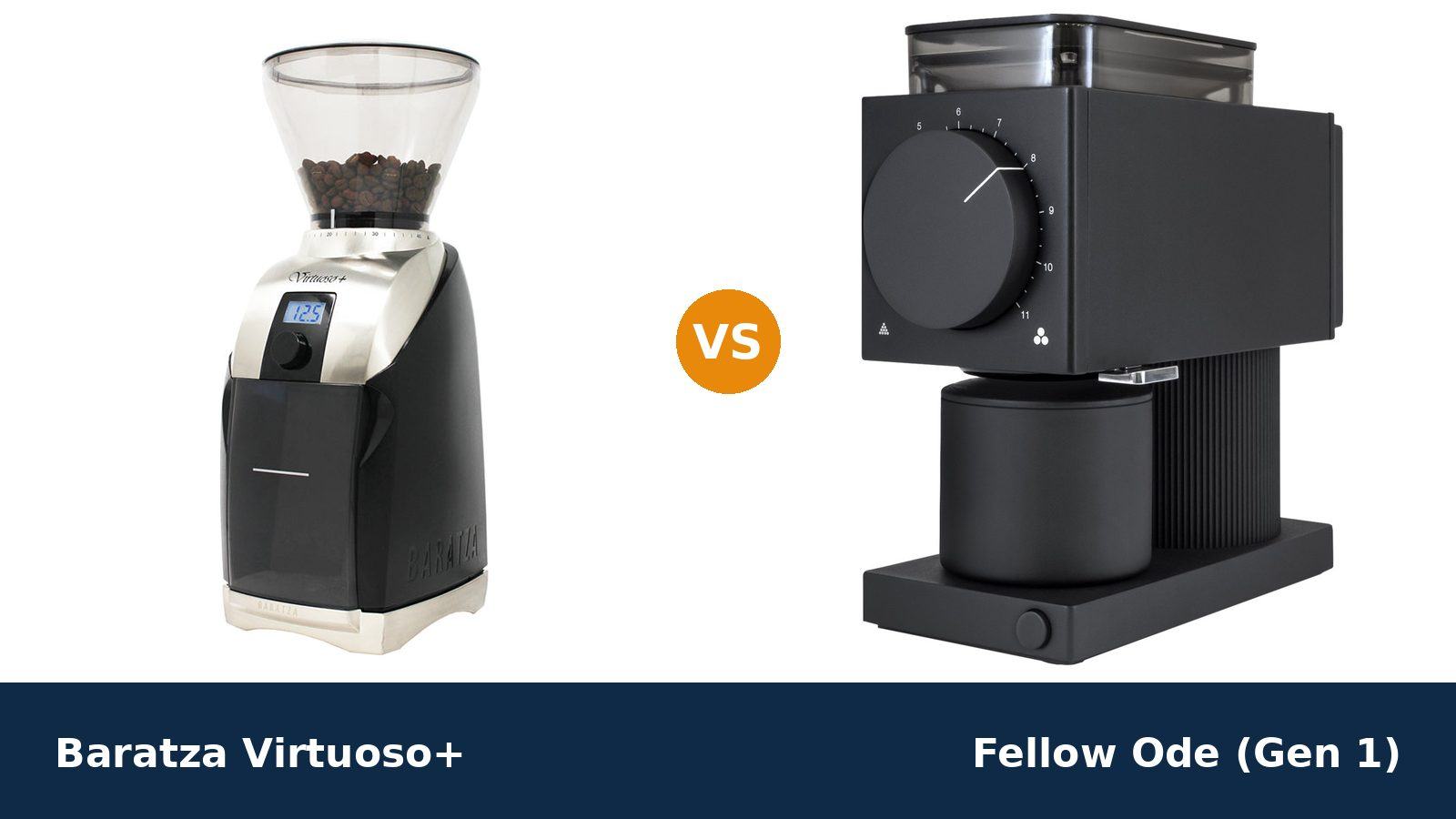
Two of the most recommended home brew grinders of the last decade — and both names in the search term need pinning down before a single specification makes sense.
First, “Virtuoso.” The original Baratza Virtuoso (model 586) was retired in late 2020, and Baratza replaced it with the Virtuoso+ (ZCG587) — the grinder with the digital timer and backlit display. Dealer pages titled simply “Baratza Virtuoso” sell the Plus today, so the bare name now belongs to the current machine. That is the Virtuoso compared here; the original is walled off by name wherever it matters.
Second, “Ode.” The bare name is the original Fellow Ode Brew Grinder of 2020 — 64 mm flat burrs, an 80 g single-dose bin, no anti-static ionizer. The Ode Gen 2 that replaced it in late 2022 is a different comparison, covered in its own guide, and is walled off here.
With the names settled, the matchup is a genuine fork in home grinding philosophy: a hopper-fed conical burr grinder with a digital timer, against a single-dose flat burr grinder built around weighing in. Every specification below comes from the manufacturers’ own published data.
Key Takeaways
- The Virtuoso+ wins overall. It is the current, warrantied machine, with a published grind range of 250 to 1200 microns against the original Ode’s roughly 500-micron burr floor.
- The daily difference is workflow, not burr size. The Virtuoso+ doses by time from a 300 g hopper; the Ode is single-dose only — weigh in, grind, weigh out, every cup.
- The Ode counters with café-format hardware. Its 64 mm flat burrs dwarf the Virtuoso+’s 40 mm conicals, and those burrs can be upgraded to the Gen 2 set later.
- Neither dials espresso properly. The Virtuoso+ spreads its 40 steps evenly with no espresso zone; Fellow excludes espresso for the Ode outright.
- The Ode is discontinued. Fellow no longer sells it new; it now trades through remaining marketplace listings, used offers and Fellow’s Rebrew refurbished programme.
Quick Verdict
Buy the Baratza Virtuoso+ if you want the grinder that fits a normal kitchen routine. Fill the hopper, set the timer once, and dose repeatably at the touch of a button — with a live warranty and Baratza’s parts catalogue behind it.
It also grinds finer, covers the wider published range, and is the only one of the two you can simply buy new today.
Consider the original Fellow Ode only as a deliberate single-dose buy — used or refurbished. Its 64 mm flat burrs, narrow footprint and weigh-in workflow are a real philosophy, not a compromise.
If a clean used example or a Fellow Rebrew unit costs meaningfully less than a new Virtuoso+, and you single-dose anyway, the Ode still does its core job well. Just know what you give up: a warranty, the fine end of the range, and any timed dosing.
The Scorecard
Scores below are derived directly from the manufacturer specifications compared in this guide. They are a reading aid, not benchmark results. Neither maker publishes a decibel figure for these models, so the noise row is scored on published noise engineering only.
| Category | Baratza Virtuoso+ | Fellow Ode (Gen 1) | ||
|---|---|---|---|---|
| Burr set | 8.5 / 10 | 7.5 / 10 | ||
| Adjustment & espresso resolution | 7 / 10 | 5 / 10 | ||
| Motor & published output | 8 / 10 | 7.5 / 10 | ||
| Retention & static control | 6 / 10 | 6 / 10 | ||
| Noise (published features) | 7.5 / 10 | 8 / 10 | ||
| Brew-method range | 8.5 / 10 | 5.5 / 10 | ||
| Build, footprint & capacity | 8 / 10 | 7.5 / 10 | ||
| Overall | 7.6 / 10 | 6.9 / 10 | ||
The pattern is the philosophy split: the Virtuoso+ takes the rows about dosing, range and published output; the Ode’s flat burr format and noise positioning keep it competitive where the grinding itself is concerned.
At a Glance: Who Each Grinder Fits
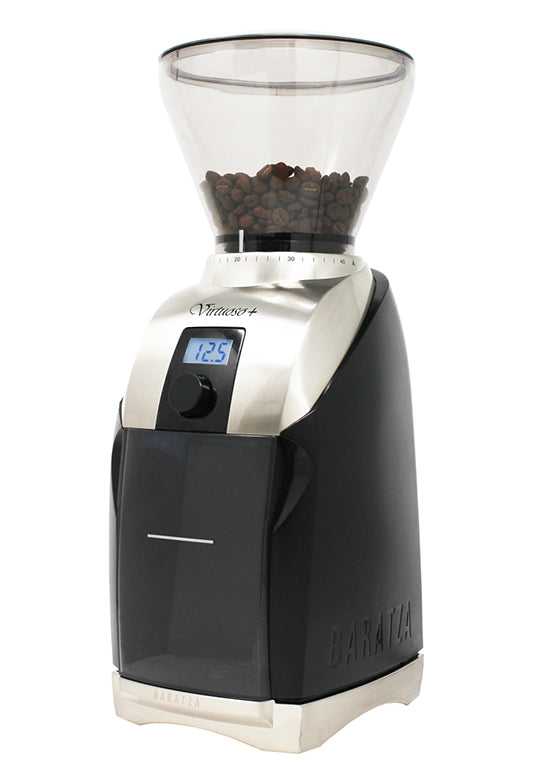
Baratza Virtuoso+
- 40 mm M2 conical burrs in hardened steel, made by Etzinger in Liechtenstein
- 40 stepped settings across a published 250 to 1200 micron range
- 40-second digital timer at 0.1-second resolution, backlit display, pulse button
- 300 g bean hopper and a 120 g LED-illuminated grounds bin — hopper-fed dosing
- 70 W DC motor, 550 RPM burr speed, published output of 1.3 to 2.4 g/sec
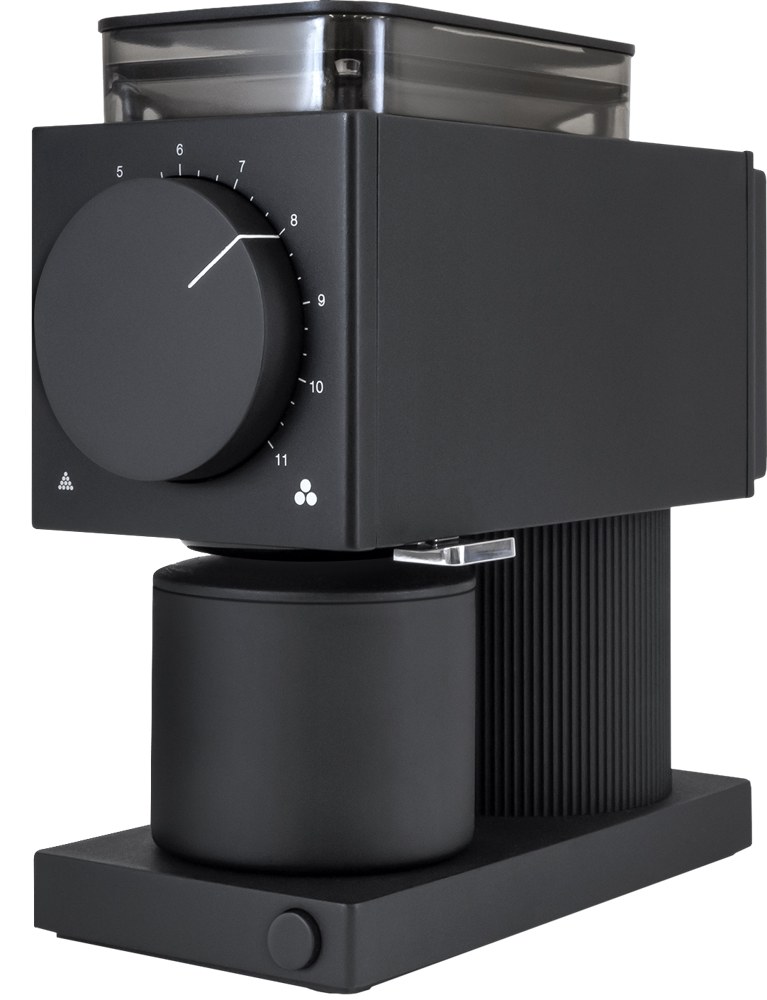
Fellow Ode (Gen 1)
- 64 mm flat stainless steel Standard Brew Burrs — Fellow rates the fine floor at roughly 500 microns
- 31 stepped grind settings on a front dial — 11 numbered settings with a printed grind guide
- Brewed coffee only: AeroPress, pour-over, drip, French press and cold brew — no espresso
- 80 g single-dose load bin and an 80 g magnetically aligned catch cup
- Aluminium body, 4.5 kg, grinds knocker and automatic stop — but no anti-static ionizer
Choose the Baratza Virtuoso+ if…
You brew on a routine. A hopper and a timer mean the same dose at the same time every morning, without a scale entering the ritual.
You want to buy new, with cover. The Virtuoso+ is a current model with a live 1-year warranty and Baratza’s published parts diagrams and spares behind it.
You grind at the fine end of brewed coffee. A 250-micron floor covers tight AeroPress and fine pour-over ranges the original Ode physically cannot reach.
Choose the Fellow Ode (Gen 1) if…
You already single-dose and rotate beans. The Ode was designed for exactly that: weigh in, grind through, knock, done — nothing stale sitting in a hopper.
Counter width is your constraint. At 105 mm wide the Ode is barely half the visual bulk of a hopper grinder, and its aluminium body feels a class above.
You found one used or Rebrew-refurbished at a genuinely low price, and your brewing lives from pour-over coarser. The platform’s burrs can be upgraded later; read the upgrade section before deciding.
As an Amazon Associate I earn from qualifying purchases at no extra cost to you.
Specifications: The Specs That Actually Matter
Every figure below is from the manufacturers’ own published data: Baratza’s official Virtuoso+ product sheet, and for the Ode, Fellow’s original manual, retail specification block and Ode gear guide.
| Specification | Baratza Virtuoso+ (ZCG587) | Fellow Ode Brew Grinder (Gen 1, 2020) |
|---|---|---|
| Model identity | Virtuoso+ (black finish: ZCG587BLK), 2019 — the current Virtuoso; it replaced the original Virtuoso (model 586) in late 2020 | Original Ode Brew Grinder (manual model BGAAUS); discontinued and replaced by the Ode Gen 2 in late 2022 |
| Burr set | 40 mm M2 conical, hardened steel, made by Etzinger in Liechtenstein | 64 mm flat, stainless steel — Standard Brew Burrs (also sold as Ode Brew Burrs) |
| Adjustment system | 40 stepped settings, adjusted by twisting the hopper; steps spread evenly across the range | Stepped front dial: 11 numbered settings, 31 steps in total, printed grind guide |
| Grind range (manufacturer) | 250 to 1200 microns (current product sheet) | Brewed coffee; Fellow rates the Standard burrs’ fine floor at roughly 500 microns |
| Espresso | Range nominally reaches espresso fineness, but steps are spread evenly with no espresso-dedicated zone; Baratza positions it for manual brewing | Not suitable — the manual states it cannot grind fine enough for most espresso machines |
| Dosing | 40-second digital timer, 0.1-second resolution; backlit display; front pulse button to top up; side on/off switch | Single-dose only — weigh beans in per brew; automatic stop when the grind finishes; no timer |
| Motor | 70 W DC motor with gear reduction and thermal cutout (100–120 V build) | Smart Speed PID motor holding a steady 1,400 RPM burr speed; manual rates the US build at 150 W (retail spec block: 140 W, 1.3 A) |
| Burr speed | 550 RPM (no load) per Baratza specification data; the current product sheet does not print a burr speed | 1,400 RPM, held steady by the PID speed control |
| Published grind output | 1.3 g/sec at setting #10 to 2.4 g/sec at setting #30 (Baratza product sheet) | No output rate published by Fellow |
| Bean storage | 300 g bean hopper with lid; optional hopper extender adds 250 g | Single-dose load bin, 80 g — no bean storage by design |
| Grounds handling | 120 g grounds bin, LED-illuminated; optional Portaholder accessory grinds into a portafilter | One 80 g magnetically aligned catch cup, with pour fins and a lid that doubles as a chaff shield |
| Retention & static handling | No anti-static system published; Baratza’s speed-control design is described as reducing heat, noise and static; no retention figure published | Electrically grounded chute and grinds chamber, built-in grinds knocker, magnetically aligned cup — no ionizer |
| Burr mount | Threaded | Burr chamber accepts Gen 2 Brew Burrs and SSP sets as upgrades (Fellow documents the swap) |
| Noise engineering | Low 550 RPM burr speed by design; no decibel figure published | Marketed by Fellow as a reduced-noise, quieter grinder; no decibel figure published |
| Dimensions (W × D × H) | 5.1 × 5.9 × 13.4 in (13 × 15 × 34 cm) | 9.4 × 4.2 × 9.5 in (239 × 105 × 241.5 mm) — far narrower |
| Weight | 8 lb (3.6 kg) | 9.9 lb (4.5 kg) |
| Housing | ABS plastic and metal | Aluminium body; plastic load bin and base; stainless steel burrs |
| Warranty | 1-year manufacturer’s warranty — live on new units | 1-year limited warranty (original manual) — long expired on every unit by age |
The Virtuoso name note: Baratza’s Virtuoso line runs 586, then 587. The original Virtuoso (model 586 — the earliest pre-2012 variant was the 585) used a mechanical 60-second timer knob and had no display; Baratza retired it in late 2020. The Virtuoso+ (ZCG587, 2019) is the one with the digital timer, backlit display and illuminated bin, and it is what dealer pages titled “Virtuoso” sell now. This guide compares the Plus throughout.
The Ode name note: the bare “ode” in the search term is the original Ode Brew Grinder of 2020. The Ode Gen 2 (2022) kept the name, body and dial but changed the burrs, capacity, static handling and warranty; it is compared against the original in its own guide and is not the machine on this side of the table.
The hopper note: Baratza’s own Virtuoso+ sheet prints 300 g as the headline hopper specification — and then describes “the existing 225 g bean hopper” in its accessories text, a line carried over from the older Virtuoso. We print the headline specification: 300 g.
The grind-range note: Baratza’s current Virtuoso+ sheet states 250 to 1200 microns. Older Baratza copy — and most dealer pages, which recycle it — say 200 to 1200. The current manufacturer document governs. Fellow, for its part, publishes no micron range on the Ode’s product pages; the roughly 500-micron floor comes from Fellow’s Ode gear guide.
The Differences That Actually Matter
1. Two names, two traps — why the pinning had to come first
Both search terms hide a discontinued machine. A listing that just says “Virtuoso” might be the current Plus or old stock of the 586; a listing that just says “Ode” might be either Fellow generation.
The checks are simple once you know them. A Virtuoso+ has a digital display and a timer you set in tenths of a second; the original has a mechanical knob. An original Ode quotes 80 g and no ionizer; a Gen 2 quotes 100 g and anti-static technology. The buying guide below turns both into a checklist.
2. Burrs — 40 mm conical against 64 mm flat
This is the hardware headline, and it is a genuine philosophical split. The Virtuoso+ runs Baratza’s 40 mm M2 conical set — hardened steel, made by Etzinger, tuned over two decades of Baratza brew grinders for uniform particles at a calm 550 RPM.
The Ode runs 64 mm flat burrs — café-format hardware, the size class of commercial filter grinders, in an aluminium body the size of a paperback standing upright. Flat burrs of that diameter are the Ode platform’s core strength.
But format is not the whole story. Fellow rates the original’s Standard Brew Burrs to a fine floor of roughly 500 microns; Baratza publishes the Virtuoso+ down to 250. The smaller burr set reaches twice as fine at the floor — which decides the fine-AeroPress row below — while the Ode’s set covers the shared middle of the brewed range with the larger format.
3. Workflow — the timer against the scale
Live with these grinders for a week and this difference swamps the burr debate. The Virtuoso+ is hopper-fed: beans live in the 300 g hopper, the 40-second digital timer doses to a tenth of a second, and a pulse button tops up. Set it once for your brewer and every morning is one button.
The Ode has no hopper and no timer because it wants neither. You weigh a dose, tip it into the 80 g load bin, grind it through, and the machine stops itself. Nothing sits staling in a hopper; nothing carries yesterday’s grind setting assumptions into today’s beans.
Neither workflow is wrong. They answer different questions: the Virtuoso+ optimises for a household brewing the same coffee the same way; the Ode optimises for a drinker rotating beans and methods who weighs anyway.
4. Adjustment — 40 steps against 31, and the espresso line
Both dials are stepped, both are repeatable, and both return to a setting exactly. The Virtuoso+ spreads 40 steps across its full 250–1200 micron range; the Ode spreads 31 steps across the brewed spectrum only.
Espresso separates them on paper only. The Ode is excluded outright — its own manual says so. The Virtuoso+ reaches espresso fineness at the bottom of its range, but its steps are spread evenly, with no micro-stepped espresso zone of the kind Baratza builds into its ESP models. Treat both as brewed-coffee grinders, one by declaration and one by geometry.
5. Static and retention — neither has the modern fix
An honest tie, and an instructive one. Neither grinder has an anti-static ionizer — the technology Fellow itself added to the Ode Gen 2 precisely because the original’s static and retention were its signature complaints.
The original Ode fights static mechanically: an electrically grounded chute and chamber, a flick-the-lever knocker, a magnetic cup. The Virtuoso+ fights it by design: a low 550 RPM burr speed that Baratza’s copy credits with reducing heat, noise and static, and a straight drop into an illuminated bin.
Neither maker publishes a retention figure for these models, so neither do we. Score the row level: both manage static rather than prevent it.
6. Capacity and footprint — volume against width
The Virtuoso+ holds more of everything: 300 g of beans against an 80 g single dose, a 120 g grounds bin against an 80 g cup. For a household grinding a full drip batch daily, it is not close.
The Ode wins the other dimension. At 105 mm wide it is one of the narrowest powered grinders ever sold, slipping beside a brewer where a hopper grinder will not. It is also the heavier machine — 4.5 kg of aluminium against 3.6 kg — and feels it.
Choose your constraint: if it is batch volume, the Baratza; if it is counter width, the Fellow.
7. Channel and support in 2026 — current against discontinued
The ownership terms are the widest gap in the comparison. The Virtuoso+ is a current model: live 1-year warranty, published parts diagrams, a spare-parts catalogue, and burrs and wear parts Baratza still sells.
One honest caveat: Baratza has announced the Virtuoso line will be sunset as its Encore ESP Pro arrives, so the Plus is a mature model late in its run — the listing this guide links is live and the warranty stands, but nobody should expect a Virtuoso++.
The Ode’s 1-year warranty has expired on every unit by age. Support has not vanished: Fellow still publishes the original’s manual and gear guides, sells the burr sets that fit it, and runs Rebrew — its certified-refurbished programme, whose units carry a 1-year warranty of their own. But dealer stock is gone, and every purchase is a used-market judgement call.
Coffee-Style Fit Guide
Which grinder serves which way of brewing? The honest pairing, method by method, grounded in the published specifications above.
| Brew method / use case | Better fit | Why, in one line |
|---|---|---|
| Pour-over, one or two cups (V60, Kalita) | Either | Both cover the pour-over band fully; the choice is timer routine against single-dose freshness |
| Drip machine, full daily batch | Baratza Virtuoso+ | 300 g hopper, 120 g bin and a repeatable timer — the Ode doses one small batch at a time |
| Fine AeroPress (short steep, tight grind) | Baratza Virtuoso+ | Its 250-micron floor reaches where the Ode’s roughly 500-micron burr floor stops |
| French press and cold brew | Either | Both reach the coarse end comfortably; the Virtuoso+ adds volume, the Ode adds nothing here |
| Rotating single-origin beans, weighed doses | Fellow Ode (Gen 1) | Single-dose by design: nothing stale in a hopper, nothing purged between beans |
| Espresso, any machine | Neither | The Ode is excluded by its manual; the Virtuoso+ has no espresso-resolution steps — see When to Skip Both |
| Smallest possible counter footprint | Fellow Ode (Gen 1) | 105 mm wide against the Virtuoso+’s 130 mm, and no hopper silhouette |
| Household routine, same coffee daily | Baratza Virtuoso+ | Set the timer once; every subsequent morning is a single button press |
30-Second Decision Guide
| Decision factor | Baratza Virtuoso+ | Fellow Ode (Gen 1) |
|---|---|---|
| Dosing style | Timed, from a hopper | Single-dose, weighed |
| Fine-grind floor | 250 microns (published) | Roughly 500 microns (burr rating) |
| Burr philosophy | 40 mm conical, proven and uniform | 64 mm flat, café format |
| Buying status in 2026 | Current model, sold new | Discontinued — marketplace, used, Rebrew |
| Warranty reality | Live 1-year manufacturer warranty | Expired (Rebrew units: own 1-year) |
| Counter demand | Hopper height and width | Narrowest footprint here |
| Espresso outlook | Reaches the range, lacks the resolution | Excluded outright |
| If you only remember one thing | Buy the Virtuoso+ for the routine; hunt an Ode only if single-dosing is already your religion and the price is used-market low. | |
Ready to decide?
Check the current listings — the Virtuoso+ as a new, warrantied model, and the original Ode’s listing, which now carries remaining marketplace and used offers.
Trade-Offs With No Winner
Hopper freshness vs dose freshness
The Virtuoso+ keeps beans in a sealed hopper for days of one-button convenience; the Ode keeps no beans at all, so every dose is as fresh as the bag. Which compromise you prefer is a lifestyle question, not a specification.
Conical consistency vs flat format
Neither burr philosophy is objectively better for brewed coffee. The M2 conical is a refined, forgiving set; the 64 mm flat format is the café standard with a wider upgrade ecosystem. Palates argue about this row more than specifications can settle.
New and covered vs discontinued and characterful
A new Virtuoso+ brings a warranty and returns window; a used Ode brings a lower entry price and a machine many owners plainly love. The right answer depends on your appetite for second-hand risk.
Pros and Cons
Baratza Virtuoso+ — Pros
- Widest published range here: 250 to 1200 microns
- Digital timer dosing at 0.1-second resolution — genuinely repeatable mornings
- Current model: live warranty, published parts diagrams, spares catalogue
- Published grind-speed figures (1.3–2.4 g/sec) most makers never print
- Threaded burr mount and a two-decade-old, well-documented platform
Baratza Virtuoso+ — Cons
- 40 steps spread evenly — no espresso-resolution zone at the fine end
- ABS-and-metal build feels a class below the Ode’s aluminium
- No anti-static system published; static is managed, not solved
- Baratza has announced the line’s sunset behind the Encore ESP Pro
- Hopper workflow bakes in some staleness for slow drinkers
Fellow Ode (Gen 1) — Pros
- 64 mm flat burrs — a format class above everything else at this size
- Single-dose purity: 80 g load bin, magnetic catch cup, auto stop
- Aluminium body and the narrowest footprint of any powered grinder here
- Documented burr upgrade path — Gen 2 burrs and SSP sets fit
- Reduced-noise design intent, marketed as a quieter grinder
Fellow Ode (Gen 1) — Cons
- Discontinued: no new stock, warranty expired on every unit
- Roughly 500-micron burr floor cuts off fine AeroPress and tight pour-over ranges
- No ionizer — static and mess were its signature owner complaints
- Espresso excluded by design, and stated so in the manual
- No published output rate; power figures disagree between Fellow’s own documents
Buying Guide: Check This Before You Order
1. Confirm you are looking at a Virtuoso+
The original Virtuoso (model 586) still circulates as old stock and used listings under the bare name. The Plus has a digital display, a timer settable in tenths of a second, and an LED-lit grounds bin; the original has a mechanical side timer knob and no display. If the listing shows a knob and no screen, it is not the grinder in this guide.
2. Confirm the Ode’s generation
An original Ode quotes an 80 g load bin and 80 g catch cup, and never mentions an ionizer. A Gen 2 quotes 100 g capacities and anti-static ionizer technology. Listings blur the two under one name; buy the generation you meant to buy — the generations are compared directly in our Ode vs Ode Gen 2 guide.
3. Price the Ode as a used machine
Every original Ode is at least three years old, out of warranty, with burr wear that depends on its previous life. Fellow’s Rebrew refurbished units — sold direct, with their own 1-year warranty — are the lowest-risk route into the platform; a marketplace listing’s condition notes are the whole contract otherwise.
4. Weigh the Virtuoso line’s sunset honestly
Baratza has signalled the Virtuoso series will give way to the Encore ESP Pro. That does not strand a Virtuoso+ buyer — Baratza’s support model is built on parts and repairability — but if buying the newest platform matters to you, the ESP Pro row of our grinder comparisons is where to look next.
5. Check voltage before importing either
Both grinders are regional builds. The Ode’s manual rates a 120 V US model and a separate 220–240 V model with identical names; the Virtuoso+ sheet covers a 100–120 V build with other regions specified separately. A cheap cross-border listing in the wrong voltage is not a bargain.
6. Budget the Ode’s burr question
A used Ode’s real cost is the machine plus, often, a burr decision: keep the Standard set, or fit the Gen 2 Brew Burrs Fellow sells for it. Price both parts before comparing the total against a new Virtuoso+ — the gap closes faster than the listings suggest.
Upgrade Path
The Ode owns this section’s surprise: a discontinued grinder with a live upgrade path. Fellow documents fitting the Ode Gen 2 Brew Burrs into the original — the same 64 mm chamber takes them, along with SSP sets — which lifts the burr floor and the cup quality without replacing the machine.
The Ode’s other ceiling is generation-shaped. Want the ionizer, the 100 g capacities and a warranty? The move is the Ode Gen 2 itself, compared head-to-head with this machine in our generation guide.
The Virtuoso+ upgrades sideways rather than up: the hopper extender for batch households, the Portaholder for portafilter users. Its real ceiling is espresso resolution — and Baratza’s own answer is the Encore ESP or Sette lines, not a burr swap.
When to Skip Both
You are buying for espresso first. Neither grinder resolves espresso adjustments properly — one by exclusion, one by geometry. Baratza’s Encore ESP and Fellow’s Opus 2 exist precisely for that job, at similar money.
You single-dose and want it all in one new machine. The Ode Gen 2 keeps this machine’s platform and adds the ionizer, bigger capacities and a warranty; dedicated single-dose grinders go further still.
You want stepless adjustment. Both dials here are stepped. If infinite fine control is the point, look at the stepless hand-crank and electric options in our other grinder comparisons.
Warranty, Support and Buying Reality
Baratza. The Virtuoso+ carries a 1-year manufacturer’s warranty, live on new units. Baratza publishes parts diagrams, sells spares and burrs directly, and built its reputation on repairability — the strongest ownership story in this comparison, with the announced line sunset as its one caveat.
Fellow. The original Ode’s 1-year limited warranty has expired on all units. Fellow still hosts the manual and gear guides, sells the burr sets that fit the platform, and runs Rebrew refurbishment with a fresh 1-year warranty on those units — real support, but routed through used-market channels.
Channel reality. The Virtuoso+ link in this guide goes to its live Amazon listing for the current model. The Ode link goes to the model’s original Amazon listing, which today carries remaining marketplace and used offers rather than new Fellow stock — Fellow sells the Ode Gen 2, not this machine. Read offer conditions carefully before buying the Ode; condition is the specification that matters most on a discontinued grinder.
Final Verdict
The Baratza Virtuoso+ is the grinder to buy — 7.6 against 6.9 — and it wins on the ownership rows as much as the grinding ones.
It doses by timer from a hopper, publishes the wider and finer range, prints its output figures, and arrives new with a live warranty and a parts catalogue behind it. For the way most households actually brew, that stack is decisive.
The original Fellow Ode remains a genuinely interesting machine: café-format flat burrs, an aluminium body the width of a book, and a single-dose purity the Virtuoso+ never attempts. Bought knowingly — used or Rebrew-refurbished, at a used-machine price, for coarser brewed coffee — it still earns its counter space.
But it is a discontinued machine bought on condition, with an expired warranty and a burr floor that cuts off the fine end of brewed coffee. The Virtuoso+ asks for none of those compromises.
View on Amazon — Baratza Virtuoso+ View on Amazon — Fellow Ode (Gen 1)FAQs
Is the Baratza Virtuoso the same grinder as the Virtuoso+?
No. The original Virtuoso (model 586) was retired in late 2020 and replaced by the Virtuoso+ (ZCG587), which added the digital timer, backlit display and illuminated grounds bin. Dealer pages titled “Virtuoso” sell the Plus today — check for the display to be sure.
Which Fellow Ode does this comparison cover?
The original Ode Brew Grinder of 2020 — 64 mm Standard Brew Burrs, 80 g capacities, no ionizer. The Ode Gen 2 replaced it in late 2022 and is compared against the original in a separate guide; the two generations should never be bought by accident.
Can either grinder make espresso?
Not properly. The Ode’s manual excludes espresso outright, and while the Virtuoso+’s range reaches espresso fineness, its 40 steps are spread evenly with no espresso-resolution zone. For espresso, look at Baratza’s Encore ESP or Fellow’s Opus 2 instead.
Why does the smaller burr set grind finer here?
Burr diameter and minimum grind are different specifications. Fellow rates the Ode’s Standard Brew Burrs to a floor of roughly 500 microns, while Baratza publishes the Virtuoso+ down to 250 microns. The Ode’s 64 mm format advantage shows in its platform and upgrade path, not in the fine floor.
Is the original Ode still worth buying used?
It can be — at a used-machine price, for pour-over and coarser brewing, ideally through Fellow’s Rebrew programme with its own 1-year warranty. Factor in possible burr replacement or a Gen 2 burr upgrade when comparing its total cost against a new Virtuoso+.
Does Baratza publish a noise rating for the Virtuoso+?
No decibel figure is published for either grinder here. Baratza designs the Virtuoso+ around a low 550 RPM burr speed, which its copy credits with reducing noise; Fellow markets the Ode as a reduced-noise grinder. Our scorecard scores those published features only.
What happens to Virtuoso+ support now the line is being sunset?
Baratza has signalled the Virtuoso series will give way to the Encore ESP Pro, but the Virtuoso+ remains a sold, warrantied model, and Baratza’s ownership model is built on published parts diagrams and a spares catalogue. Buy it as a mature, fully supported machine rather than a new platform.
Sources & Verification
Specifications verified against primary manufacturer sources only: Baratza’s official Virtuoso+ product sheet (burrs, range, timer, capacities, output, dimensions, warranty), Baratza model documentation for the original Virtuoso (model 586 manual), and reporting of the Virtuoso+ succession in 2020; Fellow’s original Ode manual (model BGAAUS: ratings, espresso exclusion, care), Fellow’s Ode retail specification block (capacities, dimensions, materials), and Fellow’s Ode gear guide (Standard burr floor of roughly 500 microns). Known conflicts are printed with both figures where they occur: the Ode’s manual power rating (150 W) against Fellow’s retail block (140 W), the Virtuoso+ sheet’s 300 g headline hopper figure against its 225 g accessories line, and historical 200–1200 micron copy against the current sheet’s 250–1200. No prices, ratings, review scores, decibel measurements or benchmark results have been invented; where a figure is unpublished — retention on both grinders, Ode output rate — this guide says so.

James has been testing coffee gear and small kitchen appliances for over a decade and writes Honestly Compared’s coffee and grinder guides. His rule for every comparison: the verdict has to survive the spec sheet, not the marketing page.