
Fellow Ode Gen 2 vs Baratza Encore: Which Should You Buy?
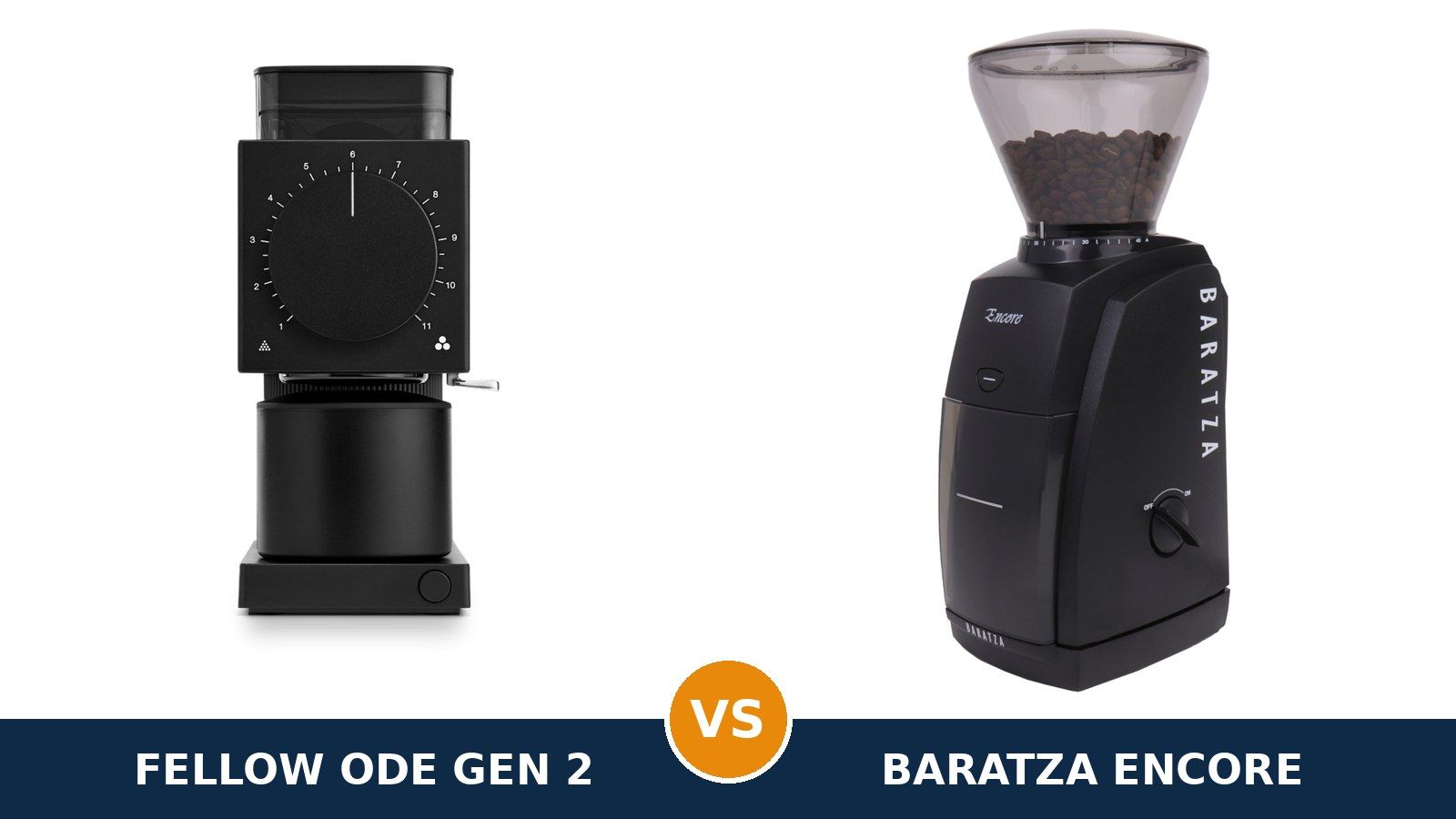
One of these is the grinder the internet recommends by default. The other is the grinder the filter-coffee hobby converged on. They overlap in your search results, and they should not overlap on your counter.
Names first, because both halves attract impostors. The “Ode 2” is Fellow’s Ode Brew Grinder Gen 2, second generation of its brew-only flat-burr grinder. The “Encore” here is the standard Baratza Encore, model ZCG485 — not the Encore ESP (ZCG495) and not the Encore ESP Pro (ZCG595), which are different, espresso-focused machines, walled off throughout this guide.
With that settled, the split is philosophical. The Ode Gen 2 is a single-dose specialist: 64 mm flat burrs, a stepped dial, and a grind range that stops before espresso — deliberately. The Encore is a hopper-fed all-rounder: 40 mm conical burrs, 40 settings across a published 250–1200 micron range, beans living in the hopper ready to grind. Every specification below comes from the manufacturers’ own published data — Fellow’s product pages, and Baratza’s official Encore product sheet and manuals.
Key Takeaways
- The Ode Gen 2 is the better brewed-coffee instrument. Bigger, purpose-built flat burrs, an ionizer and knocker, and an aluminium body — it wins this comparison on grind hardware.
- The Encore is the better daily appliance. A 227 g hopper, a switch, and no scale required; it is built for households that grind by the pot, not by the dose.
- Neither is an espresso grinder. Fellow excludes espresso outright; the Encore reaches the fine end on paper, but its steps are too wide for unpressurised baskets — that is the Encore ESP’s job.
- Adjustment differs in spread, not just count. The Ode’s 31 steps are concentrated in the brew range; the Encore’s 40 steps are spread across the full 250–1200 microns.
- Ownership terms split. Fellow gives two years of warranty; Baratza gives one — and counters with a spare-parts and repair ecosystem nobody else in the class matches.
Quick Verdict
Buy the Fellow Ode Gen 2 for the better cup of brewed coffee. It is the stronger grinder in this pairing.
Its 64 mm flat burrs are café-sized and purpose-built for filter clarity, its ionizer and knocker keep the single-dose workflow clean, and its dial is spread exactly where brewed coffee lives. If you weigh your beans and brew by recipe, this is the machine.
Buy the Baratza Encore if your kitchen runs on routine. Beans in the hopper, switch on, pot ground — no scale, no ritual. It is also the pick for pressurised-basket espresso and moka pots, the tighter counter depth, and buyers who want to still be ordering spare parts a decade from now.
The Scorecard
Scores below are derived directly from the manufacturer specifications compared in this guide. They are a reading aid, not benchmark results. Neither manufacturer publishes a decibel figure for these grinders, so the noise row is scored on published noise engineering only.
| Category | Fellow Ode Gen 2 | Baratza Encore | ||
|---|---|---|---|---|
| Burr set | 9 / 10 | 7.5 / 10 | ||
| Adjustment & espresso resolution | 5 / 10 | 6 / 10 | ||
| Motor & published output | 7.5 / 10 | 6.5 / 10 | ||
| Retention & static control | 8.5 / 10 | 6 / 10 | ||
| Noise (published features) | 8.5 / 10 | 7 / 10 | ||
| Brew-method range | 7 / 10 | 7.5 / 10 | ||
| Build, footprint & capacity | 8.5 / 10 | 7.5 / 10 | ||
| Overall | 7.7 / 10 | 6.9 / 10 | ||
The pattern is the comparison in miniature: the Ode wins the hardware rows — burrs, retention, build — while the Encore’s points come from range and capacity, the rows describing a household routine rather than a brewing ritual.
At a Glance: Who Each Grinder Fits
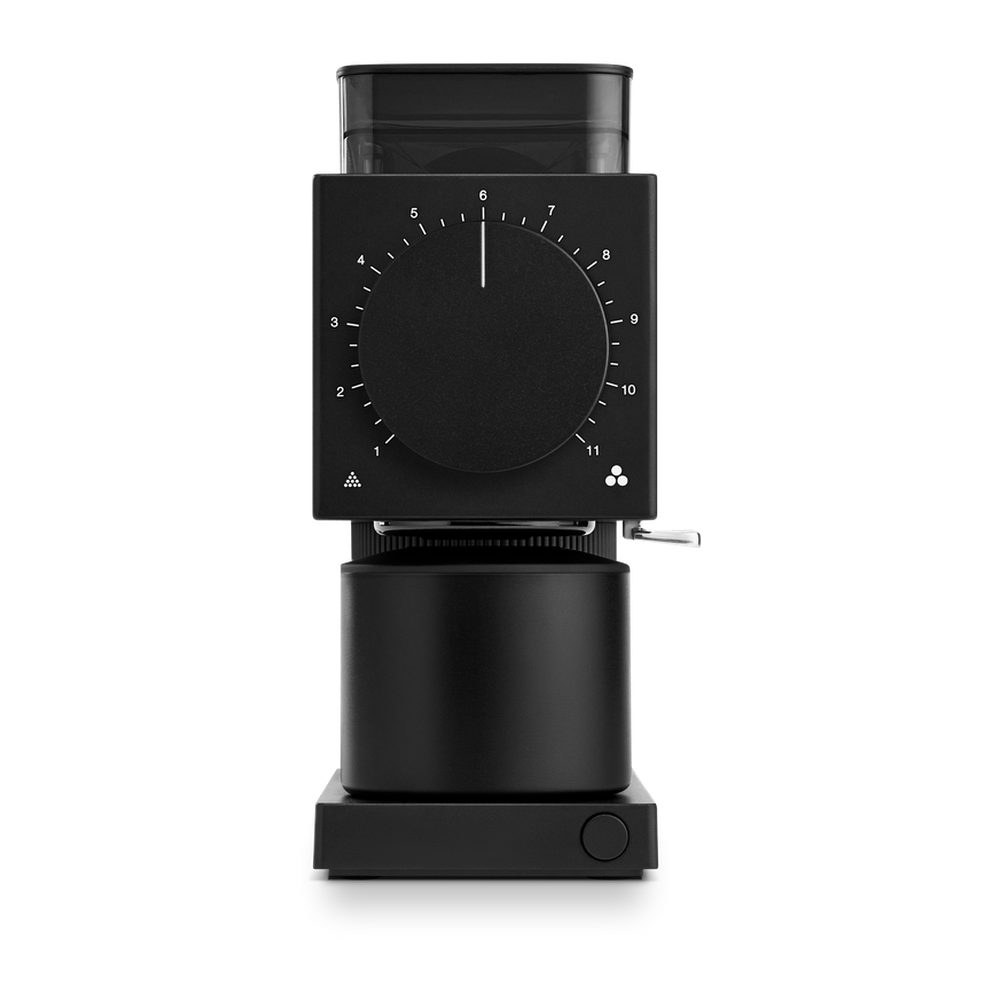
Fellow Ode Gen 2
- 64 mm flat Gen 2 Brew Burrs in uncoated stainless steel, with two-stage grinding geometry
- 31 stepped grind settings on a front dial — 11 numbered settings with a printed grind guide
- Brewed coffee only: AeroPress, pour-over, drip, French press and cold brew — no espresso
- 100 g single-dose load bin and a 100 g magnetically aligned catch cup
- Aluminium body, 4.6 kg, with anti-static ionizer, grinds knocker and automatic stop
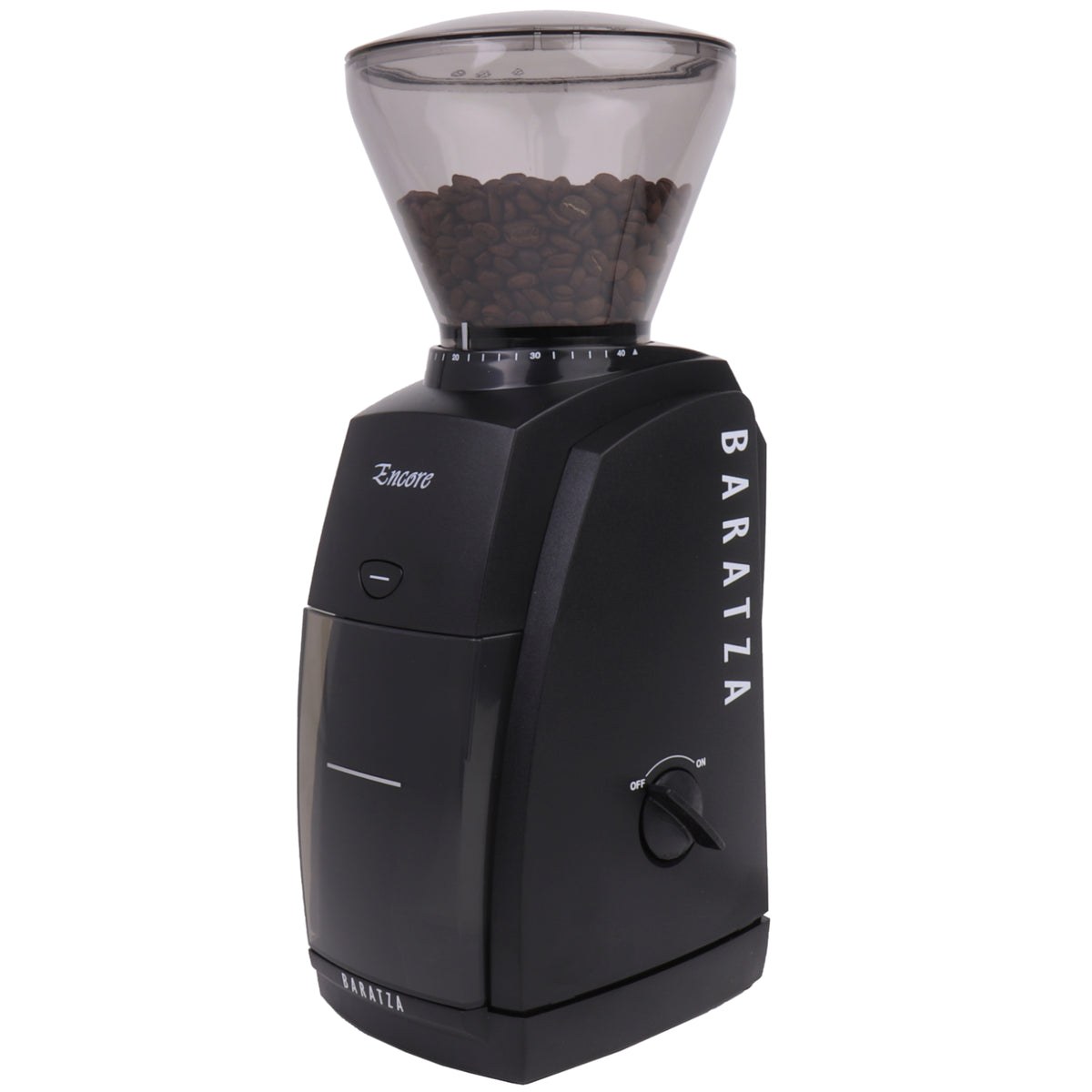
Baratza Encore
- 40 mm conical burrs (M3) in hardened steel, manufactured by Etzinger in Liechtenstein
- 40 stepped settings — twist the hopper; Baratza publishes a 250–1200 micron grind range
- Hopper-fed workflow: 227 g bean hopper, 142 g grounds bin, side switch and front pulse button
- DC motor with speed control holding the burrs at 450 RPM; 0.8–1.1 g/sec published grind speed
- Plastic housing over a steel frame, 3.1 kg; 1-year US warranty behind a full spare-parts catalogue
Choose the Fellow Ode Gen 2 if…
Brewed coffee is your hobby, not just your caffeine. Pour-over, drip, AeroPress, French press, cold brew — the Ode’s burrs and dial were designed for exactly this list.
You weigh every dose. The single-dose format, ionizer and knocker are a workflow built around a scale and a rotation of beans — and you want the appliance to feel like equipment: aluminium body, real weight, the quieter engineering of the two.
Choose the Baratza Encore if…
Your household grinds by the pot. The hopper holds the beans, the switch starts the grind, and nobody touches a scale at 7 a.m.
Your espresso comes from a pressurised basket or a moka pot. The Encore’s fine end serves those honestly, where the Ode cannot follow at all.
You keep appliances for a decade. Baratza sells burrs, motors, gearboxes and hoppers as spare parts and publishes the repair guides — longevity is its home ground.
As an Amazon Associate I earn from qualifying purchases at no extra cost to you.
Specifications: The Specs That Actually Matter
Every figure below is from the manufacturers’ own published data: Fellow’s Ode Gen 2 product page, and Baratza’s official Encore product sheet for the ZCG485.
| Specification | Fellow Ode Brew Grinder Gen 2 | Baratza Encore (ZCG485) |
|---|---|---|
| Model identity | Ode Brew Grinder Gen 2 (listing model “Ode Gen 2”) | Encore, model ZCG485 (Black: ZCG485BLK) — not the Encore ESP or ESP Pro |
| Burr set | 64 mm flat, uncoated stainless steel — Gen 2 Brew Burrs with two-stage grinding geometry | 40 mm conical (M3), hardened steel, manufactured by Etzinger in Liechtenstein |
| Adjustment system | Stepped front dial: 11 numbered settings, 31 steps in total, printed grind guide | Stepped: twist the bean hopper through 40 settings |
| Grind range | Brewed coffee only, from roughly 250–300 microns upward (Fellow dealer data) | 250–1200 microns, published by Baratza |
| Espresso | Not suitable — Fellow states the burrs and motor are geared to drip and immersion brewing | Reaches the fine end on paper; realistically pressurised baskets and moka pots — the steps are too wide to dial in unpressurised espresso |
| Motor | 140 W, 1.3 A (US version); Smart Speed PID motor holding a steady 1,400 RPM burr speed | 70 W, 0.8 A (US version); DC motor with speed control holding the burrs at 450 RPM, thermal overload cut-off |
| Published grind output | No output rate published; built around 100 g batches | 0.8–1.1 g/sec (Baratza product sheet) |
| Dosing format | Single-dose: 100 g load bin, weigh in per brew | Hopper-fed: beans stored in the hopper, grind on demand; single-dosing possible, not the design brief |
| Capacity | 100 g load bin; one 100 g magnetically aligned catch cup | 227 g (8 oz) bean hopper; 142 g (5 oz) grounds bin |
| Retention & static handling | Anti-static ionizer, built-in grinds knocker, magnetically aligned cup | Grind path designed to minimise grounds left in the grinder (Baratza); no ionizer or anti-static system |
| Controls | Front dial and power button; automatic stop when the grind finishes | Side on/off switch and front pulse button; no timer, no automatic stop |
| Noise engineering | Engineered to reduce grind noise (Fellow); no decibel figure published | Slow 450 RPM burr speed and Gearbox 2.0 designed to reduce noise, heat and static (Baratza); no decibel figure published |
| Dimensions (L × W × H) | 239 × 105 × 248.3 mm (9.4 × 4.2 × 9.8 in) | 160 × 120 × 350 mm (6.3 × 4.7 × 13.8 in) — the smaller footprint, the taller body |
| Weight | 4.6 kg / 10.14 lb | 3.1 kg / 7 lb |
| Materials | Aluminium body; plastic load bin and base; stainless steel burrs | Plastic housing over a steel frame; smoked plastic hopper and grounds bin |
| Cord length | 1 m | Not stated in Baratza’s US product sheet data |
| Warranty | 2-year warranty, extendable on registration | 1-year manufacturer’s warranty (US) |
The name note: both grinders in this comparison sit next to same-named traps, so here it is on the record. “Ode 2” is the Ode Brew Grinder Gen 2; the original Ode (Gen 1) is an older machine with coarser burrs, an 80 g catch cup and no ionizer. “Encore” is a three-model family: this guide’s standard Encore (ZCG485) has 40 evenly spread settings and the M3 burr set. The Encore ESP (ZCG495) fits the M2 burr set and rebuilds the first twenty settings as an espresso micro-range; the Encore ESP Pro (ZCG595) adds stepless adjustment and a timer. An ESP bought at a standard Encore’s job — or a standard Encore bought at an ESP price — is the classic mistake in this corner of the market.
The hopper note: Baratza’s own Encore product sheet lists the bean hopper at 225 g in one printing and 8 oz (227 g) in its brochure; we print 227 g. Some retail tables — including the comparison chart on the Encore’s own Amazon listing — print 300 g and 1.3–2.2 g/sec for this grinder; those are the Encore ESP’s figures, recycled into the wrong column. The sheet figures — 227 g, 142 g bin, 0.8–1.1 g/sec — are the numbers used throughout this guide.
The dimensions note: Fellow’s Gen 2 specification block lists the Ode at 239 × 105 × 248.3 mm and 4.6 kg, and Amazon’s listing data (9.78 in tall) agrees. Some dealer tables still print 242 mm and 4.5 kg — the original Ode’s figures. We print the Gen 2 numbers.
The grind-range note: the micron figures come from different kinds of source, and we label them as such. Baratza publishes the Encore’s 250–1200 micron range itself. Fellow publishes no micron range for the Ode; its roughly 250–300 micron floor comes from Fellow data via authorised dealers.
The Differences That Actually Matter
1. Two name traps — three Encores and two Odes
Start here, because this pairing collects naming mistakes from both directions. Baratza sells three grinders called Encore, and the standard model in this guide is the only one without espresso hardware; Fellow sells two generations of Ode that look near-identical in photographs. The checks are in the buying guide below: model codes (ZCG485, not ZCG495 or ZCG595) on the Baratza side, Gen 2 burrs, ionizer and 100 g capacity on the Fellow side.
2. Burr sets — café-sized flats against a proven 40 mm conical
The Ode’s 64 mm flat burrs are the largest hardware here, and the most specialised. Fellow’s Gen 2 Brew Burrs use a two-stage grinding geometry — beans broken down, then finished — aimed at consistency and clarity in brewed coffee. It is a café burr format shrunk into a home footprint, and it is the main reason filter drinkers choose this machine.
The Encore’s 40 mm conical set (the M3, made by Etzinger in Liechtenstein) is the opposite kind of credential: one of the longest-serving burr sets in home coffee, hardened steel Baratza rates to stay sharp for years. Conicals forgive; flats reveal. For brewed coffee alone, the Ode’s burr set is the better instrument; the Encore’s is the better-known quantity.
3. Adjustment — 31 steps where brewing lives, against 40 steps across everything
Both grinders click. What differs is where the clicks are spent. The Ode’s 31 steps are spread across the brewed-coffee range only — pour-over to French press — so each click moves the grind a small, recipe-useful amount. The Encore’s 40 steps cover the full published 250–1200 microns: genuine coarse and fine ends the Ode never reaches, at the cost of wider spacing everywhere, including the brew range.
And the fine end needs honesty. The Encore’s range touches espresso fineness, and pressurised baskets and moka pots will be happy there. But dialling in an unpressurised basket means landing between wide steps — Baratza built the Encore ESP precisely because this spread is the wrong tool for that job. Neither grinder here is an espresso grinder; one says so, and the other’s maker sells the model that is.
4. Workflow — a weighed ritual against a hopper-fed routine
This is the difference you will feel every morning, long after the burr debate fades. The Ode is a single-dose machine: weigh the beans, tip them in, grind, knock the last grounds loose, done. Beans live in a canister, the grinder starts empty, and swapping beans costs nothing.
The Encore is hopper-fed: the beans live in the 227 g hopper, and coffee is a switch, not a ceremony. For a household grinding the same beans into the same drip machine daily, that is not a compromise — it is the correct design. Its costs show up when you rotate beans (the hopper argues back) or weigh doses (you are working against the format, and Baratza sells a single-dose hopper accessory for exactly that owner). Neither workflow is the premium version of the other; they are answers to different mornings.
5. Motor and output — a PID-held 1,400 RPM against a slowed 450 RPM
The paper gap runs one way: 140 W for the Ode against 70 W for the Encore. But the two motors are tuned for opposite ends of the speed argument.
The Ode’s Smart Speed PID motor holds its burrs at a steady 1,400 RPM under load. Fellow publishes no output rate; the story is consistency at speed, batch after 100 g batch.
The Encore’s DC motor is geared and electronically slowed to 450 RPM — Baratza’s published reasoning is less heat, less noise and less static, with a smoother bean feed. The cost is pace: the sheet rates it at 0.8–1.1 g/sec, the one hard output figure in this comparison, and a family-sized drip batch takes its time. A thermal cut-off protects the motor if a jam ever reaches the burrs.
6. Retention and static — engineered cleanliness against designed simplicity
The Ode fights static and retention with hardware: an anti-static ionizer at the chute, a magnetically aligned catch cup, and a built-in knocker you flick to shake the last grounds free — Fellow’s thorough second-generation answer to the original Ode’s mess.
The Encore fights with geometry instead: Baratza’s sheet states the grind path is built to minimise the ground coffee left inside the grinder — no ionizer, no knocker, no anti-static system to name. In practice, a simpler, mostly tidy grind with the plastic bin’s static cling as the tax. Call it on design intent: the Ode’s system is the more complete, and it matters most to the single-dose workflow it serves; hopper-fed grinding forgives a gram of exchange in a way single-dosing never does.
7. Build, footprint and the decade view
The Ode is the substantial object: aluminium body, 4.6 kg, narrower at 105 mm wide — but 239 mm deep and just 248 mm tall, the easier fit under low cabinets. The Encore is taller (350 mm) on a smaller footprint (120 × 160 mm), lighter at 3.1 kg, plastic over a steel frame. On the counter, the Fellow feels like equipment and the Baratza like an appliance; both impressions are accurate.
The warranty row favours Fellow plainly: two years, extendable on registration, against Baratza’s one year. The decade row favours Baratza just as plainly: parts diagrams and repair guides published, burrs, motors, gearboxes, switches and hoppers sold individually, and a burr mount calibrated for user adjustment. Grinders in this class rarely die all at once — they wear a part at a time, and only one of these makers has built its business around that fact.
Brew-Method Fit Guide
The fastest way to choose is to start from what you actually brew — and how. This table is the whole comparison in one view.
| Your brewing | Fellow Ode Gen 2 | Baratza Encore | Our call |
|---|---|---|---|
| Espresso, unpressurised baskets | Cannot — Fellow excludes espresso outright | Reaches the fineness, but the steps are too wide to dial in | Neither — see When to Skip Both |
| Espresso, pressurised baskets, and moka pots | Cannot | Good — the fine end serves these honestly | Baratza Encore |
| Pour-over | Excellent — the burr set’s home ground | Good — consistent, with wider steps in the brew range | Fellow Ode Gen 2 |
| Drip and batch brewing | Excellent — 100 g in one weighed load | Excellent — hopper-fed, no weighing, slower grind | Dead tie — workflow decides |
| AeroPress | Excellent | Excellent | Dead tie |
| French press and cold brew | Excellent | Excellent — the published range runs to 1200 microns | Dead tie |
| Single-dosing and rotating beans | Excellent — ionizer, knocker, starts empty | Workable — weigh in per dose, but the hopper format argues back | Fellow Ode Gen 2 |
| A mixed household — drip daily, moka at weekends | Half the menu is missing | Excellent — one hopper covers both | Baratza Encore |
Read the first and fourth rows together — they are the decision. Brewed and weighed: the Ode. Routine and hopper-fed: the Encore.
Ready to check today’s price?
Both grinders sell through Amazon. Prices move, so check the live figure on the grinder that fits how you brew.
View on Amazon — Fellow Ode Gen 2View on Amazon — Baratza EncoreThe 30-Second Decision
| If this sounds like you… | Buy this |
|---|---|
| “Brewed coffee is my hobby and I weigh every dose.” | Fellow Ode Gen 2 — the specialist’s burrs win |
| “Beans live in the hopper and the drip machine runs every morning.” | Baratza Encore — no scale, no ritual |
| “My espresso machine has a pressurised basket; I also brew drip.” | Baratza Encore — the only one that covers both |
| “Unpressurised espresso is the plan.” | Neither — that is the Encore ESP’s job, not these two |
| “I rotate three bags of beans a week.” | Fellow Ode Gen 2 (single-dose by design) |
| “My counter is shallow but the cabinets are high.” | Baratza Encore (160 mm deep) |
| “My cabinets are low and the gap is narrow.” | Fellow Ode Gen 2 (105 mm wide, 248 mm tall) |
| “I want to still be buying parts for it in ten years.” | Baratza Encore (full spare-parts catalogue) |
What You Gain. What You Give Up.
Fellow Ode Gen 2
You gain: the better brewed-coffee instrument — café-sized 64 mm flat burrs designed solely for filter clarity, an ionizer and knocker keeping the weighed-dose workflow clean, an aluminium body with real heft, and a two-year warranty.
You give up: espresso, entirely and permanently — and the hopper. Every dose is weighed, and the deeper footprint takes more counter than its width suggests.
Baratza Encore
You gain: the simplest routine in home grinding — beans in the hopper, one switch, a full pot ground — plus the widest published range of the two, the smaller footprint, and a spare-parts ecosystem that treats wear as maintenance, not replacement.
You give up: the last word in filter clarity — a 40 mm all-purpose conical does not match a purpose-built 64 mm flat burr at pour-over — plus fine step spacing, anti-static hardware, and a year of warranty cover.
Pros and Cons
Fellow Ode Gen 2 — Pros
- 64 mm flat burrs purpose-built for brewed coffee
- 31 stepped settings concentrated in the brew range — dial in once, return exactly
- Aluminium body; the more substantial build of the two
- Ionizer, knocker and auto-stop; engineered for reduced grind noise
- Two-year warranty, extendable on registration
Cons
- No espresso capability — Fellow excludes it with every burr set
- Single-dose only; no hopper-fed routine
- The deeper footprint of the two (239 mm)
- The factory SSP version is a filter-clarity upgrade, not an espresso path
Baratza Encore — Pros
- Hopper-fed simplicity: 227 g of beans ready, one switch, no scale
- 40 settings across a manufacturer-published 250–1200 micron range
- Etzinger-made 40 mm conical burrs with a long service record
- The smaller counter footprint of the two
- Full spare-parts catalogue, published repair guides, user-calibratable burr mount
Cons
- Wide step spacing — no dialling in unpressurised espresso
- Slow by design: 0.8–1.1 g/sec at 450 RPM
- No ionizer or anti-static system; the plastic bin clings
- One-year warranty, the shorter term here
Check the Model Code, the Generation and the Box
Check it is the standard Encore, not the ESP. The three Encores share a silhouette and a shelf. The standard Encore is model ZCG485; the ESP is ZCG495, the ESP Pro ZCG595. The standard model’s burrs are the M3 set and its 40 settings evenly spread; the ESP rebuilds its first twenty settings into an espresso micro-range and fits the M2 set. If a listing promises a micro-range or a dosing cup, it is not this grinder.
Ignore recycled specification tables. As the hopper note above flags, some retail tables print the ESP’s 300 g hopper and 1.3–2.2 g/sec against this grinder’s name. Baratza’s Encore product sheet governs: 227 g, 142 g, 0.8–1.1 g/sec.
Check it is the Ode Gen 2, not the Gen 1. The original Ode’s burrs stop far coarser, its catch cup holds 80 g rather than 100 g, and it has no ionizer. Gen 2 listings should name the Gen 2 Brew Burrs and the 100 g capacity. The generations look alike in photographs; the specification block holds the truth.
Check which Ode you are pricing. Fellow sells the Gen 2 in two factory configurations: standard Gen 2 Brew Burrs, and a version pre-fitted with SSP MP Red Speed burrs for maximum filter clarity. This guide compares the standard configuration; the SSP version grinds the same range and is not an espresso conversion.
Check the colour and the box. The Encore sells in Black (ZCG485BLK, the listing linked here) and White, with identical hardware. The box should hold the grinder, hopper and lid, and grounds bin. Baratza’s hopper extender, single-dose hopper and Portaholder are separate accessories — a listing bundling them is a bundle, not the standard package.
Check the voltage. Both grinders are built in regional versions, and the ratings in this guide are the US builds (Ode 140 W/1.3 A; Encore 70 W/0.8 A). Buy the version made for your sockets; the warranty follows the territory.
The Upgrade Path Test
A grinder earns its money in year two, not week one.
The Ode’s upgrade story is about burrs. Its 64 mm flat format is a standard size with a real aftermarket, and Fellow itself sells the SSP configuration — a Gen 2 bought today can grow into the high-clarity version of itself. What it can never grow into is an espresso grinder; that ceiling is structural.
The Encore’s story is about the machine itself. Burrs wear: replacements are a catalogue part, the burr set lifts out without tools, and the mount is user-calibratable. Baratza also sells the finer M2 burr set from the ESP and Virtuoso+ separately, and it fits the Encore as an upgrade. Beyond parts, the honest step-up is the range itself — the Encore ESP for espresso, the Virtuoso+ for a timer. Buy the ceiling you can live with.
When to Skip Both
Honesty cuts both ways — some coffee drinkers should buy neither of these.
Skip both if espresso is the serious hobby. Unpressurised baskets reward fine, dedicated micro-adjustment, and neither grinder offers it — that gap is exactly why the Encore ESP and Fellow’s own Opus line exist.
Skip both if you want dosing by weight built in — the Ode expects you to weigh the dose, the Encore expects you not to, and neither weighs anything itself. Skip both, too, for café, office or event duty: both are household appliances with household duty cycles.
And skip the Ode if an espresso machine is honestly in your future, and skip the Encore if rotating single-origin beans by the weighed dose is your idea of the hobby. Each grinder’s strength is the other’s blind spot.
Warranty and Long-Term Support
The paper terms favour Fellow: two years for the Ode, extendable on registration, against the Encore’s one-year US warranty.
The long view complicates it. Baratza’s support model is the strongest in this class: published parts diagrams and repair guides, burrs, motors, gearboxes, switches and hoppers sold individually, a burr mount its owner can recalibrate. Fellow’s is a conventional premium-appliance operation — published manuals and gear guides. One caution applies to both: warranties are honoured by territory and voltage version, so buy the build made for your country.
Final Verdict
The Fellow Ode Gen 2 is the grinder we would put on a brewer’s counter.
It wins because the burr set is the thing you cannot retrofit. Café-sized flat burrs built for nothing but brewed coffee, a dial spread exactly across the brew range, and anti-static hardware that keeps the weighed-dose routine clean — inside the brief both grinders claim, it is the better machine by a clear margin.
Buy the Fellow Ode Gen 2 if you weigh your beans, rotate your bags, and brew by recipe — it rewards exactly that drinker.
View on Amazon — Fellow Ode Gen 2
Buy the Baratza Encore if your kitchen runs on routine: beans in the hopper, a pot ground before the kettle boils, a moka pot at the weekend, and a grinder you can still buy a gearbox for in ten years’ time.
It loses on grind hardware, not on judgement. In a hopper-fed household, the order of this page would read the other way round.
View on Amazon — Baratza Encore
Frequently Asked Questions
Is the Baratza Encore the same grinder as the Encore ESP or ESP Pro?
No — three different grinders sharing a silhouette and a name. The standard Encore (ZCG485, this guide) has 40 evenly spread settings and the M3 burr set. The Encore ESP (ZCG495) fits the M2 set, rebuilds settings 1–20 as an espresso micro-range, and adds a dosing cup. The ESP Pro (ZCG595) adds stepless adjustment, a timer and single-dose mode. Check the model code; listings blur them constantly.
Can the Baratza Encore grind for espresso?
With qualifications. Baratza publishes a 250–1200 micron range, so the fine end reaches espresso fineness, and pressurised baskets and moka pots work well there. But the 40 steps are spread across the whole range, which leaves them too wide to dial in an unpressurised basket — one click overshoots, the next undershoots. That is precisely the problem the Encore ESP was built to solve.
Can the Fellow Ode Gen 2 grind for espresso?
No. Fellow states it directly: the 64 mm flat burrs and motor are geared towards drip and immersion brewing, and the grinder is not suitable for espresso. The burrs floor out around 250–300 microns, and the factory SSP version is a clarity upgrade for brewed coffee, not an espresso conversion.
Which grinder is better for pour-over?
The Ode Gen 2. Pour-over is its home ground: 64 mm flat burrs with two-stage geometry built for brewed-coffee clarity, and 31 stepped settings concentrated in the brew range, so each click moves the grind less where pour-over recipes live. The Encore makes consistent pour-over; its steps are simply spread wider.
Which suits a household that grinds a drip pot every morning?
For most such households, the Encore: the hopper holds 227 g of beans ready, the bin takes 142 g, and the routine is a single switch — no scale, no weighing. The Ode suits the same household only if someone enjoys weighing a 100 g batch, which it does swallow in one load.
Can you single-dose the Baratza Encore?
Yes, informally — weigh the dose, tip it into the empty hopper, and grind it through; many owners do exactly that, and Baratza sells a single-dose hopper accessory that formalises it. But it is a workaround, not the design: there is no ionizer or knocker managing retention and static, and the hopper format is always pulling you back towards keeping beans in it.
How do the warranties and repairability compare?
Fellow gives the Ode two years, extendable on registration. Baratza gives the Encore one year in the US — then offsets it with the strongest parts story in the class: burrs, motors, gearboxes, switches and hoppers sold individually, published repair guides, tool-free burr removal, a user-calibratable mount. Shorter cover, longer life support.
Sources & Verification
Fellow Ode Brew Grinder Gen 2 official product page (fellowproducts.com) — Gen 2 Brew Burrs, anti-static technology, knocker, auto stop, espresso exclusion, 2-year warranty • Baratza Encore official product sheet (baratza.com, v4) — ZCG485 specifications: 40 mm conical burrs, 0.8–1.1 g/sec, 225–227 g hopper, 142 g grounds bin, 3.1 kg, 12 × 35 × 16 cm, 100–120V 70 W power rating, Etzinger burr manufacturing • Baratza Encore published feature documentation — speed control holding the burrs at 450 RPM, Gearbox 2.0, grounds-retention design, burr calibration system • Baratza model-range documentation distinguishing the Encore (ZCG485) from the Encore ESP (ZCG495) and Encore ESP Pro (ZCG595) • Fellow specification data via authorised dealers (Whole Latte Love, Prima Coffee) for the Ode’s burr floor • Amazon listing data for both models, used for ASIN verification only. Specifications verified November 2026.

James Wilson
James has been testing coffee gear and small kitchen appliances for over a decade and writes Honestly Compared's coffee and grinder guides. His rule for every comparison: the verdict has to survive the spec sheet, not the marketing page.