
Fellow Ode Gen 2 vs Fellow Opus 2: Which Should You Buy?
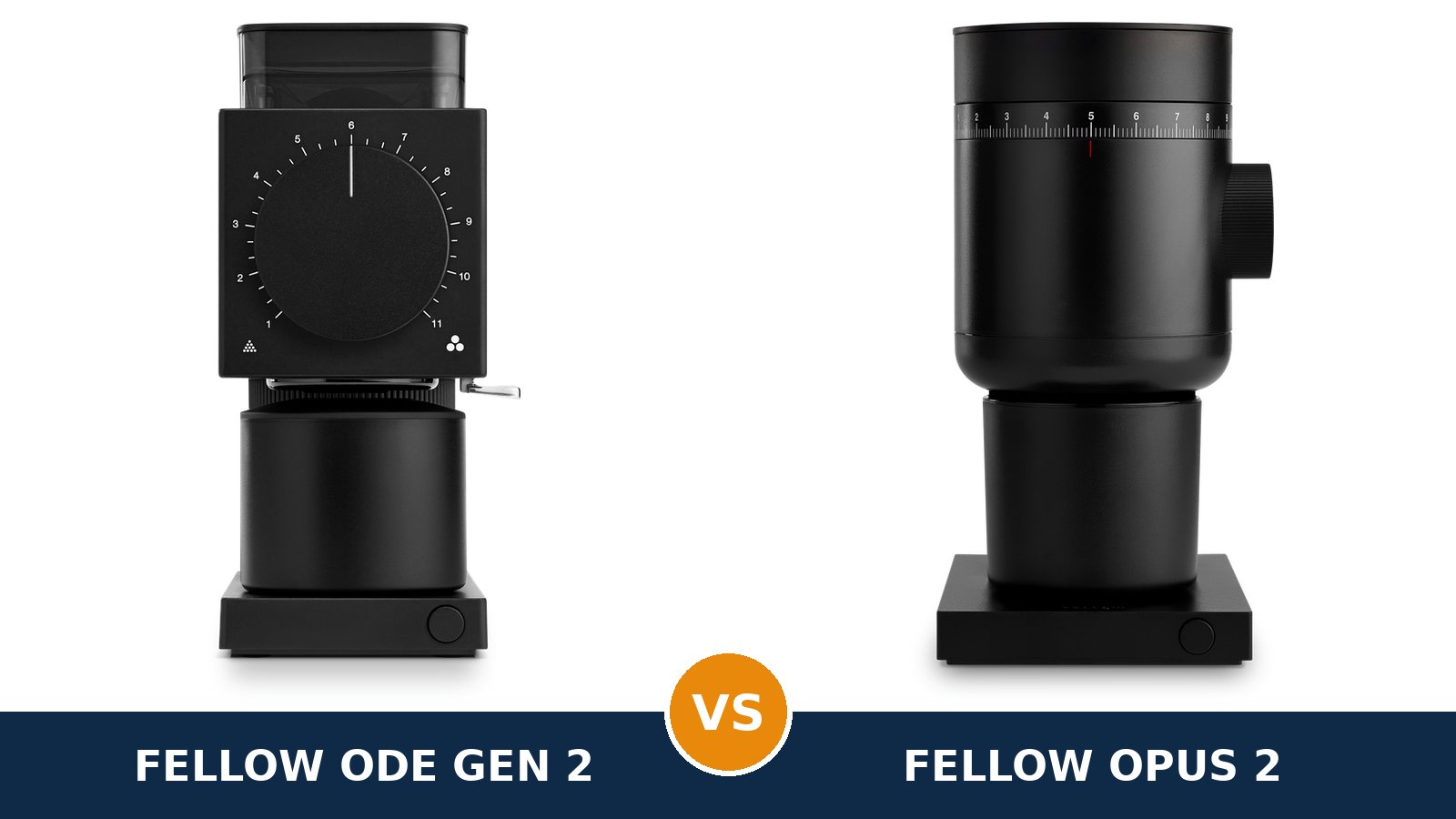
Two grinders from the same design studio, sold under two confusingly similar names — and built for two different drinks.
First, the names, because the search terms that brought you here need pinning down. The “Ode 2” is Fellow’s Ode Brew Grinder Gen 2 — Fellow’s own store uses “Ode 2” as shorthand for it. The “Opus 2” is a literal product name: the Opus 2 Conical Burr Grinder, the second-generation all-rounder Fellow released in 2026 to replace the original Opus.
With that settled, the comparison is unusually clean. The Ode Gen 2 is a specialist: 64 mm flat burrs, a stepped dial, and a grind range that stops before espresso — deliberately. The Opus 2 is the generalist: 48 mm conical burrs, a stepless dial, and a range that starts at espresso and runs to cold brew.
Neither is a cut-down version of the other — they share a badge, a single-dose format and a two-year warranty, and almost nothing else. Every specification below comes from Fellow’s own published data: its product pages, its Opus 2 manual, and its dealer specification sheets.
Key Takeaways
- The Opus 2 wins overall. It is the only one that grinds for espresso, it carries the stronger motor, and its stepless dial covers the full brew spectrum in one machine.
- The Ode Gen 2 is the better filter grinder. Its 64 mm flat burrs are purpose-built for brewed coffee, and Fellow is explicit that espresso is off its menu — with any burr set.
- Adjustment is a philosophy split. The Ode clicks through 31 repeatable steps. The Opus 2 turns continuously on a stepless side dial with 48 marked references.
- Both are single-dose machines with 100 g load bins. The Opus 2 adds a 30 g espresso cup for 54 mm and 58 mm portafilters.
- The ownership terms tie. Same two-year Fellow warranty, extendable on registration, behind both.
Quick Verdict
Buy the Fellow Opus 2 for most households. It is the complete grinder in this pairing.
It reaches espresso, which the Ode simply cannot do. Its 300 W motor is more than twice the Ode’s rating, its dial adjusts continuously instead of in clicks, and its upgraded ionizer and impeller path are Fellow’s newest answer to static and retention.
Buy the Fellow Ode Gen 2 if brewed coffee is the whole hobby. Pour-over, drip, French press and cold brew are not its side dishes; they are the entire brief.
Its café-sized flat burrs, aluminium body and batch-friendly 100 g format make it the more serious filter tool. Just be certain espresso stays off your roadmap, because this grinder will not follow you there.
The Scorecard
Scores below are derived directly from the manufacturer specifications compared in this guide. They are a reading aid, not benchmark results. Fellow publishes no decibel figure for either grinder, so the noise row is scored on published noise engineering only.
| Category | Fellow Ode Gen 2 | Fellow Opus 2 | ||
|---|---|---|---|---|
| Burr set | 9 / 10 | 8 / 10 | ||
| Adjustment & espresso resolution | 5 / 10 | 9.5 / 10 | ||
| Motor & published output | 7.5 / 10 | 8.5 / 10 | ||
| Retention & static control | 8.5 / 10 | 9 / 10 | ||
| Noise (published features) | 8.5 / 10 | 6.5 / 10 | ||
| Brew-method range | 7 / 10 | 9.5 / 10 | ||
| Build, footprint & capacity | 8.5 / 10 | 7.5 / 10 | ||
| Overall | 7.7 / 10 | 8.4 / 10 | ||
The pattern is the comparison in miniature: the Ode wins the burr, build and noise rows — the specialist’s rows — while the Opus 2 wins adjustment, range and motor, the rows that decide what you can brew.
At a Glance: Who Each Grinder Fits
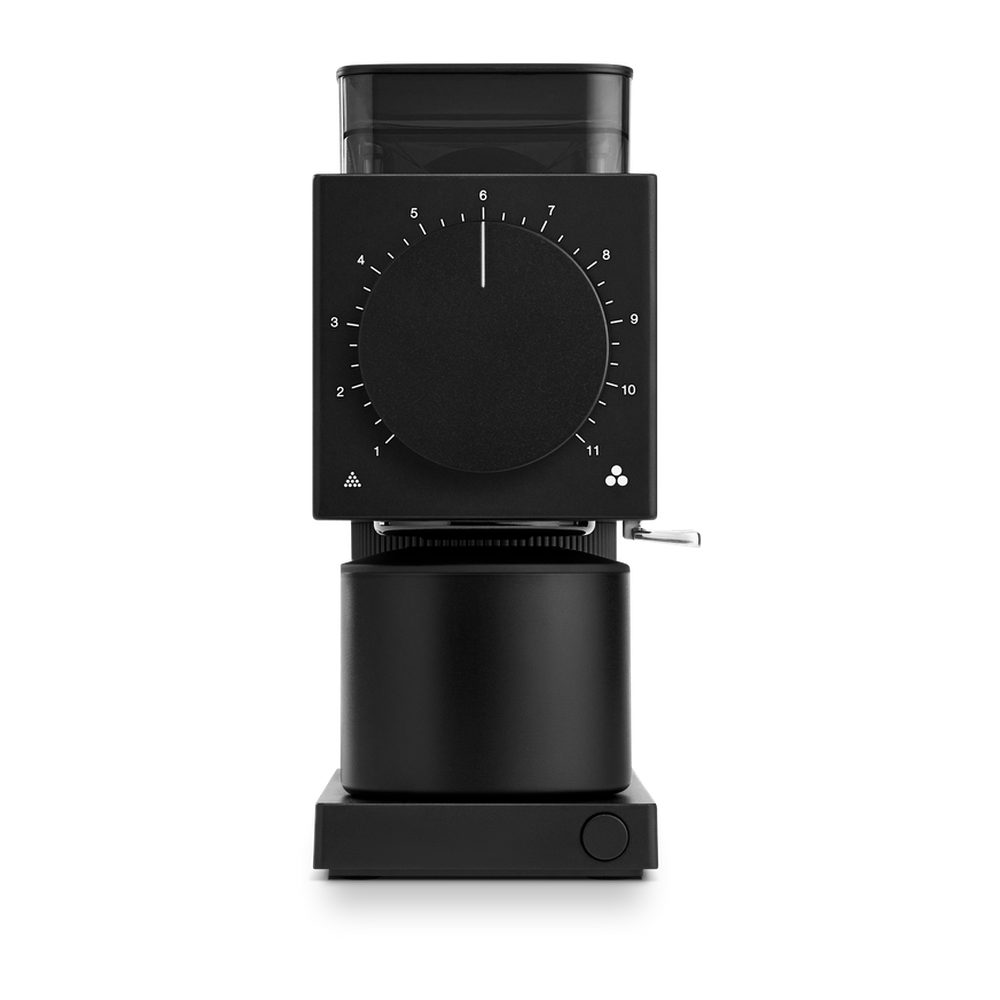
Fellow Ode Gen 2
- 64 mm flat Gen 2 Brew Burrs in uncoated stainless steel, with two-stage grinding geometry
- 31 stepped grind settings on a front dial — 11 numbered settings with a printed grind guide
- Brewed coffee only: AeroPress, pour-over, drip, French press and cold brew — no espresso
- 100 g single-dose load bin and a 100 g magnetically aligned catch cup
- Aluminium body, 4.6 kg, with anti-static ionizer, grinds knocker and automatic stop
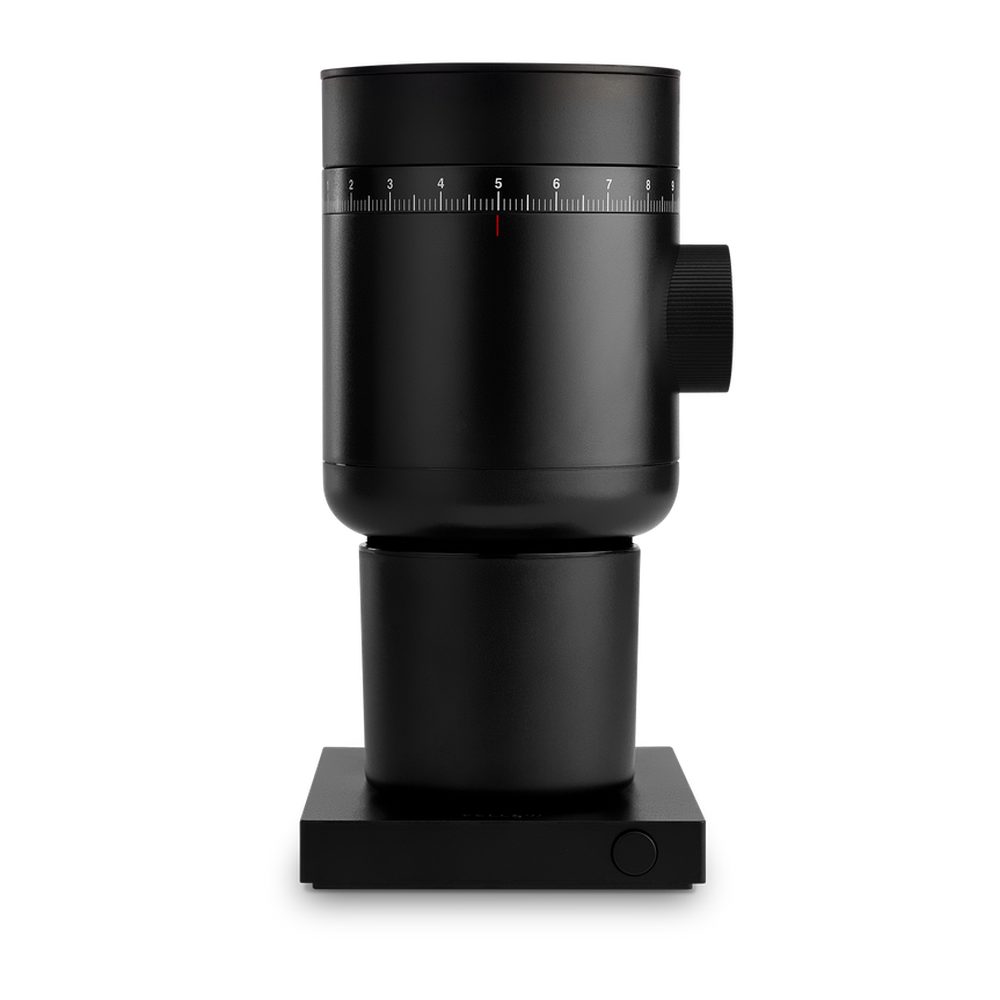
Fellow Opus 2
- 48 mm stainless steel conical burrs — up from the original Opus’s 40 mm set
- Stepless side adjustment dial with 48 marked settings, espresso to cold brew
- 300 W motor; Fellow cites roughly nine seconds for an espresso shot
- Two magnetic catch cups: a 100 g brew cup and a 30 g espresso cup for 54 mm and 58 mm portafilters
- Upgraded ionizer and an impeller grind path designed for near-zero retention
Choose the Fellow Ode Gen 2 if…
Brewed coffee is your whole menu. Pour-over, drip, AeroPress, French press, cold brew — the Ode’s burrs and dial were designed for exactly this list.
You grind batches. The 100 g load bin and catch cup swallow a full pot’s worth of beans in one run, where smaller single-dose machines make you cycle.
You want the appliance to feel like equipment. Aluminium body, real weight, and the quieter engineering of the two.
Choose the Fellow Opus 2 if…
Espresso is in your life, or plausibly in your future. This is the only grinder in the pairing that can follow you there.
One grinder has to serve a mixed household. Cappuccinos in the morning, pour-over in the afternoon, cold brew at the weekend — its range covers all of it.
You change beans and methods constantly. Stepless adjustment and near-zero retention are built for people who never grind the same thing twice.
As an Amazon Associate I earn from qualifying purchases at no extra cost to you.
Specifications: The Specs That Actually Matter
Every figure below is from Fellow’s own published data: the two product pages, the Opus 2 manual, and dealer-carried Fellow specification data, used only where Fellow’s own pages are silent.
| Specification | Fellow Ode Brew Grinder Gen 2 | Fellow Opus 2 Conical Burr Grinder |
|---|---|---|
| Model identity | Ode Brew Grinder Gen 2 (listing model “Ode Gen 2”) | Opus 2, models OP01AANA (standard) and OP02AANA (wooden upgrades) |
| Burr set | 64 mm flat, uncoated stainless steel — Gen 2 Brew Burrs with two-stage grinding geometry | 48 mm conical, stainless steel |
| Adjustment system | Stepped front dial: 11 numbered settings, 31 steps in total, printed grind guide | Stepless side dial with 48 marked reference settings — continuous, no clicks |
| Grind range | Brewed coffee only, from roughly 250–300 microns upward (Fellow dealer data) | Espresso to cold brew; roughly 200–1200 microns (retailer specification sheets) |
| Espresso | Not suitable — Fellow states the burrs and motor are geared to drip and immersion brewing | Designed for espresso; the included cup doses into 54 mm and 58 mm portafilters |
| Motor | 140 W, 1.3 A (US version); Smart Speed PID motor holding a steady 1,400 RPM burr speed | 300 W, 3.0 A (US version, per Fellow’s manual); burr speed not published by Fellow |
| Published grind output | No output rate published; built around 100 g batches | Fellow cites about 9 seconds to grind an espresso shot |
| Load bin | Single-dose, 100 g | Single-dose, 100 g; grind guide printed on the lid |
| Catch cups | One 100 g magnetically aligned catch cup | Two magnetic catch cups: 100 g brewed coffee, 30 g espresso |
| Retention & static handling | Anti-static ionizer, built-in grinds knocker, magnetically aligned cup | Upgraded ionizer and internal impeller — designed for near-zero retention |
| Automatic stop | Yes — stops when the grind finishes | Yes — stops when the load bin empties; a jam stops the grinder with a warning beep |
| Noise engineering | Engineered to reduce grind noise (Fellow); no decibel figure published | No noise figure or noise feature published by Fellow |
| Dimensions (L × W × H) | 239 × 105 × 248.3 mm (9.4 × 4.2 × 9.8 in) | 206 × 130 × 267 mm (8.1 × 5.1 × 10.5 in) |
| Weight | 4.6 kg / 10.14 lb | 2.27 kg / 5.0 lb (Fellow manual) |
| Materials | Aluminium body; plastic load bin and base; stainless steel burrs | No premium-material trim on the standard model (Fellow’s comparison table); wood-accent versions add a wood lid and weighted metal dial |
| Cord length | 1 m | Not stated in Fellow’s US manual data |
| Warranty | 2-year warranty, extendable on registration | 2-year limited warranty, extendable on registration |
The name note: both halves of this comparison needed pinning down, so here it is on the record. “Ode 2” is the Ode Brew Grinder Gen 2 — Fellow’s own Opus 2 page asks “Should I get the Opus 2 or the Ode 2?”, using the shorthand itself. The original Ode (Gen 1) is a different, older machine: coarser burrs, an 80 g catch cup, no ionizer. “Opus 2” is a current, literal model name — it replaced the original Opus (2023), which used 40 mm C6-40 burrs, 41 stepped settings plus an inner micro-adjust ring, and a 140 W motor, and which Fellow no longer sells new. Nothing from either first-generation machine appears in this guide.
The dimensions note: Fellow’s Gen 2 specification block lists the Ode at 239 × 105 × 248.3 mm and 4.6 kg, and Amazon’s listing data (9.78 in tall) agrees. Some dealer tables still print 242 mm and 4.5 kg — the original Ode’s figures. We print the Gen 2 numbers.
The power note: one Fellow dealer’s Opus 2 table prints “120 V, 140 W, 1.3 A” — the Ode’s electrical ratings, pasted into the wrong column. Fellow’s Opus 2 manual rates the machine at 300 W and 3.0 A, and the manual governs.
The grind-range note: Fellow does not publish micron ranges on its product pages. The Ode’s roughly 250–300 micron floor comes from Fellow data via authorised dealers; the Opus 2’s roughly 200–1200 micron span from retailer specification sheets. Both are printed with sources attached.
The Differences That Actually Matter
1. Two second generations — why the names had to be settled first
Start here, because Fellow’s naming invites an expensive mistake. Both grinders are second-generation machines: the Ode added a suffix (Ode Brew Grinder Gen 2, shortened by everyone to “Ode 2”), while the Opus took the number into the product name itself — Opus 2, launched in 2026.
The trap is first-generation stock still floating through listings: an original Ode that grinds coarser and holds 20 g less, an original Opus with smaller 40 mm burrs and a fiddlier two-part adjustment. The buying guide below gives you the checks.
2. Espresso — the dividing line of the whole comparison
One fact organises everything else here: the Ode Gen 2 does not grind for espresso, and Fellow says so plainly. Its product FAQ states that the 64 mm flat burrs and motor are geared towards drip and immersion brewing, and that the grinder is not suitable for espresso.
That is not a settings problem you can hack around. The burrs floor out around 250–300 microns, and the 31 steps are spread across the brewed-coffee range. Even the factory SSP version is a clarity upgrade for filter coffee, not an espresso conversion.
The Opus 2 was designed from the opposite direction. Espresso is the first method on its list, its dial turns steplessly, and the box includes a 30 g espresso cup for 54 mm and 58 mm portafilters. If espresso matters to you at all, this section is the decision; the rest is detail.
3. Burr sets — café-sized flats against a big-for-its-class conical
The Ode’s 64 mm flat burrs are the largest hardware here, and the most specialised. Fellow’s Gen 2 Brew Burrs use a two-stage grinding geometry — beans broken down, then finished — aimed at consistency and clarity in brewed coffee. Café-sized flat burrs in a home footprint: the main reason filter drinkers choose this machine.
The Opus 2’s 48 mm conical set is a different tool for a wider job. It must reach much finer than the Ode ever goes, and 48 mm is substantial for the class — a clear step up from the original’s 40 mm set, and part of why Fellow’s cited espresso grind time fell so sharply.
Judgement: for brewed coffee alone, the Ode’s burr set is the better instrument and it is not close. Across the full spectrum, the Opus 2’s set is the only one that shows up everywhere.
4. Adjustment — 31 clicks you can return to, against a dial with no clicks at all
The Ode adjusts the way stepped grinders always have: a large front dial, 11 numbered settings, 31 steps in total. Find your pour-over setting, note the number, and you can return to it exactly. Repeatability is the design’s whole point.
The Opus 2 removes the steps entirely. Its side dial turns continuously through the full range, with 48 marked settings as reference points rather than stops. For espresso, that is a genuine advantage: the correct setting is never hiding between two clicks. The trade is discipline — a stepless dial rewards keeping notes.
Neither system is a compromise version of the other. The Ode’s dial suits a small rotation of brewed recipes repeated daily; the Opus 2’s suits dialling in espresso and roaming the range.
5. Motor and output — a PID-held 1,400 RPM against twice the wattage
The paper gap is wide: 300 W for the Opus 2 against 140 W for the Ode, per Fellow’s own ratings. But the two motors are aimed at different work.
The Ode’s is a Smart Speed PID design holding the burrs at a steady 1,400 RPM under load. Fellow publishes no output rate for it; its story is the 100 g batch it takes in one load.
The Opus 2’s 300 W drives a smaller burr set much harder at the fine end, where grinding is slowest, and Fellow’s published claim is about nine seconds for an espresso shot. It does not publish the burr speed (retailer sheets say roughly 400 RPM).
One honest limit: the Opus 2’s manual caps its duty cycle — under 45 seconds per cycle, a minute’s rest between cycles, three minutes of grinding in any ten. A single-dose household rhythm, not a café shift.
6. Retention, static and the state of your counter
Both grinders are single-dose designs built around the same promise: what you weigh in is what lands in the cup, with nothing stale carried over. They keep it with overlapping but different hardware.
The Ode Gen 2 added an anti-static ionizer over the original, pairs it with a magnetically aligned catch cup, and gives you a built-in knocker — a lever you flick to shake the last grounds from the chute.
The Opus 2 is Fellow’s newer answer. The ionizer is upgraded, and an internal impeller physically moves grounds through the grind path, which Fellow describes as near-zero retention. Its two cups are magnetic too, shaped for espresso and brewed batches.
Call it on design intent: the Opus 2’s system is the more thorough of the two. The Ode’s knocker remains the more satisfying manual override.
7. Build, size and what sits on your counter
The Ode is the substantial object here: an aluminium body, 4.6 kg on the counter, and a narrow 105 mm width that fits narrow gaps. It is also the deeper machine, and at 248 mm tall the shorter of the two — worth knowing under low cabinets.
The Opus 2 is lighter in every sense: 2.27 kg, 130 mm wide, 206 mm deep, a taller 267 mm stance. Fellow’s own comparison table is blunt about the standard model’s materials — the premium-materials box is ticked only for the wood-accent versions, which add a real wood lid and a weighted metal dial. The hardware is identical across the range; you are paying for touch, not output.
Capacity is a tie despite the size difference: both load bins hold 100 g, and both stop automatically.
Brew-Method Fit Guide
The fastest way to choose between these grinders is to start from what you actually brew. This table is the whole comparison in one view.
| Your brewing | Fellow Ode Gen 2 | Fellow Opus 2 | Our call |
|---|---|---|---|
| Espresso, unpressurised baskets | Cannot — Fellow excludes espresso outright | Excellent — stepless dial, espresso cup included | Fellow Opus 2 |
| Espresso, pressurised baskets | Cannot | Excellent | Fellow Opus 2 |
| Pour-over | Excellent — the burr set’s home ground | Good — conical all-rounder covers it | Fellow Ode Gen 2 |
| Drip and batch brewing | Excellent — 100 g bin and cup, batch rhythm | Good — 100 g bin, but a single-dose duty cycle | Fellow Ode Gen 2 |
| AeroPress and moka pot | Excellent | Excellent | Dead tie |
| French press and cold brew | Excellent | Excellent | Dead tie |
| A mixed household — espresso and filter | Half the menu is missing | Excellent — one grinder covers everything | Fellow Opus 2 |
| Single-dosing and rotating beans | Excellent — knocker and ionizer | Excellent — impeller path and ionizer | Dead tie |
Read the first and third rows together — they are the decision. If espresso appears anywhere in your kitchen’s present or future, the Opus 2 is the only candidate. If it never will, the Ode’s specialisation becomes the point.
Ready to check today’s price?
Both grinders sell through Amazon. Prices move, so check the live figure on the grinder that fits how you brew.
View on Amazon — Fellow Ode Gen 2View on Amazon — Fellow Opus 2The 30-Second Decision
| If this sounds like you… | Buy this |
|---|---|
| “I pull espresso now, or I honestly might within a year.” | Fellow Opus 2 — the Ode cannot follow you there |
| “Brewed coffee is my hobby and espresso is not on the roadmap.” | Fellow Ode Gen 2 — the specialist’s burrs win |
| “Two of us drink different things all day from one grinder.” | Fellow Opus 2 |
| “I grind a full drip batch every morning.” | Fellow Ode Gen 2 (100 g in one load, no duty-cycle fuss) |
| “I want to write down a setting and return to it exactly.” | Fellow Ode Gen 2 (31 stepped settings) |
| “I keep landing between clicks on my current grinder.” | Fellow Opus 2 (stepless dial) |
| “My counter gap is narrow but my cabinets are low.” | Fellow Ode Gen 2 (105 mm wide, 248 mm tall) |
What You Gain. What You Give Up.
Fellow Ode Gen 2
You gain: the better brewed-coffee instrument — café-sized 64 mm flat burrs designed solely for filter clarity, an aluminium body with real heft, batch-friendly 100 g loading, stepped settings you can return to, and the quieter engineering of the two.
You give up: espresso, entirely and permanently. No setting, burr swap or accessory adds it. You also give up continuous adjustment, and carry the bigger, deeper footprint of the two.
Fellow Opus 2
You gain: the full brew spectrum in one machine — espresso included — with a stepless dial, the stronger motor, Fellow’s newest retention and anti-static system, and an espresso cup that doses straight into your portafilter.
You give up: the last word in filter clarity — a conical all-rounder does not match a purpose-built flat burr at pour-over. You give up click-stop repeatability, and the duty-cycle limits cap back-to-back grinding.
Pros and Cons
Fellow Ode Gen 2 — Pros
- 64 mm flat burrs purpose-built for brewed coffee
- 31 stepped settings — dial in once, return exactly
- Aluminium body; the more substantial build of the two
- 100 g load bin and catch cup suit full drip batches
- Ionizer, knocker and auto-stop; engineered for reduced grind noise
Cons
- No espresso capability — Fellow excludes it with every burr set
- Stepped adjustment only; no continuous fine-tuning
- The deeper footprint of the two (239 mm)
- The factory SSP version is a filter-clarity upgrade, not an espresso path
Fellow Opus 2 — Pros
- Full range: espresso to cold brew from one grinder
- Stepless dial with 48 marked references — nothing hides between clicks
- 300 W motor; Fellow cites about nine seconds per espresso shot
- Upgraded ionizer and impeller path, designed for near-zero retention
- Two magnetic catch cups, including a 54/58 mm espresso cup
Cons
- Conical all-rounder gives up some filter clarity to the Ode’s flats
- Stepless dial demands note-taking to repeat a setting
- Manual duty-cycle limits: short cycles, rests between
- Standard finish skips the wood-accent versions’ premium materials
Check the Generation, the Burrs and the Finish
Check it is the Opus 2, not the original Opus. The 2023 Opus still circulates through listings, and it is a different grinder: 40 mm C6-40 burrs, 41 stepped settings plus an inner micro-adjust ring, a 140 W motor. The Opus 2 has 48 mm burrs and a smooth side dial with no inner ring. If a listing’s specification says 40 mm or 41 settings, it is the old machine, whatever the headline claims.
Check it is the Ode Gen 2, not the Gen 1. The original Ode’s burrs stop far coarser, its catch cup holds 80 g rather than 100 g, and it has no ionizer. Gen 2 listings should name the Gen 2 Brew Burrs and the 100 g capacity. The generations look alike in photographs; the specification block holds the truth.
Check which Ode you are pricing. Fellow sells the Gen 2 in two factory configurations: standard Gen 2 Brew Burrs, and a version pre-fitted with SSP MP Red Speed burrs for maximum filter clarity. This guide compares the standard configuration; the SSP version grinds the same range and is not an espresso conversion.
Check the Opus 2 finish tier. Standard and wood-accent versions run identical grinding hardware — same burrs, motor and dial. The premium versions add a wood load-bin lid, a weighted metal dial and, on select models, a built-in dosing compartment. Buy the finish for how it feels, not for performance.
Check the box contents. The Opus 2 should arrive with both magnetic catch cups — 100 g brew and 30 g espresso — plus a cleaning brush; the Ode Gen 2 ships with its 100 g cup and a brush. A listing missing the espresso cup is not the standard Opus 2 package.
Check the voltage. Both grinders are built in regional versions, and the ratings in this guide are the US builds (Ode 140 W/1.3 A; Opus 2 300 W/3.0 A). Buy the version made for your sockets; the warranty follows the territory.
The Upgrade Path Test
A grinder earns its money in year two, not week one.
The Ode’s upgrade story is about burrs. Its 64 mm flat format is a standard size with a real aftermarket, and Fellow itself sells the SSP configuration — a Gen 2 bought today can grow into the high-clarity version of itself. What it can never grow into is an espresso grinder; that ceiling is structural, and it is the question to answer honestly before buying.
The Opus 2’s story runs the other way. It starts as the everything machine and grows with an espresso habit: the stepless dial and portafilter cup that feel like extras today become the workflow when a machine arrives. Its ceiling is specialisation — want a dedicated flat-burr espresso grinder or café throughput one day, and you will be shopping again.
Both hold their value the same way: current models, two-year warranties, a maker that publishes its manuals. Buy the ceiling you can live with.
When to Skip Both
Honesty cuts both ways — some coffee drinkers should buy neither of these.
Skip both if you want the grinder to dose for you. Neither has a timer, a scale or dose memory; both are weigh-in, single-dose tools that expect you at the bench.
Skip both for café, office or event duty. Both are household appliances, and the Opus 2’s manual caps its grind cycles outright.
Skip both if you want hopper-fed convenience. There is no always-full bean hopper with timed dosing on either — the 100 g load bins are single-dose by design, and beans are meant to live in a canister, not on the grinder.
And skip the Ode if there is any honest chance of an espresso machine in your future, and the Opus 2 if brewed-coffee clarity is your single pursuit. Each grinder’s strength is the other’s blind spot.
Warranty and Long-Term Support
There is nothing to separate here. Both grinders carry a two-year Fellow warranty — stated as a limited warranty in the Opus 2’s manual — extendable by registering the product with Fellow.
Support beyond the warranty is shared too: published manuals and gear guides for both models, cleaning and burr-removal procedures documented by Fellow itself, and a brush in each box. One caution applies to both: warranties are honoured by territory and voltage version, so buy the build made for your country.
Final Verdict
The Fellow Opus 2 is the grinder we would put on most counters.
It wins because range is the thing you cannot retrofit. It grinds for espresso — properly, steplessly, with a cup that fits your portafilter — and still covers every brewed method the Ode covers. Add the stronger motor and the newest retention system, and it is the more complete appliance by a clear margin.
Buy the Fellow Opus 2 for mixed households, espresso drinkers, and anyone whose brewing might change — it never boxes you in.
View on Amazon — Fellow Opus 2
Buy the Fellow Ode Gen 2 if brewed coffee is the whole hobby and espresso genuinely is not. Inside that brief it is the better machine: bigger flat burrs built for nothing else, the calmer, more solid build, and a batch rhythm the Opus 2 does not match.
It loses on versatility, not quality. In a filter-only kitchen, the order of this page would read the other way round.
View on Amazon — Fellow Ode Gen 2
Frequently Asked Questions
Is there really a Fellow Opus 2 — and is the “Ode 2” the same as the Ode Gen 2?
Yes to both, and the names work differently. The Opus 2 is a literal, current product — released in 2026 as the Opus line’s second generation, with 48 mm burrs and a stepless dial. “Ode 2” is the working shorthand for the Ode Brew Grinder Gen 2 — Fellow’s own Opus 2 page uses it (“Should I get the Opus 2 or the Ode 2?”). This guide compares those two machines, not the originals.
Can the Fellow Ode Gen 2 grind for espresso?
No. Fellow states it directly: the 64 mm flat burrs and motor are geared towards drip and immersion brewing, and the grinder is not suitable for espresso. The burrs floor out around 250–300 microns, and the factory SSP version is a clarity upgrade for brewed coffee, not an espresso conversion. For espresso, the Opus 2 is Fellow’s answer.
What changed from the original Opus to the Opus 2?
Nearly everything mechanical. The burrs grew from 40 mm to 48 mm conical, the stepped dial plus inner micro-adjust ring became a single stepless side dial, the motor rating rose from 140 W to 300 W, the ionizer was upgraded, and the box now holds two magnetic catch cups.
What is the difference between the Ode Gen 1 and the Ode Gen 2?
The Gen 2 (2022) redesigned the burrs — the Gen 2 Brew Burrs grind finer and with more precision — raised capacity from 80 g to 100 g, and added anti-static ionizer technology. The stepped dial and brewed-coffee-only brief stayed the same. First-generation listings still circulate; check for the Gen 2 burrs and 100 g capacity.
Which grinder is better for pour-over?
The Ode Gen 2. Pour-over is its home ground: 64 mm flat burrs with two-stage geometry built for brewed-coffee clarity, and 31 stepped settings you can note and repeat. The Opus 2 makes good pour-over, but a conical generalist does not match a flat-burr specialist at its own game.
Is the Opus 2 really stepless?
Yes. The side dial turns continuously with no clicks or detents; the 48 numbered settings are reference marks, not stops. That gives continuous espresso adjustment stepped grinders cannot match — at the cost of repeatability, since returning to a setting means finding your mark, not counting clicks.
How much coffee does each grinder hold?
The same at the top: both have 100 g single-dose load bins, sized for the brew in front of you. They differ at the bottom — the Ode has one 100 g catch cup, while the Opus 2 includes two magnetic cups: 100 g for brewed coffee, 30 g for espresso.
How do the warranties compare?
They do not differ. Both carry a two-year Fellow warranty, extendable when you register the product. Buy the voltage version built for your country, since cover follows the territory.
Sources & Verification
Fellow Ode Brew Grinder Gen 2 official product page (fellowproducts.com) — Gen 2 Brew Burrs, anti-static technology, knocker, auto stop, espresso exclusion, 2-year warranty • Fellow Opus 2 official product page (fellowproducts.com) — 48 mm conical burrs, stepless dial, 48 marked settings, ionizer, two catch cups, Opus 1 comparison, 2-year warranty • Fellow Opus 2 Safety and Maintenance manual (789-00291) — OP01AANA/OP02AANA specifications: 120 V, 300 W, 3.0 A, 2.27 kg, duty-cycle and jam guidance, 2-year limited warranty • Fellow specification data via authorised dealers (Whole Latte Love, Prima Coffee, ECS Coffee) for the Ode’s motor speed and burr floor and the Opus 2’s dimensions and micron range • Amazon listing data for both models, used for ASIN verification only. Specifications verified November 2026.

James Wilson
James has been testing coffee gear and small kitchen appliances for over a decade and writes Honestly Compared's coffee and grinder guides. His rule for every comparison: the verdict has to survive the spec sheet, not the marketing page.